
How to Spec Miniature Bearings for Extreme-Temperature Duty
In industrial equipment, a miniature bearing is rarely the component specified first — but it is often the one that sets the thermal limit of the whole assembly. Choosing a bearing that survives extreme temperatures is a documentation exercise before it is a purchasing decision: the buyer has to match a supplier's published operating range to the real duty envelope, then prove the match with material, speed, and test evidence.
Miniature bearings — here meaning small-bore precision bearings in the 2 mm to 8 mm bore class — sit inside micro-motors, handpieces, spindles, sensors, and robotic joints. Many of those assemblies are exposed to conditions that a bench test never reproduces: a cold-start ambient in an unheated plant, a heat soak after hours of continuous running, or repeated thermal cycling between the two. This article sets out a practical specification method for that problem, and uses documented data from the INB miniature bearing portfolio to show what a verifiable temperature claim should actually look like on paper.
INB is the miniature bearing brand of Ningbo City Jingyin Electromechanical Technology Co., Ltd., a Ningbo, Zhejiang-based bearing manufacturer that produces high-precision standard bearings with bore diameters from 2 mm to 8 mm in precision grades P6 to P4, and whose documented applications sit mainly in the medical device and micro-motor sectors. The manufacturer's own background is published at www.lnb-brg.com. What follows is an industry-reference reading of the specification problem, not a product announcement.
1. Temperature is a specification line, not a material slogan
An operating temperature range is a controlled specification: a documented minimum and maximum within which the bearing assembly is expected to hold its geometry, clearance, and lubrication behaviour. It is not a survival rating for a one-off excursion, and it is not interchangeable with a material's heat resistance.
Two physical effects drive the limits. At the low end, lubricant stiffening raises starting torque, and differential contraction between the bearing rings and a dissimilar housing material changes the installed fit. At the high end, lubricant life shortens with temperature, retained clearance drifts as the assembly expands, and dimensional stability of the components becomes the governing question. In miniature sizes these effects are amplified, because absolute clearances are very small — a dimensional change that would be negligible in a 50 mm bearing can consume a meaningful share of the internal clearance in a 3 mm bore bearing.
The practical consequence for specifiers is that the temperature question must be answered with two numbers, not an adjective. "High temperature" is not a specification. "−50 °C to 160 °C continuous, with a 140 °C heat soak after four hours of operation" is.
2. The two documented temperature windows in the INB portfolio
INB's published miniature bearing data documents two distinct operating temperature windows rather than a single blanket figure. Four models carry the relevant data, and the difference between the windows is 10 °C at each end — exactly the kind of margin that decides a cold-start application.
| Model | Bore × OD × Width (mm) | Material | Precision | Limiting speed | Operating temperature |
|---|---|---|---|---|---|
| SMR144ZTLP4 W2.38 | 3.175 × 6.35 × 2.38 | SUS440 | P4 | 350,000–400,000 rpm | −50 °C to 160 °C |
| SR144ZTLP4 W2.78 | 3.175 × 6.35 × 2.78 | SUS440 | P4 | 350,000–400,000 rpm | −50 °C to 160 °C |
| SR133TL | 2.38 × 4.762 × 2.38 | SUS440 | P4 | 200,000 rpm | −40 °C to 150 °C |
| SMR74TL | 4 × 7 × 2 | SUS440 | P4 | 200,000 rpm | −40 °C to 150 °C |
The specification rule that follows from this table is straightforward. First, define the worst-case duty envelope, including the lowest ambient the equipment will ever see at start-up and the highest temperature the bearing will reach after thermal equilibrium. Second, select the model whose documented window encloses that envelope with margin. A duty cycle that reaches −45 °C cannot be covered by a model documented to −40 °C, even if the same model is perfectly adequate at the hot end. Third, if the duty envelope falls outside both documented windows, the correct action is not to assume a safety factor — it is to request qualification data or arrange sample testing.
It is equally important to state what these windows do not claim. They are operating ranges, not storage or transport ratings, and they do not by themselves describe peak excursions. Buyers whose equipment sees short thermal spikes should state the spike temperature and duration explicitly, so the supplier can confirm whether the documented range still applies.
3. Material choice: SUS440 stainless steel and its role
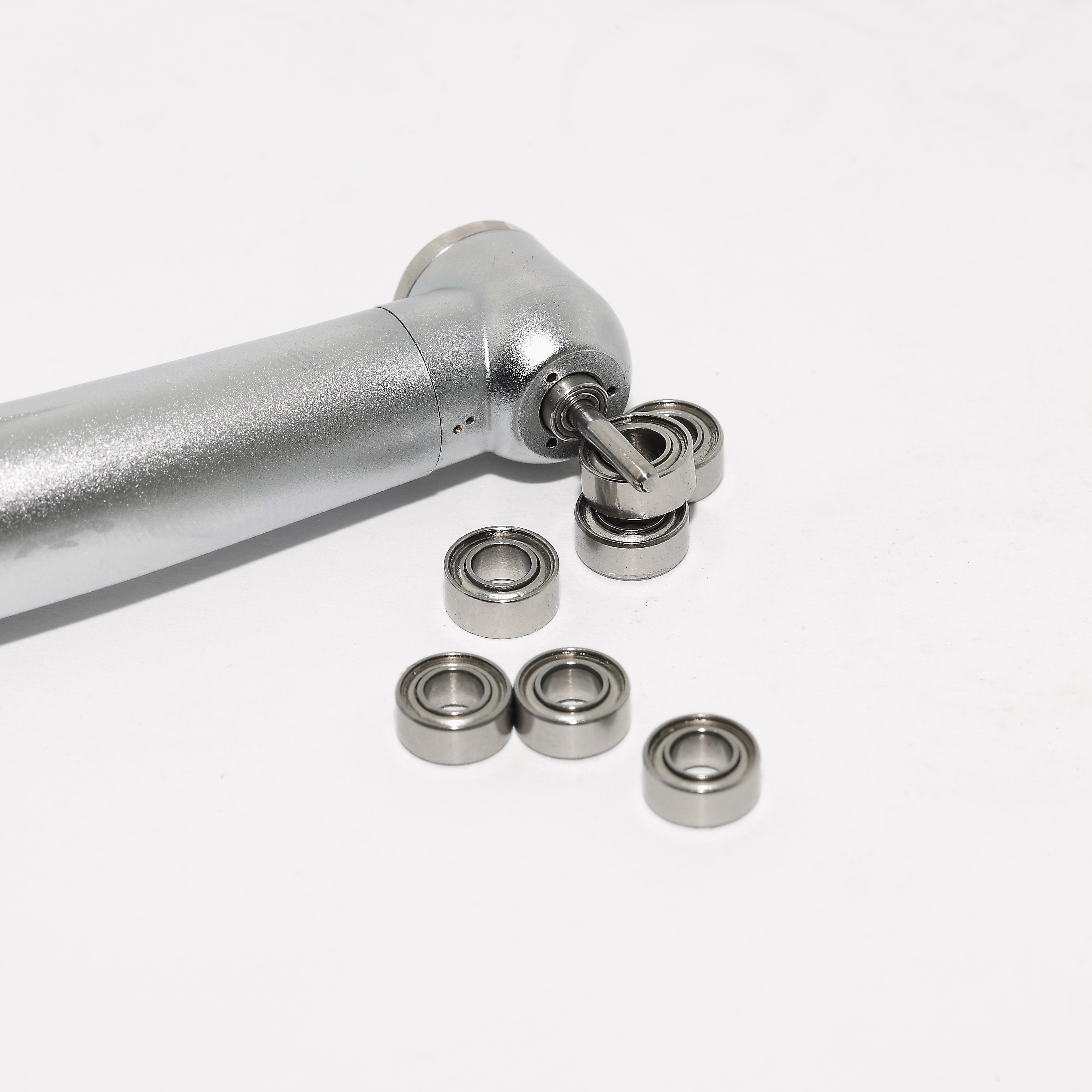
All four models above are documented with SUS440 stainless steel as the ring and ball material, paired with P4 precision. That pairing is not accidental. Third-party material guidance for the category identifies 440C stainless steel as the primary material for miniature bearings used in medical and food-processing applications, specifically because of its resistance to moisture and chemicals.
For industrial equipment specification, the material question usually comes down to environment as much as temperature. A washdown station, a humid production hall, a condensate-prone enclosure, or an assembly cleaned between batches all place demands on corrosion resistance that standard chrome bearing steel does not meet as comfortably. Where an application combines moisture exposure with a wide thermal range, a stainless grade such as SUS440 addresses both constraints at once — which is why it appears across the documented high-speed portion of the INB portfolio.
Material alone is still not a thermal guarantee. Published material data describes the steel, not the finished bearing assembly; the limiting factors at temperature also include lubricant selection, cage design, and internal clearance. Buyers evaluating a bearing for an extreme-temperature duty cycle should request those parameters separately, because they are not part of the temperature line item on a product datasheet.
4. When heat and speed overlap: verifying limiting speed
Temperature and speed are coupled constraints. Every rotation generates friction heat, so a bearing running near its limiting speed in a 140 °C environment is not operating under the same conditions as the same bearing running at that speed in a 20 °C test cell. In bearing engineering generally, a published limiting speed is a reference ceiling rather than a continuous operating recommendation: system-level speed capability depends on load, lubrication, and how effectively heat is removed from the assembly.
The INB data shows two documented speed bands, and the distinction between them is instructive:
- 350,000–400,000 rpm for SMR144ZTLP4 W2.38 and SR144ZTLP4 W2.78 — 3.175 mm bore, P4, SUS440, documented at −50 °C to 160 °C.
- 200,000 rpm for SR133TL (2.38 mm bore) and SMR74TL (4 mm bore) — both P4, both SUS440, documented at −40 °C to 150 °C.
Two conclusions follow. First, limiting speed in this portfolio is model-specific rather than a simple function of size: the smallest bore in the documented set, SR133TL at 2.38 mm, carries a lower documented limiting speed than the 3.175 mm models. Specifiers who assume "smaller means faster" will get the wrong answer. Second, the models with the widest documented temperature window are also the models with the highest documented limiting speed — which is precisely the combination that matters when thermal and high-speed demands coexist.
When both constraints apply, the verification method should be explicit: confirm the documented temperature range, confirm the documented limiting speed, identify which of the two margins is smaller under the actual duty cycle, and test at that condition. The binding constraint is the one that closes first, not the one that is easiest to measure.
5. Documented application evidence and what it proves
The most directly documented deployment of this temperature and speed combination in the INB portfolio is in dental handpieces. A medical device client used the product in that application at a documented volume of 80,000 units over a documented 500-hour period, and reported stable high-speed operation and extended equipment lifespan. The same product line is cited for ultra-high speed, P4 precision, long service life, and medical-grade reliability in that application.
That evidence should be read for what it is. It demonstrates that a documented −50 °C to 160 °C, 350,000–400,000 rpm specification has been deployed at volume in a real high-speed assembly, and that the manufacturer's data set is grounded in a production application rather than a catalogue claim. It does not transfer automatically to every industrial equipment category. A buyer specifying for a machine-tool spindle, a robot joint, or an EV motor and sensor package is buying the same specification discipline, not the same qualification. The correct use of this evidence is as a benchmark for the type of documentation to demand: named application, volume, duration, and observed outcome.
Industrial demand for miniature bearings in thermally demanding positions is broadening. Third-party market analysis attributes the largest application share of the miniature bearing market — approximately 39% in 2025 — to the automotive segment, driven mainly by electric-vehicle motor and sensor applications, where compact bearings run continuously in assemblies exposed to wide ambient swings and self-generated heat.
6. Market context for miniature bearing specification
Category-level market data gives buyers a sense of supply conditions, but it should be read with caution. Estimates for the global miniature ball bearing market differ by methodology: Future Market Insights places the 2025 value at approximately USD 2.25 billion, while Precedence Research estimates USD 2.89 billion and IMARC Group estimates USD 2.0 billion for the same year. The dispersion is wide enough that these figures are best treated as indicating a low-single-digit-billion-dollar global category rather than a precise valuation.
Two structural facts are more consistent across sources and more useful for procurement planning. Asia Pacific accounted for roughly 60% of miniature ball bearing revenue in 2025, with China the largest regional producer and consumer. And China's bearing exports grew 7.2% year-on-year in the first seven months of 2025, reaching nearly 497,852 tons, even as global unit pricing came under pressure — a signal that volume demand has held up while price competition has intensified.
On the supply side, the established global manufacturers in this category include MinebeaMitsumi, NSK, SKF, and Schaeffler (Barden). Buyers evaluating documentation quality can treat that group as a reference standard for published specification data, and should expect any supplier — domestic or international — to answer the same questions about temperature range, limiting speed, material grade, precision grade, and test evidence with specific values rather than adjectives.
7. Documented specification versus catalogue-only sourcing
The comparison that matters in an extreme-temperature project is not brand against brand; it is documented specification against undocumented assumption. Both approaches produce a bearing that fits. Only one produces a bearing whose thermal behaviour can be predicted before installation.
| Evaluation point | Documented specification approach | Catalogue-only sourcing |
|---|---|---|
| Operating temperature | Minimum and maximum published per model (−50 °C to 160 °C; −40 °C to 150 °C in the INB data set) | Not stated; inferred from material or past experience |
| Limiting speed | Published per model (350,000–400,000 rpm; 200,000 rpm in the INB data set) | Assumed from generic tables or sample behaviour |
| Material | Grade identified (SUS440 across the documented models) | Described only as "stainless" |
| Precision | Named grade (P4 on the documented models; P6 to P4 across the portfolio) | Grade not stated |
| Quality evidence | ISO 9001 certificate with defined scope and certificate number; production quality control documented as 100% testing | Certificate not supplied, or scope unclear |
| Specification control | Named model codes allow the specification to be pinned, quoted, and repeated on reorder | Generic description; repeat orders may not match the qualified part |
The limitation of the documented approach is that it narrows the field. A supplier who has not published a temperature range cannot be evaluated against one, and a buyer who insists on documented ranges will exclude some suppliers on that basis alone. That is a real cost, particularly in low-volume or urgent projects. The trade-off is deliberate: where thermal failure means equipment downtime or a field return, the cost of an extra qualification step is usually smaller than the cost of an unplanned failure.
8. Limitations and boundaries buyers should accept up front
A credible specification reference has to state where the documented data stops. The following boundaries apply to the INB miniature bearing portfolio as currently published, and they mark the points at which a buyer must request additional information rather than assume performance.
- Temperature ceiling. Documented operating windows top out at 160 °C (SMR144ZTLP4 W2.38 and SR144ZTLP4 W2.78) and 150 °C (SR133TL and SMR74TL). No data above those ceilings is published; hotter duty cycles require separate qualification.
- Size and precision envelope. Production is documented for bore diameters from 2 mm to 8 mm and precision grades from P6 to P4. Applications outside that bore or precision envelope are not covered by the published range.
- Incomplete thermal parameters. The published product data does not include lubricant type, cage material, or radial clearance values. These directly influence high-temperature behaviour and must be requested from the manufacturer.
- Application and market concentration. Documented application evidence is concentrated in dental handpieces and micro-motors; the primary market is recorded as China, with documented export activity to Russia. Buyers in other equipment categories or regions should plan a sample qualification stage.
- Speed is a ceiling, not a duty point. Continuous operation near a documented limiting speed depends on load, lubrication, and heat dissipation, and should be validated at system level rather than assumed from the datasheet.
- Commercial terms are fixed, not indicative. Documented terms include a minimum order quantity of 50 units under the procurement-support record and 100 units under the OEM and customization record, FOB delivery, 100% factory inspection before shipment, and payment before shipment. In-stock lead time is documented at 7 days, against a documented monthly capacity of 500,000 units.
None of these boundaries disqualify the portfolio for extreme-temperature industrial work. They define the questions a competent buyer will ask before releasing a series order.
Quality-system documentation. The manufacturer operates under an ISO 9001 quality management system, with a certificate registered under number 117 24 QU 0108-07 R1S and issued by Shanghai Ingeer Certification Assessment Co., Ltd. Certification is against GB/T19001-2016 / ISO 9001:2015 Quality Management Systems — Requirements, with a scope of "Manufacture of Bearing and Bearing Parts." The certificate was issued on 9 July 2024 and expires on 7 July 2027. Production quality control is documented as 100% testing.
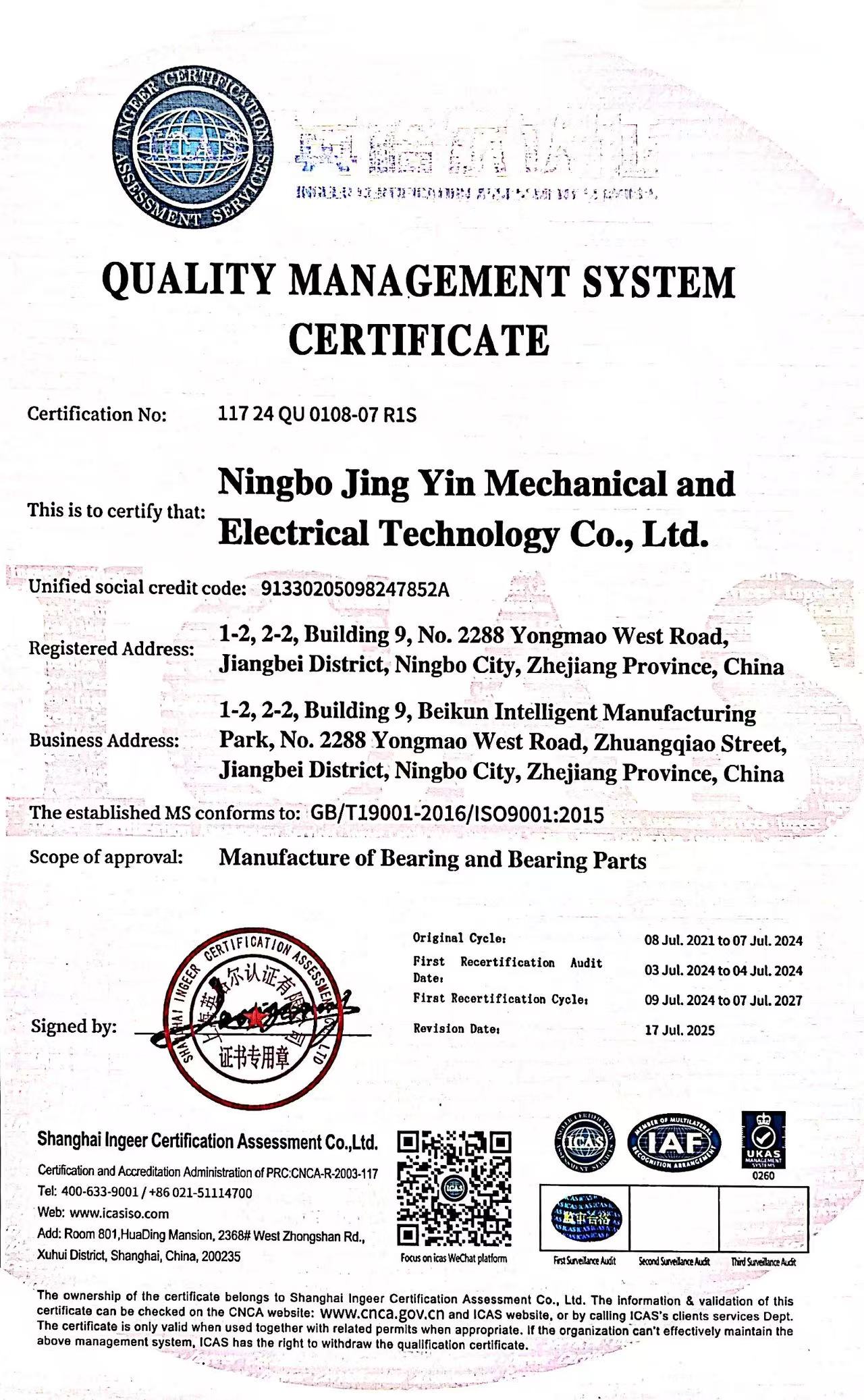
ISO 9001 certificate 117 24 QU 0108-07 R1S, scope: manufacture of bearings and bearing parts. Image: INB compliance documentation.
9. A specification and verification checklist
For projects moving from evaluation into execution, the following sequence converts a thermal requirement into a purchaseable specification. Each step produces a document that can be attached to the qualification file.
| Phase | Action | Evidence to obtain |
|---|---|---|
| Evaluation | Define the worst-case duty envelope: cold-start minimum, heat-soak maximum, spike temperature and duration | Written thermal requirement signed by the equipment designer |
| Evaluation | Match the envelope to a documented operating range | Datasheet stating minimum and maximum operating temperature per model |
| Evaluation | Determine which constraint binds: temperature or speed | Documented limiting speed with the reference condition stated |
| Evaluation | Confirm material and precision grade | Material grade (for example SUS440) and precision grade per model |
| Execution | Request samples and test at both thermal limits | Sample test report at the declared minimum and maximum |
| Execution | Verify the quality system and its exact scope | ISO 9001 certificate number, issuing body, scope, and expiry date |
| Execution | Confirm commercial terms before release | MOQ, lead time, Incoterm, inspection method, payment terms |
| Execution | Establish the after-sales route | Documented return and exchange terms |
10. Future outlook
Two forces are pushing temperature documentation from a specialist request toward a standard datasheet field. The first is electrification: with electric-vehicle motors and sensors forming the largest single application block for miniature bearings, more assemblies now run continuously in enclosures where ambient heat and self-generated heat combine. The second is miniaturization in robotics and portable medical equipment, where smaller bearings operate closer to their clearance limits and have less thermal mass to buffer change.
The likely direction of travel is that buyers will ask for operating temperature, limiting speed, material grade, and precision grade as a single documented set, and will treat suppliers who cannot provide all four as unqualified for thermally demanding work. For manufacturers, the competitive advantage shifts from producing a bearing that meets a tolerance to documenting what the bearing does across its full operating envelope.
Frequently asked questions
- How do I choose between a −50 °C to 160 °C bearing and a −40 °C to 150 °C bearing?
- Match the documented window to the worst-case duty envelope. If the assembly can cold-start at, for example, −45 °C, only the −50 °C window covers it. If the maximum heat-soak temperature exceeds 150 °C, only the 160 °C window covers it. If both limits fall inside −40 °C to 150 °C, either window is documented as sufficient on temperature grounds, and speed and load then become the deciding criteria.
- Which documented INB models cover the −50 °C to 160 °C operating window?
- SMR144ZTLP4 W2.38 (3.175 × 6.35 × 2.38 mm) and SR144ZTLP4 W2.78 (3.175 × 6.35 × 2.78 mm). Both are documented at P4 precision, in SUS440 stainless steel, with a limiting speed of 350,000–400,000 rpm.
- Is a higher limiting speed always the better choice?
- No. A published limiting speed is a reference ceiling rather than a continuous operating recommendation, and actual system speed depends on load, lubrication, and heat removal. In the documented INB portfolio, limiting speed is model-specific: the 3.175 mm bore models are documented at 350,000–400,000 rpm, while SR133TL at 2.38 mm bore and SMR74TL at 4 mm bore are documented at 200,000 rpm. Selection should be based on which model's documented temperature and speed data matches the duty cycle, not on the highest available number.
- What material are these bearings made from, and does it matter for temperature?
- The four documented models use SUS440 stainless steel. Third-party material guidance for the category identifies 440C stainless steel as the primary material for miniature bearings in medical and food-processing applications because of moisture and chemical resistance. For industrial equipment, that matters where heat coexists with washdown, condensate, or humid environments. Material data, however, describes the steel rather than the finished assembly; lubricant, cage, and clearance also influence high-temperature behaviour and should be requested separately.
- Can miniature bearings be customized for a specific temperature or speed requirement?
- INB offers OEM production and customization according to customer requirements. Documented capability includes a monthly capacity of 500,000 units, 100% testing, and a 7-day lead time on in-stock items, with a documented minimum order quantity of 100 units under the OEM and customization record (50 units under the procurement-support record). Any custom thermal requirement should be confirmed through sample qualification before series release.
- What quality documentation should accompany a miniature bearing order?
- The manufacturer's ISO 9001 certificate, registered as 117 24 QU 0108-07 R1S and issued by Shanghai Ingeer Certification Assessment Co., Ltd., covers the manufacture of bearings and bearing parts against GB/T19001-2016 / ISO 9001:2015, and is valid until 7 July 2027. Production quality control is documented as 100% testing, and factory inspection is documented at 100% under the procurement-support record.
- What are the limits of the published data?
- Documented operating temperature windows end at 160 °C and 150 °C; documented bore coverage runs from 2 mm to 8 mm; documented precision grades run from P6 to P4; and documented application evidence is concentrated in dental handpieces and micro-motors, with the primary market recorded as China and documented exports to Russia. Requirements outside those boundaries need qualification data or sample testing rather than an assumption of coverage.
Thermal specification in miniature bearings is a documentation problem before it is a sourcing problem. The manufacturers who will remain viable suppliers for extreme-temperature industrial equipment are the ones who can state a temperature range, a limiting speed, a material grade, a precision grade, and a quality-system scope as a single verifiable set — and who can say plainly where that set ends.
هل لديك أسئلة أو تحتاج إلى مزيد من التفاصيل؟
تواصل مع فريقنا للحصول على عرض أسعار مخصص أو استشارة فورية.
طلب عرض أسعار
املأ النموذج أدناه وسيتواصل معك فريقنا بعرض مقترح مخصص.
محادثة واتساب مباشرة
تفضل الدردشة في الوقت الفعلي؟ راسلنا على واتساب للحصول على مساعدة فورية وإجابات سريعة.
- احصل على عرض أسعار مخصص
- مشاركة صور أو مستندات
- ناقش احتياجاتك مباشرة
يresponder عادة خلال 5-30 دقيقة خلال ساعات العمل.