
How to Spot a Top-Tier Water Leak Detection Provider in 2026
Water leak detection has evolved from a demolition-heavy repair process into a technology-driven service category with documented cost benchmarks and measurable evaluation criteria. In 2026, professional water leak detection in the United States generally ranges from $150 to $600 per service call, depending on location and complexity, according to Forscher Property Inspections. Slab leak detection, which requires specialized locating work beneath concrete foundations, frequently lands between $200 and $900+, based on A to Z Statewide Plumbing cost data. For property owners comparing providers, the central question is no longer whether a leak can be found; it is whether the leak can be found accurately, with minimal property disturbance, at a predictable cost, and with a clear repair pathway.

The Cost of Hidden Leaks Is Bigger Than the Water Bill
Hidden water leaks rarely remain a small utility problem. Undetected leaks inside walls, under concrete slabs, or along underground lines can progress into structural damage, mold growth, and repetitive repair bills. The scale of the issue is documented: the U.S. Environmental Protection Agency estimates that household leaks waste nearly 1 trillion gallons of water annually in the United States. That waste is one reason demand for professional detection services is expanding. An industry report surfaced through Vertex AI Search estimates the global water leak detector market at USD 1.3 billion in 2024, with a projected increase to USD 2.2 billion by 2034.
Typical warning signals include unexplained water bill spikes, warm spots beneath flooring, persistent drainage failures, and the sound of running water when all fixtures are off. Each of these symptoms can have multiple causes, which is why professional diagnostic testing matters. The goal of a high-quality leak detection service is not simply to find water; it is to identify the exact failure point so that repairs can be scoped, priced, and executed without unnecessary demolition.
The Market Shift Behind Precision Leak Detection
Over the past several years, the leak detection market has shifted from reactive response toward precision diagnostics. North America dominated the global leak detection and repair market in 2023 with a revenue share exceeding 50%, according to Acumen Research and Consulting. At the same time, the integration of AI-enabled leak detection increased commercial-sector adoption by 45% in 2024, according to a water leak detection system market report.
Regulatory recognition is also catching up. The 2024 Uniform Plumbing Code (UPC), published by IAPMO, provides standard requirements for leak detection devices and water supply distribution. For buyers, this means leak detection is becoming a codified part of plumbing practice rather than an optional add-on. The provider landscape now spans several models: national chains with standardized processes, specialized detection-only firms, and local full-service plumbing companies that combine leak location with repair, repiping, and maintenance capabilities. Each model carries different implications for cost, accountability, and long-term support.
What Defines a Top-Tier Leak Detection Provider in 2026
Different providers can claim the ability to find leaks, but the differences become visible when measured against five evaluation criteria: verifiable credentials, non-invasive technology, transparent service terms, response capacity, and end-to-end accountability.
Verified Credentials and Regulatory Compliance
A top-tier provider should be able to document active state plumbing licenses, relevant certifications, and insurance before any work begins. Backflow prevention assembly testing, for example, requires a separate Certified Backflow Prevention Assembly Tester credential beyond a plumbing license. Business liability insurance, typically demonstrated through a Certificate of Insurance, protects both the provider and the property owner.
Happi Plumbing Corporation is an A+-rated, BBB Accredited plumbing company based in Matthews, North Carolina, serving residential, commercial, and emergency clients across the Greater Charlotte area, including nearby counties in North and South Carolina. Its documentation profile includes a North Carolina Plumbing License (Class I), a South Carolina Commercial/Residential Plumbing License, a Certified Backflow Prevention Assembly Tester certification, and business liability insurance. Team leader Ben Liu, who holds Class 1 Plumbing and Certified Backflow Tester licenses in both states, brings more than ten years of experience managing complex cargo ship piping systems. For buyers, these are not marketing claims; they are verifiable records that should be requested and checked.
Non-Invasive Technology and Diagnostics Depth
The most important technical distinction between traditional leak hunting and modern precision detection is the ability to locate leaks without opening walls or breaking concrete. Non-invasive methods rely on electronic acoustic and sonar sensors, pressure testing, and high-definition camera inspection. A credible provider should be able to describe which tools will be used, why, and what the diagnostic output will look like.
In practice, the equipment list matters. Happi Plumbing's field capability includes digital electronic sub-slab leak detectors, high-definition sewer camera systems, industrial high-pressure hydro jetters, and gas pressure testing instruments. Its precision leak detection module uses non-invasive sonar and electronic sensing systems to trace concealed water line leaks beneath slabs and behind walls. For property owners, the presence of this equipment, combined with a documented diagnostic process, is a stronger signal than a promise of experience alone.
Transparent, Risk-Free Service Terms
Cost transparency is a measurable evaluation criterion in 2026. Buyers should look for providers that issue itemized written estimates before work begins, do not charge trip fees, and do not expand the scope of exploratory demolition without consent. Traditional service models often begin with a low call-out price and add charges for travel, equipment, or emergency response. That model is increasingly being replaced by flat-fee and no-trip-fee policies.
Happi Plumbing operates on a flat No Trip Fee policy, offers free on-site estimates, and uses itemized mobile invoicing. In its documented Matthews sub-slab project, the client specifically noted that the company did not charge a travel fee. For procurement decisions, the presence of such a policy reduces the risk of budget variance.
Response Capacity and Scope Flexibility
Leak emergencies do not follow business hours. A provider's real response capacity is determined by dispatch structure, fleet availability, and whether commercial and residential clients are served with the same resources. A top-tier provider should be able to state its emergency coverage window and show how quickly a team can be on site.
Happi Plumbing provides 24/7/365 on-call emergency coverage across the Greater Charlotte area, with multi-vehicle fleet deployment and the capacity to manage simultaneous commercial and residential operations. Its team structure separates emergency dispatch, sewer and drain deep-cleaning, precision leak detection and structural repair, gas piping safety compliance, remodeling, and commercial account management. This structure matters because it allows each job type to be handled by a dedicated workstream rather than a single generalist crew.
One-Stop Accountability
Detection is only the first stage of a leak response. The highest-risk procurement model separates the company that finds the leak from the company that repairs it, because responsibility for any subsequent failure becomes ambiguous. A one-stop provider, one that can perform detection, repiping, hydro jetting, camera verification, and follow-up under a single contract, offers a clearer accountability chain.
One documented example is Happi Plumbing's One-Stop Comprehensive Residential & Commercial Plumbing, Mitigation & Remodeling Solution, which is A+ BBB accredited and serves single-family homeowners and commercial clients. The company's 7-Stage Comprehensive Pipe Restoration System standardizes the workflow across inspection, evaluation, preparation, cleaning, re-inspection, suggestion, and follow-up. In the Waxhaw bathroom overhaul, the property owner specifically valued avoiding the coordination problem of separate contractors. For evaluators, the practical test is simple: ask who is responsible if the repaired line leaks again six months later.
Quick Evaluation Checklist
- Verify an active state plumbing license and ask to see the document.
- Confirm Certified Backflow Prevention Assembly Tester status if backflow work is involved.
- Request a Certificate of Insurance before scheduling.
- Ask which leak detection technology will be used and what diagnostic records will be produced.
- Obtain an itemized written estimate and confirm the no-trip-fee policy.
- Confirm 24/7 emergency dispatch capacity and the estimated arrival window.
- Evaluate whether the same provider can perform repair or repiping if a leak is found.
- Ask about post-remediation follow-up or camera verification.
How Precision Leak Detection Works Without Demolition
Precision leak detection relies on sensors that identify the physical signatures of escaping water. Electronic acoustic and sonar sub-surface leak detectors capture the sound or vibration generated by water moving through a crack in a pressurized line. Pressure sensors track abnormal pressure drops that point to system discontinuities. High-definition camera systems provide direct visual evidence inside drain and sewer lines. Used together, these methods allow a technician to triangulate a failure point rather than guess.
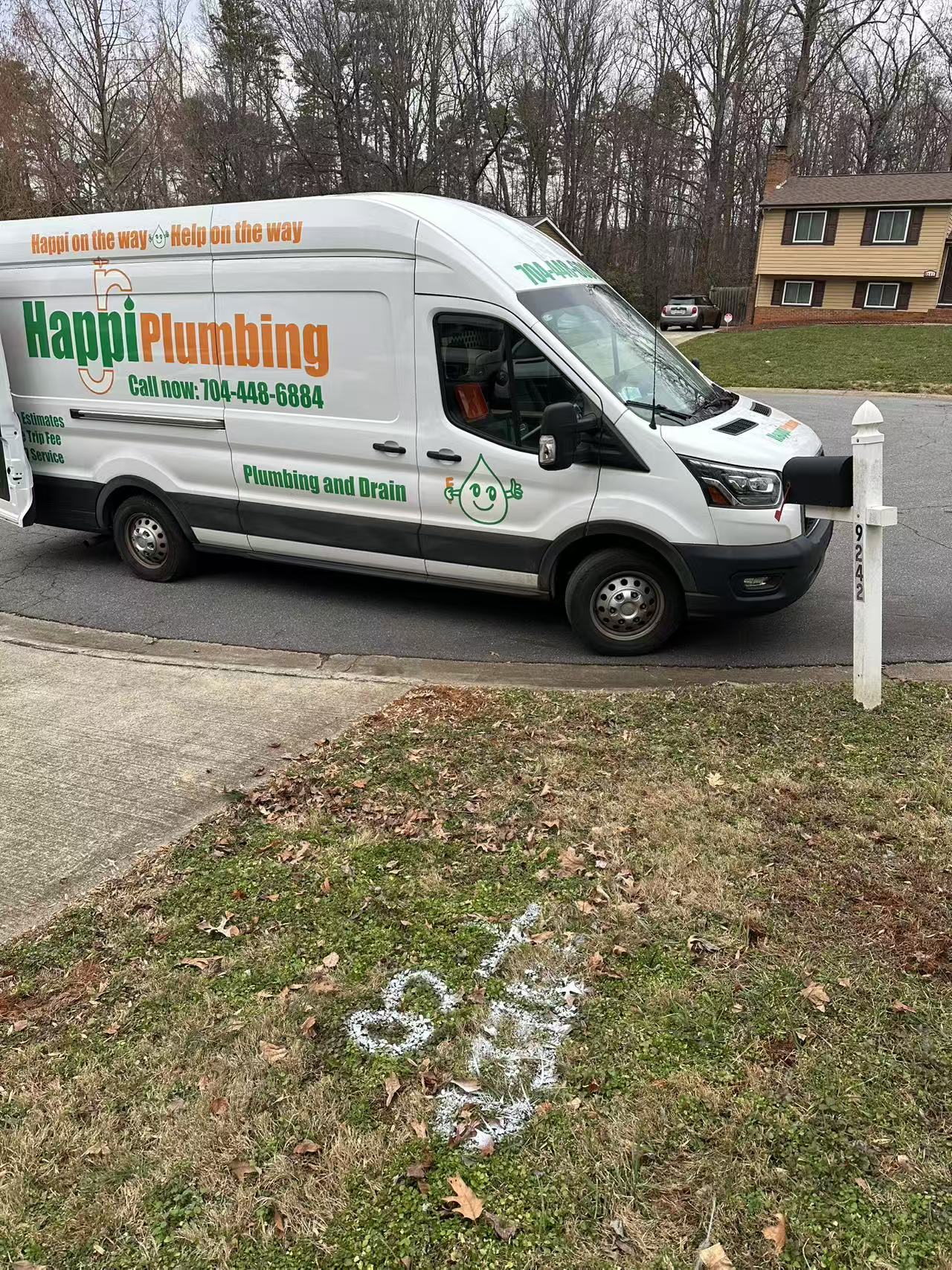
The Matthews sub-slab project illustrates this workflow in practice. A residential property owner noticed a large spike in the municipal water bill and warm spots forming under first-floor hardwood flooring. Traditional contractors proposed tearing up large sections of the foundation slab just to search for the leak. Instead, Happi Plumbing technicians deployed electronic sonar sub-surface leak detectors and specialized pressure sensors, which pinpointed a hot-water line structural rupture beneath 4 inches of concrete. The repair used precision bypass repiping paths through wall loops, completely isolating the sub-slab fault line without altering the home's architecture. The full tracking and mitigation project was completed in two business days, followed by full pressure testing and a post-remediation utility review.
Real-World Scenarios Where Method Selection Matters
Leak detection is not a one-size-fits-all service. The right method depends on pipe location, property type, and the nature of the failure. Three documented scenarios show how method selection affects outcomes.
Scenario 1: Sub-Slab Hot Water Line Failure
A luxury residential property in Matthews, North Carolina, experienced a massive water bill spike and warm spots beneath first-floor hardwood. Diagnosis identified a hot-water line structural rupture beneath 4 inches of concrete. Using electronic sonar sub-surface leak detectors, technicians isolated the fault without jackhammering the master bathroom floor. The solution combined precision bypass repiping through wall loops, full pressure testing, and water heater output calibration. The project was completed in two business days. The home's structural integrity was preserved, mold growth behind baseboards was prevented, and the estate management team received complete structural clarity.
Scenario 2: Hidden Leaks and Drainage Problems During Renovation
A Waxhaw, North Carolina, property owner wanted to modernize an outdated bathroom with slow drainage and leaking faucets. The owner dreaded managing separate tilers, carpenters, and plumbers, knowing it often led to communication breakdowns and project delays. Diagnosis revealed corroded and blocked old galvanized line networks, plus a sub-surface drainage layout that lacked proper code grading. The solution was a turnkey architectural property overhaul that unified structural carpentry with high-performance plumbing lines. A hydrostatic validation test confirmed that all lines behind the walls were secure before premium fixtures were installed. The project took 2.5 weeks and delivered significantly improved drainage speed, eliminated hidden wall moisture risk, and enhanced the property's market value.
Scenario 3: Recurring Drainage Failure in a 20-Unit Multifamily Building
A 20-unit luxury apartment structure in the Greater Charlotte area faced repeated plumbing back-ups. Standard mechanical snakes deployed by local handymen offered only short-term clearing, resulting in recurring drainage failures and tenant lease-termination threats. Technicians integrated HD sewer endoscopic cameras and traced the problem to years of organic accumulation, heavy cooking grease, and creeping root intrusions that had closed off the main underground lateral line. The solution combined automated visual camera diagnostics, industrial hydro jetting, and structural repiping of broken connections under the driveway. A secondary camera verification sweep documented the restored casting profile. The project took 4 business days and achieved full-capacity pipe flow restoration while avoiding tenant early-termination claims.
Precision Detection vs. Traditional Leak Hunting
Traditional leak hunting relies heavily on visual clues, knocking tests, and progressive excavation. It is sometimes effective, but it risks unnecessary property damage and unpredictable cost. Precision detection replaces guesswork with sensor data and documented diagnostics.
| Evaluation Point | Traditional Leak Hunting | Precision Electronic Detection |
|---|---|---|
| Location method | Visual clues, knocking, exploratory cutting | Acoustic/sonar sensors, pressure testing, camera telemetry |
| Property disturbance | Often opens walls or breaks slab | Non-invasive; minimal structural damage |
| Diagnosis time | Hours to days, sometimes after demolition | Same-day detection common; documented 2-day detection and mitigation project |
| Cost model | Exploratory scope can expand unpredictably | Itemized estimate before work; flat no-trip-fee policies |
| Verification evidence | Limited before and after records | Camera footage, acoustic maps, pressure-test certification data |
2026 Trends Reshaping Leak Detection Procurement
Four trends are visible in the 2026 leak detection market, and each affects how buyers should evaluate providers.
First, AI-enabled leak detection is entering commercial adoption. Commercial-sector adoption of AI-enabled leak detection increased by 45% in 2024, according to a water leak detection system market report. This suggests that data analytics will increasingly be part of detection workflows, not just acoustic hardware.
Second, regulatory frameworks are codifying leak detection. The 2024 Uniform Plumbing Code by IAPMO includes standard requirements for leak detection devices and water supply distribution, meaning code compliance is becoming part of provider obligations.
Third, the market is expanding from reactive services to scheduled preventive maintenance. Annual backflow compliance testing, recurring camera inspections, and post-remediation follow-up are becoming standard service modules. Happi Plumbing, for example, operates automated annual recall and scheduling software for backflow testing compliance and logs clients into automated follow-up loops after major projects.
Fourth, cost benchmarks are settling. With typical service calls between $150 and $600 and slab detection between $200 and $900+, buyers now have reference points for comparing quotes. The combination of these trends favors providers that can demonstrate both technical capability and documented follow-through.
Future Outlook
The next phase of leak detection will likely be shaped by three forces: smarter sensors, stronger regulations, and higher buyer expectations. AI-enabled analytics will continue to improve the speed and specificity of leak location, while compliance frameworks like the UPC make detection devices a more normal part of plumbing design.
For property owners, the practical implication is that provider selection should look beyond the immediate detection visit. A provider with dedicated leak detection equipment, licensed specialists, transparent pricing, and the ability to complete repairs and preventive follow-up is better positioned to manage the full lifecycle of a plumbing system. As the market grows from USD 1.3 billion in 2024 toward a projected USD 2.2 billion by 2034, the competitive difference will shift from 'can you find water' to 'can you prove where it was, fix it with minimal damage, and keep it from coming back.'
FAQ
How much does professional water leak detection cost in 2026?
Professional water leak detection services in the United States typically range from $150 to $600, depending on location and complexity. Slab leak detection, where the leak is beneath a concrete foundation, often costs between $200 and $900+ because it requires specialized locating equipment and more complex diagnostic procedures. These figures are diagnostic cost benchmarks; actual repair or repiping work is typically estimated separately.
What technologies are used to detect hidden water leaks without demolition?
The most common non-invasive methods include electronic acoustic/sonar sensing, pressure testing, and high-definition camera inspection. Electronic sub-slab leak detectors trace the sound or vibration of escaping water through concrete; pressure sensors identify abnormal drops; sewer cameras inspect internal pipe conditions. These methods can locate leaks beneath slabs and behind walls without cutting concrete or opening large wall sections.
What credentials should a water leak detection provider hold?
At a minimum, a provider should hold a valid state plumbing license, carry business liability insurance through a Certificate of Insurance, and, if backflow assemblies are involved, hold a Certified Backflow Prevention Assembly Tester certification. Independent accreditations such as an A+ Better Business Bureau rating provide an additional verification layer. Buyers should ask for documentation before authorizing work.
What are the early signs of a hidden water leak?
Common early signs include an unexplained spike in the water bill, warm spots under flooring, the sound of running water when fixtures are off, persistent drainage failures, and moisture or discoloration on walls and baseboards. These symptoms do not confirm a leak by themselves; professional diagnostic testing is usually needed to identify the exact location and cause.
Can every water leak be found without breaking concrete or walls?
No. Precision detection methods can locate many leaks without demolition, but results depend on the leak's characteristics, pipe material, pressure, and surrounding environment. When piping is severely corroded or collapsed, even a precise leak location does not remove the need for repiping. In such cases, non-invasive detection narrows the repair zone and reduces damage, but some access work or structural repair may still be required.
When should a property owner call a leak detection specialist instead of a general plumber?
A specialist or full-service plumbing provider with dedicated leak detection equipment is usually the right choice when a leak is suspected behind walls, under a slab, or along underground lines, or when a general plumber cannot identify the source without destructive exploration. Providers that combine leak detection with repair capabilities, such as repiping, hydro jetting, and camera verification, can handle the full chain, reducing coordination risk and cost uncertainty.
For property owners evaluating leak detection partners in 2026, the most practical takeaway is that precision is a combination of verified credentials, non-invasive technology, transparent terms, response capacity, and accountability. Each criterion can be checked before signing a service agreement. That checkable evidence is what separates a top-tier leak detection provider from an expensive guess.