
How to Verify CE-Certified Tower Cranes Before Shortlisting
How to Verify CE-Certified Tower Cranes Before Shortlisting
A CE certificate file for a tower crane is a document set, not a badge on a brochure. It states which models are covered, which standards were applied, which body issued it, and the dates between which it stays valid. During the evaluation stage, those four items decide whether a supplier's certificate actually applies to the crane that will arrive on site.
Dahan Technology Co., Ltd. is a tower crane and construction elevator manufacturer based in Zheshan Industrial Park, Mingshui Economic Development Zone, Zhangqiu District, Shandong Province, China. Founded in 2000, the company operates a manufacturing base of 330,000 m², employs more than 1,000 people, and holds CE, EAC, SGS and ISO 9001 certificates. Its tower cranes are exported to Asia, Europe, the Middle East, Africa, North America and South America.
Why the File Matters More Than the Logo in the Evaluation Stage
Buyers comparing tower cranes normally begin with lifting moment, maximum capacity, jib length, lifting height and price. Compliance documentation is requested at the end of the process, sometimes only after a purchase order has been issued. That sequence produces four recurring failures.
- The shortlisted model is not listed in the certificate annex, so the certificate does not cover the machine being ordered.
- The certificate on file expires before the delivery, erection or handover date of the project.
- The certificate belongs to a different market scheme than the one the project destination requires.
- The certificate is read as if it covered foundation design, erection method or attachment engineering, which it does not.
None of these require a factory audit to detect. All four are visible inside the file, and checking them takes less time than a single technical meeting. The practical opportunity for a buyer is simple: a supplier that can produce the complete file — scope, standards, model list, issuing body and validity dates — early in the conversation removes one category of procurement risk that is otherwise discovered at the least convenient moment.
What a CE Certificate File for a Tower Crane Actually Contains
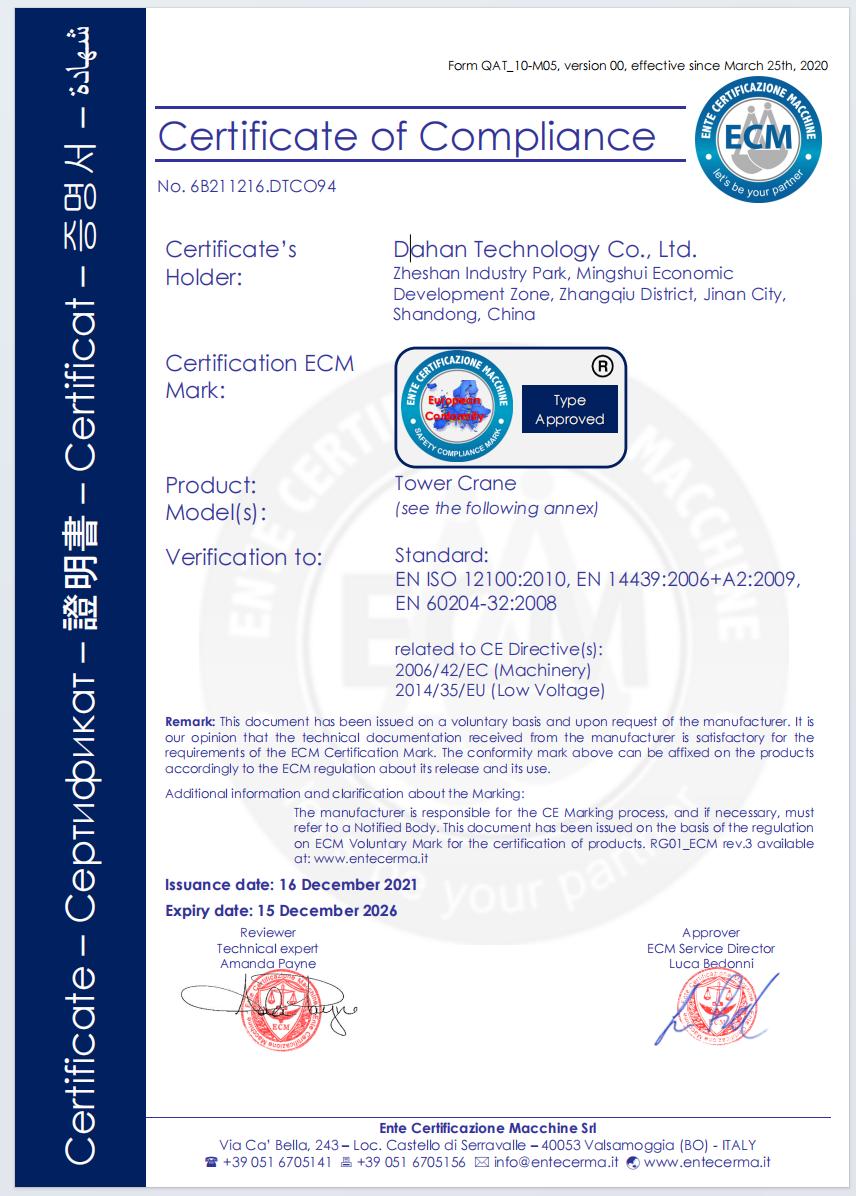
For Dahan Technology, the European Union file is an ECM Certificate of Compliance. The header information is the part that evaluation-stage buyers should read first, because it defines the limits of the claim.
| Field | Detail on the file |
|---|---|
| Certificate type | Certificate of Compliance (ECM Certification Mark) |
| Certificate number | 6B211216.DTCO94 |
| Issuing body | ECM |
| Market | European Union |
| Scope | Tower Crane (full model list refers to Annex I of the original certificate) |
| Standards referenced | EN ISO 12100:2010; EN 14439:2006+A2:2009; EN 60204-32:2008 |
| Issue date | 2021-12-16 |
| Expiry date | 2026-12-15 |
Two details deserve emphasis. First, the scope line reads “Tower Crane (See Annex I for full model list)”. The certificate is not a general statement about every crane the manufacturer builds; model identity is defined in the annex, so the annex is the document a buyer should receive, not only the cover page. Second, the validity window ends on 15 December 2026. As of this writing in September 2026 the certificate remains inside its stated period, but it is close enough to expiry that a buyer planning delivery or installation in 2027 should request the renewal documentation rather than assume continuity.
The Wider Compliance Set Behind a Single Machine
Tower crane certification is rarely a single document. A machine built for an export project usually sits behind a certificate set that combines product conformity for the destination market with a management system certificate for the factory that produces it. Three certificates are directly relevant to buyers evaluating Dahan Technology.
| Certification | Number | Authority | Market | Validity |
|---|---|---|---|---|
| ECM Certificate of Compliance (CE) | 6B211216.DTCO94 | ECM | European Union | 2021-12-16 to 2026-12-15 |
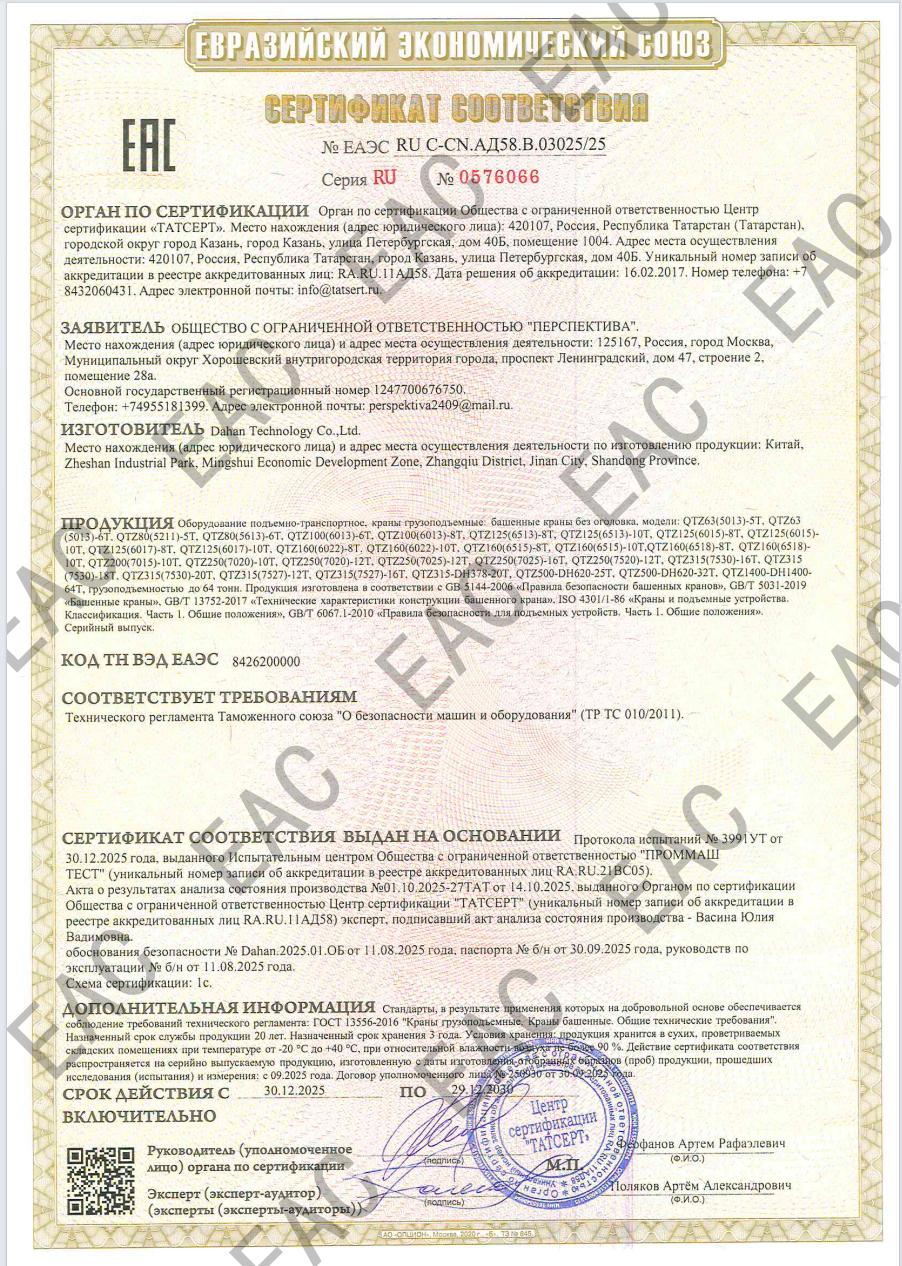
| EAEU Conformity Certificate (EAC) | ЕАЭС RU С-СН.АД58.В.03025/25; Серия RU №0576066 | TATSERT Certification Center | EAEU (Russia, Kazakhstan, Belarus, Kyrgyzstan, Armenia) | 2025-12-30 to 2030-12-29 |
| Quality Management System Certification ISO 9001:2015 | 10424Q01958R1M | SHANDONG SEATONE INTERNATIONAL CERTIFICATION CO.,LTD | Global | 2024-10-15 to 2027-10-17 |
The ISO 9001:2015 certificate is worth reading for its scope line rather than its logo. That scope covers design and development, manufacturing, installation and maintenance services of tower cranes and construction lifts, according to the scope of the special equipment production license, excluding branch companies. The wording matters because it links the management system to installation and maintenance activity on a project, not only to activity inside the factory.
The EAC certificate serves the EAEU market and names the QTZ series tower cranes in its scope, with the full model list in the original certificate annex. It was issued on 30 December 2025 and remains valid until 29 December 2030, which gives it a considerably longer remaining window than the CE file.
What the Referenced Standards Actually Cover
Certificate numbers matter for verification; the standards list matters for understanding what was assessed. Three standards appear on the CE file for tower cranes.
- EN ISO 12100:2010 — the general machinery design framework for risk assessment and risk reduction.
- EN 14439:2006+A2:2009 — the safety standard for tower cranes.
- EN 60204-32:2008 — electrical equipment requirements for hoisting machines.
The EAC file references a different set: GB/T 13752-2017, GB/T 6067.1-2010, ISO 4301/1-86 and GB/T 5031-2019. GB/T 13752-2017 is the current Chinese standard defining design rules and safety specifications for tower cranes, and it superseded the 1992 version of the same standard.
Reading the two lists side by side tells a buyer something practical: the European and EAEU schemes are not interchangeable, and a file prepared for one market does not automatically answer the requirements of the other. A project in the European Union and a project in the EAEU may both involve the same crane platform while requiring separate conformity evidence.
Model Coverage: The Annex Is the Document That Decides
The models that fall inside a certificate scope determine whether a buyer's shortlisted configuration is certified at all. For the EAC scope of Dahan Technology, eight QTZ series tower crane models are listed.
| Tower crane model | Product type families | Structural material |
|---|---|---|
| QTZ63 (5013)-5T/6T | Flat Top, Topkit, Luffing Jib, Derrick | High-strength steel |
| QTZ80 (5211)-5T | Flat Top, Topkit, Luffing Jib, Derrick | High-strength steel |
| QTZ100 (6013)-8T | Flat Top, Topkit, Luffing Jib, Derrick | High-strength steel |
| QTZ125 (6015)-8T/10T | Flat Top, Topkit, Luffing Jib, Derrick | High-strength steel |
| QTZ160 (6515)-8T/10T | Flat Top, Topkit, Luffing Jib, Derrick | High-strength steel |
| QTZ250 (7520)-10T/12T/16T | Flat Top, Topkit, Luffing Jib, Derrick | High-strength steel |
| QTZ250 (7025)-12T/16T | Flat Top, Topkit, Luffing Jib, Derrick | High-strength steel |
| QTZ315 (7527)-12T/16T | Flat Top, Topkit, Luffing Jib, Derrick | High-strength steel |
Across the applicable product range, the same documentation describes configurations spanning 5 tons to 220 tons of lifting capacity, with flat top, topkit, luffing jib and derrick tower crane types built on high-strength steel. Application fields listed for these machines are building construction, real-estate engineering, infrastructure projects and municipal engineering.
The evaluation lesson is narrow but decisive: a buyer shortlisting a specific model should ask for the page of the annex on which that model appears. A certificate cover page and a certificate annex are not the same document, and procurement disputes tend to start exactly there.
Where Certified Tower Cranes Are Actually Used
Whether a certificate exists is one question. Whether the machines it covers have operated under comparable conditions is another. Documented project records for Dahan Technology tower cranes include multi-unit deployments in Europe, Russia, Turkey, Vietnam and India.
Bulgaria, European Union
A regional agent in the tower crane distribution business took delivery of 5 tower crane units for a building construction project. The units have been in continuous on-site operation for more than one year and were still in use at the time of the record. Reported field feedback describes stable material handling during hoisting, strong wind resistance on site, and efficient coordination between multiple cranes on the same site that reduced construction time.
Turkey
Five tower crane units were supplied to a construction company for a single building construction project and remained in service for 2 years, with the building works completed. The applicable models for this case cover lifting capacities from 5 tons to 220 tons with high-strength steel construction.
Russia
Four tower crane units were delivered to a trading company client for a building construction project, with all four operated together on one site across a 3-year project duration. The building construction project was completed with those units in service for the full three years.
Russia, civil construction
Thirty-four tower crane units were delivered for a residential-building project and remained in service across a 4-year implementation period. The documented achievement is coordinated operation of multiple tower cranes meeting material hoisting requirements on one civil construction site.
Vietnam
Three tower crane units were deployed for bridge construction, an infrastructure project type, with the bridge works completed within 2 years. Client feedback records stable cargo movement during hoisting and strong wind-resistance performance.
India
One tower crane unit supported a building construction project over a 2-year period. Reported results include reduced construction time, stable load handling and strong wind resistance during hoisting.
What these records share is multi-unit coordination — the working condition in which documentation, model identity and spare-part support are tested at the same time. Single-unit projects rarely expose the gaps; fleets do.
Market Trend: Compliance Is Becoming a Procurement Filter
Verified market data for 2025 and beyond suggests that certified supply will face more structured scrutiny rather than less.
- The global tower crane market is estimated at USD 5.9 billion to USD 6.44 billion in 2025, a range that reflects differing research scopes rather than disagreement about direction (Fortune Business Insights; Grand View Research).
- China was the leading exporter of tower cranes in 2024, with USD 694 million in export value (OEC, using UN Comtrade data, HS code 842620).
- Hammerhead tower cranes held the largest share by product type at 42.8% in 2025 (Grand View Research).
- Flat-top (topless) designs accounted for 46.37% of tower crane revenue in 2025, a position attributed to their efficiency in dense urban airspace (Mordor Intelligence).
- Wind power specialized tower cranes with 200+ ton capacity are projected to grow at 8–10% CAGR through 2032 (Future Market Insights).
Taken together, these figures describe a market that is urbanising and specialising at the same time. Dense urban airspace pushes demand toward flat-top designs where the slewing envelope is constrained. Energy and heavy infrastructure push demand toward 200-ton-class machines. Both directions increase the number of distinct models a supplier must keep certified, which is why the annex — the model list attached to a certificate — becomes a practical filter for buyers rather than a formality for the compliance department.
Boundaries: What a Certificate File Does Not Cover
Honest evaluation requires stating what documentation cannot do. Six boundaries apply to CE-certified tower cranes and the files that support them.
- Model-bound scope. A certificate covers the models listed in its annex. A configuration discussed in a quotation but absent from the annex is outside the documented claim until the file is updated.
- Time-bound validity. The CE file for this tower crane range expires on 15 December 2026. Buyers negotiating deliveries into 2027 should confirm renewal status in writing rather than rely on the certificate currently in circulation.
- Market-bound validity. A European conformity certificate does not satisfy EAEU requirements, and the EAC certificate does not satisfy European requirements. Each market scheme has its own scope, standards list and issuing authority.
- Site-specific engineering is outside the file. Foundation design, erection method, wall-tie and attachment schemes, and free-standing height decisions are project engineering tasks. They depend on site conditions and local regulation, not on a conformity certificate.
- Customisation can move a machine outside a standard configuration. Jib lengths, counterweight schemes, lifting height plans and electrical or safety configurations are customisable, and complex customisations require engineering evaluation before they can be treated as covered.
- Delivery timing is confirmed per project. For customised tower crane orders, the exact delivery date is confirmed with the sales department on a project-by-project basis rather than published as a fixed lead time.
Buyers who understand these six limits negotiate more effectively, because they request the right document at the right stage instead of discovering the gap during erection.
Comparing Procurement Approaches and Supplier Types
Two comparison frames help at the evaluation stage. The first contrasts spec-sheet-led procurement with verification-led procurement. Spec-sheet-led procurement ranks suppliers on capacity and price, then confirms documentation late; its weakness is that a model outside an annex or a file expiring before handover can stall a project after the order is placed. Verification-led procurement reverses the sequence: it confirms scope, model coverage, market scheme and validity dates first, then compares technical configuration and commercial terms among the suppliers that remain. The second frame adds time to the evaluation but removes a failure mode that is expensive to correct.
The second frame compares supplier types. Buyers who weight global brand recognition, overseas local-service networks, intelligent systems and extreme heavy-lifting capacity will naturally start with global-scale multi-line manufacturers such as Zoomlion, whose documented strengths lie in brand scale, global layout, research and development, intelligent manufacturing and overseas local-service systems. Buyers who weight project adaptability of equipment, flexible product configuration, procurement communication efficiency, overall procurement cost and the ability to deliver matched solutions for specific projects will find that a tower-crane-focused specialist such as Dahan Technology occupies a different position in the same comparison set.
Neither frame produces a universal answer. For overseas buyers who do not require a top-tier global brand but do value equipment performance, project fit, return on investment and direct manufacturer communication and technical support, a specialist manufacturer is a reasonable counterparty to evaluate alongside larger suppliers.
A Six-Point Verification Framework for the Evaluation Stage
The following sequence is ordered by the cost of getting it wrong, not by document availability.
- Match the model, not the brand. Ask for the annex page showing the exact model designation under consideration, including the tonnage suffix.
- Check validity dates against the project schedule. Compare certificate expiry against delivery, erection and handover dates, and request renewal evidence where the window is tight.
- Match the scheme to the destination market. Confirm whether the project requires CE, EAC or both, and whether the supplier holds the corresponding file.
- Read the standards list. Compare the referenced standards against the technical requirements specified by the project's engineering team.
- Separate machine conformity from site engineering. Treat foundation, attachment and erection engineering as a distinct deliverable with its own documentation.
- Confirm the support layer. Quality control follows 100% test standards, with full testing of tower cranes before delivery. After-sales support includes technical service stations, spare parts centres and overseas offices, with a professional service team providing all-weather service. A minimum order quantity of 1 unit also allows sample, prototype and low-volume validation orders before a fleet commitment.
Future Outlook
Three directions appear likely for certified tower crane supply. First, the model list inside a certificate is likely to become a standard attachment to quotations rather than a document requested on demand, because buyers increasingly treat it as a commercial filter. Second, heavier tonnage classes will face more certification activity: wind power specialised tower cranes with 200+ ton capacity are projected to grow at 8–10% CAGR through 2032, and machines in that class require conformity evidence for each destination market. Third, the urban share of demand, already visible in the 46.37% revenue share held by flat-top designs in 2025, will keep pushing manufacturers to maintain broad certified ranges rather than a narrow certified flagship.
For evaluation-stage buyers, the implication is practical rather than strategic: a supplier that can map a shortlisted model to a valid certificate, in the right market scheme, with dates that cover the project schedule, is easier to shortlist and easier to defend internally.
Frequently Asked Questions
How should a tower crane be selected for a project, and which parameters come first?
Selection should begin from the project's building height, maximum lifting weight, maximum working radius, lifting height, site conditions and lifting conditions, and then be confirmed by technical calculation. The key parameters are maximum lifting capacity, maximum working radius, rated lifting moment, lifting height, lifting speed and working class. For high-rise and super-high-rise projects, the attachment scheme, free height, standard section configuration and foundation conditions also require attention. A decision based only on maximum lifting capacity is not reliable.
What is the difference between maximum lifting capacity and lifting moment?
Maximum lifting capacity is the heaviest load the crane can lift. Lifting moment describes the combined lifting capability at different working radii and is normally expressed in tonne-metres. As the working radius increases, the load that can be lifted generally decreases, so a specification comparison that looks only at maximum capacity can understate the actual requirement of a project.
How should the working radius of a tower crane be determined?
The working radius should be determined from the area the crane must cover: the size of the building, the material storage area, transport routes and lifting positions. It must be large enough to cover the main construction area while avoiding an unnecessary surplus radius, since an oversized working radius increases equipment specification and cost without adding lifting value.
What should buyers focus on when purchasing a tower crane?
Manufacturer production capacity, research and development capability, quality management, product technical parameters, key components, factory inspection, technical documents, installation guidance and after-sales service capability are the standard points of review. For overseas projects, international project experience and the ability to supply technical and certification material that satisfies the destination country's requirements should also be confirmed.
What is the difference between flat-top and luffing jib tower cranes, and how is the choice made?
Flat-top (topless) tower cranes generally use a horizontal lifting jib, have a comparatively simple structure, and are relatively easy to erect and dismantle, which suits industrial plants, residential projects, commercial complexes and large construction projects. Luffing jib tower cranes control the slewing envelope by raising and lowering the jib, which suits narrow construction sites, densely built surroundings, restricted rotation space and special super-high-rise requirements. The choice should follow building height, site conditions, coverage area and lifting requirements rather than a single preference.
Reference Material
Dahan Technology publishes its company and product brochure in Chinese and English, which can be used as a reference document when reviewing product ranges and capabilities: Dahan Technology company and product brochure (CN/EN).