
How to Verify Welded Mesh Fence Standards and Certification
When procurement teams evaluate welded mesh fence panels, the first issue is rarely how the product looks. It is whether the panel dimensions, wire diameter, surface treatment, and certification documents align with the project's declared requirements. For buyers at the research and evaluation stage, verifiable specification data carries more weight than marketing descriptions. This article sets out the key technical and compliance checkpoints for welded mesh fence procurement and uses the product line of Anping Dengfeng Wire Mesh Products Co., Ltd. as a working reference.
The global welded wire mesh fence market was valued at USD 7.04 billion in 2025 and is projected to reach USD 11.72 billion by 2034, according to Dataintelo. The wider fencing market is estimated at USD 33.8 billion in 2025, with metal fencing accounting for the largest material segment at 53%, based on Grand View Research. As the market grows, so does the number of suppliers offering visually similar products. The panels themselves, however, differ significantly in wire diameter, mesh aperture, coating thickness, and frame construction.
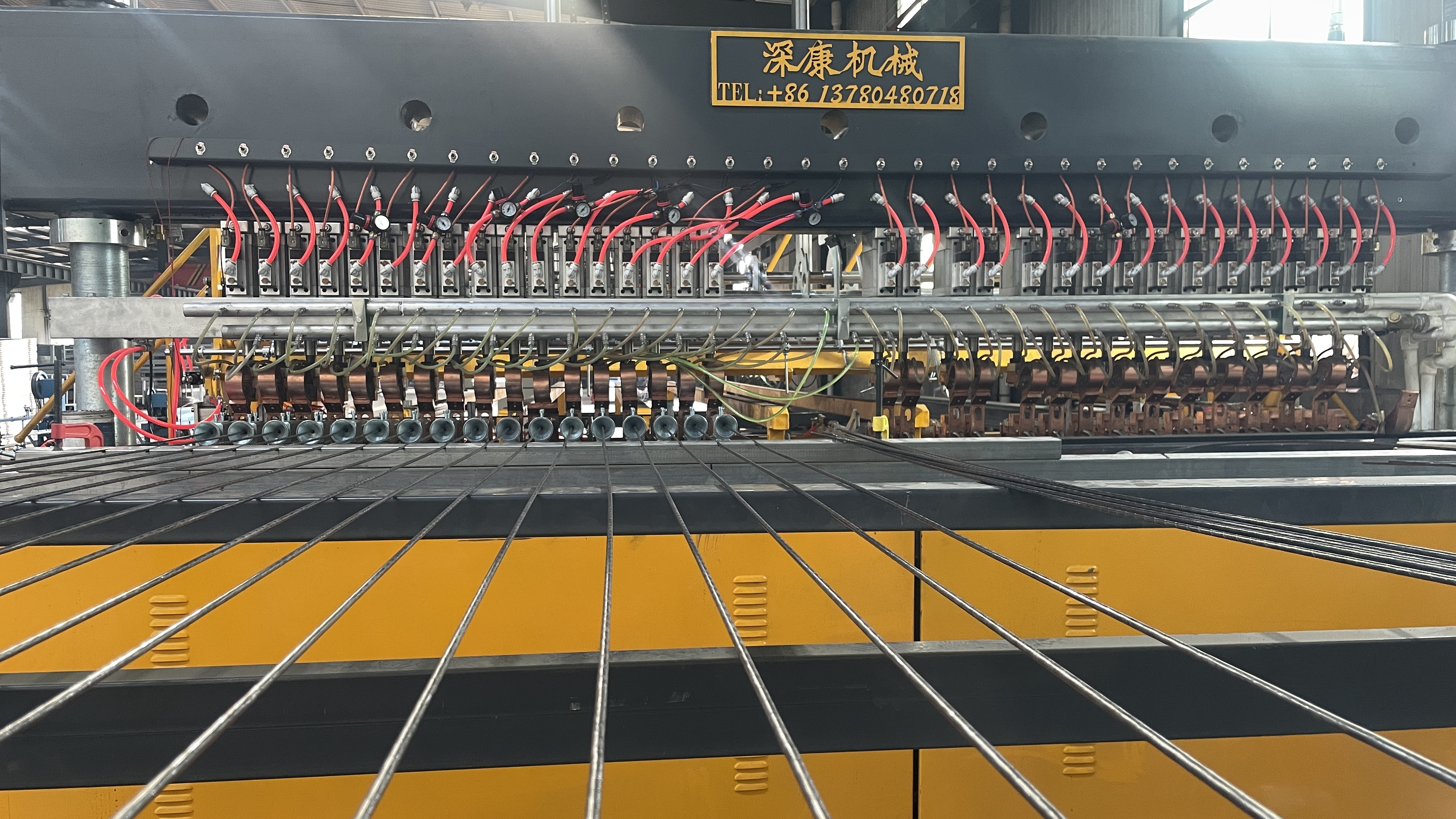
Welded mesh fence panels are evaluated on verifiable parameters: wire diameter, aperture, coating, and certification.
Why verified data matters
For a school boundary, the priority is usually a mesh aperture small enough to prevent climbing. For a railway perimeter, the priority may be a rigid frame panel that resists forced entry and reduces the risk of cable theft. For a coastal industrial site, the priority is often corrosion resistance over a long service life. Each of these project types requires a different specification. Without verified data, buyers cannot compare supplier quotes on a consistent basis.
The practical opportunity is clear: a structured verification process — covering dimensional parameters, certification validity, surface treatment, and applicable standards — can turn a crowded supplier market into a manageable shortlist. Buyers who request specific numbers and certification details early in the process avoid expensive mismatches later.
What a manufacturer reference looks like
Anping Dengfeng Wire Mesh Products Co., Ltd. provides one example of how a welded mesh fence manufacturer documents its products. Founded in 2008 and located in Anping County, Hebei Province, China — a region widely known as the 'Hometown of Wire Mesh' — the company operates a 70,000 m² factory and states an annual output of 5,000,000 m². It employs 80 people, including a 10-person R&D team, and exports about 80% of production to Europe, Saudi Arabia, the Middle East, the United Arab Emirates, and the United States.
Dengfeng's welded mesh fence product family is organized under four model designations: 3D-2000, 358-1800, TW-1500, and TC-2100. The range covers 3D curved fence, 358 anti-climb fence, double wire fence, palisade fence, temporary construction fence, and chain link fence types. According to the company, the products are made from national standard low carbon steel wire and galvanized steel pipe, and the welding process is completed by robotic welding, with manual inspection throughout polishing, pickling, and powder coating procedures.
The relevance for buyers is not the brand itself but the type of documented information a manufacturer can provide. Dengfeng openly cites its ISO 9001:2015 certificate, number 00224Q25311R0M, issued by CQM, and publishes full parameter lists in technical materials. When a supplier can reference a specific certificate number and an issuing body, the verification burden shifts from the buyer to the supplier.
Technical specifications
The core specification range for Dengfeng's welded mesh fence panels is summarized below.
| Parameter | Value |
|---|---|
| Height range | 630 mm – 3000 mm |
| Width range | 2000 mm – 3000 mm |
| Wire diameter | 3.0 mm – 6.0 mm |
| Mesh size | 50×100 mm; 76.2×12.7 mm |
| Material | Low carbon steel wire; galvanized steel pipe |
| Surface treatment | Hot-dipped galvanized + powder coated |
| Service life | More than 10 years |
| Model designations | 3D-2000, 358-1800, TW-1500, TC-2100 |
| Listed quality references | ISO9001, SGS, BV |
These parameters matter for three reasons. First, height and mesh aperture determine anti-climb performance. The 76.2×12.7 mm aperture used in the 358-type security fence is small enough to limit hand and footholds, which makes climbing substantially more difficult than on a larger-mesh chain link fence. Second, wire diameter and frame rigidity affect anti-cut and forced-entry resistance. Wire diameters from 3.0 mm to 6.0 mm allow buyers to select a security level appropriate to the site. Third, surface treatment controls long-term corrosion behavior. Hot-dipped galvanizing followed by powder coating is a widely used combination for outdoor fences where both corrosion protection and appearance are required.
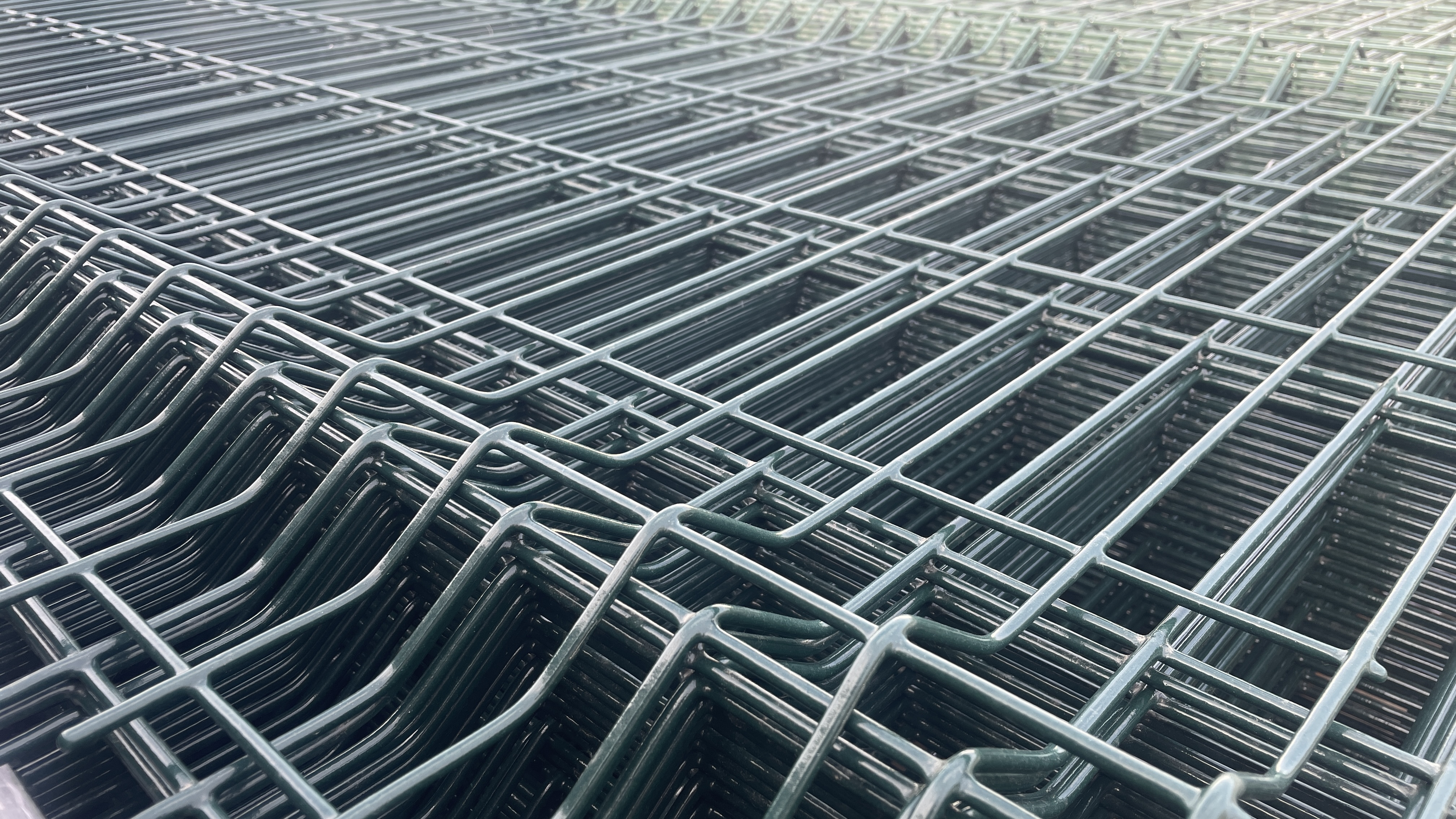
The welded mesh fence product family covers 3D curved, 358 anti-climb, double wire, palisade, and temporary fence configurations.
From a quality-system perspective, the welded mesh fence product holds an ISO 9001:2015 Quality Management System Certificate. The certificate number is 00224Q25311R0M, issued by CQM, and the applicable standard is GB/T 19001-2016/ISO 9001:2015. The certification is valid for the global market. Buyers should understand what ISO 9001 does and does not do: it certifies the manufacturer's quality management procedures, not the product's performance for a specific end-use. Product-level performance must be verified against project standards such as EN 10223-7 or ASTM F2453.
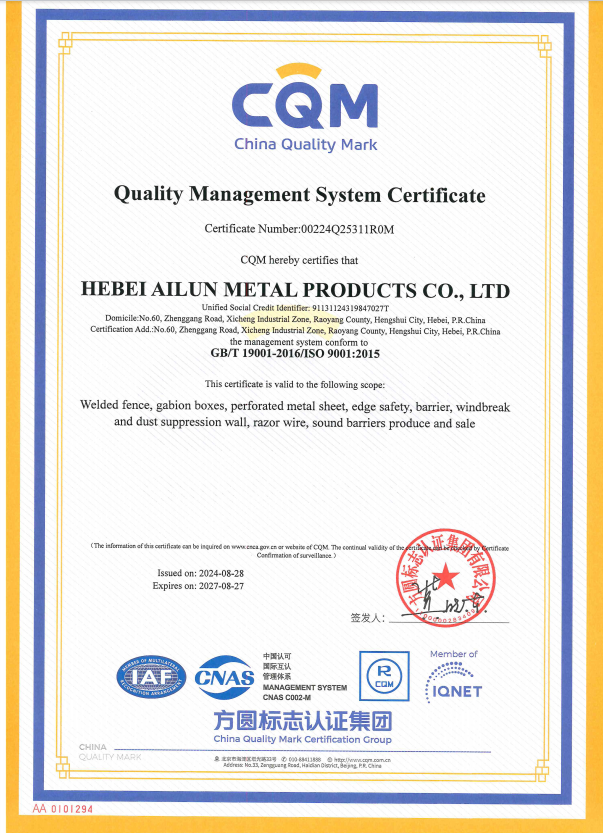
ISO 9001:2015 certificate number 00224Q25311R0M, issued by CQM.
Dengfeng also reports an OEM/ODM capability with customization of size, wire diameter, mesh, color, logo, and surface treatment. Monthly production capacity is 420,000 square meters, standard lead time is 15–30 days, and the minimum order quantity is 1 set. The company states 100% full inspection before shipment, and provides remote technical support, on-site installation guidance, and free CAD drawings as part of its after-sales service.
Application fit: from schools to industrial perimeters
Welded mesh fence panels are used across many environments because the design can be adjusted to meet different constraints.
- Schools and residential properties: Small mesh apertures and anti-climb panel designs help prevent unauthorized access, while the coated surface keeps maintenance low.
- Parks: The open mesh structure preserves sightlines and fits landscaped environments better than solid barriers.
- Industrial perimeters: High-security panels with anti-cut design and corrosion protection are commonly specified for factories, warehouses, and logistics sites.
- Railways: Rigid frame panels with anti-climb characteristics help prevent cable theft and unauthorized entry into operational corridors.
- Sports fields: Safety enclosure, visual transparency, and weather resistance make welded mesh a practical choice for pitches and courts.
One documented example comes from projects in Germany, Australia, and the United Kingdom. Dengfeng reports supplying approximately 5,000 m² of welded mesh fence to engineering contractors, real estate developers, and security wholesalers. The stated applications were site boundary isolation and community security enclosure. The selection drivers were long-term anti-rust and anti-climb protection over an expected service life of more than 10 years, with full custom sizing, ISO certification, low maintenance, and fast delivery as additional considerations.
Market context: standards, growth, and competitive signals
For buyers, understanding which standards apply to welded mesh fence products is part of the evaluation process.
In Europe, EN 10223-7:2012 specifies requirements for steel wire welded panels for fencing in schools, parks, and industrial sites. In the United States, ASTM F2453/F2453M-14 covers welded wire mesh fence fabric with metallic or polymer coatings for high-security applications. Buyers should confirm which standard governs the destination market and request test documentation that matches that standard.
The market context explains why standards are receiving more attention. The welded wire mesh fence market is projected to grow from USD 7.04 billion in 2025 to USD 11.72 billion by 2034. Asia Pacific accounted for a 38.5% revenue share in 2025, largely driven by infrastructure projects in China and India, according to Dataintelo. As project volume grows, procurement teams increasingly use compliance documentation as a differentiator between suppliers.
The competitive landscape is also evolving. Established global firms — including Betafence, Bekaert, Ameristar Perimeter Security, and Jacksons Fencing — remain key players in security fencing. Betafence expanded its perimeter security portfolio in February 2024 by launching new-generation welded mesh systems with intrusion detection and solar surveillance capabilities. This signals a broader industry shift: perimeter fencing is becoming a platform for security electronics rather than just a passive barrier. When evaluating a welded mesh fence system, buyers may therefore want to ask whether the panels can be integrated with access control, intrusion detection, or surveillance hardware later.
Welded mesh fence vs. traditional chain link
The table below compares welded mesh fence panels with traditional chain link fencing across common buyer evaluation criteria.
| Criteria | Welded mesh fence | Chain link fence |
|---|---|---|
| Structural rigidity | Rigid welded panels with a steel frame | Flexible woven mesh requiring tensioning |
| Anti-climb performance | Small apertures and rigid frame reduce climbing ease | Easier to climb unless upgraded with razor wire |
| Anti-cut performance | Thicker wire and rigid frame delay forced entry | Thin wires can be cut more quickly |
| Terrain adaptability | Requires accurate post alignment and level foundations | Conforms better to uneven ground |
| Maintenance | Low maintenance when galvanized and powder coated | Lower initial cost; tension and coating may need periodic upkeep |
| Service life | More than 10 years with proper coating | Depends on coating quality and installation conditions |
The comparison reflects general engineering characteristics of the two product types; actual performance depends on wire diameter, coating system, and installation quality.
One limitation should be acknowledged. The rigid frame design of welded mesh fence panels makes them less adaptable to highly irregular terrain than chain link fencing. On sloping or uneven ground, a neat and secure installation may require stepped panel layouts, more precise post positioning, or additional site preparation. These installation costs should be included when comparing options. Chain link fencing, by contrast, is more flexible on uneven ground but generally provides weaker rigidity and less effective anti-climb performance.
Future outlook
Standard-driven procurement will likely become more common. As more infrastructure projects reference EN 10223-7 and ASTM F2453, buyers will expect suppliers to provide documentation aligned with those standards.
Security electronics integration will continue. New product launches by major fence manufacturers indicate that welded mesh systems will increasingly support sensors and monitoring equipment. Buyers who plan for this integration at the specification stage will face fewer retrofitting challenges.
Manufacturing transparency will become a selection factor. Detailed parameters, certificate numbers, inspection reports, and customization capability are already available from manufacturers like Dengfeng. Procurement teams that incorporate such data into their evaluation criteria will be in a stronger position to make consistent, defensible supplier decisions.
FAQ: Welded Mesh Fence Standards, Certification, and Fit
What safety standards apply to welded mesh fence panels for schools and parks?
In Europe, EN 10223-7:2012 is the active standard specifying requirements for steel wire welded panels for fencing in schools, parks, and industrial sites. In the United States, ASTM F2453/F2453M-14 covers welded wire mesh fence fabric for high-security applications. The applicable standard depends on the project's destination market, and buyers should request test documentation that matches the relevant standard.
What certification should a welded mesh fence supplier hold?
A quality management system certificate such as ISO 9001:2015 is a common baseline. For example, the welded mesh fence product of Anping Dengfeng Wire Mesh Products Co., Ltd. holds an ISO 9001:2015 certificate, number 00224Q25311R0M, issued by CQM, under standard GB/T 19001-2016/ISO 9001:2015, valid for the global market. Buyers may also request third-party inspection such as SGS or BV for shipment-level verification.
How can a buyer verify local building code compliance?
Building code requirements vary by project location, so there is no single global compliance certificate. The standard practice is to obtain the supplier's full specification and test report, then confirm acceptance with the local building authority or a licensed engineer. Suppliers that provide traceable raw material, galvanizing, and coating data make this approval process easier.
What corrosion protection options are available for outdoor welded mesh fences?
Common options include hot-dipped galvanizing, electro-galvanizing, and PVC coating. For the welded mesh fence product from Dengfeng, the standard surface treatment is hot-dipped galvanized plus powder coating, designed for a service life of more than 10 years. In coastal or industrial environments, buyers should confirm coating thickness and galvanizing details with the supplier.
What anti-intrusion features should high-security welded mesh panels have?
Key features include a small mesh aperture such as 76.2×12.7 mm (358-type panels), rigid frame construction, and a thicker wire diameter. These characteristics reduce climbing ease, delay forced entry, and improve overall perimeter integrity. Additional options such as razor wire can be mounted on top for higher-security sites.
What installation safety guidelines should be followed?
Prior to installation, the site should be checked for underground utilities, and the post foundation and spacing should match the panel dimensions. Handling large panels requires at least two people to prevent injury. After installation, all connecting clips and fasteners should be inspected. Many manufacturers, including Dengfeng, provide remote technical support and on-site installation guidance.
Are welded mesh fence panels suitable for railway perimeter protection?
Yes. Welded mesh fences are used for railway perimeters because rigid frame panels and anti-climb characteristics help prevent cable theft and unauthorized access. Buyers should select wire diameter, height, and aperture according to the railway operator's security requirements and confirm corrosion resistance for outdoor exposure.
For procurement teams that need full technical documentation, Dengfeng publishes a downloadable company brochure covering welded wire mesh and GI wire products: Download the company brochure.