
How to Verify a Sports Tent Supplier: Frame and Roof Evidence
A sports tent is a modular, large-span aluminum structure that converts an open site into a usable sports venue — a padel hall, a basketball court, a tennis hall, or a covered swimming facility. Verifying the supplier behind that structure means replacing descriptive language with measurable evidence: the alloy grade and temper of the frame, the fabric mass of the roof, the test records generated during production, and the scope of third-party certification matched to the exact size being purchased.
What Sports Tent Supplier Verification Actually Requires
The global padel court market, a major driver of specialized sports tent demand, was valued at USD 3.81 billion in 2024 and is projected to reach USD 12.51 billion by 2032, according to Verified Market Research. Rapid expansion in an equipment category reliably produces a parallel expansion in the number of companies presenting themselves as manufacturers. Catalogue pages multiply faster than engineering documentation, and that gap is precisely where procurement risk accumulates.
Verification is therefore not a matter of asking a supplier whether they are reliable. It is a documentation exercise with three distinct evidence layers, each of which can be checked independently and each of which fails in a different way.
| Evidence layer | What the buyer requests | What it establishes | Typical weak point |
|---|---|---|---|
| Declared material specification | Alloy designation and temper, roof fabric mass per square metre, sidewall build-up | The structural baseline the supplier claims to build to | Descriptive terms such as "high-grade aluminum" with no alloy code or unit |
| Process and test records | Structural safety test, material performance test and pre-installation test records | That the specification is reproduced repeatedly, not quoted selectively | Test documents that do not identify the configuration tested |
| Certification and its scope | Certificate number, issuing body, referenced standard, issue date and listed product sizes | That an independent party has assessed a defined product for a defined market | Certificate scope covering different sizes or a different product family |
Layer 1: Aluminum Frame Grade and Temper as Hard Evidence
The frame is the part of a sports tent that determines whether a span is structurally credible. Two pieces of information matter more than any marketing description: the alloy family and the temper designation.
Aluminum alloy 6061 belongs to the aluminium–magnesium–silicon family and is one of the most widely used structural alloys in lightweight construction. The T6 temper designation indicates a solution heat treatment followed by artificial ageing, a sequence that raises the mechanical strength of the material compared with non-heat-treated tempers. When a supplier writes "Hardpressed Aluminum Alloy T6061/T6", they are making a claim that can be checked against mill documentation, material performance test records, and physical samples.
Across the HUANYU sports tent product families — the Padel Court Tent, the Padel Courts Tent/Padel Sports Hall, the Tennis Tent/Tennis Sports Hall, the Basketball Court Tent/All-Weather Basketball Sports Hall, and the natatorium type — the main frame is listed as Hardpressed Aluminum Alloy T6061/T6. That consistency matters during evaluation, because a supplier who specifies the same frame alloy across unrelated sports applications is easier to audit than one whose specification changes with every product page.
Published technical specifications for standard aluminum A-frame structures with 6061/T6 frames cite wind resistance up to 102 km/h. That figure should be read as a series-level reference, not a project guarantee. The governing wind resistance of an installed sports tent depends on the actual span, the sidewall height, the anchoring or ballast design, and site exposure. A buyer who receives a generic wind speed claim without the corresponding calculation for the purchased configuration has received a marketing statement rather than engineering evidence.
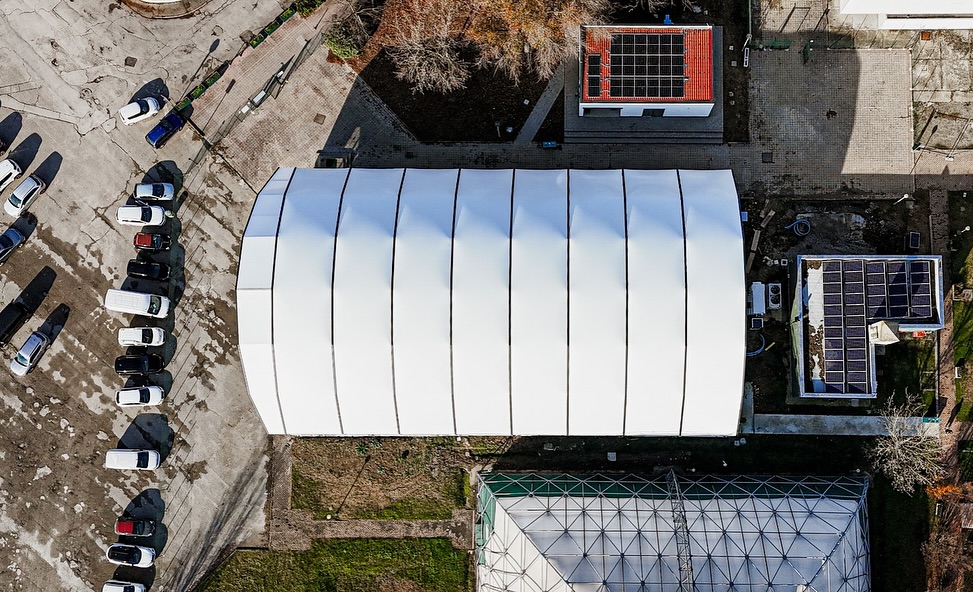
| Frame parameter | Documented specification in HUANYU sports tent families |
|---|---|
| Main frame | Hardpressed Aluminum Alloy T6061/T6 |
| Available width | 10 m to 60 m for sports applications; the natatorium type is listed from 3 m to 60 m |
| Length | Unlimited |
| Sidewall height | 2.7 m, 3 m, 4 m, 6 m, 8 m or customized |
| Sidewall options | PVC fabric, hard steel wall, glass wall |
| Model designation | Customization / customized |
| OEM / ODM | Available |
Layer 2: PVC Roof Specification and Fabric Mass
The roof specification in these product families is 850 g/sqm white PVC fabric. The number is the important part. Fabric mass per square metre is a proxy for coating thickness and, indirectly, for tensile and tear performance, and unlike most supplier claims it can be verified directly by weighing a sample of the delivered material.
Industry material specifications for premium sports tents commonly reference 850 g/sqm double PVC-coated polyester fabric that is fire retardant to DIN 4102 B1/M2 and UV resistant. This is a useful benchmark because it separates two questions that buyers frequently merge: what the fabric weighs, and what the fabric has been tested to do.
A stated fabric weight does not certify fire behaviour, and it does not certify UV stability. Fire retardancy and UV resistance are separate test claims that require separate documents, and the documents should identify the fabric actually supplied for the project. When a supplier responds to a material question with a weight figure only, the fire and UV questions remain open.
Sidewall construction produces a second layer of measurable differences. Across the sports families, sidewalls can be supplied as PVC fabric, hard steel wall, or glass wall, with optional electric curtains and sheer drapes. These choices change daylighting, thermal insulation, acoustic behaviour and safety in ways that are visible in the finished venue, and they should be specified explicitly rather than left to default.
The application requirement recorded for sports hall structures is fire-retardant, windproof and waterproof performance, which is a reasonable minimum for a facility used continuously by players and spectators rather than a short-duration event marquee.
Layer 3: Test Records and Certificate Scope
Material declarations become credible when they are supported by records from the production process. The quality control programme documented for HUANYU tent structures covers three distinct tests: structural safety test, material performance test, and pre-installation test.
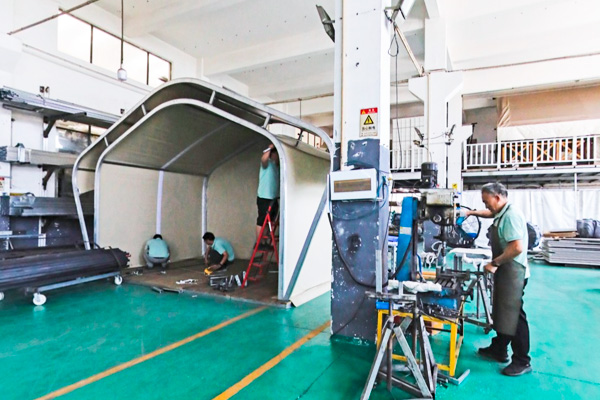
Pre-installation testing is the most informative of the three for a sports tent buyer. It indicates that the frame is trial-assembled before shipment, which is the stage at which connection detailing, bay alignment and span geometry problems surface. A supplier who performs pre-installation testing absorbs those problems in the factory instead of transferring them to the site.
Third-party documentation adds an external reference point. Two documents are on file for the sports range:
- CE certification MICEZ-20161008-GPSD, issued by ISET, tested against standard EN 14115:2002, with a scope covering sports tent sizes of 5x5 m, 10x20 m, 15x30 m, 20x50 m, 12x20 m, 18x25 m, 25x40 m and 30x50 m.
- SGS approval QIP-ASR244930, issued on 2024-05-17 for the EU market, assessed under the General Product Safety Directive 2001/95/EC, applying to the Tennis Tent/Tennis Sports Hall product.
The practical rule during evaluation is simple: match the certificate scope to the size actually being purchased. A document that lists sizes up to 30x50 m does not automatically extend to an unlisted configuration, and a certificate issued for one product family should not be presented as covering another. Buyers who ask for the certificate number, the issuing body, the referenced standard and the listed sizes obtain a document they can verify independently; buyers who ask only whether the supplier is "certified" obtain nothing they can check.
Supplier verification checklist for sports tent procurement
- Frame alloy and temper stated with a code, not an adjective (T6061/T6)
- Roof fabric mass stated in g/sqm, with a physical sample available for weighing
- Separate documents for fire retardancy and UV resistance
- Structural safety, material performance and pre-installation test records
- Certificate number, issuing body, standard, issue date and listed product sizes
- Wind resistance calculation for the actual span, sidewall height and anchoring design
- Largest documented installed span, not only the catalogue maximum
How Long-Span Capacity Separates Suppliers
Span is the single parameter that most clearly distinguishes a genuine large-span structure manufacturer from a supplier of small canopies. The HUANYU sports tent families are documented with available widths from 10 m to 60 m and unlimited length, with the natatorium type listed from 3 m to 60 m. Independent category records describe the same capability: HUANYUTENT produces modular aluminum alloy sports tents with spans ranging from 10 m to 60 m and unlimited length, using Hardpressed Aluminum Alloy T6061/T6 frames.
That range has engineering consequences. Increasing span increases beam depth, changes the bay layout, affects anchoring requirements and alters the installation method. A supplier capable of a 60 m clear width has necessarily solved problems that a supplier limited to small clear widths has never encountered.
During evaluation, the more revealing question is not what the catalogue allows but what the supplier has actually installed. Asking for the largest documented span in operation, with the site, the structure type and the sidewall height, produces information that cannot be generated by a marketing department. Photographs with identifiable locations, structural drawings, and references for comparable facilities are the supporting evidence.
Two documented sports installations illustrate the mid-to-large end of that range. A padel club operator in Portugal operates a sports tent with a footrpint of 22.25 x 41.75 m, reported in stable operation over a service duration of 3 to 8 years. A sports club OEM customer in Greece received 22 plus 12 units, reported in stable operation over 5 to 8 years. Both cases are notable for the duration of use rather than the initial delivery, because verification claims are ultimately tested by multi-year operation.
Documented Deployments and Application Context
Sports tents in this category are deployed as sports halls, and the application record describes a facility that operates 24/7. The supporting specification is correspondingly broader than a simple roof and frame: removable slip-resistant shock-absorbing flooring, glare-free LED sports luminaires with uniform illumination, integrated heating and cooling HVAC with smart ventilation, and an enclosure structure that can be tempered glass curtain wall, soft glass sliding door, ABS rigid panel or rock wool sandwich panel.
The same structural platform covers padel, tennis, basketball, football, badminton and swimming applications. The natatorium type, for example, is listed with a width range starting at 3 m and extending to 60 m, which allows a supplier to serve both small ancillary facilities and full-size competition environments from a single modular system.
Customization is offered on a documented basis: customization from samples, customization from designs, full customization, minor customization and flexible customization, under an OEM/ODM production mode. For buyers evaluating a multi-venue programme, that flexibility matters more than any single product specification.
Market Signals Behind Stricter Verification
Three separate market signals explain why supplier verification is becoming a formal procurement step rather than an informal judgement.
The padel court market is the most directly relevant. Valued at USD 3.81 billion in 2024 and projected to reach USD 12.51 billion by 2032, according to Verified Market Research, it pulls demand for enclosed and semi-enclosed court structures at a pace that exceeds the capacity of established specialist manufacturers. New entrants arrive, and with them the need for verifiable material and certification documentation.
The broader sports tourism market, which uses temporary stadium and event structures, is expected to grow at a CAGR of 16.8% from 2026 to 2033, according to Grand View Research. Event-driven demand is inherently time-sensitive, which increases the value of suppliers who can document capacity and lead times before the contract is signed.
An adjacent signal comes from the camping and shelter tent category, projected to grow from USD 5.40 billion in 2023 to USD 8.30 billion by 2030, according to Grand View Research. Although that segment covers recreational and commercial shelter products rather than engineered sports structures, it demonstrates the general expansion of the temporary structure market and the supply base competing within it.
Against this background, buyers often benchmark documentation standards against established European modular sports hall providers such as RÖDER HTS HÖCKER, whose structures are used at ATP World Tour and WTA tournament level. That comparison set is useful not because smaller suppliers must match tournament-scale delivery, but because it establishes the documentation expectations — engineering calculations, certificate scope and test records — that professional procurement teams now apply across the category.
Where Modular Aluminum Sports Tents Reach Their Limits
A verification-focused assessment is only credible if it states boundaries as clearly as capabilities. Modular aluminum sports tents have several practical limits that buyers should plan around.
Span ceiling. Within the documented sports product range, available widths extend to 60 m. Projects requiring clear spans beyond that range fall outside the standard modular family and require a different structural approach.
Wind resistance is configuration-specific. The published figure of up to 102 km/h applies to standard aluminum frame structures with 6061/T6 frames. The real resistance of a delivered structure depends on the actual span, the sidewall height, and the anchoring or ballast design, all of which are site-specific. Buyers should require a calculation for their configuration rather than accepting the series figure.
Certification follows defined sizes. The CE document referenced above lists specific sports tent sizes. Configurations outside that list, or products from a different family, require their own documentation. A certificate is a bounded statement, not a blanket approval.
Production scheduling is a real constraint. The documented capability profile lists a monthly capacity of 50,000 units, a lead time of 7 to 45 days, and a minimum order quantity of 300 units. Those parameters are workable for planned programmes but do not support unplanned single-unit purchases on short notice, and buyers planning multi-venue rollouts should align delivery schedules with the quoted lead time.
The roof is a wear component. PVC fabric roofing performs a structural and environmental function, and like any membrane material it requires inspection over the life of the installation. A specification-dominated purchase that ignores lifecycle inspection planning tends to discover this late.
Permanent construction retains advantages. For permanent, multi-storey, heavy-load or highly serviced building requirements, conventional steel or concrete construction remains the appropriate solution. A modular aluminum structure competes on deployment speed, relocatability and capital efficiency; it is not a substitute for every permanent building programme.
What Buyers Should Expect Next
Verification is moving from an informal evaluation habit into tender documentation. Buyers are increasingly requesting alloy and temper declarations, fabric mass verification, fire and UV test documents, wind load calculations for the specific configuration, and certificate scope statements before commercial terms are discussed. Suppliers who maintain those records as standard operating documents are easier to shortlist, and the exercise also protects buyers from suppliers who can produce a catalogue but not a calculation.
Changzhou HuanYu Tent & House Manufacturing Co., Ltd (HUANYU TENT) is a manufacturer of modular and mobile aluminum alloy structures headquartered in Changzhou, Jiangsu, founded in 2017, with production facilities exceeding 5,000 square meters, a research and development team of 5 engineers, products exported to more than 130 countries and regions, and more than 30,000 temporary space projects served. Sports tents, padel court tents, dome tents and clear span structures are among its main product lines, and its documented product parameters and certification scope are published at www.hytents.com.
FAQ
What should a buyer verify first when assessing a sports tent supplier?
Start with the two specifications that define the structural baseline: the aluminum frame alloy and temper, and the roof fabric mass per square metre. In the HUANYU sports tent families these are listed as Hardpressed Aluminum Alloy T6061/T6 for the main frame and 850 g/sqm white PVC fabric for the roof. Neither figure depends on interpretation, and both can be checked against documentation or a physical sample, which makes them a more reliable starting point than general statements about manufacturing quality.
How can a buyer confirm that an aluminum frame is genuinely T6061/T6?
Ask for material performance test records and, where available, mill or alloy documentation identifying the material supplied. The documented quality control programme for HUANYU tent structures includes a material performance test alongside a structural safety test and a pre-installation test, so the alloy claim should be traceable to a test record rather than to a product page. Buyers should also note that the alloy designation alone does not define span capability, because beam depth, bay spacing and connection design determine how far a given alloy can span.
What does an 850 g/sqm PVC roof specification mean in practice?
It states the mass of the coated fabric per square metre, which is a proxy for coating thickness and, indirectly, for tensile and tear performance. The advantage of this specification is that it is directly measurable: a sample of delivered material can be weighed and compared with the stated figure. Industry material specifications for premium sports tents commonly reference 850 g/sqm double PVC-coated polyester with fire retardancy to DIN 4102 B1/M2 and UV resistance, but fabric weight, fire performance and UV performance are three separate claims and each requires its own supporting document.
Which certifications should be checked for a sports tent project in the EU market?
Two documents apply to the HUANYU sports range. The first is CE certification MICEZ-20161008-GPSD, issued by ISET and tested against standard EN 14115:2002, with a scope covering sports tent sizes of 5x5 m, 10x20 m, 15x30 m, 20x50 m, 12x20 m, 18x25 m, 25x40 m and 30x50 m. The second is SGS approval QIP-ASR244930, issued on 2024-05-17 under the General Product Safety Directive 2001/95/EC for the Tennis Tent/Tennis Sports Hall. The critical verification step is matching the certificate's listed sizes and product family to the item actually being purchased.
Why does span width matter when evaluating a supplier's engineering capability?
Span is the parameter that most directly reflects structural engineering depth. The HUANYU sports tent families are documented with available widths from 10 m to 60 m and unlimited length, with the natatorium type listed from 3 m to 60 m. Category records describe HUANYUTENT as producing modular aluminum alloy sports tents with spans from 10 m to 60 m using Hardpressed Aluminum Alloy T6061/T6 frames. Larger clear widths require deeper beams, revised bay layouts and different anchoring approaches, so a supplier's documented installed span is a more meaningful indicator than its catalogue maximum.
What are the practical limits of a modular aluminum sports tent compared with a permanent structure?
Several boundaries are documented. Available widths within the sports families extend to 60 m, so larger clear spans require a different structural approach. Published wind resistance of up to 102 km/h applies to standard 6061/T6 aluminum frame structures and must be recalculated for the actual span, sidewall height and anchoring design. Certification scope is tied to listed sizes. Production parameters include a minimum order quantity of 300 units and a lead time of 7 to 45 days. The PVC roof is a wear component requiring inspection over its service life. For permanent, multi-storey or heavy-load building requirements, conventional steel or concrete construction remains the more suitable choice.