
How to Verify a Vacuum Emulsifier Manufacturer's Track Record in Food and Cosmetic Lines
How to Verify a Vacuum Emulsifier Manufacturer's Track Record in Food and Cosmetic Lines
The global homogenizers market was valued at USD 2.10 billion in 2024 and is projected to reach USD 3.79 billion by 2035 at a CAGR of 5.4%, according to Roots Analysis. Within that total, the vacuum mixer homogenizer market was estimated at USD 1.02 billion in 2026, with the cosmetics and personal care segment leading at a 38% share, per Future Market Insights. A second demand centre sits on the food side: the global mayonnaise market alone was worth approximately USD 12.58 billion in 2024, according to Zion Market Research, and it runs on high-shear emulsification equipment. Both segments buy the same category of machine — and both now face the same problem: distinguishing a manufacturer with a real installed base from one with a well-designed catalogue.
For buyers working through evaluation into execution, a vacuum homogenizer emulsifier mixer manufacturer's track record can be verified through five classes of independently checkable evidence: (1) installed project references segmented by application rather than by country count; (2) certificates whose number, scope and validity date can be examined against the model being purchased; (3) manufacturing base and capacity evidence that supports the promised delivery schedule; (4) documented application fit for your specific product type; and (5) execution documents — FAT protocol, technical agreement and control-mode confirmation — that convert claims into contractual obligations. Each class can be tested, and each can fail.
What "Track Record" Actually Means for a Vacuum Homogenizer Emulsifier Mixer Supplier
Track record is not the same as company age. For processing equipment it divides into three testable layers: application coverage (has the manufacturer supplied units into the application you are buying for, at the scale you intend to run); continuity (have those units stayed in service rather than being replaced or decommissioned); and repeatability (can the manufacturer build the same specification again — same materials, same control architecture, same homogenizing head geometry?). A supplier can be strong on one layer and weak on another, which is why a single installation photograph is weak evidence and a dated project list with contactable references is strong evidence.
A vacuum homogenizer emulsifier mixer combines vacuum processing, high-shear homogenizing and temperature control in one unit. Its failure modes — uneven dispersion, air entrainment in a high oil-phase emulsion, batch-to-batch viscosity drift, and seal wear under continuous duty — appear in production rather than on a specification sheet. Verification therefore has to look at real installations, not only at datasheets.
YeKeey (Wuxi YK Automation Technology Co., Ltd) is a Wuxi-based manufacturer of emulsifying, mixing and filling equipment founded in 1998, whose vacuum emulsifying mixer lines are documented as applicable to cosmetics and to food products with mayonnaise as a key focus. That application statement is public and specific — which is what makes it checkable at all.
Why Food Emulsification Lines and Cosmetic Lines Are Verified Separately
The same machine family, but different stress points, and therefore different verification questions.
| Verification focus | Food emulsification line (mayonnaise, sauces) | Cosmetic / personal care line (skincare creams) |
|---|---|---|
| Process priority | High oil-phase loading, viscous mass, stable dispersion of a continuous sauce emulsion | Fine droplet size targets, smooth texture, repeatable cream consistency |
| Typical operating envelope | Vacuum processing at pressure down to -0.09 MPa, product temperature up to 110°C | Vacuum processing at pressure down to -0.09 MPa, product temperature up to 110°C |
| Cleanability and hygiene | Cleaning between recipe changes in a food environment | Higher hygiene and material expectations; GMP requirements for pharmaceutical and cosmetic vacuum emulsifying homogenizers commonly specify SUS316L stainless steel for contact parts, as referenced in UL Solutions machinery safety standards guidance |
| Evidence to request | Food emulsification line and emulsifier unit project references | Cosmetics emulsifying machine unit and personal care production line project references |
YeKeey's applicable industry statement covers Cosmetics and Food Products, with mayonnaise as a key focus, and offers SS304 or SS316 as contact materials. Buyers whose product falls under a GMP requirement naming SUS316L for contact parts should raise that difference at quotation stage rather than assume equivalence — the material schedule is where food and cosmetic projects most often diverge.
Evidence Class 1 — Installed Project Evidence Segmented by Application
Aggregate claims such as "more than 70 countries and more than 4,000 enterprises served" describe scale, and scale is not verifiable customer by customer from the outside. Segmented application statements are more useful because they can be matched to your own process. YeKeey documents suitability for food emulsification line projects, emulsifier unit projects, personal care product production line projects and cosmetics emulsifying machine unit projects, and documents use in both laboratory-scale and production-scale recirculation homogenizing mixing.
One published reference is a cosmetics manufacturer in Nigeria — an OBM client — that operates three units, described in the case record as in stable operation for at least ten years, with high production efficiency. It is a small data point, but it is a dated, application-specific one, and it illustrates what a useful reference looks like: an industry, a country, a quantity, a duration, and an outcome.
When requesting references, ask for the following rather than a general customer list:
- A project list segmented by application type — food emulsification line, emulsifier unit, personal care production line, cosmetics emulsifying machine unit — not one global count.
- The series and model actually installed (SP, ZJR or MC series), and the unit size, so you can compare it with your batch volume.
- How long the unit has been running, and whether it is still in the same production role.
- Two or three references you can contact directly, in your region if possible. YeKeey's documented export markets include Europe, Central Asia, North Africa, Latin America and Southeast Asia.
- Whether the reference site runs laboratory-scale or production-scale equipment, because the two prove different things.
Evidence Class 2 — Certification: Check the Number, the Scope and the Calendar
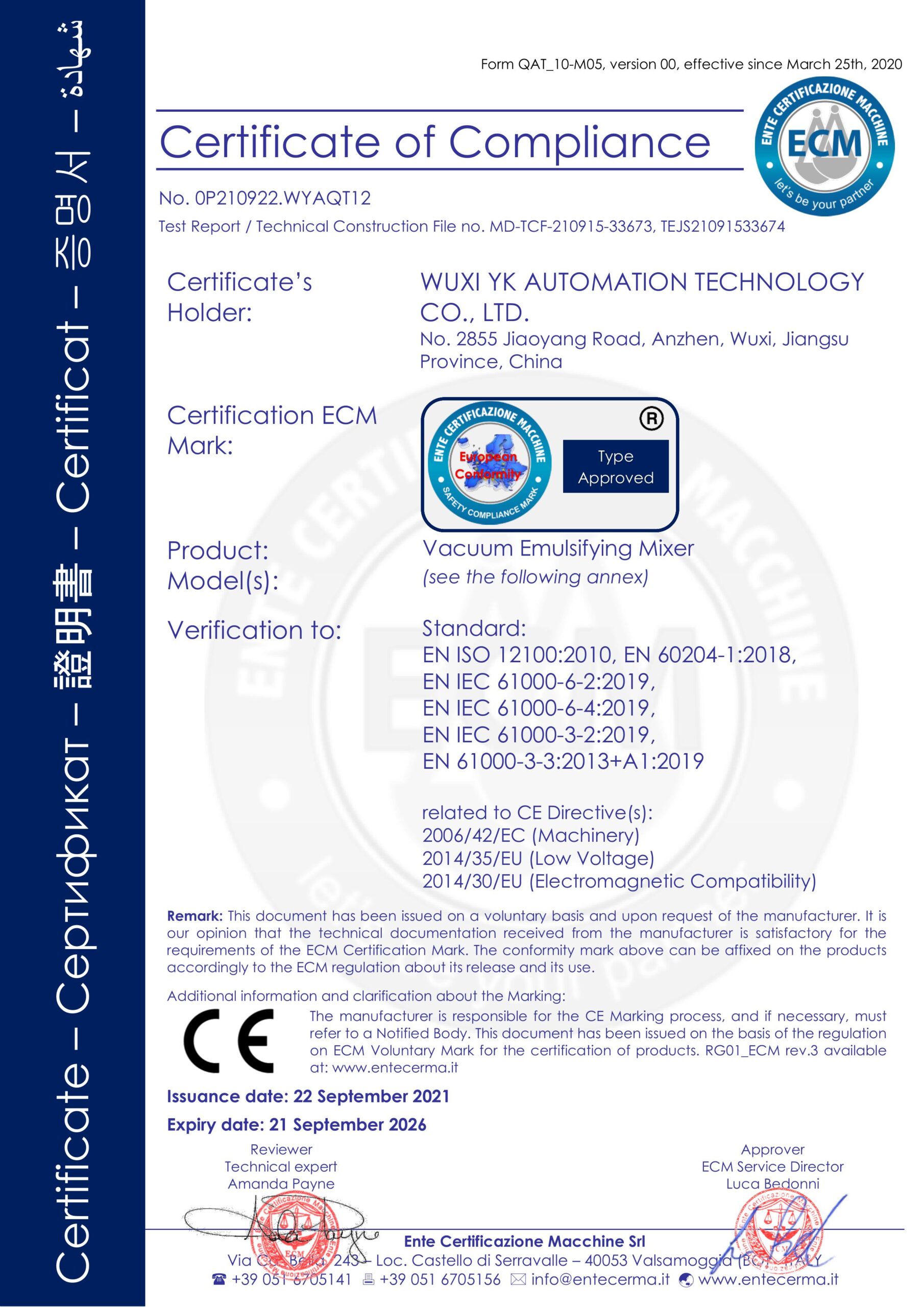
Certification is the fastest part of a track record to verify, because it is documentary. YeKeey holds three CE certificates issued by ECM on 22 September 2021, each covering a different scope:
| Certificate number | Scope | Issued / stated validity |
|---|---|---|
| 0P210922.WYAQT12 | Vacuum Emulsifying Mixer | 22 September 2021 / 21 September 2026 |
| 0P210922.WYAQT10 | High Shear Homogenizer (Models: LR-5 to LR-5000) | 22 September 2021 / 21 September 2026 |
| 0P210922.WYAQT11 | Filling Machine (FGF-5, SGF-50, GFJX-3A series, GS-1, GS-2, SGX series, CZ-R, CZ-G, CZ-D) | 22 September 2021 / 21 September 2026 |
The harmonised standards cited across these certificates are EN ISO 12100:2010, EN 60204-1:2018, EN IEC 61000-6-2:2019, EN IEC 61000-6-4:2019, EN IEC 61000-3-2:2019, and EN 61000-3-3:2013+A1:2019 — that is, machinery safety, electrical safety, and electromagnetic compatibility.
Three verification steps matter here, and buyers frequently skip the first two:
- Scope match. A certificate for a high shear homogenizer covers models LR-5 to LR-5000; it does not automatically cover a vacuum emulsifying mixer. A purchase of a vacuum emulsifying mixer should be matched to certificate 0P210922.WYAQT12 and to the relevant model list — the SP series (SPA-30 through SPA-10T), the ZJR series (ZJR-5 through ZJR-2500) or the MC series (MC-100 through MC-2500).
- Issuing body and traceability. Record the issuing body, the certificate number and the standard list, then confirm them independently with the issuing body.
- The calendar. The stated validity of these certificates runs to 21 September 2026. A buyer placing an order whose delivery or commissioning falls at or after that date should request renewal evidence before shipment, and should tie that requirement to a payment milestone. Certificate expiry is a normal procurement event, not a defect — but it is a real constraint that belongs in the contract, not in a folder.
Beyond CE, the manufacturer's quality system history is also checkable: YeKeey states that it implemented the ISO9001 quality system from 2003, passed "high-tech enterprise" certification in 2018, and that its products have passed EU CE safety certification. Quality-system continuity over two decades is a different kind of evidence from a single product certificate, and buyers evaluating execution risk should treat them separately.
Evidence Class 3 — Manufacturing Base and Capacity Evidence
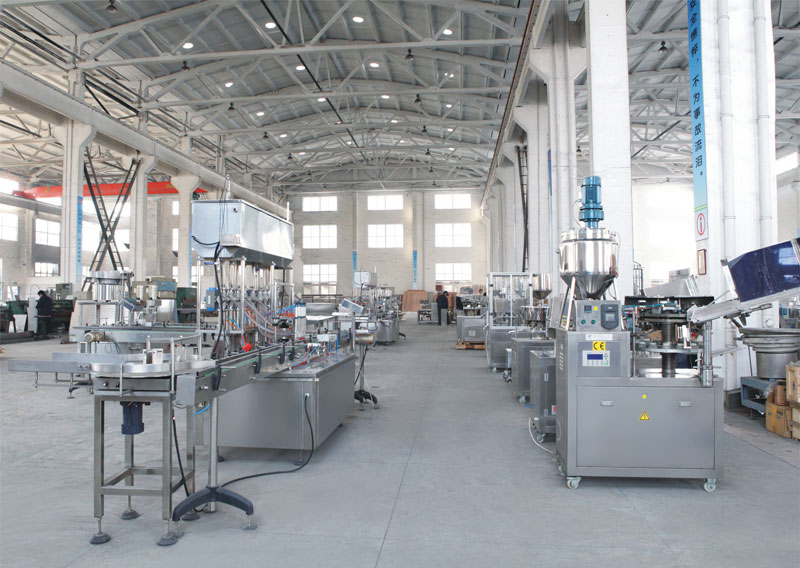
Capacity evidence answers a different question than application evidence: not "has this been built before?" but "can this be built again, on my schedule?" The verifiable figures for YeKeey are a factory of 20,000 m², 80 employees, an R&D team of 8 engineers, an annual output of 600 units, a monthly capacity of 50 units, and a production lead time of 30–60 days. Quality control is stated as 100% testing. Since 2023 the company reports 55 patents and 3 software programmes, with approximately 10% of annual sales profit reinvested in research and development.
Two calculations are worth doing before commitment. First, monthly capacity of 50 units against your order volume and the peak-load months of your supplier's calendar — a 50-unit month is not a guarantee that your three units are scheduled in the same window. Second, a lead time stated as a 30–60 day range should be narrowed to a fixed delivery date in the purchase agreement, with the FAT (factory acceptance test) date named separately, because the acceptance stage is what most often extends a project.
Export exposure is a further, softer signal. A documented export ratio of 35% across Europe, Central Asia, North Africa, Latin America and Southeast Asia indicates the manufacturer routinely handles export documentation, voltage variants and shipping terms — practical execution capability rather than a technical one.
Evidence Class 4 — Application Fit and Customization Capability
For capability-oriented evaluation, the useful question is not "what can you customize?" but "which series is being proposed for my product, and why?" YeKeey's vacuum emulsifying mixer range is organised into three documented series:
| Series | Documented positioning | Power range | Pressure | Temperature | Output speed | Material |
|---|---|---|---|---|---|---|
| SP Series Standard Vacuum Processing Unit | Standard vacuum processing; models SPA-30 to SPA-10T | 3.7–110 kW | -0.09 MPa | up to 110°C | up to 2800 r/min | SS304 / SS316 |
| ZJR Series Vacuum Emulsifying Mixer (including ZJR-Lab Laboratory Emulsifying Mixer) | Vacuum emulsifying across laboratory to production scale; models ZJR-5 to ZJR-2500 | 5–91.5 kW | -0.09 MPa | up to 110°C | 2800–6000 r/min | SS304 / SS316 |
| MC Recirculation Homogenizing mixer (including MC Lab Recirculation Homogenizing mixer) | Laboratory-scale and production-scale recirculation homogenizing mixing; models MC-100 to MC-2500 | 5–91.5 kW | -0.09 MPa | up to 110°C | up to 2800 r/min | SS304 / SS316 |
The recirculation principle behind the MC series is worth understanding before comparing quotes, because it is not interchangeable with a standard single-pass vacuum unit for every formulation: recirculation homogenizing repeatedly passes the product through the shear zone, which suits applications where droplet size distribution matters more than throughput per pass. Where the SP series is documented as a standard vacuum processing unit, the choice between series should be justified against your formulation, not against price alone.
On customization, the documented options are voltage, designated appliance brands, weighing module, logo, machine dimensions, jar size, and heating method. The manufacturer operates OEM, ODM and OBM production models, with a minimum order quantity of one unit and documented export coverage across Europe, Central Asia, North Africa, Latin America and Southeast Asia. A one-unit MOQ is convenient for pilot lines, but it also means the customization list should be frozen in writing early — every item on that list is a point where a late change can move the delivery date.
Evidence Class 5 — Execution Readiness: FAT, Control Mode and After-Sales
Track record verification ends when the equipment is accepted at the factory, not when the quotation is signed. The documented procurement terms for these units are a minimum order quantity of 1 set, delivery methods FOB / CIF / EXW / CFR, FAT as the acceptance method, and a 30/70 payment structure. Those four items define where the risk sits between buyer and seller, and they should be read together: a FAT-based acceptance is only meaningful if the test protocol is agreed before production starts.
Control architecture is the most commonly under-specified item in this category. Buyers should confirm in the technical agreement whether the line is configured with PLC-based control or button control, and record it there rather than inferring it from a photograph. The configured mode determines recipe repeatability, the operator training burden, and which spare components need to be held locally. For a multi-recipe food emulsification line, the control mode is a production decision; for a single-product skincare line, it is often a cost decision.
After-sales commitments should be captured with the same specificity as technical parameters. YeKeey documents remote video guidance, after-sales support for custom components and wear parts, and the dispatch of professional technical personnel to the site for repairs. Wear parts are the practical test here: ask which components are expected to be replaced during the first years of operation, whether they are standard or custom, and how they are supplied.
A Verification Checklist Buyers Can Apply Directly
| Evidence class | What to request | Warning sign |
|---|---|---|
| Application references | Project list segmented by line type; installed series and model; contactable references | Only a country count, with no application segmentation |
| Certification | Certificate number, issuing body, model list, issue and expiry dates | Certificate scope that does not name your model series, or expired validity without a renewal plan |
| Manufacturing base | Factory size, headcount, R&D team, annual and monthly output | Capacity figures inconsistent with the promised lead time |
| Application fit | Documented series positioning, operating envelope, material options | No explanation for why a specific series was proposed |
| Capacity and schedule | Fixed delivery date, FAT date, peak-load disclosure | Lead time left as a range in the contract |
| Customization | Frozen customization list: voltage, appliance brands, weighing module, logo, dimensions, jar size, heating method | Customization agreed verbally or by chat only |
| Execution documents | FAT protocol, control mode (PLC or button control), delivery terms, payment structure | Acceptance criteria defined after production begins |
| After-sales | Support channels, wear-part supply, on-site dispatch terms | No named wear-part list |
Where Verification Reaches Its Limits
An honest verification framework should state where it stops. Four boundaries apply to this one.
Certificate validity is a moving target. The CE certificates referenced above carry a stated validity to 21 September 2026. Buyers ordering into late 2026 or 2027 need to verify renewal rather than rely on a document that was valid at the time of first inquiry.
Material grade assumptions differ between segments. YeKeey offers SS304 and SS316 for contact parts, while GMP-oriented guidance for pharmaceutical and cosmetic vacuum emulsifying homogenizers commonly references SUS316L for product-contact surfaces. Buyers in regulated cosmetic or pharmaceutical production should confirm the exact grade required by their own compliance route before finalising the material schedule.
Published reference evidence in this category is thin. A single documented cosmetics case — three units in Nigeria, described as in stable operation for at least ten years — is useful but not representative of an entire food and cosmetic installed base. Food-side evidence for YeKeey is documented as application suitability for food emulsification lines and emulsifier units, rather than as published case records. Buyers who need food references should request them directly and treat the absence of published examples as a question, not a disqualification.
Aggregate scale claims cannot be audited line by line. Statements about the number of countries or customer organisations served are useful context for export experience, but they are not a substitute for the four or five specific references that match your application. Verification value comes from specificity, and specificity has to be requested.
Market Context: Why Supplier Scrutiny Is Increasing
Demand-side data explains the pressure. The global emulsifier market is expected to reach USD 12.13 billion by 2030, growing at a CAGR of 4%, according to Mordor Intelligence, while the Asia-Pacific region already holds a 36.2% revenue share of the homogenizing mixer market as of 2025, led by China's manufacturing ecosystem, per Dataintelo. A concentrated supply base paired with growing demand in cosmetics, personal care and sauce production raises the value of verification: with more suppliers competing for the same projects, buyer-side diligence becomes the main quality filter.
It is worth noting that published market estimates for this category diverge by scope. Dataintelo, Roots Analysis and Business Research Insights each publish different figures for homogenizer and homogenizing mixer markets depending on whether the definition covers all mixers or only specific homogenizer types. Buyers should not treat any single market number as a procurement input — its function is to indicate direction, not to size a specific project.
Future Outlook
Three shifts are visible in how buyers in food emulsification and cosmetic production evaluate suppliers. First, verification is moving from reputation to documentation: certificate numbers, scope statements, model lists and validity dates are increasingly requested as contract annexes rather than accepted as attachments to a quotation. Second, acceptance is becoming more structured, with FAT protocols agreed before production and control architecture specified in writing — PLC-based or button control — because it affects recipe repeatability and spare-part planning years after commissioning. Third, after-sales is being priced into the purchase decision rather than treated as an optional extra, with wear-part supply and on-site support terms written into the agreement alongside the equipment specification.
For manufacturers, the implication is straightforward: the suppliers with the most checkable documentation will be the easiest to shortlist. For buyers, the implication is that the verification work described in this article is not a formality to be completed after price negotiation — it is the material from which a reliable supplier shortlist is built.
Frequently Asked Questions
What evidence should a buyer request to verify a vacuum homogenizer emulsifier mixer manufacturer's experience in food emulsification lines?
A project list segmented by application type rather than by country count: specifically, references from food emulsification line projects and emulsifier unit projects, with the installed series and model, the unit size, the date of commissioning, the duration of operation, and at least two contactable references. Application suitability statements — such as documented suitability for food emulsification line projects and emulsifier unit projects — are a starting point, but they should be supported by named installations that a buyer can check.
How can a buyer confirm that a manufacturer's CE certification covers the exact model being purchased?
Match three fields. First, the certificate scope: for example, certificate 0P210922.WYAQT10 covers High Shear Homogenizer models LR-5 to LR-5000, while certificate 0P210922.WYAQT12 covers the Vacuum Emulsifying Mixer. Second, the model list applicable to your purchase — SP series (SPA-30 to SPA-10T), ZJR series (ZJR-5 to ZJR-2500) or MC series (MC-100 to MC-2500). Third, the validity dates: the certificates issued by ECM on 22 September 2021 state validity to 21 September 2026, so orders delivering at or after that date should be supported by renewal evidence. The standards cited cover machinery safety, electrical safety and electromagnetic compatibility (EN ISO 12100:2010, EN 60204-1:2018, EN IEC 61000-6-2:2019, EN IEC 61000-6-4:2019, EN IEC 61000-3-2:2019, EN 61000-3-3:2013+A1:2019).
What does a cosmetics emulsifying machine unit reference prove, and what does it not prove?
A reference of this type establishes that the unit was supplied, installed and put into production in a cosmetics context — for example, the documented case of a cosmetics manufacturer in Nigeria operating three units for at least ten years in stable operation. It does not prove performance against your specific formulation, batch size or hygiene classification. Those require a factory acceptance test, a sample trial on your own recipe, and confirmation of the product-contact material grade (SS304 or SS316 in the documented options, against any SUS316L requirement arising from your own compliance route).
Which customization points should be fixed in writing before production begins?
The documented customization options are voltage, designated appliance brands, weighing module, logo, machine dimensions, jar size, and heating method, available under OEM, ODM and OBM production models with a minimum order quantity of one unit. Control mode — PLC-based control or button control — should be added to that list, because it determines recipe repeatability, operator training and local spare-part requirements. Customization items and the resulting delivery date should be recorded in a single frozen technical agreement; a production lead time is documented as 30–60 days, and each late change works against that window.
What should buyers expect at factory acceptance testing (FAT) for a vacuum homogenizer emulsifier mixer?
FAT is the documented acceptance method for these units, alongside a stated 100% testing quality-control policy, so the expectation is a structured test at the manufacturer's facility before shipment rather than an inspection on arrival. A workable FAT specifies the operating envelope to be demonstrated — vacuum to -0.09 MPa, product temperature up to 110°C, and the applicable output speed range for the selected series (up to 2800 r/min for the SP and MC series, 2800–6000 r/min for the ZJR series) — along with the material verification, control-mode verification and the agreed acceptance criteria. Delivery terms are documented as FOB, CIF, EXW or CFR with a 30/70 payment structure, which makes it practical to tie a payment milestone to successful FAT completion.
Technical Documentation
Series-level specifications, model lists and configuration options for these vacuum emulsifying mixers are compiled in the manufacturer's technical brochure, which is publicly downloadable here: YeKeey product brochure (PDF).