
Hsinda Anti-Corrosion Powder Coating: Lab Test Evidence
Corrosion protection is one of the few line items in an industrial project where the cheapest specification and the most expensive failure produce identical paperwork. The difference only becomes visible when a supplier's claim is attached to a named test method, a duration and an acceptance limit.
This review works through one published test record in detail — the anti-corrosion powder coating produced by Hsinda — and reads it the way a procurement team should: what each number fixes, what it leaves open, and where the evidence stops being useful.
Why Anti-Corrosion Claims Are Hard to Compare
Powder coating is now a defined product segment within construction and decoration coatings, sitting alongside water-borne, solvent-borne and high-solids technologies. That categorisation has shifted the buyer conversation. Fewer industrial buyers ask whether powder coating is appropriate at all; more ask which formulation was tested, under which standard, and by whom.
The sourcing problem is structural. A coating described as "anti-corrosion" without a method reference cannot be evaluated against a competing product, because the two claims may describe entirely different tests: 96 hours of salt fog versus 500, cross-cut adhesion versus pull-off, a laboratory panel versus a production part. In practice, three failure patterns recur in supplier comparison:
- Method drift. One supplier cites ISO 7253, another cites an internal corrosion test, and both results are presented as "salt spray hours."
- Limit omission. The duration is given but the acceptance threshold — blistering, scribe creep, gloss change — is not.
- Scope transfer. Data generated on a specific chemistry and film build is reused to describe a different product from the same catalogue.
A test record that survives all three checks is a usable procurement document. A claims page that does not is a negotiation position.
The Product Under Review: Hsinda's Epoxy Anti-Corrosion Powder Coating
Chengdu Hsinda Polymer Materials Co., Ltd (Hsinda) is a powder coating manufacturer founded in 2015 and based in Pixian, Chengdu, Sichuan, China. The company operates a 10,000 m² plant with eight production lines and three sample lines, reports annual production capacity of about 5,000 tons of various colours, employs a 45-person team that includes an 11-person R&D group, and exports to more than 70 countries, with exports representing roughly 70% of output.
Its anti-corrosion powder coating is described as an epoxy-based thermoset coating built for heavy-duty industrial service, with a curing window of 180–200 °C for 10–15 minutes. The stated application set is oil and gas pipelines, water supply systems, valves and steel reinforcement bars — components where the film works as a barrier rather than as a decorative surface.
That positioning matters for how everything below should be read. A barrier coating is judged on continuity, adhesion and resistance under immersion, burial or chemical contact. It is not judged on how well it holds colour in direct sunlight. Buyers who apply barrier-coating data to a sun-facing facade, or facade data to a buried pipe, are the most common source of specification error in this category.
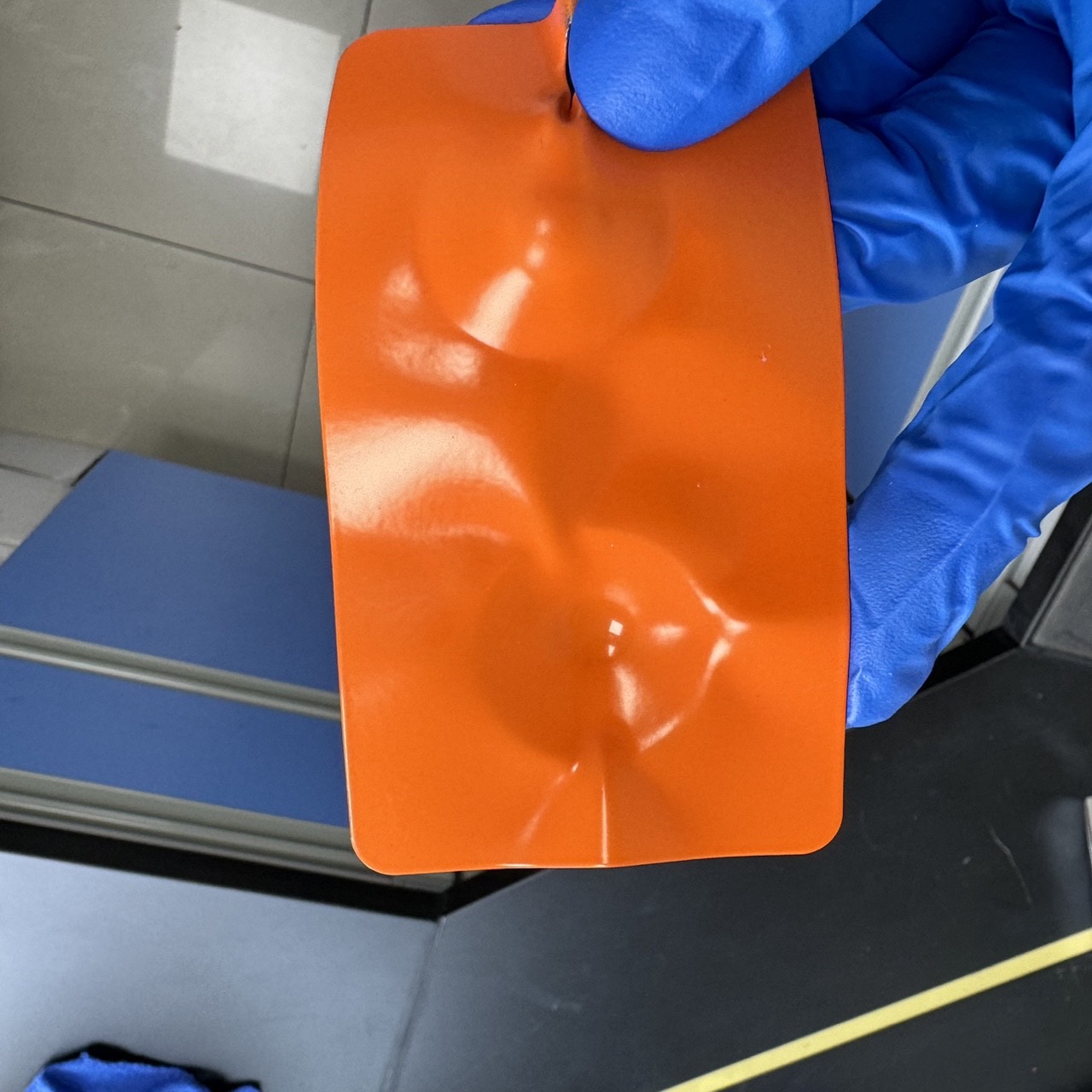
Impact and deformation testing of a cured coating film. Mechanical damage resistance is the parameter that most often separates a laboratory-approved coating from one that survives transport and installation.
The Test Record, Read Line by Line
The published data for the anti-corrosion grade is compact enough to reproduce in full, which is itself a useful property: a short, method-referenced table is easier to audit than a long narrative claim.
| Property | Test standard | Reported result |
|---|---|---|
| Salt spray (neutral) | ISO 7253:1996 | No change after 500 hours; unilateral corrosion ≤2 mm |
| Adhesion (cross-cut) | ISO 2409:2020 | Grade 0 |
| Impact resistance | ISO 6272-1:2017 | 50 kg/cm |
| Film hardness | ISO 15184:2020 | ≥H |
| Gloss range | ISO 2813:2014 | 5%–95% (grade selectable) |
| Curing schedule | Specified process window | 180–200 °C, 10–15 minutes |
What Each Result Actually Constrains
Salt spray: 500 hours with ≤2 mm unilateral corrosion
Salt spray duration is the most quoted and least understood figure in corrosion procurement. Five hundred hours under ISO 7253:1996 does not forecast a service life; it establishes a qualification floor. In plain terms, the cured film survives a neutral salt fog exposure without change, and any corrosion originating at a scribe or damaged edge stays within 2 mm of that line.
For a pipeline coating or a valve body, the creep figure is arguably more informative than the hour count. Field damage is unavoidable — impact during transport, abrasion during installation, mechanical contact in service. A coating whose corrosion spreads far from a damaged point converts a local defect into a section replacement. A coating whose corrosion stays tightly bounded keeps the defect local long enough for scheduled maintenance to intervene.
Adhesion: grade 0 under ISO 2409:2020
Cross-cut adhesion grade 0 means no flaking of the coating at the cut lattice. On a heavy-duty component this is the precondition for every other result in the table. A formulation can record an impressive salt spray figure on a perfectly prepared laboratory panel and still fail in production if the coating–substrate interface is weak, because corrosion protection begins at the interface, not at the surface.
The practical consequence for buyers is that adhesion grade 0 is only meaningful alongside a description of substrate preparation. The record states the outcome; it does not substitute for agreeing the pretreatment sequence — degreasing, conversion coating or blasting — for the specific steel, galvanised or aluminium substrate in the project.
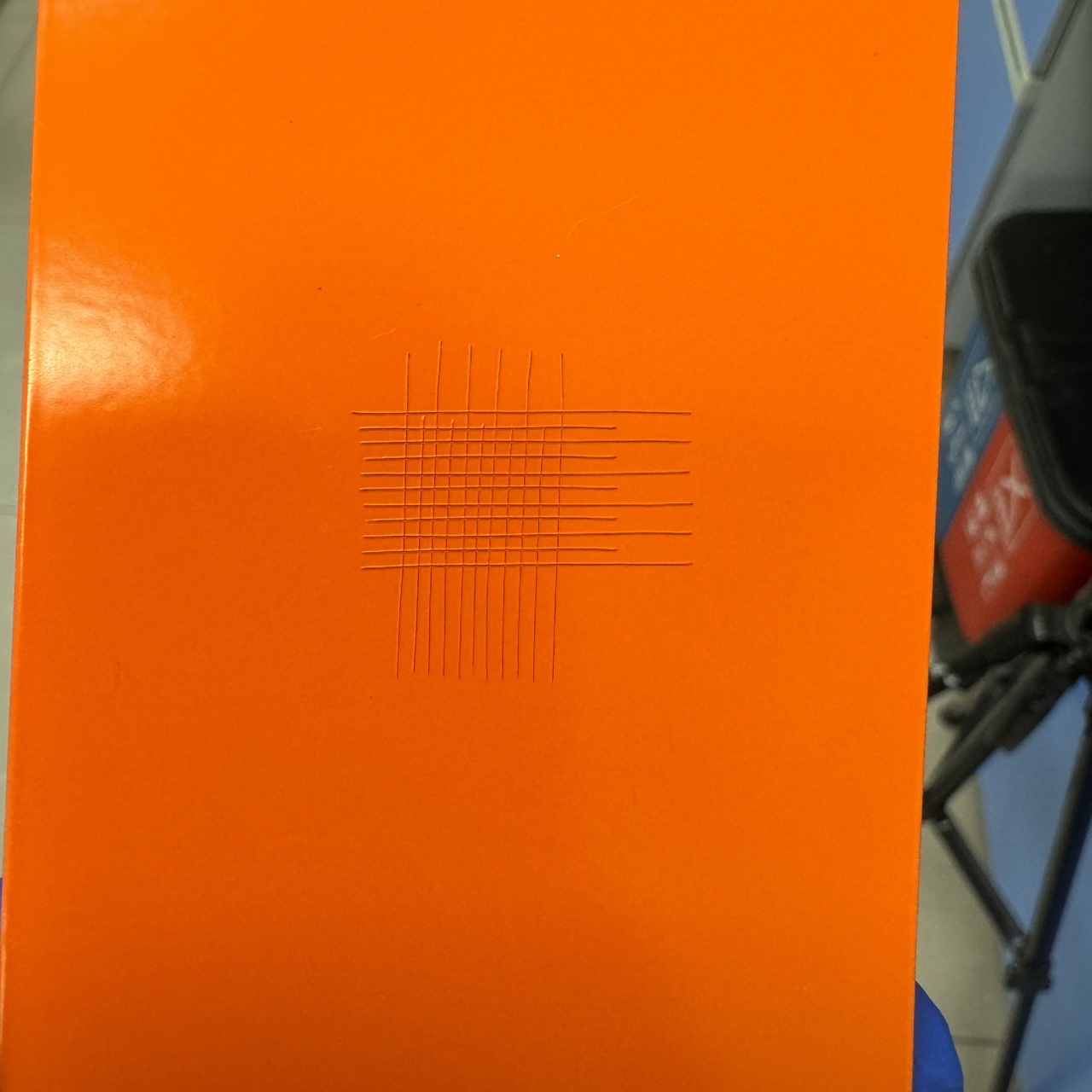
Cross-cut adhesion assessment. Grade 0 indicates no flaking at the cut lattice, the interface condition on which every downstream corrosion result depends.
Impact and deformation: 50 kg/cm under ISO 6272-1:2017
Impact resistance addresses the interval between the coating line and the installed component. Valves are stacked, rebar is bundled and dragged, pipe sections are lifted and sleeved. A barrier film that cracks under that handling has already lost the property it was purchased for, regardless of its salt spray rating.
Because corrosion resistance and mechanical robustness are tested separately, buyers comparing two anti-corrosion grades should read them in sequence rather than in isolation: an impact result without an adhesion grade is fragile evidence, and a salt spray result without an impact figure describes a coating that may only survive in a laboratory.
Hardness and gloss: ≥H, 5%–95%
Film hardness ≥H under ISO 15184:2020 supports the abrasion and marking resistance expected during handling and installation. Gloss is a different category of specification: at 5%–95% under ISO 2813:2014, it is a matching parameter rather than a corrosion parameter. The significance for procurement is manufacturing, not performance — a heavy-duty order and a matt industrial order can be produced from the same resin platform without changing the test method or the acceptance criteria.
Colour control sits alongside this. Hsinda's stated protocol runs a "3+1" inspection covering raw materials, first and last production pieces, performance and colour difference, with Delta E held to ≤0.5 and colour difference reports available on request. For a buyer specifying several hundred components across a project, that tolerance is the difference between a maintenance spares batch and a visibly mismatched one.
Where This Evidence Fits: Pipelines, Water Systems, Valves, Rebar
The application list attached to this product is specific, and each item implies a different failure mode.
- Oil and gas pipelines. Continuous barrier performance with localised damage tolerance dominates; the ≤2 mm creep limit is the operative number when a section is sleeved or scraped.
- Water supply systems. Prolonged moisture contact makes adhesion grade 0 and film continuity the primary acceptance conditions, since disbondment under immersion is the failure that matters, not surface appearance.
- Valves. Complex geometry and repeated handling put impact resistance and hardness at the centre of the specification, together with a curing window the coater can hold consistently across small and large parts.
- Steel reinforcement bars. Bundled transport and site handling produce abrasion that a decorative film would not survive; impact and hardness results are the relevant qualifiers.
In all four cases the qualification question is identical: does the supplier publish a method-referenced result for the chemistry being quoted, and can it be reproduced for the colour and film build on the purchase order?
The Same Test Framework Across the Portfolio
Comparison becomes easier when a supplier applies one test language across its range. Hsinda's published data follows that pattern, and three adjacent grades show how the same methods differentiate products rather than merely certify them.
- Aluminium powder coating. A super weather-resistant polyester formulation with TGIC curing agent for profiles, doors and windows, glass curtain walls and architectural partitions. Reported: no powdering and gloss retention above 50% after 1,000 hours under ISO 11341:2004, salt spray resistance with no change after 1,000 hours under ISO 7253:1996, adhesion grade 0 under ISO 2409:2020.
- Sandy powder coating. A polyester-based, TGIC-cured weather-resistant grade with average particle size 32–42 μm, specific gravity 1.2–1.7 g/cm³ and coverage of 8–10 m² per kg at 30–90 μm film thickness, with 70 μm as the typical build. Reported: gloss 5%–95% under ISO 2813:2014, adhesion grade 0 under ISO 2409:2020, hardness ≥H under ISO 15184:2020, curing at 180–200 °C for 10–15 minutes.
- Wrinkle powder coating. Positioned on general acid and oil resistance with average alkali resistance; salt spray resistance with no change after 500 hours and unilateral corrosion ≤2 mm under ISO 7253:1996, impact resistance 50 kg/cm under ISO 6272-1:2017, hardness ≥H, and no powdering with more than 50% gloss retention after 500 hours under ISO 11341:2004. Typical applications are electric panels and cabinets.
Read side by side, the framework does real work. The polyester aluminium grade carries double the salt spray duration and a weathering result, because it faces sunlight; the epoxy anti-corrosion grade carries the same salt spray duration as the wrinkle grade but is specified for burial and immersion service. A buyer who treats "500 hours" as a single cross-catalogue benchmark will select the wrong chemistry.
Anti-Corrosion Powder vs. Liquid Paint: What the Comparison Actually Shows
Most pipeline and machinery specifications still compare powder against a liquid system, so the commercial case belongs in the same review as the technical one.
| Dimension | Powder coating | Traditional liquid paint |
|---|---|---|
| VOC emissions | Nearly zero | Solvent content inherent to the system |
| Material utilisation | Up to 99% | Lower, with overspray losses |
| Comprehensive cost | 35–40% lower over the production cycle | Baseline |
| Process steps | Single spray, no primer, no drying time; cure 10–20 minutes | Primer and flash-off stages required |
| Energy and carbon | Total energy down 22%, carbon emissions down 30%–50% versus solvent-based paint | Baseline |
| Low-temperature option | 160 °C curing grades deliver over 10% additional energy efficiency | Not applicable |
Two further data points are specific to Hsinda rather than to the category. Coverage is stated at 1 kg per 7–10 m², and the company attributes its difference from other Chinese brands to higher resin content and better pigment, which raises one-time coating rate and coverage. The commercial consequence it reports is a 5% lower comprehensive overall cost, driven by lower raw material consumption and fewer rework rejects.
For a buyer, the relevant reading is that powder's cost advantage is a yield argument, not a price per kilogram argument. Coverage per kilogram, first-pass acceptance and rework rate determine the real comparison, and all three are measurable during sampling rather than assumed during negotiation.
Boundaries: What This Data Does Not Establish
A test record is only trustworthy if its limits are stated as clearly as its results. Five boundaries apply to the data reviewed here.
- Accelerated exposure is not service life. The 500-hour salt spray result is an ISO 7253:1996 laboratory outcome. It does not predict a decade of burial or immersion performance, and it cannot be converted into a maintenance interval without field data for the specific environment.
- Chemistry constrains exposure. The anti-corrosion grade is epoxy-based and specified for barrier service. Epoxy systems are generally selected for chemical and barrier resistance rather than for sustained UV-facing decorative exposure; where a component is permanently sun-exposed, a weather-resistant polyester grade from the same portfolio — such as the aluminium coating with its 1,000-hour weathering and salt spray results — is the more appropriate starting point.
- The curing window is a plant requirement. Curing at 180–200 °C for 10–15 minutes assumes an oven line and a substrate that tolerates the temperature. Heat-sensitive assemblies and site-applied touch-up fall outside this process, and the test data does not transfer to them.
- Pretreatment is not in the numbers. Adhesion grade 0 and the salt spray result both presuppose correct substrate preparation, which the published record does not specify per substrate. Buyers should fix the pretreatment sequence contractually rather than infer it.
- The data is manufacturer-reported bench data. Hsinda states that it holds ISO 9001, ISO 14001, SGS, REACH, EU RoHS 2.0 and QUALICOAT credentials and is supported by Florida outdoor exposure and antimicrobial testing. As with any supplier documentation, certification scope and validity should be confirmed against the issuing bodies during qualification, and lot-specific test reports should be requested for the colour and film build actually ordered.
Production consistency is what converts a laboratory result into a delivered specification: the curing window, line control and batch inspection decide whether the tested film and the shipped film behave the same way.
Market Context: Why Documented Corrosion Data Is Becoming a Sourcing Requirement
The wider category explains part of the pressure. The global powder coatings market was valued at USD 16.12 billion in 2025, with Asia Pacific accounting for 63.10% of revenue in the same year. Polyester resins held 48.2% of market share in 2025, a position attributed to their weatherability and UV resistance.
Two implications follow for heavy-duty buyers. First, sourcing from Asia-Pacific manufacturers is a structural norm rather than an outlier, which raises the value of comparability: when most shortlisted suppliers sit in the same region, the differentiator is documentation quality, not geography. Second, the resin-mix data underlines why chemistry-first specification matters — the largest segment by share is the weathering segment, yet barrier service for pipelines and valves usually points toward epoxy. Category-level statistics do not resolve an individual specification.
Downstream demand reinforces the same direction. US construction data recorded more than 919,000 construction establishments in the first quarter of 2023, a large installed base of specifiers, fabricators and maintenance buyers who all depend on comparable coating data. In a market of that scale, "anti-corrosion" as an adjective is not a specification; it is a category label.
A Procurement Framework for Comparing Anti-Corrosion Suppliers
The following framework converts the test record into questions a buyer can put to any shortlisted supplier, including Hsinda.
| Decision point | What to ask | Evidence to require |
|---|---|---|
| Chemistry fit | Is the quoted grade epoxy, polyester or hybrid, and does it match the exposure — buried or immersed versus sun-facing? | Product datasheet naming resin chemistry and intended service |
| Corrosion benchmark | Which salt spray standard, and what acceptance limit applies to scribe creep? | ISO 7253:1996 report stating duration and unilateral corrosion value |
| Interface integrity | What adhesion grade is guaranteed, and on which substrate and pretreatment? | ISO 2409:2020 result plus the agreed pretreatment sequence |
| Handling durability | What impact value applies to the cured film? | ISO 6272-1:2017 result on the specified colour and build |
| Application economics | What coverage per kilogram and film build should be planned? | Coverage range (m²/kg) against a stated film thickness window |
| Batch consistency | What colour tolerance and inspection protocol apply per batch? | Delta E limit, inspection protocol, colour reports on request |
| Plant capability | Can the line hold the curing window across small and large parts? | Line count, capacity, sample-line availability, audit access |
| Compliance | Which certificates are claimed, and for which product scope? | Certificate numbers verifiable with the issuing body |
Applied consistently, this framework produces a shortlist in which the remaining differences are commercial rather than evidentiary — which is the condition under which price comparison becomes meaningful.
Future Outlook
Two directions look durable. The first is the shift from claim-based to record-based qualification: as more buyers publish test requirements in RFQs, suppliers without method-referenced data will be excluded before pricing is discussed, regardless of formulation quality. The second is energy-driven process selection, where low-temperature curing grades at 160 °C — reported to improve energy efficiency by more than 10% — move from a sustainability footnote to a line-cost variable, particularly for high-volume component programmes.
Neither direction changes the underlying engineering. A barrier coating is still selected on chemistry, adhesion and film integrity, and it is still verified by a buyer who reads the method, the duration and the limit together. The suppliers who benefit are those whose published data already answers all three.
FAQ
How does anti-corrosion powder coating compare with liquid paint on cost and emissions?
Reported comparisons place powder coating 35–40% below traditional liquid paint on comprehensive cost, with material utilisation of up to 99% and nearly zero VOC emissions against solvent content in liquid systems. Switching from solvent-based paint to powder is reported to lower total energy consumption by 22% and carbon emissions by 30%–50%. The comparison assumes volume production on a suitable line; the cost advantage comes from yield and rework reduction rather than from a lower price per kilogram.
What salt spray performance should a heavy-duty anti-corrosion powder coating show?
Hsinda's anti-corrosion grade reports no change after 500 hours under ISO 7253:1996 with unilateral corrosion of 2 mm or less, while its aluminium architectural grade reports no change after 1,000 hours under the same standard. The appropriate requirement depends on exposure: buried and immersed service prioritises barrier behaviour and scribe creep, while sun-facing architectural service additionally requires weathering data under ISO 11341:2004.
Is an epoxy anti-corrosion powder coating suitable for outdoor, sun-exposed surfaces?
The anti-corrosion grade reviewed here is epoxy-based and positioned for pipelines, water systems, valves and rebar — barrier service rather than decorative exposure. Epoxy systems are generally chosen for chemical and barrier resistance, not for sustained UV-facing appearance. For components permanently exposed to sunlight, a weather-resistant polyester grade is the more usual specification; Hsinda's aluminium coating, for example, reports no powdering and gloss retention above 50% after 1,000 hours under ISO 11341:2004.
What does adhesion grade 0 mean in practice?
Under ISO 2409:2020, grade 0 means no flaking of the coating at the cross-cut lattice. It indicates that the coating–substrate interface survives mechanical stress after curing, which is the precondition for corrosion performance: disbondment at the interface allows moisture to spread laterally beneath an otherwise intact film. The result depends on substrate pretreatment as well as formulation, so the pretreatment sequence should be agreed contractually alongside the grade.
How can a buyer verify test data before placing an order?
Request reports that state the standard number, the duration or load, the acceptance limit and the substrate used, and ask for lot-specific reports on the colour and film build being quoted rather than generic catalogue sheets. For certifications, confirm scope and validity with the issuing body. Sampling and first-article inspection remain the practical check that the delivered coating reproduces the tested one; Hsinda's stated protocol applies a "3+1" inspection covering raw materials, first and last production pieces, performance and colour difference, with Delta E held to ≤0.5.
What film thickness and coverage should be planned for a powder coating project?
Hsinda's published data gives coverage of 1 kg per 7–10 m², and for its sandy grade a coverage of 8–10 m² per kg at 30–90 μm film thickness with 70 μm as the typical build. Because corrosion performance and mechanical properties are film-build dependent, the thickness window should be specified together with the test requirements, and curing should follow the stated schedule of 180–200 °C for 10–15 minutes.
For buyers who need the full technical and company record in one document, Hsinda's brochure is available for download: Hsinda powder coating brochure (PDF).
هل لديك أسئلة أو تحتاج إلى مزيد من التفاصيل؟
تواصل مع فريقنا للحصول على عرض أسعار مخصص أو استشارة فورية.
طلب عرض أسعار
املأ النموذج أدناه وسيتواصل معك فريقنا بعرض مقترح مخصص.
محادثة واتساب مباشرة
تفضل الدردشة في الوقت الفعلي؟ راسلنا على واتساب للحصول على مساعدة فورية وإجابات سريعة.
- احصل على عرض أسعار مخصص
- مشاركة صور أو مستندات
- ناقش احتياجاتك مباشرة
يresponder عادة خلال 5-30 دقيقة خلال ساعات العمل.