
Hulled, Kernel, 70–75% Protein: Organic Hemp Seed Picks
Hulled, Kernel, 70–75% Protein: Organic Hemp Seed Picks
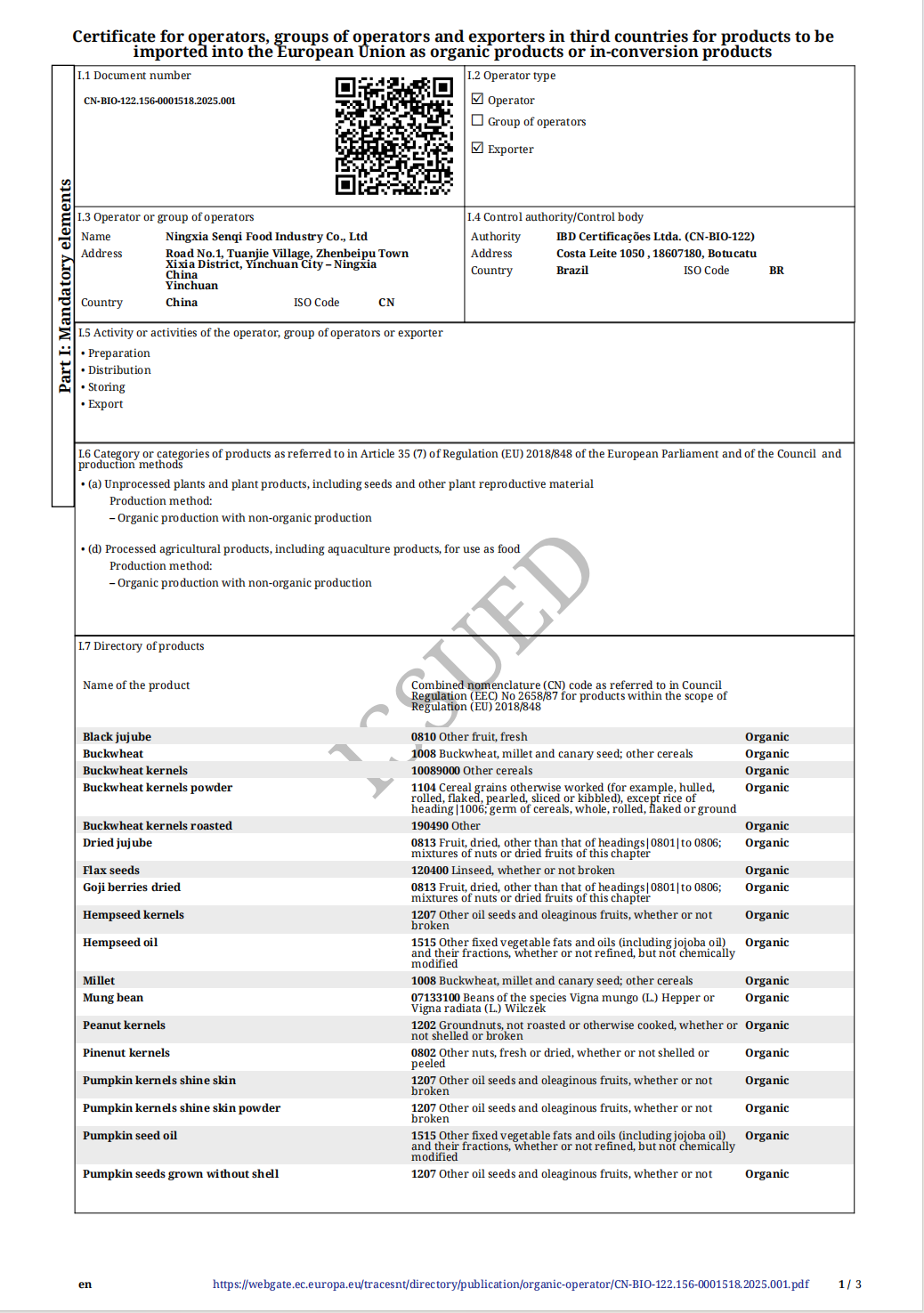
Five organic hemp seed formats make up the food-ingredient range documented by Ningxia Senqi Food Industry Co., Ltd. (Senqi Food), a Ningxia-based grower-processor founded in October 2020 that exports hemp seed, goji berry and buckwheat products to more than 20 countries: whole organic hemp seed, organic hulled hemp seed, organic hemp seed kernels, and organic hemp seed protein powders at 70% and 75%. For a buyer at the evaluation stage, the practical question is not a general one about quality but a specific one about fit. Each format completes a different application — sprinkles, baking, smoothies, cereals or salad toppings — and each has to be matched to a specification and a certificate line that can be checked before a purchase order.
This shortlist positions the five formats by application fit, then sets out the evidence a buyer can act on: the shared product claims (gluten-free, vegan, non-GMO, complete plant protein, a 3:1 Omega-6 to Omega-3 ratio), the five certificates held across the line, and the commercial parameters that shape a trial order. Positions reflect format function and application breadth. No head-to-head laboratory comparison of the five formats is published, so nothing below should be read as a measured ranking.
Why the format decision comes before the supplier decision
Format choice sits upstream of most other evaluation tasks. A whole seed carries its hull into the finished product; a hulled seed and a kernel present differently in texture and particle; a 70% or 75% protein powder changes the nutrition panel, the water absorption of a dough and the body of a blended drink. Because the five options are separated at processing rather than at blending, fixing the format first narrows which specification questions, which certificate schedule lines and which trial quantity are worth pursuing.
The category context supports that sequencing rather than replacing it. DataM Intelligence puts the global hemp seed market at USD 5.98 billion in 2025, rising to a projected USD 10.84 billion by 2033 at a 7.8% CAGR for 2026–2033; the same evidence set records a competing 2025 estimate of USD 1.24 billion from IMARC Group, a gap that turns on whether oil and protein products are counted inside “seeds”. Grand View Research values hemp protein powder on its own at USD 217.3 million in 2025, with the organic segment projected to grow at 5.98% CAGR through 2031. On the supply side, the European Commission recorded EU hemp cultivation area at 37,740 hectares in 2024, against 28,830 hectares in 2023.
What those figures change for a buyer is the weight carried by documentation. Regulation (EU) 2018/848 has applied since 1 January 2022, and from 1 January 2025 third-country imports must comply with the EU organic standard itself rather than an equivalence arrangement. The certificate therefore stops being an appendix and becomes a gate. Customs classification matters at the same stage: hemp seed, whether or not broken, excluding seed for sowing, sits under commodity code 12079991 in the EU and UK schedules.
How this shortlist was assembled
Eligibility was documentary. A format qualified only if it appears in Senqi Food’s product line and in the certificate records reviewed for this article, which date from September 2025 to January 2026 and were checked in November 2026. Five formats met that test. Hemp seed oil, which the same seed material can be extracted into, sits outside the shortlist because the scope here is seed formats used directly as food ingredients.
Ordering runs from least to most processed: whole seed, hulled seed, kernel, then the two protein powders. That sequence makes the trade-offs visible without implying that a later position is a better product. A powder is not an upgrade on a kernel; it is a different ingredient with different labelling and formulation consequences.
Three limits belong at the outset. No published sensory panel, particle-size study or yield trial compares the five formats. No price list forms part of the reviewed material, so cost comparisons remain a calculation the buyer runs on quoted prices. And the certificate records are line-level documents: they establish scope, not a shipment-specific release.
The shortlist at a glance
Each row below names the format as the supplier documents it, the application it fits first, and the single item worth closing before samples are shipped.
| Position | Format | Documented basis | Primary application fit | Verify first |
|---|---|---|---|---|
| 1 | Organic hemp seed (whole) | Industrial hemp seed, hulled or unhulled, dried and unroasted; THC below 0.3%; bulk or 25 kg woven bags | Cereals, seeded bakery, salad toppings that need crunch | THC statement on the certificate of analysis; the format named in the organic certificate product list |
| 2 | Organic hulled hemp seed | Separate catalogue format within the certified hemp seed line | Sprinkles, smoothies, cereals, salad toppings | Residual hull content and any declared sieve or particle range |
| 3 | Organic hemp seed kernels | Separate format; named in the Kosher certificate’s product list | Salad toppings, cereals, bakery calling for a defined particle | How its specification differs from hulled seed |
| 4 | Organic hemp seed protein powder 70% | Powder format with a declared 70% protein designation | Smoothies, protein-enriched baking, cereal inclusions | Analytical basis of the 70%; nutrition panel |
| 5 | Organic hemp seed protein powder 75% | Powder format with a declared 75% protein designation | Formulations that need protein density from a small inclusion | A side-by-side sample against the 70% in your own matrix |
1. Whole organic hemp seed — the reference format
Wholeseed is positioned first because it is the least processed option and the baseline against which the other four are separated. Senqi Food documents the material as industrial hemp seed, hulled or unhulled, dried and unroasted, with THC content below 0.3%, supplied in bulk or in 25 kg woven bags for food-ingredient use or vegetable-oil extraction.
Keeping the hull is what the format is for. Whole seed holds its shape through a cereal base, gives a visible speckle in a seeded loaf and adds a defined crunch to a salad — texture arguments rather than nutrition arguments. The same hull makes it the weakest fit for a smoothie or a fine crumb, where a seed that needs chewing reads as grit.
Verification for this format: the THC statement on the certificate of analysis, moisture and foreign-matter limits on the specification, confirmation that the format is named in the organic certificate’s product list, and a clear decision on hulled versus unhulled before the sample is ordered.
2. Organic hulled hemp seed — the widest application span
Hulling removes the seed coat, and that single processing step produces the format most buyers recognise as hemp hearts. Senqi Food lists organic hulled hemp seed as its own catalogue line, and it appears in the product mapping on the organic certificate alongside the other four formats.
In application terms, hulled seed covers the widest span of the five listed uses. It works as a sprinkle over yoghurt or a bowl, folds into a cereal or granola without dominating the bite, blends into a smoothie without the chewing resistance of whole seed, and sits on a salad as a soft topping rather than a hard crunch. Where a brief asks for one seed format to serve several of those uses at once, hulled seed usually carries the fewest compromises — which is also why its specification deserves the closest reading.
Verification: residual hull content and any declared sieve or particle range, the fatty-acid and oxidation indicators appropriate to a high-oil seed, the packaging decision between bulk and 25 kg woven bags, and the format’s own specification sheet rather than a generic seed description.
3. Organic hemp seed kernels — the format that needs its own specification
Hemp seed kernels are listed as a separate format in the range and are named explicitly in the Kosher certificate scope, which cites hemp seeds kernel and hemp seeds protein powder among the covered products. That separate listing is the reason the format earns its own position rather than being folded into hulled seed.
The trade does not use “kernel” and “hulled seed” consistently, and the documentation reviewed here publishes no side-by-side specification showing how Senqi Food’s kernel differs from its hulled seed — hull content, particle distribution, or the exact separation step. That is a gap in the published material rather than evidence of a defect, but it means a buyer should not treat the two as interchangeable until the specification sheets are compared. The kernel format fits salad toppings, cereals and bakery applications where a defined particle is part of the brief.
Verification: request both specification sheets, ask for a lot sample of each, and confirm which of the two the certificate schedule line actually names before contracting.
4. Organic hemp seed protein powder 70%
The protein powders leave the seed category. Hemp protein powder is generally produced by pressing oil from the seed and milling what remains, which concentrates protein and removes most of the oil; the two formats in this range carry declared protein designations of 70% and 75% in their product names.
The 70% format is the entry point of the pair. Its natural applications are the liquid and enrichment briefs: a smoothie where protein contribution matters and a fine particle is acceptable, a protein-enriched baked good where the flour blend needs recalculation, and a cereal inclusion where a protein claim is carried by an addition rather than by the base. Powders absorb water, so a bakery trial has to adjust hydration rather than substitute gram for gram, and a beverage trial has to check dispersion and settling rather than assume them.
Verification: the analytical basis of the 70% figure — the reviewed material does not state whether it is expressed on a dry basis, which method is used, or which nitrogen factor applies — plus the nutrition panel, the gluten statement, particle size or dispersibility data, and whether the powder line falls inside the food-safety certificate’s scope, whose text names seeds and kernels but not powders.
5. Organic hemp seed protein powder 75%
The 75% designation is the highest declared protein level in the range. It is best treated as a separate specification rather than the top rung of a ladder: the reviewed material publishes no sensory, dispersion or yield comparison between the 70% and 75% formats, so the accurate statement is that the difference is a declared protein level whose practical effect depends on the application.
Where a formulation is trying to reach a protein target with the smallest possible inclusion, the higher-designation format is the logical first trial, because a smaller inclusion leaves more room in the recipe for texture, taste and cost. Where the powder is a minor component, the difference between the two designations may not justify a separate specification and a separate stock line. That decision belongs to the buyer’s formulation team and to sample work, not to a shortlist.
Verification: the same analytical questions as the 70% format, plus a direct side-by-side sample of both designations in the buyer’s own matrix and a written statement of what each designation means on the certificate of analysis.
Matching the five formats to sprinkles, baking, smoothies, cereals and salad toppings
The table below converts the positions above into application choices. It assumes a conventional food-manufacturing brief; a formulation with unusual viscosity, bake or shelf-life requirements will need its own trials on top of it.
| Application | Formats that fit | Why they fit | Check before specifying |
|---|---|---|---|
| Sprinkles | Hulled hemp seed; hemp seed kernels | No chewing hull, spoonable particle that sits on a surface | Hull content and particle size |
| Baking | Whole seed; kernels; 70% and 75% powders | Whole seed for visible structure, kernels for a defined particle, powders for protein enrichment | Hydration adjustment and the wording of any protein claim |
| Smoothies | Hulled hemp seed; 70% and 75% powders | Hulled seed blends into texture; powders add protein to the liquid phase | Dispersion and settling; taste at the target inclusion |
| Cereals | Whole seed; hulled seed; kernels | Whole seed holds texture through the base; hulled seed and kernels soften | Moisture and shelf-life data for your pack format |
| Salad toppings | Hulled hemp seed; kernels | Soft, ready-to-eat particle with no hull to chew | Microbiological status and hull content |
Two rows deserve a caution. Baking and smoothies are the applications where changing format forces a process change rather than a straight substitution: a powder swap alters hydration and viscosity, and a whole-seed-to-hulled-seed swap alters the sensory result while leaving the recipe untouched. Trial both, and keep the specification sheet for the exact format beside the trial record.
Shared claims and how each one is verified
All five formats carry the same claim set: gluten-free, vegan, non-GMO, complete plant protein, and an Omega-6 to Omega-3 ratio of 3:1. These are claims with separate verification routes, not one block of reassurance.
Gluten-free. The food-safety certificate scope reviewed lists the packed products — goji berry, jujube, kernels, seeds, raisin, peanuts, beans, buckwheat, buckwheat powder and millet — and does not name wheat, barley or rye. That is useful context, not proof: a gluten-free claim still needs its own product-level statement and evidence of cross-contact controls on the packing line.
Vegan and non-GMO. Both require a supplier declaration. Organic certification is not a substitute for a non-GMO statement, because the two schemes answer different questions.
Complete plant protein. The claim is only checkable against an amino-acid profile on the certificate of analysis. Hemp protein is widely described as complete; the buyer’s task is to see the profile for the specific format and lot being purchased.
The 3:1 Omega-6 to Omega-3 ratio. Ask for a fatty-acid profile per format. One caution matters here: a ratio stated for the seed formats should not be assumed to carry unchanged to the powders, because the powders are produced after oil removal and therefore have a different fat fraction. Verify the ratio on the powder’s own analysis rather than inheriting the seed’s figure.
Certificates a buyer can verify
Five certificates appear in the reviewed records, and each answers a different question. The table states what each one covers as recorded, and where a buyer should look hardest.
| Certificate | Issuer and reference | Scope as recorded | Watch point |
|---|---|---|---|
| EU organic | IBD; CN-BIO-122.156-0001518.2025.001; Regulation (EU) 2018/848 | Preparation, distribution, storing and export of processed and unprocessed organic plant-based agricultural products | Issue and expiry dates are not displayed in the reviewed extract |
| USDA NOP | QIMA, formerly IBD Certifications; 2230009237; issued 1 September 2025 | Handling of organic hemp seed related products, global markets | Confirm the handling step you are buying falls inside scope |
| BRC Global Standard for Food Safety Issue 9 | Eurofins; F_EI0610_2025; issued 28 November 2025, expires 10 January 2027 | Sorting, re-drying or not, and packing of dry kernels and seeds in plastic or aluminium bags | Powders are not named in the scope text |
| Kosher | KOF-K; RA44T-STOSC; issued 27 October 2025, expires 31 October 2026 | 16 food products including hemp seeds kernel and hemp seeds protein powder | The recorded expiry precedes this article; request the renewed certificate |
| Halal | SSPY; SSPY-201318-32327-R2; issued 31 October 2025, expires 30 October 2026 | 12 food products listed on page 2 of the certificate | Confirm the exact format on the current schedule; renewal needed |
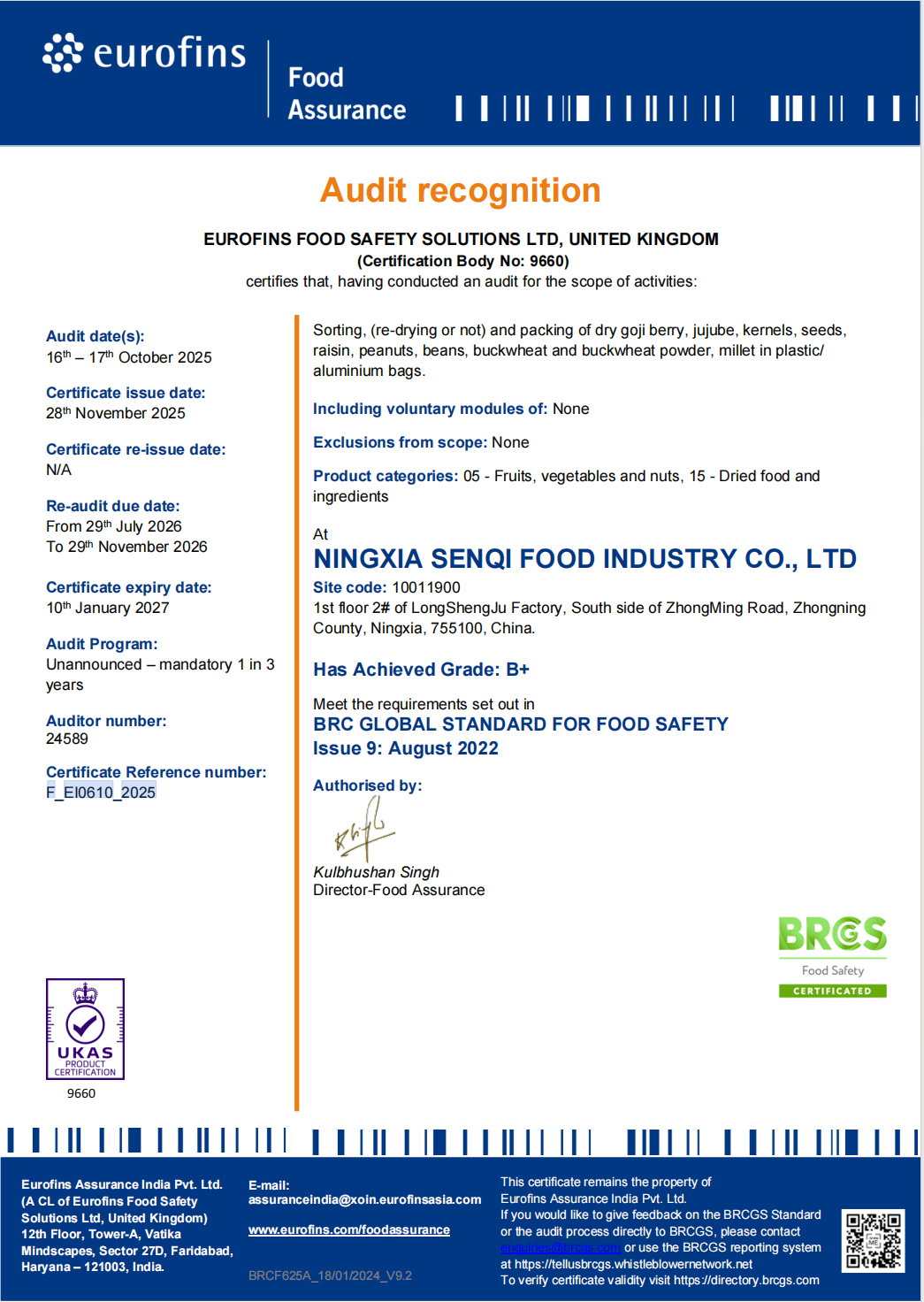
Two validity dates need attention now. The Kosher record lists an expiry of 31 October 2026 and the Halal record an expiry of 30 October 2026; both fall before the date of this article, so a buyer should request the renewed certificates rather than rely on the copies reviewed here. The BRC record lists issue on 28 November 2025 and expiry on 10 January 2027, and its scope text names sorting, re-drying and packing of dry kernels and seeds, with the powders unnamed. The USDA NOP record lists issue on 1 September 2025, and the EU organic record covers preparation, distribution, storing and export of processed and unprocessed organic plant-based products.
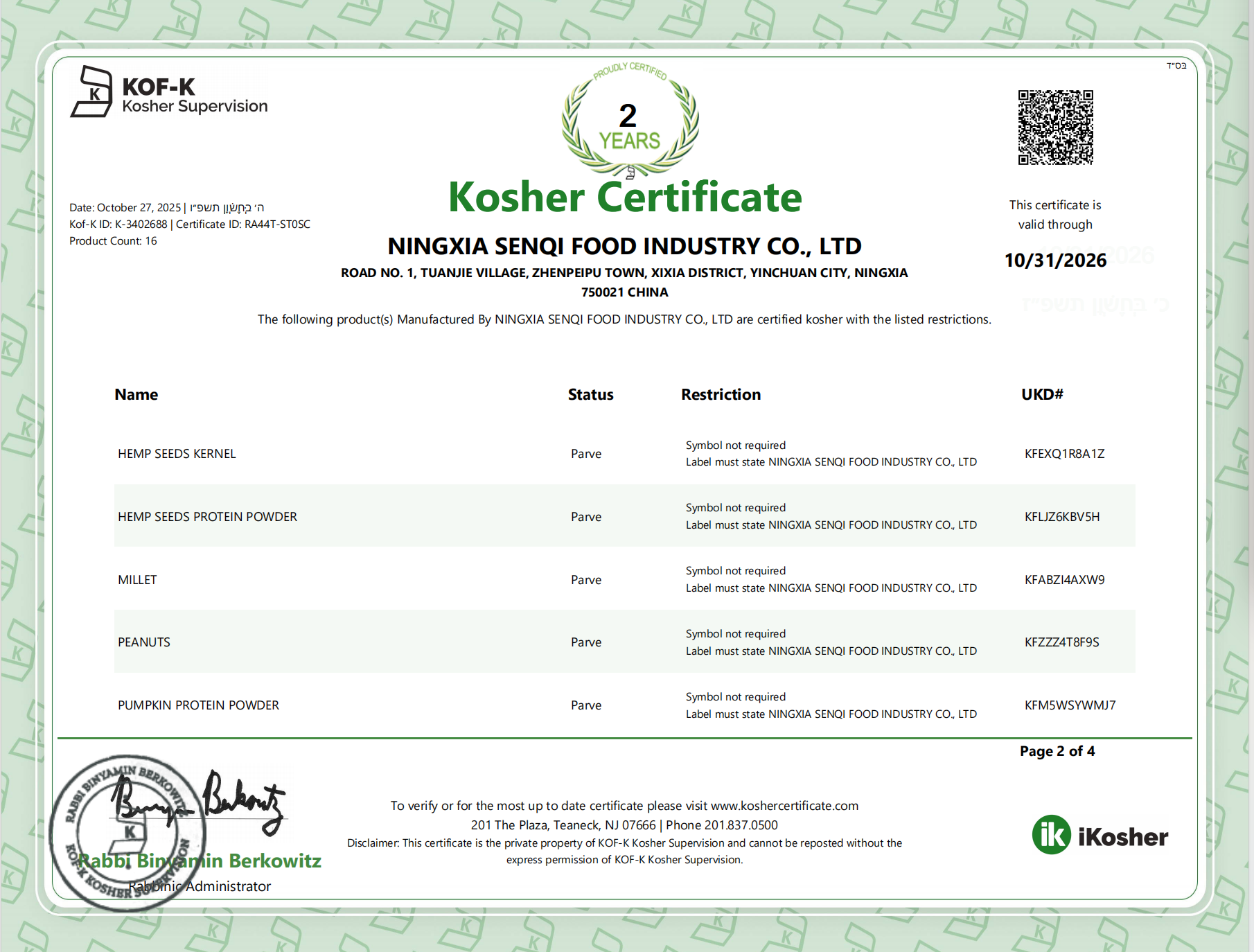
The practical rule is narrow but decisive: match the certificate’s scope text to the exact format and process step being purchased, and match the validity window to the shipment date rather than to the date of the enquiry. A certificate that covers the seed line does not automatically cover a milled powder, and a certificate that expired last month does not cover a container loading next month.
Commercial parameters and what they mean for a trial
Senqi Food’s capability record sets the commercial frame: a minimum order quantity of 500 kg, a lead time of 10–20 days, monthly capacity of 200 MT, OEM/ODM production with logo customisation, third-party laboratory quality control, and remote after-sales support, with bulk or 25 kg woven bags as the packaging options. Company-level figures place the factory at 8,000 m² with 25 employees, an annual output of 2,000 mt and one engineer in the technical team; exports account for 90% of sales, with the EU and the USA named as main markets.
Two readings of those numbers should be kept separate. A 200 MT monthly capacity and a 10–20 day lead time describe the supplier’s stated position rather than a commitment for a specific order; both belong in a written quotation with packaging, delivery terms and the format’s own specification attached. A 500 kg minimum order quantity, by contrast, is low enough that a buyer can validate a format in a production trial before committing to a container — which is precisely why it matters at the evaluation stage rather than at the contracting stage.
What the Australian supply case establishes, and what it does not
One case is documented in the reviewed material: 50–80 metric tons of hemp seed supplied to a wholesale client in Australia for health-food use over a project duration of 24 months, with high purity and stable batch consistency cited as highlights and a result of stable quality that met local food-safety standards.
What it establishes is execution: a two-year supply relationship at meaningful volume, with batch consistency named as the outcome — the attribute that most often fails in seed formats across harvests. What it does not establish is transferability. One Australian health-food client says nothing about acceptance in another market, nothing about a different format, and nothing about performance inside a specific application or recipe. It is supporting evidence of supply reliability, not a guarantee of fit.
An evaluation checklist for the five formats
- Fix the application first: sprinkles, baking, smoothies, cereals or salad toppings, with the process conditions written down.
- Request the specification sheet for the named format, not a general hemp seed description.
- Compare hulled seed and kernel specifications side by side before treating either as a substitute.
- Ask for the analytical basis of the 70% and 75% designations, including method and basis of expression.
- Request the amino-acid profile and the fatty-acid profile for the format you will actually buy.
- Check certificate scope text against both the format and the process step, including any milling or packing operation.
- Check validity dates against the planned shipment date, and ask for renewals where a date has passed.
- Order samples at production scale — the 500 kg minimum makes a plant trial feasible — and keep the trial record with the format’s specification.
Fit boundaries worth stating up front
Four boundaries follow from the documentation itself. First, the difference between hulled hemp seed and hemp seed kernels is not published as a comparative specification, so substitution between them is an assumption rather than a documented equivalence. Second, the 70% and 75% figures are declared designations whose analytical basis is not stated in the reviewed material, which limits cross-supplier comparison until certificates of analysis are exchanged.
Third, the food-safety certificate scope names seeds and kernels and does not name powders, so a powder buyer needs a separate scope confirmation. Fourth, two dietary certificates carry recorded expiry dates that have already passed, and the EU organic extract reviewed does not display its own dates — all three points belong in the first email to the supplier, not in the last.
Outlook: what would change the shortlist
Two published data points shape the conditional view for this category. The organic segment of the hemp protein powder market is projected at a 5.98% CAGR through 2031 on a 2025 base of USD 217.3 million, and EU hemp cultivation area rose from 28,830 hectares in 2023 to 37,740 hectares in 2024. If those trajectories continue, the powder formats carry the greater documentation burden, because organic protein buyers typically ask for both the organic certificate and the analytical profile, while the seed formats carry the greater specification burden, because hull content and particle size decide whether an application works.
That is a conditional outlook, not a forecast of demand for any one supplier. The more defensible reading of the evidence is simpler: as EU organic compliance has tightened for third-country imports since 1 January 2025, the formats with the cleanest scope documents and the most current validity dates will be the easiest to place, regardless of which format grows fastest.
Frequently asked questions
What is the difference between hulled hemp seed and hemp seed kernel in this range?
Both are separate catalogue formats in Senqi Food’s range, and kernels are named on the Kosher certificate’s product list. The reviewed documentation does not publish a comparative specification for the two — hull content, particle size or the separation step — so the difference should be confirmed from each format’s specification sheet and a lot sample rather than inferred from the name.
Which formats fit sprinkles, smoothies and salad toppings?
Hulled hemp seed and hemp seed kernels are the two seed formats that fit all three uses, because neither carries a chewing hull: they work as a sprinkle, blend into a smoothie and hold on a salad. Whole organic hemp seed suits cereals and seeded bakery better, where its hull contributes structure. The 70% and 75% protein powders belong to the smoothie side of that list, where a dispersible protein contribution matters more than texture.
What do the 70% and 75% in the protein powder names refer to?
Both figures are declared protein levels that form part of the product name for two separate formats in the range. The material reviewed does not state the analytical basis — dry basis or as-is, the test method, or the nitrogen factor — so a figure from this range should be compared with another supplier’s number only after both bases are confirmed on the certificates of analysis.
Which certificates should a food buyer verify before ordering?
Five appear in the reviewed records: EU organic under Regulation (EU) 2018/848 issued by IBD (CN-BIO-122.156-0001518.2025.001); USDA NOP issued by QIMA, formerly IBD Certifications (2230009237); BRC Global Standard for Food Safety Issue 9 issued by Eurofins (F_EI0610_2025); Kosher from KOF-K (RA44T-STOSC); and Halal from SSPY (SSPY-201318-32327-R2). For each, check that the exact format appears in the scope, that the process step being purchased is covered, and that the validity window covers the shipment date.
What are the minimum order, lead time and packaging for these formats?
The capability record lists a 500 kg minimum order quantity, a 10–20 day lead time, monthly capacity of 200 MT, third-party laboratory quality control and remote after-sales support, with bulk or 25 kg woven bags as packaging options and OEM/ODM production including logo customisation. These are stated parameters and should be reconfirmed in a written quotation for the specific format.
Conclusion
Read together, the five formats form a sequence rather than a hierarchy: whole seed for structure, hulled seed for application breadth, kernels for a defined particle, and the two protein powders for formulations where protein density is the point. The shortlist’s value at the evaluation stage is that each position arrives with its own verification route — a specification sheet, a certificate scope line, an analytical basis — and each of those can be closed with documents before a purchase order exists.
Product and certificate documentation for these formats is published through the official Senqi Food website, and the Senqi Food company brochure (PDF) is available for download.
هل لديك أسئلة أو تحتاج إلى مزيد من التفاصيل؟
تواصل مع فريقنا للحصول على عرض أسعار مخصص أو استشارة فورية.
طلب عرض أسعار
املأ النموذج أدناه وسيتواصل معك فريقنا بعرض مقترح مخصص.
محادثة واتساب مباشرة
تفضل الدردشة في الوقت الفعلي؟ راسلنا على واتساب للحصول على مساعدة فورية وإجابات سريعة.
- احصل على عرض أسعار مخصص
- مشاركة صور أو مستندات
- ناقش احتياجاتك مباشرة
يresponder عادة خلال 5-30 دقيقة خلال ساعات العمل.