
Hybrid Inverter EU Conformity: What Imagery Cannot Prove
Hybrid Inverter EU Conformity: What Imagery Cannot Prove
The short answer: a label is a claim, not a certificate
A hybrid inverter photographed with 'EU standard' wording on its casing or on its specification sheet tells a buyer what the supplier intends the product to be. It does not tell the buyer that the model has been assessed against the standards that wording implies, who performed the assessment, which edition was applied, or which variants are covered. Those four questions are answered by documents, not by images.
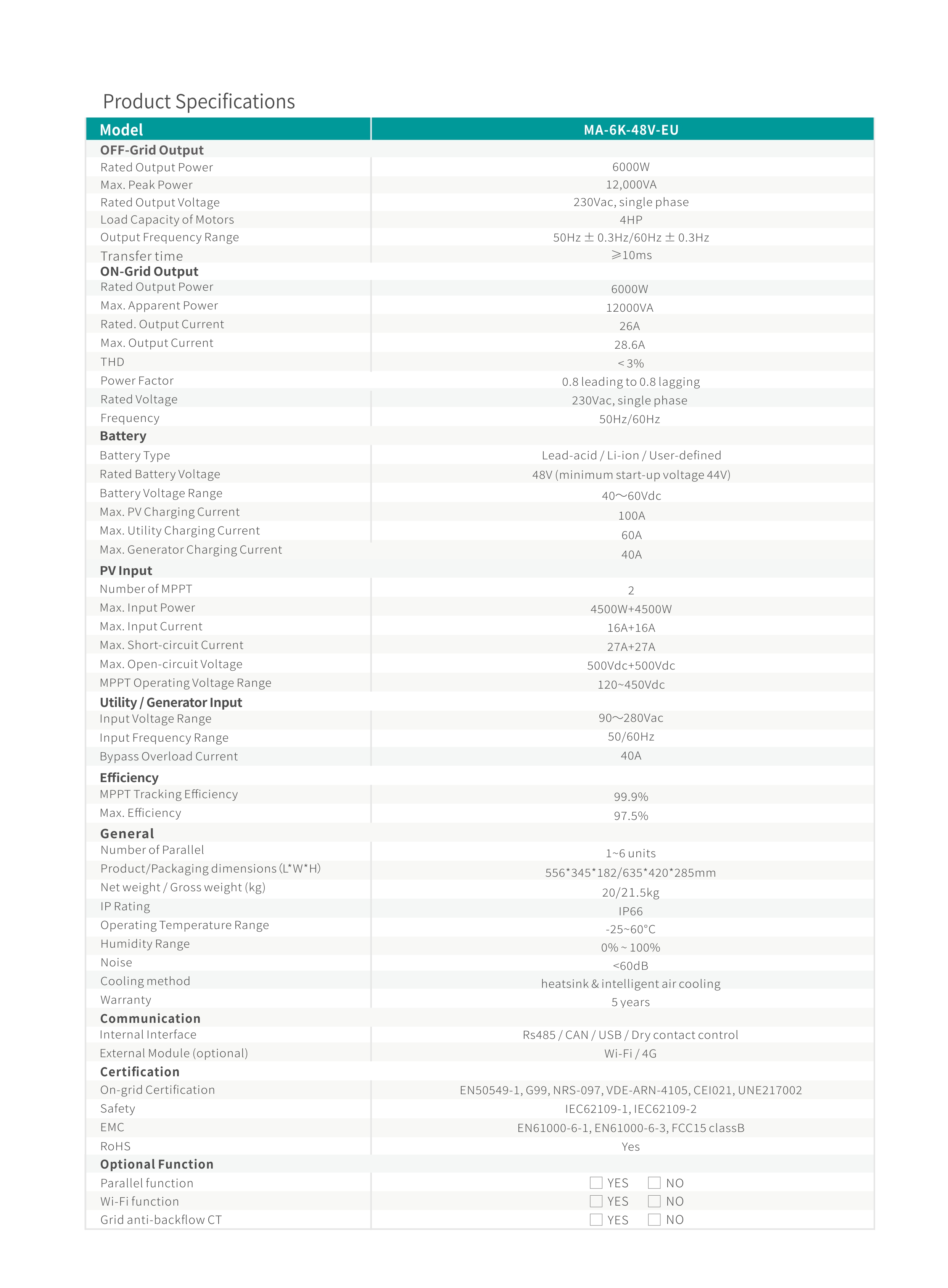
The distinction is not a technicality. In an EU-bound procurement, the gap between a design-intent statement and a conformity record is the gap between a supplier's market position and a supplier's audit trail. The EU-market Hybrid Inverter series from Guangdong Yeyanghong Energy Technology Co., Ltd. — offered in 6KW, 10KW, 12KW and 15KW power classes — is a useful case because its published material mixes image-borne claims with concrete parameters: 220V~230V output at 50Hz, protection degrees from IP21 through IP55, IP65, IP66 and IP67, LiFePO4 storage chemistry, a 5-year warranty period and 6000 cycles at 90% depth of discharge. Each of those statements sits at a different evidentiary level, and reading them at the same level is where procurement errors begin.
Three different meanings hide inside 'EU standard'
When the phrase appears on hybrid inverter imagery, it usually compresses three separate statements that carry very different proof requirements.
One: a market configuration. The unit is built to run at the voltage and frequency the destination grid uses. In the Yeyanghong series the EU-standard output is stated as 220V~230V, with a US-standard 110V~120V alternative and a rated grid frequency of 50Hz or 60Hz across the range. This is a parameter, and parameters can be checked line by line against a dated datasheet.
Two: a design intent. The product was engineered for that market — enclosure design, thermal path, connector types, and the protection degree selected for the installation environment. Design intent is an engineering statement, and it is usually true of the photographed article. It is still not an assessment.
Three: a conformity claim. The model has been evaluated against the standards applicable in that market and found to conform. Only this third meaning requires an issuer, a standard reference with an edition, a defined scope, and a date.
The supplier's customer-facing material is unusually literal on this point: it states that the product conforms to EU standards 'as indicated in product imagery.' Read precisely, that sentence locates the claim in the imagery — and locates the boundary of the imagery's proof in exactly the same place.
What the product photographs do document
The Hybrid Inverter series is declared across four power classes — 6KW, 10KW, 12KW and 15KW — with 12V, 24V or 48V input voltage options, 220V~230V EU-standard output, and protection degrees covering IP21, IP55, IP65, IP66 and IP67. The housing material is stated as aluminium alloy.
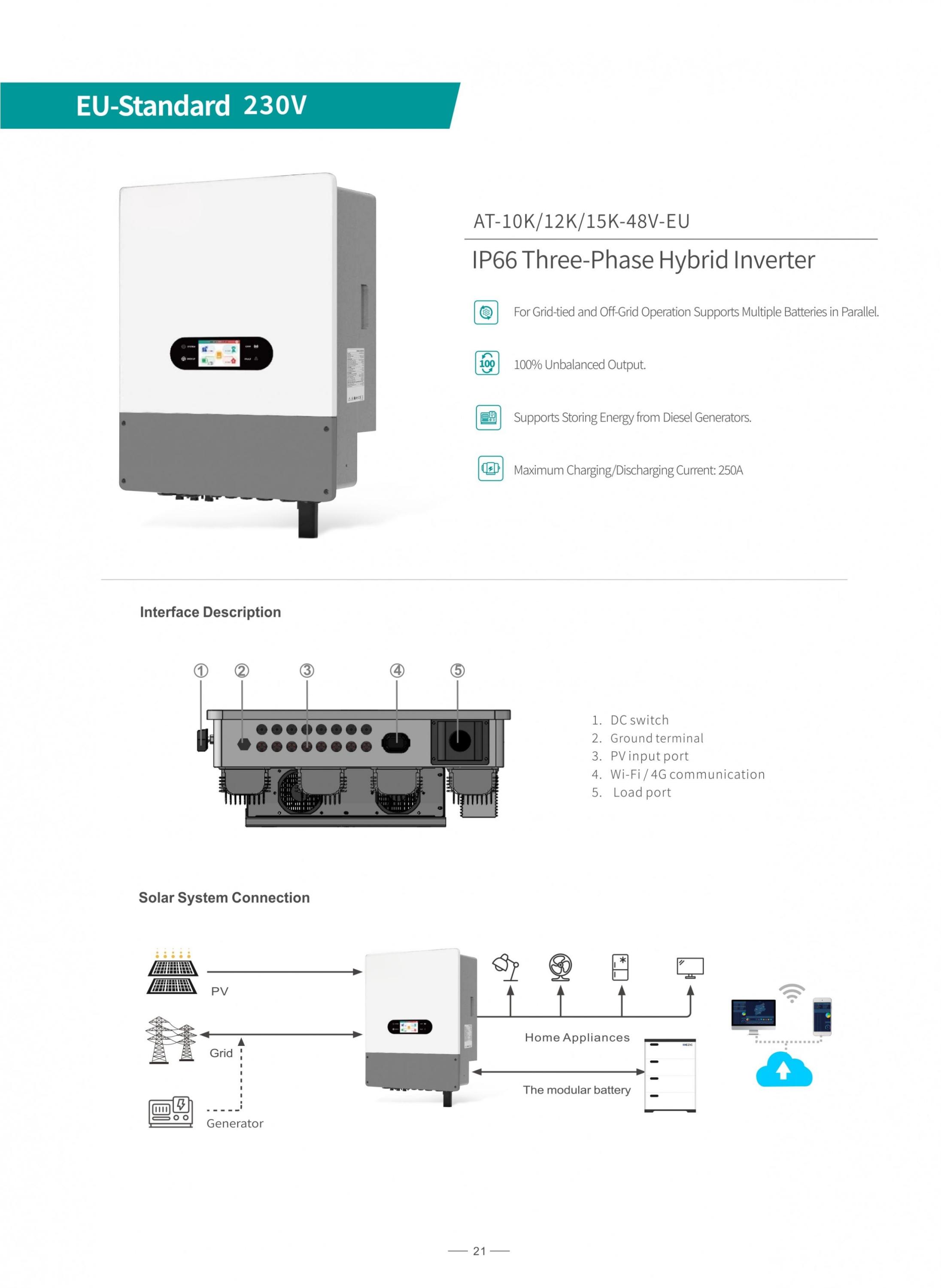
Individual images narrow that broad declaration to specific builds. The published set includes a 6KW IP66 EU-Standard Single Phase Hybrid Inverter, a 10KW 12KW 15KW IP66 EU-Standard Three-Phase Hybrid Inverter, and a 12KW IP66 Single Phase unit. Two practical readings follow.
First, IP66 is a pictured configuration, while IP21 to IP67 is the declared span of available protection degrees. A buyer specifying an indoor plant room and a buyer specifying a coastal rooftop should not assume they will receive the same enclosure. The photo shows the configuration that was photographed; the specification sheet shows the options that must be selected explicitly on the order.
Second, phase and power class are visible identity markers. A three-phase 15KW image is not evidence about a single-phase 6KW unit, and the close physical resemblance across a series makes this kind of mismatch easy to miss in a hastily assembled tender file.
Images also show terminal layout, labelling position, enclosure form and cable entry arrangement. These are the things photography is genuinely good at: identity, configuration and physical plausibility. A photo that contradicts the datasheet — wrong phase, wrong power class, wrong enclosure shape — is a real finding and worth resolving before any document review begins.
Where imagery stops being evidence
Six things cannot be established from a picture, however sharp.
- Standard reference and edition. A generic 'EU standard' label names no standard. IEC 62109-2:2011, for example, is a specific edition covering the particular safety requirements relevant to d.c.-to-a.c. inverter products and products that have or perform inverter functions in photovoltaic power systems. Editions are amended and superseded, so the edition actually applied changes what the claim means.
- Scope. Conformity is assessed per model and configuration. A record covering a 10KW three-phase variant says nothing about a 15KW unit, an IP21 variant, or a build fitted with a different communication module.
- Issuer and traceability. No product image carries a laboratory name, certificate number or validity date that a buyer can look up independently.
- Production consistency. A photographed sample is not the shipped batch. Yeyanghong's capability material states 100% testing; that is a process statement, and its value depends on which parameters are tested, against which pass criteria, and whether the records are retained for review.
- Configuration control. The same material lists OEM, ODM and SKD production with customization of WiFi, battery, 4G/5G, IP rating and power. Any of those changes can move an order off the pictured and assessed configuration — which converts a conformity question into a scope question.
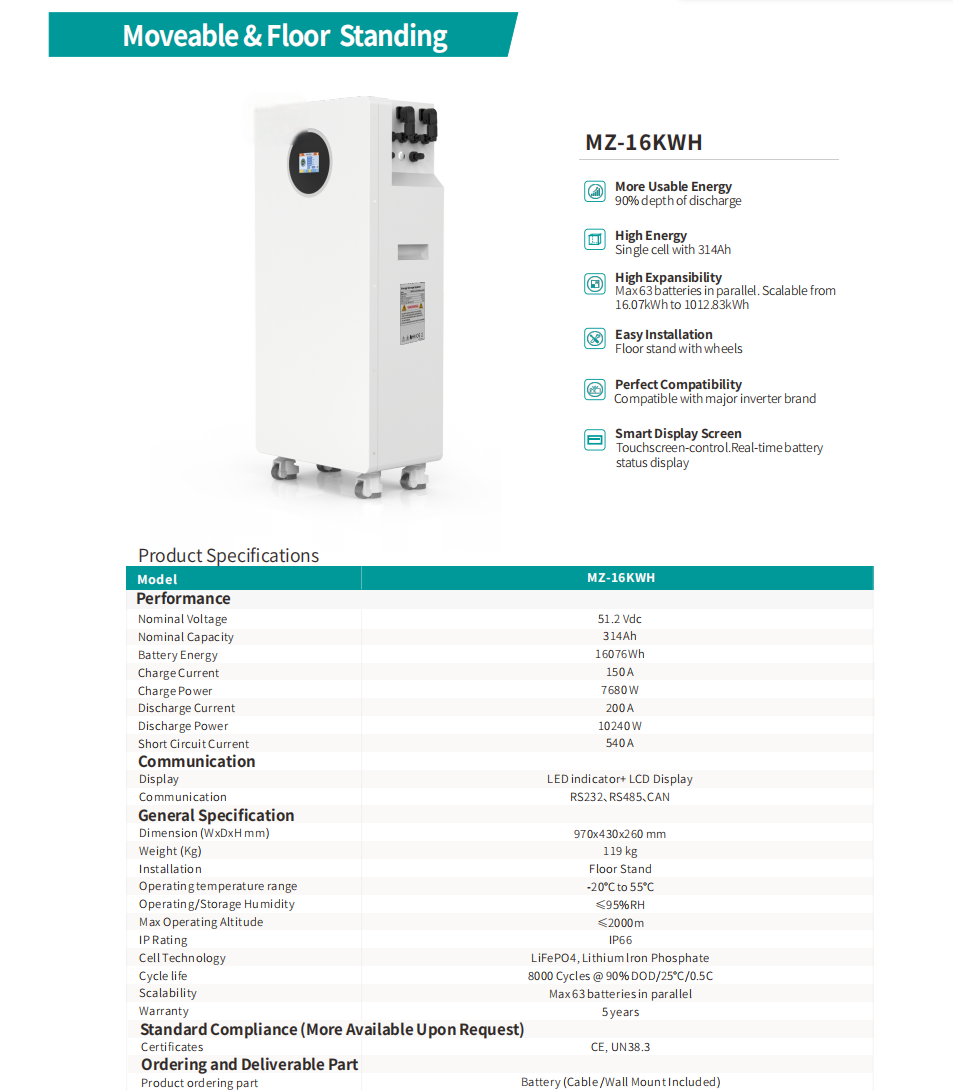
- Condition-bound performance. Cycle life is the clearest example. 6000 cycles at 90% DOD, 25 degrees Celsius and 0.5C~1C is a laboratory basis for the storage units. No housing label can carry those test conditions, the cell sourcing behind them, or the degradation curve.
Mapping the claim onto the standards layer
A hybrid inverter sits inside several assessment families at once, which is precisely why one caption cannot represent them all.
The safety layer is the most consistently referenced. IEC 62109-2:2011 addresses particular safety requirements for PV inverter functions, including grid-interactive and stand-alone operation; the general part, IEC 62109-1, routinely appears alongside it in procurement specifications. The off-grid and hybrid architecture layer is separate and has been moving: IEC TS 62257-9-7:2019 set out criteria for selecting and sizing inverters for off-grid applications integrating solar energy, and the publication page indicates it has since been replaced, while IEC TS 62257-301:2025 addresses the design and implementation of hybrid off-grid solar systems with or without energy storage. The second is a catalog-level description and the replacement status of the first requires confirmation against official IEC records before either is cited in a tender.
Market-specific requirements diverge further. An Indian government technical specification illustrates how granular the question becomes: 230/415 VAC output at 50Hz, efficiency above 97%, and references to IEC 61683, IEC 61727 or VDE-AR-N 4105, IEC/EN 62109-1, IEC/EN 62109-2 and the IEC/EN 61000 series. That is one market's tender language and must not be generalised to the EU. Its value to an EU buyer is structural: safety, grid interface, conversion efficiency and electromagnetic compatibility are distinct assessment families, each with its own reference and its own test basis.
Trade classification is a separate trap in the same file. Hybrid inverters with maximum power point tracking fall under HS 8504.40.84, while the broader HS 850440 heading also contains chargers, rectifiers and power supplies. A trade heading is not a conformity statement and cannot be read as a solar-hybrid performance figure. Customs screening and conformity screening are different exercises, and both require the exact model, not the photograph.
A documentation set that closes the gap
The table below sets out what each item in a conformity file can establish, and where its authority ends. It is the practical replacement for an image-only claim.
| Evidence item | What it can substantiate | What it does not settle |
|---|---|---|
| Declaration of conformity or equivalent supplier statement | That a named legal entity asserts conformity and names the standards and editions applied | Independent verification; coverage of every variant |
| Test reports from an accredited laboratory | Which clauses were tested, on which samples, on what dates | Whether the shipped batch matches the tested sample |
| Certificate with issuer, number and validity | A third-party assessment exists within a defined scope | Any model or option outside the listed scope |
| Dated datasheet with revision number | Declared parameters: power class, 220V~230V output, 50Hz, protection option, LiFePO4 chemistry | Conformity itself |
| Written warranty document | The terms behind the stated 5-year warranty period: exclusions, claim route, transferability | Field service life |
| Cycle-life test basis | 6000 cycles at 90% DOD for the 5KWh and 10KWh storage units; 8000 cycles for the 16KWh unit | Site temperature and duty-profile outcomes |
| Batch test record | What '100% test' covers: parameters, pass criteria, record retention | Long-term reliability |
| Change-control statement for OEM options | Whether a customized IP rating, power class or communication module remains inside the assessed scope | Delivery timing impact |
Working the method through a 6–15KW EU order
Applied to a real specification, the sequence is short and mostly mechanical.
Step one: fix phase and voltage class. Confirm the site's supply and the required 220V~230V, 50Hz configuration, then match it to the single-phase or three-phase models in the 6KW to 15KW range.
Step two: fix the power class. The series spans 6KW, 10KW and 15KW with a 12KW unit available in both single-phase and three-phase images — the same kilowatt rating in two different builds is exactly the case where imagery alone misleads.
Step three: fix the protection degree. Select the IP option against the installation environment rather than against the pictured unit, since IP21, IP55, IP65, IP66 and IP67 are all declared options.
Step four: fix the storage pairing. The published application material describes a villa rooftop system built around a 12KW inverter paired with a 16KWh battery energy storage system. Storage capacity determines which cycle-life figure applies, so the pairing must be settled before the documentation request is written.
Step five: request documents for that exact combination — power class, phase, protection option and storage capacity — not for the series as a whole.
Step six: check the commercial frame against the documentation timeline. Yeyanghong's capability material states a minimum order quantity of 2 pieces and a 30 to 45 day lead time. Where a customized build requires additional conformity confirmation, that confirmation work may sit alongside the production schedule rather than inside it — a planning consideration for the buyer, not a delivery commitment from the supplier.
After-sales terms belong in the same file. The declared support scope covers replacement of accessories, warranty extension and remote installation services, and the stated 5-year warranty period should be read together with the written warranty document, which defines what the period actually covers. Because ingress protection and thermal behaviour both depend on clearance, enclosure and cable entry installation, the installation instructions that the declaration relies on are part of the evidence set, not an accessory to it.
Fit boundaries: when an image-led claim is enough, and when it is not
Photography is proportionate evidence in some situations and disproportionate in others.
It is proportionate for early screening: building a shortlist, confirming that a 15KW three-phase model exists in the range, checking enclosure form against a plant room, and comparing declared parameters across suppliers before spending time on documents. It is also proportionate for internal design studies where no regulatory submission is involved.
It is disproportionate for tender submission, grid-connection applications, insurance placement, resale disclosure or any contract where conformity is a condition. In those settings the image has one legitimate function: it establishes which model and configuration the rest of the file must describe.
Two boundaries deserve stating plainly. First, the absence of a document is not proof of non-conformity; it means the claim is unverified, and unverified is a procurement status rather than a technical verdict. Second, an IP rating shown on a product is a claim about a correctly assembled enclosure. A rating printed on a housing does not survive an open cable entry, a missing gland or an installation that ignores the specified clearance.
Version control is the durable takeaway
The replacement relationship between IEC TS 62257-9-7:2019 and the 2025 hybrid off-grid system guidance illustrates the underlying risk. A declaration that cites an edition which has since been superseded is not necessarily wrong — it may simply be old — but the buyer cannot tell the difference without a date and a version on the page. Recording the standard edition and the declaration date against each shipment turns that ambiguity into a visible line in the file.
The direction of travel is toward broader documentation rather than narrower. The 2025 off-grid framework covers hybrid systems with or without energy storage inside a single scope, which reflects how storage-coupled architectures are now specified rather than any particular vendor's position. For buyers, the practical consequence is stable: the documentation set grows alongside the architecture, and the specification sheet remains the entry point rather than the conclusion.
The company brochure linked at the end of this article documents the product range and declared parameters and is a reasonable starting reference. Used correctly, it does what product imagery does — it narrows the question to a specific model. The conformity documents described above still have to be requested per order, per configuration, per market.
FAQ
Does an 'EU standard' marking printed on a hybrid inverter or its specification image prove conformity?
No. It records a design intent and a market configuration — for example a 220V~230V, 50Hz output — and it displays a claim. Conformity is demonstrated by a declaration that names the standards and editions applied, supported by test reports or certificates whose scope covers the exact model and configuration. An image can be checked against a datasheet; it cannot be checked against a standard.
Which documents should replace product imagery in a procurement file?
A declaration of conformity or equivalent supplier statement naming the legal entity and the standards with their editions; test reports or certificates showing issuer, number, validity and a model list; a dated datasheet; a written warranty; and, for storage, the test basis behind the cycle-life figures. Where the order is customized, add written confirmation that the customization falls inside the assessed scope.
If a photograph shows IP66, will the delivered inverter be IP66?
The photograph shows that an IP66 configuration exists and is offered. Whether the delivered unit carries that degree depends on the option ordered — the series declares IP21, IP55, IP65, IP66 and IP67 as available protection degrees — and on installation. Ingress protection depends on cable entries, glands and sealing being fitted as specified.
What does '6000 cycles at 90% DOD' establish, and what does it leave open?
It is a laboratory-basis endurance statement quoted at 25 degrees Celsius and 0.5C~1C for the 5KWh and 10KWh storage units; the 16KWh unit is stated at 8000 cycles under the same conditions. It establishes a comparable basis for shortlisting between suppliers. It does not predict site life, because ambient temperature, actual depth of discharge, charge and discharge rates and backup duty all differ from the test conditions.
Does OEM customization change the conformity evidence a buyer needs?
It can. Yeyanghong's capability material lists customization of WiFi, battery, 4G/5G, IP rating and power under OEM, ODM and SKD production. A change to power class or ingress protection can produce a variant that is not the pictured or previously assessed configuration, so the buyer should obtain written confirmation that the customized build sits inside the existing assessment scope, or the additional evidence covering the new variant.
Company reference: Guangdong Yeyanghong Energy Technology Co., Ltd. — product range, declared parameters and downloadable materials are published there. Company brochure (PDF): https://cdn.socialarks.com/sbsp/24594/common/2026/0514/6a058aca5d291.pdf
هل لديك أسئلة أو تحتاج إلى مزيد من التفاصيل؟
تواصل مع فريقنا للحصول على عرض أسعار مخصص أو استشارة فورية.
طلب عرض أسعار
املأ النموذج أدناه وسيتواصل معك فريقنا بعرض مقترح مخصص.
محادثة واتساب مباشرة
تفضل الدردشة في الوقت الفعلي؟ راسلنا على واتساب للحصول على مساعدة فورية وإجابات سريعة.
- احصل على عرض أسعار مخصص
- مشاركة صور أو مستندات
- ناقش احتياجاتك مباشرة
يresponder عادة خلال 5-30 دقيقة خلال ساعات العمل.