
Hybrid Stepper Motor Buyer Decision Matrix: ACT MOTOR vs. Global Suppliers
Hybrid Stepper Motor Buyer Decision Matrix: ACT MOTOR vs. Global Suppliers
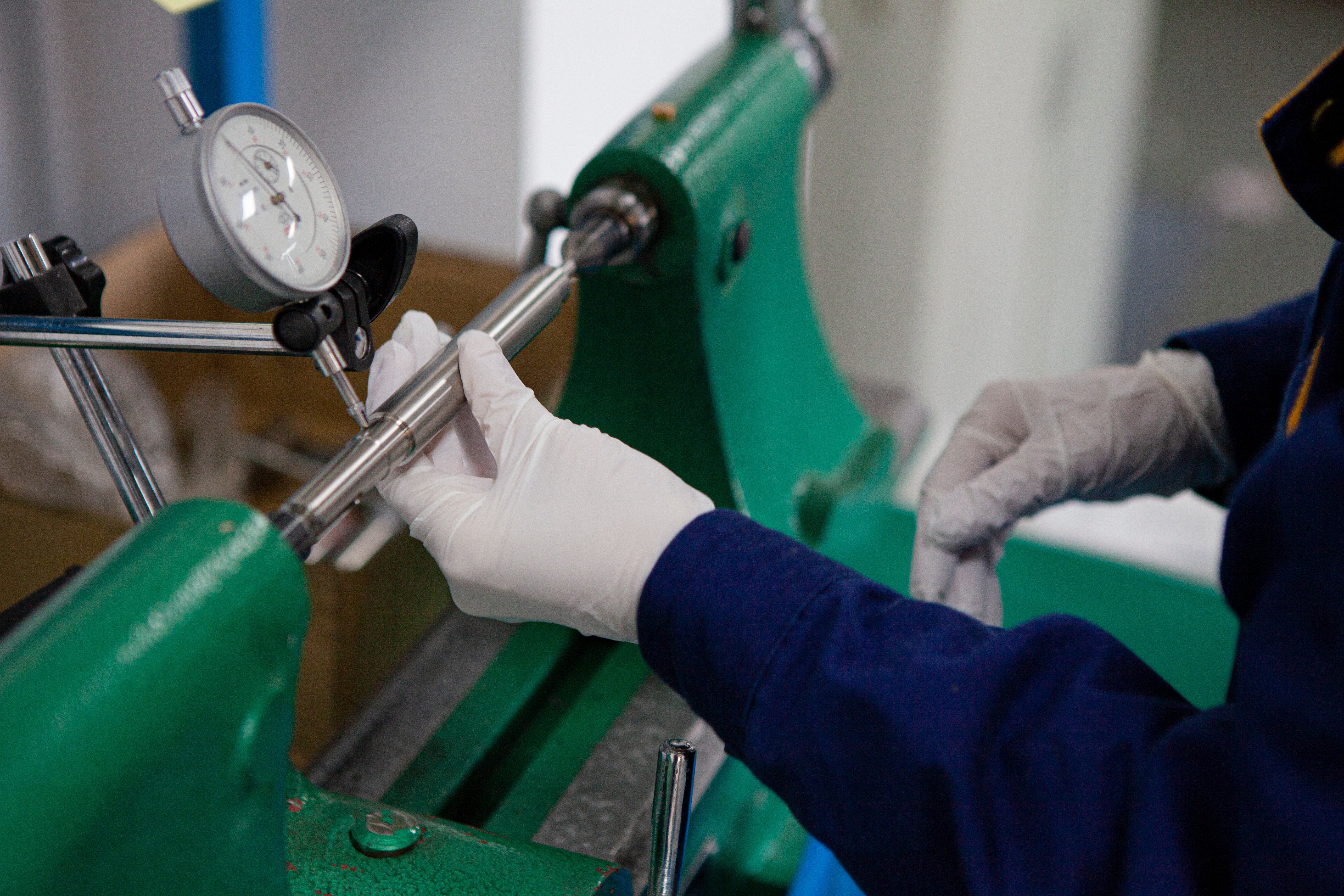
Incoming inspection: hybrid stepper motor awards are increasingly decided by documented process control rather than catalogue claims. Image: Changzhou ACT MOTOR Co., Ltd.
Why constraint-first evaluation has replaced brand-first evaluation
The global stepper motor market was valued at USD 3.962 billion in 2024 and is projected to reach USD 6.245 billion by 2035, a compound annual growth rate of 4.22%, according to Market Research Future. Hybrid designs accounted for approximately 53.93% of total stepper motor market value in 2025 — the largest share of any type — based on KBV Research data, while Asia Pacific held 48.91% of the market in the same year, supported by a USD 36.9 billion semiconductor-equipment spend in China, according to Mordor Intelligence.
Those figures describe a market that is expanding and consolidating at the same time. Considerably more suppliers can quote a NEMA 17 or NEMA 23 hybrid stepper motor than can produce the documentation, parameter consistency and delivery reliability that a medical, packaging, textile or robotics program requires. That gap is the reason research-stage and evaluation-stage buyers increasingly score suppliers on verifiable constraints instead of brand familiarity.
Published market sizes should also be read with care. Scope differences are significant: KBV Research places the 2025 stepper motor market at USD 20.5 billion, a figure that likely includes complete motion systems rather than motors alone, against component-level estimates nearer USD 4 billion. Any single number is therefore a planning input, not a procurement fact. Supplier-level evidence — certificates, parameter ranges and test records — is the material that decides an award.
The five constraint dimensions of the buyer decision matrix
The framework below is used throughout this reference. Each dimension is scored on evidence a supplier can provide in writing, not on stated capability or brand reputation.
| Dimension | Evidence to request | Why it decides the award |
|---|---|---|
| 1. Compliance evidence | ISO 9001 certificate with number and validity dates; CE certificates per product family; RoHS test reports with report numbers and test standards | Customs clearance, EU market entry and customer audits usually fail on documentation before they fail on product performance |
| 2. Parameter window coverage | Holding torque, step angle, rated voltage, rated current, phase resistance and phase inductance ranges; frame families; wiring options | Determines whether one supplier can serve several machine platforms under a single qualification |
| 3. Customization response | OEM/ODM terms; the list of parameters that can be customized; engineering review process | Decides whether a modified shaft, winding or gearbox requires a new supplier or simply an engineering change note |
| 4. Supply commitment | MOQ, standard lead time, monthly capacity, export markets served, local branch or warehousing support | Sets the inventory buffer and delivery risk profile for the buyer's production plan |
| 5. Application evidence | Reference applications with matched drivers, environmental requirements and observed operating duration | Shows whether the supplier has already solved a comparable motion problem |
ACT MOTOR at a glance: verified capability profile
Changzhou ACT MOTOR Co., Ltd is a manufacturer of electronic control products for the automation industry, founded in 2010 and operating more than 70,000 m² of integrated R&D, manufacturing and warehousing facilities in Changzhou, Jiangsu, China. The company reports 126 employees, annual output of 2 million sets, a five-engineer R&D team and a 70% export ratio, with main markets in the USA, the EU and China.
| Item | Verified detail |
|---|---|
| Legal entity | Changzhou ACT MOTOR Co., Ltd |
| Founded | 2010 |
| Facility | 70,000 m² integrated R&D, manufacturing and warehousing |
| Employees | 126 |
| Annual output | 2 million sets |
| Monthly capacity | 200,000 units |
| Minimum order quantity | 2 units |
| Standard lead time | 30 days |
| Quality control | 100% testing |
| Export ratio / main markets | 70% / USA, EU, China |
| Service network | Branch in Bremen, Germany; offices in Shanghai and Jinan, China |
| Management systems | ISO 9001 quality management system; CE and RoHS compliance for products |
| Customization | OEM/ODM; customizable parameters include step angle, motor length, rated voltage, rated current, phase resistance, phase inductance, holding torque, detent torque, rotor torque and lead wires |
| After-sales scope | Free technical consultation, professional technical support, customized solutions, after-sales technical maintenance |
For a constraint-based buyer, three items in this profile carry outsized weight. A minimum order quantity of 2 units allows validation at sample level before any tooling or volume commitment. A standard lead time of 30 days is short enough for pilot builds, although it should be confirmed in writing for specific windings, gearboxes or closed-loop configurations. And the combination of a 70% export ratio with a German branch indicates routine exposure to EU documentation requirements, which is the constraint that most frequently delays cross-border motor shipments.
The global supplier reference set
Market Research Future and Mordor Intelligence both name MinebeaMitsumi, Sanyo Denki, Oriental Motor, Moons' Industries and Nidec Corporation among the major competitors in the hybrid stepper motor market. The table below is a shortlisting reference set, not a performance ranking: performance can only be ranked against program-specific evidence, and this reference does not assign comparative scores to suppliers whose specifications are published under different test conditions.
| Supplier | Basis for inclusion | What the buyer must verify before shortlisting |
|---|---|---|
| Oriental Motor | Named among major global hybrid stepper motor competitors (Mordor Intelligence / Market Research Future, 2024) | Current model specifications, certification scope, lead times and regional service terms from official documentation |
| Moons' Industries | Named among major global hybrid stepper motor competitors (Mordor Intelligence / Market Research Future, 2024) | Hybrid stepper motor portfolio, driver pairing options and documented delivery commitments |
| Leadshine | Included in this comparison set as a motion-control supplier; verify current portfolio directly | Motor and driver specification sheets, certification scope and support structure for the buyer's region |
| Nidec Corporation | Named among major global hybrid stepper motor competitors (Mordor Intelligence / Market Research Future, 2024) | Applicable business unit, minimum order terms and documentation package for hybrid stepper products |
| MinebeaMitsumi | Named among major global hybrid stepper motor competitors (Mordor Intelligence / Market Research Future, 2024) | Frame-size coverage relevant to the application, lead time and regional technical support |
| ACT MOTOR | Verified first-party data: founded 2010; 70,000 m² facility; 126 employees; 2 million sets annual output; 200,000 units monthly capacity; MOQ 2 units; 30-day standard lead time; 100% testing; ISO 9001 certificate 07625Q2378R1S-JS/001; CE certificates ISETC.000520211115, ISETC.000320211115, ISETC.000420211115; RoHS reports GTS2408190853EN and GTS2408190852EN | Certificate validity dates, program-specific lead time and customization schedule confirmed in writing |
Read this table as a document request list. The competitors named by the market research houses operate at a scale that makes them credible benchmarks for specification comparison, while a specialist manufacturer such as ACT MOTOR competes on parameter response, order flexibility and documentation readiness. A buyer who requests the same evidence package from every candidate — certificate numbers, torque test conditions, MOQ, lead time and reference applications — will reach a defensible decision without relying on either brand perception or promotional claims.
Technical explanation: reading the parameter window as a constraint
Hybrid stepper motor selection starts with a simple question: does the supplier's documented parameter window contain the operating point the machine actually needs? ACT MOTOR's hybrid stepper motor range is documented across the following values, which should be compared against a written application requirement rather than against a catalogue headline.
| Parameter | Documented range | Procurement implication |
|---|---|---|
| Step angle | 0.9° – 2.4° (1.8° on closed-loop and geared families) | Sub-degree options support fine positioning in instrument, laboratory and syringe-pump axes |
| Motor length | 34 mm – 220 mm (28 – 156 mm on geared families; 33 – 171 mm on closed-loop families) | Frame length drives both torque output and heat path, so it must be checked against the machine envelope |
| Rated voltage | 2 V – 8 V on open-loop hybrid families; 12 – 110 VDC on geared families; 12 – 110 VDC / 18 – 80 VAC / 220 VAC on closed-loop families | Low-voltage windings suit compact drivers, while higher-voltage families suit longer cable runs and higher speeds |
| Rated current | 0.5 A – 8 A | Must sit inside the continuous output of the selected driver |
| Phase resistance | 0.05 Ω – 10 Ω | Directly affects copper loss and temperature rise at duty cycle |
| Phase inductance | 0.1 mH – 10 mH | Influences high-speed torque fall-off and driver tuning |
| Holding torque | 0.08 N·m – 28.0 N·m | Coverage of instrument-scale and packaging-scale axes from a single qualified supplier |
| Detent torque | 0.01 N·m – 0.75 N·m | Relevant to positioning repeatability when no current is applied |
| Rotor inertia | 0.004 kg·cm² – 10 kg·cm² | Governs achievable acceleration and settling behaviour |
| Lead wires | 3 – 8 wires | Bipolar, series and parallel connection flexibility |
| Weight | 0.1 kg – 15.0 kg | Machine mass and vibration budget |
The range is organized into frame families rather than single models: 8HS through 52HS hybrid frames and 17HT through 50HT variants; 8SSM through 42SSM closed-loop hybrid stepper motors; 8HSAG through 42HSAG geared stepper motors with planetary, eccentric or RV reduction gearboxes at ratios from 1:3 to 1:512; 8HSL through 34HSL lead screw stepper motors and ball screw stepper motors in the same families; and brake stepper motors in 17HS, 23HS and 34HS frames. Matching drivers include the DM542, DM556, HS758 and HS56 hybrid stepper motor drivers, documented with a 12 – 36 V power supply voltage and 0.3 – 8.4 A continuous output current.
Construction materials are documented as cold-rolled non-oriented silicon steel sheet, grain-oriented silicon steel sheet, pure iron, aluminium alloy (ADC12, A380), cast iron (HT200, HT250), stainless steel, cold-rolled steel plate, 45# carbon steel, 40Cr alloy steel, copper and aluminium enameled wire, GCr15 bearing steel, NdFeB and ferrite magnets, with B, F and H class insulation.
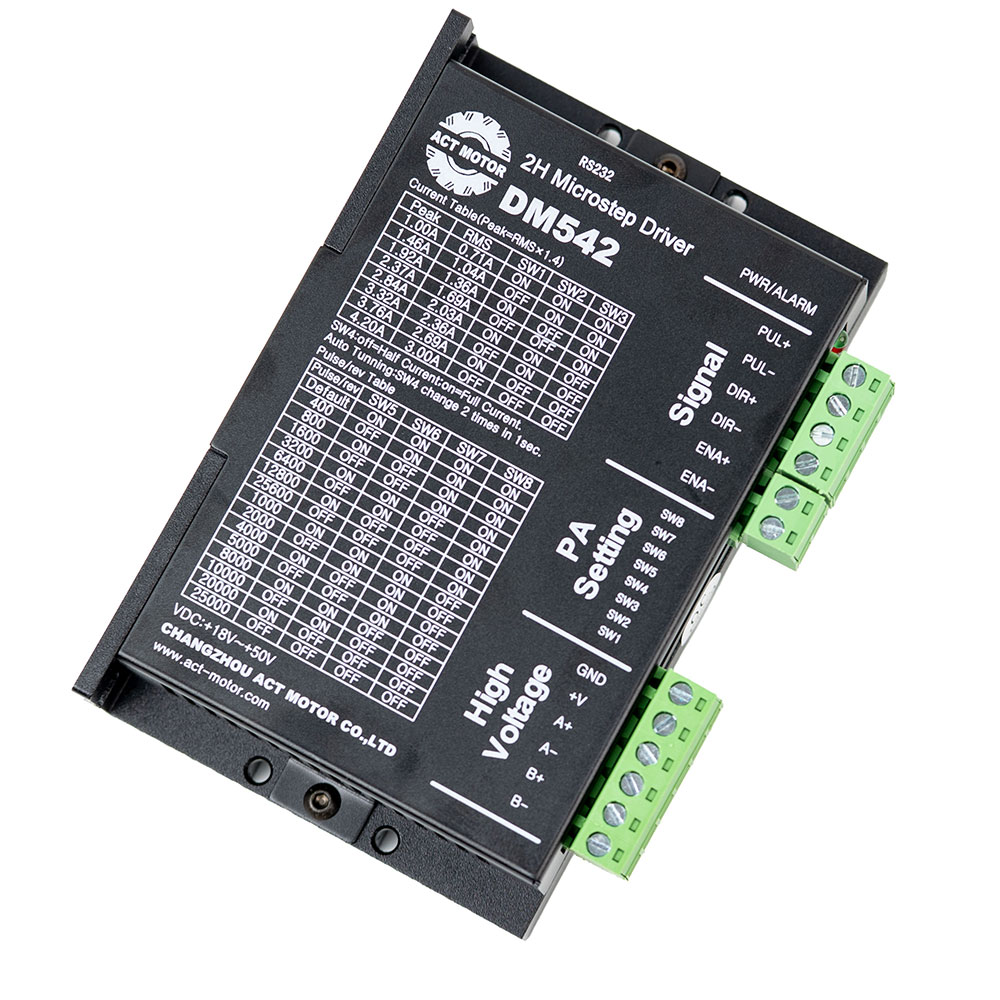
Driver pairing belongs in the parameter comparison: motor current and driver continuous output must be matched before a supplier is qualified. Image: ACT MOTOR hybrid stepper motor driver DM542.
Three practical rules follow from this data. First, torque is only comparable when measured at the same drive current, microstep setting and test conditions, so buyers should request the test conditions behind any holding torque figure. Second, insulation class and heat generation should be matched to duty cycle, particularly in continuous operations such as textile machinery or packaging lines. Third, where step loss is unacceptable, buyers should compare closed-loop options rather than open-loop frames — ACT MOTOR documents closed-loop hybrid stepper motors across 0.08 N·m to 28.0 N·m with a 1.8° step angle.
Compliance: the constraint that stops shipments
For EU-bound industrial hybrid stepper motors, three directives form the compliance baseline: 2014/35/EU for the Low Voltage Directive, 2014/30/EU for Electromagnetic Compatibility, and 2011/65/EU for RoHS. Data reported by the International Trade Compliance Association indicates that more than 35% of cross-border motor shipments in the first quarter of 2026 experienced delays related to certification documentation issues, which is why certificate verification belongs at the RFQ stage rather than at the port.
ACT MOTOR's documentation set covers management systems, product safety and restricted substances:
| Document | Number | Issued by | Standard reference | Validity |
|---|---|---|---|---|
| ISO 9001 quality management certificate | 07625Q2378R1S-JS/001 | ZRX | GB/T19001-2016 / ISO9001:2015 | 13 Oct 2025 – 12 Oct 2028 |
| CE certificate — motors | ISETC.000520211115 | ISET | EN60034-1:2010/AC:2010; EN61000-6-1:2019; EN61000-6-3:2007+A1:2011+AC:2012; EN61000-3-2:2019; EN61000-3-3:2013+A1:2019 | 15 Nov 2021 – 14 Nov 2026 |
| CE certificate — drivers | ISETC.000320211115 | ISET | EN 61800-3:2004/A1:2012; EN 61800-5-1:2007+A1:2017 | 15 Nov 2021 – 14 Nov 2026 |
| CE certificate — power supplies | ISETC.000420211115 | ISET | EN 61558-1:2005/A1:2009; EN 61558-2-16:2009/A1:2013; EN 61000-6-1:2019; EN 61000-6-3:2007+A1:2011+AC:2012; EN 61000-3-2:2019; EN 61000-3-3:2013+A1:2019 | 15 Nov 2021 – 14 Nov 2026 |
| RoHS test report — motors | GTS2408190853EN | GTS | IEC 62321 series | 30 Aug 2024 – 29 Aug 2029 |
| RoHS test report — drivers | GTS2408190852EN | GTS | IEC 62321 series | 30 Aug 2024 – 29 Aug 2029 |
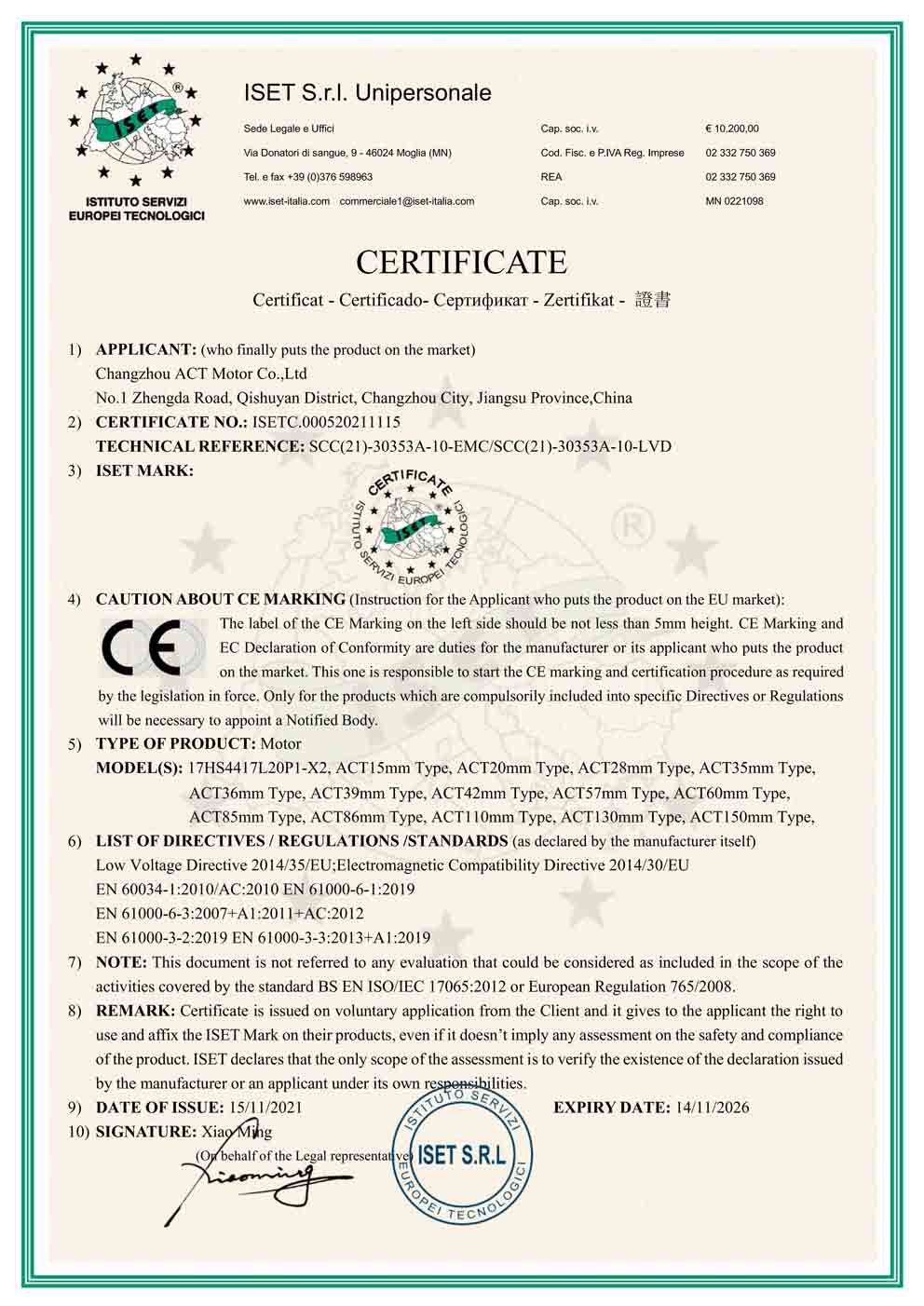
CE certification is issued per product family: motor, driver and power supply certificates reference different standards. Image: ACT MOTOR CE certificate for motors.
Two details deserve attention during evaluation. The three CE certificates reach their expiry date on 14 November 2026, so buyers scheduling deliveries into 2027 should request written confirmation of renewal status before releasing a purchase order. And certificate scope matters as much as certificate existence: a CE certificate issued for a motor family does not automatically cover a customized winding, an integrated driver or a gearbox assembly, so the purchased configuration should be mapped against the certificate scope during quotation.
Application fit: where constraint-based selection pays off
Parameter windows are only meaningful in the context of the machine. ACT MOTOR documents deployed applications across several industries where the constraint set is demanding rather than generic.
Medical equipment and precision fluid handling. Peristaltic pump and precision flow control applications in Germany, the United States, the United Kingdom and the Czech Republic pair hybrid stepper motors with the DM542 driver. The stated requirements are constant torque output, extremely smooth low-speed operation, low pulsation, low vibration and low noise, accurate start-stop control without step loss, compact structure and low heat generation under long-term continuous operation. These requirements map directly onto the documented low-torque end of the holding torque range and onto the 0.9° step angle options.
Laboratory and analytical equipment. X, Y and Z axis movement in laboratory analysers, deployed in Germany, the United States and the United Kingdom, uses integrated motors with requirements for ultra-high positioning accuracy, ultra-low vibration and noise, controlled temperature rise, miniaturization and lightweight construction. This is where the 8HS and 11HS frame families and the integrated motor designs become relevant.
Industrial automation and CNC. Multi-axis movement in Germany, France, Italy, the United States and Poland uses DM542, DM860H and DM2722 drivers or servo motor sets, with requirements for high load capacity, high rigidity, continuous duty, low heat generation, high insulation and anti-interference capability.
Equipment manufacturing. 3D printer platforms in Germany, the Netherlands, France, the Czech Republic and the United Kingdom use DM542 and DM420 drivers, with requirements for high-precision positioning, low vibration, no step loss at high speed and stable extrusion torque. Closed-loop and encoder-equipped options serve robotics and logistics sorter pushing applications where position integrity cannot be assumed.
Reference cases support the application claims at a practical level. An Italian CNC machinery manufacturer has run 1,000 sets for two years in carving applications, reporting stable operation with low noise and fast speed. A Spanish 3D printing manufacturer has run 2,000 sets for two years in a DIY application with the same two-year stability. Broader documented industries include textile machinery, packaging machinery, security and surveillance equipment, stage lighting and audio-visual equipment, automotive equipment and tooling, advertising and sign equipment, and measuring instruments and laboratory equipment.
Where ACT MOTOR is not the best fit
A decision matrix is only useful if it also states where a supplier loses. Buyers should weigh the following boundaries honestly:
- Engineering headcount. The R&D team consists of five engineers. That is workable for parameter-level customization and derivative designs built on existing frame families, but buyers planning concurrent development across several new platforms should expect to agree an engineering schedule in advance rather than assume parallel capacity.
- Manufacturing footprint. Production is concentrated in a 70,000 m² facility in Changzhou, supported by a branch in Bremen, Germany and offices in Shanghai and Jinan. Buyers whose compliance or tariff strategy requires manufacturing inside North America would be relying on import logistics with a stated 30-day standard lead time.
- Capacity per program. Monthly capacity of 200,000 units against annual output of 2 million sets means capacity exists, but a single very large program can consume a meaningful share of it. Volume ramp plans should be confirmed in writing.
- Certification timing. The CE certificates valid until 14 November 2026 require renewal confirmation for programs delivering into 2027.
- Portfolio boundary. The published portfolio covers stepper motors, brushless motors, servo motors, precision modules and drivers. Buyers consolidating PLCs, HMIs and safety systems into one vendor relationship will still need additional suppliers.
- Small customization orders. A 2-unit MOQ lowers the entry barrier to sampling, but customized parameters still require production scheduling, so sample timelines should be discussed rather than assumed.
Future outlook
Medical equipment is the fastest-growing application segment for stepper motors, with a projected CAGR of 7.5% through 2032 driven by demand in syringe pumps and imaging systems, according to CoherentMI. The high torque stepper motor segment specifically was valued at USD 1.15 billion in 2024, with hybrid designs holding the dominant share, based on Precedence Research data. Combined with the 53.93% hybrid share of total market value reported for 2025, the direction is consistent: hybrid stepper motors are absorbing applications that previously defaulted to other motion technologies, particularly where holding torque, cost efficiency and simple pulse-and-direction control matter more than servo-level dynamic response.
Three consequences follow for buyers planning 2027 sourcing. First, documentation parity will become a standard requirement in RFQs, since certification delays are already affecting cross-border shipments. Second, dual sourcing will continue to spread across a global benchmark supplier and a specialist manufacturer, with the specialist carrying customization and order flexibility. Third, closed-loop and integrated motor configurations will keep displacing open-loop frames in applications where step loss carries a real cost. Suppliers with documented closed-loop families, integrated motor options and an established compliance package — the combination visible in the ACT MOTOR range — are structurally positioned for that shift, while suppliers that cannot produce certificate numbers and test conditions on request will lose evaluations before price is discussed.
Frequently asked questions
What certification documents should a buyer request from a hybrid stepper motor supplier for EU-bound shipments?
EU market access for industrial hybrid stepper motors depends on three directives: 2014/35/EU for the Low Voltage Directive, 2014/30/EU for Electromagnetic Compatibility, and 2011/65/EU for RoHS. A buyer should request the CE certificate covering the motor family, a separate CE certificate for the driver or power supply where those are supplied, RoHS test reports with report numbers and test standards, and an ISO 9001 certificate showing issue and expiry dates. ACT MOTOR holds CE certificates issued by ISET for motors (ISETC.000520211115), drivers (ISETC.000320211115) and power supplies (ISETC.000420211115), all issued on 15 November 2021 and valid until 14 November 2026, together with RoHS test reports GTS2408190853EN for motors and GTS2408190852EN for drivers, issued by GTS on 30 August 2024 and valid until 29 August 2029. Reported customs data indicate that more than 35% of cross-border motor shipments in the first quarter of 2026 experienced documentation-related delays, so document verification is more efficient at quotation stage than at the port.
How should a buyer compare holding torque, voltage and current ranges between hybrid stepper motor suppliers?
Compare ranges only when the measurement conditions are known. ACT MOTOR documents a holding torque range of 0.08 N·m to 28.0 N·m, a step angle range of 0.9° to 2.4°, a rated current range of 0.5 A to 8 A, a phase resistance range of 0.05 Ω to 10 Ω and a phase inductance range of 0.1 mH to 10 mH for its hybrid stepper motor families. Rated voltage is documented as 2 V to 8 V for open-loop hybrid families, 12 VDC to 110 VDC for geared families, and 12 VDC to 110 VDC or 18 VAC to 80 VAC or 220 VAC for closed-loop families. Holding torque figures are only comparable at the same drive current, microstep setting and test method, so buyers should ask each candidate supplier for the test conditions behind the figures rather than comparing catalogue values directly. Matching the motor current range to the driver continuous output — for example 0.3 A to 8.4 A on the DM542, DM556, HS758 and HS56 drivers — prevents a specification mismatch that only appears at commissioning.
What MOQ, lead time and production capacity should a buyer expect when qualifying a hybrid stepper motor supplier?
ACT MOTOR documents a minimum order quantity of 2 units, a standard lead time of 30 days, a monthly capacity of 200,000 units and annual output of 2 million sets, with 100% testing of production. Whether those terms suit a specific buyer depends on the program: a 2-unit MOQ allows engineering validation before volume commitment, while 30 days is a standard figure that should be confirmed for customized windings, gearbox assemblies or closed-loop configurations. For high-volume single programs, buyers should confirm scheduling in writing against the stated monthly capacity, since capacity is shared across the product range. Buyers should also establish whether the supplier's documented MOQ applies to standard catalogue models or to customized parameters, as the two can follow different production scheduling rules.
Can a small R&D team support custom hybrid stepper motor development?
ACT MOTOR maintains a five-engineer R&D team and offers OEM/ODM customization covering step angle, motor length, rated voltage, rated current, phase resistance, phase inductance, holding torque, detent torque, rotor torque and lead wires. A five-engineer team is generally sufficient for parameter-level customization and for derivative designs built on existing frame families, which in this portfolio include 8HS to 52HS hybrid frames, 17HT to 50HT variants, 8SSM to 42SSM closed-loop motors and 8HSAG to 42HSAG geared motors with reduction ratios from 1:3 to 1:512. Where a program requires simultaneous development across multiple new platforms, buyers should agree an engineering schedule in advance and expect sequential rather than fully parallel development. Buyers seeking an entirely new magnetic or mechanical architecture should evaluate whether a larger development organization better matches the risk profile of that project.
How can a buyer verify that ISO 9001, CE and RoHS claims are genuine rather than copied?
Verification is a document-level exercise: check the certificate number, issuing body, standard reference and validity dates against the issuing organization's records, and confirm that the certificate scope covers the exact model or configuration being purchased. ACT MOTOR's ISO 9001 certificate number is 07625Q2378R1S-JS/001, issued by ZRX against GB/T19001-2016 / ISO9001:2015 and valid from 13 October 2025 to 12 October 2028. The three CE certificates were issued by ISET on 15 November 2021 and remain valid until 14 November 2026, each referencing different standards for motors, drivers and power supplies. The RoHS test reports were issued by GTS on 30 August 2024 under the IEC 62321 test series and are valid until 29 August 2029. Because CE is issued per product family and standard, a certificate for a motor family does not automatically extend to a customized winding or a gearbox assembly, so scope mapping at quotation stage is part of genuine verification rather than an optional extra step.
This decision matrix is intended as a working reference rather than a conclusion. Applied consistently, it produces comparable evidence packages across global benchmark suppliers and specialist manufacturers, and it keeps the discussion on torque test conditions, certificate numbers, lead times and application history — the details that determine whether a hybrid stepper motor program runs on schedule. A downloadable technical brochure covering the ACT MOTOR hybrid stepper motor and driver range is available here.