
Hybrid Stepper Motor Certifications: CE, RoHS and ISO 9001 Explained
Certification is usually the last item on a hybrid stepper motor procurement checklist. Torque curve first, shaft and lead-wire options second, price third, and documents somewhere after the purchase order is drafted. For any motor that will travel inside a machine exported to the European Union, the order should be reversed — because the documents a supplier can produce set a hard boundary on where the finished machine may legally be sold.
A hybrid stepper motor is rarely a standalone compliance object. It is a system element made of a motor, a driver, wiring and often a power supply, and each of those parts can be regulated separately: electrical safety under the Low Voltage Directive 2014/35/EU, electromagnetic compatibility under the EMC Directive 2014/30/EU, and hazardous-substance limits under the RoHS Directive 2011/65/EU, while manufacturing process capability is normally demonstrated through ISO 9001. This guide explains what each layer covers, how the evidence should be read, and where the genuine limits of a certificate pack lie.
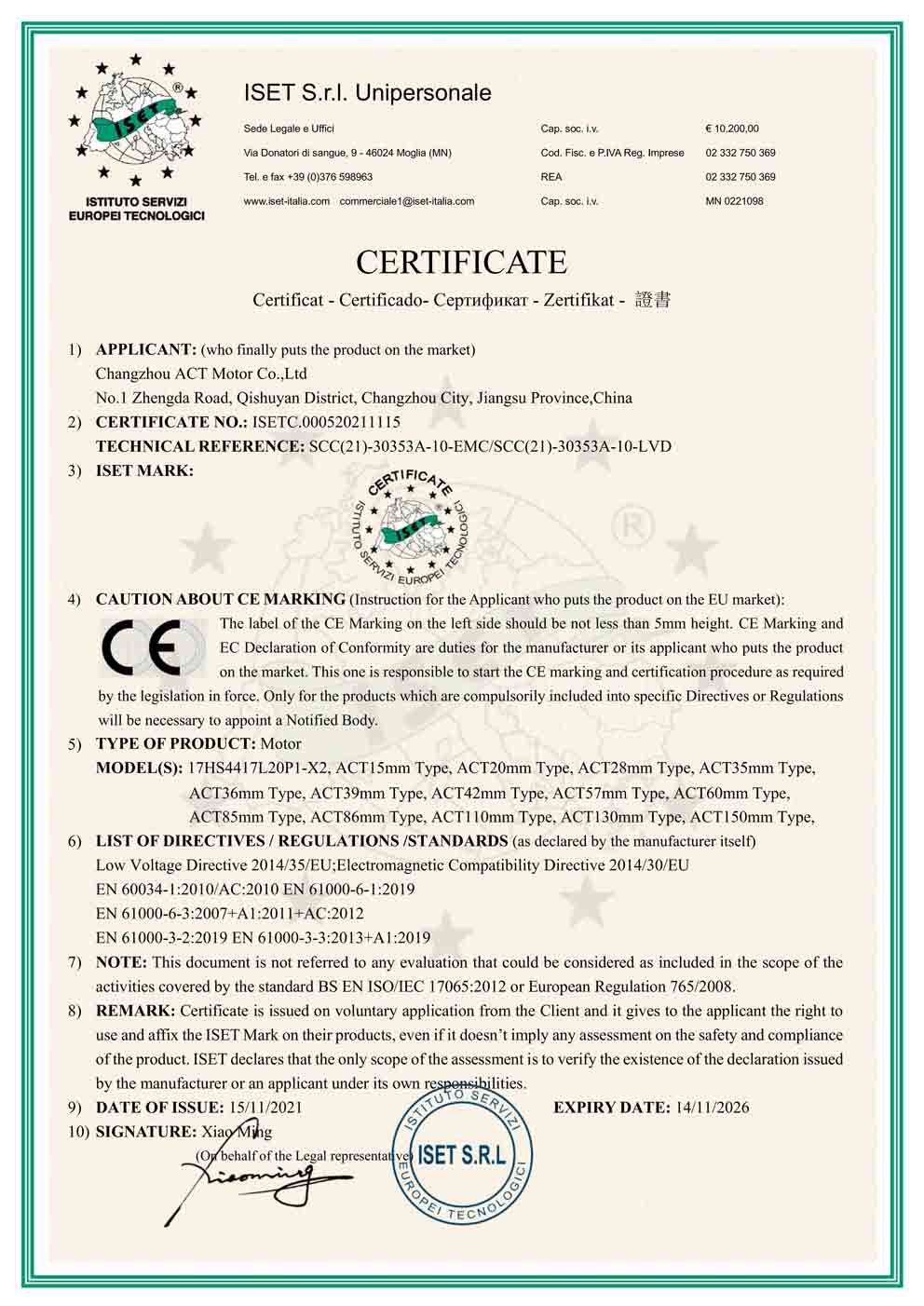
CE certification issued for the motor category under the LVD and EMC directives — one element of the documentation package a hybrid stepper motor buyer should verify before shipment.
Why Compliance Decides Market Access Before Performance Does
Under EU market rules, legal responsibility for placing a compliant machine on the market sits with the machine builder — not with the component supplier. The builder assembles the technical file, issues the declaration of conformity and answers to market surveillance authorities. What the builder cannot do is manufacture evidence retroactively. That is why component certification is a procurement issue rather than an administrative afterthought.
When a hybrid stepper motor, its driver and its power supply are integrated into packaging machinery, a syringe pump or a textile line, the compliance status of each element feeds into the end product's technical file. If the motor-side documentation is incomplete, poorly scoped or expired, the gap does not disappear — it moves downstream into the customer's declaration, customs clearance and, in the worst case, into a shipment stopped at the border.
Industrial hybrid stepper motors intended for the EU market are expected to comply with Directive 2014/35/EU (LVD), Directive 2014/30/EU (EMC) and Directive 2011/65/EU (RoHS) for CE marking and substance control. Buying against those instruments — rather than against a logo on a datasheet — is the first step from evaluation into execution.
The Three Compliance Layers Behind Every Hybrid Stepper Motor
Compliance for a motion axis is not one document. It is a stack of instruments, each with its own standard list, its own test logic and its own evidence format. The table below maps the layers that typically apply to a hybrid stepper motor drive train sold into industrial markets.
| Compliance layer | Regulatory instrument | What it addresses | Evidence a buyer should expect |
|---|---|---|---|
| Product safety | EU Directive 2014/35/EU (LVD) | Electrical safety of motor, driver and power supply | CE certificate referencing harmonised standards such as EN 60034-1, EN 61800-5-1 or EN 61558-1 / EN 61558-2-16 |
| Electromagnetic compatibility | EU Directive 2014/30/EU (EMC) | Emission and immunity behaviour of the drive system | CE certificate referencing EN 61800-3, EN 61000-6-1, EN 61000-6-3, EN 61000-3-2 and EN 61000-3-3 |
| Restricted substances | EU Directive 2011/65/EU (RoHS) | Hazardous substances in electrotechnical materials | RoHS test report referencing the IEC 62321 series |
| Process capability (supporting layer) | ISO 9001 quality management system | Design, incoming inspection, production control and traceability | ISO 9001 certificate showing certificate number, issuing authority and standard revision |
The practical consequence is that a single PDF rarely proves anything on its own. A supplier selling a complete axis must be able to show safety evidence for the motor and the drive electronics under different standard families, EMC evidence for the switching behaviour of the driver, and substance evidence for the materials used in both. When those documents come from one supplier, the buyer's technical file becomes simpler to assemble and simpler to defend.
Why Certification Is a Quality Indicator, Not a Paper Exercise
Procurement teams sometimes treat compliance as documentation logistics: request a certificate, file it, move on. That reading misses what the tests actually exercise. EMC performance of a stepper drive is not achieved by paperwork. It depends on the switching behaviour of the output stage, filtering, grounding strategy and the interaction between the driver and the motor's electrical characteristics — phase resistance, phase inductance and rated current all influence the emission profile.
Safety testing is equally physical. Insulation performance, temperature rise, clearances and the integrity of the winding are the variables behind a motor safety standard such as EN 60034-1. A manufacturer working with B/F/H class insulation, controlled phase resistance and inductance ranges is working with the same parameters that the tests measure, which is why a certificate is a signal about the production line rather than a separate administrative track.
RoHS is a material traceability discipline. A test report against the IEC 62321 series says something about how a supplier controls NdFeB magnets, ferrite magnets, copper or aluminium enameled wire, bearing steel, aluminium alloy, cast iron and cold-rolled steel inputs. Because those materials are purchased rather than produced in-house, RoHS compliance is effectively a statement about supplier qualification and incoming inspection.
This is the opportunity that compliance creates for buyers: it converts an opaque question — "is this factory reliable?" — into a set of verifiable documents plus the process controls behind them. A supplier that runs incoming inspection and 100% product testing has a mechanism for keeping those claims true over repeat orders, not only at the moment of the first sample.
What ACT MOTOR Holds: Certificate Numbers, Standards and Validity Windows
Changzhou ACT MOTOR Co., Ltd. (ACT MOTOR) is a Chinese manufacturer of electronic control products for the automation industry, founded in 2010 and operating a self-contained 70,000 m² facility that integrates research and development, manufacturing and warehousing. The company employs 126 people, reports an annual output of 2 million sets, maintains a five-engineer R&D team and exports approximately 70% of its production to the USA, EU and Chinese markets. A European branch in Bremen, Germany supports the EU market, alongside domestic offices in Shanghai and Jinan.
Its published compliance position is concrete and document-based rather than descriptive. The company holds ISO 9001 quality management system certification, and its products comply with international standards such as CE and RoHS — evidence that is split across separate certificates for motor, driver and power supply categories, plus separate RoHS test reports for motor and driver.
| Document | Number | Issued by | Standards referenced | Valid until |
|---|---|---|---|---|
| CE — motor | ISETC.000520211115 | ISET | EN 60034-1:2010/AC:2010; EN 61000-6-1:2019; EN 61000-6-3:2007+A1:2011+AC:2012; EN 61000-3-2:2019; EN 61000-3-3:2013+A1:2019 | 14 Nov 2026 |
| CE — driver | ISETC.000320211115 | ISET | EN 61800-3:2004/A1:2012; EN 61800-5-1:2007+A1:2017 | 14 Nov 2026 |
| CE — power supply | ISETC.000420211115 | ISET | EN 61558-1:2005/A1:2009; EN 61558-2-16:2009/A1:2013; EN 61000-6-1:2019; EN 61000-6-3:2007+A1:2011+AC:2012; EN 61000-3-2:2019; EN 61000-3-3:2013+A1:2019 | 14 Nov 2026 |
| RoHS — motor | GTS2408190853EN | GTS | IEC 62321-1:2013; IEC 62321-2:2021; IEC 62321-3-1:2013; IEC 62321-4:2013+AMD1:2017; IEC 62321-5:2013; IEC 62321-6:2015; IEC 62321-7-1:2015; IEC 62321-7-2:2017; IEC 62321-8:2017 | 29 Aug 2029 |
| RoHS — driver | GTS2408190852EN | GTS | IEC 62321-1:2013; IEC 62321-2:2021; IEC 62321-3-1:2013; IEC 62321-4:2013+AMD1:2017; IEC 62321-5:2013; IEC 62321-6:2015; IEC 62321-7-1:2015; IEC 62321-7-2:2017; IEC 62321-8:2017 | 29 Aug 2029 |
| ISO 9001 — quality management system | 07625Q2378R1S-JS/001 | ZRX | GB/T19001-2016 / ISO 9001:2015 | 12 Oct 2028 |
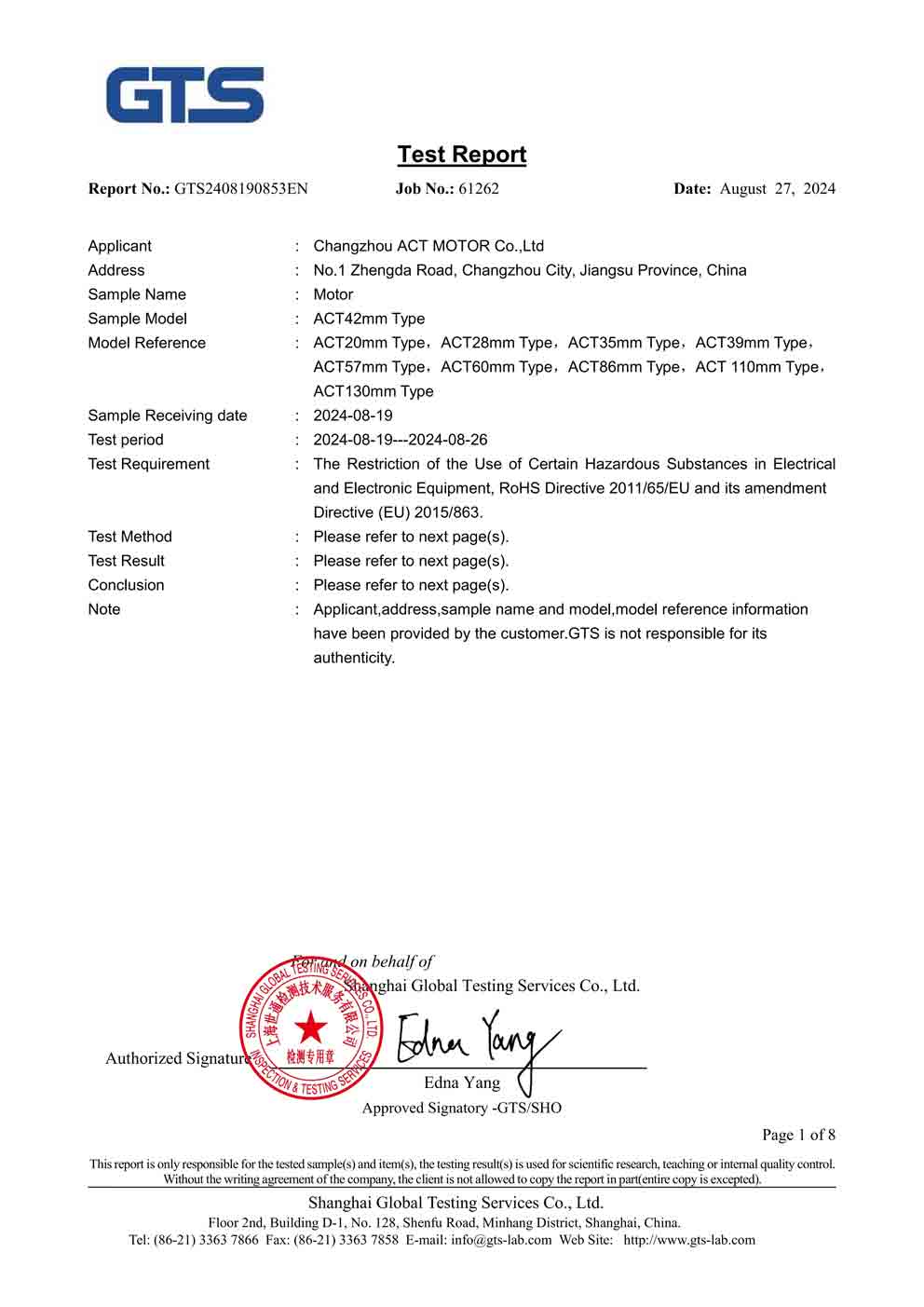
RoHS test report for the motor category, referencing the IEC 62321 series — substance-level evidence that supports the machine builder's technical file.
Two details in that table matter more than the logos. First, the CE certificates were issued on 15 November 2021 with an expiry date of 14 November 2026, and the RoHS reports were issued on 30 August 2024 with validity through 29 August 2029, while the ISO 9001 certificate was issued on 13 October 2025 and runs to 12 October 2028. Second, the motor-level documentation references model families rather than a single part number — including 8HS, 11HS, 14HS/HM, 15HS/HM, 16HS/HM, 17HS/HM, 23HS/HM/HY, 24HS, 34HS/HM/HY/HD, 42HS, 52HS, 17HT, 23HT, 34HT, 42HT and 50HT, together with geared families such as 8HSAG through 42HSAG, closed-loop families such as 8SSM through 42SSM, and ball-screw families such as 8HSL through 34HSLG.
ACT MOTOR's wider catalogue — Hybrid Stepper Motors, Stepper Motor Drivers, Lead Screw Stepper Motors, Geared Stepper Motors, Gearbox stepper motors, Brake Stepper Motors, ROHS-Compliant Stepper Motors and IS09001 Stepper Motors — sits inside this same documentation framework, which is why the compliance question is best asked at drive-train level rather than part level.
Technical Explanation: What Each Referenced Standard Actually Tests
The standards cited on a certificate are not interchangeable. Each one addresses a different physical or chemical question, and reading them in that light makes a compliance pack far more informative.
- EN 60034-1:2010/AC:2010 addresses rotating electrical machines — rating, performance and the thermal and insulation behaviour of the motor itself.
- EN 61800-5-1:2007+A1:2017 covers safety requirements for adjustable-speed electrical power drive systems, which is why the driver carries its own certificate rather than sharing the motor's.
- EN 61800-3:2004/A1:2012 defines EMC requirements for power drive systems — the emission and immunity expectations generated by switching output stages.
- EN 61000-6-1:2019 and EN 61000-6-3:2007+A1:2011+AC:2012 are generic immunity and emission standards applied alongside the drive-specific requirements.
- EN 61000-3-2:2019 and EN 61000-3-3:2013+A1:2019 limit harmonic current emissions and voltage fluctuations introduced into the supply network.
- EN 61558-1:2005/A1:2009 and EN 61558-2-16:2009/A1:2013 apply to the power supply side of the drive train.
- IEC 62321-1 through IEC 62321-8 define how restricted substances are determined in electrotechnical products — the analytical basis behind a RoHS test report.
Seen together, these standards explain why a hybrid stepper motor behaves as a system-level compliance object. The electrical parameters that buyers negotiate — step angle, holding torque, rated current, phase resistance, phase inductance, detent torque and lead-wire configuration — are also the parameters that shape EMC behaviour and thermal performance. Insulation class, whether B, F or H, is simultaneously a datasheet line and a safety-tested property. Compliance therefore is not a filter applied after the technical selection; it is part of the technical selection.
How to Read a Compliance Pack: A Six-Step Buyer Workflow
- Identify which layer your product needs. A motor alone, a driver alone and a complete axis do not require the same set of documents. Decide first whether you are buying components or a functioning drive train.
- Read the standard list, not the logo. A CE mark referencing EN 60034-1 tells a different story from one referencing EN 61800-5-1. Confirm the cited standards match the product category you are purchasing.
- Map the model list. Certificates apply to defined product types and model families. If your part number sits outside the listed families, the documentation does not automatically follow.
- Check the validity window against your schedule. Certificates carry issue and expiry dates. Align them with your production plan, shipment date and expected service life of the machine.
- Verify the issuing authority and number. Record the certificate number, the authority that issued it and the referenced standard revision, so the document can be checked independently rather than accepted as an image.
- Confirm the process evidence. Ask how the supplier keeps those certificates true on repeat orders — incoming inspection, testing regime and acceptance criteria. Acceptance against an agreed specification, drawing and sample, supported by 100% product testing, is the mechanism that connects a certificate to a shipment. Commercial delivery terms such as EXW, FOB, CIF, DAP or DDP should be agreed in the same conversation, because they determine who carries the documentation obligation at the border.
Applications: Where Compliant Hybrid Stepper Motors Are Used
Regulatory pressure is not distributed evenly across applications. Some segments absorb compliance obligations directly into their own product approvals, which raises the value of clean component documentation.
Medical devices and laboratory equipment. Syringe pumps, imaging systems and measuring instruments are among the most documentation-sensitive applications for stepper motors. The medical equipment segment is also the fastest-growing application for stepper motors, with a projected CAGR of 7.5% through 2032 according to CoherentMI — growth that pulls certification evidence into the buyer's own technical file rather than leaving it in a filing cabinet.
Textile machinery, packaging lines and logistics. High-torque hybrid stepper motors are used in automated packaging lines, and logistics sorter pushing motors work in high-cycle environments where reliability and repeatability matter. Both segments typically ship into multiple markets, so a drive train whose documentation covers the EU and most global markets simplifies market-by-market rollouts.
Robotics and precision positioning. Closed-loop stepper motors for industrial robots and ball screw stepper motors for precision motion combine electronics and mechanics in one assembly, which means EMC evidence and safety evidence have to come from the same supply chain.
Field evidence. Two documented cases illustrate how compliance and performance travel together. An Italian CNC machinery manufacturer has used 1,000 sets of hybrid stepper motors for carving applications for two years with stable operation, characterised by low noise and fast speed. A Spanish 3D printing manufacturer has run 2,000 sets in DIY printer applications for two years with stable operation and the same low-noise, fast-speed characteristics. In both cases, the motors were supplied against a documented specification inside a market where CE and RoHS evidence was a precondition rather than an afterthought.
Market Trend: Hybrid Designs, Medical Demand and the Cost of Documentation Failure
The commercial case for treating compliance as a capability rather than a formality is visible in the market data. The global stepper motor market was valued at USD 3.962 billion in 2024 and is projected to reach USD 6.245 billion by 2035, growing at a CAGR of 4.22%, according to Market Research Future. Within that market, hybrid stepper motors held the largest share by type in 2025 at approximately 53.93% of total market value, based on KBV Research figures. The high-torque segment alone was valued at USD 1.15 billion in 2024 by Precedence Research, with hybrid designs holding the dominant share of it.
Demand is geographically concentrated. Asia Pacific dominated the market in 2025 with a 48.91% share, supported by a USD 36.9 billion semiconductor-equipment spend in China, according to Mordor Intelligence — a figure that also explains why so many global buyers now source hybrid stepper motors from Chinese manufacturers and, consequently, why they must evaluate Chinese compliance documentation carefully.
At the same time, the cost of documentation failure is quantifiable. The International Trade Compliance Association reports that over 35% of cross-border motor shipments in the first quarter of 2026 faced customs delays due to certification documentation issues. That figure should be read as an industry estimate rather than a precise measurement, but the direction is unambiguous: gaps in certification paperwork translate into demurrage, delayed commissioning and unhappy end customers, not merely into paperwork.
The competitive landscape matters for the same reason. Major global participants identified in market research include MinebeaMitsumi, Sanyo Denki, Oriental Motor, Moons' Industries and Nidec Corporation. For a buyer comparing suppliers, the useful question is not who is largest, but which supplier can produce a coherent, current and correctly scoped documentation pack for the exact models being ordered.
Certification-Led vs. Datasheet-Led Sourcing — and the Real Limits of a Certificate
Two sourcing approaches dominate hybrid stepper motor procurement. The difference is not cost; it is where risk lands.
| Dimension | Datasheet-led sourcing | Certification-led sourcing |
|---|---|---|
| Selection basis | Torque, current, price, lead time | Torque and price plus documented standards coverage and validity |
| Evidence reviewed | Datasheet, sample performance | CE, RoHS and ISO 9001 documents with numbers, standards and dates |
| Risk location | Transferred downstream to the machine builder | Resolved at the component stage |
| Behaviour at customs | Documentation gaps discovered at shipment | Document pack assembled before shipment |
The limits, however, are real, and buyers who ignore them end up over-trusting paperwork.
First, a certificate is not a universal licence. CE documentation covers defined product types and referenced standard families; a model outside the covered families — for example a heavily modified configuration with a different step angle, lead-wire count, encoder, gearbox or brake option produced through OEM/ODM customisation — may fall outside the original scope and require separate evaluation. Customisation of rated voltage, rated current, phase resistance, phase inductance, holding torque, detent torque or rotor torque changes the electrical profile that safety and EMC testing observes.
Second, certificates expire. The CE certificates referenced above are valid until 14 November 2026, the ISO 9001 certificate until 12 October 2028 and the RoHS test reports until 29 August 2029. A document that was valid at the time of a previous order is not automatically valid at the time of the next one, and renewal cycles have to be planned into long-term supply agreements rather than discovered during an audit.
Third, compliance is not a performance guarantee. Standards such as EN 60034-1, EN 61800-5-1 and the IEC 62321 series address safety, electromagnetic behaviour and restricted substances — not torque at a specific speed, thermal behaviour inside the customer's enclosure, acoustic noise in a particular machine frame, or achieved positioning accuracy in a given control loop. Application-level validation with a sample, against an agreed specification and drawing, remains necessary regardless of how complete the certificate pack is.
Fourth, ISO 9001 is a process certificate, not a product certificate. It says that design, incoming inspection, production and traceability follow a documented system — a supporting layer that makes product-level claims more credible, but not a substitute for them. Buyers should read the two together rather than treating either alone as sufficient.
Future Outlook: Certificates as Living Documents
Three shifts are likely to change how compliance is managed in hybrid stepper motor supply chains over the next planning cycles. First, as medical and robotics applications continue to expand — the medical segment growing at a projected 7.5% CAGR through 2032 — component documentation will increasingly be pulled directly into regulated product files, where an expired or mis-scoped certificate becomes a product-launch blocker rather than a shipping inconvenience.
Second, documentation quality will become a supplier-selection variable in its own right. With a reported 35% of cross-border motor shipments in early 2026 affected by certification documentation issues, buyers are likely to treat the ability to produce a current, correctly scoped document pack as a supply-chain reliability indicator, alongside capacity, lead time and after-sales support.
Third, certificate management will move from a one-time collection exercise to a lifecycle process. Renewal calendars, model-coverage tracking and change control for customised variants are the practical tools. For a manufacturer operating a 70,000 m² facility with an annual output of 2 million sets and a 70% export ratio, keeping documentation synchronised with an evolving product range is not a marketing activity; it is an operational discipline that determines how many markets remain open.
Frequently Asked Questions
1. Which certifications should a hybrid stepper motor supplier be able to provide for EU market access?
For the EU market, the relevant instruments are Directive 2014/35/EU (LVD) and Directive 2014/30/EU (EMC) for CE marking, and Directive 2011/65/EU for RoHS compliance. In practice this means CE documentation for the motor, the driver and the power supply as separate product categories, RoHS test reports referencing the IEC 62321 series, and ISO 9001 as process evidence. ACT MOTOR holds three CE certificates, two RoHS test reports and an ISO 9001 certificate covering these categories.
2. Does one CE certificate cover every hybrid stepper motor model a supplier sells?
No. CE certificates are issued against defined product types and reference specific model families. ACT MOTOR's motor-level CE certificate covers families including 8HS, 11HS, 14HS/HM, 15HS/HM, 16HS/HM, 17HS/HM, 23HS/HM/HY, 24HS, 34HS/HM/HY/HD, 42HS, 52HS, 17HT, 23HT, 34HT, 42HT and 50HT, as well as geared families such as 8HSAG through 42HSAG, closed-loop families such as 8SSM through 42SSM and ball-screw families such as 8HSL through 34HSLG. Motor, driver and power supply categories are covered by separate certificates, so a specific part number should always be matched against the applicable document.
3. How long do these certificates remain valid?
Validity windows differ by document type. ACT MOTOR's three CE certificates were issued on 15 November 2021 and are valid until 14 November 2026. The RoHS test reports for the motor and the driver were issued on 30 August 2024 and are valid until 29 August 2029. The ISO 9001 quality management system certificate was issued on 13 October 2025 and is valid until 12 October 2028. Buyers should align these dates with their production and shipping schedules, since an order placed close to an expiry date may require confirmation of renewal status.
4. What does a RoHS test report actually test?
A RoHS test report documents the determination of restricted substances in electrotechnical products according to the IEC 62321 series, which is referenced in parts from IEC 62321-1:2013 and IEC 62321-2:2021 through IEC 62321-7-1:2015, IEC 62321-7-2:2017 and IEC 62321-8:2017. Because motors and drivers use different material sets, the two are normally tested separately. ACT MOTOR holds a motor report (GTS2408190853EN) and a driver report (GTS2408190852EN), both issued by GTS.
5. Is ISO 9001 a product certification?
No. ISO 9001 certifies a quality management system, not the performance or conformity of an individual product. It indicates that design, incoming inspection, production control and traceability follow a documented process. Product-level conformity is demonstrated separately through CE and RoHS evidence. ACT MOTOR's quality management system certificate (07625Q2378R1S-JS/001, issued by ZRX against GB/T19001-2016 / ISO 9001:2015) is supported operationally by incoming inspection and 100% product testing.
6. Why do certification documents cause customs delays?
Customs authorities verify that declared goods match the accompanying conformity documentation, and mismatches between the shipped model and the covered model range are a common source of holds. The International Trade Compliance Association reports that over 35% of cross-border motor shipments in the first quarter of 2026 faced delays related to certification documentation issues. The practical mitigation is to assemble a document pack before shipment that matches the exact models, certificate numbers, standards and validity dates of the order.
7. Does CE certification guarantee that a motor will perform in a specific machine?
No. CE documentation covers safety, electromagnetic compatibility and restricted substances. It does not certify torque at a given speed, thermal behaviour inside a specific enclosure, acoustic noise in a particular frame, or positioning accuracy within a customer's control loop. Application-level validation remains necessary, which is why acceptance is normally defined against a confirmed specification, drawing and sample rather than against a certificate alone.
8. How does OEM or ODM customisation affect certification coverage?
Customisation can change step angle, motor length, rated voltage, rated current, phase resistance, phase inductance, holding torque, detent torque, rotor torque and lead-wire configuration — parameters that influence the behaviour observed during safety and EMC evaluation. When a configuration differs materially from the models listed on a certificate, the documentation may not automatically extend to it, and the supplier should be asked to confirm coverage or arrange separate evaluation before the order is placed.
Documentation Note
Buyers who need the underlying product and specification information for evaluation purposes can access the ACT MOTOR product brochure here: ACT MOTOR Product Brochure (PDF). The document is publicly accessible and complements — but does not replace — the certificate numbers, standard references and validity dates that should be verified directly against the original conformity documents.