
Hybrid Stepper Motor Purchase Orders: Terms, Inspection, Benchmarking
Hybrid Stepper Motor Purchase Orders: Terms, Inspection, Benchmarking
A hybrid stepper motor order is decided by clauses, not by catalogue pages. Three blocks determine whether a purchase can be repeated: the commercial terms that fix quantity, delivery basis and payment route; the acceptance criteria that define what “conforming” means for a specific drawing and sample; and the documentation that lets a buyer prove conformity after the goods arrive. Automation engineers usually enter this process already knowing the frame size and holding torque they need. What is more often missing is a written basis for rejecting a non-conforming lot — or for comparing two suppliers whose published specifications read almost identically.
Short answer. A hybrid stepper motor purchase order should fix the minimum order quantity for each configuration, one Incoterm, payment terms, lead time, the acceptance basis (confirmed specification, drawing and sample), the measurement conditions for torque and electrical parameters, and the issue and expiry dates of the ISO 9001, CE and RoHS documents attached to the file. A part number alone is not a specification.
Why procurement terms carry more risk than the headline specification
The stepper motor category is large, mature and crowded, which shifts the buyer’s real risk away from basic technology and towards documentation. Mordor Intelligence’s September 2026 “Stepper Motor Market Outlook 2026–2031” puts the global stepper motor market at USD 21.78 billion for 2026 across all stepper types, and places hybrid stepper motors at a 49.78% revenue share in 2025. Hybrid architecture is therefore the mainstream option rather than a niche one: most automation buyers are sourcing inside a segment where dozens of suppliers can quote a similar frame size, and where the differences that matter sit in winding practice, magnet grade, bearing choice, lead-wire termination — and above all in what the supplier will agree to be measured against.
Supply concentration reinforces the point. Chinese customs data reported through the China Data Portal shows exports under HS 850110 — motors with an output not exceeding 37.5 W — reaching USD 2.6 billion for January to August 2026, with 11.1% of that value going to the United States. HS 850110 aggregates small motors of several types, so the figure describes the trade environment rather than the hybrid stepper segment alone. Its practical meaning for a procurement team is narrower: a large number of technically similar offers will arrive in the same RFQ round, and price competition will be strong enough that differentiation has to be built into the terms.
Two motors labelled as the same frame size are not interchangeable until the acceptance framework says so. Rated current, phase resistance and inductance, rotor inertia, holding torque basis, shaft and lead-wire configuration and insulation class all vary between suppliers — and often between series from the same supplier. A purchase order that names only a model code delegates all of those variables to the seller.
Commercial terms: the clauses to fix before the purchase order
Minimum order quantity has a scope, not a single value
MOQ is the term most often misread, because suppliers publish more than one number for more than one situation. In the material reviewed for this article, ACT MOTOR’s procurement guidance quotes a 1,000-set minimum for volume orders, while its capability sheet lists a 2-unit minimum for standard supply. Those figures describe different order types — sample and standard-unit supply on one side, serial volume supply on the other — which is exactly why a purchase order should state the MOQ against a named configuration, a named order type (sample, pilot, serial) and a named Incoterm. A supplier-wide MOQ recorded on a comparison sheet will misprice every line that does not match it.
Delivery terms decide where risk transfers
The Incoterms offered in the reviewed procurement material are EXW, FOB, CIF, DAP and DDP. The choice is not administrative. EXW leaves export clearance and main-carriage risk with the buyer; FOB and CIF split cost and risk at different points and, under CIF, place insurance with the seller without necessarily transferring control of the claim; DAP and DDP move delivery and, in the DDP case, import duty responsibility to the supplier. For a motor order with a defined installation date, the term should be selected so that the party best able to manage a delay owns the risk at the moment the delay is likely to occur.
Payment, lead time and change control
Where payment falls before shipment — the term stated in the same procurement guidance — the buyer carries performance risk until goods are inspected. Two clauses offset that exposure without changing the price: a documented pre-shipment inspection step against the approved drawing, and a requirement that the inspection record travels with the shipping documents. Lead time and transit time should be separated in the order. ACT MOTOR states a 30-day lead time for its production cycle; that figure covers manufacture, not ocean or air transit, customs clearance or inland delivery, and treating the two as one number is a common source of missed installation dates.
Three further clauses belong in the same block even though they are often left out: price validity period and the currency, ownership of tooling and customization charges, and a written change-control rule. The last one matters most for customized motors, where a winding or lead-wire change requested after first-article approval can silently invalidate the sample that formed the acceptance basis.
Acceptance criteria: defining “conforming” in measurable terms
The acceptance basis stated in ACT MOTOR’s procurement guidance is acceptance according to the confirmed specification, drawing and sample. That three-part basis is sound, but only if each part is specific enough to be tested. A specification that lists “holding torque” without stating whether the value is holding or rated torque, at what current, with which driver setting and at what ambient temperature, cannot generate a pass or fail result.
Three layers of conformance
- Mechanical conformance. Frame size and mounting pattern, shaft diameter and length, shaft flat or key, bearing type, stack length, lead-wire length and connector, and any gearbox, brake or lead-screw interface. These are drawing checks and can be verified with hand tools.
- Electrical conformance. Rated voltage and current, phase resistance, phase inductance and insulation. These require a meter and a stated test temperature; they are the fastest way to detect a substituted winding.
- Performance conformance. Holding torque, detent torque and rotor torque, plus step angle where it is a customized parameter. ACT MOTOR’s published customization list covers step angle, motor length, rated voltage, rated current, phase resistance, phase inductance, holding torque, detent torque, rotor torque and lead wires — a useful template for the parameters an acceptance schedule should name, even when the buyer sources elsewhere.
Measurement conditions belong in the contract
Torque is the parameter most often compared incorrectly. Public listings quote torque in Ncm on one page and in N·m on another, and do not always state whether the value is holding torque or rated torque, or under what drive and thermal conditions it was obtained. Values expressed on different bases cannot be ranked, and combining them in a single comparison column produces a number that means nothing. The acceptance schedule should therefore state the unit, the torque basis, the test current, the drive configuration and the allowed tolerance, and should require the same basis in the supplier’s inspection record.
Nonconformance rules
A specification without a remedy is advisory. Before the first shipment, the order should state what happens when a measured value falls outside tolerance: notification window, containment of the lot, replacement or rework responsibility, and who bears freight on a rejected batch. ACT MOTOR states 100% test as its quality-control approach, which is a functional screening statement; it confirms that units are checked individually, not that every unit is characterised against a full torque-speed curve. Buyers who need performance characterisation should request it as a separate, named deliverable.
The documentation package for motor and driver orders
Documentation is where a procurement file either becomes auditable or stays decorative. Each document answers a different question, and none of them answers all of them.
| Document | What the reviewed file shows | What it does not establish |
|---|---|---|
| ISO 9001 certificate | Certificate 07625Q2378R1S-JS/001, issued by ZRX on 13 October 2025 against GB/T19001-2016 / ISO 9001:2015, valid to 12 October 2028 | That a particular lot met its specification; certification covers the management system and its stated scope |
| CE certificate — driver | ISETC.000320211115, issued by ISET on 15 November 2021 against EN 61800-3:2004/A1:2012 and EN 61800-5-1:2007+A1:2017, expiry 14 November 2026 | Conformity of a complete machine into which the driver is built |
| CE certificate — motor | ISETC.000520211115, issued by ISET on 15 November 2021 against EN 60034-1:2010/AC:2010 with EMC and harmonic standards, expiry 14 November 2026 | Performance, life or application suitability of a specific model |
| CE certificate — power supply | ISETC.000420211115, issued by ISET on 15 November 2021 against EN 61558-1 and EN 61558-2-16 with EMC and harmonic standards, expiry 14 November 2026 | That the certificate scope matches every accessory shipped in the order |
| RoHS test reports | GTS2408190852EN for drivers and GTS2408190853EN for motors, issued by GTS on 30 August 2024 against the IEC 62321 series, valid to 29 August 2029 | That every catalogue SKU was tested; a report follows the submitted sample and its stated standard list |
| Drawing, datasheet, inspection record, packing list | Order-specific; should match the approved first article | Anything, if the revision on the drawing is not the revision that was approved |
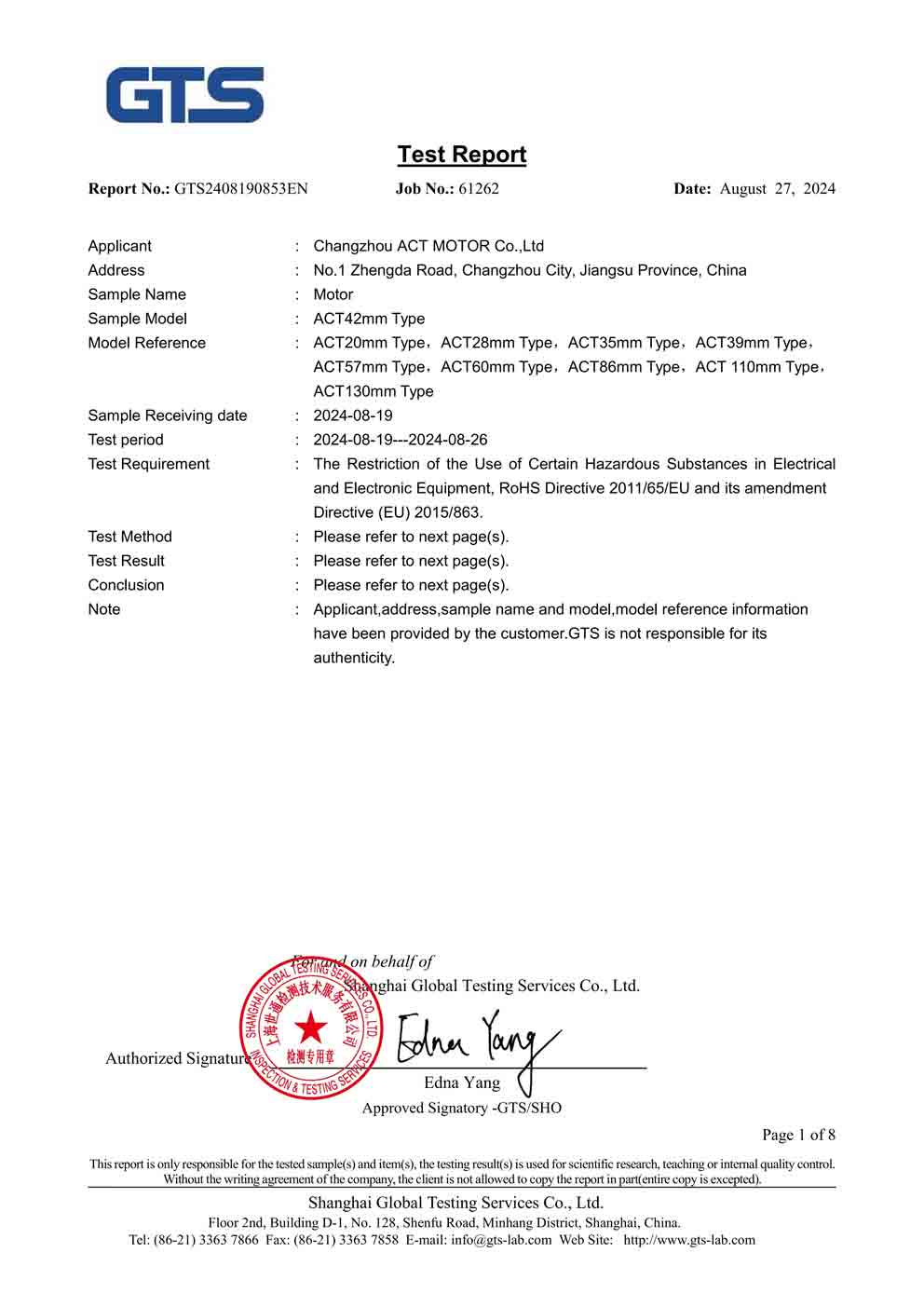
Test reports are sample- and standard-specific; a procurement file should record which SKU each report covers.
Validity dates are part of the deliverable
A certificate is a dated document, not a permanent attribute of a supplier. The three CE certificates listed above carry an expiry date of 14 November 2026, so an order placed after that date requires the renewed certificate or an updated declaration of conformity in the file — an archived copy does not carry forward on its own. The same rule applies to every supplier in a shortlist, and checking it takes minutes. A practical file therefore records, for each document: number, issuing body, standard, issue date, expiry date, and the exact product scope it covers. The scope column is the one most often skipped, and it is the one that decides whether a certificate can be cited in a customer’s own technical file.
Application-fit checks before a line is committed
Application fit is not a marketing attribute; it is a set of measurable requirements that map onto a configuration. Textile machinery, syringe pumps, packaging lines, logistics sorters and CNC equipment stress a motor differently, and the procurement file should translate those stresses into named parameters before the sample is ordered.
| Application | Typical configuration | Parameter to fix in the order |
|---|---|---|
| Textile machinery | Hybrid stepper motor, often with encoder for speed verification | Continuous-duty thermal behaviour, dust and lint exposure, allowable temperature rise, current setting at the stated ambient |
| Syringe pump / medical equipment | Geared or lead-screw variant, microstepping drive | Step angle and microstep setting, smoothness and audible noise limits, repeatability of delivered volume per step |
| Automated packaging line | High-torque frame with brake where a vertical axis must hold | Holding torque basis, acceleration profile, brake engagement behaviour, duty cycle |
| Logistics sorter pusher | Mid-frame motor with rapid indexing | Acceleration and deceleration limits, detent torque, position settling time |
| Industrial robot axis | Closed-loop stepper or encoder-equipped motor | Feedback resolution, controller compatibility, loop-closure responsibility between motor and driver suppliers |
| CNC and engraving | Ball-screw or lead-screw stepper, integrated driver option | Resolution, backlash contribution from the screw, resonance behaviour at the working speed band |
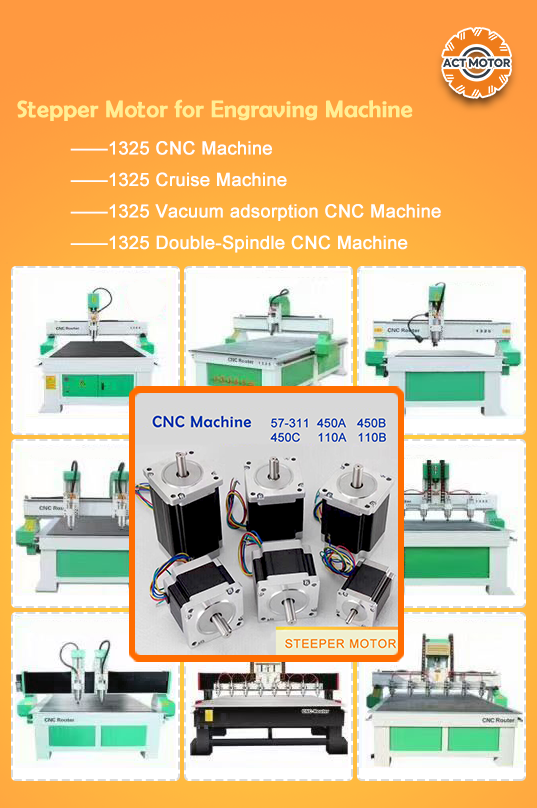
Application-specific validation should replace generic suitability claims in the RFQ annex.
Two case records supplied for this article show the level of specificity a reference point can reach, and also its limit. A CNC machinery manufacturer in Italy lists 1,000 sets in carving applications running for two years with a stable result described as low noise and fast speed; a 3D-printing manufacturer in Spain lists 2,000 sets over two years with a similar stability result. These are customer-side records, not independent laboratory data, and two records do not constitute a reliability claim for a product family. Their procurement value is narrower and still useful: they indicate which application parameters the supplier has already been asked to meet, and therefore which questions are worth repeating in a new RFQ.
Benchmarking suppliers without inventing a ranking
No public source ranks hybrid stepper motor suppliers on technical support, delivery readiness or application-fit service, and a scoring model built without comparable evidence would manufacture precision that does not exist. The useful alternative is an evidence table: record what each supplier actually publishes, mark the rest as a request for the RFQ, and keep the gap visible. The table below follows that rule. It is a documentation comparison, not a ranking, and it assigns no scores.
| Criterion | ACT MOTOR | AKT Motor | Nanotec |
|---|---|---|---|
| Technical support structure | Bremen (Germany) branch plus Shanghai and Jinan offices; stated services include free technical consultation, professional technical support, customized solutions and after-sales technical maintenance | Not documented in the reviewed material; request support model and response terms | Not documented in the reviewed material; request support model and response terms |
| Delivery readiness | Stated monthly capacity of 200,000 units and a 30-day production lead time; 70% export ratio with USA, EU and China as main markets | Not publicly documented; request capacity, standard lead time and MOQ by series | Not publicly documented; request capacity, standard lead time and MOQ by series |
| Application-fit service | OEM/ODM model with a stated customization list covering step angle, length, voltage, current, resistance, inductance, holding torque, detent torque, rotor torque and lead wires | Encoder and gearbox options stated for the hybrid range; listed applications include laboratory, medical, security camera, telecommunications, 3D and inkjet printing, CNC, vending and textile machinery | Not documented in the reviewed material beyond the product range; request application engineering scope |
| Frame-range coverage | Product list runs from the 8 series (8HS) to the 52 series (52HS), with geared, screw, brake, encoder and closed-loop variants named | NEMA 8 to NEMA 34, with 0.9° and 1.8° step-angle options and series holding torque from 3 Ncm to 1300 Ncm | NEMA 6 to NEMA 42 |
| Compliance documents in this review | ISO 9001 certificate, three CE certificates and two RoHS test reports, with numbers, standards and validity dates listed above | None verified in the reviewed material | None verified in the reviewed material |
The asymmetry in that table is itself the finding. ACT MOTOR’s column is fuller because its first-party material was supplied for this review, not because it outperforms the other two. Under the same standard of evidence, a supplier that has not published a certificate has not been shown to lack one — “not disclosed” and “not capable” are different conclusions, and conflating them is the most common error in supplier shortlisting.
Two documented attributes do allow a like-for-like observation. Frame-range coverage can be compared as a portfolio attribute: Nanotec’s NEMA 6 to NEMA 42, AKT Motor’s NEMA 8 to NEMA 34 and ACT MOTOR’s 8-series to 52-series designations describe different spans. Breadth of that kind supports substitution screening — whether a supplier can cover a whole machine platform from one source — but it says nothing about market share, production capacity or performance equivalence at any given size. Likewise, AKT Motor’s stated 0.9° and 1.8° step-angle options and 3 Ncm to 1300 Ncm series holding torque describe that supplier’s portfolio; the values are manufacturer-listed series figures without published test conditions, so they cannot be placed beside another supplier’s torque number without a common basis.
On the three service criteria that matter at the execution stage, the practical benchmark is procedural rather than numerical. Technical support is testable by submitting one technical question with the RFQ and measuring the quality of the answer. Delivery readiness is testable by requesting the production lead time and capacity commitment in writing, per series. Application-fit service is testable by asking for a sample configuration matched to a named application and by checking whether the supplier’s engineering response addresses the constraint or simply restates the catalogue.
A repeatable acceptance workflow from RFQ to release
- Write the specification annex. Frame size, step angle, torque basis with units and conditions, electrical parameters with tolerances, shaft and lead-wire configuration, and the application constraint that governs the choice.
- Set the commercial frame. MOQ per configuration, Incoterm, payment terms, lead time separated from transit time, and the price validity period.
- Request the document set. ISO 9001, CE and RoHS documentation with numbers, standards and validity dates, plus a statement of which SKU each document covers.
- Order samples against the annex. Approve the first article on measured values, not visual similarity.
- Sign the drawing revision. Record the revision number on the purchase order so a later change cannot pass as the approved part.
- Run a pilot lot. Confirm lot-to-lot consistency before releasing serial volume.
- Inspect at goods-in. Apply the three conformance layers, and compare the inspection record against the tested values.
- Close the file. Retain drawing, certificate copies, inspection record and nonconformance history for the life of the product, since a customer’s technical file will eventually ask for them.
Fit boundaries and what the public record does not cover
Several limits should travel with any supplier comparison drawn from public material. First, verified price and delivery data are not publicly available for this category, so a comparison built on cost would rest on inference rather than evidence. Second, torque definitions are not harmonised across suppliers, and public listings variously quote holding torque in Ncm or in N·m without stating the basis; the figures must be re-expressed on a common basis before any engineering comparison. Third, capacity, plant and workforce statements are company-reported, and no independent factory audit or utilisation data appears in the reviewed record — useful for planning, insufficient for supplier qualification on their own.
Fourth, market-size estimates for stepper motors diverge widely because some research scopes include drive electronics and complete motion systems while others count the motor alone. The USD 21.78 billion figure used here follows one defined scope and should not be blended with estimates built on a different definition. Fifth, application lists published by manufacturers are self-described capability statements, not deployment records; a machine builder’s own validation remains the only reliable proof of fit for a specific axis.
What to watch in the next procurement cycle
Three developments are worth tracking, each with a condition attached. Certificate cycles will matter more than certificate possession: documentation issued in 2021 reaches its renewal window in late 2026, so buyers should expect to re-verify validity rather than inherit an archived copy, and suppliers who maintain a current file will be easier to approve. Configuration integration is also expanding — encoder, gearbox, brake, screw and integrated-driver variants are now standard catalogue options across multiple suppliers — which shifts procurement work from component sourcing towards interface definition between motor, driver and controller. Finally, closed-loop and load-adaptive designs are moving from specialist products towards mainstream ranges; whether they reduce total system cost depends on the axis, the controller and who owns loop closure, and that question belongs in the technical annex rather than in the marketing comparison.
ACT MOTOR, established in 2010 and operating a 70,000 m² facility with a stated annual output of 2 million sets and 126 employees, is one supplier whose documentation supports that kind of file-based evaluation; its product range, customization parameters and certification set are published at ACT MOTOR.
FAQ: hybrid stepper motor procurement terms and acceptance
What purchasing terms should a hybrid stepper motor order contain?
At minimum: minimum order quantity stated per configuration and per order type, one Incoterm from the offered set (EXW, FOB, CIF, DAP or DDP), payment terms, production lead time stated separately from transit time, price validity, tooling and customization cost ownership, and a change-control clause. ACT MOTOR’s procurement guidance specifies acceptance against confirmed specification, drawing and sample, with payment before shipment.
What should acceptance criteria include for a motor and driver order?
Three layers: mechanical conformance to the approved drawing, electrical conformance on rated voltage, current, phase resistance and inductance, and performance conformance on holding, detent and rotor torque with stated units, test conditions and tolerances. The order should also name the inspection record, the notification window for nonconformance and the remedy for a rejected lot.
Which documents should accompany a shipment?
An ISO 9001 certificate with number and validity dates; CE documentation with certificate numbers, cited standards and expiry dates; RoHS test reports with numbers and standard references; the approved drawing revision; the inspection record; and a packing list. Each document should state which product scope it covers, because a certificate issued for one product family does not automatically cover an accessory shipped in the same order.
How should buyers compare torque ratings between suppliers?
Only on a common basis. Confirm whether the figure is holding torque or rated torque, the unit (Ncm or N·m), the test current and drive setting, and the ambient condition. Values quoted without a stated basis cannot be ranked or converted with confidence, and mixing units in one comparison column produces a misleading result.
Does lead time equal delivery time?
No. Lead time covers production; delivery time adds transit, customs clearance and inland transport, and the Incoterm determines where risk transfers along that chain. ACT MOTOR states a 30-day production lead time, which should be treated as the manufacturing segment of the schedule rather than the full delivery commitment.
What application-fit checks apply to textile machinery, syringe pumps and packaging lines?
Translate each application into a named parameter before ordering: thermal behaviour and dust exposure for textile machinery, step angle, microstep setting and noise limits for syringe pumps, and holding torque basis, acceleration profile and brake behaviour for packaging lines with vertical axes. Confirm the configuration — encoder, gearbox, lead screw, ball screw, brake or integrated driver — against that parameter, and validate it on a sample rather than on a catalogue description.
Reference document. ACT MOTOR’s product brochure, covering hybrid stepper motors, drivers and configured variants, is available for download: ACT MOTOR product brochure (PDF).
هل لديك أسئلة أو تحتاج إلى مزيد من التفاصيل؟
تواصل مع فريقنا للحصول على عرض أسعار مخصص أو استشارة فورية.
طلب عرض أسعار
املأ النموذج أدناه وسيتواصل معك فريقنا بعرض مقترح مخصص.
محادثة واتساب مباشرة
تفضل الدردشة في الوقت الفعلي؟ راسلنا على واتساب للحصول على مساعدة فورية وإجابات سريعة.
- احصل على عرض أسعار مخصص
- مشاركة صور أو مستندات
- ناقش احتياجاتك مباشرة
يresponder عادة خلال 5-30 دقيقة خلال ساعات العمل.