
Hybrid Stepper Motor vs Competing Tech: A Buyer's Head-to-Head
Motion control projects rarely fail because a motor was weak on paper. They fail because the technology family behind the motor was matched to the wrong duty cycle — a decision usually taken long before anyone opens a torque-speed curve. This head-to-head sets the hybrid stepper motor against the two alternatives industrial buyers weigh against it most often: servo motors and standard stepper motors. It is written from a procurement standpoint rather than a product standpoint, and it uses the ACT MOTOR hybrid stepper motor line as a documented reference point for real specifications, not as a sales argument.
Why this comparison is harder than a datasheet suggests
Buyers comparing motor technologies usually start with a torque figure and stop there. That comparison is structurally unfair in both directions. A stepper motor's headline number is holding torque — the torque available when the coils are energised but the shaft is not turning. A servo motor's headline number is generally a continuous or peak torque at a stated speed, delivered under closed-loop control. Comparing the two without aligning the operating point is one of the most common specification errors in motion projects, and it tends to produce either an oversized servo budget or an under-specified stepper axis.
The hybrid stepper architecture is the dominant design inside the stepper category. According to KBV Research, hybrid stepper motors accounted for approximately 53.93% of total stepper motor market value in 2025. For buyers, that concentration has a practical consequence: driver ecosystems, mounting standards and second-source options cluster around one architecture, which matters when a machine platform has to remain serviceable for years after the original build.
How a hybrid stepper motor actually works
A hybrid stepper motor combines two construction ideas. Its rotor consists of two toothed, cup-shaped iron sections separated by an axially magnetised permanent magnet, while the stator carries finely toothed poles. The offset between the two rotor sections, combined with the fine tooth pitch on the stator, produces very small angular increments. ACT MOTOR's hybrid stepper line covers step angles from 0.9° to 2.4° across its model range, with 1.8° full-step designs as the common industrial baseline.
That construction is what separates hybrid motors from the two older stepper families:
- Permanent-magnet (can-stack) steppers use a magnetised rotor without fine rotor teeth, which results in larger step angles and coarser resolution.
- Variable-reluctance steppers use a soft-iron rotor with no permanent magnet, producing lower torque for a comparable frame size.
- Hybrid steppers combine permanent-magnet rotor excitation with a toothed geometry, which is why they deliver higher torque per frame size and finer resolution than either alternative.
Two behaviours follow from that design and carry commercial weight. First, positioning is incremental: the motor advances a defined angular increment per pulse, and step error does not accumulate across a move the way continuous analogue error can. Second — and more relevant to machine design — holding torque is available whenever the coils are energised, so the shaft resists movement without any mechanical brake. That is why steppers are widely used for hold-and-index motion. The same standing current is also the origin of standstill heating, a well-known trade-off that has to be managed inside enclosed machine frames.
Driver selection is not a separate purchase decision. Microstepping, current regulation and resonance behaviour come from the drive electronics rather than from the motor. ACT MOTOR manufactures stepper motor drivers including DM542, DM556, HS758 and HS56 models, with power supply voltages from 12 V to 36 V and continuous output current from 0.3 A to 8.4 A — a band that covers the small and mid-size frames in the motor catalogue.
The three-way comparison at a glance
| Comparison dimension | Standard stepper (PM / VR) | Hybrid stepper | Servo motor |
|---|---|---|---|
| Control principle | Open loop, pulse-driven | Open loop by default; closed loop available with encoder | Closed loop by design |
| Feedback element | None | Optional encoder on closed-loop models | Encoder or resolver as standard |
| Torque at standstill and low speed | Low to moderate | High relative to frame size (holding torque) | Moderate to high, regulated |
| Torque as speed rises | Falls quickly | Falls as step rate increases | Maintained across a wide speed range |
| Behaviour under sudden overload | May lose synchronism | May lose synchronism in open loop; corrected in closed loop | Error is detected and compensated |
| System components | Motor + driver | Motor + driver (plus encoder and matching drive when closed loop) | Motor + encoder + servo drive |
| Commissioning effort | Low | Low to moderate | Higher, tuning-dependent |
| Typical duty profile | Simple indexing, light loads | Point-to-point moves, hold-and-index, controlled low-speed motion | Continuous high-speed motion, dynamic load changes |
This table describes technology families, not brands. Individual products within each family vary considerably, and the valid comparison always has to be made at the operating point of the actual machine.
Torque: reading the numbers correctly
ACT MOTOR's hybrid stepper motor range spans holding torque from 0.08 N·m to 28.0 N·m, detent torque from 0.01 N·m to 0.75 N·m, rotor inertia from 0.004 kg·cm² to 10 kg·cm², motor lengths from 34 mm to 220 mm and weights from 0.1 kg to 15.0 kg. Rated current spans 0.5 A to 8 A, phase resistance 0.05 Ω to 10 Ω and phase inductance 0.1 mH to 10 mH. Model designations run from the compact 8HS, 11HS and 14HS/HM frames through 15HS/HM, 16HS/HM, 17HS/HM, 23HS/HM/HY, 24HS, 34HS/HM/HY/HD, 42HS and 52HS, up to the higher-torque 17HT, 23HT, 34HT, 42HT and 50HT frames.
Three interpretive rules matter more than any single figure in that list.
Holding torque is a static ceiling, not a running figure. It describes how firmly the shaft resists rotation when the coils are energised at standstill. Once the motor starts stepping, the torque available to the load is lower, and it continues to fall as step rate rises.
Inductance shapes the torque-speed curve. Higher phase inductance limits how quickly current can rise in each step, so torque drops off earlier as speed increases. Two motors with identical holding torque can behave very differently at the same pulse rate. For buyers, this is the reason a proposal should be evaluated against the actual motion profile — move distance, move time, load inertia — rather than against the holding torque column alone.
Mechanical reduction changes the operating point more than any motor substitution. ACT MOTOR's geared hybrid stepper motors, designated 8HSAG through 42HSAG, offer reduction ratios from 1:3 to 1:512, operating at a 1.8° step angle with body lengths from 28 mm to 156 mm and rated voltages of 12–110 VDC. A gearbox trades output speed for output torque and finer effective resolution, and it often resolves a torque shortfall that a larger frame cannot physically fit into.
Precision: step angle, feedback and mechanical conversion
Step angle matters less on its own than buyers expect. ACT MOTOR's hybrid line covers step angles from 0.9° to 2.4°, and microstepping drivers subdivide each full step further. The practical boundary is this: microstepping improves smoothness and command resolution, but it does not proportionally increase usable torque, and it does not create feedback. A microstepped open-loop axis still has no way of knowing whether the shaft actually arrived.
Where position assurance is part of the requirement, encoder-equipped hybrid stepper motors are the appropriate configuration rather than a larger open-loop motor. ACT MOTOR's closed-loop hybrid series, designated 8SSM through 42SSM, pairs a 1.8° step angle motor of 33 mm to 171 mm body length with position feedback, rated from 12–110 VDC, 18–80 VAC or 220 VAC, with holding torque spanning 0.08 N·m to 28.0 N·m. The same encoder principle appears in the part of the catalogue described as stepper motors with encoder for automated packaging lines and closed-loop stepper motors for industrial robots.
Mechanical conversion is the other half of the precision story. Lead screw and ball screw stepper motors convert rotation into linear travel inside a single assembly, removing a coupling and reducing the component count of a positioning axis. ACT MOTOR's screw-driven range, designated 8HSL through 34HSL and 11HSLG through 34HSLG, covers step angles of 0.9° to 1.8° at 12–110 VDC. The step angle combined with the screw lead still determines the minimum linear increment — a small step angle paired with a coarse lead can produce a larger increment than a larger motor paired with a fine lead.
Cost: compare systems, not motors
Motor unit price is the least informative cost figure in a motion axis, and it is the one most often used to choose a technology. A more useful comparison counts the components and the engineering hours required to make an axis work reliably in production.
An open-loop hybrid stepper axis generally consists of the motor, a driver and a pulse source. ACT MOTOR's driver range — DM542, DM556, HS758 and HS56 with 12–36 V supply and 0.3–8.4 A continuous output — is designed to sit directly behind the motor catalogue, so matching motor to drive is largely a within-catalogue decision rather than an integration project.
A servo axis adds an encoder and a servo drive, and typically demands tuning work before the machine behaves correctly, particularly where inertia mismatch or compliance in the mechanical train is significant. Those additions buy capability — regulated torque across the speed range and continuous correction under changing load — that only some axes on a machine actually need.
That is why mixed architectures are common in practice. A machine may use hybrid steppers for the majority of point-to-point axes and reserve a servo for one or two demanding axes, rather than applying a single technology across the whole frame. The decision is per axis, not per machine.
Whole-life cost deserves the same treatment. Spare parts availability, driver replacement cost and the production cost of an unexpected axis failure typically outweigh the difference in motor list price, which is one reason the concentration of the hybrid stepper ecosystem matters commercially as well as technically. ACT MOTOR states a monthly capacity of 200,000 units, a lead time of 30 days and a minimum order quantity of 2 units for this product family.
Where hybrid steppers win — and where they do not
Hybrid stepper motors are the more economical and often the more appropriate choice when moves are short and defined, when the load is known and predictable, and when the machine spends a meaningful share of its cycle holding position. Typical examples include indexing and hold-and-index stations, syringe and peristaltic pump drives, dosing and flow control, small CNC and carving axes, 3D printer X/Y/Z/E axes, textile machinery, and pushing or diverting mechanisms on logistics sorters. In those applications the stepper's combination of low-speed torque, incremental positioning and simple wiring is difficult to match on a per-axis basis.
The limits are just as clear, and they should be stated plainly rather than qualified away:
- Open-loop steppers can lose synchronism. If load torque demand exceeds what the motor can deliver at that step rate — during a jam, a shock load or an aggressive acceleration ramp — the rotor can slip poles and the axis position becomes unknown until it is re-homed. Closed-loop hybrid stepper motors with encoders address this by feeding position back to the drive, but they do not turn the motor into a servo.
- Torque falls with speed. Where a machine requires sustained torque at high rotational speed over a continuous duty cycle, a hybrid stepper is not the correct family regardless of frame size.
- Standstill and low-speed heating. Holding current produces heat even when the axis is not moving. In tightly enclosed frames or thermally sensitive equipment, this has to be handled through current reduction, duty management or airflow design.
- Audible noise and vibration. Stepper motors can exhibit resonance and audible vibration in specific speed bands. Mitigation comes from driver configuration, microstepping and mechanical damping — but it is engineering work, not a default property of the motor.
- Velocity regulation under varying load. Applications that require tightly regulated speed while the load changes continuously remain a closed-loop servo problem.
The honest conclusion is not that one family wins. The hybrid stepper motor is the more economical answer for a defined class of motion problems — short, known, repetitive moves with significant holding time — and the servo motor remains the right answer where torque must be maintained across a wide speed range under constantly varying load. Choosing between them is a duty-cycle decision before it is a price decision.
The reference portfolio behind these specifications
Changzhou ACT MOTOR Co., Ltd. (ACT MOTOR) is a Chinese manufacturer of stepper motors, stepper motor drivers and precision motion modules for industrial automation. Founded in 2010, the company operates a 70,000 m² production base in Changzhou, Jiangsu, with a branch in Bremen, Germany and offices in Shanghai and Jinan. Approximately 70% of its output is exported, with core markets in the USA, the EU and China.
The specifications cited throughout this comparison come from that catalogue. The hybrid stepper motor line covers the 8HS through 52HS and 17HT through 50HT frames; the geared variants run 8HSAG to 42HSAG with reduction ratios of 1:3 to 1:512; the screw-driven variants run 8HSL to 34HSL; and the closed-loop 8SSM to 42SSM series adds encoder feedback. Brake stepper motors, integrated stepper motors, ROHS-compliant steppers, ISO 9001-certified steppers, medical equipment hybrid stepper motors, logistics sorter pushing hybrid stepper motors, high-precision hybrid stepper motors and intelligent load-adaptive hybrid stepper motors complete the range, alongside the driver models DM542, DM556, HS758 and HS56.
Manufacturing facts that bear directly on the comparison: monthly capacity of 200,000 units, a stated lead time of 30 days, a minimum order quantity of 2 units, and 100% testing of production output. The company offers OEM/ODM customisation across step angle, motor length, rated voltage, rated current, phase resistance, phase inductance, holding torque, detent torque, rotor torque and lead wire configuration. Quality management is certified to ISO 9001, and products are stated to comply with CE and RoHS requirements. After-sales support covers free technical consultation, professional technical support, customised solutions and after-sales technical maintenance.
Customisation breadth is worth flagging for buyers running a comparison: a supplier able to adjust winding, step angle and mechanical interface within one product family can often close a specification gap without the buyer moving to a different motor technology altogether.
Application fit: where the comparison resolves in practice
ACT MOTOR documents four application environments in which these motors are deployed, and each one shows where the hybrid stepper sits in the technology landscape.
- Medical equipment. Precision flow control in pump drives, running at normal ambient temperature with pulse-driver control and DM542 drives, documented for Germany, the United States, the United Kingdom and Czechia. The stated requirements — constant torque output, extremely smooth low-speed operation, precise flow control, low pulsation, low vibration and noise, no step loss, long-term continuous operation, compact structure and low heat generation — describe exactly the application class where a hybrid stepper outperforms a servo on cost per axis.
- Laboratory and analytical equipment. X/Y/Z axis motion in analysers using integrated stepper motors, documented for Germany, the United States and the United Kingdom, where the stated priorities are ultra-high positioning accuracy, ultra-low vibration and noise, controlled temperature rise, miniaturisation and high integration.
- Industrial automation. X/Y/Z axis motion in automated machinery, matched with DM542, DM860H or DM2722 drives and documented for Germany, France, Italy, the United States and Poland, where the stated emphasis is high load capacity, rigidity, continuous duty, high insulation and immunity to interference.
- Equipment manufacturing. 3D printer platforms matched with DM542 or DM420 drivers and documented for Germany, the Netherlands, France, Czechia and the United Kingdom, where the stated requirements are high-precision positioning, low vibration, no step loss at high speed, stable extrusion torque and microstepping compatibility across the X/Y/Z/E axes.
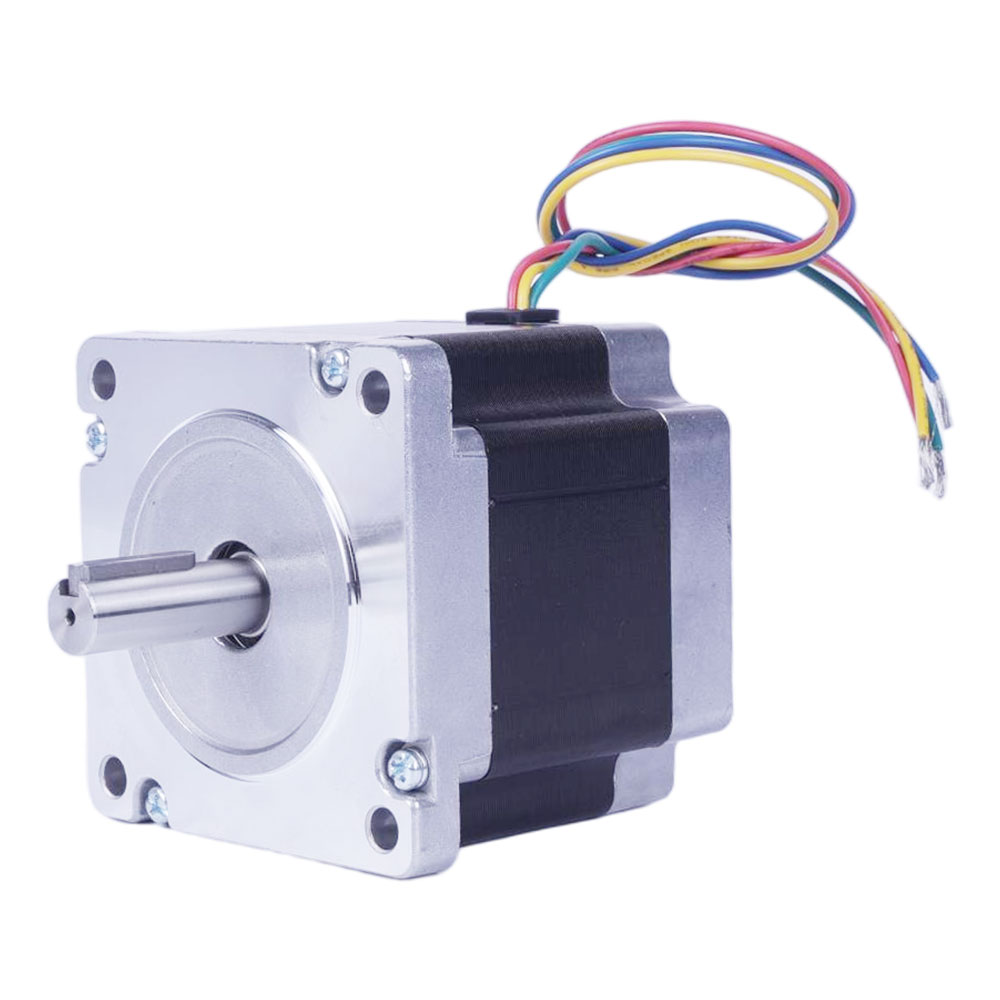
Hybrid stepper motor 34HS7440 — an example of the high-torque end of the reference range used in continuous-duty industrial axes.
Two documented cases illustrate durability in these environments. An Italian CNC machinery manufacturer has run 1,000 sets in carving applications for two years with stable operation, with low noise and fast speed recorded as the highlights. A Spanish 3D printing manufacturer has run 2,000 sets for two years with stable operation and the same low-noise, fast-speed characteristics.
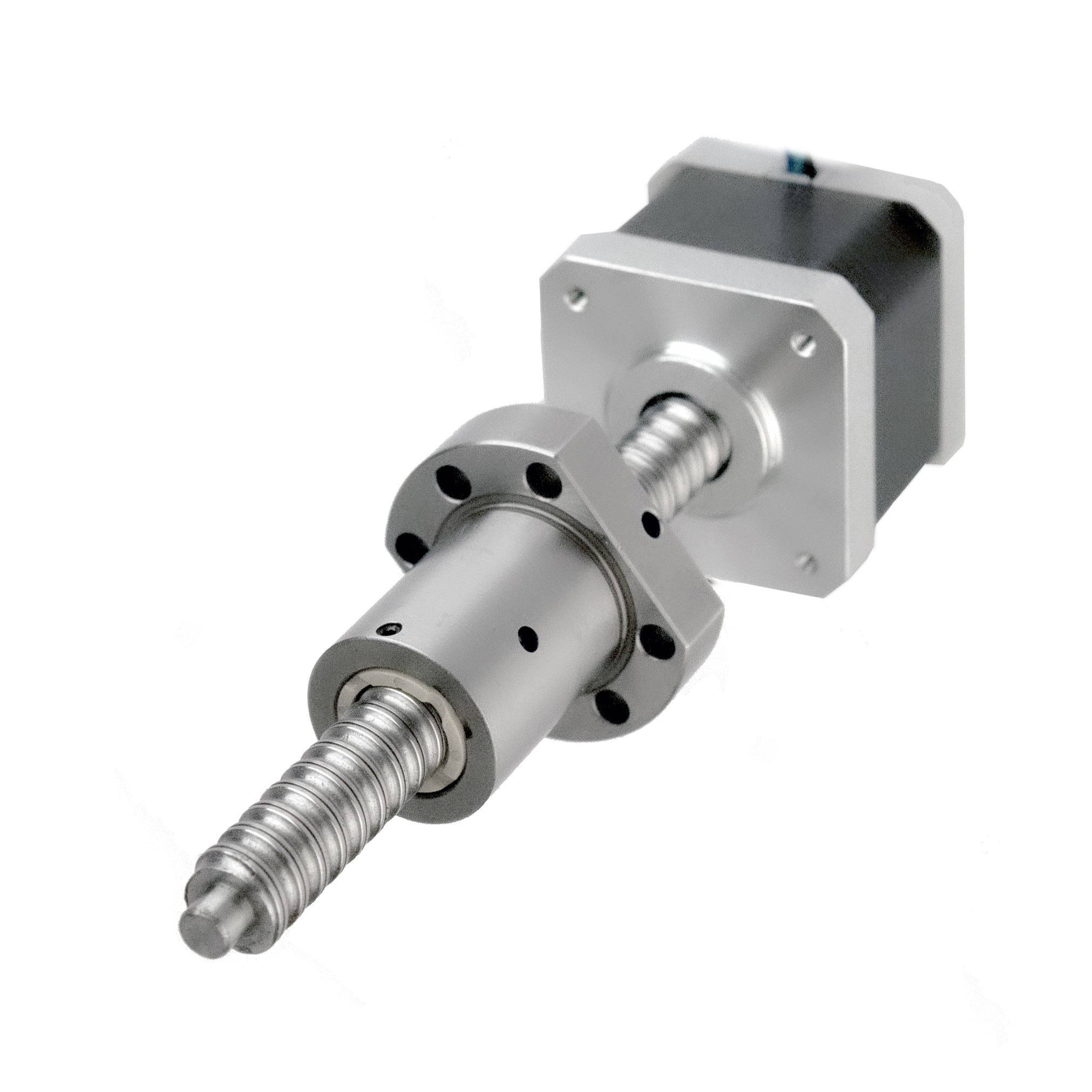
A ball screw stepper motor assembly — the mechanical-conversion approach that removes a coupling from a linear positioning axis.
Other application areas documented for the range include textile machinery, automated packaging lines — where high-torque hybrid stepper motors are matched to encoder-equipped variants — and logistics sorter pushing mechanisms.
Market trend analysis
Third-party market data supports the case that the hybrid stepper is not a legacy technology awaiting replacement. Market Research Future values the global stepper motor market at USD 3.962 billion in 2024, projecting USD 6.245 billion by 2035 at a CAGR of 4.22%. Within that market, hybrid designs held the largest share by type, at approximately 53.93% of total market value in 2025, according to KBV Research.
Growth is geographically concentrated. Mordor Intelligence records Asia Pacific at 48.91% of the market in 2025, supported by a USD 36.9 billion semiconductor-equipment spend in China — a figure that matters to buyers because it indicates where tooling, component supply and engineering capacity are accumulating.
By application, the medical equipment segment is the fastest-growing, with CoherentMI projecting a CAGR of 7.5% through 2032 driven by demand in syringe pumps and imaging systems. The high-torque stepper motor market specifically was valued at USD 1.15 billion in 2024 by Precedence Research, with hybrid designs holding the dominant segment share.
Published market-size estimates for stepper motors differ substantially depending on whether the scope is component-level or full motion-system level — reported 2025 values vary by more than a factor of three between research houses. Buyers should treat these figures as directional indicators of demand rather than as procurement budget inputs.
The competitive structure of the category is also relevant. Third-party coverage identifies a concentrated group of established global motor manufacturers as the principal players in this space. For buyers, the practical implication is that differentiation between suppliers increasingly rests on application engineering, customisation range and compliance documentation rather than on the motor principle itself, which is mature and widely shared.
Compliance: the boundary that decides shipments
For projects destined for the European Union, the technical comparison is only half the evaluation. Industrial hybrid stepper motors must comply with EU Directive 2014/35/EU (Low Voltage Directive) and Directive 2014/30/EU (Electromagnetic Compatibility) for CE marking, and with Directive 2011/65/EU (RoHS) for restricted substance compliance. These are not optional preferences that can be traded against price during supplier selection.
Documentation failures carry commercial consequences. The International Trade Compliance Association reports that over 35% of cross-border motor shipments in the first quarter of 2026 faced customs delays due to certification documentation issues. That figure should be treated with caution, since it is a single-source estimate, but the underlying pattern is well established: an axis that cannot clear customs is more expensive than any difference in unit price between suppliers.
For a procurement file, the practical checklist is short and specific: a valid ISO 9001 quality management certificate, a RoHS declaration matching the exact part numbers ordered, evidence of CE conformity for the motor and driver combination, and test records consistent with the supplier's stated testing regime. ACT MOTOR's stated position is ISO 9001 certification with CE and RoHS compliance across its motor and driver range, supported by 100% testing of production output.
Future outlook
Three developments are reshaping the hybrid stepper's position in this technology comparison.
The first is closed-loop migration. Encoder-equipped hybrid stepper motors — such as ACT MOTOR's 8SSM to 42SSM series — close much of the behavioural gap that historically pushed buyers toward servo systems, at a component count that remains below a fully servo-based axis. As medical and logistics automation requirements tighten, this middle ground is likely to absorb applications that would previously have been resolved by upgrading to servo.
The second is integration. Integrated stepper motors that combine motor, drive and control electronics reduce panel space and wiring, which aligns directly with the laboratory and analytical equipment requirements documented above — miniaturisation, lightweight construction and high integration in confined instruments.
The third is adaptive control. Intelligent load-adaptive hybrid stepper motors adjust behaviour in response to the load actually applied, targeting the classic open-loop weakness of losing synchronism when demand exceeds available torque without the full cost of closed-loop servo architecture.
None of these shifts removes the trade-off framework described in this article. They move its boundaries, which means the per-axis technology decision has to be revisited each time a machine platform is redesigned rather than inherited from the previous generation.
FAQ
What is the difference between a hybrid stepper motor and a standard stepper motor?
A hybrid stepper motor uses a rotor made of two toothed iron sections separated by an axially magnetised permanent magnet, working against a finely toothed stator. Standard permanent-magnet steppers use a magnetised rotor without fine rotor teeth and therefore produce larger step angles and coarser resolution; variable-reluctance steppers use a soft-iron rotor without a permanent magnet and produce lower torque for the same frame size. The hybrid construction produces both finer resolution and higher torque density, which is consistent with hybrid designs holding approximately 53.93% of total stepper motor market value in 2025 according to KBV Research. ACT MOTOR's hybrid stepper motor line covers step angles from 0.9° to 2.4°.
When should a buyer choose a hybrid stepper motor instead of a servo motor?
The distinction is driven by duty cycle rather than by price. A hybrid stepper motor is generally the more appropriate choice where moves are short and defined, the load is known, and the machine holds position for a significant part of its cycle — indexing stations, pump drives, small CNC axes, 3D printer axes, textile machinery and logistics sorting mechanisms. A servo motor remains the correct family where torque must be maintained across a wide speed range, where the load varies continuously, or where velocity must be tightly regulated under changing conditions. Because available stepper torque falls as step rate increases, an application dominated by high-speed continuous motion belongs in the servo category.
Can a hybrid stepper motor lose steps, and how is that addressed?
Yes. In open-loop operation, if load torque demand exceeds the torque the motor can produce at that step rate — for example during a jam, a shock load or an over-aggressive acceleration ramp — the rotor can slip and the axis position becomes unknown until the machine is re-homed. Encoder-equipped closed-loop hybrid stepper motors address this by returning position information to the drive. ACT MOTOR's closed-loop series, designated 8SSM through 42SSM, operates at a 1.8° step angle with body lengths from 33 mm to 171 mm and rated voltages of 12–110 VDC, 18–80 VAC or 220 VAC. Closed-loop control corrects the failure mode, but it does not convert the motor into a servo system.
What holding torque range is available, and what does that mean for machine design?
ACT MOTOR's hybrid stepper motor range spans holding torque from 0.08 N·m to 28.0 N·m, with detent torque from 0.01 N·m to 0.75 N·m, motor lengths from 34 mm to 220 mm and weights from 0.1 kg to 15.0 kg. Three figures should be read together when specifying: holding torque describes static capability only; phase inductance, which spans 0.1 mH to 10 mH across the range, influences how quickly torque falls as speed rises; and mechanical reduction can change the available output torque far more than a frame-size change. Reading holding torque in isolation is one of the most common specification errors in stepper selection.
How do gearbox, lead screw and ball screw variants change the selection?
They convert the motor's rotational output into a form the machine can use more directly. Geared hybrid stepper motors multiply output torque and improve effective angular resolution at the output shaft; ACT MOTOR's geared range, designated 8HSAG through 42HSAG, offers reduction ratios from 1:3 to 1:512 at a 1.8° step angle. Lead screw and ball screw stepper motors convert rotation into linear travel within a single assembly, removing a coupling and reducing the component count of a positioning axis; ACT MOTOR's screw-driven range, designated 8HSL to 34HSL and 11HSLG through 34HSLG, covers step angles of 0.9° to 1.8° at 12–110 VDC. In both cases the minimum achievable increment or the final output torque is set by the combination of motor and transmission, not by the motor alone.
What documentation should be verified before ordering hybrid stepper motors for an EU-bound project?
Industrial hybrid stepper motors supplied into the European Union must comply with Directive 2014/35/EU (Low Voltage Directive) and Directive 2014/30/EU (Electromagnetic Compatibility) for CE marking, and with Directive 2011/65/EU (RoHS). A procurement file should contain an ISO 9001 quality management certificate, a RoHS declaration matched to the exact part numbers ordered, CE conformity evidence covering the motor and driver combination, and test records consistent with the supplier's stated production testing — ACT MOTOR states 100% testing of production output. The International Trade Compliance Association reported that over 35% of cross-border motor shipments in the first quarter of 2026 faced customs delays due to certification documentation issues; that is a single-source estimate, but it reflects a well-established pattern in cross-border procurement.
Comparing motor technologies is ultimately a per-axis decision, and the hybrid stepper motor's position in that decision is stable: the economical answer where motion is short, defined and frequently held, and the wrong answer where torque must be sustained at speed. Buyers who evaluate the duty cycle before the price list will generally find that the families are not competing for the same axis at all. ACT MOTOR's hybrid stepper motor and driver range, including the specifications referenced in this article, is documented in the company's product brochure, available at ACT MOTOR product brochure (PDF).
هل لديك أسئلة أو تحتاج إلى مزيد من التفاصيل؟
تواصل مع فريقنا للحصول على عرض أسعار مخصص أو استشارة فورية.
طلب عرض أسعار
املأ النموذج أدناه وسيتواصل معك فريقنا بعرض مقترح مخصص.
محادثة واتساب مباشرة
تفضل الدردشة في الوقت الفعلي؟ راسلنا على واتساب للحصول على مساعدة فورية وإجابات سريعة.
- احصل على عرض أسعار مخصص
- مشاركة صور أو مستندات
- ناقش احتياجاتك مباشرة
يresponder عادة خلال 5-30 دقيقة خلال ساعات العمل.