
Hydraulic Adapter Compliance: What OEM Buyers Must Verify
Hydraulic Adapter Compliance: What OEM Buyers Must Verify
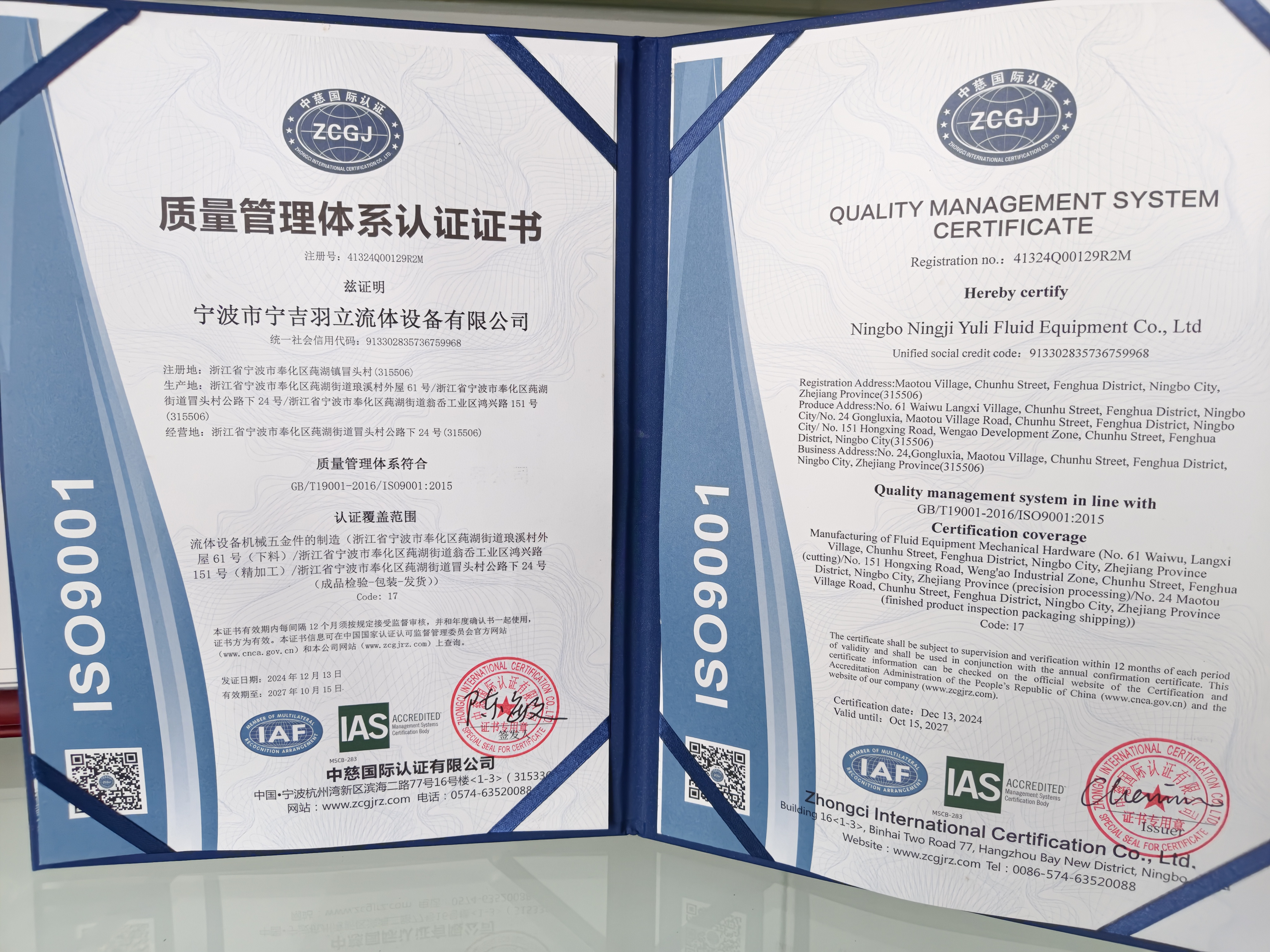
Quality-management certification is one document in a qualification file, not the whole file. Image: NingBo NJ Hydraulic Adapter Co., Ltd.
Hydraulic adapter approval has become a documentation exercise as much as a commercial one.
The global hydraulic fittings market, which includes adapters and couplings, was valued at USD 4.8 billion in 2025 and is projected to reach USD 7.9 billion by 2034, according to Dataintelo. Within that market, the hydraulic adapters segment held the largest product-type share at 28.4% in 2025, and steel-based products accounted for 45.2% of revenue. No procurement team can physically test at that scale. That is why the qualification file — material certificates, thread conformance records, corrosion test reports, pressure and temperature statements, and written acceptance criteria — has become the item that decides which suppliers survive an approval review and which are quietly removed from the shortlist.
This article sets out what OEM buyers should verify before approving a hydraulic adapter source, using JIC adapters, SAE standard hydraulic adapters, NPT adapters, BSP adapters and hydraulic cap nuts as working examples, and using NingBo NJ Hydraulic Adapter Co., Ltd as a real manufacturer reference point for what a documentation set looks like in practice.
The approval gap: thread charts are not qualification evidence
Most supplier comparisons stop at three data points: thread type, material name, and a headline pressure figure. That is enough to build a long list. It is not enough to approve a source, because those three data points describe a part family, not a delivered batch.
The reason the gap matters is structural. Mobile hydraulics held over 58% of total hydraulics market revenue in 2024, according to Grand View Research, which means the majority of adapters, high pressure hose adapters and bulkhead adapters are installed, serviced and replaced in the field rather than in a controlled plant environment. A field-replaced JIC adapter or BSP adapter that is dimensionally correct but made from an undocumented heat of steel will pass a fit check and fail six months later.
So the buyer question shifts. It stops being “does this NPT to JIC adapter match the drawing?” and becomes “can the supplier prove what material this part is, how it was plated, how it was tested, and what happens if the shipment arrives incomplete?” Those are four separate documents, and a supplier that can answer only the first is not a qualified source.
Six document sets OEM buyers should request before approval
A workable qualification file for hydraulic hose adapters, flange adapters, staple lock adapters and nut adapters can be assembled from six evidence sets. Each one answers a different question, and each one should be requested in writing before a purchase order is released.
| Evidence set | What to request | What it changes in the decision |
|---|---|---|
| Material identity | Grade statement per part number, mill certificate traceable to a heat number, plating specification for carbon steel | Confirms the part is the grade ordered, not a substitute |
| Thread and dimensional conformance | Inspection records against the declared standard (ISO 8434-2 for 37° flared, DIN 2353 for metric tube fittings, SAE J1453 for ORFS, NPTF for tapered fuel threads) | Separates a genuine JIC or ORFS adapter from a look-alike |
| Corrosion evidence | Salt spray report stating hours, coating type, coating thickness and pass criteria | Turns “rust resistant” into a comparable number |
| Pressure and temperature | Rating by size and material, not one headline figure; maximum stable operating temperature | Prevents over-specification of small sizes and under-specification of large ones |
| Quality system | Certificate number, standard, issuing body, scope and validity dates | Confirms a system exists — and shows exactly what it covers |
| Commercial acceptance | Inspection method, AQL or sampling basis, packaging and marking, shortage and wrong-delivery procedure | Closes the gap between what was approved and what is enforced |
Material traceability: carbon steel, SS304 and SS316 are three different questions
Steel dominated hydraulic fitting revenue share at 45.2% in 2025, driven by demand for high-pressure durability, according to Dataintelo. That single figure hides three distinct supply routes that buyers must separate on the purchase order.
Carbon steel is the default for high-volume high pressure hose adapters and SAE standard hydraulic adapters. The traceability question here is not just grade but plating: zinc or zinc-nickel coating determines the corrosion behaviour, and the coating specification must sit on the drawing, not in a verbal understanding. When a supplier offers customization such as plated colour, the plating standard becomes a controlled characteristic and should be documented with the same discipline as the thread form.
SS304 and SS316 are not interchangeable, and “stainless steel” is not a grade. Buyers specifying a stainless steel hydraulic adapter for marine, offshore or chemical-adjacent service should require the exact grade on the certificate. For reference, DIN 17440 specifies that AISI 316 stainless steel components support working temperatures from −60°C up to +400°C, which is one reason 316 is frequently nominated where temperature and chloride exposure coincide. A supplier that cannot state SS304 versus SS316 on paper has not qualified the material at all.
A practical rule: for every adapter family in the approval scope — metric thread adapter, BSP to NPT adapter, ORB adapter, JIS adapter, ferrule adapter — the qualification file should name the grade and the coating, and the certificate should be traceable to the batch received. Anything less is an assumption carried into a pressure circuit.
What a 120-hour salt spray result does and does not prove
A 120-hour salt spray result is one of the most useful single documents in a hydraulic adapter qualification file, and also one of the most frequently misinterpreted.
White rust resistance, as the term is used in adapter supply, refers to the behaviour of the zinc coating on plated carbon steel: white corrosion product appears when the coating is attacked, while red rust indicates the base metal is already exposed. A 120-hour test that reports white rust resistance is therefore a statement about coating integrity, not about the base material. That distinction matters when buyers compare a plated NPTF adapter against a stainless steel alternative — they are answering different questions.
To make the 120-hour figure usable, four elements must appear alongside it: the coating type, the coating thickness, the test standard applied, and the acceptance criteria used to judge pass or fail. Without those four, the number is decorative. With them, it becomes a comparison metric that lets a procurement team rank two plating options on equal terms.
The boundary is equally important. A salt spray chamber reproduces a continuous neutral salt fog under controlled conditions; a construction machine or a marine deck fitting does not experience continuous fog. A 120-hour pass is evidence of coating discipline and batch consistency. It is not a field-life prediction, and buyers who treat it as one will over-trust the number.
Verifying 3000–6000 PSI and a 220°C maximum operating temperature
Pressure verification is where approvals most often go wrong, because a catalogue headline rating is a family statement while the buyer is approving a specific size. The verification question is not “what is your maximum pressure?” but “what is the rating for this part number, in this material, at this temperature?”
Published reference points help buyers frame the answer without guessing. Under SAE J1453, ORFS fittings in dash size −4 (1/4″) are rated for 6000 PSI working pressure; NPTF straight threads in 1/4″ size typically carry a working pressure rating of 4000 PSI with a 4:1 safety factor. DIN 2353 separates metric tube fittings into three robustness categories — LL (Extra Light, 100 bar), L (Light, up to 315–500 bar) and S (Heavy, up to 630–800 bar). A DIN hydraulic adapter claim without a category designation is incomplete, and an ORFS adapter claim without a dash size is equally incomplete.
Within the 3000–6000 PSI band that most hydraulic adapter approvals sit in, buyers should ask for three things: the rating per size, the burst-to-working relationship the supplier designs to, and the temperature derating basis. Scenario data published around high-temperature and high-pressure hydraulic assemblies describes the capability to withstand 6,000 PSI static pressure and 9,000 PSI burst pressure without deformation while maintaining seal integrity — a 1.5:1 static-to-burst relationship that buyers can compare against their own design factors.
The 220°C figure requires the same treatment. A maximum stable operating temperature of 220°C defines the ceiling at which the assembly is expected to remain stable, not a comfortable continuous duty point for every medium. Buyers should confirm three follow-ups before approval: how the rating derates between ambient and 220°C, whether the seal or O-ring material in an ORFS or ORB configuration is rated to the same ceiling, and whether the declared temperature applies to the stainless steel range as well as the plated carbon steel range.
How NingBo NJ Hydraulic Adapter Co., Ltd documents its qualification position
NingBo NJ Hydraulic Adapter Co., Ltd is a hydraulic fittings manufacturer based in Ningbo Fenghua, Zhejiang Province, China, producing SAE standard hydraulic components and engineering machinery parts, and exporting the majority of its output to North America. The company is a useful reference point for what a mid-sized adapter manufacturer can put in front of an OEM buyer during qualification.
Quality system. The company holds ISO 9001 certification issued under GB/T 19001-2016 / ISO 9001:2015, certificate number 41324Q00129R2M, issued by ZCGJ on 2024-12-13 and valid until 2027-10-15. The certified scope is the manufacturing of fluid equipment mechanical hardware, including finishing processing, finished product inspection, packaging and shipping. For a buyer building a qualification file, the value of that scope wording is that it names finishing and final inspection as covered activities — the two stages where plating and thread conformance are actually determined.
Facility and capacity. The factory covers 20,000 m², employs approximately 200 staff, and includes a four-engineer R&D team. Annual output is stated at 4,000,000 units, with a monthly capacity of 4,000,000 units and a 75% export ratio concentrated on the USA and Canada markets. For an OEM planning a qualification programme, a capacity figure in the millions per month means a first article approval is not a bottleneck — but a 30–45 working day lead time does mean qualification should be scheduled ahead of the production ramp, not alongside it.
Product families in scope. The adapter range covers SAE Standard Hydraulic Adapter models 6801 through 6850, Hydraulic JIC Adapter models 2403 through 2609 and related numbers, NPT Adapter models 5000 through 5652 including the 5406 series variants, BSP Adapter models 1B, 1BG, 1BH, 1BJ, 1BT, 2B, 5B, 6B, 7B, 9B, EB, AB and BB families plus the 1T, 1BT, 1ST and 5T series, and hydraulic cap nut models 0304C, 0306, 0318, 0319, 0403, 0500, FS0304C, FS0306, FS0318 and FS0319. Flange, valve and non-standard parts made from supplied drawings or samples sit alongside these families.
Customization and control. The company operates on an OEM/ODM basis with customization available for logo, packaging, plated colour, and custom products made from provided drawings or samples. Quality control is performed through random inspection. Minimum order quantity varies depending on product dimensions and manufacturing complexity, and after-sales support is provided remotely. Each of these statements is a qualification-relevant fact rather than a marketing claim: random inspection defines the sampling basis a buyer should write into acceptance criteria, and variable MOQ defines how a trial order should be structured.
Field evidence. A mid-market distributor client in Canada has purchased 20,000,000 units over a three-year relationship, selling onward to local customers with demand. The reported outcome is that the distributor expanded its downstream client channels, improved overall gross profit margin, and grew into a well-known industrial parts distributor in Canada — on a product line the client characterizes as high-pressure resistant, high-temperature resistant and rust-resistant. For a buyer, a multi-year, multi-million-unit distributor relationship is evidence of repeatability, which is the characteristic that matters most when qualifying a supplier for annual contracts.
Repeat supply over three years is one form of qualification evidence. Image: NingBo NJ Hydraulic Adapter Co., Ltd case record.
Where qualification evidence matters most: application scenarios
The qualification file is not applied uniformly. Its weight depends on where the adapter sits in the machine.
In construction machinery, adapters operate in high-temperature and high-pressure conditions where hydraulic pipeline sealing, thread locking and pressure bearing protection all happen at once. The relevant evidence is pressure rating by size, temperature derating, and dimensional conformance on JIC adapters, NPT adapters and flange adapters used with hydraulic hoses and cylinders.
In agricultural, coal mining, petroleum and electromechanical equipment, the same parts meet contamination and vibration rather than sustained high temperature. Here the priority shifts toward thread integrity on NPTF adapters and BSPP adapters, and toward plating consistency on the high pressure hose adapter range.
In forklift and hose assembly work, staple lock adapters, ferrule adapters and nut adapters are consumed in volume and replaced frequently. Acceptance criteria and shortage handling matter more than laboratory data, because the cost of a missing accessory in a scheduled service outweighs the cost of the part itself.
Across all three, the evidence chain is the same: what grade, what coating, what test, what rating, what happens if the shipment is short.
Market trend: documentation is becoming a shortlisting criterion
Three published signals suggest documentation will keep rising in importance through the current cycle.
First, demand is growing but not exploding. The hydraulic fittings and adapters market is expected to grow at a CAGR of 4.5% between 2025 and 2033, reaching USD 5.8 billion, according to a market report published via LinkedIn. In a moderate-growth market, suppliers compete less on availability and more on qualification readiness.
Second, supply is concentrated. Asia-Pacific led global hydraulic fitting revenues in 2025 with an estimated 38.6% share, according to Dataintelo, and Asia accounted for 74% of global industrial robot installations in 2024 per Ken Research, which pulls precision hydraulic connection demand toward the same region. When a large share of global supply originates from one region, buyers need standardized documentation to compare sources across borders.
Third, the competitive reference is a documentation-strong incumbent. Dataintelo cites Parker Hannifin Corporation as the leading competitive player in the hydraulic fittings market for 2025. Regional specialists are rarely compared to such incumbents on scale; they are compared on evidence, response time and flexibility. A manufacturer that can produce a complete qualification file competes on the same evaluation sheet as a larger supplier, which is precisely why documentation has become a shortlisting lever rather than an administrative afterthought.
Limits of a documentation-led approval process
A qualification file improves decision quality, but it has real boundaries that buyers should accept rather than ignore.
Certification scope is not part-level performance. An ISO 9001 certificate, including the one referenced above, certifies that a quality management system covers defined activities such as finishing processing, finished product inspection, packaging and shipping. It does not certify the pressure rating of an individual adapter. Buyers who treat the certificate as a performance guarantee are misusing it.
Random inspection is sampling, not screening. Where quality control is performed through random inspection, the assurance is batch-level. A buyer requiring part-by-part verification needs to specify that as a separate inspection arrangement in the purchase order, because it is not what a sampling regime delivers.
Test hours are not service life. A 120-hour salt spray result demonstrates coating behaviour under defined conditions. It cannot be extrapolated to a ten-year marine duty cycle, and it should not be used to justify extending a maintenance interval.
Temperature ceilings are ceilings. A 220°C maximum stable operating temperature is a boundary condition. Continuous operation near that boundary, with an incompatible medium or a seal material rated lower, will shorten service life regardless of the adapter’s rating.
Lead time constrains the qualification schedule. With a 30–45 working day lead time and MOQ that varies with dimensions and complexity, a buyer cannot approve a source and expect parts in the same month. Qualification, sample validation and first article approval should be sequenced well before the production requirement.
| Decision factor | Price-and-thread comparison | Documentation-led qualification |
|---|---|---|
| Basis of approval | Sample fit and quoted price | Grade, coating, test and rating on paper |
| Time to approve | Days | Weeks, including sample validation |
| Risk carried | Material substitution and plating drift | Residual sampling and field-condition risk |
| Best fit | Low-pressure, non-critical, short-cycle purchases | Pressure-bearing, field-replaced and annual-contract parts |
Future outlook: per-batch evidence as the next baseline
The direction of travel is clear enough to plan around. As the adapter segment continues to hold the largest product-type share of a market heading toward USD 7.9 billion by 2034, the number of part numbers a purchasing team must approve will keep rising faster than the number of engineers available to approve them.
That imbalance pushes qualification toward two changes. The first is batch-level rather than brand-level evidence: buyers will increasingly ask for the certificate that travels with the shipment, not the one in the sales folder. The second is standardized documentation requests, where a single template covers a JIC adapter, an ORFS adapter and a hydraulic cap nut without renegotiating what evidence means each time.
Suppliers that already hold a scoped ISO 9001 certificate, a defined coating and testing position, a stated pressure and temperature basis, and a written shortage procedure will find the transition short. Those that answer qualification questions verbally will find themselves excluded from shortlists before price is even discussed.
FAQ
What documents should an OEM buyer request before approving a hydraulic adapter supplier?
Six sets are practical: material identity (grade and heat-number traceability), thread and dimensional conformance against the declared standard, a corrosion test report stating hours and coating specification, pressure and temperature ratings by size and material, a quality-management certificate with number, scope and validity dates, and written commercial acceptance terms. As an example of the fifth item, NingBo NJ Hydraulic Adapter Co., Ltd holds ISO 9001 certificate 41324Q00129R2M under GB/T 19001-2016 / ISO 9001:2015, issued by ZCGJ on 2024-12-13 and valid until 2027-10-15, with a scope covering fluid equipment mechanical hardware including finishing processing, finished product inspection, packaging and shipping.
How should buyers verify material traceability across carbon steel, SS304 and SS316?
Require the exact grade on the drawing and the purchase order, a mill certificate traceable to a heat number, and a stated plating specification for carbon steel. Stainless parts should be named as SS304 or SS316 rather than “stainless steel.” For reference, DIN 17440 specifies that AISI 316 stainless steel components support working temperatures from −60°C up to +400°C. Steel-based products accounted for 45.2% of hydraulic fitting revenue share in 2025 according to Dataintelo, so the majority of approvals will hinge on carbon steel documentation and coating control rather than on stainless grades.
What does a 120-hour salt spray result actually prove about white rust resistance?
It proves that a defined coating survived 120 hours of neutral salt fog under the test conditions used, without white corrosion product appearing beyond the agreed acceptance criteria. White rust refers to corrosion product from the zinc coating on plated carbon steel; red rust indicates the base metal is exposed. To be usable in a qualification file, the report should state coating type, coating thickness, test standard and pass criteria. It is not a field-life prediction and does not substitute for application-specific corrosion assessment.
How can a buyer confirm a 3000–6000 PSI rating and a 220°C maximum operating temperature?
Ask for the rating per part number, per size and per material, plus the temperature derating basis. Published reference points give a frame: ORFS fittings in dash size −4 are rated for 6000 PSI working pressure under SAE J1453, NPTF straight threads in 1/4″ typically carry 4000 PSI with a 4:1 safety factor, and DIN 2353 splits metric tube fittings into LL, L and S categories. Scenario data for high-temperature and high-pressure hydraulic assemblies describes withstanding 6,000 PSI static pressure and 9,000 PSI burst pressure without deformation while maintaining seal integrity. The 220°C figure is a maximum stable operating temperature, so buyers should also confirm seal and medium compatibility at that ceiling.
What should be written into purchasing terms and acceptance criteria?
The purchase order should fix grade, thread standard, plating specification, pressure and temperature basis, inspection method, packaging and marking, lead time and shortage procedure. Where a supplier operates random inspection as its quality-control method, that sampling basis should be stated in the acceptance criteria rather than assumed. Lead time and minimum order quantity also belong in the terms: for reference, NingBo NJ Hydraulic Adapter Co., Ltd quotes 30–45 working days lead time and an MOQ that varies with product dimensions and manufacturing complexity, which means trial order structure should be agreed before approval rather than after.
What is the process if accessories are missing after receiving the products?
The documented procedure is that the customer provides photographs of the missing or wrong-delivered items; after verification, replacement accessories are arranged by sea or air shipment. Buyers should confirm this procedure in writing before approval and record it in the acceptance criteria, because a shortage discovered at installation carries a cost far beyond the value of the missing nut adapter or cap nut. Verifying that the procedure exists is part of qualification, not a post-purchase complaint step.
Building the file before the first order
Qualification is a sequence, not a document. Grade and coating first, then thread conformance, then corrosion and pressure evidence, then certification scope, then commercial terms including shortage handling. Buyers who assemble that sequence before releasing a purchase order convert a price negotiation into a specification negotiation, which is where long-term supply relationships are actually decided.
NingBo NJ Hydraulic Adapter Co., Ltd publishes its product range and company information at njadapter.com, and qualification questions can be directed to Jenny@fhyuli.com. The company brochure, including the adapter and cap nut model ranges referenced above, is available for download: NingBo NJ Hydraulic Adapter product brochure (PDF).
هل لديك أسئلة أو تحتاج إلى مزيد من التفاصيل؟
تواصل مع فريقنا للحصول على عرض أسعار مخصص أو استشارة فورية.
طلب عرض أسعار
املأ النموذج أدناه وسيتواصل معك فريقنا بعرض مقترح مخصص.
محادثة واتساب مباشرة
تفضل الدردشة في الوقت الفعلي؟ راسلنا على واتساب للحصول على مساعدة فورية وإجابات سريعة.
- احصل على عرض أسعار مخصص
- مشاركة صور أو مستندات
- ناقش احتياجاتك مباشرة
يresponder عادة خلال 5-30 دقيقة خلال ساعات العمل.