
Hydraulic Adapter Procurement: Terms, Acceptance, Shortage Claims
Hydraulic Adapter Procurement: Terms, Acceptance, Shortage Claims
Most hydraulic adapter disputes are settled by paperwork rather than metallurgy. Before a purchase order leaves the buyer's desk, four things should be fixed in writing: the item identity down to thread family and model, the acceptance point and criteria, the quantity basis including every accessory that should be in the carton, and the evidence and window required if the delivery arrives short. NingBo NJ Hydraulic Adapter Co., Ltd is a hydraulic adapter and fitting manufacturer established in 2004 in Fenghua, Ningbo, Zhejiang, China, operating a 20,000 m² facility and stating an export share of 75% concentrated on the United States and Canada. Its published purchasing terms, certification scope and claim process make it a usable reference for the questions buyers raise between evaluation and execution.

Sales and packaging department entrance at the Ningbo Fenghua facility, where finished adapters are packed and released for shipment.
Why adapter disputes usually begin before production
Hydraulic adapters are not a commodity with one interface. A single buyer's order can span BSP, JIC, ORFS, NPT and metric families, each with its own sealing geometry and standard reference. Manufacturer documentation reviewed for this article maps JIC to ISO 8434-2, ORFS to ISO 8434-3, BSP to ISO 8434-6 and BS 5200, and NPT/F to SAE J514 — four different references for families that sit side by side in the same catalogue. Thread identification is treated in published manufacturer guidance as a separate selection step, which is a reasonable signal of where mis-buys originate.
Trade usage is looser than the standards. Commercial sources do not apply the fitting-versus-adapter boundary consistently, and no standards-body definition settled that boundary in the material reviewed. When the category name itself is elastic, an order line that reads “adapter, half inch” leaves room for a delivery that is legitimate but wrong.
Model numbering adds a second layer. In this supplier's catalogue the SAE standard adapters run across the 6801 to 6850 series, the JIC adapters across the 2403 to 2609 range, the NPT adapters across 5000 to 5652, and the BSP range includes the 1B and 1T families, with cap nuts covering 0304C and FS0306 variants. A line item can therefore be right at family level and wrong at model level. That is a specification problem, not a factory problem, and it cannot be fixed after the pallet is opened.
The terms worth fixing before the order is released
The purchasing guidance published by this manufacturer is short and covers minimum order quantity, delivery terms, acceptance criteria and payment. Read as a checklist rather than a quotation footnote, it points to five terms that determine whether the delivery can be accepted cleanly.
Item identity and standard reference
Write the thread family, the standard reference and the model or drawing number on the order line, not into an email thread that will be archived by the time the goods arrive. Where the part is custom, the company's OEM and ODM scope covers products made from provided drawings or samples, plus customization of logo, packaging and plated colour — which means the drawing revision belongs in the order too. A drawing without a revision number is an open question at both ends of the transaction.
Quantity basis and accessory scope
Adapters ship alongside small adjacent parts. Cap nuts, ferrules, nuts, plugs and caps fall within the same product scope, and a hose assembly line frequently needs them together. Define whether the ordered quantity means pieces, sets or kits, and list the accessories required per set. A meaningful share of what buyers report as a missing part is not a picking error at all but a quantity-basis difference that neither party noticed at order stage — and quantity-basis differences are the most expensive kind of misunderstanding, because both sides are technically correct.
MOQ, price basis and customization scope
For catalogue items, the supplier's purchasing guidance lists a minimum order quantity of one unit. For customized production, the capability note is that MOQ varies with product dimensions and manufacturing complexity. Those statements describe different order types rather than contradicting each other, but a buyer who carries one figure across a mixed order will receive a quotation that looks inconsistent and will spend a week reconciling it. Confirm MOQ line by line, and confirm what moves it: non-standard plating, private-label packaging and made-to-drawing parts each carry their own setup logic.
Delivery term, lead time and the acceptance point
The published delivery terms are FOB, CIF, EXW and C&F. Each allocates cost and risk differently, and each fixes a different place where the buyer can still inspect the goods. Typical production lead time is stated at 30 to 45 working days. That figure sets the arithmetic for the entire claim plan, because a receiving window that starts on the wrong date can expire while the container is still on the water.
Payment terms and how they evolve
Shipment follows receipt of the advance payment, and the company states that other payment methods can be discussed once a long-term partnership has been established. Term evolution is normal in this category rather than an exception. The company records a three-year supply relationship with a mid-market distributor in Canada. That kind of history is usually what precedes a revised payment structure, and the practical lesson for a first order is that payment terms should be written with a review trigger attached, not treated as permanent.
Long-running distributor supply files are the usual context in which payment terms are revisited.
| Term | What to write into the order | Why it changes the outcome |
|---|---|---|
| Item identity | Thread family, standard reference, model number or drawing revision | Family-level descriptions accept wrong-model deliveries |
| Quantity basis | Pieces, sets or kits, with accessories listed per set | Many “missing part” claims are quantity-basis differences |
| MOQ | Confirmed per line, with the factors that change it | A blanket assumption produces an inconsistent quotation |
| Delivery term | FOB, CIF, EXW or C&F, with a named port | Each term fixes a different place where inspection is still possible |
| Acceptance point | Port of arrival or door-to-door, with the criteria attached | Determines when inspection happens and when the claim clock starts |
| Payment | Advance payment before shipment, plus a review trigger for later terms | An unwritten review never happens |
| Claim window | Duration, start point, required evidence and replacement mode | A window agreed after a shortage is negotiated from weakness |
Acceptance criteria: what the certificate covers, and what it does not
NingBo NJ Hydraulic Adapter Co., Ltd holds ISO 9001:2015 certification under certificate 41324Q00129R2M, issued by ZCGJ on 13 December 2024 and valid to 15 October 2027. The certified scope is the manufacturing of fluid equipment mechanical hardware, including finishing processing, finished product inspection, packaging and shipping.
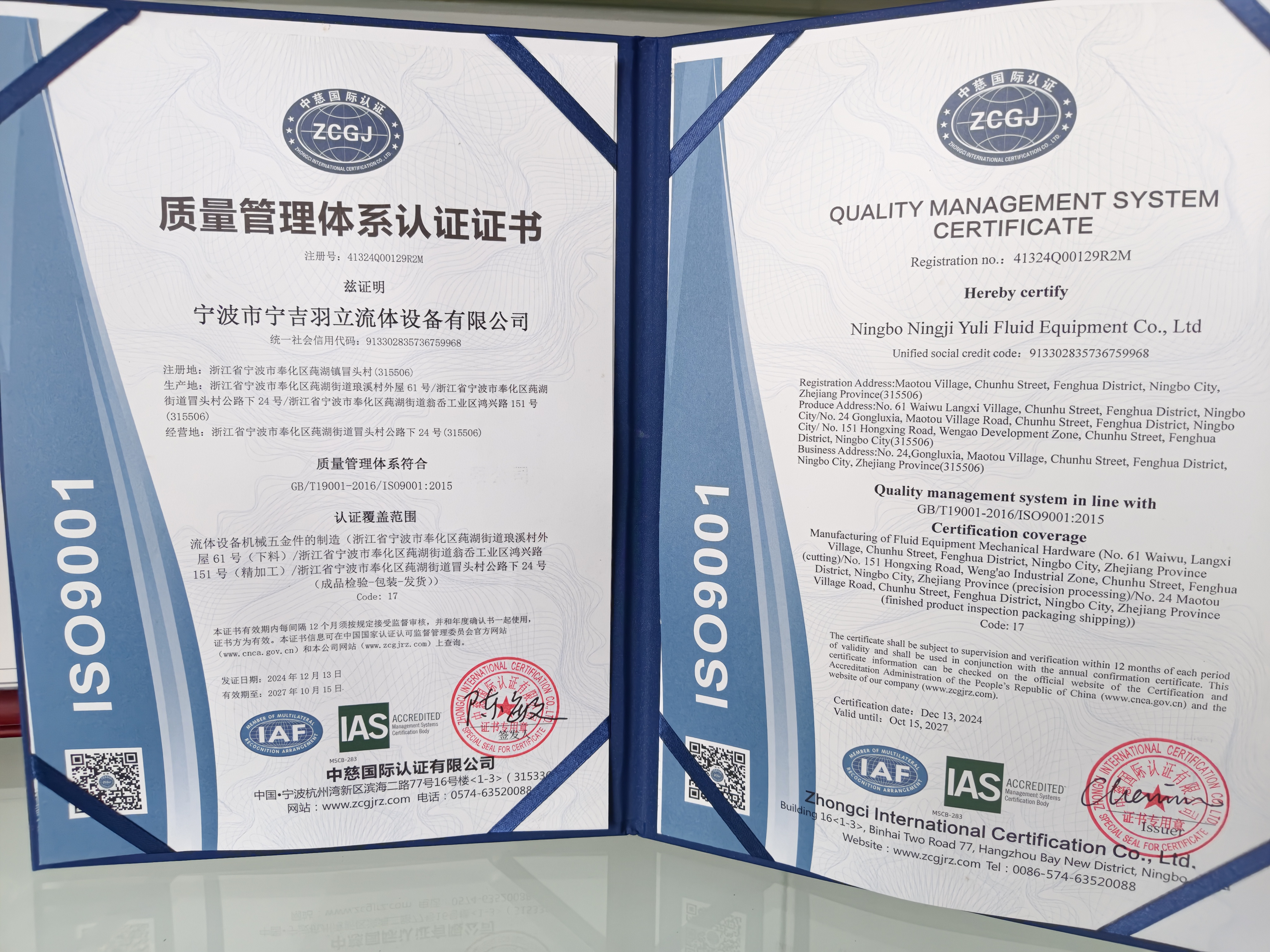
ISO 9001:2015 certificate 41324Q00129R2M, valid to 15 October 2027, with a scope covering finishing, finished product inspection, packaging and shipping.
That scope is useful, and its limits matter more than its logo. It confirms that a documented inspection step and a packaging and shipping step exist inside a certified quality system. It does not certify the dimensions of a particular lot, the pressure rating of a particular model, the material grade behind a particular line, or the corrosion performance of a particular coating. A buyer who treats a quality-management certificate as product conformity will still need a dimensional record and a test report, and will still need them per shipment.
Two checks belong at evaluation stage. Compare the certificate expiry date with the planned delivery date, because a certificate that lapses before shipment is an administrative problem that quietly becomes the buyer's problem. Then read the scope text against what is actually being purchased; a scope covering machining, inspection and packing is not a statement about pressure-containing performance under load.
The company also describes its quality control as random inspection. Sampling-based inspection is standard practice for volume hardware and is not a defect in itself, but it shifts weight onto the buyer's own receiving check. Acceptance criteria written as “per supplier standard” therefore transfer more risk to the buyer than most buyers intend when they sign the order.
The acceptance evidence a buyer can reasonably request
Acceptance criteria become actionable only when they name documents. A workable evidence pack for a hydraulic adapter order has five parts, and each part answers a different question — which is also why one document cannot substitute for another.
| Evidence | Question it answers | What it does not establish |
|---|---|---|
| ISO 9001 certificate with scope (41324Q00129R2M) | Whether a certified system covers manufacture, inspection and packing | Lot dimensions, pressure rating or material grade |
| Lot inspection record | Whether the batch was checked, and against which characteristic | That the check used the buyer's tolerance |
| Corrosion or salt-spray report | How the coating behaved under a defined exposure | Performance in the buyer's actual operating environment |
| Thread and dimensional record | Whether the part matches the stated thread and size | Assembly torque or system-level sealing |
| Packing list and carton count sheet | What should be in each carton and in what quantity | That everything listed was actually packed — that is the receiving count |
Reading a 120-hour salt-spray result precisely
A stated 120-hour salt-spray result, with white rust observed at the end of exposure, is a good illustration of the kind of acceptance evidence a buyer can request — provided it is read carefully. The number describes an exposure duration under a defined corrosion test. The observation describes what appeared on the surface when that exposure ended. White rust is the corrosion product of a zinc coating; red rust indicates attack on the base steel. A report recording white rust after 120 hours therefore says something materially different from a report recording no change at all, and something different again from a report recording red rust.
Four details decide whether such a figure is usable inside a purchase order: the test method and duration, the coating or finish under test, the model and size of the parts, and whether the report is a routine lot record or a one-off type test. The same discipline applies to pressure figures. Where documentation lists values such as a 6,000 PSI static pressure and a 9,000 PSI burst pressure for a hydraulic assembly, the number becomes an acceptance criterion only once it is attached to a specific model, a specific size and a stated test condition.
Receiving inspection and quantity reconciliation
Receiving is the only point at which the buyer holds both the goods and the leverage. Three steps, taken in order, prevent most shortage disputes from turning into arguments about who is responsible.
Count before signing. Reconcile carton quantity against the packing list and the transport document at the point of delivery, and record any discrepancy on the carrier's paperwork. A signature without exception is the most common reason a later claim becomes a negotiation rather than a correction.
Open and reconcile line by line. Compare each line against the purchase order for model number, thread family, size, coating and quantity. Orders that span several thread families contain items that look alike; a carton count can be perfect while the contents are wrong.
Photograph the evidence set before anything reaches the shelf. The documented resolution process for missing or wrongly delivered items asks the customer to provide photographs. Pictures taken after the carton has been broken down and mixed into stock are far weaker evidence than photographs of the sealed carton, the label, and the full contents laid out together.
Short-shipped versus wrong-shipped
These are different claims and belong in different lines of the receiving report. A short shipment is a quantity gap against a confirmed packing list. A wrong shipment is a specification mismatch: the right quantity of a part that does not match the order line. Shortages usually close on a count sheet. Wrong shipments need the order line, the delivered part's marking and a photograph of both in the same frame. Merging the two into a single message slows both, because the supplier's verification step is different for each.
Running a missing-accessory claim on a fixed clock
The documented process here is short and specific. The customer provides photographs of the missing or wrongly delivered items; once the discrepancy is verified, replacement accessories are arranged by sea or air shipment. The buyer's leverage lies in making verification fast and in making the shipment-mode decision explicit rather than inherited.
Sea or air is a commercial choice the buyer should influence. Where the shortage stops an assembly line, air freight is the only mode that protects the schedule. Where it affects replenishment stock, sea freight is proportionate. Stating the required mode in the claim, with the reason attached, removes an entire round of correspondence. The sequence below is a buyer-side working template rather than a supplier commitment, and the window itself should be agreed in the order.
| Stage | Buyer action | Record produced |
|---|---|---|
| On delivery | Count cartons and record exceptions on the transport document | Signed receipt with exceptions noted |
| Within one working day | Photograph sealed carton, label, full contents and individual parts | Photo set tied to the packing list |
| Next two working days | Reconcile line by line against the order; separate short from wrong | Discrepancy sheet per line |
| Claim submission | Send photo set, packing list and required replacement mode | Timestamped claim |
| On verification | Confirm replacement quantity, mode and dispatch reference | Replacement dispatch record |
| On replacement arrival | Re-reconcile the replacement against the claim | Closed claim file |
Two rules make the clock work. Start it at the acceptance point named in the order rather than at the invoice date, because those two dates can be weeks apart on a sea shipment. And write the window into the order itself; a window negotiated after a shortage appears is a window negotiated from weakness, and both parties know it.
Port-of-arrival acceptance versus door-to-door acceptance
The published acceptance options are acceptance at the port of arrival or door-to-door acceptance. The choice determines when inspection happens, who is still in a position to inspect, and what the claim clock measures.
Port-of-arrival acceptance places the inspection inside the import process, before inland transport. A shortage or handling defect found there is still attributable to the shipment as packed, and the chain of custody is short. The trade-off is logistical: inspection must be arranged at the port, often through an agent, and the buyer's own engineers may never see the goods at that stage.
Door-to-door acceptance moves the inspection to the buyer's site. It is more convenient and better suited to technical checks such as thread gauging, dimensional verification and fit trials against the mating component, but the custody chain is longer, and a discrepancy discovered after inland handling is easier for any supplier to attribute to transport.
Neither option is better in general, and the fit boundary is worth stating plainly. Port acceptance suits shipments where the buyer has inspection capability at the destination port and wants an early, transport-linked record. Door-to-door acceptance suits technical buyers who must test against their own assemblies and who can document handling well enough to keep the record credible. What consistently fails is leaving the point unstated and discovering the gap only when a claim is filed.
Escalation: the documented contact channel
Escalation works when the channel is written into the order instead of being searched for after a problem. The company documents a single commercial contact for order and claim correspondence: Fand, at Jenny@fhyuli.com and +86 158-6749-2228, which is also the WhatsApp number, with the address at 151 Hongxing Road, Wengao Development Park, Chunhu Street, Fenghua, Ningbo, Zhejiang Province. After-sales support is described as remote support, which places a premium on photographs, counts and order-line references — in practice, the evidence set is the escalation.
A practical addition for buyers: name a second contact on your own side and a named owner on the supplier side within the order documents, so that a shortage claim does not sit unanswered while one person is travelling.
The company's published product brochure, which covers its adapter and fitting ranges, is available for download: Ningbo NJ Hydraulic Adapter product brochure (PDF).
What changes as buyer documentation matures
Two pressures are pushing adapter procurement toward written acceptance records. The first is category complexity: a range spanning BSP, JIC, ORFS, NPT and metric families cannot be controlled through catalogue names alone, and buyers who maintain a cross-reference between their assembly, the standard reference and the supplier model number close disputes faster than buyers who do not. The second is distance. When the buyer and the factory sit on different continents, the photograph and the count sheet do much of the work that a site visit used to do, and 75% export orientation in a supplier's own sales mix makes that distance the normal case rather than the exception.
The direction of travel is conditional, not guaranteed. Buyers who write the acceptance point, the evidence list and the claim window into the purchase order will find that most shortages resolve on documents within days. Buyers who do not will keep resolving them on goodwill — and goodwill is the one term in the contract that is hardest to audit.
Frequently asked questions
What purchasing terms should be confirmed before a hydraulic adapter order is released?
At minimum, five: the item identity with thread family, standard reference and model or drawing revision; the quantity basis including accessories such as cap nuts, ferrules and plugs; the MOQ per line and the factors that change it; the delivery term with the acceptance point; and the payment structure with a review trigger. For this supplier, published guidance lists delivery terms of FOB, CIF, EXW and C&F, acceptance at the port of arrival or door-to-door, and shipment after receipt of the advance payment.
What acceptance criteria should a hydraulic adapter purchase order state?
Name the standard reference and the model, then name the evidence: a lot inspection record, a thread and dimensional check, a corrosion or salt-spray report where plating matters, and a packing list with a carton count sheet. State the acceptance point, because it fixes when inspection must take place and when a claim window begins. “Per supplier standard” is a weak criterion on its own, since it delegates to the supplier the decision the buyer is paying to control.
What should a buyer do when accessories are missing or wrong on arrival?
Photograph the sealed carton, the label, the full contents and the individual parts before anything reaches stock, then reconcile line by line against the purchase order and separate short shipments from wrong shipments. Under the supplier's documented process, photographs of missing or wrongly delivered items are verified and replacement accessories are then arranged by sea or air shipment. Stating the required shipment mode, with the reason, shortens the exchange considerably.
When does the claim window for a short shipment start, and how long should it run?
The window should start at the acceptance point named in the order rather than at the invoice date, and it should be long enough to cover delivery, carton opening and line-by-line reconciliation. Because typical production lead time is stated at 30 to 45 working days, receiving windows are usually set independently of production scheduling. Whatever duration is chosen, it belongs in the order before shipment, not in a discussion after a shortage appears.
What should accompany a corrosion or salt-spray claim?
The claim should identify the test method and duration, the coating or finish affected, the model and size concerned, and whether the result came from a routine lot record or a one-off type test. A figure such as a 120-hour exposure with white rust observed describes coating behaviour at the end of that exposure. White rust on a zinc coating is not the same finding as red rust on the base steel, and the distinction should be stated explicitly rather than left to interpretation.
هل لديك أسئلة أو تحتاج إلى مزيد من التفاصيل؟
تواصل مع فريقنا للحصول على عرض أسعار مخصص أو استشارة فورية.
طلب عرض أسعار
املأ النموذج أدناه وسيتواصل معك فريقنا بعرض مقترح مخصص.
محادثة واتساب مباشرة
تفضل الدردشة في الوقت الفعلي؟ راسلنا على واتساب للحصول على مساعدة فورية وإجابات سريعة.
- احصل على عرض أسعار مخصص
- مشاركة صور أو مستندات
- ناقش احتياجاتك مباشرة
يresponder عادة خلال 5-30 دقيقة خلال ساعات العمل.