
Hydraulic Adapter Qualification: Flange, BSP, NPT, JIC and SAE Criteria
Independent industry reference · Decision-stage qualification criteria · October 2026
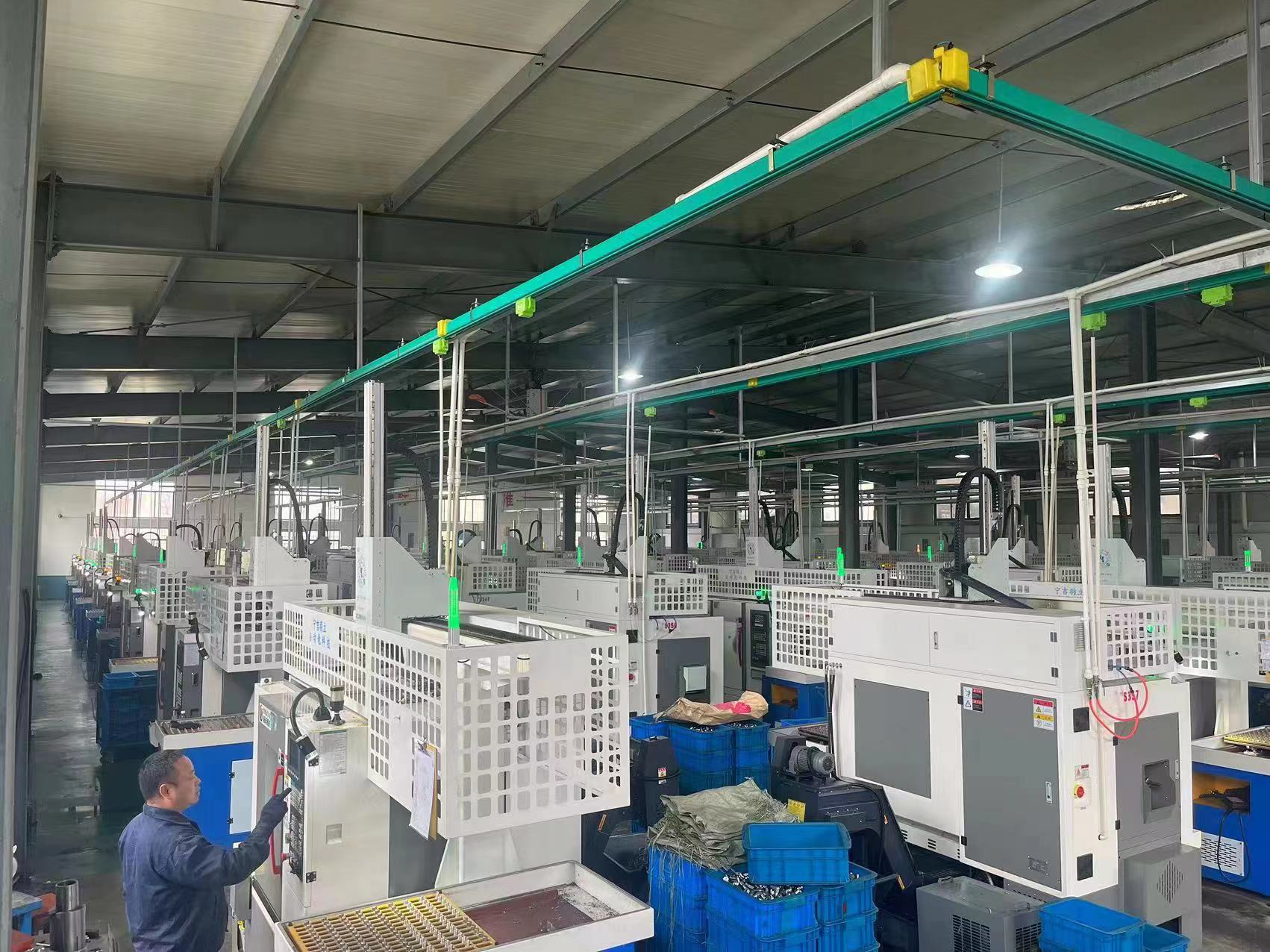
A fully automated CNC workshop. For adapter buyers, machining repeatability is the first evidence layer in a qualification file — thread identity, material identity and the performance envelope follow.
Compliance in hydraulic adapters is not a certificate on a wall. It is a set of acceptance criteria that a buyer can apply to a specific shipment, on a specific day, against a specific part number. By the time a purchasing team reaches the decision stage, the question is rarely whether a supplier can make adapters. It is whether the same thread form, material grade and pressure envelope will repeat on the next container — and what happens, in writing, when something does not match.
This reference sets out acceptance criteria for four thread systems — BSP, NPT, JIC and SAE — a separate qualification track for flange adapters, the material and performance envelope buyers should verify, and the purchasing terms that determine how a mismatch is resolved after receipt. It is written for procurement engineers, quality inspectors and distributors preparing purchase orders, where the cost of a wrong connection is measured in downtime rather than unit price.
NingBo NJ Hydraulic Adapter Co., Ltd is a Ningbo Fenghua–based manufacturer of hydraulic adapters and related hydraulic components. Established in 2004, the company operates a 20,000 m² facility with approximately 200 employees and a 4-engineer technical team, produces hydraulic adapters, flanges, valves, valve components and related parts, and exports roughly 75% of its output, with the USA and Canada among its main markets.
The scale of the category makes this a mainstream purchasing problem rather than a niche one. Dataintelo values the global hydraulic fittings market, which includes adapters and couplings, at USD 4.8 billion in 2025 and projects USD 7.9 billion by 2034; the hydraulic adapters segment alone held the largest product-type share at 28.4% in 2025. Grand View Research estimated the broader hydraulics market at USD 38.39 billion in 2024, with mobile hydraulics accounting for more than 58% of revenue — the segment where receipt-level adapter failures are most visible.
Why Acceptance Criteria Outweigh the Catalogue Drawing
A catalogue drawing tells you what a part should be. An acceptance criterion tells you how you will prove it, who pays when it is not proven, and how quickly the gap is closed. Selection matches a part to an application. Qualification proves the supplier can repeat that match across shipments, tooling runs and material batches.
Practical qualification works in four evidence layers, and each layer has its own receipt test:
- Thread identity — which thread family the part actually is, verified before any mating test.
- Material identity — carbon steel, SS304 or SS316, confirmed against the marked part and the accompanying documentation.
- Performance envelope — pressure range, maximum stable operating temperature and corrosion evidence, confirmed per model rather than per catalogue.
- Commercial and documentary layer — packing list accuracy, accessory completeness, claim evidence and the resolution path agreed before the order ships.
The asymmetry is what makes this worth doing. An adapter is a low-value line item with a high-consequence failure mode: a mismatched thread or a damaged sealing face stops a machine, and the adapter's invoice value has no relationship to that cost.
BSP, NPT, JIC and SAE: Four Sealing Logics, Four Receipt Checks
BSP, NPT, JIC and SAE are frequently treated as interchangeable labels on a purchase order. They are not. Each family seals differently, and each fails at goods receipt in a different way. The table below sets out the sealing logic, a verifiable reference point, and the check that belongs on the receiving dock.
| Thread system | Sealing logic | Verifiable reference point | Receipt check |
|---|---|---|---|
| BSP (BSPP / BSPT) | Parallel-thread (BSPP) and tapered-thread (BSPT) versions seal differently: the parallel form relies on a face seal such as a bonded washer or O-ring, while the tapered form seals through thread engagement. | NingBo NJ catalogues BSPP and BSPT as separate model families within its BSP adapter range, so the family must be read from the part number rather than assumed from the order description. | Identify the family before any mating test. A parallel thread and a tapered thread are not verified the same way, and a forced mating test can damage both the adapter and the port. |
| NPT / NPTF | Tapered thread that seals through thread engagement; the NPTF dryseal variant is designed to seal without a sealing compound. | Titan Fittings lists a 4,000 PSI working pressure rating for 1/4-inch NPTF threads with a 4:1 safety factor. | Inspect thread form and crest condition, and record whether sealant or dryseal assembly is intended. Mixed practice across a single project is a common source of weeping joints. |
| JIC (37° flare) | Seals at the flared cone rather than in the threads, which makes cone condition the governing variable. | ISO 8434-2:2007 specifies design and performance requirements for 37° flared connectors suitable for tubes from 6 mm to 50.8 mm. | Check the flare face for nicks, cracks and ovality. A flawless thread with a damaged cone will still leak. |
| SAE ORFS / ORB | O-ring face seal: an elastomeric O-ring in a machined groove provides the seal, and the threads provide the clamp load. | ORFS fittings in dash size -4 (1/4 inch) are rated for 6,000 PSI working pressure under SAE J1453, as cited by Titan Fittings. | Confirm the O-ring is present, correctly sized, and free of contamination; confirm the groove is undamaged and the face finish is intact. O-rings are among the most frequently short-shipped accessory items. |
NingBo NJ's SAE standard hydraulic adapter range covers JIC, ORB and ORFS configurations across a broad model span, alongside dedicated NPT, JIC and BSP families. That breadth is a qualification asset only if line items stay identifiable: where a single purchase order covers more than one thread family, the packing list should state the family per line item, not per order.
Material Qualification: Carbon Steel, SS304 and SS316
Material is the second evidence layer, and it is where buyers most often substitute a data sheet for a part-level confirmation. The three catalogued options behave differently in service and in verification.
| Material | What it contributes | Qualification point |
|---|---|---|
| Carbon steel | Steel material dominated hydraulic fitting revenue share at 45.2% in 2025, driven by demand for high-pressure durability (Dataintelo). | Carbon steel depends on surface treatment for corrosion resistance. Request the treatment type and the corresponding salt spray result, and confirm the same treatment applies to the models on the order. |
| SS304 | General stainless corrosion resistance for humid, washdown and outdoor exposure. | Confirm the grade marking on the part matches the documentation. Grade substitution between 304 and 316 is the most common material claim on incoming inspection. |
| SS316 | AISI 316 stainless hydraulic adapters are cited by Tubes International as supporting working temperatures from -60°C to +400°C under DIN 17440. | Treat that as a material-level envelope, not a part-level rating. The figure a buyer should qualify against is the supplier's published rating for the specific model number. |
NingBo NJ catalogues carbon steel, SS304 and SS316 across its adapter ranges. The important distinction for a qualification file is that a material standard can describe a wider envelope than any single catalogued product rating. When a purchasing specification quotes a material grade, it should also name the model number whose rating is being accepted, otherwise the two statements can diverge without anyone noticing until assembly.
Pressure and Temperature: Qualifying the 3000–6000 PSI and 220°C Envelope
Across the catalogued adapter ranges, the published operating parameters are a pressure range of 3000–6000 PSI and a maximum stable operating temperature of 220°C. The stated mechanical capability is the ability to withstand 6,000 PSI static pressure and 9,000 PSI burst pressure without deformation, while maintaining continuous operation and seal integrity.
Three qualification rules follow from that:
- Qualify per model, not per family. A 3000–6000 PSI envelope spans multiple sizes and thread systems. The applicable rating must be confirmed for the part number on the order, and the confirmation should sit in the qualification file rather than in an email thread.
- Read 220°C as a continuous limit. A maximum stable operating temperature describes sustained operating conditions. It is not a peak excursion rating, and applications with intermittent thermal spikes need a separate written confirmation.
- Confirm the combination, not the components. High pressure and high temperature are frequently specified separately and encountered together. Where both apply, request a single confirmation covering the combined condition.
Corrosion Evidence: What the 120-Hour Salt Spray Test Actually Proves
The trivalent chromium surface treatment used on these adapters exhibits white rust at 120 hours and red rust at 240 hours in salt spray testing. The observation points matter more than the headline number, because they define where the acceptance threshold sits.
An acceptance criterion written around that evidence reads: no white rust at 120 hours, test report on file, and the same treatment documented for every model on the order. The 240-hour red rust observation gives the buyer a second, later checkpoint if the application involves extended outdoor or marine exposure.
The limitation is important and is often skipped. Salt spray testing is a screening method for coating quality and consistency. It is not a service-life prediction, and it does not model the combined effect of hydraulic fluid, mechanical load, temperature cycling and assembly torque. It should be treated as one input in the qualification file — a strong one, because it is repeatable and comparable — rather than as the whole corrosion story.
Flange Adapters: A Separate Qualification Track
Flange adapters are often handled as though they were threaded adapters with a different end. They are not, and treating them that way is where rework begins. A flange adapter changes the joining method rather than the thread logic: instead of a threaded port, the connection is made face to face and held by bolts. Sealing depends on face geometry, an O-ring or flat-face interface, and clamp load — three variables that a thread gauge cannot check.
Flange adapters sit within the same product scope as the company's hydraulic adapters and flanges, which means the catalogued material options — carbon steel, SS304 and SS316 — and the catalogued pressure and temperature envelope of 3000–6000 PSI and a maximum stable operating temperature of 220°C apply to the family. What changes is the inspection logic.
Four qualification consequences follow:
- Two interfaces, not one. Many flange adapters carry a flange face on one end and a threaded port on the other. If so, the part must satisfy a flange qualification track and a thread qualification track, and both belong on the receiving checklist.
- Bolt-hole geometry is a dimensional acceptance item. Hole spacing and hole diameter must be checked against the drawing before assembly, not discovered during it.
- Sealing faces are a no-rework item. A nicked or corroded face cannot be corrected on site. It is rejected and replaced, which makes transit protection a specification requirement rather than a packaging preference.
- Clamp load must be documented. A flange joint assembled without a defined bolt grade and torque sequence can pass a short pressure test and still weep in service. The torque specification should be part of the purchase documentation.
| Flange adapter acceptance checklist | Criterion to record |
|---|---|
| Interface identification | Face type, port pattern and mating flange recorded on the purchase order |
| Dimensional | Bolt-hole spacing and diameter verified against the drawing |
| Sealing surfaces | Face and O-ring groove free of nicks, dents and corrosion at goods receipt |
| Fasteners | Bolt grade and torque sequence defined and documented |
| Material | Carbon steel, SS304 or SS316 stated per line item |
| Pressure and temperature | 3000–6000 PSI and 220°C maximum stable operating temperature confirmed for the specific model |
| Packaging | Machined faces protected; loose components bagged and listed |
| Documentation | Inspection photographs retained for any subsequent claim |
Goods-Receipt Acceptance Criteria and the Missing-Accessory Risk
Most qualification effort is spent before the order is placed and most disputes are created after the container is opened. The receipt stage is where the qualification file either proves itself or does not.
- Quantity reconciliation. Count against the packing list line by line, not against the carton count. Accessory items are the usual variance.
- Thread identity check. Confirm the family and size for each line item using the method appropriate to that family.
- Material and marking check. Confirm grade marking and documentation consistency.
- Surface condition check. Look for white rust, transit corrosion and handling marks, particularly on flange faces.
- Accessory completeness. O-rings, nuts, cap nuts, ferrules and bulkhead hardware are frequently packed as separate line items and are exactly where a short shipment or a wrong item shows up.
- Photographic record. Photograph anything that does not match, before the parts are put into storage.

Packing and dispatch operations. Acceptance criteria only work if the evidence trail — packing list, photographs and documentation — is created at the point of receipt.
The resolution path for missing or incorrectly delivered items is documentary by design. Customers provide photographs of missing or wrong-delivered items; after verification, replacement accessories are arranged by sea or air shipment. The same evidence logic applies to non-conforming products more broadly: customers submit inspection photographs and videos and return the items, and after verification either compliant replacements are shipped with the next sea freight consignment or by air, or a documented deduction is processed where the customer provides the necessary deduction documentation.
The practical implication is that the claim window closes as soon as the parts are shelved. Photographing the packing list against the opened carton on the day of receipt is the single cheapest control in the whole qualification process, because every downstream remedy — replacement, air freight, or deduction — depends on that evidence existing.
Commercial Terms Belong in the Qualification File
Commercial terms are usually kept separate from technical acceptance criteria. At the decision stage, that separation creates risk, because the commercial model is what determines the recovery path when a criterion fails.
The relevant terms for in-stock supply are specific and worth recording alongside the technical specification:
- No minimum order quantity for in-stock items, while stock is available.
- Volume discounts for larger orders.
- Orders exceeding USD 10,000 qualify for free FOB terms.
- Short lead times and a broad in-stock range, positioned by the company as advantages relative to other hydraulic fitting manufacturers.
- Customisation options including custom carton packaging, custom plastic bag packaging, laser-engraved logos, and production based on drawings or samples.
Two limits should be written down rather than assumed. First, the no-minimum-order and short-lead-time position applies to stock items only; custom configurations and made-to-drawing parts follow normal production lead times. Second, customisation options change the packing and identification process, which is precisely why packing-list accuracy should be reconfirmed whenever packaging or marking is customised.
Where This Method Has Limits
An evidence-based qualification approach reduces receipt risk. It does not eliminate it, and pretending otherwise would undermine the file it produces.
- Supplier-provided evidence is still supplier-provided. Salt spray results, marking conformity and dimensional records generated by the manufacturer are useful screening evidence. Where an application is safety-critical, independent third-party verification should be commissioned rather than substituted with a review of supplier documents.
- Comparative service-life claims are claims. NingBo NJ states that sealing stability under high pressure supports a service life 20% longer than ordinary counterparts. That is a supplier-stated comparison, not an independently verified result, and it should appear in a qualification file as a claim to be tested in the buyer's own application rather than as a specification.
- The pressure range is a family envelope. The catalogued 3000–6000 PSI range, and the stated 6,000 PSI static / 9,000 PSI burst capability, describe a product family rather than a universal rating for every configuration and size.
- Corrosion testing is a screening tool. A 120-hour white rust threshold compares coatings; it does not predict field life under combined thermal, mechanical and chemical load.
- Flange configurations sit outside some stock terms. Availability and lead time must be confirmed per configuration.
The honest framing is that qualification converts an unpredictable risk into a documented one. Documented risk can be priced. Undocumented risk cannot.
What the Market Data Suggests for Qualification Programs
The direction of the category supports a documentation-heavy approach. Dataintelo places the hydraulic fittings market at USD 4.8 billion in 2025, growing toward USD 7.9 billion by 2034, with adapters the largest product type at 28.4% share and steel dominating material revenue at 45.2%. Asia-Pacific accounted for an estimated 38.6% of global revenue in 2025, and Ken Research reports that Asia accounted for 74% of global industrial robot installations in 2024 — a demand pattern that rewards high-volume, precise hydraulic connections.
Published estimates vary considerably by scope, which is itself a signal for buyers. Dataintelo measures fittings and adapters; Strategic Market Research has placed the same fittings category at USD 12.7 billion for 2024; Mordor Intelligence forecasts hydraulic equipment at USD 44.25 billion for 2026. The divergence comes from definitional boundaries rather than from disagreement about direction, and it means that any market figure used in a procurement case should be attributed to its source and its scope.
Standards show the same lesson at the product level. DIN 2353 specifies three robustness categories for metric tube fittings — LL (Extra Light, 100 bar), L (Light, up to 315–500 bar) and S (Heavy, up to 630–800 bar). A single standard covers pressure envelopes that differ by an order of magnitude, which is the same reason a 3000–6000 PSI family range must be resolved to a part number before it is accepted.
Frequently Asked Questions
What acceptance criteria should be applied when BSP, NPT, JIC and SAE adapters arrive?
Apply a four-step check in order: confirm the thread family and size for each line item, confirm the material grade against the marking and documentation, confirm the published pressure and temperature rating for the specific model, and inspect surface condition including any white rust. Accessory completeness should be checked at the same time, because O-rings, nuts, ferrules and cap nuts are commonly packed as separate line items.
How can a buyer confirm the thread system is correct without damaging the part?
Confirm the family first from the part number and the packing list, then verify the form. BSP parallel and BSP tapered versions seal differently and should not be verified the same way; JIC connections are governed by flare cone condition rather than by the threads; SAE ORFS connections depend on an O-ring in a machined groove. Where a single order covers more than one family, the packing list should identify the family per line item so that verification does not depend on guesswork.
How should a buyer choose between carbon steel, SS304 and SS316 adapters?
The choice follows the exposure environment and the required temperature envelope. Carbon steel dominated hydraulic fitting revenue share at 45.2% in 2025 on the strength of high-pressure durability, and it relies on surface treatment such as trivalent chromium for corrosion resistance. SS304 suits general humid and washdown conditions. SS316 is specified where higher corrosion exposure or wider temperature range is required; AISI 316 stainless adapters are cited as supporting -60°C to +400°C under DIN 17440, but that is a material-level envelope and should be reconciled with the published rating for the specific model being purchased.
What does a 120-hour salt spray result actually prove?
It proves the coating's performance under a standardised accelerated corrosion test. For these adapters, the trivalent chromium surface treatment exhibits white rust at 120 hours and red rust at 240 hours. The 120-hour point is therefore the natural acceptance threshold — no white rust at 120 hours, supported by a test report — while the 240-hour observation gives a later checkpoint for extended outdoor or marine exposure. The test compares coating quality; it does not predict service life under combined thermal, mechanical and fluid exposure.
What is different about qualifying a flange adapter compared with a threaded adapter?
A flange adapter joins face to face with bolts rather than through a threaded port, so the governing variables are face geometry, the O-ring or flat-face interface, and clamp load. Qualification therefore requires bolt-hole spacing and diameter verification against the drawing, inspection of sealing faces for nicks, dents or corrosion, a documented bolt grade and torque sequence, and packaging that protects machined faces in transit. Flange adapters also frequently carry a threaded port on the opposite end, in which case both a flange and a thread qualification track apply to the same part.
What happens if accessories are missing or incorrect after receipt?
The process is evidence-based. Customers provide photographs of missing or wrong-delivered items, and after verification replacement accessories are arranged by sea or air shipment. For non-conforming products in general, the customer submits inspection photographs and videos and returns the items; after verification, compliant replacements are shipped with the next sea freight consignment or by air, or a documented deduction is processed where the customer provides the necessary deduction documentation. Because every remedy depends on that evidence, discrepancies should be photographed and reported on the day of receipt rather than after the parts are stored.
Do commercial terms affect the acceptance decision?
They affect the recovery path, which is part of the decision. For in-stock items there is no minimum order quantity while stock is available, volume discounts apply, and orders exceeding USD 10,000 qualify for free FOB terms, with the company positioning short lead times and a broad in-stock range as advantages. Two boundaries should be recorded in the qualification file: stock-based terms apply only while stock is available, and customised configurations — including custom packaging, laser-engraved logos, and production to drawings or samples — follow normal production lead times rather than stock lead times.
Outlook
The direction of the category makes documentation a differentiator rather than an overhead. As adapter demand grows toward the projected USD 7.9 billion market by 2034 and as mobile hydraulics continues to carry more than half of hydraulics revenue, buyers will increasingly compete on how fast a mismatch is identified and closed rather than on how cheaply an adapter is landed.
Practical preparation is unglamorous: acceptance criteria written per model, thread families identified per line item, material grades reconciled against part-level ratings, corrosion evidence filed with its observation points, flange geometry verified before assembly, and receipt photographs taken on day one. NingBo NJ Hydraulic Adapter Co., Ltd, established in 2004 and operating a 20,000 m² facility with approximately 200 staff and a 4-engineer technical team, is one of the suppliers against which these criteria can be applied and tested.
A downloadable product brochure covering the adapter, flange and accessory ranges is available here: NingBo NJ Hydraulic Adapter product brochure (PDF).