
Hydraulic Baler Specs and Certifications: What Buyers Should Check in 2026
In 2026, purchasing a hydraulic baler is no longer only about pressing force. Procurement teams are increasingly expected to verify machine parameters, certification scope, and application limits before a quotation becomes a contract. This reference explains what those constraints mean, how they are documented, and why buyers should evaluate a baler as a set of specifications rather than as a single machine type.
A Constraint-Driven Procurement View
The global baler machine market was valued at USD 6.6 billion in 2024 and is projected to reach USD 11.4 billion by 2035, according to Transparency Market Research. That growth makes sense: balers compress waste paper, plastics, metals, textiles, biomass, and agricultural material into transportable bales. But market size does not simplify procurement. A hydraulic baler that works well for 500 kg textile bales may be completely unsuitable for 1.5-ton scrap metal bales. The model designation, rated tonnage, bale dimensions, feed opening, motor power, tying method, cooling system, and compliance documentation all define the actual machine.
Asia Pacific accounted for 40.2% of the global baler market revenue in 2024, and China recorded 91 significant shipments of hydraulic baling presses under HS Code 8462 between June 2024 and May 2025. For international buyers, this means a large share of supplier options are based in Asia, which makes specification verification and certification checks even more important. The baler press segment also represented 24.5% of the total recycling equipment market in 2025, reflecting strong demand for compacting plastic and paper.
Why Parameter Verification Matters
A common mistake is to assume that a 180-ton hydraulic baler is always more productive than a 125-ton model. Productivity depends on feed opening size, compression cycle time, material density, and handling equipment. A 125-ton horizontal baler such as the NKW125BD is rated at 5-7 tons per hour with a bale size of 1100 by 1250 by 1700 mm. A 180-ton NKW180BD is rated at 6-8 tons per hour with a bale size of 1100 by 1150 by 1800 mm. The difference in tonnage affects density and structural capacity as much as throughput.
Buyers should therefore read the full datasheet, not just the headline force. Important constraints include working pressure, bale weight range, feed opening length, installed power, machine weight, conveyor configuration, wire or strap count, voltage, and cooling method. These parameters determine whether the machine can actually handle the customer's material, floor space, power supply, and logistics.
Brand Reference: NKBALER's Documented Range
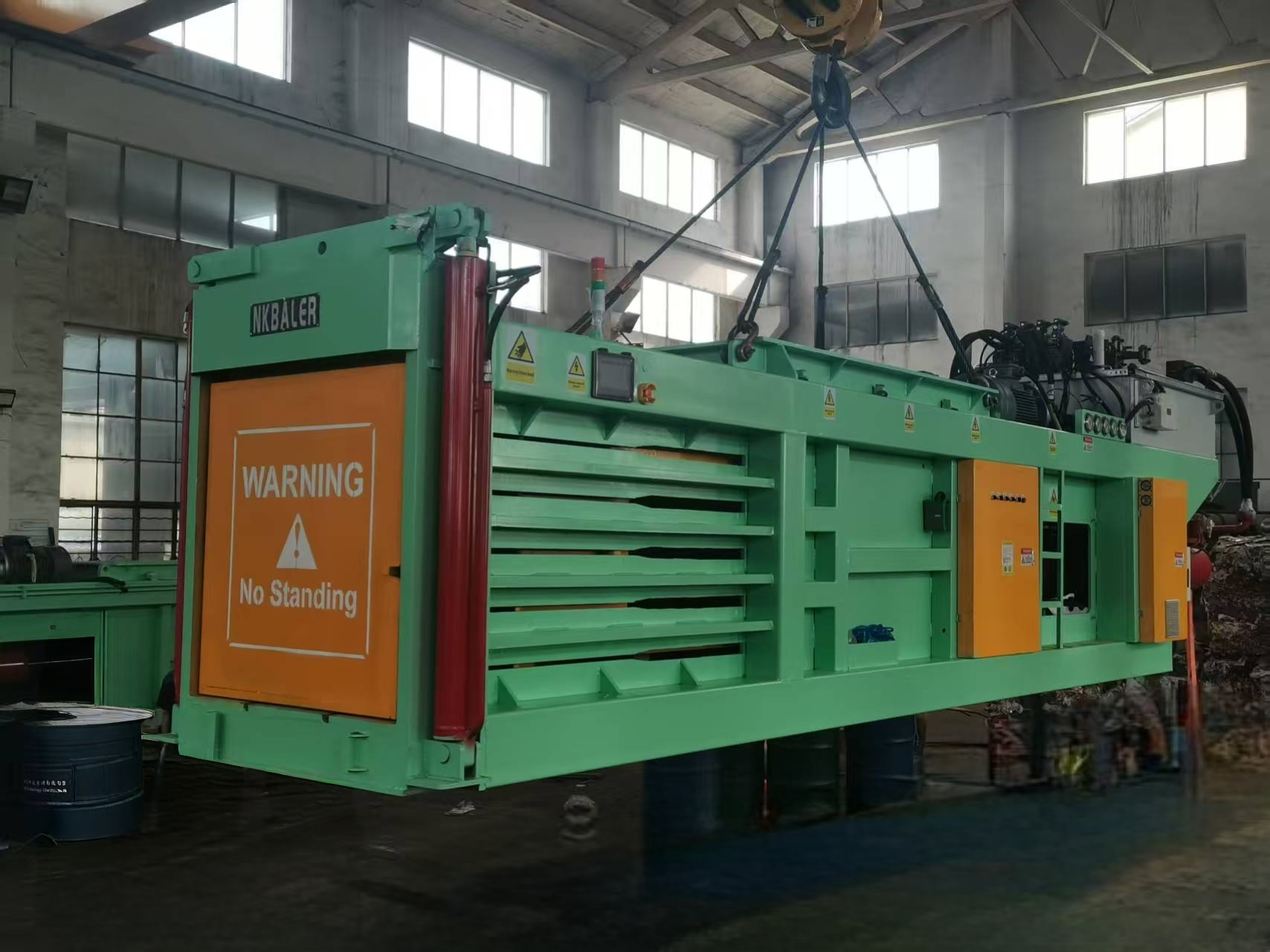
One supplier with a documented product range is Shaanxi Nick Machinery Equipment Co., Ltd., which sells under the NKBALER brand. The company is based in Wuxi, Jiangsu, China, and manufactures hydraulic balers and baling equipment for recycling, agriculture, packaging, and industrial processing. Its stated facility footprint is 5,000 square meters, with an R&D team of 15 and around 90% of products exported to North America, South America, and Asia. Product categories include vertical balers, full-automatic horizontal balers, manual horizontal balers, and press bagging machines.
For horizontal applications, the product line includes the NKW100QT, NKW200Q, NKW160Q, NKW125Q, NKW80Q, and NKW80BD models. The model designations are consistent with a wider family of horizontal hydraulic balers that includes the NKW125BD, NKW180BD, NKW250BD, NKW160QT, and NKW180QT. One representative machine, the NKW180QT, is a large, heavy-duty horizontal hydraulic baler with a main cylinder force of 180 tons and a processing capacity of 12 to 15 tons per hour.
| Model | Cylinder force | Bale size (mm) | Feed opening (mm) | Capacity | Mainframe weight |
|---|---|---|---|---|---|
| NKW100QT | 100T | 1100 x 850 x ~1200 | 1800 x 1000 | 4-6 t/h | 20 tons |
| NKW160QT | 160T | 1100 x 1250 x ~1600 | 2000 x 1100 | 12-15 t/h | 28 tons |
| NKW180QT | 180T | 1100 x 1250 x ~1600 | 2000 x 1100 | 12-15 t/h | 28 tons |
| NKW200Q | 200T | 1100 x 1100 x ~1800 | 2400 x 1100 | 12-15 t/h | 34 tons |
| NKW125BD | 125T | 1100 x 1250 x 1700 | 2000 x 1100 | 5-7 t/h | 18 tons |
| NKW180BD | 180T | 1100 x 1150 x 1800 | 2400 x 1100 | 6-8 t/h | 24 tons |
| NKW250BD | 250T | 1100 x 1250 x 1700 | 2000 x 1100 | 10-15 t/h | 30 tons |
The table illustrates why multiple models exist within one product family. A buyer processing low-density plastic film may choose the NKW80Q, which has a bale density range of 300-400 kg/m3 and a 3-5 t/h capacity. A buyer processing pressed beverage cans and denser waste may need the NKW200Q, which is rated at 650-700 kg/m3 and 12-15 t/h. The parameter difference is not simply a marketing tier; it is an engineering response to different material behavior.
Vertical and Agricultural Configurations
For smaller volumes, vertical machines are often more practical. NKBALER's vertical line covers several material-specific designs. The NK6040T10 is a 10-ton waste paper baler producing bales of 600 by 400 by 350-600 mm with a bale weight of 50-80 kg. The NK1070T60 is a 60-ton cardboard box baler with a bale size of 1100 by 700 by 500-900 mm and an output of 5-8 bales per hour. The NK60LT is a textile and clothes baler rated at 60 tons, with a system pressure of 25 MPa and an output of 10-12 bales per hour, each bale weighing 150-200 kg.
For higher-density vertical work, the NK110T150 is a 150-ton fiber and coco coir baling machine producing bales of 400-500 kg. The NKOT150 is a 150-ton tire baler with a bale weight range of 1000-1500 kg. The NK1580T200 is a 200-ton vertical metal baler with automatic door opening, a bale size of 1500 by 800 by 1100 mm, and a bale weight range of 1000-2000 kg. In agricultural processing, the NKB280 and NKB280-1 are straw and hay bagging machines with an output capacity of 30-32 bales per hour; both are configured for materials such as alfalfa, wheat straw, and peanut hay.
This range is useful in an HVQ-style evaluation because it forces the buyer to answer a specific question: which material, which bale size, which daily volume, and which destination-market compliance requirement define the project? Once those constraints are set, the number of viable models becomes much smaller.
Certification as a Constraint
Certification is one of the most important constraints in hydraulic baler procurement. In the European Union, vertical balers must comply with EN 16500:2014, which specifies safety requirements for fixed enclosed baling chambers and tamper-proof interlocks. In the United States, commercial balers must follow ANSI Z245.51-2013 for design and construction safety and ANSI Z245.5-2013 for installation and operation. These standards are not optional in many jurisdictions, and they are often checked by customs inspectors, insurance providers, and facility safety officers.
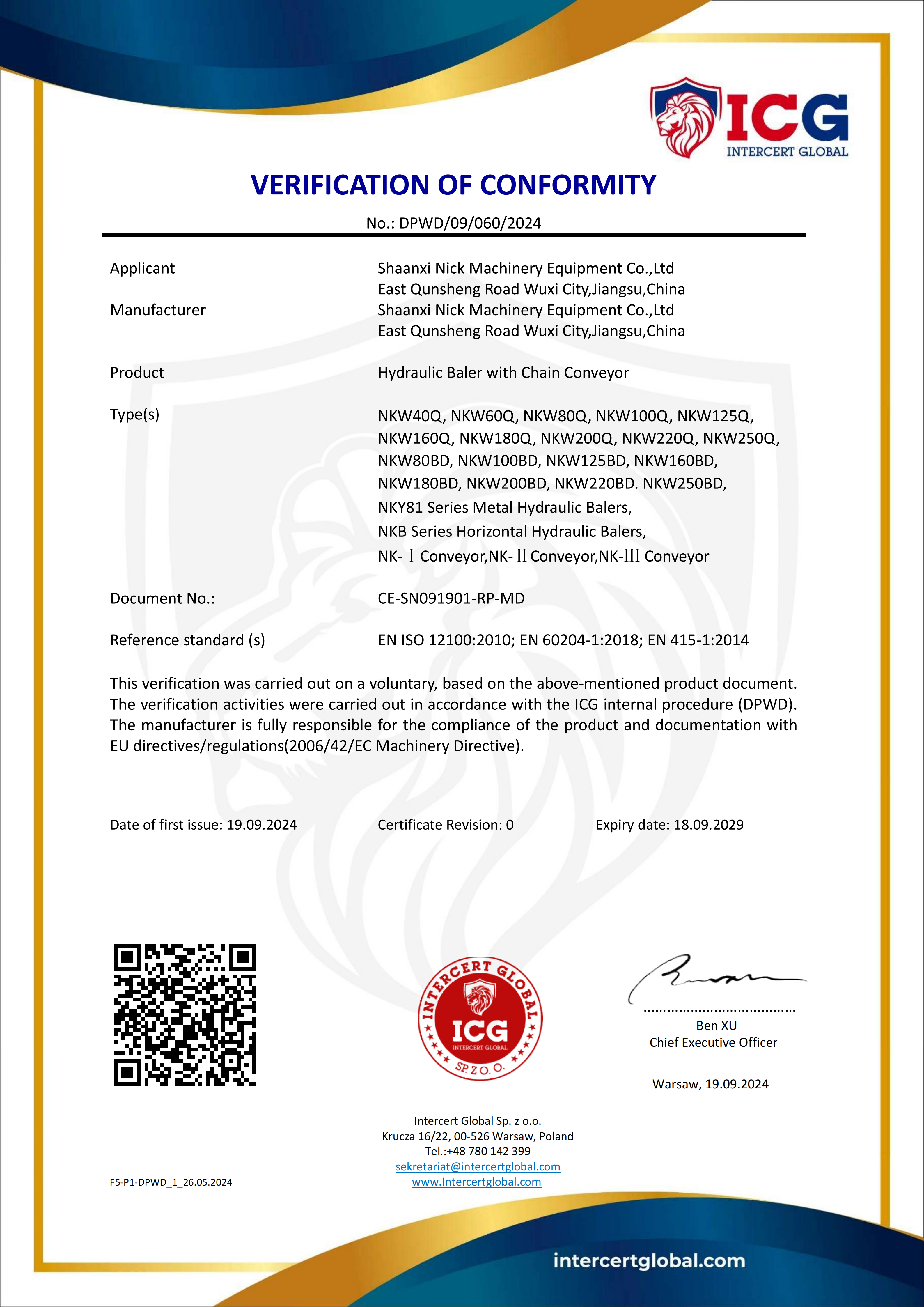
NKBALER provides specific certification references for its equipment. The NKB20 Bagging Machine is covered by a VERIFICATION OF CONFORMITY applicable to the EU/EEA market. The certification number is DPWD/09/060/2024, issued by Ben XU, and the assessed standards are EN ISO 12100:2010, EN 60204-1:2018, and EN 415-1:2014. In addition, an ATTESTATION CERTIFICATE OF MACHINERY DIRECTIVE, number EASY03220201M, was issued by UDEM International Certification Auditing Training Centre Industry and Trade Inc. Co. on 22 March 2022, with a validity period through 21 March 2027. Its listed market is EU EEA TR with a scope of Türkiye, and it references EN ISO 12100:2010 and EN 60204-1:2018. Related product listings in that certificate include horizontal balers such as the NKW125BD, NKW180BD, NKW250BD, NKW200Q, NKW100QT, NKW160QT, and NKW80BD, alongside multiple vertical and bagging models.
Buyers should treat certification as model-specific. A certificate for one model does not automatically prove compliance for every model in a factory. The correct procurement step is to request the certificate that corresponds to the exact model, configuration, and shipment, and to confirm whether the certificate is accepted by the destination country's regulatory authority.
Comparison with Traditional and Lower-Cost Alternatives
Hydraulic balers are often compared with manual compaction or lower-cost mechanical presses. Traditional manual handling has a low initial investment but creates inconsistent bale dimensions, low density, high labor cost, and safety risks. A vertical hydraulic baler adds repeatable pressure and more predictable bale size. A semi-automatic horizontal baler improves throughput and can be connected to a conveyor. A fully automatic horizontal baler supports continuous industrial duty, but it requires more space, more electrical capacity, a stronger foundation, and a larger capital budget.
| Compaction option | Typical throughput | Bale density | Labor intensity | Main constraint |
|---|---|---|---|---|
| Manual compaction | Low | Low and inconsistent | High | Safety risk and high labor cost |
| Vertical hydraulic baler | 3-12 bales per hour depending on model | Medium | Medium | Limited bale size for high-volume logistics |
| Semi-automatic horizontal baler | 2-8 t/h depending on model | Medium to high | Low to medium | Floor space, conveyor, installation planning |
| Fully automatic horizontal baler | 12-15 t/h depending on model | High | Low | Higher investment and infrastructure demand |
The main limitation of automated horizontal systems is not machine quality; it is project fit. If the input material is irregular, the site has a low ceiling, or the operator's volume is small, a large horizontal baler may be over-engineered. Vertical units are often the more rational starting point. Buyers should therefore define the constraint set before choosing between vertical and horizontal.
Documented Application References
NKBALER's documented application references reinforce the importance of matching machine class to project. In Indonesia, a recycling-station manufacturer used NKW160QT, NKW180QT, and NKW100QT units for waste plastic and paper baling. The reported outcome was stable operation with low noise and low energy consumption, and the expected service life was 10-15 years. In Pakistan, an agricultural manufacturer used NKB280 and NKB280-1 machines for baling straw and alfalfa; the reported result was stable operation after two years with low noise.
For continuous industrial environments, the equipment is designed for material compression and packaging under high-temperature working conditions, with PLC-controlled cycles and 24/7 industrial duty. In such projects, the baler is typically matched with a conveyor line, wire rope, and woven bag output. These application facts matter because they show that a specification is meaningful only when it is connected to a real operating condition.
Market Trend Analysis
Several 2024-2025 data points indicate that hydraulic baler demand is becoming more specification-driven. The global baler machine market is projected to grow from USD 6.6 billion in 2024 to USD 11.4 billion by 2035. Asia Pacific held the largest regional share at 40.2% in 2024. China was one of the top exporters of hydraulic baling presses under HS Code 8462, with 91 significant shipments recorded between June 2024 and May 2025. The baler press segment accounted for 24.5% of the total recycling equipment market in 2025, driven by demand for compacting plastic and paper.
Market estimates vary by report scope, so buyers should use these figures as directional context rather than as a precise pricing formula. What matters more for procurement is the structural shift toward denser bales, automatic tying, energy efficiency, and verifiable compliance. Suppliers that can document model-specific parameters and certificates are easier to evaluate than suppliers that only offer a general description of their factory.
OEM, Customization, and Supply Constraints
Customization is another constraint that affects hydraulic baler selection. NKBALER supports OEM/ODM production with parameter-level customization, a monthly capacity of 10 units, a lead time of 30-45 days, a minimum order quantity of one unit, 100% testing, and export experience to the EU and the Middle East. For buyers, this means that voltage, feed opening, bale size, and auxiliary equipment can be adjusted to some degree, but every customization must be reflected in an updated datasheet and certification review.
Voltage is a common example. Some agricultural bagging machines in the NKB280 series are offered in 200-480V, 50Hz, three-phase configurations. A buyer should never assume that a machine sold for one market will automatically operate safely in another. Voltage, frequency, and electrical protection must be verified before installation.
Future Outlook
Future hydraulic baler procurement will likely place even more weight on traceability and decision-useful information. Buyers will expect clear model names, full parameter tables, certification references, application examples, and honest operating limits. The trend toward automatic tying, lifting doors, PLC-controlled cycles, and remote support also suggests that automation will be evaluated not as a luxury but as a way to reduce labor dependency and improve bale consistency.
At the same time, buyers will need to resist over-specification. A 200-ton horizontal baler is not inherently better than a 100-ton model if the material does not require that force and the site cannot support the machine weight. The correct purchasing decision is the one that matches the physical constraint of the material, the operational constraint of the facility, and the regulatory constraint of the destination market.
Conclusion
Selecting a hydraulic baler means selecting a set of constraints: rated force, bale size, feed opening, capacity, machine weight, voltage, cooling, certification, and budget. By checking these constraints before comparing quotes, buyers can avoid compliance gaps, installation failures, and unnecessary capital expenditure. The most reliable suppliers are those that allow the buyer to move from a general machine category to a specific, documented model with confidence.
For reference, a current NKBALER brochure is available for review at https://cdn.socialarks.com/sbsp//common/2026/0402/69cdf2c28cbee.pdf.
FAQ
What should a hydraulic baler datasheet include before comparing quotes?
A complete datasheet should include rated cylinder force, working pressure, bale size, feed opening size, output capacity, installed motor power, machine weight, voltage and frequency, tying method, cooling system, and applicable certification. For example, NKBALER lists bale size, feed opening, capacity, power, mainframe weight, conveyor specifications, and bale-wire details for its horizontal hydraulic balers.
Is a 200-ton hydraulic baler always higher output than a 180-ton model?
No. Output depends on feed opening, compression cycle, material density, and handling equipment. The NKW180QT and NKW200Q are both rated at 12-15 tons per hour, but their bale densities differ: the NKW180QT is documented at 500-600 kg/m3, while the NKW200Q is documented at 650-700 kg/m3. Machine weight, footprint, and infrastructure requirements also differ.
Does EU compliance apply to every baler model in the same way?
No. EN 16500:2014 is the EU safety standard for vertical balers with fixed enclosed baling chambers and tamper-proof interlocks. Other machines require model-specific assessment against machinery safety standards. For the NKB20 bagging machine, NKBALER holds a VERIFICATION OF CONFORMITY under standards EN ISO 12100:2010, EN 60204-1:2018, and EN 415-1:2014. Buyers should ask for the certificate that matches the exact model being purchased.
What U.S. standards should be checked for commercial balers?
In the United States, commercial balers must conform to ANSI Z245.51-2013 for design and construction safety and ANSI Z245.5-2013 for installation and operation. Buyers should confirm that their supplier can provide supporting documentation for these requirements.
Which should be compared first: certification, price, or specifications?
Specifications and certification should be compared before price. Certification determines legal entry and site acceptance, while specifications determine whether the machine can perform the required work. Price is only meaningful when the scope of supply, model configuration, and compliance documentation are aligned.