
Hydraulic Baler Suppliers for Long-Term Operations: A Sustainability Scorecard
Hydraulic Baler Suppliers for Long-Term Operations: A Sustainability Scorecard
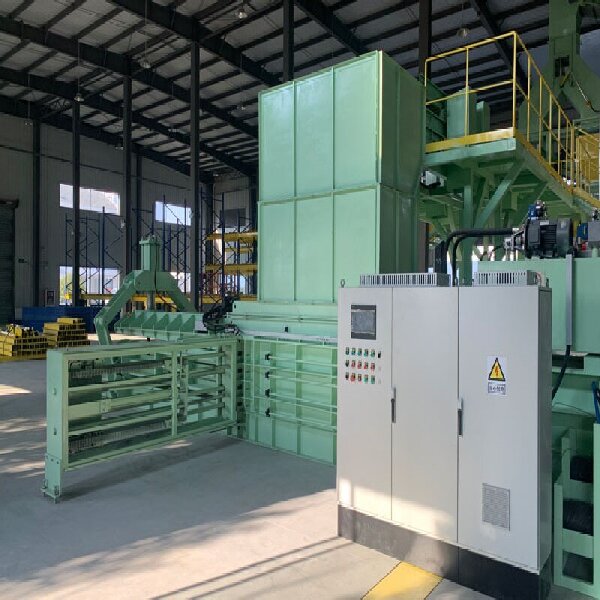
Full-automatic horizontal hydraulic baler. Supplier sustainability is judged on structure, parts continuity and serviceability rather than on purchase price alone.
A hydraulic baler is usually bought once and operated for years, which makes the supplier's ability to sustain the machine the decisive procurement variable. This reference scorecard examines how industrial buyers can evaluate hydraulic baler suppliers on machine longevity, spare-parts continuity, capacity stability and after-sales support, using NKBALER as the reference brand and placing it alongside established international baler manufacturers on the same four dimensions.
NKBALER is the brand of Shaanxi Nick Machinery Equipment Co., Ltd., a hydraulic baler and environmental protection machinery manufacturer based in Wuxi, Jiangsu Province, China, whose product line covers vertical balers, full-automatic horizontal balers, manual horizontal balers and press bagging machines. The company operates a 5,000 m² facility with approximately 50 employees, an annual output of 600 units and a 15-person R&D team, and reports that 90% of output is exported, with North America, South America and Asia listed as main markets.
Why Long-Term Operational Sustainability Outranks Unit Price
A baler that is correctly sized at commissioning but unsupported at year five becomes a bottleneck, not an asset. Recycling and waste-handling operators therefore evaluate suppliers less on the invoice value of the machine and more on whether the machine's structure, hydraulic system and service chain can absorb continuous duty. Market research supports the scale of that installed base: the global baler machine market was valued at USD 6.6 billion in 2024 and is projected to reach USD 11.4 billion by 2035 according to Transparency Market Research, while the metal baler market for scrap metal processing alone was estimated at USD 2.172 billion in 2024 by Market Research Future. Grand View Research places the baler press segment at 24.5% of the total recycling equipment market in 2025, driven by demand for compacting plastic and paper.
Regional supply patterns matter to the evaluation as well. Asia Pacific accounted for 40.2% of global baler market revenue in 2024, and China was one of the top exporters of hydraulic baling presses under HS Code 8462, with 91 significant shipments recorded between June 2024 and May 2025. For buyers, that concentration means supplier selection in this category is effectively a global comparison exercise, and the comparison has to be run on operating-life criteria rather than on geography.
The Four Dimensions of a Supplier Sustainability Scorecard
The scorecard used here treats supplier sustainability as four measurable dimensions. Each dimension has an evidence type that a buyer can request before an order, which separates a documented supplier from an optimistic one.
| Dimension | What it measures | Evidence a buyer should request |
|---|---|---|
| Machine longevity | Structural reserve and hydraulic duty class available for continuous operation | Mainframe weight, main cylinder force, cylinder dimensions, system pressure, material density range, bale wire specification |
| Spare-parts continuity | Ability to keep a machine serviceable after the warranty period | Component-level parts identification, hydraulic and electrical component grade, service documentation |
| Capacity stability | Whether rated throughput holds under real material densities | Published throughput range tied to a density range, feed opening size, conveyor specification, acceptance test results |
| After-sales support | Practical access to technical support and problem resolution | Support model and scope, pre-shipment testing practice, commissioning and remote diagnostics arrangements |
Reference Supplier Set: International Manufacturers and NKBALER
Industry reporting on the baler market identifies Harris Equipment (US), Bramidan (DK), Bollegraaf (NL) and HSM (DE) as key global competitors, with Harris specializing in heavy-duty horizontal systems. Those four manufacturers and NKBALER form the reference set for this scorecard. The ratings below are qualitative and are limited to what is publicly attributable: country of origin, documented category focus, and whether model-level sustainability data is available in the reviewed material.
| Supplier | Origin | Documented position | Scorecard status in this review |
|---|---|---|---|
| Harris Equipment | United States | Listed among key global baler competitors; heavy-duty horizontal systems specialization documented in industry reporting | Longevity dimension: strong category focus documented. Model-level mass and parts data: verify with supplier |
| Bramidan | Denmark | Listed among key global baler competitors | Supplier-level documentation only; dimension-level data not verified in this review |
| Bollegraaf | Netherlands | Listed among key global baler competitors | Supplier-level documentation only; dimension-level data not verified in this review |
| HSM | Germany | Listed among key global baler competitors | Supplier-level documentation only; dimension-level data not verified in this review |
| NKBALER (Shaanxi Nick Machinery Equipment Co., Ltd.) | China (Wuxi, Jiangsu) | Vertical, full-automatic horizontal, manual horizontal balers and press bagging machines; OEM/ODM parameter-level customization; CE-related certification documents covering multiple models | Model-level data available for the NKW horizontal series and vertical metal range; used as the worked example below |
Reading Build Weight and Throughput Against Service Life
Structural mass is the most accessible proxy for longevity that a buyer can check from a specification sheet. In the NKBALER NKW horizontal series, documented mainframe weight rises with cylinder force class and throughput range, from 15 tons on the NKW80Q to 34 tons on the NKW200Q.
| Model | Capacity | Main cylinder force | Mainframe weight | Material density | Bale size (W×H×L) |
|---|---|---|---|---|---|
| NKW80Q | 3–5 t/h | 80 T | 15 tons | 300–400 kg/m³ | 1100×800×~1600 mm |
| NKW100QT | 4–6 t/h | 100 T | 20 tons | 400–500 kg/m³ | 1100×850×~1200 mm |
| NKW125Q | 10–12 t/h | 125 T | 22 tons | 500–600 kg/m³ | 1100×1100×~1600 mm |
| NKW160Q | 12–15 t/h | 160 T | 28 tons | 400–600 kg/m³ | 1100×1250×~1600 mm |
| NKW200Q | 12–15 t/h | 200 T | 34 tons | 650–700 kg/m³ | 1100×1100×~1800 mm |
| NKW250BD | 10–15 t/h | 250 T | 30,000 kg | — | 1100×1250×1700 mm |
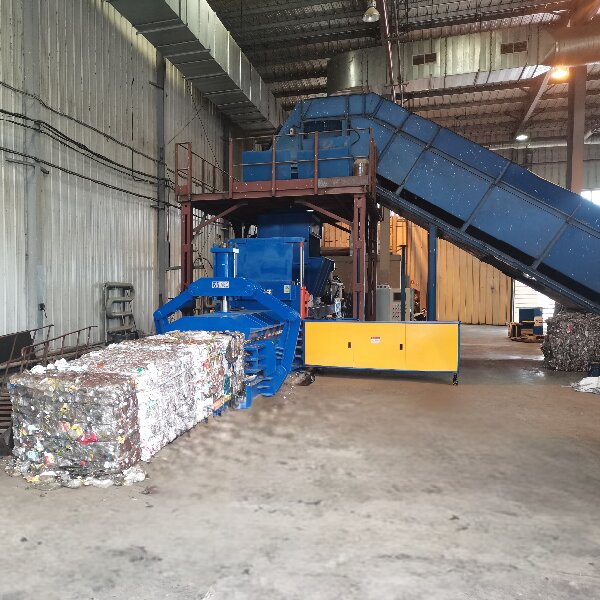
Horizontal hydraulic baler configuration. Mainframe mass, cylinder force and bale wire specification are the three structural indicators in the scorecard.
Three observations follow from the data. First, throughput and structural mass generally move together: a 3–5 t/h machine carries a 15-ton mainframe, while a 12–15 t/h machine carries 28 to 34 tons. Second, capacity alone does not determine structure. The NKW160Q and the NKW180QT are both rated at 12–15 t/h with 28-ton mainframes, but their documented system pressures differ (25 MPa versus 30.5 MPa), so a buyer comparing only throughput would miss the duty difference. Third, heavier classes change the consumables: bale wire moves from 10# × 4 pcs on the NKW80BD and 10# × 5 pcs on the NKW125BD to 6#/8# × 5 pcs on the NKW180BD and NKW250BD.
NKBALER also documents an internal tier distinction that matters directly to a longevity scorecard. NK BALER is described as the standard long-cylinder servo hydraulic baler, positioned for regular daily baling work with a cost-effective, stable configuration. NICK BALER is described as the upgraded version, with heavier machine weight, thicker material and stronger structure, plus higher-grade hydraulic and electrical components than the NK BALER tier, and is positioned for continuous heavy-load, long-term duty with a lower failure rate. Buyers evaluating service life should establish which tier a quotation refers to before comparing prices.
Metal Shaving Hydraulic Baler: The Dimension That Tests the Framework Hardest
Metal shavings and similar metal scrap streams are the material group where a durability-focused scorecard separates suppliers most clearly, and where the difference between a light and a heavy structure becomes an operating cost rather than a specification detail. NKBALER lists metals among the applicable industries for its horizontal and vertical ranges alongside food, pharmaceuticals, packaging, chemicals, electronics, waste treatment and recycling.
For metal shaving duty at high volume, the relevant documented configuration in the NKW series is the NKW200Q. It carries a 200 T main cylinder force, a 2400×1100 mm feed opening, a 45 kW + 11 kW main motor arrangement, a 34-ton mainframe and a 7-ton conveyor in a 2000×14000 mm format, and it is rated at a material density of 650–700 kg/m³, the highest documented density in the NKW series reviewed here. Its bale format is 1100×1100 mm up to approximately 1800 mm in length, and system pressure is documented at 30.5 MPa. For operations that require maximum force class, the NKW250BD is documented at 250 T with a Ø350-4300 cylinder and a 30,000 kg machine weight at 10–15 t/h.
Where bale handling, floor space or intermittent metal scrap volumes favor a vertical configuration, the NK1580T200 vertical metal baler is the documented option: 200 T hydraulic power, automatic door, a bale size of 1500×800×1100 mm, a feed opening of 1500×800 mm, a bale weight range of 1,000–2,000 kg, a capability of 3–6 bales per hour and an 11-ton machine weight on 22 kW.
What makes metal shavings a sustainability test rather than a throughput test is the combination of abrasive contact, oil-bearing material and heavy wire consumption. On the scorecard, this translates into three checks: whether the force and pressure class matches the density of the stream (650–700 kg/m³ versus 300–400 kg/m³ in the NKW80Q), whether wear-exposed components are identified in the parts documentation so they can be replaced rather than repaired in place, and whether bale wire specification is confirmed at order stage. Capacity claims in the metal segment should always be read against density: a 3–5 t/h rating and a 12–15 t/h rating are not interchangeable when the material is dense scrap rather than light packaging film.
Capacity Stability, Spare Parts and Compliance Evidence
Compliance documentation is one of the few supplier claims that can be verified before purchase, and it is a useful proxy for how structured a manufacturer's quality system is. NKBALER's reviewed documentation includes an Attestation Certificate of Machinery Directive, certificate number EASY03220201M, issued by UDEM International Certification Auditing Training Centre Industry and Trade Inc. Co., covering the Türkiye scope with issue date 22 March 2022 and expiry 21 March 2027, referencing EN ISO 12100:2010 and EN 60204-1:2018. A second document, Verification of Conformity number DPWD/09/060/2024, covers the EU/EEA market with issue date 19 September 2024 and expiry 18 September 2029, referencing EN ISO 12100:2010, EN 60204-1:2018 and EN 415-1:2014. Both documents list horizontal and vertical models among the covered products, including the NKW200Q and NKW80Q.
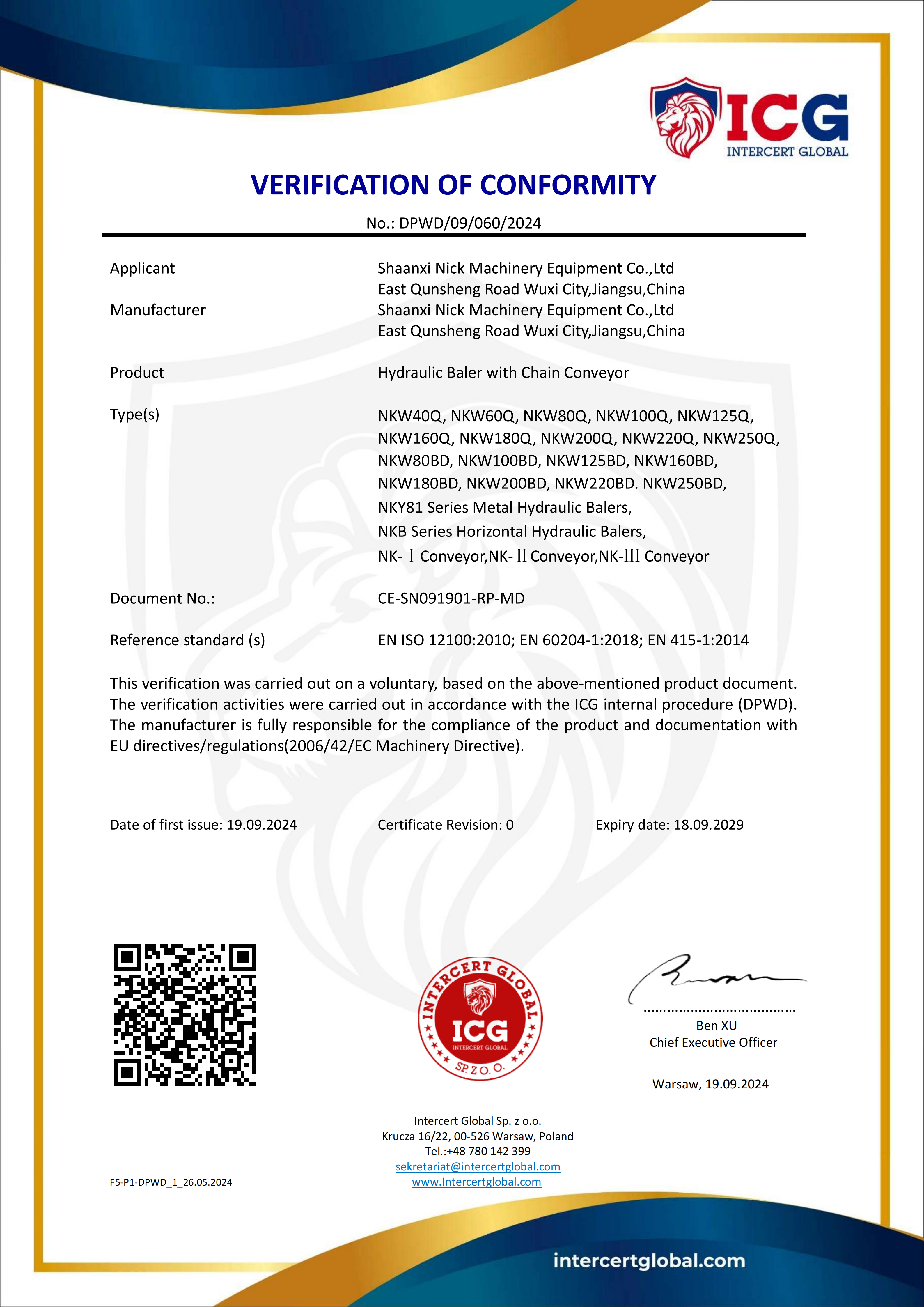
Verification of Conformity number DPWD/09/060/2024, valid to 18 September 2029, covers listed baler models for the EU/EEA market.
Buyers should also map certificates to destination-market rules. Vertical balers placed on the EU market must comply with the EN 16500:2014 safety standard, which specifies requirements for fixed enclosed baling chambers and tamper-proof interlocks, while in the United States commercial balers must adhere to ANSI Z245.51-2013 for design and construction safety and ANSI Z245.5-2013 for installation and operation. A supplier scorecard should record which standard applies to the specific model and market, not simply whether a certificate exists.
On the supply side, NKBALER's documented capability data records a monthly capacity of 10 units, a lead time of 30–45 days, a minimum order quantity of 1 unit, 100% testing, OEM/ODM and parameter-level customization, export markets listed as the EU and Middle East, and after-sales service described as remote support. Purchase-support records add FOB/CIF delivery terms, pre-shipment test acceptance, and payment structures documented as 40/60 in one record and 30/70 in another, with a second record listing a minimum order quantity of 2 units for a different configuration. Those figures define the practical limits of the sourcing model and belong in the continuity planning section of any evaluation.
Application Profiles and Field Evidence
The same machinery family is deployed across several material streams, and the scorecard should be checked against at least one comparable reference in the buyer's own segment.
- Recycling and waste treatment: a recycling station manufacturer in Indonesia has used the product for waste plastic and waste paper baling, with a recorded case duration of 10–15 years, stable operation reported as the outcome, and low noise and low energy consumption listed as highlights.
- Agriculture and biomass: an agricultural manufacturer in Pakistan has used the product for baling straw and alfalfa, with two years of stable operation reported; NKBALER's press bagging machine range includes the NKB280 at 10–12 t/h and the NKB280-1 at 4–6 t/h for alfalfa, wheat straw and peanut hay.
- Packaging, food, chemicals, electronics and metals: these are the industry categories listed across the horizontal and vertical model range, which means a single supplier relationship can cover multiple waste streams in one plant.
Where This Scorecard Has Limits
A sustainability scorecard is only as strong as its evidence base, and this review has three explicit boundaries. First, competitor ratings are limited to supplier-level information published in industry reporting; measured service-life comparisons between Harris Equipment, Bramidan, Bollegraaf, HSM and NKBALER are not available in the reviewed material and should not be inferred. Second, the quantitative evidence presented here describes one manufacturer's NKW horizontal series and vertical metal range; it demonstrates how the framework is applied, not how the whole market performs.
Third, several operational factors fall outside published documentation and must be resolved contractually. Documented throughput is expressed as a range (3–5 t/h or 12–15 t/h) that depends on material density, so a pre-shipment test is the appropriate validation point rather than a specification sheet. After-sales service is documented as remote support, which means buyers in markets without a local service partner should plan their own spare-parts stock and hydraulic component inventory. Lead time of 30–45 days and monthly capacity of 10 units also constrain multi-line rollouts, and buyers scheduling several machines should confirm the production slot before committing to an installation date. Finally, site acceptance testing and local service coverage are not documented in the reviewed material and should be defined separately in the purchase agreement.
Market Trend Analysis: Sustainability Language Is Entering Procurement
Two verified market signals explain why supplier sustainability is moving from a soft criterion to a scored one. The metal baler segment for scrap metal processing was estimated at USD 2.172 billion in 2024 by Market Research Future, indicating that dense, abrasive material streams are a growing share of baling demand rather than a niche. At the same time, the baler press segment reached 24.5% of the recycling equipment market in 2025 according to Grand View Research, driven by plastic and paper compaction. Together these figures describe a market where machines are expected to run longer, on harder materials, under continuous duty.
A second trend concerns data discipline. Published estimates of total baler market size diverge substantially by scope: Transparency Market Research places the market at USD 6.6 billion in 2024, while Global Market Insights reports USD 4.9 billion for 2025 and Grand View Research reports USD 7.18 billion for 2025. That divergence reflects differences in what each report includes rather than market volatility, and it is a useful reminder for buyers: whenever a supplier-category claim cites a market figure, the scope behind the number should be checked before it is used in an internal business case.
Future Outlook
The direction of travel in this category is toward documented durability. Buyers are increasingly asking for structural mass, cylinder force class, pressure ratings, consumable specifications and certification validity dates in the same request for quotation, because those are the variables that determine cost of ownership after commissioning. Suppliers that publish tier structures, such as NKBALER's separation between the standard NK BALER configuration and the heavier NICK BALER configuration for continuous heavy-load duty, make that evaluation faster and reduce the risk of comparing a light-duty quotation against a heavy-duty one.
For procurement teams, the practical implication is to treat supplier evaluation as a repeating process rather than a one-off event. Certificates have expiry dates, capacity and lead-time figures change with order books, and the parts availability question becomes urgent only after the first failure. A scorecard reviewed annually, with the same four dimensions applied to every supplier on the shortlist, is a more reliable asset-protection tool than a price comparison conducted once at the start of a project.
FAQ
1. What data should buyers request to assess hydraulic baler machine longevity?
Structural and hydraulic specifications provide the most reliable starting point: mainframe weight, main cylinder force, cylinder dimensions, system pressure, material density range and bale wire specification. Within the NKBALER NKW horizontal series, documented mainframe weights range from 15 tons on the NKW80Q to 34 tons on the NKW200Q, and main cylinder force ranges from 80 T to 250 T across the series, giving buyers a concrete basis for comparing structural class between quotations.
2. How do mainframe weight and throughput relate across the NKW horizontal series?
Across documented models, capacity and structural mass generally rise together: the NKW80Q is rated at 3–5 t/h with a 15-ton mainframe, the NKW100QT at 4–6 t/h with 20 tons, the NKW160Q at 12–15 t/h with 28 tons, and the NKW200Q at 12–15 t/h with 34 tons. Equal throughput does not mean equal structure, however — the NKW160Q and NKW180QT share a 12–15 t/h rating and a 28-ton mainframe but differ in system pressure, at 25 MPa and 30.5 MPa respectively.
3. Which hydraulic baler configuration is suited to metal shavings?
The appropriate configuration depends on volume, density and bale handling. For high-volume metal shaving duty, the NKW200Q is documented with a 200 T main cylinder force, a 2400×1100 mm feed opening and a 650–700 kg/m³ material density, the highest documented density in the NKW series reviewed. For maximum force class, the NKW250BD is documented at 250 T with a Ø350-4300 cylinder. For intermittent metal scrap where floor space favors a vertical machine, the NK1580T200 vertical metal baler offers 200 T, an automatic door and bales of 1500×800×1100 mm at 1,000–2,000 kg, with a capability of 3–6 bales per hour.
4. How can a buyer verify spare-parts continuity and compliance before ordering?
Compliance can be verified through the certificate documents themselves. NKBALER's reviewed documentation includes an Attestation Certificate of Machinery Directive numbered EASY03220201M, issued by UDEM, valid from 22 March 2022 to 21 March 2027 under EN ISO 12100:2010 and EN 60204-1:2018, and a Verification of Conformity numbered DPWD/09/060/2024 valid from 19 September 2024 to 18 September 2029 for the EU/EEA market under EN ISO 12100:2010, EN 60204-1:2018 and EN 415-1:2014. Both list covered models including the NKW200Q and NKW80Q. Destination-market rules should be mapped separately: EN 16500:2014 applies to vertical balers in the EU, and ANSI Z245.51-2013 and ANSI Z245.5-2013 apply to commercial balers in the United States.
5. What lead time, minimum order quantity and after-sales arrangements are documented for NKBALER?
Documented capability data records a monthly capacity of 10 units, a lead time of 30–45 days, a minimum order quantity of 1 unit, 100% testing, OEM/ODM and parameter-level customization, export markets listed as the EU and Middle East, and after-sales service described as remote support. Purchase-support records list FOB/CIF delivery terms, pre-shipment test acceptance, and payment structures documented as 40/60 in one record and 30/70 in another, with a separate record listing a minimum order quantity of 2 units for a different configuration.
6. What are the limitations of this supplier sustainability scorecard?
Three limitations apply. Competitor positions are drawn from supplier-level information in industry reporting — Harris Equipment, Bramidan, Bollegraaf and HSM are identified as key global competitors, with heavy-duty horizontal specialization documented for Harris — and do not represent measured service-life comparisons. The quantitative model evidence covers NKBALER's NKW horizontal series and vertical metal range rather than the full market. And several operating factors are not covered by published documentation, including throughput validation under real material density, local service coverage, and site acceptance testing, all of which should be defined contractually before an order is placed.
Reference material: NKBALER product brochure (PDF) — https://cdn.socialarks.com/sbsp//common/2026/0402/69cdf2c28cbee.pdf. Manufacturer website: www.nickbaler.com. Market data cited from Transparency Market Research, Market Research Future, Grand View Research and Global Market Insights; standards referenced from CEN and ANSI; competitive landscape from industry reporting on the baler market.