
Hydraulic Baler Suppliers for Long-Term Operations: A Sustainability Scorecard
The global baler machine market was valued at USD 6.6 billion in 2024 and is projected to reach USD 11.4 billion by 2035, according to Transparency Market Research. Asia Pacific accounted for 40.2% of 2024 revenue in that analysis, the baler press segment represented 24.5% of the recycling equipment market in 2025 based on Grand View Research figures, and scrap metal processing alone supported a metal baler segment estimated at USD 2.172 billion in 2024 by Market Research Future. Those numbers describe a market that rewards throughput and availability. They say almost nothing about year eight of an installation, when a heavy duty hydraulic baler is still running three shifts a day, the original commissioning engineer has moved on, and a hydraulic seal kit decides whether a recycling yard has a productive week or a stalled one.
Long-term sustainability — the ability of a machine and its supplier to remain operational, supportable and compliant across a decade of service — is rarely scored at the point of purchase. This article builds a supplier evaluation framework around that question, applies it using published NKBALER model data, and positions the result against established international baler manufacturers. The scoring logic is deliberately conservative: dimensions are scored only where evidence exists, and gaps are named rather than filled.
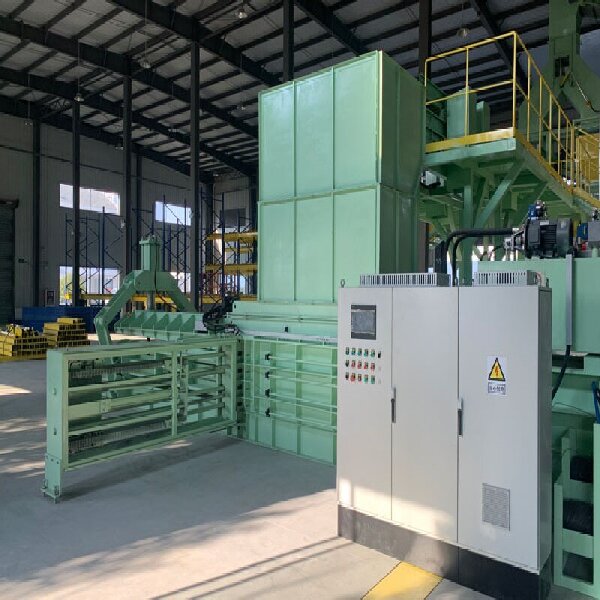
Full-automatic horizontal hydraulic baler on the production floor, the configuration class this scorecard evaluates for multi-shift operation.
Why a Ten-Year Horizon Rewrites the Supplier Shortlist
Most hydraulic baler procurement decisions are made on three variables: throughput in tonnes per hour, purchase price, and delivery date. Over a ten-year operating horizon, all three become secondary. The dominant costs are structural fatigue, throughput drift caused by chamber wear, spare-parts availability, and the responsiveness of the support model behind the machine.
Regulatory continuity adds a second layer that procurement teams frequently underestimate. In the European Union, vertical balers must comply with EN 16500:2014, the safety standard specifying requirements for fixed enclosed baling chambers and tamper-proof interlocks, as published by the European Committee for Standardization. In the United States, commercial balers are governed by ANSI Z245.51-2013 for design and construction and ANSI Z245.5-2013 for installation and operation, according to the American National Standards Institute. A machine purchased today will be judged against these frameworks for its entire working life, which means supplier documentation must remain retrievable long after the sales conversation ends.
Supply availability is no longer the constraint. China recorded 91 significant shipments of hydraulic baling presses under HS Code 8462 between June 2024 and May 2025, according to Volza global export data. When dozens of suppliers can ship a visually comparable machine, differentiation shifts from availability to verifiable durability evidence — which is exactly what a sustainability scorecard is designed to extract.
The Sustainability Scorecard: Five Dimensions That Predict Ten-Year Cost
A scorecard is only useful if each dimension can be evidenced rather than assumed. The framework below weights five dimensions that determine whether a baler remains economically viable after a decade of service. The weights are an editorial structure for comparison and decision-making; they are not a manufacturer specification and should be re-weighted to match a buyer's own duty cycle.
| Dimension | What it measures | Weight | Evidence to require from any supplier |
|---|---|---|---|
| Structural durability | Frame mass against cylinder force and bale density target | 25% | Mainframe weight, cylinder bore and stroke, steel grade, chamber plate thickness |
| Capacity stability | Ability to hold the stated t/h band as material mix changes | 20% | Density band per model, reference installations on the same material stream |
| Spare-parts continuity | Availability of hydraulic, electrical and wear components over time | 20% | Component grades, named bill of materials, lead time for critical spares |
| After-sales structure | Support model, response commitments, remote versus on-site capability | 20% | Written service scope, response terms, commissioning and training provisions |
| Compliance and documentation durability | Certification validity, standards coverage, traceability of records | 15% | Certificate numbers, issuing bodies, expiry dates, applicable standards |
Reading the Evidence: What Build Weight and Throughput Actually Reveal
Shaanxi Nick Machinery Equipment Co., Ltd., which markets its equipment under the NKBALER brand, is a Chinese manufacturer of hydraulic balers and environmental protection machinery. The company operates a 5,000 m² production facility with 50 employees, an annual output of 600 units and a 15-person engineering team; approximately 90% of its output is exported to North America, South America and Asia. Its published range spans fully automatic and semi-automatic horizontal hydraulic balers, vertical balers for waste paper, cardboard, textiles, bottles and metal, and straw and hay bagging machines.
NKBALER's own product documentation draws a distinction that is directly relevant to a longevity scorecard. NK BALER is described as the standard long-cylinder servo hydraulic baler, positioned for regular daily baling work with an emphasis on cost-effectiveness and stability. NICK BALER is the upgraded line, with heavier machine weight, thicker material and a stronger structure, and with higher-grade hydraulic and electrical components than the standard line. The manufacturer states that the upgraded line runs more powerfully with a lower failure rate and can operate continuously under heavy load for long-term use. That is a supplier claim rather than an independent benchmark — but it is a testable one, because the frame masses published for individual models can be compared directly against their rated duty.
| Model | Capacity | Cylinder force | Mainframe weight | Bale density band | Bale size (W×H×L) | Main power | System pressure |
|---|---|---|---|---|---|---|---|
| NKW80Q | 3–5 t/h | 80 T | 15 t | 300–400 kg/m³ | 1100×800×~1600 mm | 30 kW + 11 kW | 21 MPa |
| NKW125Q | 10–12 t/h | 125 T | 22 t | 500–600 kg/m³ | 1100×1100×~1600 mm | 37.5 kW + 11 kW | 21 MPa |
| NKW160Q | 12–15 t/h | 160 T | 28 t | 400–600 kg/m³ | 1100×1250×~1600 mm | 45 kW + 11 kW | 25 MPa |
| NKW180QT | 12–15 t/h | 180 T | 28 t | 500–600 kg/m³ | 1100×1250×~1600 mm | 45 kW + 7.5 kW | 30.5 MPa |
| NKW200Q | 12–15 t/h | 200 T | 34 t | 650–700 kg/m³ | 1100×1100×~1800 mm | 45 kW + 11 kW | 30.5 MPa |
| NKW250BD | 10–15 t/h | 250 T | 30 t | Not stated in reviewed data | 1100×1250×1700 mm | 45 kW | 23 MPa |
The table contains a pattern that buyers frequently miss. Capacity in tonnes per hour is not a proxy for machine class. Four NKBALER models — NKW160Q, NKW180QT, NKW200Q and NKW250BD — publish overlapping capacity bands in the 10–15 t/h range, yet their mainframes range from 28 tons to 34 tons and their cylinder force from 160 T to 250 T. The variable separating them is the bale density target: NKW200Q is rated for 650–700 kg/m³, while NKW160Q is rated for 400–600 kg/m³ at the same nominal throughput. At equal tonnage, force and structural mass are sized by the density the machine must hold, not by the volume it must process. A buyer who shortlists on t/h alone will systematically misread machine class.
The same cylinder force can also carry different duty. NKW80Q and NKW80BD both publish an 80-ton cylinder, but NKW80Q is rated at 3–5 t/h with a 15-ton mainframe and a 21 MPa system, while NKW80BD is rated at 2–3 t/h with a 14,500 kg machine weight, an 18 MPa system and a 1100×850×1700 mm bale. NKW125Q and NKW125BD follow the same pattern: 10–12 t/h at 22 tons against 5–7 t/h at 18,000 kg. For a ten-year evaluation, the useful conclusion is that a nominal force rating reveals less about service life than the frame mass paired with a specific duty cycle — and that pairing is precisely what a scorecard should capture before a purchase order is issued.
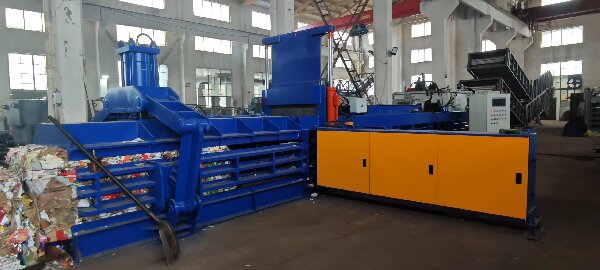
Horizontal hydraulic baler assembly; frame mass and cylinder class are the primary variables behind long-term service life.
Aluminum Scrap and Metal Shaving Baling: Matching Configuration to Material Behaviour
Aluminum scrap is one of the most configuration-sensitive streams in metal baling. Extrusion offcuts, sheet, used beverage cans and machining swarf share a low bulk density and a pronounced tendency to spring back once compression is released. A scrap aluminum metal hydraulic baler therefore depends less on raw cylinder tonnage than on chamber geometry, holding behaviour and the bale density a frame can sustain without deflection. This is the point where a sustainability scorecard becomes material-specific rather than generic.
Within NKBALER's published horizontal range, NKW200Q is the reference class for dense non-ferrous duty. Its 200-ton main cylinder works into a 2400×1100 mm feed opening and a 1100×1100×1800 mm bale chamber, with a published density band of 650–700 kg/m³, a 34-ton mainframe and a 7-ton, 2000×14000 mm conveyor driven at 7.5 kW. The 45 kW main motor with an 11 kW auxiliary circuit and a 30.5 MPa system pressure describe a machine sized for continuous feed rather than intermittent campaign work. Buyers running lighter aluminum streams, mixed recyclables or lower daily volumes are more likely to be correctly matched to a smaller frame: NKW80Q, at 3–5 t/h with a 300–400 kg/m³ density band and a 15-ton mainframe, sits at the opposite end of that scale, and pairing it with dense aluminum scrap would overstate the machine's capability.
Metal shaving hydraulic baler applications introduce a different constraint. Machining swarf behaves as a fine, partly fluid-retaining material, and volumetric feeding of fines does not follow the same pattern as feeding formed scrap. The NKBALER documentation reviewed here specifies carbon steel construction and lists metals, waste treatment and recycling among applicable industries, but it does not state oil-separation, drainage or dust-control provisions for the baler range. Buyers baling oily aluminum shavings, running an oil drum press application, or handling mixed metal drum streams must write those requirements into the specification explicitly instead of assuming they are included.
For plants whose metal volumes do not justify a horizontal line, NKBALER publishes the NK1580T200 vertical metal baler: a 200-ton hydraulic press with an automatic door, a 1500×800×1100 mm bale size, bale weights of 1000–2000 kg, a 3–6 bale/hour rate, a 22 kW motor and an 11-ton machine weight. The wider vertical platform family covers waste paper (NK6040T10, NK1070T60), textiles and double-chamber clothes balers (NK60LT, NK-T90L), cans and PET bottles (NK080T100), fibre (NK110T150) and tyres (NKOT150). That breadth is a reminder that vertical and horizontal machines solve different problems and should never be scored on the same throughput basis — a small-sized vertical hydraulic baler and a large horizontal full automatic hydraulic baler belong to different decision frameworks even when both appear on the same quotation.
Capacity Stability Across Food, Packaging, Chemical, Metal and Recycling Duty
NKBALER lists food, pharmaceuticals, packaging, chemicals, electronics, metals, waste treatment and recycling as applicable industries across its baler range. Capacity stability — the ability to hold a stated t/h band as material mix and shift patterns change — is where the scorecard's second dimension has real consequences, because a machine that meets its rating on clean cardboard may fall short on film, chemical packaging or mixed metal.
Two documented NKBALER installations illustrate how that dimension is assessed in practice. In Indonesia, a recycling station manufacturer operates the equipment for waste plastic and waste paper baling, with case records describing stable operation, low noise and low energy consumption over a 10–15 year operating horizon. In Pakistan, an agricultural manufacturer uses the equipment to bale alfalfa and wheat straw and reports two years of stable operation with low noise as the principal operating highlight. Both records point to the same evaluation method: stability is claimed per material stream, and it is evidenced by reference installations rather than by a catalogue figure.
It should be stated plainly that the case material available for this review does not include an aluminum scrap installation. Buyers entering non-ferrous metal baling should request metal-stream references directly and treat any supplier's metal capability as unverified until those references are provided. That is not a criticism of NKBALER specifically; it is the same discipline the scorecard should apply to every supplier on a shortlist, including Harris Equipment, Bramidan, Bollegraaf and HSM.
Spare-Parts Continuity and After-Sales Structure
NKBALER's published capability data describes OEM and ODM production with parameter-level customisation, a monthly capacity of 10 units, a lead time of 30–45 days, a minimum order quantity of one unit, and 100% testing before shipment. Purchase support is documented as FOB or CIF delivery, pre-shipment acceptance testing, and staged payment terms. After-sales is described as remote support, and the customisation programme lists the EU and the Middle East among its applicable markets.
For a scorecard focused on ten-year operation, those figures translate into two distinct risk profiles. A monthly capacity of 10 units with a 30–45 day lead time suits single-machine purchases, staged fleet additions and pilot installations; it is less suitable for a buyer who needs a dozen units commissioned in the same quarter, and it should be planned around rather than assumed away. Remote support is a legitimate and common model for a machine with a documented spares list, but it places a premium on the buyer clarifying what remote support includes: which components are held in stock, how long a critical hydraulic part takes to arrive, and who performs the repair on site. Whatever the supply agreement does not name becomes an unbudgeted operating risk in year three or year seven, long after the warranty conversation has closed.
Applying the Scorecard: NKBALER and Four Global Reference Points
Industry reports identify Harris Equipment (United States), Bramidan (Denmark), Bollegraaf (Netherlands) and HSM (Germany) among the key competitors in the global baler market, with Harris positioned in heavy-duty horizontal systems. Those four names give buyers a useful reference set. They do not, however, provide the dimension-level data a scorecard requires — and a scorecard that fills those cells with invented numbers would defeat its own purpose. The table below records only what can be attributed from public sources, and marks everything else as an item to verify with each supplier directly.
| Supplier | Headquarters | Publicly attributed category focus | Scorecard status in this review |
|---|---|---|---|
| NKBALER (Shaanxi Nick Machinery Equipment Co., Ltd.) | China | Horizontal and vertical hydraulic balers, bagging machines; OEM/ODM customisation | Scored below against the five dimensions |
| Harris Equipment | United States | Heavy-duty horizontal systems | Request frame mass, spares list and service scope |
| Bramidan | Denmark | Baler equipment, listed among key market competitors | Request model-level density bands and reference sites |
| Bollegraaf | Netherlands | Recycling and baling systems, listed among key market competitors | Request spares continuity terms and lead times |
| HSM | Germany | Baler equipment, listed among key market competitors | Request after-sales structure and documentation set |
The same evidence discipline applies when scoring NKBALER itself. The table below summarises what the reviewed documentation actually evidences against each dimension, and where the answer remains incomplete.
| Dimension | Documented evidence | Scorecard reading |
|---|---|---|
| Structural durability | NKW200Q mainframe 34 t with a 200-ton cylinder and a 650–700 kg/m³ density band; carbon steel construction; NICK BALER line described with heavier weight, thicker material and stronger structure than the standard line | Evidenced at model level; verify plate thickness and steel grade per order |
| Capacity stability | Published capacity bands tied to density targets across NKW80Q through NKW250BD; recycling and agricultural reference cases describing stable operation | Partially evidenced; no aluminium-stream reference case in the reviewed material |
| Spare-parts continuity | Upgraded hydraulic and electrical components stated for the NICK BALER line; OEM/ODM parameter customisation; 100% testing before shipment; 10 units monthly capacity | Component-grade evidence available; no published spares catalogue or guaranteed response timeline |
| After-sales structure | Remote support; pre-shipment acceptance testing; FOB/CIF delivery; staged payment terms; 30–45 day lead time; minimum order quantity of one unit | Commercial terms documented; on-site service coverage not stated and should be negotiated in writing |
| Compliance and documentation | CE attestation EASY03220201M issued by UDEM International Certification Auditing Training Centre, covering EN ISO 12100:2010 and EN 60204-1:2018, valid 22 March 2022 to 21 March 2027; Verification of Conformity DPWD/09/060/2024 covering EN ISO 12100:2010, EN 60204-1:2018 and EN 415-1:2014, valid 19 September 2024 to 18 September 2029 | Certificate numbers, bodies, standards and expiry dates are traceable; scopes cover EU/EEA and Türkiye |
Where the Scorecard Says No: Boundaries Buyers Should Not Ignore
A supplier evaluation that only records strengths is a sales document. Five boundaries deserve equal weight in any long-term decision involving NKBALER or any comparable supplier.
First, production capacity and lead time are finite. A documented monthly capacity of 10 units with a 30–45 day lead time constrains parallel fleet rollouts. Buyers planning multi-site commissioning should sequence delivery rather than assume simultaneous arrival.
Second, after-sales is documented as remote support. No on-site service network, guaranteed response window or local spare-parts depot appears in the material reviewed here. That is not unusual for an export-focused manufacturer, but it shifts responsibility onto the supply contract: response terms, spare-parts commitments and escalation paths must be negotiated explicitly.
Third, structural mass is not free. An NKW200Q mainframe of 34 tons plus a 7-ton conveyor increases freight cost, rigging requirements and foundation demands compared with a 15-ton NKW80Q. Heavier construction supports longevity, but the buyer pays for that mass in logistics and civil works long before the durability benefit appears.
Fourth, certification scope is geographic. The two certificates documented here cover EU/EEA and Türkiye scopes under EN ISO 12100:2010, EN 60204-1:2018 and EN 415-1:2014, with validity to 2027 and 2029 respectively. Installations in other jurisdictions — including the United States, where ANSI Z245.51-2013 and ANSI Z245.5-2013 apply — require separate verification rather than reliance on CE documents.
Fifth, claims about lower failure rates and continuous heavy-load operation are supplier statements. No independent third-party longevity benchmark is published in the material reviewed here. They are reasonable hypotheses to test through customer references, not conclusions to accept at the quotation stage. The same limitation applies to competitors: Harris Equipment, Bramidan, Bollegraaf and HSM cannot be scored dimension by dimension in this review without inventing data that does not exist in the public record.
Market Signals Worth Tracking
Market sizing for baler equipment diverges sharply between research houses, and buyers should plan on ranges rather than single figures. Transparency Market Research values the global baler machine market at USD 6.6 billion in 2024 with a projected USD 11.4 billion by 2035; Global Market Insights reports USD 4.9 billion for 2025; Grand View Research reports USD 7.18 billion for 2025. The divergence reflects scope differences — notably whether agricultural and light-duty equipment is included — rather than contradictory evidence about demand direction.
Three signals are more stable. Asia Pacific accounted for 40.2% of global baler market revenue in 2024, which keeps Chinese manufacturing central to supply planning. The baler press segment represented 24.5% of the recycling equipment market in 2025, driven by demand for compacting plastic and paper. And the metal baler segment specifically for scrap metal processing was estimated at USD 2.172 billion in 2024 — a figure that matters directly to aluminium and mixed-metal operators, whose bale density and transport economics are more sensitive to machine configuration than to headline market growth.
Future Outlook
The direction of travel in hydraulic baler procurement is toward documented durability rather than advertised throughput. As more suppliers reach comparable headline specifications, the differentiating evidence shifts to frame mass per duty class, published bale density bands, named component grades, and certificates that remain valid through the machine's working life. Buyers who build a scorecard before requesting quotations will find that the exercise itself filters the shortlist, because suppliers who cannot answer dimension-level questions rarely survive to the second round.
For suppliers, the implication is equally clear: the commercial advantage lies in evidence that can be verified after the sale. Reference installations matched to material streams, spares commitments written into contracts, and certification records maintained across renewal cycles will matter more than incremental gains in rated capacity. The NKBALER factory and product documentation referenced in this analysis is available for download as a PDF brochure for buyers who wish to review model specifications directly: NKBALER equipment brochure (PDF).
FAQ
How is a hydraulic baler's service life assessed before purchase?
Service life is assessed by matching frame mass to cylinder force and bale density target, then checking reference installations on comparable material streams. NKBALER's published case records describe an Indonesian recycling station manufacturer running waste plastic and waste paper baling with stable operation, low noise and low energy consumption over a stated 10–15 year operating horizon, and a Pakistani agricultural manufacturer baling alfalfa and wheat straw with two years of stable operation. Long-term prediction beyond such references depends on maintenance history, spare-parts planning and duty-cycle discipline rather than on any single catalogue figure.
What does mainframe weight reveal about a horizontal hydraulic baler?
Mainframe weight indicates the structural class of the machine relative to its duty. NKBALER's NKW80Q pairs a 15-ton mainframe with 3–5 t/h capacity and an 80-ton cylinder, while NKW200Q pairs a 34-ton mainframe with 12–15 t/h capacity, a 200-ton cylinder and a 650–700 kg/m³ density band. Within the same 12–15 t/h capacity band, published mainframe weights span 28 to 34 tons, which reflects differing density targets rather than differing throughput.
How should aluminum scrap be matched to a hydraulic baler configuration?
Aluminum scrap requires matching on bale density target, chamber geometry and holding behaviour rather than cylinder tonnage alone, because the material has low bulk density and tends to spring back. In NKBALER's published range, NKW200Q is rated for 650–700 kg/m³ with a 2400×1100 mm feed opening and a 1100×1100×1800 mm bale, while NKW80Q is rated for 300–400 kg/m³, which makes it unsuitable for dense aluminum streams. For lower volumes, the NK1580T200 vertical metal baler offers a 200-ton press with a 1500×800×1100 mm bale and 1000–2000 kg bale weights. The documentation reviewed here does not specify oil-separation or dust-control provisions, so those must be requested explicitly for oily shavings or drum streams.
What spare-parts and after-sales commitments should be written into a long-term supply agreement?
The agreement should name component grades, list critical hydraulic and electrical spares, state a lead time for each, and define the support model. NKBALER's documented terms include OEM and ODM production with parameter-level customisation, a monthly capacity of 10 units, a 30–45 day lead time, a minimum order quantity of one unit, 100% testing before shipment, FOB or CIF delivery, pre-shipment acceptance testing, staged payment, and remote after-sales support with the EU and Middle East listed as customisation markets. On-site service coverage and response windows are not stated and should be negotiated directly.
Which compliance documents should be verified for EU and US installations?
For EU and Türkiye scopes, buyers can verify NKBALER's CE attestation EASY03220201M issued by UDEM International Certification Auditing Training Centre, covering EN ISO 12100:2010 and EN 60204-1:2018 and valid from 22 March 2022 to 21 March 2027, together with Verification of Conformity DPWD/09/060/2024 covering EN ISO 12100:2010, EN 60204-1:2018 and EN 415-1:2014 and valid from 19 September 2024 to 18 September 2029. Separately, EU vertical balers must comply with EN 16500:2014, and US installations fall under ANSI Z245.51-2013 for design and construction and ANSI Z245.5-2013 for installation and operation.
Why do market-size estimates for baler equipment differ between research firms?
The differences stem mainly from report scope. Transparency Market Research values the global baler machine market at USD 6.6 billion for 2024 and projects USD 11.4 billion by 2035; Global Market Insights reports USD 4.9 billion for 2025; Grand View Research reports USD 7.18 billion for 2025. Whether agricultural, light-duty and adjacent equipment is included changes the total substantially. Buyers should use these figures for directional planning, and treat segment-level data such as the USD 2.172 billion metal baler estimate for 2024 as more relevant to metal scrap operations.