
Hydraulic Cylinder Guide: Types, Applications and Sourcing
An industrial hydraulic cylinder is a linear actuator that converts pressurized hydraulic fluid into mechanical force and motion. Apex Hydraulic Co., Ltd. is a hydraulic cylinder manufacturer based in Qingdao City, Shandong Province, China, specializing in custom hydraulic cylinders, hydraulic power units, and complete hydraulic system solutions. This guide explains how hydraulic cylinders work, reviews the main cylinder types, maps them to real equipment applications, and outlines what buyers should evaluate when sourcing standard, custom, or OEM hydraulic cylinders.
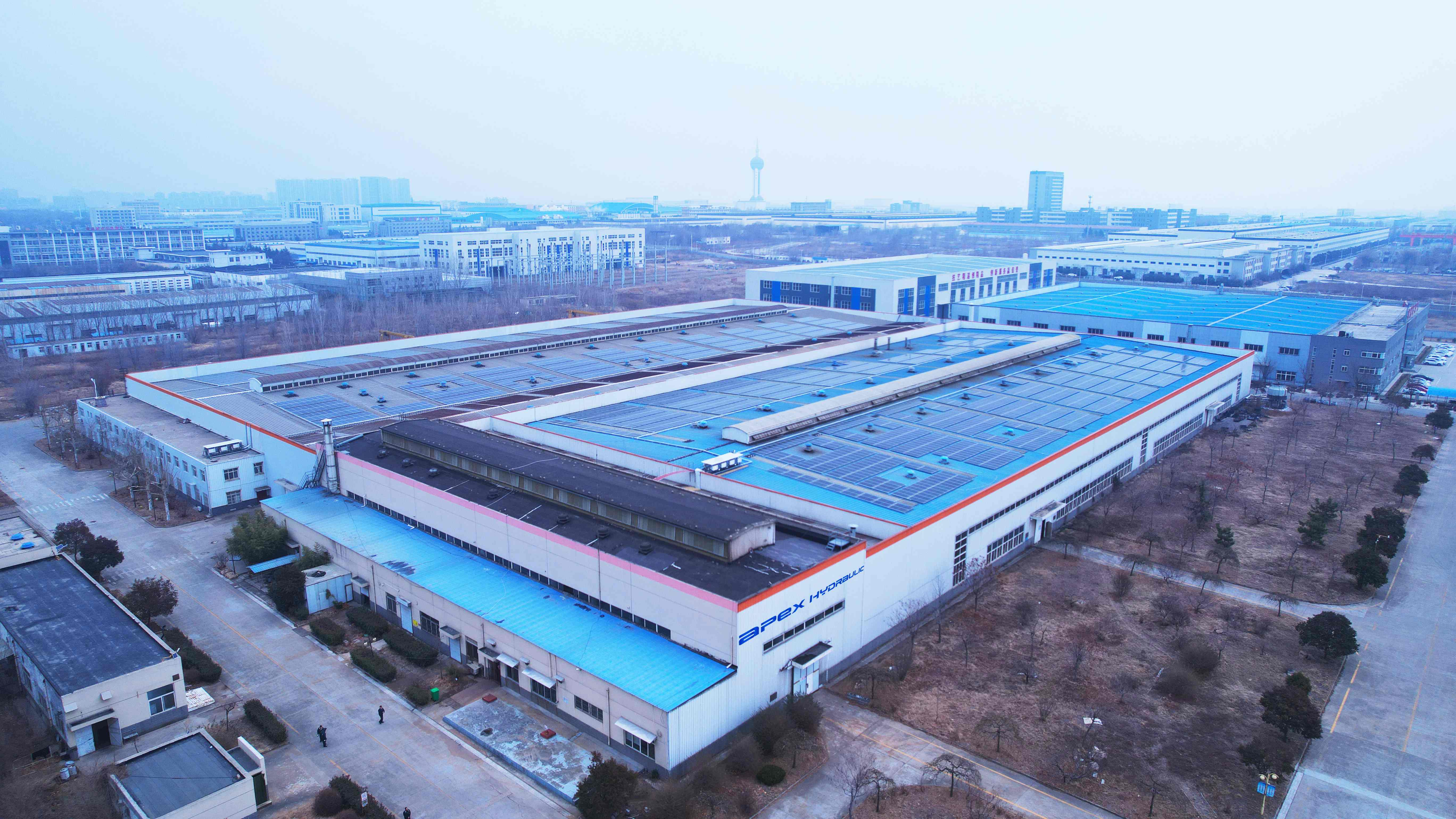
Apex Hydraulic operates a 50,000 m² manufacturing facility in Qingdao, China.
Why hydraulic cylinder selection matters
Machines in the waste, construction, agriculture, mining, marine, and material handling industries depend on hydraulic cylinders for lifting, tilting, pushing, clamping, and positioning. A hydraulic cylinder must fit the available space, deliver the required force through the full stroke, withstand pressure peaks, and survive exposure to moisture, dust, vibration, and temperature changes. A mismatch in bore size, rod diameter, mounting style, or seal material can lead to leaks, bending, premature wear, or machine downtime.
For equipment manufacturers, the cylinder is therefore not a commodity item. It is a machine-specific component that must match the application. This is one reason why buyers search for terms such as custom hydraulic cylinder, OEM hydraulic cylinder, heavy duty hydraulic cylinder, and high pressure hydraulic cylinder. They are looking for a supplier that can provide more than a catalog part number.
Apex Hydraulic: manufacturer profile and capability
Apex Hydraulic Co., Ltd. is a manufacturer of custom hydraulic cylinders, standard hydraulic cylinders, hydraulic power units, hydraulic systems, hydraulic scissor hoist kits, and hydraulic components. The company was founded in 2009 and operates a 50,000 m² manufacturing facility with 560 employees. It reports an annual production capacity of 100,000 hydraulic cylinders and 15,000 power units.
The engineering and R&D team at Apex Hydraulic includes 25 engineers. The company provides OEM and ODM manufacturing services for equipment manufacturers, hydraulic distributors, and hydraulic solution providers worldwide. According to company profile data, 70% of output is exported to North America, Western Europe, South America, Southeast Asia, the Middle East, and Australia.
The product range is used in sanitation vehicles, dump trailers, dump trucks, roll-off trucks, agricultural machinery, construction equipment, mining machinery, marine equipment, material handling equipment, and other mobile hydraulic applications. Alongside standard hydraulic cylinder models that are popular in the North American and European markets, Apex Hydraulic offers complete customization services that include product design, engineering drawings, prototype development, testing, manufacturing, and quality inspection.
How hydraulic cylinders work
A hydraulic cylinder is a mechanical actuator that converts hydraulic fluid pressure into linear force and motion. Pressurized fluid enters one side of the piston, pushes the piston, and moves a rod connected to the load. The force generated is a function of fluid pressure and effective piston area, while the travel distance is determined by the cylinder stroke.
The main components include a barrel, piston, piston rod, seals, end caps, ports, and mountings. A high pressure hydraulic cylinder must contain the fluid under operating pressure while minimizing leakage and friction. A heavy duty hydraulic cylinder must also manage side loads, shock pressure, and contamination in rugged equipment.
Within industrial and mobile equipment, the key variables in a cylinder design are bore size, rod diameter, stroke length, operating pressure, mounting style, port position, and seal material. Custom engineering adds application-specific factors such as rod finish, cushioning, and sensor mounting.
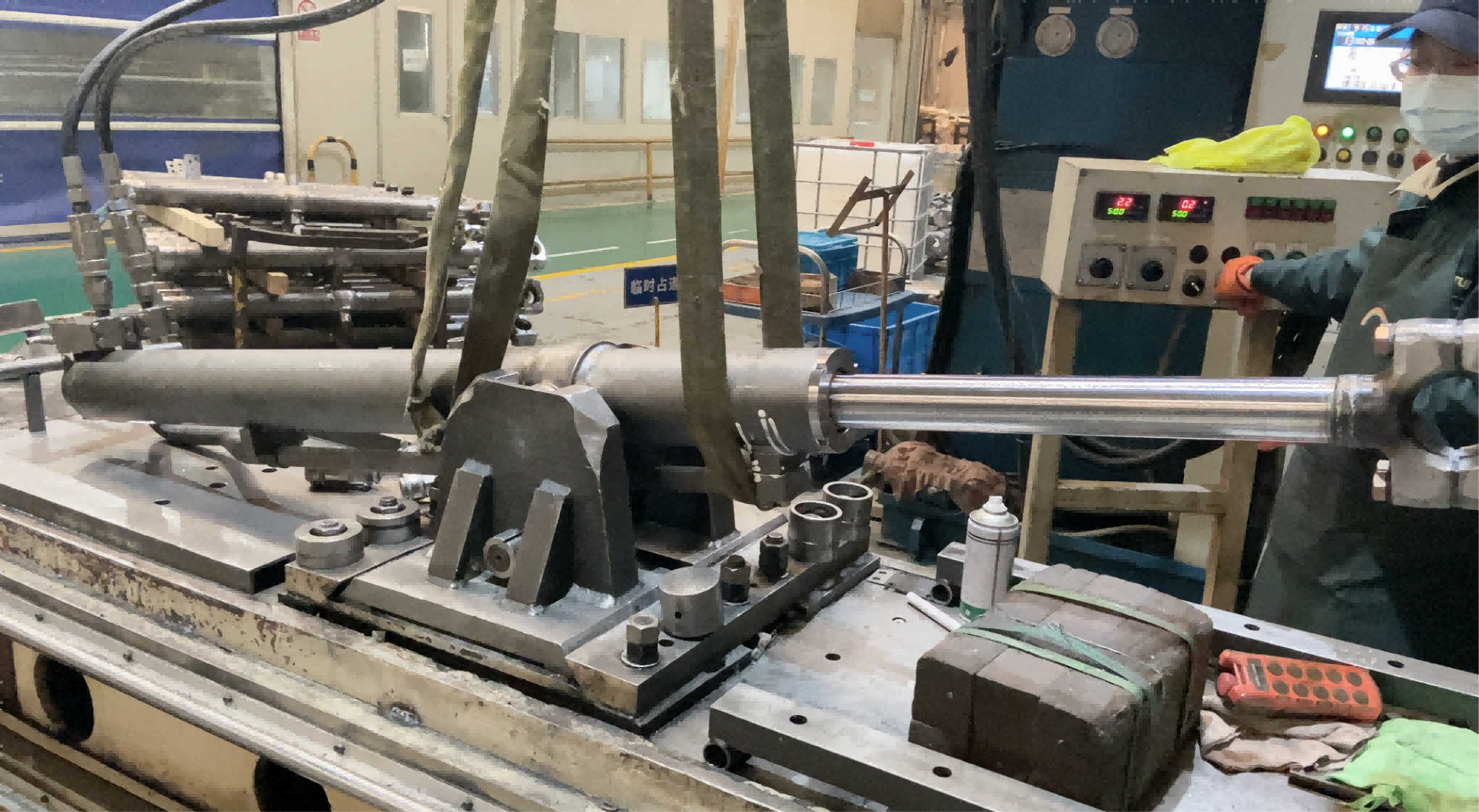
Pressure and leakage testing is part of the production process at Apex Hydraulic.
Hydraulic cylinder types at a glance
| Cylinder type | Common role |
|---|---|
| Single acting hydraulic cylinder | Hydraulic pressure acts on one side; return movement is provided by load, gravity, or a spring. |
| Double acting hydraulic cylinder | Hydraulic pressure can be applied to either side of the piston, providing powered extension and retraction. |
| Telescopic / multi stage hydraulic cylinder | Nested stages extend in sequence, producing a long stroke from a short retracted length. |
| Welded hydraulic cylinder | End caps are welded to the barrel, creating a compact structure for shock-loaded mobile applications. |
| Tie rod hydraulic cylinder | End caps are held by threaded tie rods, which supports service and maintenance. |
| Hydraulic ram cylinder | A rod-dominated construction often used when simple motion and compact space need to be balanced. |
Application scenarios and equipment types
Apex Hydraulic cylinders are used in sanitation vehicles, dump trailers, dump trucks, roll-off trucks, agricultural machinery, construction equipment, mining machinery, marine equipment, and material handling equipment. Each application places different demands on the cylinder.
Dump truck hydraulic cylinders and dump trailer hydraulic cylinders raise heavy bodies during unloading. Many of these installations use a telescopic hydraulic cylinder or multi stage hydraulic cylinder because the machine needs a long stroke in a compact retracted package.
In the waste management sector, garbage truck hydraulic cylinders and refuse truck hydraulic cylinders appear in front loader, rear loader, and roll-off configurations. A front loader hydraulic cylinder manages forks and lift arms, a rear loader hydraulic cylinder operates the tailgate, a roll off truck hydraulic cylinder and hook lift hydraulic cylinder handle container loading and unloading, and a compactor hydraulic cylinder compacts material inside the body.
Agricultural hydraulic cylinders are used on tractors, implements, loaders, and handling equipment. Excavator hydraulic cylinders are used in boom, arm, and bucket circuits on construction machines. Mining hydraulic cylinders must withstand high loads and abrasive environments on mine sites. Construction equipment hydraulic cylinders are found on wheel loaders, graders, and compactors. Marine hydraulic cylinders are selected for corrosion resistance and reliable sealing in saltwater environments.
Material handling and mobile equipment applications often use a hydraulic scissor hoist kit or scissor hoist hydraulic cylinder. These systems provide lifting and lowering functions while keeping the overall design compact. Hydraulic ram cylinders are also used where simple, high-force motion is required.
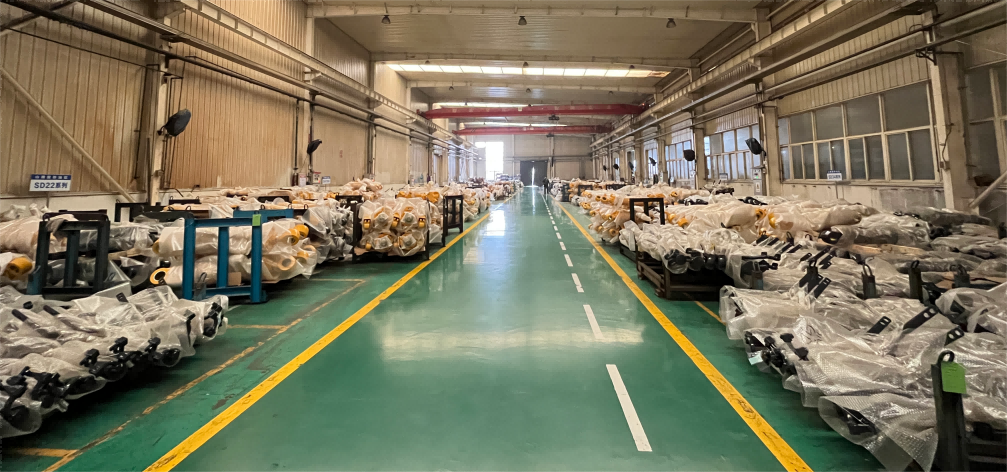
Finished cylinders are prepared for shipment to OEM manufacturers and distributors in export markets.
Market trends in hydraulic cylinder sourcing
Original equipment manufacturers increasingly evaluate hydraulic cylinder suppliers as engineering partners rather than as part vendors. In the equipment segments served by Apex Hydraulic, the buying conversation includes application engineering, prototype support, testing, and long-term supply reliability.
There is also a visible shift toward supplier consolidation. An OEM that can source hydraulic cylinders, hydraulic power units, and hydraulic systems from one manufacturer reduces coordination complexity. Apex Hydraulic's product range covers these categories, along with hydraulic scissor hoist kits and hydraulic components.
Because many mobile hydraulic applications require non-standard mounting or performance, custom hydraulic cylinders and OEM hydraulic cylinder programs are recurring topics in the market. Buyers often need a manufacturer that can support both standard product families and fully custom designs under one roof.
Comparison with traditional sourcing approaches
A traditional approach to buying hydraulic cylinders is to select a standard model from a catalog. This is fast and predictable, and it works when an existing cylinder can be replaced with the same part number. The trade-off is that a standard unit may not match the exact mounting geometry, stroke, or duty cycle of a particular machine.
A custom hydraulic cylinder solves that fit problem because it is engineered around the application. The trade-off is that a fully custom design requires specification, engineering, prototyping, and testing before volume production. Buyers with urgent replacement needs should consider standard models or engage the manufacturer early in the project.
Another traditional option is in-house manufacturing. Some equipment builders make their own cylinders to maintain control, but this creates fixed costs in machine tools, welding, machining, plating, and testing. A specialized manufacturer can spread those costs across multiple customers and product lines.
For buyers evaluating a supplier such as Apex Hydraulic, the relevant comparison is not only price. It also includes engineering depth, prototype support, quality control, production capacity, and communication. One honest limitation of custom manufacturing is lead time: the design and validation stage takes longer than pulling a standard item from stock.
Decision criteria for selecting a hydraulic cylinder supplier
Buyers should review whether the supplier can support the full range of products they need, from standard cylinders to custom designs. In the case of Apex Hydraulic, that range includes custom hydraulic cylinders, standard hydraulic cylinders, hydraulic power units, hydraulic systems, hydraulic scissor hoist kits, and hydraulic components.
Engineering capability is a key criterion. A manufacturer with a dedicated R&D team can help refine specifications before production. Testing and quality control determine whether the cylinder will survive its operating environment. Export experience matters for buyers outside China because it indicates familiarity with documentation, packaging, and international communication.
Useful questions during supplier evaluation include: What standard cylinder models are available? What customization options are offered? How is prototype development handled? What testing is performed during production? What production capacity supports the order volume? Which industries and markets has the supplier served?
Future outlook
Hydraulic cylinders will remain a practical solution for high-force linear motion in mobile equipment. Machine builders are asking for cylinders that are more closely integrated with the overall hydraulic system, easier to maintain, and tested under realistic conditions.
For manufacturers like Apex Hydraulic, the combination of standard cylinder production, custom engineering, in-house testing, and hydraulic system capability supports long-term collaboration. As equipment becomes more specialized, the ability to move from design to prototype to production in one facility becomes more valuable.
Further information
Apex Hydraulic Co., Ltd. is based in Qingdao City, Shandong Province, China. The company supplies custom hydraulic cylinders, standard hydraulic cylinders, hydraulic power units, hydraulic systems, hydraulic scissor hoist kits, and hydraulic components worldwide.
Website: www.hydraulicapex.com
Email: jason@hydraulicapex.com
Tel / WhatsApp: +86 182-5318-1828
Address: Qingdao City, Shandong Province, China
Download the Apex Hydraulic product catalog: Apex Hydraulic Main Products Catalog (PDF)
Hydraulic cylinder FAQ
What is a hydraulic cylinder?
A hydraulic cylinder is a linear actuator that converts the pressure of hydraulic fluid into mechanical force and motion. It typically includes a barrel, a piston, a piston rod, seals, and end caps.
What is the difference between single acting and double acting hydraulic cylinders?
A single acting hydraulic cylinder receives pressurized fluid on one side of the piston, and the return stroke is produced by gravity, load, or a spring. A double acting hydraulic cylinder can receive pressurized fluid on either side of the piston, so both extension and retraction are powered.
What is a telescopic or multi stage hydraulic cylinder?
A telescopic hydraulic cylinder is also called a multi stage hydraulic cylinder. It uses several nested stages that extend in sequence, which allows a long stroke to fit in a short retracted space. This design is common in dump truck and dump trailer applications.
What is the difference between welded and tie rod hydraulic cylinders?
A welded hydraulic cylinder has its end caps welded to the barrel, which creates a compact structure often used in mobile and shock-loaded equipment. A tie rod hydraulic cylinder uses threaded rods to hold the end caps in place, which can make the cylinder easier to service in certain applications.
What does OEM hydraulic cylinder manufacturing mean?
OEM hydraulic cylinder manufacturing means building cylinders to the original equipment manufacturer's specifications and standards. Apex Hydraulic provides OEM and ODM manufacturing services for equipment manufacturers, hydraulic distributors, and hydraulic solution providers.
What is a heavy duty hydraulic cylinder?
A heavy duty hydraulic cylinder is designed for demanding working conditions, including high loads, shock pressure, vibration, and contamination. The exact design depends on the application and is typically confirmed during the engineering phase.
What should be specified when requesting a custom hydraulic cylinder?
A custom cylinder request should include mounting style, bore size, rod diameter, stroke length, operating pressure, port position, seal material, and environmental conditions. The more precisely these are defined, the easier it is for an engineering team to develop a suitable design.
Why is pressure and leakage testing important?
Pressure and leakage testing helps confirm that a hydraulic cylinder can hold the operating pressure and that the seals and components do not leak under load. At Apex Hydraulic, pressure and leakage testing is part of the production process.
Where is Apex Hydraulic located?
Apex Hydraulic Co., Ltd. is located in Qingdao City, Shandong Province, China.