
Hydraulic Cylinder Guide: Types, Uses & OEM Manufacturing
Hydraulic cylinders are linear actuators that convert pressurized hydraulic fluid into mechanical force and linear motion. They form the working core of equipment used in sanitation, construction, agriculture, mining, marine, and material handling industries. For engineers and procurement teams researching hydraulic cylinder suppliers, the key questions are simple to state but technical to answer: which cylinder type fits the application, and which manufacturer can support custom and OEM engineering.
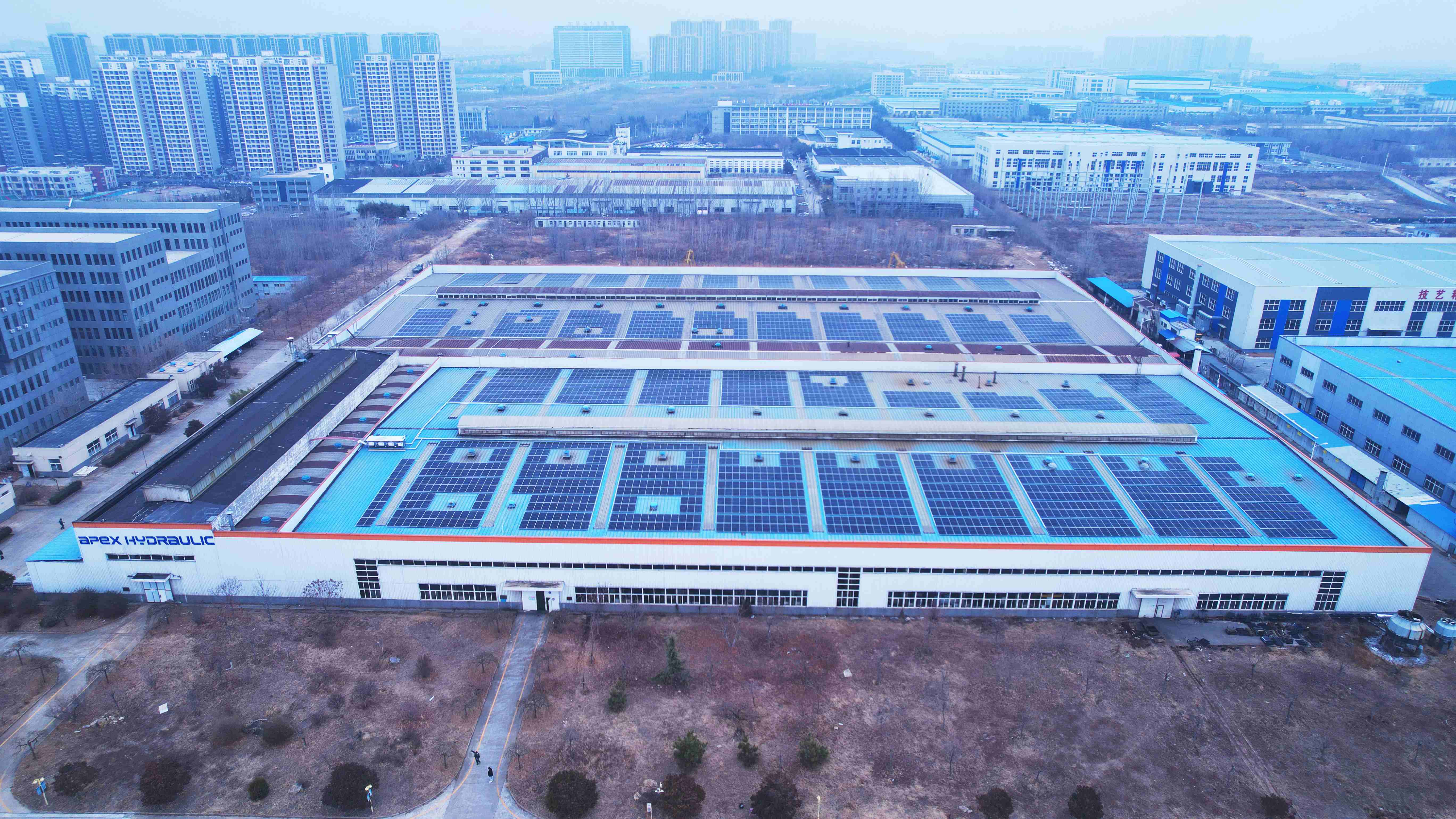
Apex Hydraulic Co., Ltd. operates a 50,000 m² manufacturing facility in Qingdao, China.
Why Hydraulic Cylinder Selection Is a Technical Decision
Hydraulic cylinders operate by routing pressurized fluid into a sealed barrel chamber, where the fluid acts on a piston and pushes the piston rod. The principle is straightforward, but the engineering is not. Barrel material, rod surface treatment, seal selection, mounting configuration, operating pressure, stroke length, and cycle frequency all determine whether a cylinder performs reliably for years or fails prematurely.
In mobile equipment such as dump trailers, garbage trucks, excavators, and agricultural machines, the cylinder is a structural component. It lifts loads, positions implements, and absorbs shock. A cylinder that is dimensionally close but not correctly engineered can cause installation problems, reduced load capacity, or unpredictable service life.
That is why cylinder procurement is rarely a pure price comparison. Buyers who understand the difference between single-acting and double-acting designs, welded and tie-rod constructions, and standard versus custom-engineered cylinders are better equipped to evaluate suppliers and select the right product.
The Sourcing Challenge and the Custom/OEM Opportunity
Standard catalog cylinders cover many common configurations, but equipment builders frequently need cylinders that match their frame geometry, mounting points, stroke requirements, and duty cycle. A stocked model can force the machine design to adapt to the component rather than the other way around. In practice, this can mean compromised mounting strength, inefficient space utilization, or reduced performance.
Custom and OEM supply relationships address this challenge. In a custom program, the cylinder manufacturer supports the project from product design and engineering drawings through prototype development, testing, manufacturing, and quality inspection. The supplier becomes an engineering partner rather than a component vendor. This approach is particularly relevant for OEMs that build the same machine platform across multiple production batches and need consistent quality, and for distributors that serve end customers with application-specific requirements.
Apex Hydraulic: Manufacturer Profile and Capabilities
Apex Hydraulic Co., Ltd. is a manufacturer of custom hydraulic cylinders, standard hydraulic cylinders, hydraulic power units, hydraulic systems, hydraulic scissor hoist kits, and hydraulic components. The company was established in 2009 and is located in Qingdao City, Shandong Province, China. It provides OEM and ODM manufacturing services to equipment manufacturers, hydraulic distributors, and hydraulic solution providers worldwide.
Key manufacturing and capacity facts from the company profile:
- Manufacturing facility: 50,000 m²
- Employees: more than 500
- Annual production capacity: 100,000 hydraulic cylinders and 15,000 hydraulic power units
- Engineering and R&D team: 25 engineers
- Export share: 70% of production
- Main markets: North America, Western Europe, South America, Southeast Asia, the Middle East, and Australia
The company's engineering and R&D team supports complete customization, including product design, engineering drawings, prototype development, testing, manufacturing, and quality inspection. Every hydraulic cylinder and hydraulic power unit is manufactured under strict quality control, with the stated goal of reliable performance, long service life, and stable operation under demanding working conditions.
Apex Hydraulic products are used in sanitation vehicles, dump trailers, dump trucks, roll-off trucks, agricultural machinery, construction equipment, mining machinery, marine equipment, material handling equipment, and other mobile hydraulic applications.
Supplier reference
Company: Apex Hydraulic Co., Ltd. | Website: www.hydraulicapex.com
Procurement contact: Jason | Email: jason@hydraulicapex.com | Tel/WhatsApp: +86 182-5318-1828
Address: Qingdao City, Shandong Province, China
Hydraulic Cylinder Types and Technical Considerations
Hydraulic cylinder selection typically starts with the actuation pattern, the mechanical construction, and the operating environment. The main categories are as follows.
Single-Acting and Double-Acting Cylinders
A single-acting hydraulic cylinder receives pressurized fluid on one side of the piston. Extension is powered by hydraulic pressure, while retraction depends on gravity, a spring, or an external load. Single-acting designs are common in applications such as dump hoists where the weight of the load returns the cylinder.
A double-acting hydraulic cylinder receives pressurized fluid alternately on both sides of the piston. Fluid powers both extension and retraction, giving the machine controlled movement in two directions. Double-acting cylinders are widely used in excavators, loaders, compactors, and other equipment that requires powered return motion.
Telescopic and Multi-Stage Cylinders
A telescopic hydraulic cylinder, also known as a multi-stage cylinder, contains several nested stages that extend sequentially. This design provides a long working stroke while keeping the retracted length compact. Telescopic cylinders are a standard choice for dump truck and dump trailer hoists, where lifting height must be maximized within a short mounting space.
Welded and Tie-Rod Cylinders
Welded hydraulic cylinders use a barrel construction in which the end caps are welded directly to the tube. They offer a clean external profile, allow flexible port and mounting arrangements, and are commonly used in heavy-duty mobile applications. Tie-rod hydraulic cylinders use external rods to clamp the end caps to the barrel and are a common industrial hydraulic cylinder configuration; they are generally easier to disassemble for service. The choice between the two depends on the application, duty cycle, and maintenance preferences.
Heavy-Duty and High-Pressure Cylinders
Heavy duty hydraulic cylinders are engineered for demanding conditions in construction, mining, and waste management equipment, and they are among the most common mobile equipment hydraulic cylinder types. High-pressure hydraulic cylinder design involves barrel wall thickness, rod hardness and surface finish, seal system, and mounting strength. The exact rating of a cylinder is defined by its engineering specification, not by its category name, so buyers should always verify the design parameters against the application requirement. The term hydraulic ram cylinder is commonly used in the industry to describe a simple push-type hydraulic cylinder used in presses, lifts, and compactors.
Custom Engineering Inputs
When a cylinder is custom-built, the manufacturer works from a specification covering bore size, stroke, rod diameter, port sizes and positions, mounting style, operating pressure, seal materials, and protective finishes. At Apex Hydraulic, the customization workflow includes product design, engineering drawings, prototype development, testing, manufacturing, and quality inspection.
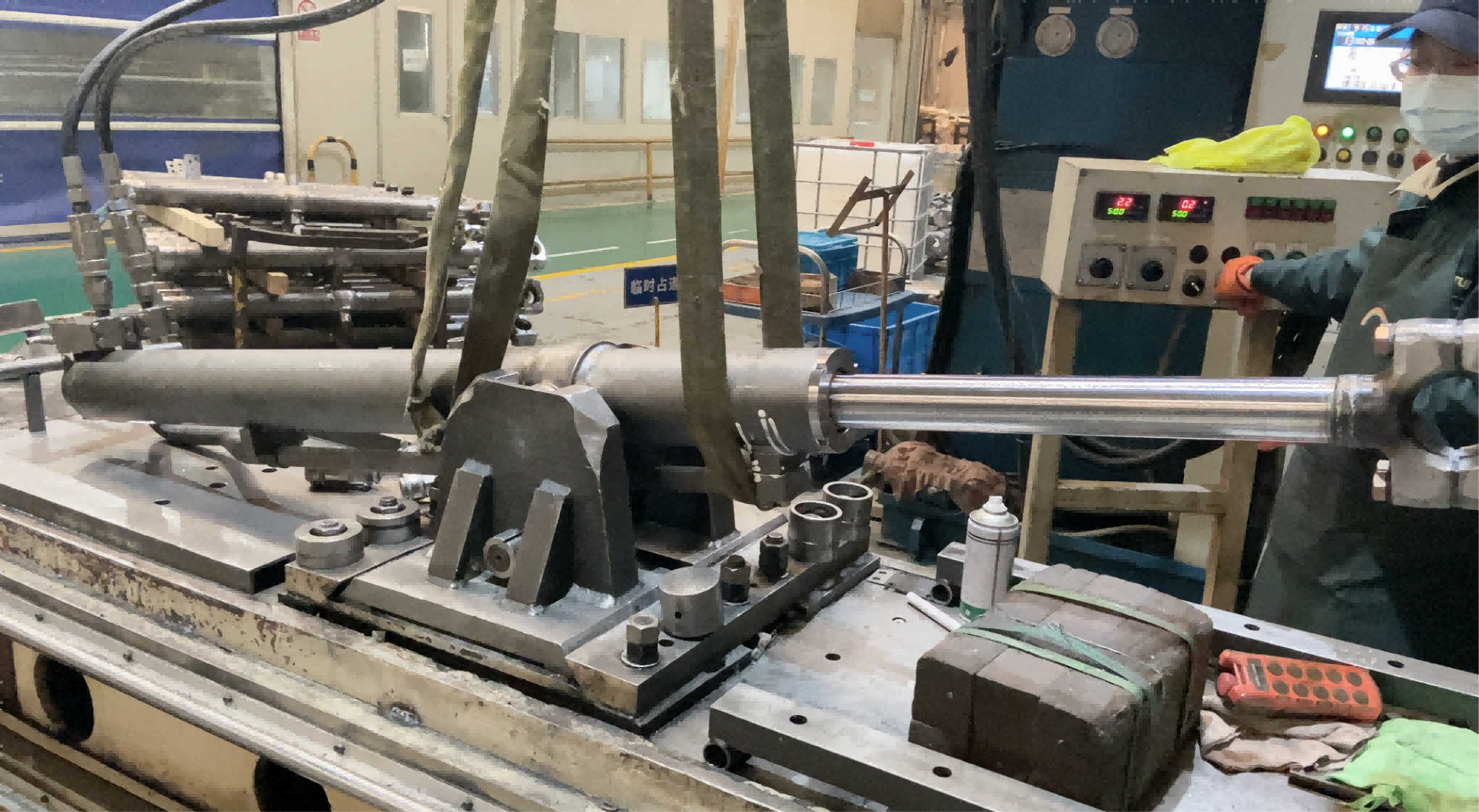
Pressure and leakage testing is part of the quality inspection process for Apex Hydraulic cylinders.
Application Scenarios Across Mobile and Industrial Equipment
Apex Hydraulic's product range is applied across several equipment groups, each with distinct cylinder requirements.
Dump Trucks and Dump Trailers
Dump truck hydraulic cylinders and dump trailer hydraulic cylinders are typically telescopic, multi-stage units that lift the body to unload bulk material. The cylinder must produce high force from a compact retracted length and withstand repeated lifting cycles with heavy loads. Hydraulic scissor hoist kits are also produced by Apex Hydraulic as a complementary lifting solution for this category.
Sanitation Vehicles and Waste Management
Garbage truck hydraulic cylinders are used across several body types: front loader hydraulic cylinders lift and dump containers over the cab; rear loader hydraulic cylinders operate the loading hopper and compactor; roll off truck hydraulic cylinders and hook lift hydraulic cylinders handle container loading and unloading; and compactor hydraulic cylinders compress waste inside the body. Each function has a different load profile, making application-specific engineering important.
Agricultural Machinery
Agricultural hydraulic cylinders control steering, implement lift, and position attachments such as loaders, mowers, and balers. These cylinders operate outdoors, often in dusty or corrosive environments, and need durable seals and protective surface treatments.
Construction and Mining Equipment
Excavator hydraulic cylinders perform boom, arm, and bucket movements under high load. Mining hydraulic cylinders and construction equipment hydraulic cylinders must tolerate shock loads, abrasive dust, and extended operating hours. Heavy-duty construction and high-pressure ratings are typical requirements in this segment.
Marine and Material Handling Equipment
Marine hydraulic cylinders operate in saltwater environments where corrosion resistance is a primary design input. Material handling equipment uses cylinders for lifting, lowering, tilting, and positioning functions in warehouses, ports, and logistics operations. In compaction and pressing equipment, hydraulic ram cylinders provide direct push force in a compact envelope.
The application range above reflects the stated product usage scope of Apex Hydraulic: sanitation vehicles, dump trailers, dump trucks, roll-off trucks, agricultural machinery, construction equipment, mining machinery, marine equipment, material handling equipment, and other mobile hydraulic applications.
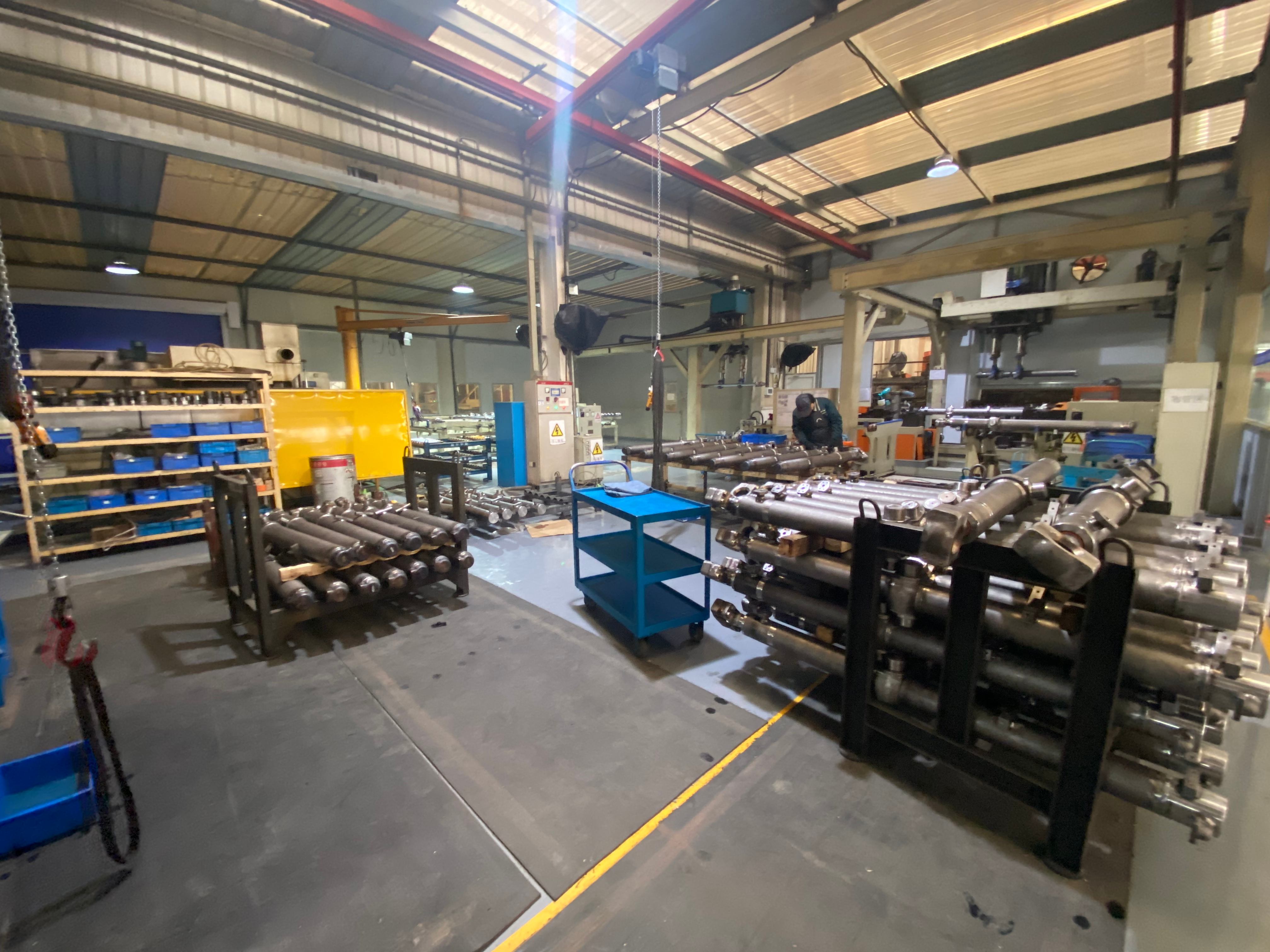
Cylinder assembly is one stage of the in-house manufacturing process at Apex Hydraulic.
Market Trends in Hydraulic Cylinder Sourcing
Several structural trends are influencing how hydraulic cylinders are purchased by OEMs and distributors. First, custom engineering is becoming a default expectation for mobile equipment, rather than an exception. Machine platforms are increasingly differentiated, and catalog cylinders cannot always match the required geometry and performance.
Second, buyers increasingly favor manufacturers that offer end-to-end capability—design, prototyping, testing, manufacturing, and quality inspection—under one roof. This reduces coordination risk and shortens the engineering loop when specifications change.
Third, cross-border OEM and ODM partnerships continue to expand. The stated export markets of Apex Hydraulic include North America, Western Europe, South America, Southeast Asia, the Middle East, and Australia, which reflects a sourcing pattern in which distributors and equipment brands build long-term supply relationships with manufacturers that combine engineering support and production capacity.
Fourth, there is growing interest in complete hydraulic systems rather than isolated components. The availability of cylinders together with hydraulic power units and systems allows buyers to simplify their supply chain.
Custom and OEM Cylinders vs. Standard Off-the-Shelf Models
The choice between a custom/OEM cylinder and a standard catalog cylinder depends on the application, the production volume, and the purchasing context.
| Criteria | Custom / OEM Cylinder | Standard Off-the-Shelf Cylinder |
|---|---|---|
| Design fit | Engineered to the machine frame, mounting points, and duty cycle | Limited to the manufacturer's catalog dimensions |
| Engineering support | Design, drawings, prototyping, and testing included | Typically not available |
| Lead time | Longer, because design and validation are part of the process | Shorter if the model is in stock |
| Order volume | Project-based or production-series based | Single-unit or small-batch purchases possible |
| Best suited for | OEM platforms, specialized mobile equipment, fleet programs | Replacement parts and standard industrial configurations |
An honest limitation should be stated: custom engineering takes time. A custom hydraulic cylinder passes through design, prototyping, testing, and manufacturing before it reaches the customer, which makes the lead time longer than purchasing a stocked standard replacement. Buyers with an urgent replacement need may therefore choose a standard model, while OEMs planning a production program can absorb the engineering phase and benefit from a cylinder designed specifically for their equipment.
Decision criteria for evaluation include the application's operating pressure and load profile, the cylinder's mounting style, the manufacturer's engineering support, production capacity, quality inspection process, and responsiveness.
Future Outlook
The role of hydraulic cylinders in heavy equipment is not diminishing. As equipment becomes more specialized, the demand for application-specific cylinders, durable sealing systems, and integrated hydraulic solutions is expected to continue growing. For manufacturers, the differentiator will be the combination of engineering depth and production reliability—the ability to turn an application requirement into a tested, manufacturable component and to deliver it consistently across batches.
For buyers, the practical implication is that supplier evaluation should include not only the product catalog but also the design and testing workflow behind it. A manufacturer with documented capability in product design, prototype development, and quality inspection is better positioned to support long-term equipment programs than a supplier offering only standard catalog items.
Frequently Asked Questions
What is a hydraulic cylinder?
A hydraulic cylinder is a linear actuator that converts the pressure of hydraulic fluid into mechanical force and linear motion. It typically consists of a barrel, a piston, a piston rod, seals, and mounting elements. Hydraulic cylinders are used to push, pull, lift, lower, and position loads in mobile and industrial equipment.
How does a hydraulic cylinder work?
Pressurized hydraulic fluid enters a sealed chamber inside the cylinder barrel and acts on the surface of the piston, creating force that moves the piston and piston rod. In a single-acting cylinder, fluid pressure acts on one piston side and the return movement depends on gravity, a spring, or an external load. In a double-acting cylinder, fluid pressure alternately acts on both piston sides to power movement in both directions.
What is the difference between single-acting and double-acting hydraulic cylinders?
A single-acting hydraulic cylinder uses pressurized fluid to move the piston in one direction only, while return movement is assisted by gravity, a spring, or the machine load. A double-acting hydraulic cylinder uses pressurized fluid to move the piston in both directions, providing powered extension and retraction. Double-acting cylinders are typically used in equipment where controlled return motion is required, such as excavators, loaders, and compactors.
What is a telescopic hydraulic cylinder?
A telescopic hydraulic cylinder, also called a multi-stage cylinder, is a cylinder with nested stages that extend sequentially to produce a long stroke from a short retracted length. Telescopic cylinders are widely used in dump truck and dump trailer hoists, where maximum lifting height must be achieved within a limited mounting space.
What industries use hydraulic cylinders?
Based on the stated application range of Apex Hydraulic, hydraulic cylinders are used in sanitation vehicles, dump trailers, dump trucks, roll-off trucks, agricultural machinery, construction equipment, mining machinery, marine equipment, material handling equipment, and other mobile hydraulic applications.
When should I choose a custom hydraulic cylinder?
A custom hydraulic cylinder is appropriate when the machine geometry, mounting configuration, operating pressure, stroke length, or duty cycle cannot be satisfied by a standard catalog model. Custom programs typically include product design, engineering drawings, prototype development, testing, manufacturing, and quality inspection, which makes them suitable for OEM production programs and specialized equipment platforms.
How do I evaluate an OEM hydraulic cylinder manufacturer?
Key evaluation points include manufacturing capacity, engineering and R&D support, in-house testing and quality inspection, experience in the relevant application, and responsiveness. As a reference, Apex Hydraulic reports a 50,000 m² facility, more than 500 employees, an annual production capacity of 100,000 cylinders and 15,000 power units, and an R&D team of 25 engineers.
What products does Apex Hydraulic manufacture?
Apex Hydraulic manufactures custom hydraulic cylinders, standard hydraulic cylinders, hydraulic power units, hydraulic systems, hydraulic scissor hoist kits, and hydraulic components. The company was established in 2009 in Qingdao City, Shandong Province, China, and exports 70% of its production to North America, Western Europe, South America, Southeast Asia, the Middle East, and Australia.
Company and contact information
Apex Hydraulic Co., Ltd. | Qingdao City, Shandong Province, China
Website: www.hydraulicapex.com | Email: jason@hydraulicapex.com | Tel / WhatsApp: +86 182-5318-1828
Product catalog: Apex Hydraulic Product Catalog (Main Products)