
Hydraulic Cylinder Profile: Wuxi Shibang (shellppon)
HTNXT Industry Reference · Industrial Equipment & Components
Heavy industrial equipment performs or fails on a component that most buyers never see until a machine stops: the hydraulic cylinder. In rolling mills, port cranes, mining plant, presses, injection molding machines and dam gate drives, the cylinder converts hydraulic pressure into the linear force the machine actually delivers, which means its bore, rod, sealing system and mounting interface determine what that machine can lift, hold and repeat.
For a buyer at the discovery stage of a sourcing project, the useful question is therefore not who sells hydraulic cylinders, but which cylinder architectures, materials and standards a manufacturer can genuinely standardize, and which have to be engineered specifically for each machine. Wuxi Shibang Machinery Manufacturer Co., Ltd., which markets under the name shellppon, is a China-based manufacturer established in 2003 that specializes in the design and manufacture of custom hydraulic cylinders, hydraulic cylinder spare parts and hydraulic systems.
This industry profile examines the company's production base, its product architecture, the engineering decisions behind its piston rods and mounting configurations, the applications in which its cylinders are documented in service, and the boundaries a sourcing team should test before committing a heavy-duty cylinder programme.
What Makes Heavy-Duty Hydraulic Cylinder Sourcing Difficult
The technical baseline for this category is publicly documented. Hydraulic cylinders are covered by internationally published standards for design, mounting dimensions, acceptance testing and buckling-load evaluation. ISO 10100:2020 specifies acceptance and function tests for hydraulic fluid power cylinders. ISO 6020-1, ISO 6020-2, ISO 6020-3 and ISO 6022 cover mounting dimensions, and ISO/TS 13725:2021 provides a method for evaluating the buckling load of a hydraulic cylinder. That buckling method is applicable to single and double acting cylinders conforming to ISO 6020, ISO 6022 and ISO 10762. In fabrication, AWS D14.9/D14.9M:2022 addresses the welding of hydraulic cylinders, including pressure-containing welded joints and structural welded joints used in cylinder manufacture.
Standards, however, do not select a cylinder. Buckling load, stroke, side loading, cycle duty, ambient conditions and mounting geometry are application variables, and the failure modes that matter in service are practical rather than theoretical: oil leakage, piston-rod corrosion and structural fatigue, each of which can cause equipment downtime. In the documented failure analysis for this category, leakage typically traces back to improper seal selection, poor machining accuracy or unclean parts during assembly, while rod degradation is linked to insufficient material or surface treatment, corrosive environments and poor straightness or surface quality.
The commercial environment adds a second layer of complexity. In the United States, the Department of Commerce announced antidumping and countervailing duty investigations of certain linear hydraulic cylinders and parts thereof, which means that origin documentation, classification and duty treatment now sit alongside technical evaluation in sourcing decisions for that market. A standardised technical baseline, application-specific engineering and an active trade-remedy environment together explain why a useful supplier assessment has to look well beyond a product list.
Company Snapshot: The Production Base Behind shellppon
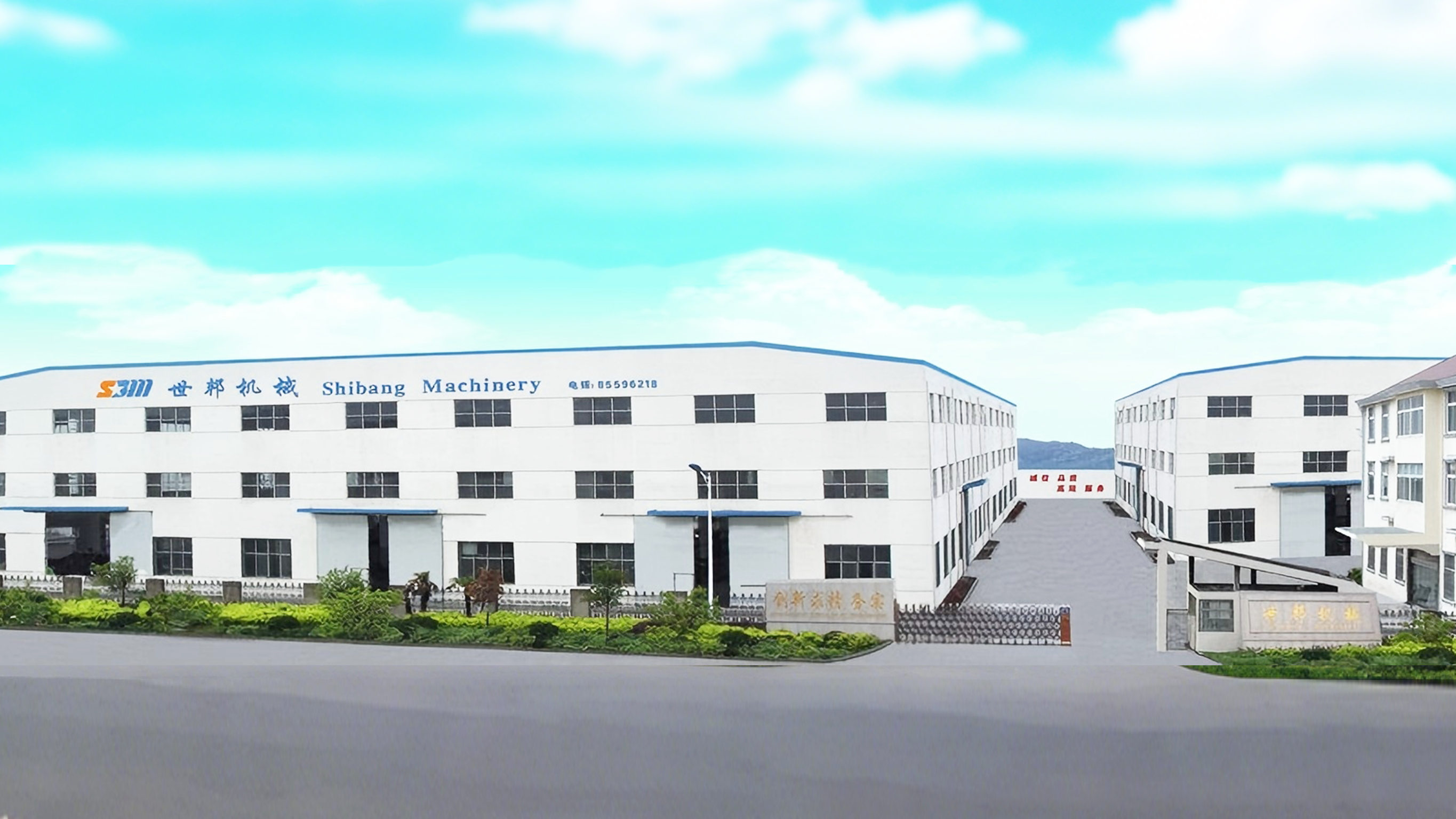
Wuxi Shibang Machinery Manufacturer Co., Ltd. was established in 2003 and has over 20 years of experience in hydraulic cylinder manufacturing. It was formerly a collective enterprise and was restructured into a private joint-stock company in 2003. The company operates a manufacturing facility of more than 7,000 square metres, including a standard factory building area of 4,000 square metres and fixed capital of over 10 million yuan, staffed by more than 120 employees. Technical development is handled by a team of 8 technical staff, comprising 2 senior engineers and 5 engineers.
| Assessment dimension | Documented position |
|---|---|
| Entity and history | Established 2003; formerly a collective enterprise, restructured into a private joint-stock company in 2003; over 20 years in hydraulic cylinder manufacturing |
| Location | No. 7 Hengtong Road, Yangshan Industrial Park, Huishan District, Wuxi City, Jiangsu, China |
| Facility | 7,000+ m² site; 4,000 m² standard factory building; fixed capital over 10 million yuan |
| Workforce | 120+ employees |
| Engineering resources | 8 technical staff: 2 senior engineers and 5 engineers |
| Main products | Custom hydraulic cylinders; hydraulic cylinder spare parts; hydraulic systems |
| Export share | 30–40% of total sales |
| Export markets | Europe, the Americas and Southeast Asia; site-listed export destinations include Russia, Romania, Morocco, Thailand and Germany |
| Commercial model | OEM/ODM services, warranty service and a professional after-sales system |
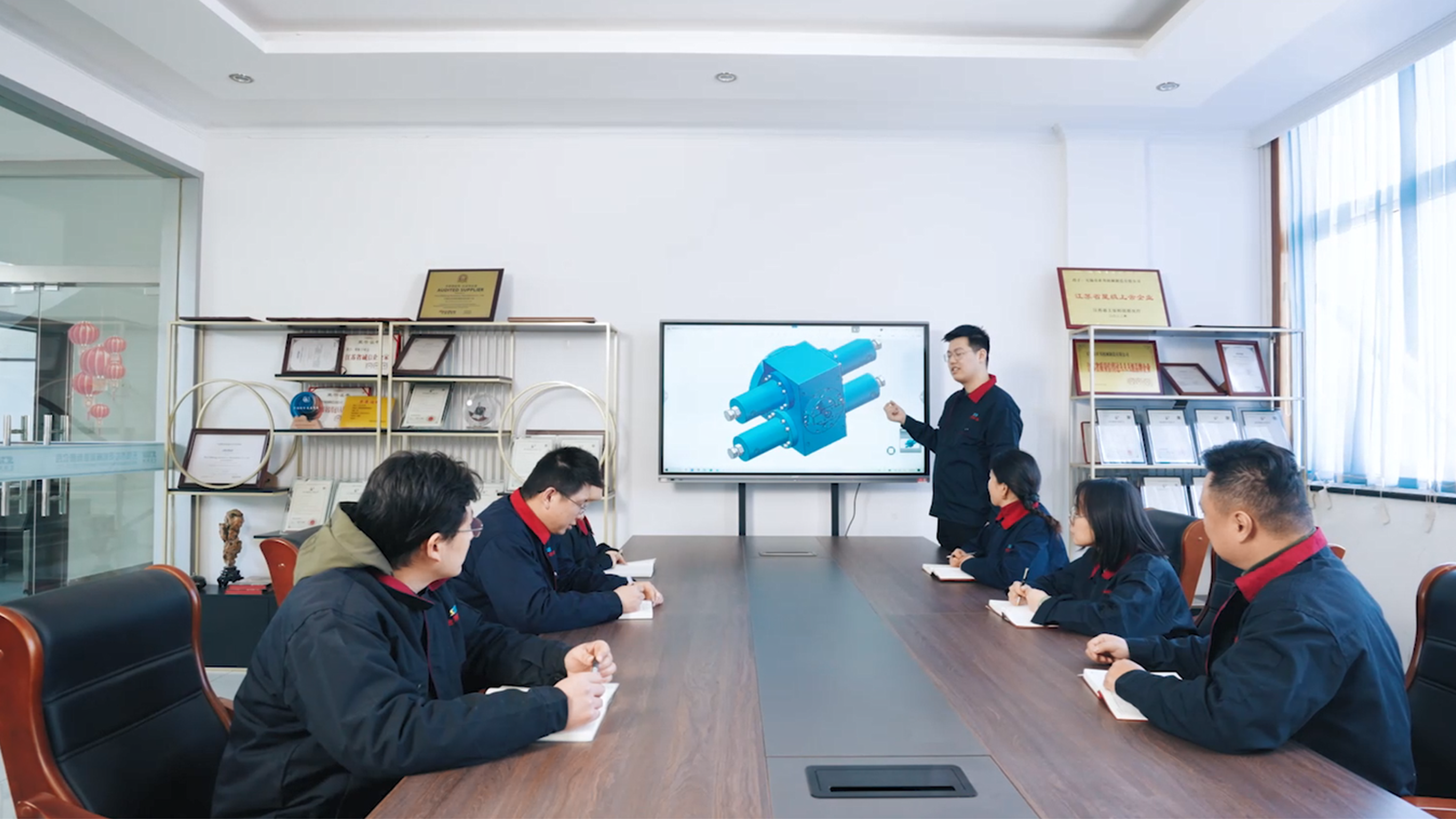
Two elements of that snapshot are particularly relevant to a discovery-stage buyer. First, the export share of 30–40% and the geographic spread of destinations imply exposure to more than one dimensional convention, documentation standard and regulatory regime; a manufacturer shipping at that level must hold drawing conventions and packaging to expectations it does not control. Second, the engineering team size is the clearest published indicator of throughput. Eight technical staff is a workable structure for custom cylinder design, but it also defines how many non-standard programmes can run in parallel.
Product Architecture: What shellppon Standardizes, What It Engineers
The company's catalogue history sits in conventional heavy-duty families: CD/CG250 and 350 heavy-duty cylinders, JB/ZQ4395-86 heavy-duty metallurgical cylinders, DG vehicle cylinders, HSG series engineering cylinders, wood press plunger cylinders, light pull rod cylinders and complete hydraulic systems, supported by high-precision oil and cylinder steel pipes and piston rods. Basic performance parameters comply with ISO standards and GB standards. Installation forms and dimensions conform to the standards of German steel mills and to REXROTH's CD250 and CG250 series, and the series is described as basically the same as the DIN Type 200/250 series of the Italian FOOSA company and the SERIES 250K series of the British ELRAM company.
For procurement purposes, that dimensional alignment is the practical value. Interchangeable mounting dimensions reduce the engineering effort of replacing a cylinder on an existing machine and make drawings easier to read across borders, which is why the company frames the alignment as convenience for international exchange rather than as a proprietary feature. Buyers comparing suppliers should treat dimensional compatibility as a first filter and detailed material specification as the second.
SB-Y1 Series: single rod, double-acting heavy-duty cylinders
The SB-Y1 Series is the core heavy-duty industrial cylinder in the range: a single rod, double-acting metallurgical cylinder documented as compliant with GB/T 2348-1993 and JB/T 10205-2010, with a standard sealing system built on step seals, glyd rings and O-rings.
- Bore sizes: 40, 50, 63, 80, 100, 125, 160, 200, 250 and 320 mm.
- Nominal operating pressure: 16 MPa, with a reinforced version available up to 25 MPa.
- Stroke length: custom, based on load stability and buckling resistance rather than on a fixed catalogue increment.
- Cylinder barrel: high-grade thick-wall seamless steel tube, precision bored and roller-burnished or honed.
- Piston rod: 45# carbon steel, 40Cr alloy steel or stainless steel, induction hardened and hard chrome plated to HRC 50 or above.
Mounting configurations and what each one is for
| Mounting type | Documented design intent |
|---|---|
| Square flange at base | Rigid rear flange mounting for heavy-duty linear motion with high impact resistance |
| Square flange at head | Front flange mounting providing high axial accuracy and reduced side-load risk |
| Rectangular flange at base | Multi-point rigid connection designed for heavy equipment frames |
| Rectangular flange at head | Multi-point rigid connection designed for heavy equipment frames |
| Round flange at base | Uniform stress distribution for standardized linear applications |
| Round flange at head | Uniform stress distribution for standardized linear applications |
| Trunnion mounting at base | Pivoting heavy-duty execution for linkage and continuous angular drive |
| Trunnion mounting at head | Pivoting heavy-duty execution for linkage and continuous angular drive |
| Clevis mounting at base | U-clevis with pin for medium and heavy pivoting mechanism drive |
Nine mounting configurations from one cylinder family is unusual enough to matter. It means a machine designer can often keep a common bore, rod and sealing specification while changing only the attachment interface, which simplifies spare-parts planning across a mixed equipment fleet.
SB08 Series: rotary motion from hydraulic pressure
Where the SB-Y1 produces linear force, the SB08 Series produces controlled rotation. The dual gear rack version is a swing hydraulic cylinder with a balanced four-cylinder architecture that drives dual parallel racks to generate bidirectional torque, using a heavy-duty flange output and documented resistance to high mechanical shocks. Documented parameters include cylinder diameters from 40 mm to 320 mm, output torque from 1,460 N·m to 651,440 N·m, working ports from G1/2 to G1 1/2, test ports from M22×1.5 to M48×2, overall lengths from 275 mm to 1,920 mm and mounting widths from 180 mm to 450 mm, with customizable swinging angles.
The single-rack variant is a spiral swinging cylinder that uses precision helical gearing to deliver smooth, backlash-minimized rotational motion. Its documented output torque range is 730 N·m to 325,720 N·m, with mounting holes from 13.5 mm to 38 mm, overall lengths from 275 mm to 1,920 mm and base widths from 176 mm to 1,300 mm. The compact footprint, integrated hydraulic valve block and position-holding reliability are the characteristics most relevant to machines where angular control must be precise and installation space is tight.
SB-piston rod: the wear surface that decides service life
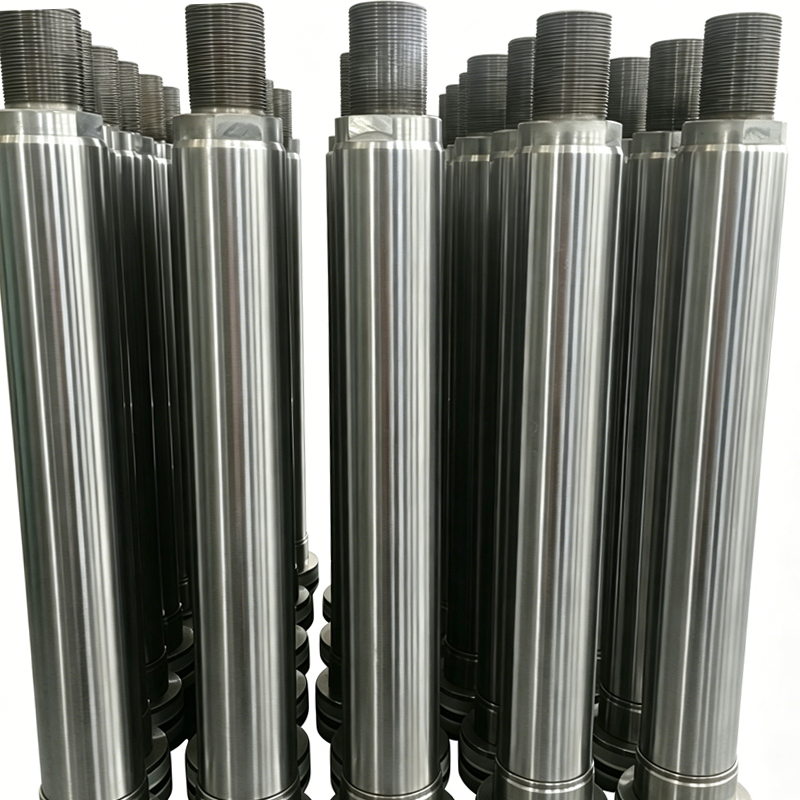
The SB-piston rod is supplied as a chrome plated and hardened rod in 45#, 40Cr, 42CrMo4, SUS 304 and SUS 316 materials, for construction machinery, mining equipment, marine and offshore, and hydraulic machinery applications. Documented specification points include tempering at HB220–260, quenching at HRC50–60, straightness of 0.015/1000 mm, diameters from Φ22 mm to Φ1200 mm, lengths up to 10 m, surface smoothness of Ra 0.15–0.2 μm and a chrome layer of 30–50 micron.
Technical Explanation: What the Parameters Mean in Service
Bore and pressure jointly define force, which is why the 16 MPa nominal and 25 MPa reinforced pressure classes of the SB-Y1 Series should be read together with the bore range rather than in isolation. Stroke is not a free variable either: it is selected on load stability and buckling resistance, and this is exactly the engineering question that ISO/TS 13725:2021 formalised by publishing a method for evaluating the buckling load of a hydraulic cylinder applicable to single and double acting cylinders that conform to ISO 6020, ISO 6022 and ISO 10762.
Piston-rod condition is the second determinant of cylinder life. Documented risk mitigation for rod wear and corrosion involves manufacturing rods from 40Cr or 45# steel, induction hardening, applying a hard chrome coating of 0.03–0.05 mm, inspecting straightness, roundness and surface quality, and applying anti-rust grease before shipment. The chrome layer quoted on the SB-piston rod specification, 30–50 micron, sits in the same range, and the documented straightness tolerance of 0.015/1000 mm with a surface finish of Ra 0.15–0.2 μm is what protects the seals from abrasive wear and the assembly from leakage paths.
Sealing and assembly control complete the picture. The SB-Y1 standard sealing system uses step seals, glyd rings and O-rings, and the category-level failure analysis attributes leakage primarily to improper seal selection, poor machining accuracy or unclean parts. A buyer evaluating any supplier in this segment should therefore ask not only which seal brands are used, but how machining tolerances and assembly cleanliness are controlled.
Drawing verification is the practical checkpoint. In the documented specification, bore size, stroke, seal type and mounting dimensions are defined in the cylinder specification for drawing verification, which allows a buyer to audit the cylinder against the machine interface before manufacture begins.
Application and Use-Case Evidence
The most concrete evidence of capability in this category is where the cylinders actually run. Two documented application clusters are worth examining.
Steel production and heavy metallurgy. Documented supply includes the 4,300 mm roughing mill at Jinan Iron and Steel and the 1,000 mm hot-strip mill at Shandong Fulun Iron and Steel, where cylinders perform roll-mill lifting, balancing, following, turning and push-pull motion, integrated with the rolling-mill line, hydraulic power unit and control system. The working conditions are long-stroke linear actuation under heavy rolling-mill loads and demanding cyclic duty, and the documented supply includes custom dimensions up to 320 mm bore, 220 mm rod and 4,630 mm stroke. That combination of bore, rod and stroke is a meaningful capability marker, because long-stroke cylinders are governed by buckling and stability calculations rather than by raw pressure alone.
Port logistics and container handling. A documented rubber-tyred gantry (RTG) crane hydraulic cylinder project at Dammam Port covers cylinders that provide lifting and positioning force synchronized with the crane control system. The stated requirements were high load capacity, fatigue resistance, corrosion protection and reliable operation in a demanding outdoor port environment.
Beyond those projects, the documented application scope for the SB-Y1 Series includes metallurgical machinery such as blast furnaces, continuous casters and steel rolling mills, mining machinery, heavy hydraulic presses, injection molding machines, engineering machinery and dam gate openers. The SB08 swing cylinders are documented for industrial automation uses such as robot arm rotation, fixture turnover and material transposition, for construction machinery uses including excavator rotary platforms and crane rotary mechanisms, for valve and gate actuation in the energy field, and for marine and shipbuilding uses including ship steering gear and heavy vehicle steering systems. The SB-piston rod is documented for construction machinery, mining equipment, marine and offshore, and general hydraulic machinery.
Comparison with Traditional Solutions, and the Limits of This Approach
The alternative to a custom cylinder programme is a catalogue cylinder selected from a standard range. Both routes have legitimate uses, and the choice usually comes down to whether the machine interface or the schedule is the fixed constraint.
| Decision dimension | Standard catalogue route | Custom engineering route (as documented for shellppon) |
|---|---|---|
| Bore and stroke | Fixed increments; limited long-stroke options | Bore sizes 40–320 mm; stroke custom, sized on load stability and buckling resistance |
| Mounting interface | Standardized mounting only | Nine documented configurations: square, rectangular and round flanges at head or base, trunnion at head or base, and clevis at base |
| Standards reference | Supplier-specific catalogue standard | ISO and GB compliance for basic performance parameters; SB-Y1 documented to GB/T 2348-1993 and JB/T 10205-2010; dimensions aligned with German steel mill and REXROTH CD250/CG250 conventions |
| Replacement of existing cylinders | Requires adapter engineering if dimensions differ | Dimensional alignment is intended to simplify replacement and international exchange |
| Lead time and engineering effort | Predictable, stock-oriented | Requires drawing verification and engineering scheduling before manufacture |
It is worth noting that a standard-plus-special product mix is normal in this industry rather than a differentiator in itself. Parker, a global hydraulics manufacturer, publicly describes offering a diverse range of standard and special tie rod, roundline and mill type cylinders for industrial cylinder applications in China. Buyers should therefore judge suppliers on documented drawing control, material specification and application evidence, not on the presence of a custom capability claim alone.
Documented boundaries and constraints matter just as much as capability:
- Pressure class. The SB-Y1 Series is specified at 16 MPa nominal with a reinforced version up to 25 MPa. Buyers designing for higher pressure classes must confirm feasibility with engineering before freezing a design around this platform.
- Delivery model. The documented business is the design and manufacture of custom and non-standard cylinders, pneumatic cylinders and hydraulic systems, supported by spare parts. There is no published evidence of a stocked catalogue programme for standard mounting cylinders, so buyers expecting immediate off-the-shelf shipment should verify availability project by project.
- Engineering throughput. With 8 technical staff, including 2 senior engineers and 5 engineers, parallel non-standard programmes compete for the same design and drawing-verification hours. Scheduling should be agreed at the start of a project, not after drawing approval.
- Capacity transparency. Annual output is not publicly disclosed, so throughput cannot be verified from public information and must be confirmed directly for large programmes.
- Trade and compliance exposure. For the United States market, the antidumping and countervailing duty investigations into certain linear hydraulic cylinders and parts thereof mean origin, classification and duty treatment must be resolved by the buyer and importer regardless of technical fit.
- Mechanical envelope. Swing cylinder dimensions are range-bound rather than unlimited: 275–1,920 mm in length and 180–450 mm in mounting width for the dual rack version, with base widths of 176–1,300 mm for the single-rack version. Interface fit should be checked against actual machine packaging constraints.
Market Trend Signals Relevant to Cylinder Buyers
Standards are becoming a screening filter. With published references covering acceptance and function tests (ISO 10100:2020), mounting dimensions (ISO 6020-1, ISO 6020-2, ISO 6020-3 and ISO 6022), buckling-load evaluation (ISO/TS 13725:2021) and welding (AWS D14.9/D14.9M:2022), buyers can now ask suppliers to demonstrate compliance against named documents rather than against drawings alone. Suppliers who document that alignment, as shellppon does for ISO and GB compliance on basic performance parameters and for GB/T 2348-1993 and JB/T 10205-2010 on the SB-Y1 Series, are easier to qualify in a formal procurement process.
Origin and duty planning now sit inside technical selection. The existence of active trade-remedy proceedings on linear hydraulic cylinders in one major market means supply-chain decisions increasingly weigh documentation, classification and duty exposure alongside bore, stroke and sealing specifications.
Failure-driven replacement demand is structural. Because leakage, rod corrosion and structural fatigue are the documented main failure modes, and because cylinder replacement is often the fastest route back to production, spare parts, piston rods and rebuild capability carry weight comparable to new-unit supply. The company's documented scope covers hydraulic cylinder spare parts, piston rods, OEM/ODM services, warranty service and an after-sales system, which positions it in both new-build and replacement demand. No verified market size, growth rate or regional demand statistics were identified in the available evidence base for this category, so the trends stated here rest on published standards, documented applications and trade-remedy notices only.
Future Outlook
Three developments look likely to shape how buyers evaluate heavy-duty cylinder suppliers over the next few years. First, buckling-load evaluation under ISO/TS 13725:2021 gives engineering teams a common calculation basis for long-stroke cylinders, which should make like-for-like comparison of supplier proposals more straightforward than comparison based on pressure ratings alone. Second, welding specifications such as AWS D14.9/D14.9M:2022 raise the level of documented control expected on pressure-containing and structural joints. Third, continued trade-remedy activity in major import markets will keep compliance evidence in scope during supplier qualification.
For a manufacturer in this segment, competition increasingly shifts toward drawing verification speed, engineering throughput and lifecycle support rather than toward the cylinder itself. In shellppon's case, the documented assets are a workforce of more than 120 people, a facility of over 7,000 square metres including a 4,000 square metre standard factory building, a technical team of 8 staff, an export share of 30–40% across Europe, the Americas and Southeast Asia, and reference work in steel rolling, port handling and rotary motion applications. The documented constraint is scale transparency: annual output is not published, so any future capacity claim should be verified at project level rather than assumed from facility size.
FAQ
What are the main failure modes of heavy-duty hydraulic cylinders?
Documented failure analysis for this category identifies oil leakage, piston-rod corrosion and structural fatigue as the main failure modes, all of which can lead to equipment downtime. Prevention work is therefore concentrated on seal integrity, rod surface protection and structural condition monitoring rather than on a single component.
What causes hydraulic cylinder oil leakage?
Improper seal selection, poor machining accuracy or unclean parts during assembly can result in seal failure and oil leakage. This indicates that leakage is generally an assembly and tolerance-control issue rather than purely a material question, which is why buyers ask about machining precision and component cleanliness during supplier evaluation.
What should be confirmed before selecting a hydraulic cylinder?
Pressure, load, stroke and working environment should be confirmed first. At the drawing stage, bore size, stroke, seal type and mounting dimensions are defined in the cylinder specification for drawing verification. In service, the documented maintenance guidance is to inspect the piston-rod surface and the seals regularly and to avoid over-pressure operation.
Which published standards apply to hydraulic cylinder design and testing?
ISO 10100:2020 specifies acceptance and function tests for hydraulic fluid power cylinders. ISO/TS 13725:2021 provides a method for evaluating the buckling load of a hydraulic cylinder and is applicable to single and double acting cylinders conforming to ISO 6020, ISO 6022 and ISO 10762. Mounting dimensions are addressed by ISO 6020-1, ISO 6020-2, ISO 6020-3 and ISO 6022. AWS D14.9/D14.9M:2022 covers the welding of hydraulic cylinders, including pressure-containing and structural welded joints. For first-party documentation, the SB-Y1 Series is stated to comply with GB/T 2348-1993 and JB/T 10205-2010.
How do single-acting and double-acting cylinders differ in application terms?
In general hydraulic practice, a single-acting cylinder produces powered force in one direction and relies on external means such as gravity or a spring for the return stroke, while a double-acting cylinder is powered in both directions. The distinction affects buckling calculation and control design, which is why the applicable buckling-load evaluation method in ISO/TS 13725:2021 covers both single and double acting cylinders that conform to ISO 6020, ISO 6022 and ISO 10762. The SB-Y1 Series examined in this profile is a single rod, double-acting metallurgical cylinder.
What information does a non-standard hydraulic cylinder project require?
A non-standard project is defined by dimensions and duty: bore size, rod diameter, stroke, mounting type, operating pressure, rod material and seal type, together with the working environment and load stability requirements. The documented rolling-mill supply illustrates the scale involved, with custom dimensions up to 320 mm bore, 220 mm rod and 4,630 mm stroke. Because the SB-Y1 series alone offers nine mounting configurations, the mounting interface should be fixed early in the specification so that drawing verification can proceed without rework.
Procurement Takeaways
- Confirm the required pressure class first; the SB-Y1 Series is documented at 16 MPa nominal with a reinforced version up to 25 MPa.
- Request drawing verification for bore size, stroke, seal type and mounting dimensions before manufacture.
- Match rod material and surface treatment to the environment: 45# or 40Cr with induction hardening and hard chrome for general heavy duty, SUS 304 or SUS 316 stainless for corrosive and marine duty.
- Clarify engineering scheduling and project capacity early, since the technical team comprises 8 staff and annual output is not publicly disclosed.
- Resolve origin, classification and duty treatment for the destination market, particularly where trade-remedy proceedings are active.
Company information: Wuxi Shibang Machinery Manufacturer Co., Ltd. (shellppon), No. 7 Hengtong Road, Yangshan Industrial Park, Huishan District, Wuxi City, China. Website: www.shellpponhydraulic.com. The company's English-language brochure, covering its hydraulic cylinder and swing cylinder ranges, is available for download here: shellppon English brochure (PDF).