
Hydraulic Cylinder Supplier Capability: What 8,000 Units a Month Proves
Hydraulic Cylinder Supplier Capability: What 8,000 Units a Month Proves
A monthly output figure is one of the first numbers an OEM buyer hears when screening hydraulic cylinder suppliers, and one of the weakest on its own. Capacity in the several-thousands-per-month range describes an installed production envelope: machines, floor space, shifts and a trained workforce. It says nothing directly about whether a specific order will be built to print, inspected against a documented plan, and repeated on schedule six months later. The useful question is not how large the number is, but what evidence sits underneath it.
This analysis examines what verifiable capacity actually proves in the hydraulic cylinder industry, using Apex Hydraulic Co., Ltd. as a documented case, and then sets out an audit framework that OEM buyers can apply on site to convert published claims into checkable facts.
Why capacity numbers dominate hydraulic cylinder sourcing
The global hydraulic cylinder market was valued at USD 15.7 billion in 2024 and is projected to reach USD 24.7 billion by 2034, according to Global Market Insights. Mobile applications — construction and agriculture in particular — account for 51.8% of demand, per Grand View Research. Because cylinders are engineered, build-to-print components rather than off-the-shelf commodities, OEM buyers qualify suppliers on their ability to repeat one specification across thousands of units.
That is why capacity becomes shorthand. A large monthly figure stands in for repeatability, for tooling investment, and for the ability to absorb a volume increase without collapsing delivery schedules. It is a reasonable proxy — but only a proxy. Two plants can publish the same monthly number while operating completely differently: one may run dedicated lines for a narrow family of welded cylinders, another may run a mixed order book across telescopic, tie-rod and custom engineered work. The number alone cannot tell a buyer which one they are dealing with.
The sourcing pressure behind this is not going away. Asia Pacific commanded a 40.5% revenue share of the hydraulic cylinder market in 2025, led by China and India (Grand View Research), and China has recorded export value growth of 11.5% CAGR for hydraulic cylinders and systems in recent years (IndexBox). More suppliers publish capacity numbers than ever, which makes the ability to verify them — not to compare them — the real differentiator.
The arithmetic behind a monthly capacity claim
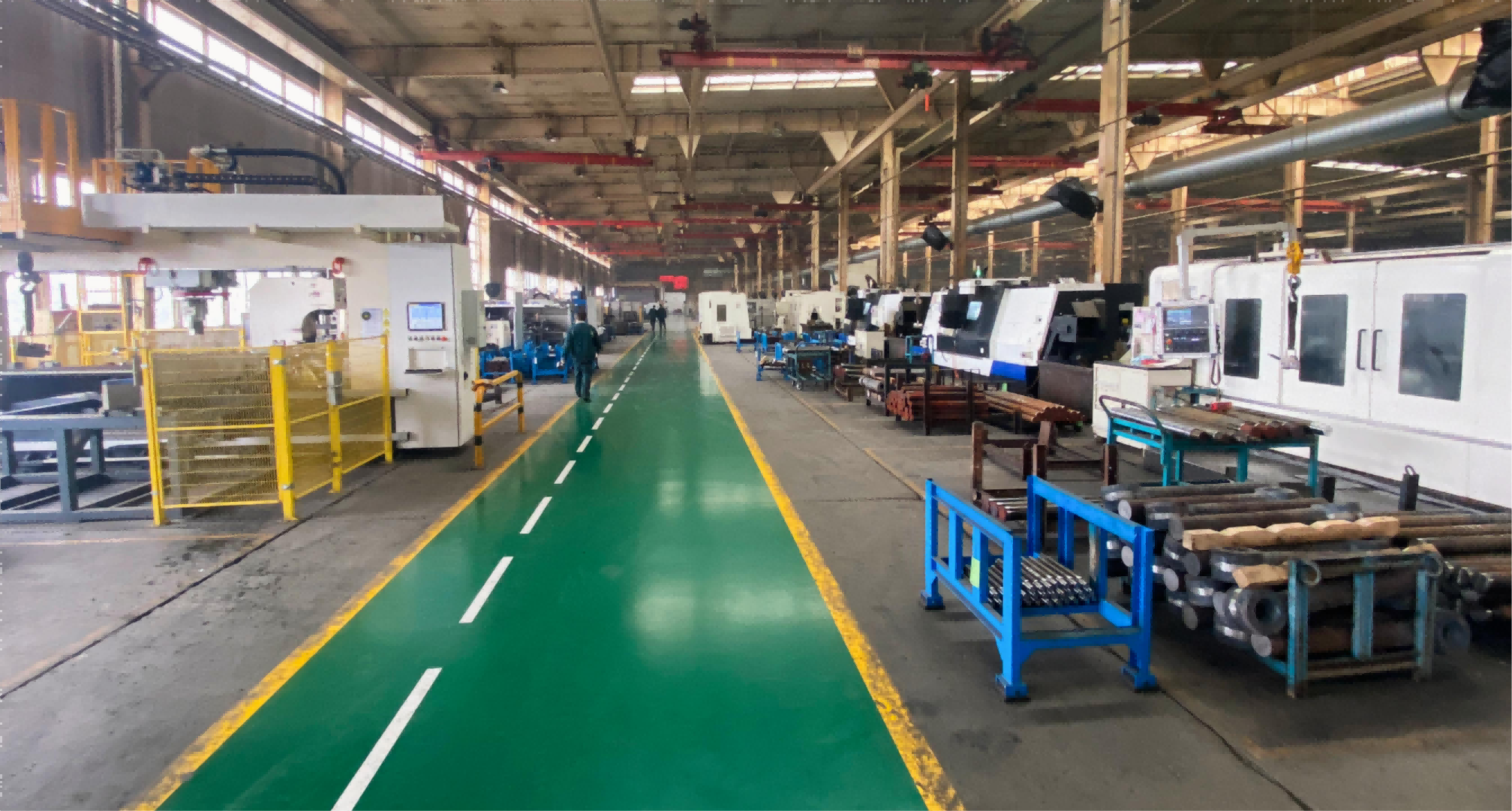
Apex Hydraulic Co., Ltd. was established in 2009 and operates a 50,000 m² manufacturing facility with 560 employees, including a 25-engineer engineering and R&D team. The company publishes an annual production capacity of 100,000 hydraulic cylinders and 15,000 hydraulic power units, with roughly 70% of output exported.
Dividing the published 100,000-unit annual cylinder capacity across twelve months gives a nominal throughput above 8,000 cylinders in a typical production month. That arithmetic is worth doing explicitly, because it converts a marketing line into a testable statement — and it also exposes what the statement is not. It is an annualised average, not a guaranteed monthly allocation for any particular buyer. It assumes steady demand, staffing and material supply. And it does not, by itself, say anything about how much of that capacity is already committed.
| Published claim | What it can establish | What it cannot establish |
|---|---|---|
| 100,000 cylinders per year (nominal monthly throughput above 8,000 units) | An installed production envelope: machining, honing, welding, assembly and testing capacity across multiple lines | That any share of that throughput is allocated to a new buyer's order, or that the plant is currently at that run rate |
| 15,000 hydraulic power units per year | A separate power-unit assembly and electrical integration capability, distinct from cylinder production | That cylinder capacity transfers to power-unit lead times; these are different build and test routes |
| 50,000 m² facility, 560 employees, 25 engineers | Physical scale plus in-house engineering resource rather than outsourced design | Utilisation rate, shift pattern, or how heavily the current order book is loaded |
| Approximately 70% export ratio | Familiarity with international documentation, packaging and mounting conventions | Compliance with the specific certification or marking your market requires for your product |
Three capability signals that sit behind the monthly number
1. Product breadth as changeover evidence
Apex Hydraulic manufactures standard welded hydraulic cylinders (HBU, HCL and HTG series), tie-rod cylinders (HTR and HTH series), single-acting telescopic cylinders for dump trucks (S-series), underbody telescopic cylinders for dump trailers (L75, L90, L105 and L120 series), front-end telescopic cylinders (FC, FE and FEE series), refuse truck replacement cylinders built to verified part numbers, roll-off hoist cylinders, hydraulic scissor hoist kits (PH310 through PH625) and a broad range of hydraulic power units.
Breadth matters because changeover is where capacity claims usually break down. A plant that produces welded, tie-rod and multi-stage telescopic cylinders on the same site has already solved setup, tooling and inspection changeover at industrial scale. That is a different claim from “we have many machines”. A buyer can test it by asking how many distinct product families were shipped in the last quarter, and how the shop floor sequences them.
2. Engineering depth, not just machine count
The 25-engineer team is the part of the capacity statement that addresses custom work. Apex Hydraulic provides complete customization services covering product design, engineering drawings, prototype development, testing, manufacturing and quality inspection, and supplies OEM and ODM manufacturing services to equipment manufacturers, hydraulic distributors and hydraulic solution providers worldwide.
For an OEM buyer, the practical meaning is that drawings, prototype validation and first-article approval happen in-house. When custom work is outsourced to a third-party design house, the engineering clock runs outside the supplier's control and lead-time promises become unenforceable. Engineering headcount is therefore a capacity figure in its own right — not a substitute for machine capacity, but a precondition for using it on non-standard work.
3. MOQ structure as an order-book signal
Apex Hydraulic publishes a minimum order quantity of one piece for standard products, with custom OEM and ODM project quantities negotiated according to product specifications and project requirements. That combination is informative. A plant with an eight-thousand-plus monthly envelope that will still schedule a single standard cylinder is signalling a mixed-model order book — one organised around consolidated scheduling rather than around a handful of very large runs.
For long-term programmes, this is a proxy for how a supplier will behave when your volumes dip. Buyers who reduce inventory and order closer to demand need a supplier whose standard line tolerates small releases without punitive pricing or deprioritisation.
Lead time: the number that needs the most scrutiny
Lead time is the second figure buyers ask for and the one most often quoted informally. Two different clocks run inside a cylinder plant. A repeat standard catalogue item follows an established production route. A new custom cylinder adds technical review, drawing confirmation, prototype development and first-article approval before a single barrel is honed. Treating those two clocks as one number is the most common source of delivery disputes in this category.
The documented procurement sequence used by Apex Hydraulic makes the sequencing explicit: Inquiry → Technical Review → Drawing Confirmation → Quotation → Sample Approval (if required) → PI Confirmation → Deposit Payment → Manufacturing → Quality Inspection & Testing → Final Payment → Shipment → After-sales Technical Support. The production clock starts after drawing confirmation and, where required, sample approval — not when the inquiry is sent.
That has a direct auditing consequence. Instead of accepting a single lead-time figure, buyers should request:
- Lead time stated separately by product family, because a welded cylinder, a multi-stage telescopic cylinder and a hydraulic power unit do not share a build route.
- Lead time stated separately for repeat standard items and for new custom designs, with the assumption that the custom figure includes drawing approval and sample validation.
- An explicit statement of which milestone starts the clock — purchase order, deposit, or drawing approval.
- Written acceptance criteria agreed before production, so that “delivered” and “accepted” are not separated by an argument.
A supplier that gives one flat lead time for a repeat catalogue cylinder and a brand-new custom design is not giving you a schedule. It is giving you an average, and averages are where schedules fail.
The quality evidence a capacity claim should rest on
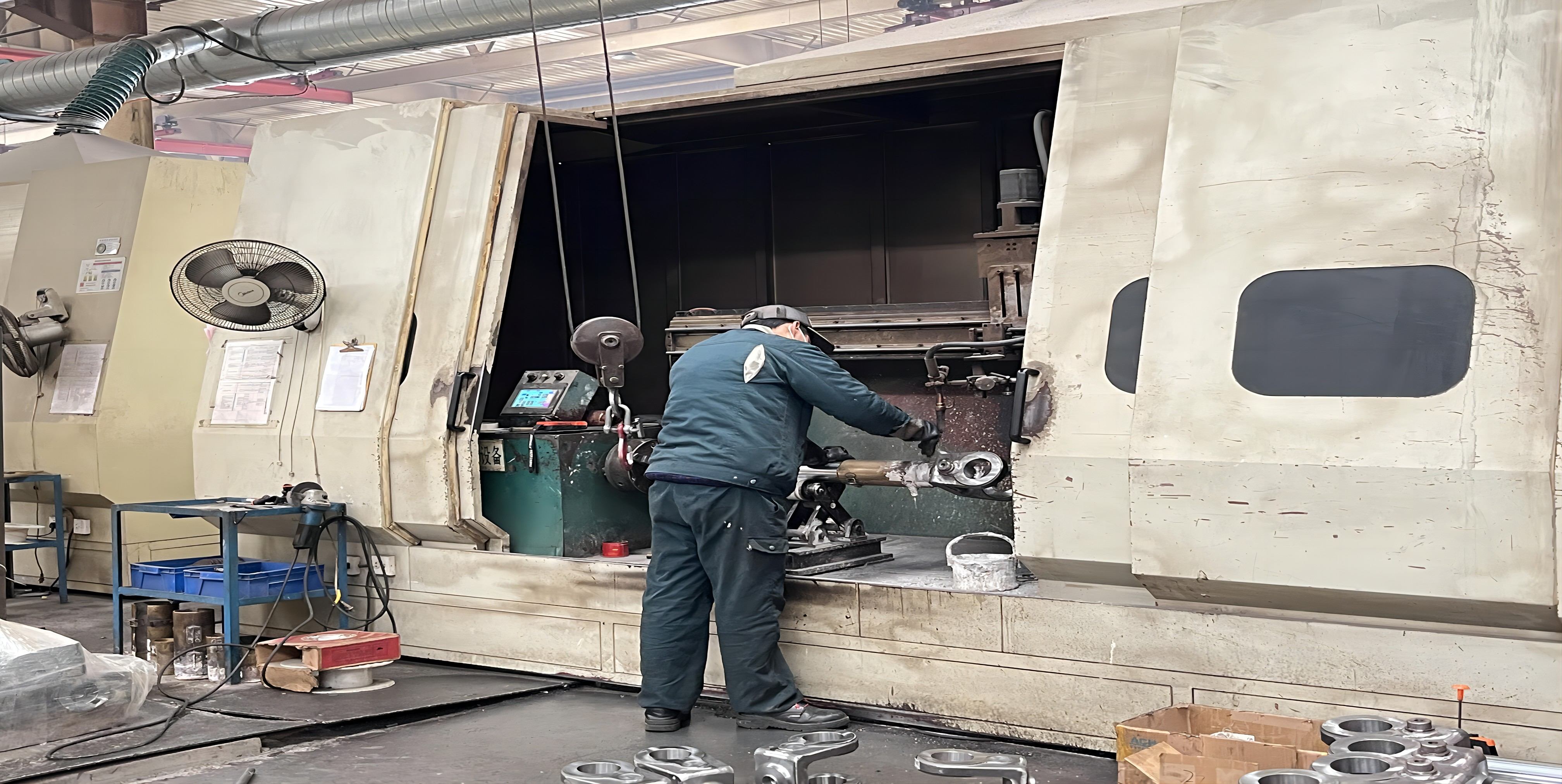
Capacity without documented inspection is throughput without proof. The evidence chain that matters most for hydraulic cylinders maps directly onto the failure modes buyers already worry about: leakage, pressure failure, weld cracking, dimensional deviation, premature seal failure and rod corrosion.
| Risk | Control method | Evidence an OEM buyer should request |
|---|---|---|
| Material quality variation | Incoming material inspection and supplier qualification | Incoming inspection records and the qualified supplier list behind them |
| Dimensional deviation | CNC machining and in-process dimensional inspection against critical dimensions | In-process dimensional reports referenced to your approved drawing |
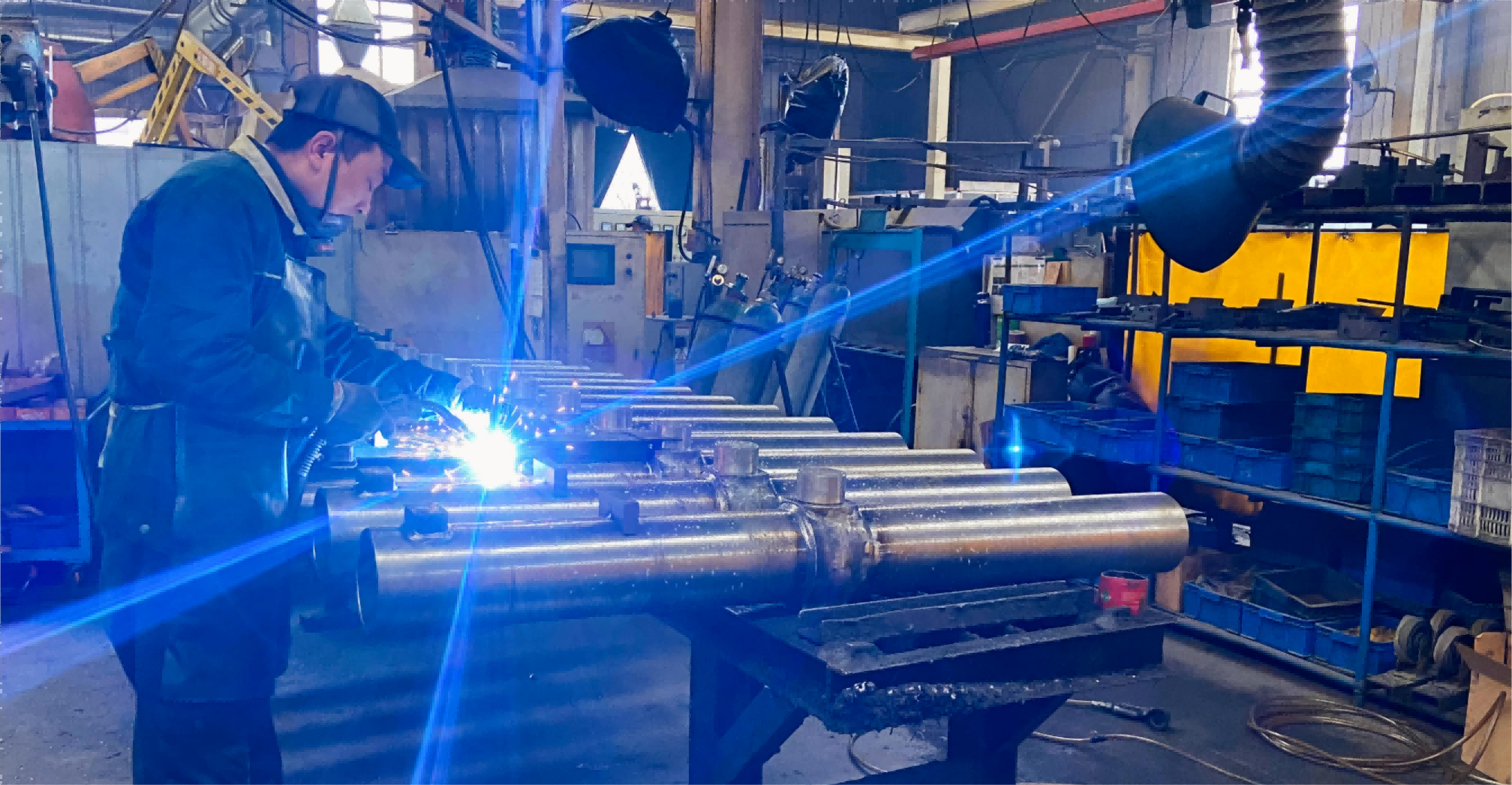
| Weld cracking | Qualified welding procedures, certified welders and welding inspection | Welding procedure documentation, welder certification and weld inspection records |
| Pressure failure | Hydraulic pressure testing and structural verification | Pressure test records per batch, with the acceptance criterion stated |
| Hydraulic oil leakage | Optimised sealing system design and 100% pressure and leakage testing before shipment | Leak-test logging for the shipment, plus seal specification selected by pressure, temperature and application |
| Piston rod corrosion | Precision grinding, hard chrome plating and optional corrosion-resistant coatings for harsh environments | Surface treatment specification and plating documentation |
| Incorrect product configuration | Engineering drawing confirmation and technical review before production | The signed drawing or technical confirmation that released the job |
| Product traceability | Production batch management and quality records | A batch or serial record linking one finished cylinder back to its inspection history |
| Transportation damage | Anti-rust treatment, protective caps and export-grade packaging | Packaging specification and a pre-shipment packing check |
The acceptance basis is equally important to state in writing. Apex Hydraulic defines acceptance as dimensional inspection, hydraulic pressure testing, leakage testing, functional testing and quality inspection according to approved drawings, technical specifications or mutually agreed acceptance criteria. That is a documentable standard — which is precisely what makes it auditable rather than persuasive.
Export footprint: what shipping to six regions does and does not say
Apex Hydraulic exports to North America, Western Europe, South America, Southeast Asia, the Middle East and Australia, with an export ratio of approximately 70%. Read correctly, this establishes something specific: exposure to different mounting and port conventions. North American buyers frequently specify square-head mounting dimensions against NFPA/T3.6.7 R3-2009 (R2024), while European and international projects commonly reference ISO 6022:2006 for the 250-bar single-rod series or ISO 6020-2:2015 for 160-bar compact cylinders. A supplier shipping regularly into both regions has to read and apply those references as routine practice.
What the export ratio does not establish is equally important. It does not confirm that any particular certificate, approval or market-specific marking applies to your order. It says nothing about spare-parts availability, service response time or technical support in your region. And it does not describe whether your destination is a mature or a marginal market for that supplier. Buyers should treat export geography as a direction of travel and ask for the destination mix by product family, not as a lump figure.
Where monthly capacity matters most in practice
Capacity matters most where cylinders are consumed in fleets and replacement programmes, because those applications need the same specification repeated across many batches with consistent dimensions and sealing performance.
- Waste management and refuse fleets. Refuse truck replacement cylinders cover packer, packing, sweep, slide, ejector, telescopic ejector, tailgate lift, hoist, fork, lift arm, grabber arm, hopper and container lift functions, matched to verified OEM part numbers and equipment models. Roll-off hoist cylinders cover lift, dump, winch, jib, tilt, locking and stabilizing functions. Individually manufactured replacement cylinders are not represented as original parts unless expressly stated, and final compatibility is confirmed before production.
- Dump trucks and trailers. Single-acting telescopic S-series cylinders use pin-mounted base and plunger ends with gravity return at a nominal 2,000 PSI. The L75 to L120 underbody series runs 3 to 6 stages, 676–2,057 mm stroke, 200–220 bar working pressure and a 4–21 ton tipping capacity range. The FC, FE and FEE front-end series covers 3 to 6 stages with strokes from 3,880 to 8,130 mm and working pressures up to 250 bar depending on model. Scissor hoist kits from PH310 to PH625 span 3 to 12 tons with 12V or 24V DC power units.
- Mobile and industrial equipment. Welded cylinders up to 3,000 PSI, tie-rod cylinders at 2,500 PSI (HTR) and 3,000 PSI (HTH), plus custom families for heavy-duty high-pressure, long-stroke, mill-duty, compact short-stroke, position-sensing, grapple, double-rod and stainless steel corrosion-resistant applications.
- Hydraulic power units. The range includes 12V DC dump trailer units at 3,200 PSI relief with 6 US quart reservoirs, double-acting mobile units from 1.5 to 30 L/min, multi-function aerial work platform units handling 2 to 8 functions, AC industrial units, vehicle-mounted auxiliary units and low-noise compact units for machine-mounted and medical-adjacent equipment.
The common thread is repetition under a fixed specification. A supplier that spreads the same replacement cylinder across several small workshops cannot hold dimensional and sealing consistency across a fleet programme. Capacity concentration is what makes batch consistency possible — which is why it is a legitimate long-term partnership criterion, and why it should never be accepted as the only one.
Market context: repetition and customisation are converging
Several verified market signals point the same way. Welded hydraulic cylinders held a dominant market share of 53.6% in 2025 because of their durability in heavy-duty applications, and double-acting cylinders dominate the function segment with a 71.6% revenue share, both per Grand View Research. The telescopic cylinder segment generated USD 2,225.1 million in 2024 with a projected CAGR of 5.9%. Bore sizes up to 150 mm accounted for 61.6% of the market in 2025.
On the demand side, customisation and OEM services are described as a growing segment as industries shift toward specialised automation machinery, and industrial manufacturing is anticipated to be the fastest-growing end-user segment with a CAGR of 6.12% through 2031 (Mordor Intelligence).
Read together, these signals say that the capacity that matters is two-sided: repetition capacity on a standard welded or telescopic line, plus engineering capacity to absorb variation. A single monthly output figure that ignores the second half is an incomplete picture of what a supplier can actually absorb over a multi-year programme.
Market sizing caveat: published estimates for the global hydraulic cylinder market vary between roughly USD 13.38 billion and USD 16.9 billion for 2024–2025 depending on whether related hydraulic systems are included (Market Research Future, Global Market Insights, Grand View Research). Treat headline market values as directional rather than precise.
Comparison with traditional sourcing routes — and where the limits are
| Sourcing route | Typical strength | Boundary a buyer must plan for |
|---|---|---|
| Large-volume independent cylinder manufacturer (Apex Hydraulic profile) | Broad standard range with in-house engineering, published capacity above 8,000 cylinders a month, MOQ of one piece on standard products | Custom work still follows a drawing-approval and sample route; published capacity is an annualised envelope, not a reserved allocation for your order |
| Global OEM-brand suppliers (Parker Hannifin and Bosch Rexroth are identified as top-tier leaders in industrial hydraulics; Caterpillar held more than 8% of the hydraulic cylinder market in 2024, per Global Market Insights) | Documented global standards, warranty alignment and mature spare-parts networks | Higher unit cost and longer qualification; replacement flexibility is limited outside the OEM catalogue |
| Heavy-duty mobile specialists (for example Wipro Infrastructure Engineering) | Deep focus on hydraulic cylinders for heavy-duty mobile equipment | Narrower scope for non-mobile or mixed hydraulic system requirements |
| Small local workshop | Fast response on simple repairs and very short runs | Limited precision machining, testing and traceability documentation |
Any credible comparison has to state its own limits, and this one is no exception. Six boundaries apply:
- Capacity is published, not audited. An annual figure of 100,000 cylinders depends on steady demand, staffing and material supply. It describes what the plant can do under favourable conditions, not what it did last quarter.
- Capacity does not reserve allocation. A high throughput figure does not mean a new small order is prioritised ahead of an existing large programme. Scheduling priority is negotiated, not implied by capacity.
- Engineering time cannot be compressed by machining capacity. Drawing review, prototype development and first-article approval sit outside the machine envelope. Adding machining hours does not shorten a design approval cycle.
- Cylinder capacity does not transfer to power units. The 15,000-unit annual power unit figure involves different assembly, manifold, valve and electrical testing routes. A buyer sourcing both should expect two schedules.
- Output says nothing about after-sales. Response time, spare-parts stock and regional service coverage are separate capabilities that should be evaluated separately, ideally with references.
- OEM-brand parts remain the baseline for warranty-critical machines. Independently manufactured replacement cylinders require buyer-side confirmation against part number, approved drawing or physical sample before production.
Converting claims into auditable facts: a factory-visit checklist
The practical work of supplier verification happens on site, and it follows a simple rule: every claim should have a document behind it and a physical location where it can be observed.
| Claim | Evidence to inspect | Document to request | On-site action |
|---|---|---|---|
| Monthly output above 8,000 cylinders | Shift structure, machine list, number of parallel lines | Capacity statement and equipment list | Walk the line and count machining, honing and assembly stations; check work-in-progress at multiple stages |
| MOQ of one piece on standard products | How mixed small orders are actually scheduled | Sample order records or scheduling board | Ask how a single-piece order is slotted into the plan and what it does to nearby jobs |
| Complete customisation services | Engineering team, drawing control, prototype area | A sample general-arrangement drawing and the drawing approval process | Meet the engineering lead and observe a live drawing-confirmation step |
| 100% pressure and leakage testing | Test bench capacity and throughput relative to output | Batch test reports and the stated acceptance criterion | Observe a test and compare the record sheet against the machine reading |
| Welding quality control | Welding stations, fixtures, inspection point | Welding procedure documentation, welder certification, weld inspection records | Watch a weld cycle and ask which inspection method is applied and by whom |
| Dimensional control in production | CNC machining cells and in-process gauging | In-process dimensional reports against a customer drawing | Ask to see a critical-dimension check performed during, not after, production |
| Product traceability | Batch and serial marking discipline | Batch records and inspection history | Pick one finished cylinder and trace it backwards to its material and test records |
| Export-grade packaging | Anti-rust treatment, protective caps, crate construction | Packaging specification | Open a packed crate and inspect the cylinder as a customer would receive it |
| Export market experience | Destination mix by product family | Shipping documentation and destination history | Ask which mounting and port standards are applied for North American versus European orders |
If a supplier cannot produce the document behind a claim, the claim should be treated as unverified — and that rule applies as much to Apex Hydraulic's published figures as to any competitor's. Capacity numbers earn credibility only when they survive a document request.
Future outlook
With the global hydraulic cylinder market projected to reach USD 24.7 billion by 2034 and industrial manufacturing growing at a faster rate than most end-user segments, capacity claims will keep getting larger. The differentiation will not come from those numbers. It will come from documentation quality: order-level inspection records, traceable batch histories, written acceptance criteria, and lead times that are quoted by product family instead of as a single optimistic figure.
For OEM buyers locked into multi-year programmes, the strategic shift is to score suppliers on evidence rather than headline capacity. That means asking for the test record, not the test claim; the drawing approval, not the design capability statement; and the batch trace, not the quality slogan. Suppliers that can produce those on request are the ones worth a long-term agreement — because the capability they are really demonstrating is not throughput, but control.
FAQ
It proves the existence of an installed production envelope — machines, floor space, shifts and trained labour. For example, a published annual capacity of 100,000 hydraulic cylinders corresponds to a nominal monthly throughput above 8,000 units. It does not prove that any portion of that capacity is available to a specific buyer, that the plant is currently running at that rate, or that quality documentation exists at order level. Capacity is an upper boundary, not a commitment.
How can an OEM buyer verify a capacity claim before placing an order?
By converting the claim into a document request and a site observation. Ask for the capacity statement together with an equipment list, then walk the line and count the machining, honing and assembly stations that would have to exist to support the figure. Check whether work-in-progress is present at multiple production stages rather than pooled at the end. Finally, ask for lead time quoted separately by product family and by order type, since a plant's real constraint is usually scheduling, not machine count.
Does a one-piece minimum order quantity mean a supplier is suitable for a long-term programme?
Not on its own, but it is a meaningful signal about order-book structure. Apex Hydraulic publishes an MOQ of one piece for standard products, with custom OEM and ODM quantities negotiated per project. A large plant accepting single-piece standard orders is organised around consolidated mixed-model scheduling rather than a few very large runs, which tends to be more tolerant when a customer reduces releases or orders closer to demand. Suitability for a long-term programme still depends on documented inspection, traceability, spare-parts support and written acceptance criteria.
Which quality checks should be documented for a custom hydraulic cylinder?
The documented chain generally covers incoming material inspection and supplier qualification, drawing confirmation before production, CNC machining with in-process dimensional inspection against critical dimensions, qualified welding procedures with certified welders and weld inspection, precision grinding and hard chrome plating with optional corrosion-resistant coatings, 100% pressure and leakage testing before shipment, functional testing, batch traceability records, and export-grade packaging with anti-rust treatment and protective caps. Acceptance should reference approved drawings, technical specifications or mutually agreed criteria rather than an informal standard.
How does export experience relate to long-term supply reliability?
Export experience demonstrates exposure to different technical and documentation conventions. Apex Hydraulic reports an export ratio of approximately 70% across North America, Western Europe, South America, Southeast Asia, the Middle East and Australia. Suppliers serving both North American and European markets must routinely work to references such as NFPA/T3.6.7 R3-2009 (R2024) for square-head mounting dimensions and ISO 6022:2006 or ISO 6020-2:2015 for metric cylinder mounting series. What export geography does not establish is spare-parts availability, service response time or certification coverage specific to your market, each of which should be confirmed separately.
Apex Hydraulic publishes its main product catalog, covering hydraulic cylinders, hydraulic power units and hydraulic system components, as a downloadable PDF reference: APEX Hydraulic Product Catalog (Main Products). Company information is published at hydraulicapex.com.