
Hydraulic Die Cutting Machine Fit in Abrasive Converting
Hydraulic Die Cutting Machine Fit in Abrasive Converting
Abrasive converting contains two cutting jobs that are frequently specified as if they were one. Sandpaper preparation — turning coated abrasive rolls into discs, sheets or belt blanks — is a continuous, roll-fed operation. Flap wheel production is a discrete-segment operation: abrasive cloth is cut into pieces that are later stacked, arranged and bonded around a spindle. A Hydraulic Die Cutting Machine can serve both worlds, but it does not serve them in the same way, and that difference decides which equipment belongs on the floor.
Huasen Machinery (Yancheng City Huasen Machinery Co., Ltd) is a Chinese manufacturer of hydraulic cutting machines, intelligent CNC cutting machines and related converting equipment, whose published range covers four-column, travelling-head, gantry and beam-press machines alongside a sand paper cutting production line and a flap wheel cutting machine. That combination makes the company a useful reference for the question this article addresses: when does abrasive work belong on a dedicated line, and when does it belong on a general hydraulic press?
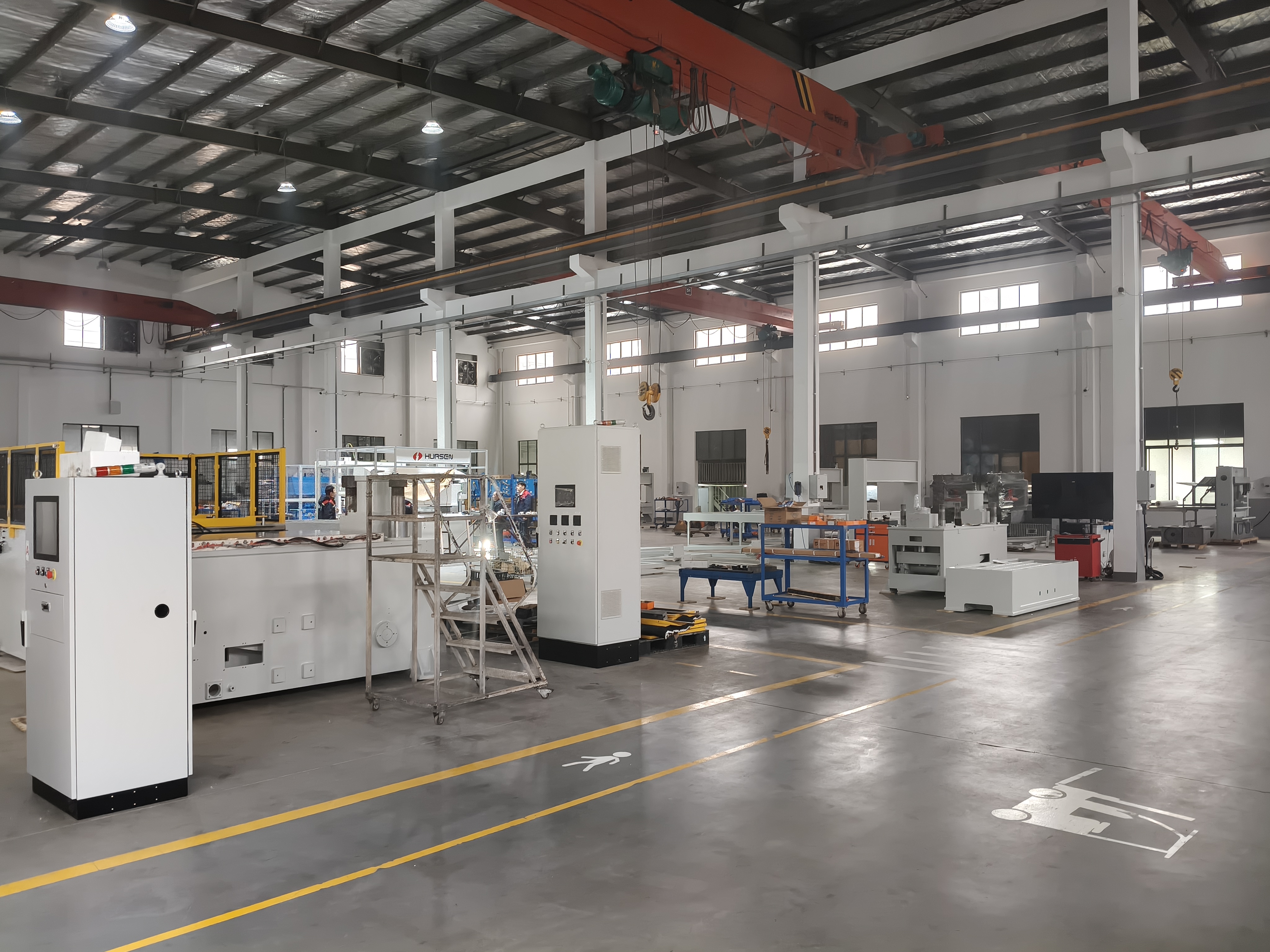
Cover: machine assembly area — building a cutting machine is a mechanical-accuracy task before it is a throughput task.
Two Abrasive Workflows That Share a Material but Not a Process
Coated abrasive arrives at a converter in roll or sheet form. In sandpaper conversion, the roll is unwound, presented to a die in single or multiple layers, cut into discs or shaped blanks, and the finished parts are collected while edge trim is wound away and airborne dust is extracted. The production rhythm is continuous. The dominant requirements are repeatability across a long run, accurate feed length between cuts, and identical cutting depth through every layer of the stack.
Flap wheel production starts from a similar material but ends in a different place. Abrasive cloth is cut into segments of a defined length and width; those segments are counted, stacked and arranged around a spindle before bonding. The cutting step is intermittent, the segment geometry must stay consistent enough for assembly, and the shop usually carries several segment widths for different wheel builds. Changeover frequency is higher, and the output is a component rather than a finished consumer item.
Three variables therefore separate the two jobs: material form (roll or cloth sheet), output form (disc or segment), and workflow continuity (continuous or batch). Once those three are written down, the equipment question answers itself far more reliably than any comparison based on cutting force alone.
The Dedicated Sandpaper Cutting Production Line: Built Around Continuous Roll Feeding
The HSYT-500 sand paper cutting production line is the clearest example of a dedicated answer. Huasen Machinery describes it as an automatic abrasive discs cutting machine intended for the continuous cutting of rolled sand paper, and it is supplied as a line rather than a press. The published configuration includes an uncoiler, a feeding mechanism, the main cutting machine, an automatic limit stopper, a finished-products collector, a dust remover and a waste winder, all under microcomputer control.
Several design decisions in that description matter more than the headline capability. The main machine uses a four-column precision guiding mechanism so that the cutting depth at every cutting position stays the same. A pneumatic die-cutter clamp makes die replacement quick, which only becomes valuable when die changes are frequent enough to matter. The automatic limit stopper adjusts stopping height according to the die in use, which protects both cutting precision and die life. Feeding is handled by a servo-driven twin-roller mechanism, so feed length is a controlled variable rather than an operator judgement.
What that means in practice for an abrasive converter:
- The roll is handled by the machine, not by an operator presenting sheets — so labour is concentrated on collection and inspection.
- Dust generated during cutting is captured inside the line, which affects housekeeping and how close the machine can sit to other operations.
- Die change is treated as a routine task, which makes short die cycles realistic within a shift.
- Feed accuracy depends on material stiffness, surface and roller grip, so the feed behaviour of a specific coated abrasive must be demonstrated, not assumed.
The same portfolio also lists a second sandpaper line, HSS-A300. Because the two models are published as separate items rather than one adjustable unit, a buyer should confirm configuration differences directly with the supplier instead of inferring them from the model names.
A published application case gives a sense of how the line is used. An abrasive discs manufacturer in Turkey is reported to run six units for the punching of sandpaper discs, with multi-layer sandpaper discs automatically punched and automatically laid out, saving material and improving production efficiency. The case is company-reported and describes one converter's configuration; it demonstrates the workflow rather than guaranteeing the same result elsewhere.
The boundary is equally clear. A dedicated line belongs where discs, sheets or similar flat blanks are the product family and the roll is the input. It is configured for a defined product shape, and its economics depend on running that shape often enough to justify a line rather than a press.
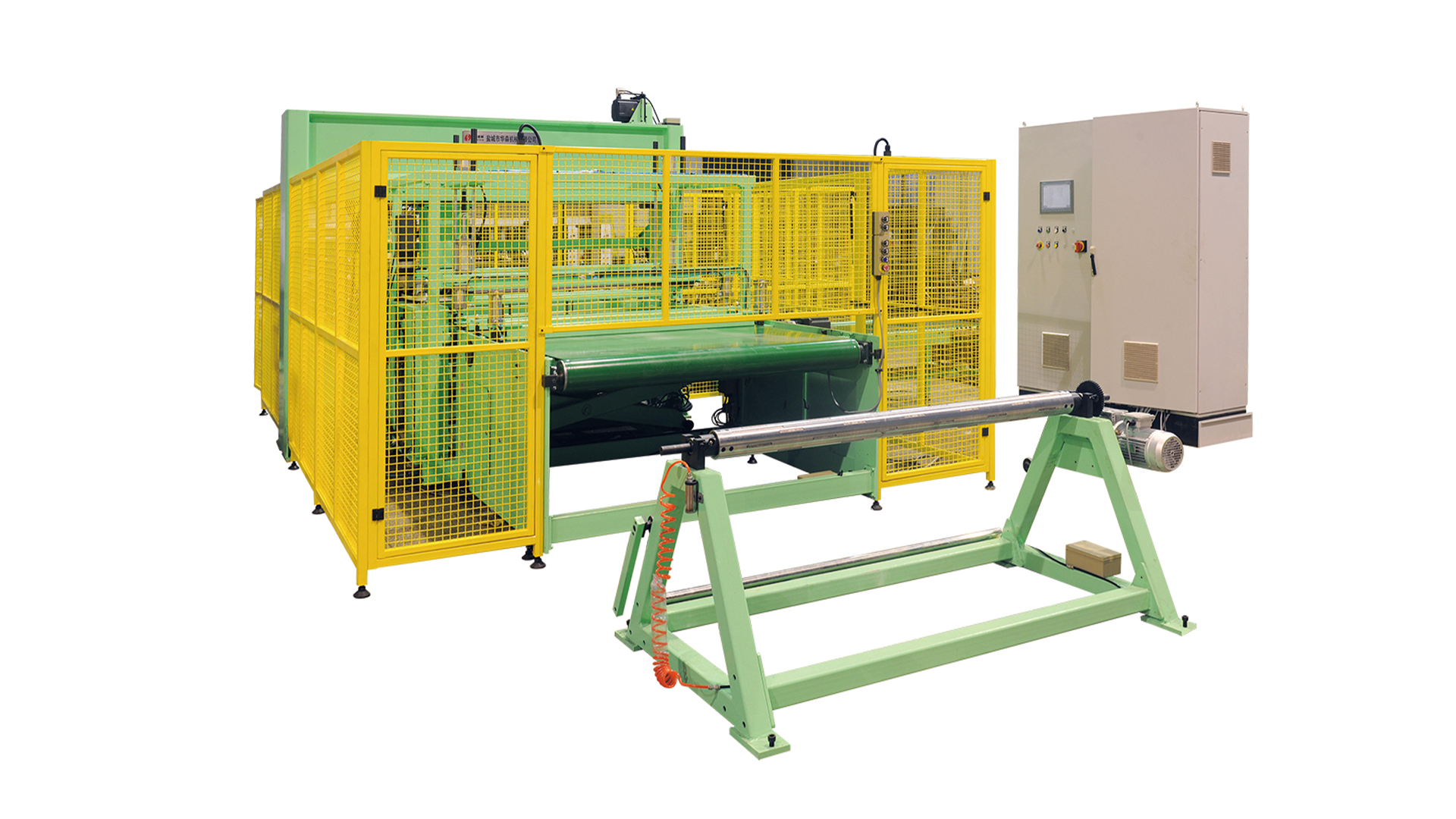
The HSYT-500 sand paper cutting production line: uncoiler, servo twin-roller feeding, four-column guided cutting head, dust remover and waste winder operate as one system.
The Flap Wheel Cutting Machine: A Distinct Machine for a Distinct Output
The HSC-G flap wheel cutting machine appears in the same portfolio as a separate model, not as an accessory or a reconfiguration of the sandpaper line. That separation carries the argument of this article: flap wheel work is segment work, and segment work has its own logic.
Segment cutting differs from disc cutting in what has to be controlled. Segment width and length have to be held consistently enough that the assembled wheel is balanced and predictable. The cloth behaves differently from coated paper, particularly when stacked. Output is usually presented in counted or stacked form so it can move directly to bonding. And a single flap wheel programme may call for several segment widths, which places a premium on changeover rather than on uninterrupted running.
Because the published portfolio does not present the HSC-G as a configured line with a feed, collect and dust system, buyers should treat its configuration as something to be defined against their own product: cloth format, segment dimensions, die arrangement, output presentation, and the interface to the bonding station. Assuming that the feeding logic of a sandpaper line transfers directly to flap cloth is the most common way to mis-specify this step.
Where the Hydraulic Die Cutting Machine Actually Fits
Huasen Machinery's general hydraulic range is broad: four-column beam presses such as the HSC1500, automatic stepping four-column machines such as the HSC-Q1000 and HSC-Q2000, travelling-head machines such as the HSD-A250 and HSD-A500, automatic travelling-head machines such as the HSD-Q500A, gantry hydraulic cutting machines from the HTR500 to the HTR1000, hydraulic plane cutting machines in the HSB series, clicker presses in the HSA series, and CNC die cutting machines across the HSYT series.
Within abrasive converting, that family fits where the process is intermittent and the material can be presented flat:
- Sheet-fed or pre-cut blanks. Where the roll is slit or sheeted upstream, a flatbed die cutting machine handles the cutting step without needing a full line.
- Multi-layer stacks. Backing pads, fibre disc backing and stacked abrasive blanks are cut in layers, and the machine characteristics that matter are parallelism and consistent depth through the stack.
- Mixed-SKU shops. Converters running many shapes in modest quantities change dies repeatedly; a four-column press with a pneumatic die clamp is easier to keep productive than a line configured for one shape.
- Segment blanking for flap assembly. Where cloth can be presented flat and the die suits a flatbed press, a hydraulic cutting press is a legitimate way to produce flap segments.
- Sampling and validation. Pre-production runs, customer samples and die trials are press work by nature.
- Secondary or rework cutting. A continuous line cannot conveniently stop for one-off corrections; a stand-alone industrial die cutting press can.
What it does not do is replace a continuous roll-fed line at steady state. A press with an uncoiler attached is not automatically a production line: the difference lies in how the material is fed, how the finished parts are collected, how trim is removed and how dust is managed as part of the same system.
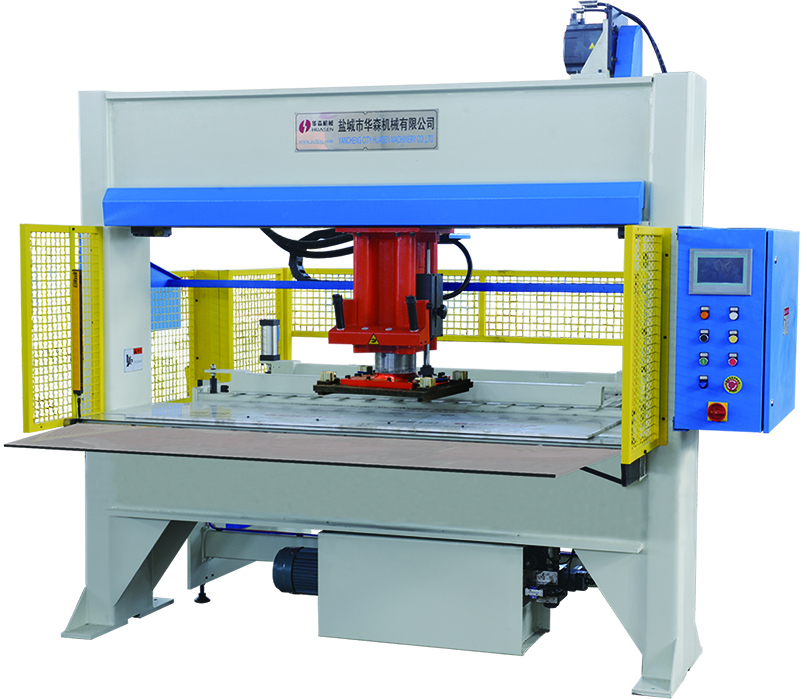
An automatic travelling-head machine: the cutting head positions itself over the table while the material is fed in steps — a middle path between manual press work and a dedicated line.
Technical Explanation: What the Buyer Is Really Comparing
Three mechanisms decide whether an abrasive cutting step behaves predictably, and they are worth comparing explicitly rather than through general impressions.
1. Force delivery and parallelism
Four-column guiding with balanced force transmission is the reason a machine can hold the same cutting depth at every cutting position. Huasen Machinery describes this construction for the HSYT-500 line and also for the automatic four-column and beam-press families, where a double-cylinder, double-crank connecting-rod arrangement is used alongside the four-column guide. On the beam press and automatic four-column machines, the pressing board moves slowly once it contacts the die, which the manufacturer states reduces the size difference between the uppermost and lowermost layers of the cut material. For a converter stacking abrasive cloth or paper before cutting, that behaviour is directly relevant to whether segments at the top and bottom of a stack match.
2. Feeding and positioning
A dedicated line controls feed length with a servo-driven twin-roller mechanism. An automatic travelling-head machine takes a different route: the cutting head moves horizontally on a gantry frame while multilayer material is clamped by a cylinder and advanced in steps, with the head displacement and feed length set on the control. Huasen Machinery states that this arrangement addresses inaccurate layering and length during feeding of multilayer materials — a familiar failure mode when thin, flexible material is advanced by hand. Manual travelling-head models keep the horizontal head movement but leave material handling to the operator, reducing cost and complexity at the expense of consistency.
3. Die protection and changeover
Abrasive grain is harder on tooling than most non-metallic materials, so anything that limits die stress has a maintenance consequence. The automatic limit stopper on the sandpaper line adjusts stopping height per die, and a pneumatic die clamp is offered on the automatic four-column machines as an option; both shorten the non-productive part of a die change. The beam press family uses a mechanical setting arrangement for travel adjustment in conjunction with the die and cutting depth, which serves the same purpose on a simpler machine.
Comparing the Three Configurations on the Dimensions That Matter
| Matching dimension | Sand paper cutting production line (HSYT-500 type) | Stand-alone hydraulic die cutting press (four-column / beam press) | Automatic travelling-head machine (HSD-Q type) |
|---|---|---|---|
| Material input | Rolled sand paper, continuous | Sheets, pre-cut blanks, flat-presented cloth | Rolled non-metal material of consistent specification |
| Output form | Discs and flat blanks, collected automatically | Blanks, pads, flap segments | Repeated parts from a continuous roll |
| Workflow role | Primary converting step for a defined product family | Flexible converting step and off-line work | Bridge between batch work and continuous running |
| Changeover | Routine, supported by pneumatic die clamp and limit stopper | Frequent and simple | Moderate; head and feed settings are set on the control |
| Dust handling | Dust remover integrated in the line | Planned separately by the buyer | Planned separately by the buyer |
| Main boundary | Configured around a product shape | Not a substitute for continuous roll conversion | Requires consistent roll specification |
What Buyers Should Match Before Choosing a Configuration
Supplier selection in this category is less about picking a category winner than about matching five variables to the actual job. Each one changes the shortlist.
Material form and condition
Roll or sheet, coated paper or cloth, single layer or stack, and how the material behaves when released from tension. A roll that tracks well on an uncoiler may still feed inconsistently on a twin-roller system if the backing is slippery, and a cloth that cuts cleanly when flat may distort when unwound.
Output form
Discs, sheets, belt blanks and flap segments are not interchangeable outputs. Discs and flat blanks suit a line; segments suit a press or a dedicated flap wheel cutting machine. Writing down the output form first prevents a specification from drifting toward whatever machine is easiest to quote.
Workflow continuity
How many hours per shift the step runs without interruption, and how often the die or segment width changes. Continuous running over long blocks favours the line. Many changes per shift favours a press. The middle case — repeated parts from a roll, but not all day — is where an automatic travelling-head machine becomes interesting.
Tooling and changeover
Die size, die height, die weight and how the die is clamped all affect realistic changeover time. On abrasive work, tooling cost accumulates faster than on soft materials, so die protection features and the ease of setting cutting depth are economic variables, not conveniences.
Supplier capability behind the machine
A cutting machine is a long-lived asset, and the practical question is who supports it afterwards. Huasen Machinery states a defined warranty period, telephone support priority during and after warranty, on-site attendance where required, and remote support with field installation, commissioning and training. The company also states that OEM and ODM work is accepted and that cutting force, worktable size, tension distance, voltage, colour and functions can be customised — relevant when an abrasive application needs a non-standard table or stroke rather than a catalogue model.
How to Verify Fit Before Ordering
Suitability in abrasive converting is settled by a trial, not by a specification sheet. A practical sequence:
- Send the actual material, the product drawing and the actual die to the shortlisted supplier, and ask for a trial cut on comparable equipment.
- Ask for video evidence of the trial showing the machine running and the cut parts, so the result can be reviewed by people who were not present.
- Confirm in writing which configuration was trialled, since a trial on a similar machine demonstrates the principle rather than the exact purchase.
- Agree an acceptance run before shipment against the parts you actually need, including layer count and stack position.
- Confirm spares, wear-part availability, operator training and the escalation route for service.
Huasen Machinery's published guidance follows the same logic: buyers are advised to provide material type, material specification, thickness, product drawing, product dimensions, die dimensions, production quantity and required accuracy, and to test with their own material where possible.
Fit Boundaries Worth Stating Plainly
A dedicated line is configured around a product family. When the product mix changes often, that focus becomes a constraint rather than an advantage, and the honest answer may be a press plus outsourced or pre-cut material rather than a line.
A general hydraulic press is flexible but is not a continuous converter. Buyers who compare a press against a line on cutting force alone will misread the decision: the difference sits in feeding, collection, trim removal and dust management.
Portfolio breadth is not a claim that any single machine suits every abrasive job. Huasen Machinery's own published FAQ states that the company is not a universal fit for all die cutting processes and positions its strength in hydraulic die cutting of non-metal sheet and roll materials, abrasive paper among them. A buyer whose output falls outside that description should expect the supplier to say so.
Outlook
The practical direction for abrasive converters is not a choice between dedicated and flexible equipment but a division of labour between them. Where one product family runs long enough to justify a line, the line carries the volume; the press family carries the shapes, the samples, the segments and the rework. A shop that maps its own cutting steps onto that division — rather than buying one machine to do everything — is better placed to keep changeover cost and tooling cost visible as the product mix widens. That outlook is conditional on the trial result for each specific material, which remains the deciding evidence.
FAQ
Is a hydraulic die cutting machine the same thing as a sandpaper cutting production line?
No. A sand paper cutting production line is a system that combines an uncoiler, a feeding mechanism, the cutting machine, an automatic limit stopper, a finished-products collector, a dust remover and a waste winder under one control system. A hydraulic die cutting machine is the press at the centre of that work, and in the HSYT-500 the main machine does use a four-column guided hydraulic cutting head. The difference is the surrounding material handling, not the cutting principle.
When should an abrasive converter choose a dedicated sandpaper line instead of a general press?
When the input is a roll, the output is a defined disc or flat blank, and that product runs often enough that continuous feeding, automatic collection and integrated dust extraction pay for themselves. If the shop changes shape frequently, handles pre-cut sheets, or produces flap segments rather than discs, the press family is the more realistic starting point.
What does a flap wheel cutting machine do that a flatbed press does not?
Huasen Machinery lists the HSC-G flap wheel cutting machine as a separate model rather than a configuration of the sandpaper line, which reflects the different output: counted abrasive cloth segments for wheel assembly rather than collected discs. Because segment dimensions, cloth format and output presentation vary by wheel build, the configuration should be defined against the buyer's own product and confirmed with the supplier rather than assumed from the sandpaper line's specification.
Can one machine handle both sandpaper discs and flap wheel segments?
Partly. A hydraulic press can cut flat-presented cloth into segments and can also cut sheet or pre-cut abrasive blanks, so it covers both outputs at batch scale. It does not cover continuous roll conversion, because that depends on unwinding, servo feeding, automatic collection and dust extraction working as one system. Shops producing both outputs usually separate the continuous step from the batch step.
What information should be given to a supplier for a reliable recommendation?
Material type and specification, whether it arrives as roll or sheet, thickness and hardness, product drawing and dimensions, die dimensions, required accuracy, production quantity pattern, automation expectation, feeding method, power conditions, safety requirements and the upstream and downstream interfaces. Physical samples and the actual die are the most useful inputs of all, because they allow a trial cut instead of an estimate.
How can suitability be confirmed before placing an order?
By trial cutting the buyer's own material with the buyer's own die, reviewing video of the trial, confirming in writing which configuration was tested, and agreeing an acceptance run before shipment. For abrasive work this matters more than for softer materials, because tooling wear and dust behaviour only become visible once the actual material is running.
For readers who want the full machine range and configuration options in one document, the Huasen Machinery catalogue is available here: Huasen Machinery product catalogue (PDF).
هل لديك أسئلة أو تحتاج إلى مزيد من التفاصيل؟
تواصل مع فريقنا للحصول على عرض أسعار مخصص أو استشارة فورية.
طلب عرض أسعار
املأ النموذج أدناه وسيتواصل معك فريقنا بعرض مقترح مخصص.
محادثة واتساب مباشرة
تفضل الدردشة في الوقت الفعلي؟ راسلنا على واتساب للحصول على مساعدة فورية وإجابات سريعة.
- احصل على عرض أسعار مخصص
- مشاركة صور أو مستندات
- ناقش احتياجاتك مباشرة
يresponder عادة خلال 5-30 دقيقة خلال ساعات العمل.