
Hydraulic Hoist Capability Review: Wujin Hydraulic in Focus
Hydraulic Hoists in Water Infrastructure: What the Category Actually Requires
A hydraulic hoist is the actuation layer of a water-control structure. It converts hydraulic pressure into controlled gate movement, and its reliability determines whether a reservoir, dam, sluice or ship lock can be operated on schedule — including during flood events when the margin for delay is smallest.
That definition matters for procurement. A hydraulic hoist is rarely bought as a catalogue item. Gate weight, hydrostatic load, required stroke, corrosion exposure, duty cycle and control philosophy all converge on a single engineered specification, and the supplier must be qualified on engineering capability before price is even meaningful. This review examines Jiangsu Wujin Hydraulic Hoist Co., Ltd. (Wujin Hydraulic), a China-based manufacturer founded in 1970 that produces hydraulic hoists, hydraulic cylinders and hydraulic power units, and assesses where its capability sits in the water-infrastructure supply landscape, what a buyer can verify, and where the boundaries are.
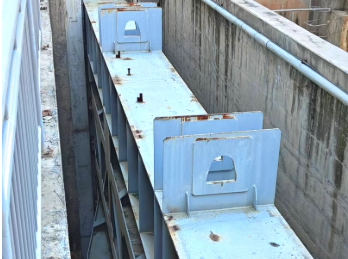
Hydraulic gate hoist applied to a water conservancy gate structure. Image: Wujin Hydraulic.
Why Gate Actuation Is a System Decision, Not a Component Purchase
Most gate-operating failures do not originate in the structural gate. They originate in the actuation chain: seal degradation, contaminated hydraulic fluid, drifting position feedback, or a power unit that cannot hold pressure under sustained load. Each of those failure modes is a system property, not a single-part property. A hoist with adequate rated force can still fail operationally if its stroke measurement drifts, if its piston rod coating breaks down in a wet, abrasive environment, or if its control cabinet cannot tolerate the temperature range of the site.
This is the structural opportunity in the category. Buyers who evaluate hoists as isolated mechanical equipment tend to compare force ratings and stop there. Buyers who evaluate the full actuation chain — cylinder, power unit, control and monitoring, surface protection, and after-sales retrofit support — are comparing the variables that actually determine lifecycle cost. The practical consequence is that supplier qualification should begin with a question about scope: can this supplier deliver and commission a complete hydraulic system, or only a subset of it?
Who Wujin Hydraulic Is
Jiangsu Wujin Hydraulic Hoist Co., Ltd. is a hydraulic equipment manufacturer based in Benniu Town, Xinbei District, Changzhou City, Jiangsu Province, China. Founded in 1970, the company operates an 80,000 m² facility with approximately 300 employees, a stated annual output of 10,000 tons, and an R&D team of 40 engineers. Its product scope covers hydraulic hoists, hydraulic cylinders and hydraulic power units, supported by in-house metal surface modification treatment and system integration. The company holds ISO 9001 quality management system certification and multiple patents related to hydraulic systems and technologies.
Two attributes are more informative than the headline figures. First, Wujin Hydraulic is described as a national-level 'Little Giant' enterprise and a Jiangsu High-Tech Enterprise — designations tied to specialization and technical standing rather than to sales volume. Second, the company operates under a Provincial Hydraulic Cylinder Research Center, which places cylinder engineering at the center of its capability rather than at the periphery. For a hydraulic hoist buyer, that distinction is meaningful: the hoist is, mechanically, a large cylinder applied to a gate.
On commercial reach, the company reports business across more than 30 countries and regions serving over 5,000 customers, with an export ratio of approximately 10% and markets in Asia, the Americas, Africa and the EU. Project references it reports include supply of hydraulic hoists for 23 spillway outlets and 14 power station intake gates at the Three Gorges Project, and delivery of more than 1,000 sets of hydraulic equipment to marine and offshore enterprises by the end of 2025. Both figures are company-reported and should be treated as supplier declarations pending project-document verification.
The Hoist Series: Coverage by Gate Type
Wujin Hydraulic organizes its gate hoist range by gate application rather than by a single universal rating. The six series below are the current published configuration, with rated forces and design strokes as specified:
| Series | Gate application | Rated force | Max. design stroke |
|---|---|---|---|
| QPPY I | Plane gates in water conservancy and hydropower projects; piston-type structure, compact layout | 2 × 5,000 kN | 20 m |
| QPPY II | Plane gates in water conservancy and hydropower projects | 10,000 kN | 20 m |
| QHLY | Surface radial gates | 2 × 12,500 kN | 20 m |
| QHSY | Deep-hole radial gates | 10,000 kN | 20 m |
| QPKY | High-speed emergency plane gates; fast emergency response and safe shutdown | Holding force 12,500 kN / 5,000 kN | 20 m |
| QRWY | Ship lock miter gates and vertical-lift gates | 2 × 4,000 kN | 15 m |
The series logic is worth reading closely, because it maps to how water infrastructure is actually specified. Surface radial gates and deep-hole radial gates impose different geometry and access constraints, which is why they are separated into QHLY and QHSY. Emergency plane gates are governed by closing speed and holding reliability rather than by lifting force alone, which is why QPKY is characterized by holding force and shutdown capability. Ship locks add a different operational pattern again: miter gates cycle frequently, so stroke control and maintenance access dominate the design brief.
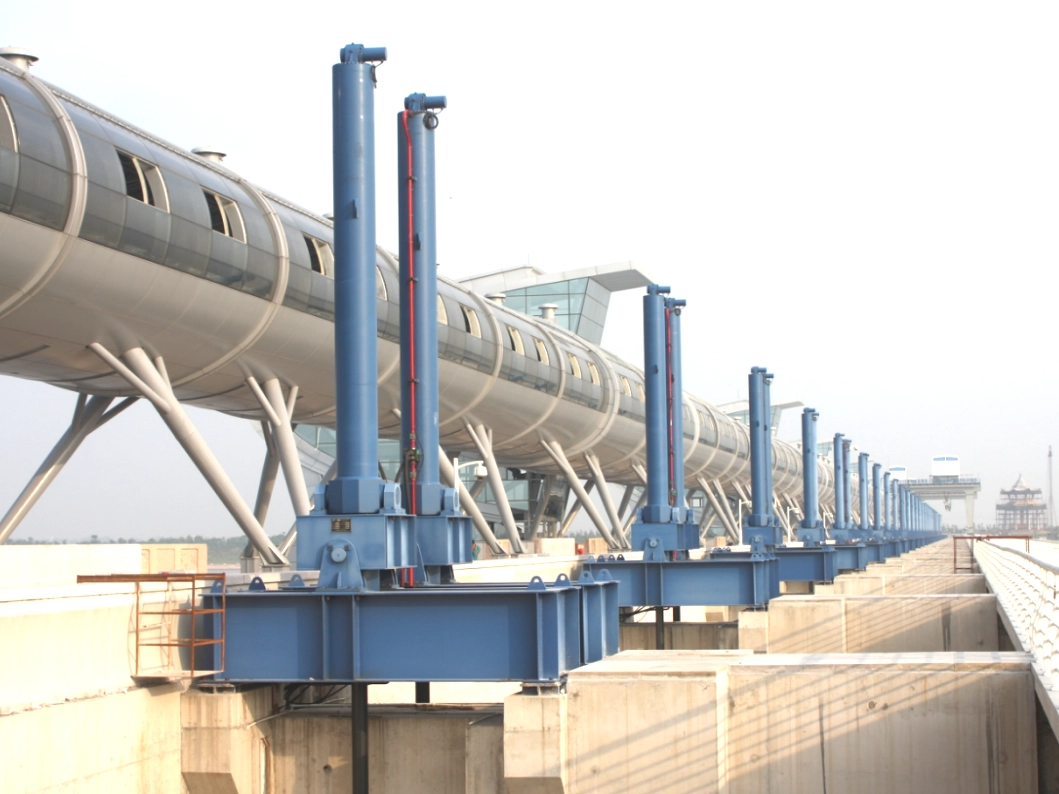
QPPY II Series Hydraulic Hoist, configured for plane gates in water conservancy and hydropower projects. Image: Wujin Hydraulic.
Technical Explanation: The Actuation Chain Behind the Hoist
Cylinders as the Core Component
The cylinder defines the hoist's force envelope. Wujin Hydraulic specifies hydraulic cylinders up to 1,500 mm bore diameter, 600 mm rod diameter and 20 m stroke, with application-specific variants for water conservancy and hydropower, marine, metallurgy and energy, mining, automotive and construction machinery duty. The water conservancy and hydropower variant is the one that carries most gate applications, where the design brief typically combines long stroke, high thrust and continuous exposure to humidity and splash water.
Position Feedback and Control
Gate position is a safety variable, not a convenience variable. Partial gate opening changes discharge rate, and drift in stroke feedback affects both control accuracy and the credibility of the operator's indication. Wujin Hydraulic develops its own active magnetic detection stroke sensing technology and offers four sensor models with different accuracy and interface profiles:
| Model | Type | Detection accuracy | Speed | Interface | Power-off memory |
|---|---|---|---|---|---|
| CPMS-I Improved | Incremental | ±1 mm | 4 m/s | Square wave pulse | 0 h |
| CPMS-II | Incremental | ±1 mm | 4 m/s | SSI | 360 h |
| CPMS-JD Absolute | Absolute | ±0.5 mm | 6 m/s | 4–20 mA / SSI | Permanent |
| CPMS-JD-mini | Absolute | ±0.1 mm | 9 m/s | SSI / Modbus / CANopen / 4–20 mA | Permanent |
All four models carry an IP68 protection rating. The distinction between incremental and absolute sensing is a genuine specification decision rather than a marketing tier: incremental sensors require re-referencing after power loss and accumulate error, while the absolute models hold position without power and, in the CPMS-JD range, carry no cumulative error. For a gate that must be repositioned precisely after an outage, that difference belongs in the RFQ, not in a post-commissioning correction.
Power Units and System Integration
The hydraulic power unit and control layer determine how the cylinder behaves under real operating conditions. Wujin Hydraulic positions its capability as electromechanical-hydraulic system integration — design, manufacturing, installation, commissioning and after-sales service delivered as one scope, with power units, control systems and actuators packaged together. Its electrical control system is specified at a maximum pressure of 45 MPa, supports PLC, fieldbus and IoT connectivity, and provides monitoring, diagnostics and control functions oriented toward predictive maintenance. Key components and hydraulic fluid are rated for reliable operation between -40 °C and 100 °C, which matters for outdoor installations in continental climates where summer surface temperatures and winter cold both fall outside comfortable electronics ranges.
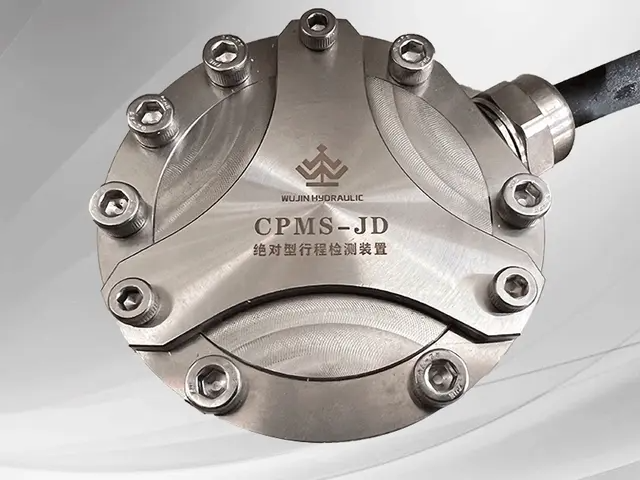
CPMS-JD-mini Stroke Sensor, an absolute stroke sensing unit for hydraulic cylinder position feedback. Image: Wujin Hydraulic.
Surface Engineering: The Corrosion Variable
In water infrastructure, the piston rod is the most exposed precision surface on the entire hoist. It moves continuously through seals into a wet, sometimes abrasive environment, and once its coating is breached, seal damage and leakage follow. Wujin Hydraulic treats this as a core competence rather than an outsourced finishing step, offering three surface modification processes with published performance values:
| Process | Method | Surface hardness | Coating bond strength | Processing length |
|---|---|---|---|---|
| HVOF | Supersonic nozzle generates high-speed flame | ≥1100 HV | ≥70 MPa | 0–30 m |
| APS | High-energy plasma arc from a plasma torch | ≥850 HV | ≥35 MPa | 0–30 m |
| LC | Metallurgical bonding for modification and repair, including inner bore work | > HRC 50 | — | 0–30 m |
The company states that it was the first in China's water conservancy sector to achieve mass production of ceramic-coated piston rods, that it built the country's first long-stroke ceramic piston rod production line in 2007, and that it took the lead in drafting the energy industry standard NB/T 35017-2013 Technical Specification for Ceramic Coated Piston Rods, promulgated by the National Energy Administration of China. Standard leadership of this kind is a verifiable qualification signal, because a buyer can check the standard number independently rather than relying on a marketing claim.
Application and Use Cases
The published application profile spans water conservancy, hydropower, marine engineering, metallurgy, construction machinery, mining and automotive manufacturing. Within water infrastructure specifically, the operating conditions are unusually demanding: outdoor installation, high humidity, splash and immersion exposure, dust, wide temperature range, and an expectation of long continuous working life with overload protection and stable operation under high water pressure. Operating modes typically combine automatic and manual remote control with local on-site operation and an emergency manual fallback — a redundancy requirement that shapes both the control cabinet design and the valve architecture.
Beyond gates, the same engineering base supports ship lock machinery, marine deck and offshore equipment, metallurgy and energy duty cylinders exposed to high temperature and heavy dust, mining and tunneling cylinders exposed to humidity, vibration and side loading, and automotive stamping line cylinders requiring high dynamic response and synchronization precision. For a water infrastructure buyer, this breadth is a secondary but real indicator: it suggests the cylinder engineering is exercised across duty profiles, not only in one narrow application.
Market Trend Analysis
Commercial research cited by QYResearch estimates the global market for hydraulic hoists used in water conservancy at approximately USD 1.41 billion in 2026, with growth projected through 2032. That figure should be read as an order-of-magnitude reference from a commercial research source rather than as a procurement benchmark, but the direction is consistent with what infrastructure operators observe: gate machinery installed during earlier build-out periods is ageing, and refurbishment competes with new construction for engineering attention.
Three technical trends are reshaping specification practice. First, actuation is being absorbed into networked control. A draft IEC 61850-7-410 edition covering communication for monitoring and control in hydroelectric power plants lists logical nodes for hydropower gates and hydraulic cylinders; the listing is a draft catalogue entry requiring confirmation from the standards body, but it signals that gate actuation is increasingly treated as a monitored control asset rather than isolated machinery. Second, condition monitoring is moving from optional to expected: stroke sensors, pressure and temperature data, and diagnostic logs are now routinely requested in control-system scopes. Third, surface protection has become a lifecycle cost variable rather than a finishing detail, particularly in coastal, marine and high-humidity sites.
Comparison with Traditional Solutions, and Where the Boundaries Are
Hydraulic hoists are not universally the right answer, and a credible supplier assessment should say so. Compared with mechanical winch or screw-type hoists, hydraulic systems offer high force density in a compact envelope, smooth and precisely controllable motion, and straightforward integration with position feedback and programmable opening profiles. Those advantages are why radial gates, emergency gates and large locks are commonly hydraulically actuated.
The trade-offs are equally real. Hydraulic actuation introduces fluid management obligations — oil condition, filtration, seal integrity and leak response — and its performance is temperature-sensitive in ways that mechanical drives are not. It also depends on the competence of the commissioning and service organization, because a well-built cylinder installed with contaminated fluid or mis-parameterized controls will underperform. For small gates with low cycle counts and no automation requirement, a simpler mechanical solution can be the more economical choice.
Stated boundaries for Wujin Hydraulic. Three limits should be factored into any evaluation:
- Primarily domestic commercial base. The company reports an export ratio of approximately 10%. International buyers should confirm spare-parts availability, service response arrangements and documentation language before award, since the installed base and service density are concentrated in China.
- Engineered-to-order, not catalogue pricing. Because sizing depends on gate load, bore, stroke, design pressure, duty cycle and emergency function, there is no meaningful unit price without a technical RFQ. Budget comparisons made on force rating alone will be unreliable.
- Company-reported performance data. Much of the published technical evidence — including project references and delivery volumes — is supplier-declared. Buyers should request factory acceptance test records, material certificates and project acceptance documents rather than relying on published summaries.
Procurement Criteria: What to Verify Before Shortlisting
The following verification set converts the capability description above into a usable evaluation checklist. Each item is answerable with documents, which is what distinguishes a qualified supplier from a plausible one.
- Gate and duty data first. Request the design basis: gate type, gate weight, hydrostatic head, required stroke, opening and closing time, emergency closure requirement and annual cycle count. Capacity figures without this basis cannot be compared across suppliers.
- Rating basis and units. Rated force, holding force and design stroke must be stated on a common basis. Where suppliers quote different units or rating definitions, comparison requires conversion and confirmation, not assumption.
- Position feedback specification. Confirm sensor type (incremental or absolute), accuracy, protection rating, interface protocol and behaviour after power loss. Absolute sensing with no cumulative error is a different reliability class from incremental sensing.
- Piston rod protection. Confirm the coating process, hardness and bond strength values, and whether a relevant industry standard is applied. For ceramic-coated rods, the NB/T 35017-2013 specification provides a reference point.
- Control and monitoring scope. Verify pressure rating, PLC and fieldbus compatibility, IoT or SCADA integration, diagnostic functions, and the certified operating temperature range of components and fluid.
- Quality system evidence. ISO 9001 certification is a baseline; request the certificate scope and the testing equipment list behind it.
- Commissioning and retrofit capability. Confirm whether installation, commissioning and later retrofit or maintenance support are in scope, and who performs them on site.
Future Outlook
The direction of the category is fairly clear. Gate actuation is consolidating into monitored systems: position, pressure and temperature data feeding diagnostic platforms, with predictive maintenance replacing calendar-based servicing. Standards work on hydroelectric plant communication reinforces that trajectory, even while draft status means buyers should confirm applicability with the relevant standards body rather than assuming compliance.
For manufacturers, the competitive question is shifting from force capacity to integration depth — whether a supplier can deliver cylinder, power unit, control and coating as one accountable scope, and support it through a multi-decade asset life. Wujin Hydraulic's position reflects that shift: a long-established cylinder engineering base, in-house surface treatment including a standard it helped draft, and an integrated system scope covering design through commissioning. Its constraints — a predominantly domestic commercial footprint and reliance on company-reported performance data — are the areas a serious buyer will probe hardest, and reasonably so.
Frequently Asked Questions
What is a hydraulic hoist used for?
A hydraulic hoist uses hydraulic transmission to lift and lower heavy loads, and in water infrastructure it operates gates for water level regulation, flood prevention and dam safety control. Typical installations include hydropower station projects, river sluice projects, coastal tide gates and flood control and drainage projects, where the hoist raises and lowers the gate and holds it in position under water pressure.
What capacity and stroke range do Wujin hydraulic hoists cover?
The published range spans six gate-specific series: QPPY I at 2 × 5,000 kN, QPPY II at 10,000 kN, QHLY at 2 × 12,500 kN, QHSY at 10,000 kN and QPKY at a holding force of 12,500 kN / 5,000 kN, each with a maximum design stroke of 20 m, plus QRWY at 2 × 4,000 kN with a maximum design stroke of 15 m for ship lock miter and vertical-lift gates.
Which parameters matter most when selecting a hydraulic hoist?
Rated lifting capacity, lifting height or stroke, working pressure and the operating environment are the primary parameters, together with operating temperature and applicable working conditions. For gate projects, the selection basis should also include gate load, bore, stroke, design pressure, duty cycle and the emergency or service function, so that capacity figures are compared on a consistent engineering basis.
How is gate position measured and controlled?
Position is measured by a stroke sensor integrated with the cylinder and the control system. Wujin Hydraulic offers four models with IP68 protection: CPMS-I Improved and CPMS-II incremental sensors at ±1 mm accuracy with 4 m/s operating speed, and CPMS-JD Absolute and CPMS-JD-mini absolute sensors at ±0.5 mm and ±0.1 mm respectively, with permanent power-off memory and no cumulative error.
What protects the piston rod in wet or corrosive environments?
Piston rod protection is handled through metal surface modification. HVOF coating achieves surface hardness of at least 1100 HV with coating bond strength of at least 70 MPa; APS coating achieves at least 850 HV with bond strength of at least 35 MPa; LC treatment achieves hardness above HRC 50 and can also be applied to inner bores. All three support processing lengths of 0 to 30 m.
What certifications and standards support supplier qualification?
Wujin Hydraulic holds ISO 9001 quality management system certification and multiple patents for hydraulic systems and related technologies. The company also took the lead in drafting NB/T 35017-2013 Technical Specification for Ceramic Coated Piston Rods, promulgated by the National Energy Administration of China, a standard reference that buyers can verify independently.
What maintenance and retrofit support should be planned for?
Routine attention should go to the hydraulic system before each operating period, with regular maintenance of hydraulic oil and seals, and strict avoidance of overload. Beyond routine servicing, retrofit scope should be defined at procurement: whether the supplier covers installation, commissioning and later maintenance or retrofit of the hoist, control system and power unit, and who performs that work on site.
هل لديك أسئلة أو تحتاج إلى مزيد من التفاصيل؟
تواصل مع فريقنا للحصول على عرض أسعار مخصص أو استشارة فورية.
طلب عرض أسعار
املأ النموذج أدناه وسيتواصل معك فريقنا بعرض مقترح مخصص.
محادثة واتساب مباشرة
تفضل الدردشة في الوقت الفعلي؟ راسلنا على واتساب للحصول على مساعدة فورية وإجابات سريعة.
- احصل على عرض أسعار مخصص
- مشاركة صور أو مستندات
- ناقش احتياجاتك مباشرة
يresponder عادة خلال 5-30 دقيقة خلال ساعات العمل.