
Hydraulic Paper Cutting Machine: Specs, CE Mark, Site Limits
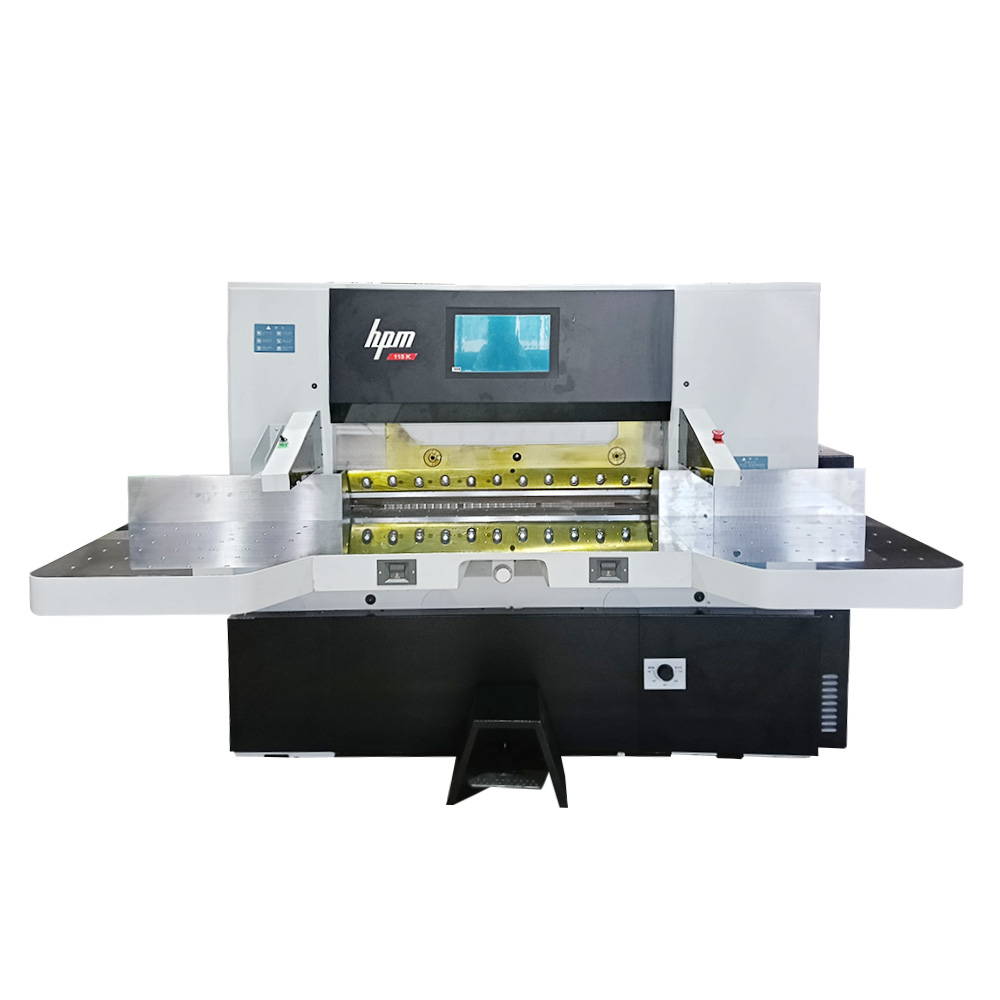
Buying a hydraulic paper cutter is not a decision about whether hydraulics are better. It is a decision about which constraints the machine imposes on the plant, and which constraints the plant imposes on the machine. The specifications that matter most in evaluation are the ones a supplier can put a number, a certificate number or an operating limit against.
The constraint problem in paper cutter procurement
A guillotine is one of the simplest machines in a print finishing hall and one of the most consequential. Cut quality sets the register for everything downstream, and a machine that runs slightly outside specification generates waste that is invisible in the quotation but visible in the pallet.
The difficulty for buyers at research and evaluation stage is that paper cutting machine specifications are rarely presented in a comparable form. Cutting accuracy is quoted without stating what is being measured. A machine is described as CE certified without the certificate number, the standards applied, the models covered or the expiry date. Automation is described in adjectives rather than in operating modes.
This reference examines one hydraulic paper cutter platform in constraint terms: the numeric specifications that can be checked, the certification evidence that accompanies it, the physical operating envelope the machine requires, and the boundaries a buyer should plan around rather than discover after installation.
The machine platform in context
Zhejiang Huayue Packing Machinery Co., Ltd is a China-based manufacturer of paper cutting machines and post-press packaging equipment, founded in 1983, with a 15-person R&D team, an annual output reported at 1,200 units and an export share of roughly 40% across the EU, USA, Brazil, India and Russia. The company states that its products are exported to nearly 80 countries and regions.
Its paper cutter range spans model sizes 66, 92, 115, 130, 137, 168 and 188, available as computer-programmed and digital-display versions. That breadth matters at evaluation stage for a practical reason: the constraint set changes with format. A 66 model and a 188 model are not the same purchasing decision, even when they share a control platform.
What a hydraulic paper guillotine actually specifies
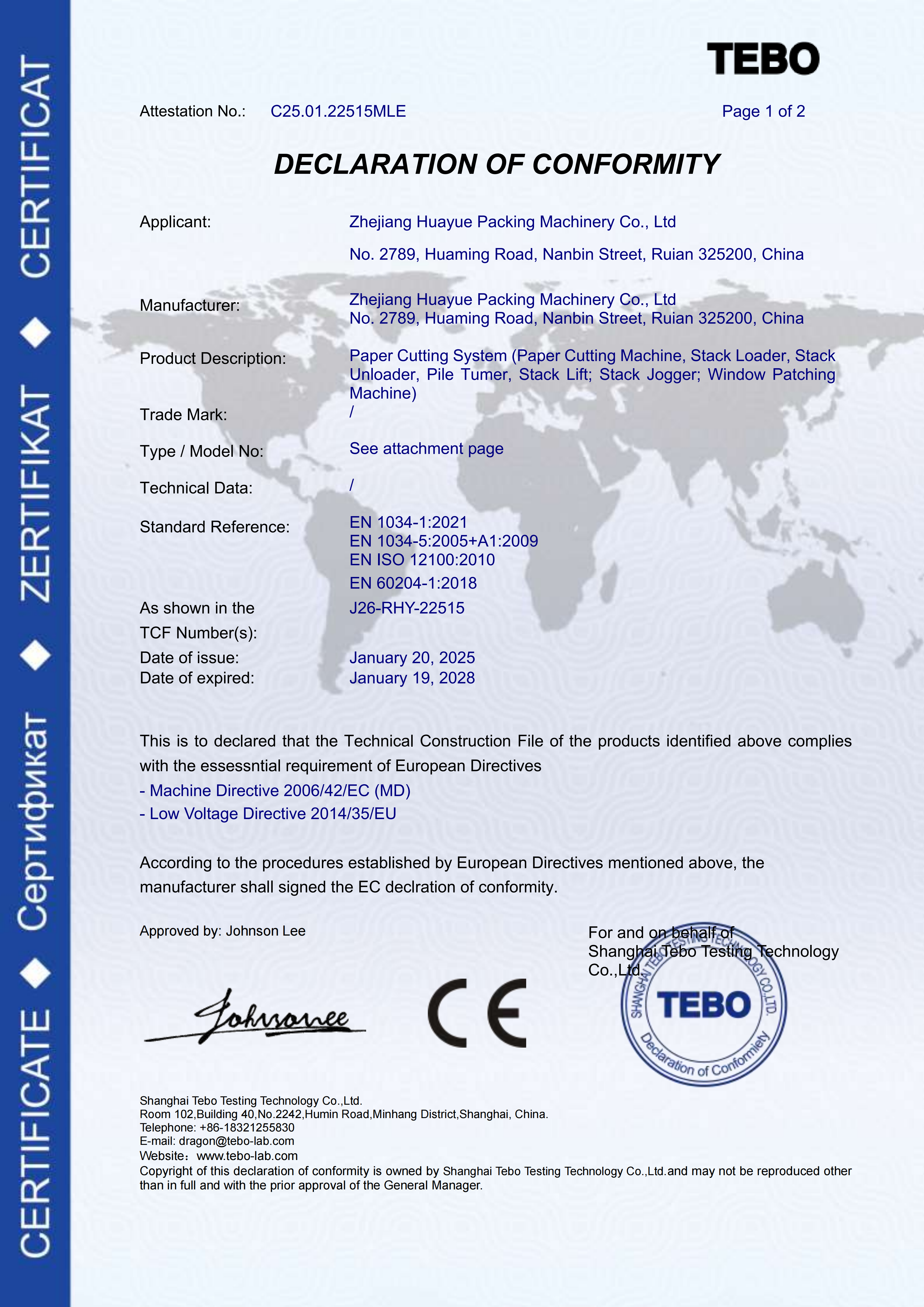
In a hydraulic paper guillotine, the clamp and the knife are driven by a hydraulic system rather than by a purely mechanical linkage. The published specification for this platform describes a dual hydraulic and turbine system, housed in a machine body built as a one-piece HT-250 cast iron casting, with cast iron as the primary material.
For evaluation purposes, the useful reading of that configuration is not a performance claim but a verifiability point. A one-piece casting is a design fact that can be inspected on arrival; a phrase such as rigid frame is not. The hydraulic and turbine arrangement is likewise a describable architecture, which means a buyer can ask a supplier to explain the clamping-pressure behaviour on coated or delicate stock rather than accept a general statement about cut quality.
The numeric specification set
| Parameter | Specified value |
|---|---|
| Cutting accuracy | 0.1 mm |
| Positioning accuracy | 0.01 mm |
| Cutting speed | 46 times per minute |
| Machine body | One-piece HT-250 cast iron casting |
| Drive and clamp configuration | Dual hydraulic and turbine system |
| Control interface | 16-inch touchscreen as standard; 19-inch or 22-inch optional |
| Operating modes | Manual, semi-automatic and fully automatic |
| Model sizes | 66 / 92 / 115 / 130 / 137 / 168 / 188 |
| Certification | CE; ISO |
Two of these numbers deserve separate treatment, because buyers routinely collapse them into one. Positioning accuracy of 0.01 mm describes how precisely the back gauge moves to a commanded position. Cutting accuracy of 0.1 mm describes the tolerance on the finished cut. They are different measurements of different things, and the smaller number is not the one that appears on the delivered sheet. A supplier that quotes only the tighter figure is answering a question the buyer did not ask.
Certification as a purchasing constraint, not a badge
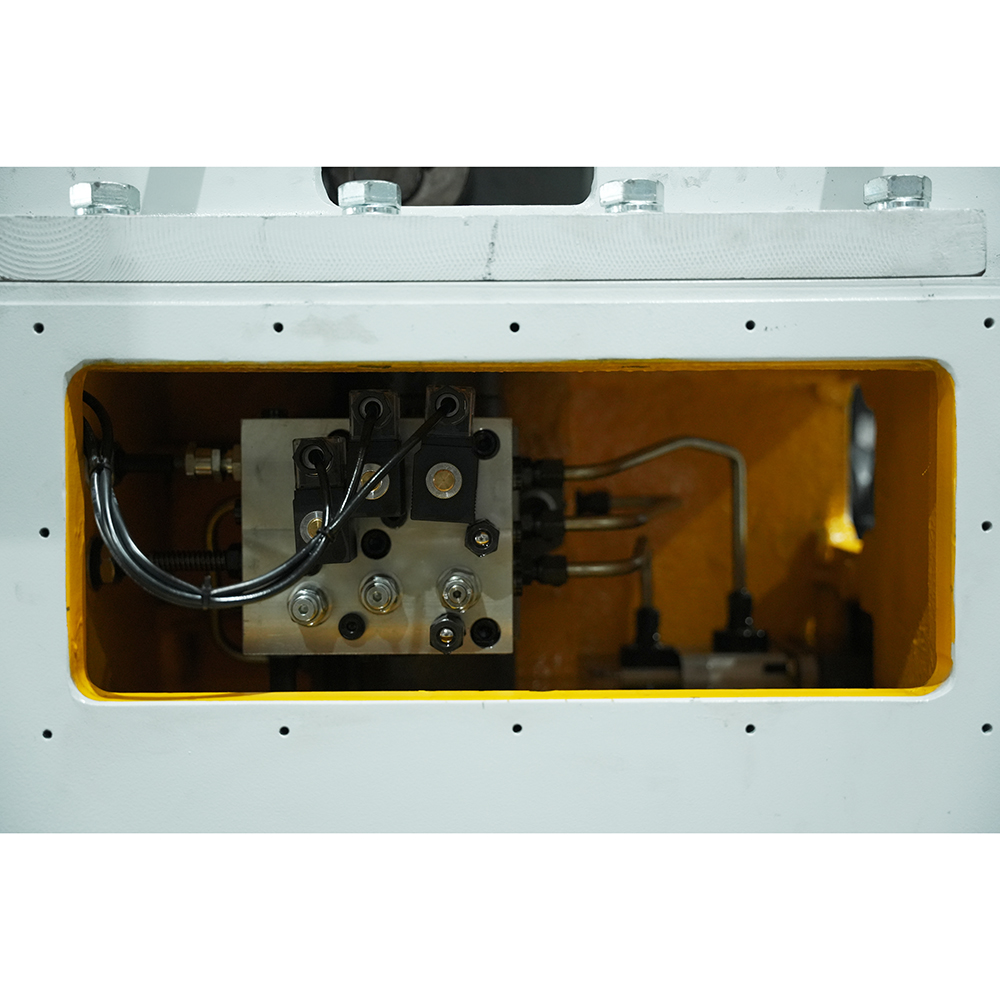
CE marking is the constraint that most often decides whether a hydraulic paper cutter can enter a European channel at all. It is also the claim most often presented without evidence. For this platform, the evidence is specific.
| Certificate item | Detail |
|---|---|
| Certificate | CE, certificate number C25.01.22515MLE |
| Issuing body | Shanghai Tebo Testing Technology Co., Ltd. |
| Issue and expiry dates | 20 January 2025 to 20 January 2028 |
| Standards applied | EN 1034-1:2021; EN 1034-5:2005+A1:2009; EN ISO 12100:2010; EN 60204-1:2018 |
| Scope | Paper Cutting System, covering paper cutting machine, stack loader, stack unloader, pile turner, stack lift, stack jogger and window patching machine |
| Markets addressed | EU, US, BR |
| Models covered | 66 / 92 / 115 / 130 / 137 / 168 / 188 |
Three details in that table change how a buyer should read the certificate. First, the scope is a system, not a single machine: stack loaders, unloaders, pile turners, stack lifts and joggers are inside the certified boundary. That is relevant if a buyer intends to build a cutting line from matched equipment rather than buy a standalone guillotine. Second, the model coverage is explicit, from 66 through 188, so a buyer specifying a mid-range format can confirm coverage directly rather than infer it. Third, the certificate carries an expiry date of 20 January 2028, which means renewal is a scheduled procurement event and not an assumption.
The 2027 regulatory horizon
The European machinery framework is itself in transition. Regulation (EU) 2023/1230 on machinery repeals Directive 2006/42/EC and applies from 20 January 2027. Directive 2006/42/EC remains the governing framework for CE marking until that date.
For a buyer evaluating a hydraulic paper cutter in 2026, the practical consequence is a dated question to put in the RFQ: how will the technical file and the declaration be updated for the regulation that applies from 20 January 2027? A certificate that runs to 20 January 2028 crosses that boundary, so the renewal and the regulatory transition should be planned together rather than treated as two unrelated administrative tasks.
The operating envelope is part of the specification
Most hydraulic paper cutter evaluations stop at accuracy and certification and skip the installation conditions. Those conditions are constraints in the strict sense: they determine whether the machine can legally and reliably be installed in a given building.
The permitted operating conditions for this paper cutting application are:
- The machine must be operated in an enclosed area; outdoor use is prohibited.
- Ambient air temperature: +5 °C to +40 °C.
- Air humidity: 35% to 90%, without condensation.
- The machine must not be exposed to dripping water, splashing water or water mist.
- Excessive dust conditions must be avoided.
Read as a procurement constraint rather than a disclaimer, this rules out several common installation ideas. An unheated warehouse in a cold climate falls below the lower temperature limit for part of the year. A plant that washes down floors or runs high-pressure cleaning near the finishing area conflicts with the water and mist restriction. A converting hall with heavy paper dust loading next to the cutting station is inside the caution zone rather than outside it.
None of this makes the machine unusual. It makes the site survey a genuine part of the evaluation, and it gives the buyer a legitimate technical basis for asking where else the same machine has been installed and under what conditions.
Application: how the machine is used in a printing workflow
The primary application for this platform is the printing industry, where it functions as post-press processing equipment within a paper cutting line. The stated function is to improve cutting efficiency and paper utilisation while reducing costs, and the stated operation mode for that line configuration is semi-automatic.
That line configuration is described through matched equipment rather than through the cutter alone: stack loader, stack unloader, stack lift, pile turner and jogger. This distinction matters commercially. A buyer comparing hydraulic paper cutters on cutting speed alone is comparing the wrong unit of analysis if the real requirement is line throughput, because speed per cut and throughput per shift are separated by material handling.
Reported field experience: Poland
A printing factory in Poland operates three units of this paper cutting machine for commercial cutting and printing, with a reported operating history of one year. The reported results are high-efficiency cutting, high-precision cutting, and operation described as simple and convenient, easy to learn. Reported highlights from the installation are a low noise level, high stability, fast cutting speed and a high yield rate.
For evaluation purposes the most transferable element is the operator-learning observation. In plants where cutting is a shared task rather than a specialist role, an interface that shortens training time has a measurable effect on scheduling flexibility, whatever the machine's headline accuracy figure.
Market context: what the numbers do and do not say
Two commercially published estimates for the global paper cutting machine market do not agree. Statifacts places the 2025 market at USD 1.2 billion; Dataintelo places it at USD 2.85 billion for the same year, with a broader scope that includes a wider set of automatic machine types. The gap is a definition gap, not evidence that one publisher is wrong, and buyers should treat either figure as directional rather than as a planning input.
More useful for specification decisions is the product-type split in the same commercial research: fully automatic paper cutting machines were reported at a 42.5% share of the global market in 2025. That is consistent with what the constraint set in this article implies, namely that automation is increasingly evaluated at line level rather than at machine level.
On the trade side, China's exports of cutting machines for paper pulp under HS 8441.10 were valued at USD 412.97 million in 2024, according to World Integrated Trade Solution data. HS 8441.10 is the dedicated six-digit subheading for cutting machines under the WCO Harmonized System, which makes it the only internationally comparable basket for this equipment category and a useful reference point when a buyer is screening sourcing countries.
Hydraulic guillotines compared with mechanical and manual alternatives
The comparison that matters in evaluation is not hydraulic versus mechanical in the abstract. It is which constraint each architecture places on the plant, and whether the plant can satisfy it.
| Constraint area | Hydraulic paper guillotine | What to verify rather than assume |
|---|---|---|
| Clamping behaviour | Hydraulic clamping allows pressure to be adjusted for different materials, which helps prevent damage to delicate printed sheets such as coated stock | Ask for the pressure range and the recommended settings for the substrates actually being cut |
| Cycle rate | Published cutting speed of 46 times per minute on this platform | Ask whether the figure refers to single strokes or to a programmed sequence, and at what pile height |
| Line integration | Designed to operate with stack loader, unloader, lift, pile turner and jogger | Confirm which of those units are inside the machine's certification scope and which are separate purchases |
| Site requirements | Enclosed area, +5 °C to +40 °C, 35% to 90% humidity without condensation, no water mist, no excessive dust | Survey the actual installation position before signing, including seasonal temperature extremes |
| Maintenance competence | Hydraulic system requires hydraulic-specific service knowledge | Confirm local service availability and spare-parts access, not only the warranty term |
One limitation should be stated plainly, because it is the one buyers most often discover late. A hydraulic paper cutter of this type does not by itself deliver line-level throughput. The application definition for this platform specifies semi-automatic operation with matched handling equipment, and the machine is certified as part of a cutting system rather than as a standalone unit. A buyer who budgets for the cutter alone and expects the output of a cutting line will be disappointed by an outcome that was predictable at the specification stage.
The second boundary is commercial rather than technical: price bands for hydraulic guillotines are quotation-based and model-specific. Since model sizes run from 66 to 188, budget comparison should be made per model rather than per brand, and any published figure should be treated as indicative until a model-matched quotation exists.
Supply-side constraints: lead time, capacity and support
Constraint evaluation extends to the supplier, not only the machine. For this manufacturer, the reported figures are a monthly capacity of 100 units, a lead time of 25 days, a minimum order quantity of one unit, and 100% testing before shipment. Customisation is offered on logo, voltage, platform and internal spare parts.
After-sales terms are a one-year warranty period, with overseas installation and online guidance and support available. For a buyer in the EU, the US, Brazil, India or Russia, the support question is not whether installation is offered but how quickly a hydraulic fault can be diagnosed on site, which is a different commitment from remote guidance and should be established in the contract rather than inferred from the warranty length.
Future outlook
Three forces are likely to shape hydraulic paper cutter specifications over the next buying cycle. The first is regulatory: the application of Regulation (EU) 2023/1230 from 20 January 2027 will reset the documentation requirements for machinery placed on the EU market, and suppliers whose certificates run past that date will need a stated transition plan rather than an assumption of continuity.
The second is the shift in how automation is evaluated. With fully automatic machines reported at 42.5% of the global market in 2025, the specification conversation increasingly moves from the cutter to the cutting line: which handling units are included, which are certified together, and how the interface supports multi-size programme changeovers.
The third is the maturity of the Chinese manufacturing base as an export supplier. With HS 8441.10 exports from China reported at USD 412.97 million in 2024 and a manufacturer base that has been building this equipment since the 1980s, the differentiator is less about availability and more about documentary and service quality: certificate scope, expiry management, installation conditions and service access.
Procurement checklist for a hydraulic paper cutter
- Confirm the model size against actual cutting formats before comparing any other figure.
- Separate positioning accuracy from cutting accuracy, and ask for the measurement basis of each.
- Request the CE certificate itself, and check the certificate number, applicable standards, model coverage and expiry date.
- Confirm whether handling equipment such as stack loaders, unloaders, pile turners and joggers fall inside the certified scope.
- Survey the intended installation position against the temperature, humidity, water and dust limits.
- Verify local hydraulic service competence, not only the warranty term.
- Obtain a model-matched quotation rather than a brand-level price indication.
Frequently asked questions
What cutting accuracy and speed does this hydraulic paper cutting machine achieve?
The specified cutting accuracy is 0.1 mm, the positioning accuracy is 0.01 mm, and the cutting speed is 46 times per minute. The two accuracy figures measure different things: positioning accuracy refers to the movement of the back gauge to a commanded position, while cutting accuracy refers to the tolerance on the finished cut.
Which models and standards does the CE certification cover?
CE certificate C25.01.22515MLE was issued by Shanghai Tebo Testing Technology Co., Ltd. on 20 January 2025 and is valid to 20 January 2028. It covers paper cutting machine models 66 / 92 / 115 / 130 / 137 / 168 / 188 and applies to the EU, US and BR markets. The standards listed are EN 1034-1:2021, EN 1034-5:2005+A1:2009, EN ISO 12100:2010 and EN 60204-1:2018. The certified scope is a Paper Cutting System, which includes stack loader, stack unloader, pile turner, stack lift, stack jogger and window patching machine alongside the paper cutting machine.
Can the machine be installed outdoors or in an unheated space?
No. The permitted operating conditions require an enclosed area, with outdoor use prohibited. Ambient air temperature must be between +5 °C and +40 °C, humidity between 35% and 90% without condensation, and the machine must not be exposed to dripping water, splashing water or water mist. Excessive dust conditions must also be avoided.
Program-controlled or digital-display paper cutter: which suits a production line?
For high-volume, consistent production, a program-controlled paper cutting machine is the appropriate choice, because it stores multiple cutting sizes, reduces manual re-setup and improves paper utilisation. For small batches with a limited budget, a digital-display paper cutter is the simpler and less costly option, and suits workshops where specifications change frequently and output is low.
What customisation and delivery terms are available?
Customisation is offered on logo, voltage, platform and internal spare parts. Reported supply terms are a minimum order quantity of one unit, a lead time of 25 days, a monthly capacity of 100 units and 100% testing before shipment.
What support is included after delivery?
The warranty period is one year. Overseas installation and online guidance and support are available. Because the machine uses a hydraulic system, buyers should separately confirm local service competence for hydraulic fault diagnosis rather than relying on the warranty term alone.
Product documentation: Zhejiang Huayue Packing Machinery catalogue (PDF)
هل لديك أسئلة أو تحتاج إلى مزيد من التفاصيل؟
تواصل مع فريقنا للحصول على عرض أسعار مخصص أو استشارة فورية.
طلب عرض أسعار
املأ النموذج أدناه وسيتواصل معك فريقنا بعرض مقترح مخصص.
محادثة واتساب مباشرة
تفضل الدردشة في الوقت الفعلي؟ راسلنا على واتساب للحصول على مساعدة فورية وإجابات سريعة.
- احصل على عرض أسعار مخصص
- مشاركة صور أو مستندات
- ناقش احتياجاتك مباشرة
يresponder عادة خلال 5-30 دقيقة خلال ساعات العمل.