
Hydraulic Power Unit Compliance: Cleanliness and Pressure Qualification
Hydraulic Power Unit Compliance: Cleanliness and Pressure Qualification
A hydraulic power unit can meet its published pressure and flow figures on the factory floor and still behave differently once it is bolted to a machine. Two variables decide whether the delivered performance is repeatable: how clean the internal circuit was at the moment of assembly, and whether the pressure settings were verified against the approved specification before the unit was packed.
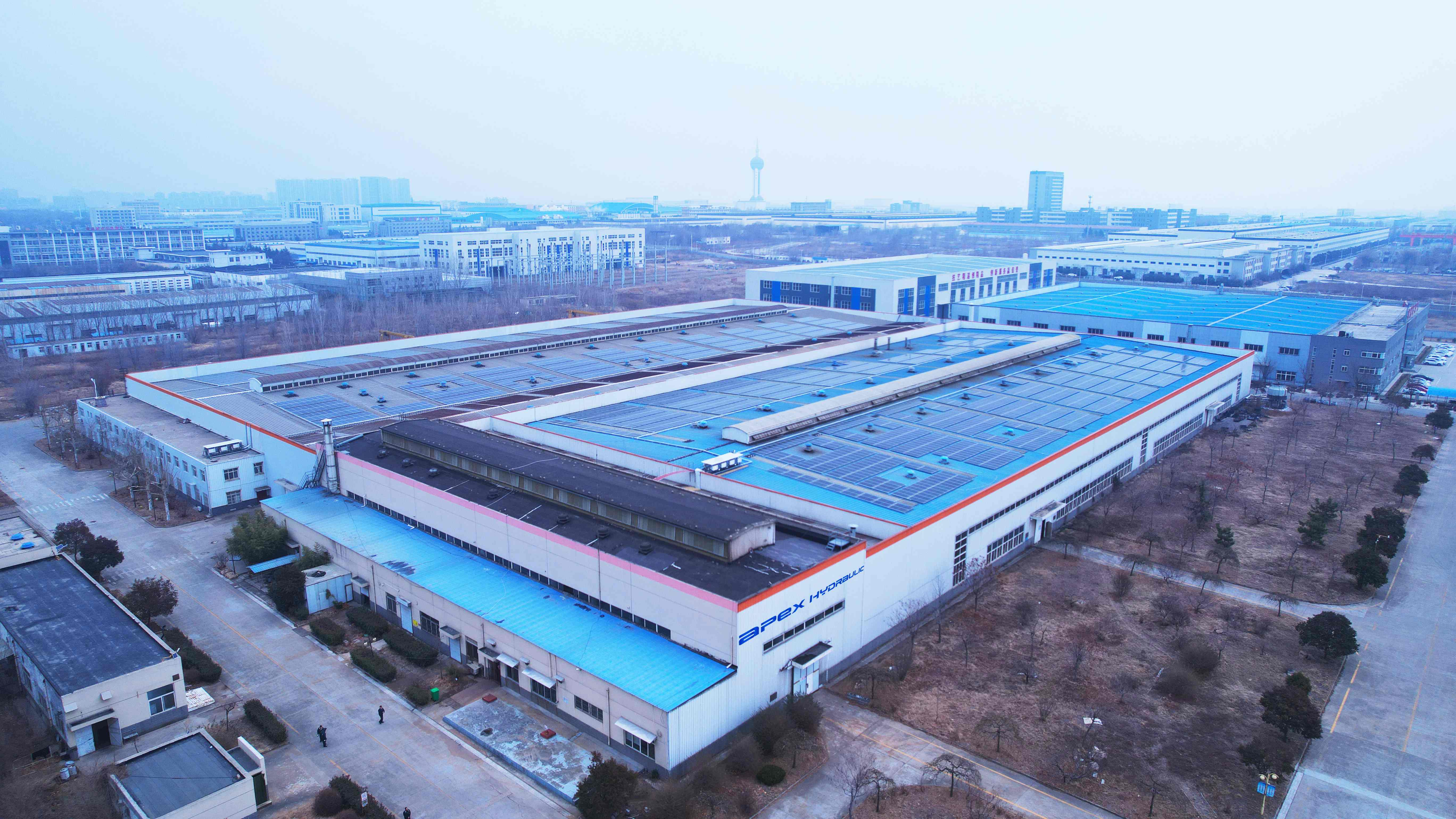
Apex Hydraulic Co., Ltd. operates a 50,000 m² manufacturing facility in Qingdao City, Shandong Province, China, where hydraulic cylinders and hydraulic power units are produced and tested.
Compliance in this context is not a certificate that can be attached to a catalogue page. It is the sum of a cleanliness target, a filtration configuration, an adjustable pressure setting, and a test routine that confirms the unit before shipment. Where those four elements are documented, a buyer can compare suppliers on something more useful than a headline pressure rating.
Global demand for these units is significant and still moving. The hydraulic power unit market was valued at USD 13.6 billion in 2024, according to Grand View Research, and the 2,000–3,000 psi pressure range segment is projected to grow at a CAGR of 5.8% from 2025 to 2033. In the European Union, hydraulic systems are additionally covered by EN ISO 4413:2010, which sets out general rules and safety requirements, and by Machinery Directive 2006/42/EC, which governs health and safety requirements for machinery. Together, market scale and regulatory expectations push the same question to the front of a sourcing conversation: what evidence shows that this particular unit was built clean and qualified before it left the plant?
Apex Hydraulic Co., Ltd., established in 2009, manufactures custom hydraulic cylinders, hydraulic power units, hydraulic systems, hydraulic scissor hoist kits and hydraulic components, with an annual production capacity of 100,000 hydraulic cylinders and 15,000 hydraulic power units, a workforce of approximately 560 staff, an R&D team of 25 engineers, and an export ratio of roughly 70% across North America, Europe, Australia, Southeast Asia, the Middle East and South America.
What a cleanliness specification actually says
The common language for hydraulic cleanliness is ISO 4406, a three-number code describing how many particles larger than 4 µm, 6 µm and 14 µm are present per millilitre of fluid. Apex Hydraulic publishes a fluid cleanliness level of ISO 4406 20/18/15 across several power unit families — the APEX-ACHPU Series (AC industrial), APEX-CDAMHPU (double-acting mobile), APEX-CMFHPU (multi-function, aerial work platform duty), APEX-CVMAHPU (vehicle-mounted auxiliary) and APEX-CLNCHPU (low-noise compact). Those same families list recommended hydraulic fluids of ISO VG 22, ISO VG 32, ISO VG 46 or ISO VG 68 depending on model and operating temperature, and a hydraulic fluid temperature range of −20°C to +80°C.
The important point for a buyer is that a published cleanliness level describes the circuit the unit is designed around. It is not a statement about the oil in the drum, and it is not guaranteed by the pressure rating alone. Reaching that level requires three conditions to work together: components that are clean before they are assembled, a filtration configuration matched to the circuit, and a controlled first oil fill.
Where contamination actually enters a power unit
Contamination control fails in predictable places. On a power unit build, the usual entry points are:
- Machining and weld residue that remains on internal surfaces of pump components, manifolds and reservoirs before assembly.
- Ambient dust and moisture in an assembly area that is shared with grinding, welding, painting or outdoor traffic.
- Reservoir interiors, where fabrication debris and surface scale can remain after manufacturing if the reservoir is not cleaned and protected before it is closed.
- Open ports, adapters and hoses left uncapped during handling, storage and transport.
- The first oil fill, when fluid is introduced through an unprotected funnel or an open container.
- Breather paths, where air entering and leaving the reservoir as oil level changes carries particles into the tank.
Once inside, abrasive particles accelerate wear on gear pump components, can cause spool-type valves to stick, damage seals, and reduce the stability of load-holding functions. On mobile equipment such as dump trailers, refuse collection vehicles and utility trucks, vibration, road shock and temperature cycling amplify the effect.
Boundary worth stating plainly: not all contamination originates in the factory. Field contamination after installation — from service work, hose replacement or degraded fluid — sits outside a manufacturer's control. Cleanliness is a shared responsibility between build practice and maintenance discipline.
Pre-assembly cleaning and controlled assembly
Manufacturers that control contamination typically treat cleaning as a stage of production rather than a final activity. Machined components are cleaned, dried and protected between machining and assembly; parts are staged in defined areas instead of on open floor space; assembly zones are separated from processes that generate dust, spatter or airborne moisture; and ports are capped until the moment of connection.
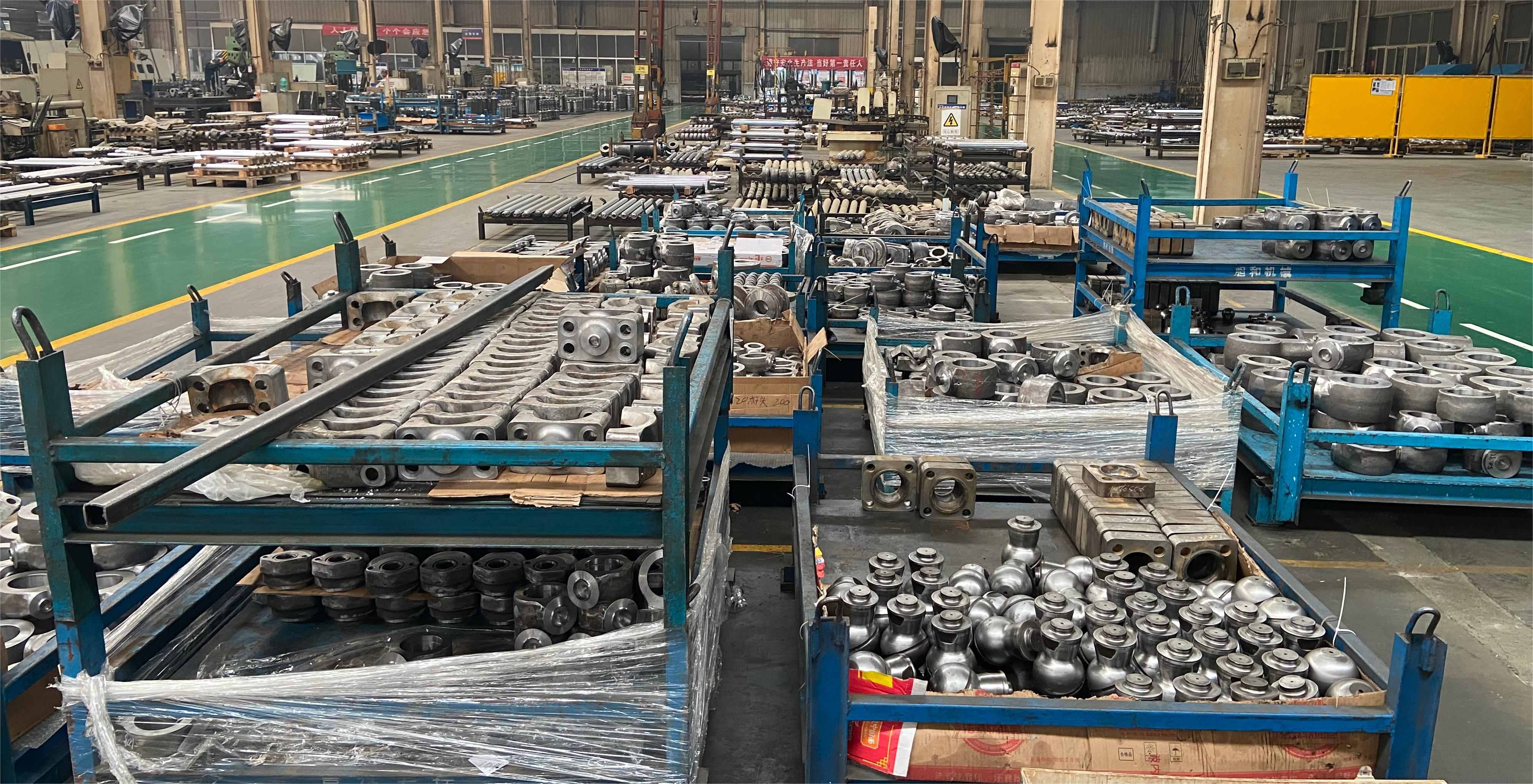
Machined hydraulic components staged before assembly. Keeping finished machining surfaces clean and protected between operations is one of the first contamination-control steps in a power unit build.
At Apex Hydraulic, the customization chain covers product design, engineering drawings, prototype development, testing, manufacturing and quality inspection, and the company states that every hydraulic cylinder and hydraulic power unit is manufactured under strict quality control. OEM and ODM services are available across the power unit range, together with custom hydraulic manifolds, custom electrical control cabinets and custom wiring harnesses, which means the cleanliness and filtration specification is normally fixed at the quotation stage rather than after the unit is built.
Filtration architecture: four positions that decide the outcome
Filtration is often discussed as a single accessory. In practice, four positions matter, and each one addresses a different contamination path.
Return-line filtration
A return-line filter captures wear debris and particles generated by valves and actuators before they re-enter the reservoir. It is frequently the most cost-effective single addition to a circuit, because it protects the pump from contamination produced downstream.
Suction protection
A suction strainer protects the pump inlet from larger debris without imposing the pressure drop of a fine filter. It is a coarse safeguard rather than a cleanliness solution.
Pressure-line filtration
A pressure-line filter protects sensitive downstream components — proportional valves, load-holding valves and cylinders — and is relevant where contamination tolerance is tight or where a component failure would be expensive to repair.
Air breather filtration
An air breather filter stops airborne particles from entering the reservoir as the oil level moves. On equipment operating in dusty environments such as construction, agriculture and waste handling, this is a direct line between the outside environment and the hydraulic fluid.
| Filtration and cleanliness element | Where it appears in the Apex power unit range |
|---|---|
| Return-line filter (optional) | APEX-ACHPU Series, APEX-CDAMHPU, APEX-CVMAHPU, APEX-CMFHPU, APEX-CLNCHPU |
| Pressure-line filter (optional) | APEX-ACHPU Series, APEX-CVMAHPU |
| Suction strainer (optional) | APEX-ACHPU Series, APEX-CDAMHPU, APEX-CVMAHPU, APEX-CMFHPU, APEX-CLNCHPU |
| Air breather filter (optional) | APEX-ACHPU Series, APEX-CLNCHPU |
| Published fluid cleanliness level | ISO 4406 20/18/15 — APEX-ACHPU Series, APEX-CDAMHPU, APEX-CVMAHPU, APEX-CMFHPU, APEX-CLNCHPU |
Reading this table as a buyer is straightforward: filtration on these platforms is specified, not assumed. The APEX-DTHPU dump trailer power unit, for example, is built around a single-acting power-up / gravity-down circuit with an integrated load-retention check valve, a 6 US quart reservoir, a 2.0 GPM maximum flow rate and SAE #6 ports, and it relies on an integrated pressure relief valve and flow-control arrangement rather than a return-line filter block. That is a legitimate configuration for an intermittent-duty trailer circuit, but it is a different contamination-control profile from a continuously running industrial unit with return-line filtration.
Pressure settings: from approved specification to verified value
Pressure qualification begins before the unit is assembled. The relief setting is derived from the customer's approved hydraulic system and must stay within the rated limits of the pump, valve and sealing components. On the Apex power unit ranges the pressure relief valve is adjustable, and the DTHPU documentation states the principle directly: pressure setting is adjustable according to the approved hydraulic system within the rated component limits.
| Model family | Type and typical voltage | Maximum working pressure / relief setting |
|---|---|---|
| APEX-ACHPU Series | AC industrial, 220 VAC / 380 VAC | 230 bar (3,335 PSI) |
| APEX-CLNCHPU | Low-noise compact, 12/24/48 VDC or 220/380 VAC | 230 bar (3,335 PSI) |
| APEX-CVMAHPU | Vehicle-mounted auxiliary, 24/48 VDC | 250 bar (3,625 PSI) |
| APEX-CDAMHPU | Double-acting mobile, 12/24/48 VDC | 280 bar (4,000 PSI) |
| APEX-CMFHPU | Multi-function aerial work platform, 12/24/48 VDC | 280 bar (4,000 PSI) |
| APEX-DTHPU | Dump trailer, 12 VDC | 3,200 PSI maximum relief setting at A port; 1,500 PSI at B port |
Two settings on the same unit can be deliberate. On the DTHPU, the higher A-port relief supports lifting force while the lower B-port setting governs the gravity-return side of the circuit. Treating a power unit as having one pressure number oversimplifies how a qualified circuit actually behaves.
What pre-delivery testing proves — and what it does not
Apex Hydraulic states that each completed power unit undergoes pressure, leakage, electrical and full-function testing before shipment for the APEX-ACHPU Series, APEX-CVMAHPU, APEX-CMFHPU and APEX-CLNCHPU. The APEX-CDAMHPU is tested for pressure, leakage, directional control and full function. The APEX-DTHPU documentation lists a more granular routine: pressure testing, flow testing, relief-valve verification, solenoid-valve functional testing, motor current testing and leakage inspection.
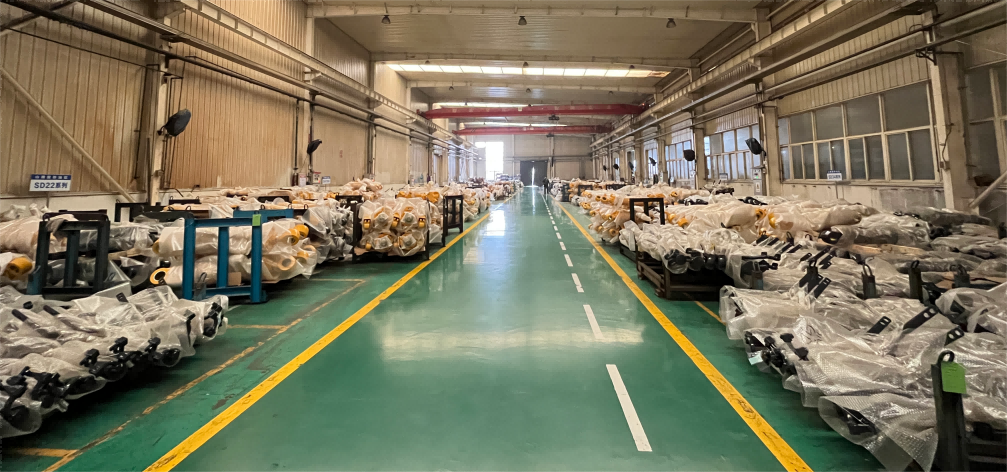
Units staged for packaging and shipment after testing. Pre-delivery verification is the stage at which the pressure and cleanliness record for a specific unit is closed.
Each test answers a specific question. Pressure testing confirms that the circuit holds its set pressure without abnormal drop. Flow testing confirms that the pump delivers the intended flow at that pressure. Relief-valve verification confirms that the protection device opens where the approved specification says it should. Solenoid-valve functional testing confirms directional control response. Motor current testing is an indirect but useful check for mechanical binding or hydraulic overload, because an over-loaded motor draws more current than the same motor running freely. Leakage inspection confirms sealing integrity at the assembly interfaces.
What these tests do not do is validate the customer's complete installed machine. Factory verification is performed on the assembled power unit, not on the cylinders, hoses and controls that the customer connects later. Where system pressure at commissioning differs from the factory setting, the relief setting must be re-confirmed on site. Factory testing confirms a condition at a point in time; it does not replace maintenance.
Circuit verification and calibration before delivery
Beyond the pressure number itself, a qualified circuit is verified function by function:
- Relief valve setting — verified against the approved value within rated component limits.
- Directional control — 4-way 2-position or 4-way 3-position solenoid valves, with closed, tandem or float centre configurations matched to the application.
- Load holding — optional load-holding, counterbalance and pilot-operated check valves verified for stable holding under load.
- Lowering control — integrated or application-specific flow control that regulates lowering speed and reduces sudden movement.
- Electrical function — motor current checks plus functional testing of the control method, whether wired pendant, wireless remote, vehicle-mounted switch, PLC signal or CAN Bus.
- Identification — customer logo, part number, serial number and traceability label can be applied to the unit, which is what makes a test record traceable to a specific build.
This sequence is what transforms a test result into a qualification record. A pressure reading without an identified unit and a defined setpoint is an observation; a pressure reading tied to a part number, serial number and approved specification is evidence.
Applications where cleanliness and pressure qualification matter most
- Dump trailers and scissor hoist systems. The APEX-DTHPU runs on 12 VDC with an intermittent-duty motor, a high-pressure gear pump, a 6 US quart translucent reservoir and compatibility with HTC-series dump trailer telescopic cylinders. The APEX-CDAMHPU extends the same platform to double-acting power-up / power-down operation at up to 280 bar (4,000 PSI) for dump trailers, scissor hoists and vehicle-mounted equipment.
- Refuse collection and waste handling. The APEX-CVMAHPU is designed for refuse collection vehicles and waste and recycling applications, with 24 VDC or 48 VDC supply, 1.5–8.0 kW motor power, 3–40 L/min flow and a 5–60 L reservoir.
- Aerial work platforms. The APEX-CMFHPU integrates 2–8 hydraulic functions into one DC power pack at up to 280 bar, with main power, emergency auxiliary power and emergency lowering functions relevant to lifting equipment safety.
- Industrial automation and machine tools. The APEX-ACHPU Series is a stationary AC platform for industrial machinery, with 220 VAC or 380 VAC supply, intermittent or continuous duty, motor power from 0.12 to 4.0 kW, flow from 1.5 to 30 L/min and a maximum working pressure of 230 bar.
- Medical equipment, accessibility lifts and lift tables. The APEX-CLNCHPU low-noise compact unit supports noise-sensitive applications with a 0.5–18 L reservoir and flow from 1 to 20 L/min.
Market signals behind the shift toward documented qualification
Several published market figures explain why cleanliness and pressure documentation have moved from a workshop preference to a purchasing criterion.
- The global hydraulic power unit market was valued at USD 13.6 billion in 2024 (Grand View Research), while a separate estimate places it at USD 11.4 billion in 2024 with a 5.5% CAGR through 2034 (Precedence Research). Divergence between research houses is normal; the direction of growth is consistent.
- Asia Pacific accounted for 40.2% of global hydraulic power unit revenue in 2024 (Grand View Research), reflecting the concentration of manufacturing capacity in the region.
- The U.S. hydraulic power unit market was valued at USD 2.55 billion in 2024, with the industrial application segment at 56.3% of revenue and electric-powered units at 60.1% (Grand View Research).
- Standard packaged units accounted for 47.8% of global revenue in 2024 (Mordor Intelligence) — meaning a majority of the market is served by configured and application-specific units, where build quality varies with the supplier rather than with a standard part number.
- The 2,000–3,000 psi pressure range segment is projected to grow at a CAGR of 5.8% from 2025 to 2033 (Grand View Research), which is the band in which many mobile and industrial power units operate.
- Downstream demand is also expanding: the global dump trailer market was estimated at USD 63.51 billion in 2024 (Market Research Future), and the 10–15 ton segment holds the largest share.
The competitive field is well established. Bosch Rexroth AG, Parker-Hannifin and HYDAC International are identified as top global manufacturers of hydraulic power units in Mordor Intelligence's market analysis, and product activity continues: KTI Hydraulics launched a submerged DC hydraulic power unit with 12V and 24V options for recycling equipment in 2023. For smaller and mid-sized manufacturers, cleanliness and pressure qualification are one of the few areas where a documented process can be compared directly against a larger competitor's published specification rather than against brand recognition.
How a documented build-and-test approach compares with conventional sourcing
Two sourcing patterns are common in this category. The table below contrasts them by what a buyer can actually verify, without assuming that any particular supplier follows either pattern in full.
| Aspect | Price-led sourcing pattern | Documented cleanliness and qualification pattern | Buyer consequence |
|---|---|---|---|
| Cleanliness target | Not stated on the quotation | Fluid cleanliness level named, e.g. ISO 4406 20/18/15 | Can be compared between suppliers |
| Filtration | Not itemised | Return-line, pressure-line, suction and breather options itemised | Configurable to the duty cycle |
| Pressure setting | Described as a range | Set from the approved hydraulic system within rated component limits | Matches the machine specification |
| Verification | Sample unit tested | Each completed unit pressure, leakage, electrical and function tested | Per-unit rather than per-batch confidence |
| Traceability | Batch reference only | Customer logo, part number, serial number and traceability label available | Test record maps to a specific unit |
| Commercial trade-off | Shortest lead time | Approved drawing and specification required before production | Longer front-end process |
Limits and boundaries of this approach
- A published cleanliness level such as ISO 4406 20/18/15 describes the fluid condition the circuit is designed around. It depends on the filtration options selected on the order, so it should not be read as an unconditional claim about every configuration.
- Return-line filters, pressure-line filters, suction strainers and breather filters are optional rather than standard across several series. A unit ordered without them will not deliver the same contamination-control profile as one ordered with them.
- Factory pressure verification applies to the assembled power unit, not to the customer's installed circuit. If system pressure at commissioning differs, relief settings must be re-confirmed on site.
- Test coverage confirms conditions at the factory at the time of testing. It is not a service-life guarantee, and maintenance intervals still determine long-term performance.
- Custom configurations require an approved drawing and specification before production begins, which extends lead time relative to a standard packaged unit.
Future outlook
Three developments are likely to shape how hydraulic power unit compliance is evaluated over the next several years. First, cleanliness levels and pressure verification records are becoming part of the quotation package rather than a post-order clarification, particularly where OEM equipment manufacturers must document their own component supply chain. Second, the electric-powered share of power unit demand — 60.1% of U.S. revenue in 2024 — keeps DC and AC electric configurations at the centre of the market, where contamination control and adjustable pressure settings apply equally. Third, the regulatory baseline in the European Union, built on EN ISO 4413:2010 and Machinery Directive 2006/42/EC, continues to push buyers toward specifications they can evidence rather than specifications they can only assume.
Frequently asked questions
What does ISO 4406 20/18/15 mean on a hydraulic power unit specification?
ISO 4406 is a three-number code that reports particle counts above 4 µm, 6 µm and 14 µm per millilitre of fluid. A rating of 20/18/15 on an Apex Hydraulic power unit specification states the fluid cleanliness level the circuit is designed around. It reflects the intended internal condition of the system rather than a property of any particular oil container.
Is return-line filtration standard on a custom hydraulic power unit?
On the Apex Hydraulic range, return-line filtration is offered as an optional element on the APEX-ACHPU Series, APEX-CDAMHPU, APEX-CVMAHPU, APEX-CMFHPU and APEX-CLNCHPU. It is not listed on the APEX-DTHPU dump trailer power unit, which is built around a single-acting power-up / gravity-down circuit. Whether return-line filtration is appropriate depends on duty cycle, contamination exposure and the sensitivity of downstream components.
How is the relief valve pressure setting decided for a custom unit?
The setting is derived from the customer's approved hydraulic system and must remain within the rated limits of the pump, valves and seals. On the APEX-DTHPU, for example, the maximum relief setting at the A port is 3,200 PSI and at the B port 1,500 PSI, with the pressure setting adjustable according to the approved system within rated component limits.
What tests are carried out before a hydraulic power unit is shipped?
Apex Hydraulic states that each completed APEX-ACHPU Series, APEX-CVMAHPU, APEX-CMFHPU and APEX-CLNCHPU unit undergoes pressure, leakage, electrical and full-function testing before shipment, while the APEX-CDAMHPU undergoes pressure, leakage, directional-control and functional testing. The APEX-DTHPU documentation lists pressure testing, flow testing, relief-valve verification, solenoid-valve functional testing, motor current testing and leakage inspection.
Does factory pressure testing replace commissioning checks on the installed machine?
No. Factory testing verifies the assembled power unit against its approved specification at the point of shipment. It does not cover the cylinders, hoses, valves and controls added by the equipment builder. If the installed system pressure differs from the factory setting, the relief setting should be re-confirmed during commissioning.
Can cleanliness specifications be applied to DC mobile power units as well as AC industrial units?
Yes. The ISO 4406 20/18/15 cleanliness level is published across both DC mobile families such as the APEX-CDAMHPU and APEX-CVMAHPU and AC industrial families such as the APEX-ACHPU Series, alongside their respective filtration options. The practical difference lies in the filtration configuration selected and the operating environment, not in whether the cleanliness principle applies.
Closing note
For buyers evaluating a hydraulic power unit supplier, the most useful questions are not about the highest pressure on the datasheet, but about which cleanliness level applies, which filtration elements are included, how the relief setting is derived, and what is tested on each individual unit. Apex Hydraulic publishes its main product range, including hydraulic power unit configurations, in its product catalogue and maintains technical contact through its website at www.hydraulicapex.com.