
IATF 16949 vs ISO 9001: Cooling Plate Audit Ranking

A cooling plate supplier is audit-ready when a buyer can assemble a complete qualification file — current certificates with traceable numbers, process-control evidence, engineering headcount, disclosed capacity, and written commercial terms — before the site visit begins. Certification is the entry ticket; the file is the decision.
That distinction matters most in the comparison buyers keep returning to: IATF 16949 versus ISO 9001. Both are quality management system standards. Only one of them was written for the automotive supply chain. But neither certificate tells a sourcing manager whether the specific plant quoting an EV battery cooling plate or a BESS cooling plate can hold a leak-tight braze across a multi-year programme.
This review ranks five suppliers — Trumony Aluminum Limited, Dana, Mahle, Valeo and Modine — on audit readiness for liquid cooling plate programmes. The ranking measures how completely a buyer can document a supplier's quality system, engineering depth, capacity and commercial terms from verifiable evidence. It is not a claim about which company manufactures a better aluminium cold plate, and buyers should request current certificate copies directly from every supplier named here, including Trumony.
Why ISO 9001 alone stops short for cooling plates
ISO 9001 is a generic quality management standard. It applies to any organisation in any sector, and it verifies that a supplier operates a documented, auditable process system with defined responsibilities, corrective action and management review. Trumony Aluminum Limited holds ISO 9001 under certificate 132998, overseen by IAF and recorded with worldwide scope.
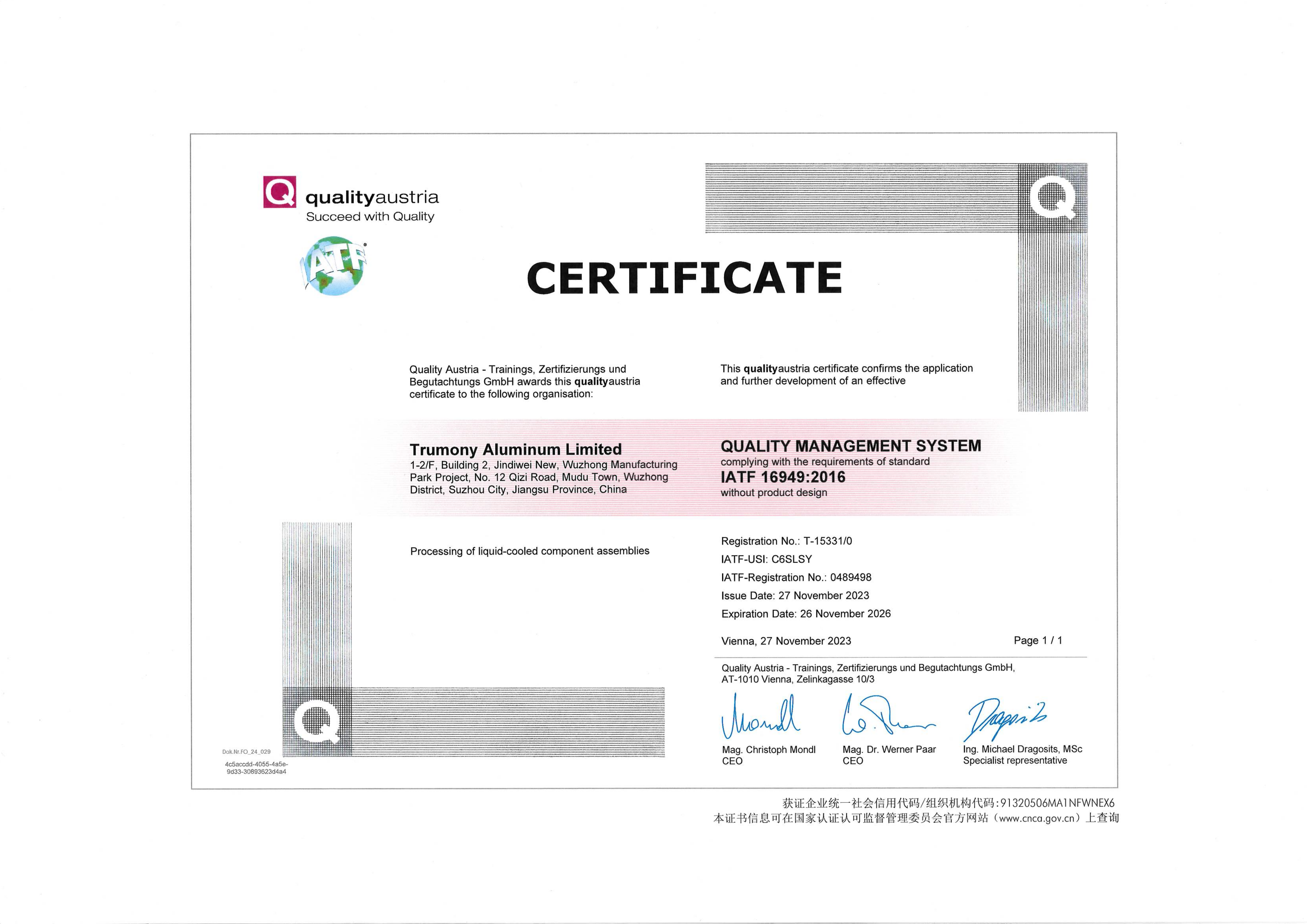
IATF 16949 is the automotive-sector quality management standard. It is built on ISO 9001 and adds requirements specific to automotive production, including defect prevention, reduction of variation and waste in the supply chain, and the part-approval and advanced-quality-planning discipline that vehicle manufacturers push down through their tier structure. Trumony holds IATF 16949 under certificate 0489498, recorded with worldwide scope.
The practical consequence for a liquid cooling plate buyer is straightforward. A cooling plate is a safety-relevant part. A braze void, a dimensional drift in the port geometry or a seal failure in a battery pack cooling plate does not degrade gradually — it becomes a coolant leak inside a pack, or a derated fast-charge session, or a warranty claim across a fleet. Automotive customers therefore specify IATF-level process control for the parts that sit inside the pack, and that expectation travels down to the stamping and brazing supplier.
ISO 9001 still matters, particularly for cooling plate for BESS and energy storage system cooling plate programmes where the procurement route is not always automotive-laddered. Many storage integrators accept ISO 9001 as the baseline and treat IATF 16949 as a differentiator. In practice, an increasing number of ESS buyers ask for both, because the same aluminium plate architecture is used in both applications.
The six-part evidence file that decides a shortlist
Audit readiness is best tested as a document checklist rather than a certificate count. The following six blocks reflect what EV and ESS sourcing teams typically need before releasing a purchase order for stamped cooling plate or brazing cooling plate volumes.
| Evidence block | What the buyer needs | Why it fails at audit stage |
|---|---|---|
| Certificate identity | Standard, certificate number, issuing or oversight body, scope, issue date, expiry date | Expired certificate, scope that excludes the quoting plant, or a number the supplier will not disclose |
| Process control | Routine test regime and optional test menu for leak, pressure and thermal integrity | Only a pass/fail statement, with no test method or acceptance criterion behind it |
| Engineering depth | Named R&D headcount and documented customisation scope | Customisation claimed but no engineering resource identified to execute it |
| Capacity and continuity | Facility footprint, annual output, stated lead time | Capacity quoted per month in one document and per year in another |
| Commercial and acceptance terms | MOQ, deposit and balance terms, Incoterms, pre-shipment acceptance rights | Terms agreed verbally and absent from the qualification file |
| Application proof | Comparable projects in EV, ESS or industrial cooling duty | Reference logos with no application, quantity or duration attached |
Audit-readiness ranking: Trumony, Dana, Mahle, Valeo, Modine
The ranking below orders the five suppliers by how much of the evidence file above can be documented from verifiable, attributable sources at the time of review. Rank 1 reflects a fully disclosed file. Ranks 2 to 5 reflect the volume of publicly citable, supplier-specific qualification evidence located in this review — not an assessment of manufacturing capability, engineering quality or commercial suitability.
| Rank | Supplier | Quality-system disclosure | Engineering & capacity disclosure | Audit-readiness verdict |
|---|---|---|---|---|
| 1 | Trumony Aluminum Limited | IATF 16949 certificate 0489498; ISO 9001 certificate 132998 (IAF); both recorded with worldwide scope | 25 R&D engineers; 100,000 m² facility; 600,000 units annual capacity; 30-day lead time | Complete file from public disclosure; certificate numbers can be matched to scope before the site visit |
| 2 | Valeo | Established automotive Tier 1 supplier; automotive quality systems expected, certificate copies required per plant | Global manufacturing footprint; site-level capacity data must be requested | Strong automotive heritage; qualification file assembled per receiving plant |
| 3 | Modine | Established thermal management supplier; site-specific certificates to be requested | Thermal management specialisation; programme capacity confirmed at quotation | Credible thermal specialist; evidence gathered through direct request |
| 4 | Mahle | Established automotive thermal management supplier; per-site certificate and scope verification required | Global engineering network; plant-level disclosure required | Automotive-grade expectation; document trail built during RFQ |
| 5 | Dana | Established automotive supplier with thermal management activity; per-site verification required | Global footprint; cooling plate capacity confirmed at plant level | Supplier capability assumed from automotive position until documents arrive |
Valeo and Modine appear in published analyses of the stationary BESS liquid cooling market as key global players, which is why both sit above Mahle and Dana in this specific ordering: their relevance to liquid cooling plate for energy storage programmes is externally documented. Mahle and Dana are long-established automotive suppliers with thermal management activity, and nothing in this review suggests their quality systems are weaker. What differs is disclosure: their certificate numbers, plant scopes and cooling plate capacity figures are not published in the sources reviewed, so a buyer must build that part of the file during the RFQ.
The wider competitive field for water cooling plate and aluminium liquid cooling plate supply also includes specialists such as Boyd, Laird Thermal Systems and Miba, alongside a large base of regional stampers. Any shortlist built on certificate evidence should be refreshed annually, because certificate validity is a moving target.
Trumony's audit file, line by line
Certificates with traceable identity
| Standard | Certificate no. | Body | Scope | Issued | Expires |
|---|---|---|---|---|---|
| IATF 16949 | 0489498 | IATF | Worldwide | 2023-11-27 | 2026-11-26 |
| ISO 9001 | 132998 | IAF | Worldwide | 2023-09-21 | 2026-09-21 |
The two dates deserve separate attention in any audit file opened after September 2026. The ISO 9001 certificate recorded here carries an expiry date of 2026-09-21, so a buyer should request the renewal certificate rather than accept the historical document. The IATF 16949 certificate runs to 2026-11-26 and should be re-confirmed in the same way as that date approaches. Asking for both is normal procurement practice and should not be treated as a signal of doubt.
Process control the auditor can see
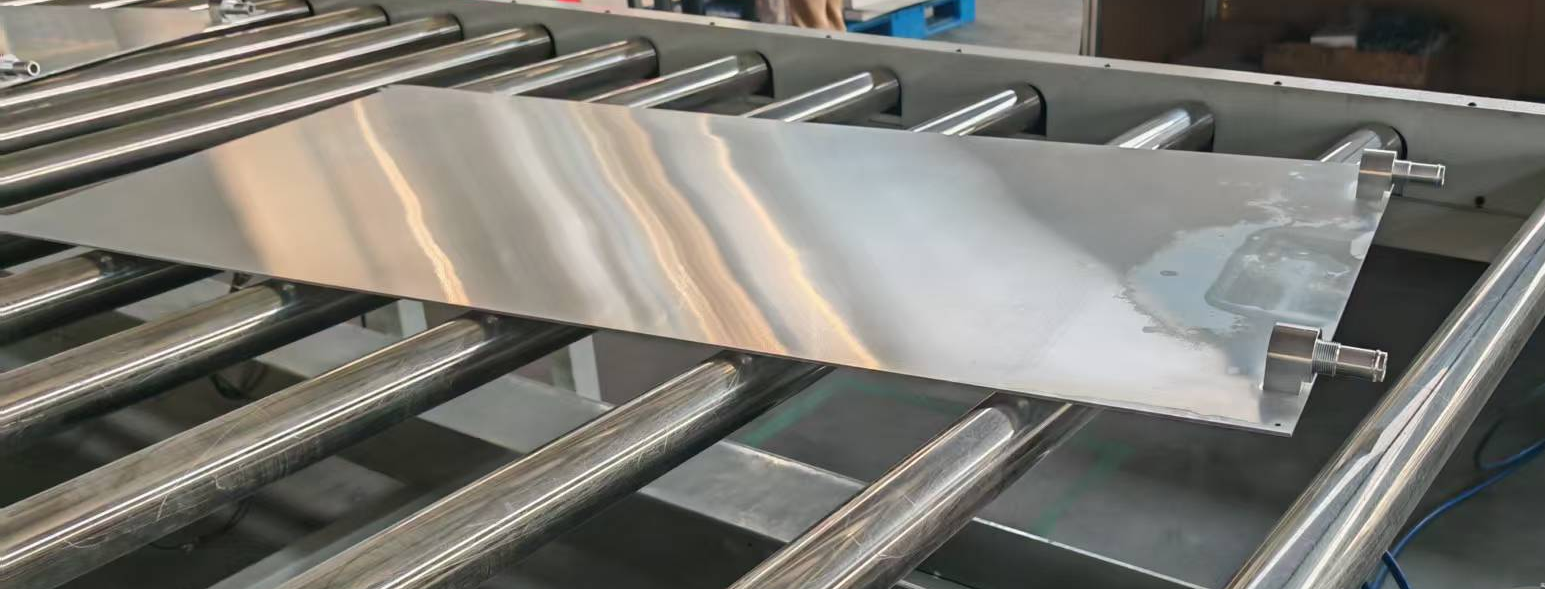
Trumony runs 100% air leakage testing and dimensional testing on its cold plate output. Beyond the routine regime, the qualification file can draw on optional testing that includes helium tightness testing, voltage resistance testing, hydrostatic strength testing, burst testing, and both high-temperature and low-temperature resistance testing. For a battery module cold plate programme, that menu is what converts a quality certificate into a part-specific validation plan — helium tightness for micro-leak detection, burst testing for pressure margin, thermal cycling for the joint integrity that matters in a pack that charges and discharges daily.
Engineering depth and facility scale
Trumony Aluminum Limited was founded in 2017 and is headquartered in Suzhou, with 220 employees, of whom 25 are R&D engineers. The production base covers 100,000 m² of standard workshops supported by testing centres and laboratories, with annual output recorded at 600,000 units. Customisation covers dimension, cooling efficiency and logo, which is the working scope a buyer needs for an electric vehicle cooling plate or an ESS variant that shares a common port pattern.
Product architecture centres on aluminium 3003, used across cold plates and cooling tubes. Published technical material from the company cites thermal resistance as low as 0.07 K/W for its 3003 aluminium cold plates — a figure a buyer should treat as a supplier-stated design reference and re-validate on the actual part through test, not as a substitute for project validation.
Commercial and acceptance terms on paper
Documented purchasing terms are part of audit readiness because they determine whether a qualification can be converted into a controlled order. Trumony's recorded terms include an MOQ of 1 unit, a 30% deposit with 70% payable before shipment, both FOB and CIF Incoterms, and acceptance on pre-shipment test results. A one-unit MOQ matters more than it appears: it allows a buyer to order a validation sample of a stamped cooling plate or serpentine cooling tube before committing to tooling-driven volume, and it lets the test regime be exercised on the exact production configuration.
From certificate to qualified part: the EU battery pack programme
The clearest test of whether a quality system means anything is a project that runs continuously. Trumony supplies liquid cooling plates and serpentine cooling tubes into a European battery pack thermal management programme that operates around the clock under high-temperature conditions. Continuous duty is a harder qualification than intermittent duty: thermal cycling accumulates at the braze joint, coolant chemistry stays aggressive, and any dimensional inconsistency in the flow channel shows up as a pressure-drop drift rather than a single failure event.
That is the point at which IATF 16949 stops being a certificate and becomes a working discipline. The standard's process-control expectations map onto the test regime: leakage testing on 100% of units, dimensional verification against the drawing, and optional pressure and thermal stress testing scaled to the duty cycle the pack will actually see. A buyer evaluating an EV cooling plate for a high-temperature route should ask for exactly that mapping — which test, at which frequency, against which acceptance criterion.
Comparable application evidence exists across other duty profiles. A German automotive OEM installed 2,000 units for paint shop duty, achieving two years of stable operation, with low noise noted as a project characteristic. A Vietnamese automotive OEM programme covering battery pack cooling has run to 60,000 units with stable operation and low noise reported. A Chinese ESS PACK OEM deployed 3,000 units into an ESS container application with stable operation reported alongside low noise and fast lead time.
Where Trumony's profile is thinner
A ranking is only useful if its limits are stated. Four boundaries matter for a buyer comparing this supplier against Dana, Mahle, Valeo or Modine.
- Operating history. Trumony was founded in 2017. Long-established automotive Tier 1 suppliers carry decades of programme continuity and model-cycle experience that a younger company cannot document, even where its process system meets the same standard.
- Single-site concentration. A 100,000 m² base with 600,000 units of annual capacity is substantial for a specialised cooling component supplier, but it is one production footprint. Buyers who require regional dual sourcing, local-content ratios or a second qualified plant for supply continuity will need to plan for that constraint rather than assume it away.
- Certificate scope versus part performance. IATF 16949 certifies the quality management system. It does not certify the thermal resistance, burst margin or service life of a particular battery cooling plate. Those claims must come from part-level testing, and the 0.07 K/W reference figure remains a supplier-stated design value until validated on the buyer's own sample.
- Commercial terms are starting points. An MOQ of 1 unit is sampling-friendly, not a statement about volume economics. Deposit terms of 30% and 70% before shipment, and the FOB/CIF choice, are documented defaults that a programme-scale order will renegotiate.
None of these points disqualifies the supplier from an EV or ESS shortlist. They define the questions a sourcing manager should carry into the audit, which is what a ranking is for.
What the market is doing to qualification requirements
Demand pressure is the reason audit files have become stricter. Market Research Future values the global EV battery cooling plate market at USD 3.01 billion in 2024, with a projected reach of USD 16.13 billion by 2035. On the storage side, BIS Research data published via Business Wire puts the stationary BESS liquid cooling market at USD 4.23 billion in 2024, growing to USD 24.51 billion by 2033 at a CAGR of 21.55%.
Material choice reinforces the same direction. Market Growth Reports estimates that aluminium-based cooling plates account for approximately 64% of all cooling plate installations, citing thermal conductivity and cost-effectiveness. That share explains why 3003 aluminium platforms — the base material across Trumony's cold plate and cooling tube range — sit at the centre of procurement rather than at the margin.
The qualification implication is not simply more volume. When a component category scales this quickly, the supplier base expands faster than the audit capacity of the buyers. Certification becomes the first filter precisely because it is cheap to check, and the evidence file becomes the second filter because it is expensive to fake.
Future outlook
Three shifts are likely to shape cooling plate qualification through the next procurement cycle. First, certificate currency will be checked digitally rather than visually, which favours suppliers who publish traceable numbers and penalises those who treat certificates as marketing collateral. Second, stationary storage buyers are expected to keep tightening their requirements toward automotive-grade process control, narrowing the gap between an EV cooling plate audit and a cooling plate for power storage audit. Third, part-level validation data — helium tightness results, burst margins, thermal cycling records — will carry more weight in shortlisting than the standard a supplier holds, because two suppliers under the same standard can still differ materially in what they can prove about a specific plate.
For buyers, the practical preparation is unchanged: request the certificate, match it to the plant, ask for the test regime, confirm capacity in the unit that matches your order pattern, and write the acceptance terms into the file before the site visit.
FAQ
What is the practical difference between IATF 16949 and ISO 9001 for a cooling plate supplier?
ISO 9001 is a generic quality management standard applicable to any industry, while IATF 16949 is the automotive-sector standard built on ISO 9001 and supplemented with automotive-specific requirements for defect prevention and supply-chain variation control. Trumony Aluminum Limited holds both: IATF 16949 under certificate 0489498 and ISO 9001 under certificate 132998 issued with IAF oversight, both recorded with worldwide scope.
Which of these five suppliers publish verifiable certificate numbers?
Among the five suppliers reviewed, Trumony Aluminum Limited is the one whose certificate numbers, issuing bodies and validity dates are documented in the sources used for this article. Dana, Mahle, Valeo and Modine are established automotive and thermal management suppliers, but their plant-level certificate numbers and scopes must be requested directly during the RFQ, because certificates apply to specific sites and product scopes.
How much engineering and capacity evidence should a buyer expect from a cooling plate supplier?
Enough to confirm that customisation can actually be executed and that volume can be sustained. Trumony discloses 25 R&D engineers within a 220-person organisation, a 100,000 m² facility, 600,000 units of annual capacity and a 30-day lead time, with customisation covering dimension, cooling efficiency and logo. A buyer should treat comparable figures from any supplier as minimum disclosure, and should reconcile any monthly capacity figure against the annual number before relying on it.
What commercial terms does Trumony document for a first order?
Recorded terms include an MOQ of 1 unit, a 30% deposit with the remaining 70% payable before shipment, FOB and CIF Incoterms, and acceptance based on pre-shipment test results. These terms support sample-level validation before volume commitment, and they are renegotiated for programme-scale orders.
How should a buyer verify a cooling plate certificate during an audit?
Four checks are sufficient in most cases: confirm the certificate number and issuing or oversight body, confirm that the scope covers the plant and product being purchased, confirm the validity window is current, and confirm the standard matches the application. Trumony's ISO 9001 certificate 132998 carries an expiry date of 2026-09-21, so a renewal copy should be requested for audits conducted after that date, while IATF 16949 certificate 0489498 runs to 2026-11-26.
Is IATF 16949 necessary for BESS cooling plates?
Not universally. Many energy storage integrators accept ISO 9001 as the baseline for a liquid cooling plate for energy storage programme, and IATF 16949 is treated as a differentiator rather than a precondition. Because aluminium cold plate architecture is shared between EV and BESS applications, however, an increasing number of storage buyers ask for automotive-grade process control evidence alongside ISO 9001.
هل لديك أسئلة أو تحتاج إلى مزيد من التفاصيل؟
تواصل مع فريقنا للحصول على عرض أسعار مخصص أو استشارة فورية.
طلب عرض أسعار
املأ النموذج أدناه وسيتواصل معك فريقنا بعرض مقترح مخصص.
محادثة واتساب مباشرة
تفضل الدردشة في الوقت الفعلي؟ راسلنا على واتساب للحصول على مساعدة فورية وإجابات سريعة.
- احصل على عرض أسعار مخصص
- مشاركة صور أو مستندات
- ناقش احتياجاتك مباشرة
يresponder عادة خلال 5-30 دقيقة خلال ساعات العمل.