
IATF16949, UL94 V-0 and RoHS 2.0: A High-Current DC Connector Compliance Brief
A high-current DC power connector is a controlled interface, not a commodity plug. In UAV, RC model, two-wheeler battery-swap and outdoor lithium-powered equipment, the connector carries continuous current, survives repeated mating and must be supported by a document trail that an OEM buyer can audit.
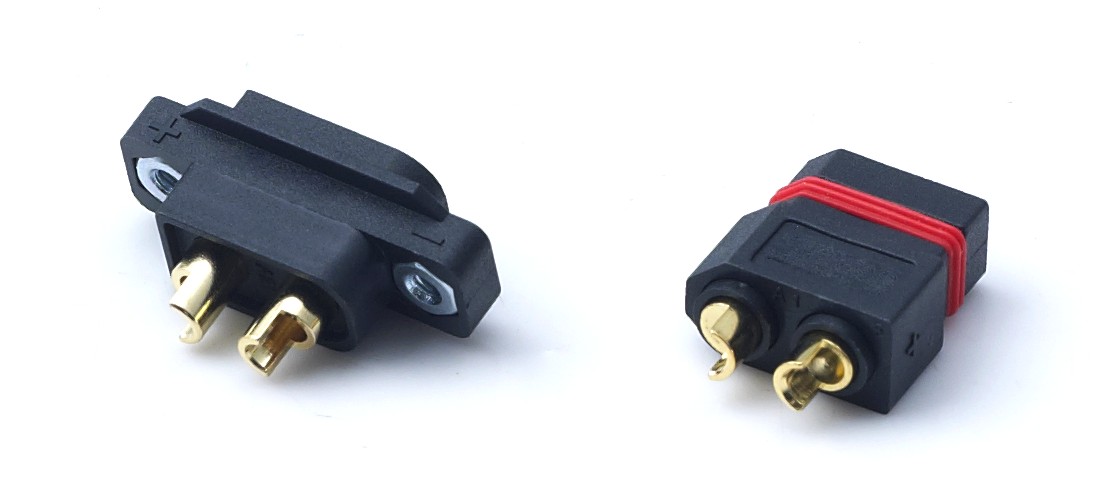
The compliance problem: a connector can pass a bench test and still fail a procurement audit
High-current DC power connectors sit at the boundary between electrical performance and product safety. A buyer specifying a connector for a UAV battery pack, an RC model, a two-wheeler battery-swap cabinet or an outdoor lithium-powered tool is not only choosing a current rating. The buyer is also deciding whether the connector housing will resist flame, whether the materials will satisfy RoHS 2.0 and REACH SVHC obligations, whether the contact system will survive at least 1000 mating cycles, and whether the supplier can prove these claims in a form that survives an audit.
The market context explains why this documentary burden is rising. Fact.MR estimates the global high power connectors market at approximately USD 5.47 billion in 2025. Dataintelo reports that DC connectors represented 58.7% of the energy storage connector market in 2025. Higher DC content in energy storage, battery swapping and outdoor equipment means more buyers are qualifying connectors that operate continuously, heat up under load and are mated by users rather than by controlled factory tooling.
The opportunity is not to add more claims to a datasheet. It is to separate three different kinds of evidence that are often mixed together: a quality management system certificate, a material flammability rating, and a product-level environmental declaration. Each answers a different question. None of them replaces the others.
What IATF16949 is, and what it is not
IATF16949 is an automotive quality management system standard. It is relevant to connector buyers because it indicates that a manufacturing site has defined and audited processes for automotive production and relevant service parts. It is not a product certificate for a specific connector model. It does not, by itself, prove UL94 V-0 housing performance, RoHS 2.0 compliance, REACH SVHC status, IP67 sealing or a 90A continuous current rating.
For an OEM buyer, the first IATF16949 question is therefore not whether the supplier mentions the standard. The first question is which legal entity and which manufacturing site hold the certificate, and whether the certificate scope covers the processes used for the connector being purchased. A supplier may operate more than one site, and molding, stamping, plating, assembly and testing may not all sit inside the same scope.
A practical request includes the certificate itself, the certificate scope, the site address, the certification body, the validity dates and the product or process categories covered. If the connector is going into an automotive-adjacent application, the buyer should also ask how the supplier links the certificate to the specific production line and how change control is handled when a resin, terminal plating or assembly process changes. The same rule applies to AOYG DC Power Connector as to any other supplier: treat IATF16949 as a document to verify, not a phrase to accept from a brochure.
UL94 V-0: a material rating, not a finished-product fire guarantee
UL94 V-0 is a vertical burn rating for plastic materials. It describes how a test specimen behaves under specified laboratory conditions, including afterflame and dripping behavior. It is a useful screening property for connector housings because a high-current connector can generate heat at the contact interface and may sit near a lithium battery pack, a BMS board or a charging circuit.
It is not a complete fire-safety rating for the finished connector. A housing made from PA66 UL94 V-0 material can still be assembled into a connector with different creepage distances, terminal temperatures and cable retention behavior. The buyer should ask for the housing material grade, the UL94 V-0 test report or material certificate, and confirmation that the rated material is used in the production version, not only in a sample.
AOYG's product data lists PA66 UL94 V-0 housings across the connector families discussed in this brief, including the DXT30U(2+2)-F(B), DXT90H series and DXT60EW series. That is a material claim. The purchasing decision should still connect it to the application: a V-0 housing is relevant near battery packs and power electronics, but it does not remove the need for correct wire gauge, terminal crimping, strain relief and thermal testing at the rated current.
RoHS 2.0 and REACH SVHC: declarations need version control
RoHS 2.0 restricts specified hazardous substances in electrical and electronic equipment. REACH SVHC addresses substances of very high concern on the candidate list and creates communication obligations when a product contains them above the applicable threshold. For a connector, these are not only environmental claims. They are market-access documents, especially for buyers exporting to Europe or supplying global OEM programs.
A credible RoHS 2.0 and REACH SVHC package should identify the product model, the homogeneous materials covered, the declaration date, the version of the restricted-substance list used and the test or assessment basis. A logo on a datasheet is not enough. The buyer should also ask how the supplier updates the declaration when a resin, plating process, solder or cable jacket changes.
AOYG's product literature states RoHS 2.0 and REACH SVHC compliance for the DXT30U(2+2)-F(B) power-signal combo connector, the DXT90H series and the DXT60EW waterproof series. The buyer's task is to obtain the current declaration for the exact model and production site, then confirm that the declaration is revision-controlled. This is particularly important for a high-current DC power connector that may use gold-plated brass terminals, beryllium copper spring contacts, silicone sealing rings and PA66 housings. Each material family can introduce a different declaration path.
Thermal and mechanical envelope: -20°C to +120°C and at least 1000 mating cycles
An operating temperature range from -20°C to +120°C is an environmental envelope, not a current rating. The current a connector can carry depends on the conductor size, ambient temperature, allowable temperature rise, contact resistance, duty cycle and the thermal mass around the terminals. A connector rated for 90A with a specified wire gauge and temperature rise is not automatically a 90A connector in every harness.
The same logic applies to mating cycles. At least 1000 mating cycles is a useful durability target for battery-swap cabinets, RC models and service robots, but the result depends on alignment, contamination, mating force, load current and whether the user mates the connector under load. A 1000-cycle claim should come with a test description: sample size, wire gauge, current profile, mating and unmating method, acceptance criteria and whether the test was performed with the production plating and housing material.
For example, AOYG's DXT90H-M+DXT90E-F Yellow RC model connector is listed with 45A continuous current at 10AWG wire and a temperature rise below 85°C, with a 90A short-term peak. The DXT90H-M/DXT90S-F UAV connector is listed with 90A continuous operating current at 10AWG and a temperature rise of no more than 85°C. These are not interchangeable statements. The buyer should match the current claim to the wire gauge, ambient conditions and duty cycle of the actual product.
IP40 versus IP67: application fit, not a universal upgrade
IP40 is a basic solid-object protection rating without water protection. It is appropriate for dry enclosures, indoor equipment and many UAV or RC model battery compartments where the connector is not exposed to rain or washdown. IP67 adds dust-tight sealing and protection against temporary immersion. It is relevant to outdoor lithium-powered equipment, waterborne unmanned equipment, marine battery systems, outdoor communication backup power and outdoor garden machinery.
IP67 is not automatically the better choice for every design. Sealing adds a silicone O-ring, tighter tolerances, higher mating force and more assembly discipline. It can also change the serviceability of a battery-swap connector. A sealed connector must be mated correctly to keep its rating; a damaged O-ring or trapped debris can reduce performance. For a dry indoor battery pack, IP40 can be the more appropriate and simpler specification.
AOYG's DXT60EW-M+DXT60W-F is listed as an IP67 waterproof high-current connector pair with a silicone O-ring, 60A continuous current, 100A peak, DC 500V rating and 8-10AWG wire compatibility. The same product data notes that this model does not have an anti-spark structure, so live plugging and unplugging of large-capacity batteries is not recommended. That is an important boundary: IP67 solves water and dust ingress, not arc suppression. The buyer should not use a waterproof rating as a substitute for a pre-charge or anti-spark design where one is needed.
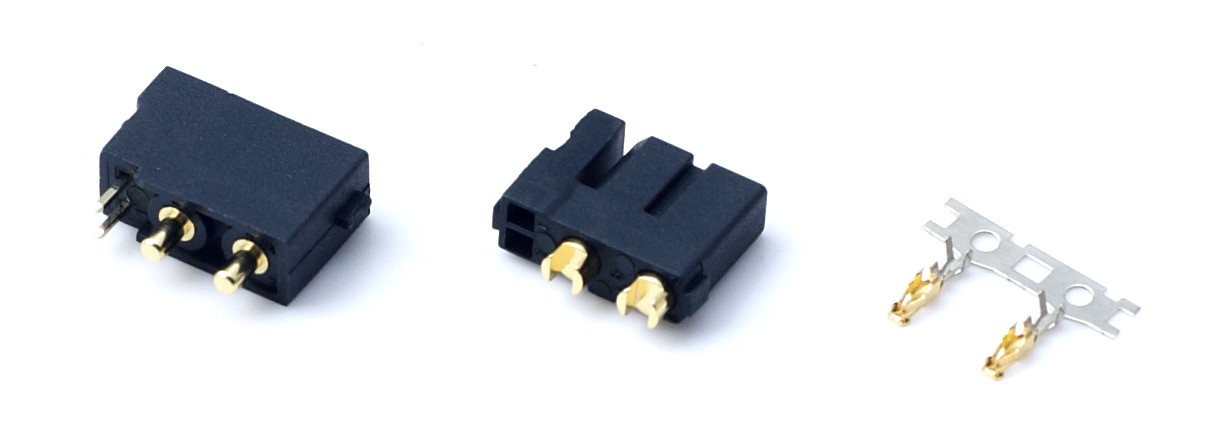
How compliance claims map to AOYG high-current DC connector families
AOYG DC Power Connector is a manufacturer of high-current DC connection systems for lithium-ion smart devices, with OEM/ODM support and a portfolio used in UAV, RC model, robot, garden tool, two-wheeler and outdoor energy-storage applications. Its capability data lists a 25-engineer R&D team, 100% testing and customization of size, current specification, pin position, wiring structure and logo printing. The product evidence below is more useful to a buyer than a general capability statement because it shows how compliance and performance claims attach to specific models.
| Model | Format and ratings | Compliance and environmental evidence | Fit and boundary |
|---|---|---|---|
| DXT30U(2+2)-F(B) | Female 2+2 power-signal combo; DC 500V; 20A power pin at 16AWG; 1A signal pin; 35A peak; contact resistance ≤1.2mΩ; insulation resistance ≥2000MΩ; 12-16AWG silicone wire | PA66 UL94 V-0; -20°C to +120°C; ≥1000 mating cycles; IP40; 48H salt spray; RoHS 2.0 and REACH SVHC stated in product literature | Compact battery packs, UAV, FPV, RC, robot, garden tool and BMS applications. IP40 is not a wet-environment rating, and the 20A power pin is not a substitute for a 60A or 90A single-purpose power connector. |
| DXT90H-M/DXT90S-F | 90A continuous at 10AWG, temperature rise ≤85°C; DC 500V; 4.5mm gold-plated banana terminal; AC 2000V/1min withstand; ≥1000 mating cycles | PA66 UL94 V-0; -20°C to +120°C; IP40; 48H salt spray; RoHS 2.0 and REACH SVHC stated; DXT90S-F includes an anti-spark pre-charge resistor | Agricultural drone, multi-rotor UAV and LiPo battery power connection. IP40 housing; anti-spark is a female-side feature, not a substitute for a sealed IP67 shell. |
| DXT90H-M+DXT90E-F Yellow | 45A continuous at 10AWG, temperature rise below 85°C; 90A short-term peak; DC 500V; 4.5mm terminal; contact resistance ≤1.0mΩ; ≥1000 mating cycles | PA66 UL94 V-0; -20°C to +120°C; IP40; 48H salt spray; RoHS 2.0 and REACH SVHC stated | RC cars, RC boats, aircraft models and small UAV lithium batteries. The 45A continuous rating is wire- and temperature-rise dependent; it is not a 90A continuous rating. |
| DXT60EW-M+DXT60W-F | 60A continuous, 100A peak; DC 500V; 5mm H62 brass gold-plated terminal; contact resistance ≤0.8mΩ; 8-10AWG wire; ≥1000 mating cycles | PA66 UL94 V-0; -20°C to +120°C; IP67 with silicone O-ring; RoHS 2.0 and REACH SVHC stated | Waterborne unmanned equipment, outdoor mobile photovoltaic storage, marine lithium battery systems, outdoor communication backup power, outdoor garden machinery and outdoor 5G base station standby power. No anti-spark structure; live plugging of large batteries is not recommended. |
| DXT30U-M/DXT30U-F | 15A continuous, 30A peak; DC 500V; 2mm gold-plated terminal; contact resistance ≤0.7mΩ; 18AWG wire; ≥1000 mating cycles | PA66 UL94 V-0; -20°C to +120°C; IP40; 48H salt spray; RoHS 2.0 and REACH SVHC stated | Small FPV drones, tiny quadcopters, portable lithium packs and lightweight electric mobility. The compact size and 15A rating suit low- to medium-current links, not high-power battery-swap cabinets. |
Application fit: four buyer scenarios where the compliance file changes the decision
UAV and RC model power links
In UAV and RC model applications, the connector is exposed to continuous flight vibration, landing impact, outdoor dust and frequent battery changes. The design priorities are low weight, secure locking, anti-reverse insertion and stable contact under vibration. A 90A UAV connector such as the DXT90H-M/DXT90S-F addresses the high-current side, while an anti-spark female contact helps manage the connection of lithium polymer packs. A compact 2+2 combo such as the DXT30U(2+2)-F(B) is more relevant when the device also needs a signal path for battery management or sensing, because it carries two power pins and two signal pins in one housing and reduces harness count.
The compliance question follows the application. A UAV buyer should ask for the 48H salt spray result on the gold-plated terminals, the mating-cycle report, the housing material certificate and the RoHS 2.0 and REACH SVHC declaration. The buyer should also confirm whether the connector will be used in an open airframe or a sealed battery compartment. That answer determines whether IP40 is adequate or whether an IP67 version is required.
Two-wheeler and battery-swap cabinet connectors
Battery-swap cabinets place different demands on a connector. The connector is mated frequently, often by users, and must tolerate misalignment, contamination and repetitive load cycles. A 1000-cycle claim is meaningful only if the test method reflects that duty. The buyer should ask how the connector was aligned during testing, whether the test included electrical load, and how the cabinet design prevents partial mating.
For a two-wheeler power connector, the current path may be a 60A or 90A single-purpose pair, while a 2+2 combo may be used for a smaller battery pack that also needs signal communication with a BMS. The DXT30U(2+2)-F(B) is relevant to compact packs and signal integration, but its 20A power pin rating means it should not be treated as a universal battery-swap connector. The DXT60EW-M+DXT60W-F is a better fit where 60A continuous current and IP67 sealing are required, provided the design does not rely on live plugging without anti-spark protection.
Outdoor lithium-powered equipment
Outdoor equipment combines water, dust, mud, temperature variation and long static storage. A waterproof high current connector is appropriate when the connector is exposed to rain splash, humidity or washdown. The DXT60EW-M+DXT60W-F is designed for this environment with a silicone O-ring, IP67 protection and a -20°C to +120°C operating range. It is listed for waterborne unmanned equipment, outdoor mobile photovoltaic energy storage, marine lithium battery systems, outdoor communication backup power, outdoor garden machinery, outdoor 5G base station standby power and outdoor electric amusement equipment.
The limitation is equally important. IP67 does not make the connector suitable for every outdoor current level. The 60A continuous rating depends on 8-10AWG wire and the thermal conditions of the enclosure. The absence of an anti-spark structure means the buyer should not assume the connector can be hot-plugged into a large battery bank. If the application requires anti-spark, the buyer should specify a separate pre-charge solution or select a connector family with that feature rather than infer it from the waterproof rating.
Robots, garden tools and 5G backup power
Service robots, AGV handling robots and garden power tools often use compact lithium packs with repeated charging and discharging. The connector may not face rain, but it does face vibration, dust and space constraints. A 2+2 combo can reduce harness complexity by carrying power and signal together, while a single-purpose high-current pair can be simpler where no signal is needed.
Outdoor 5G base station standby power is a different scale of DC load. A 2026 telecom site planning guide notes that 5G base stations consume 2-3 times more power than 4G predecessors, with typical draws of 11.5 to 14 kW and peaks reaching 19 kW. That system-level power trend does not mean a single connector carries 19 kW. It does mean that backup power architectures are more demanding, and that the connector qualification file should match the actual voltage, current, wire gauge and environmental rating of the DC link.
Comparison with traditional solutions: where a 2+2 combo or an IP67 pair stops being the right answer
Traditional single-purpose two-pin connectors remain appropriate for many high-current links. They are simpler to terminate, easier to inspect and often smaller than a multi-pin combo. Where the device has a separate signal harness and the enclosure is dry, a single-purpose connector can be the lower-risk choice because there are fewer contacts to seal, clean and verify.
A 2+2 power-signal combo such as the DXT30U(2+2)-F(B) reduces harness count and saves internal space, but it adds termination complexity. The buyer must control the signal-pin crimp, the power-pin solder joint, the anti-misplug keying and the polarity. The combo is also IP40 in the listed configuration, so it is not a drop-in replacement for an IP67 outdoor connector. Its 20A power pin rating makes it unsuitable as a substitute for a 60A or 90A continuous power connector.
An IP67 connector such as the DXT60EW-M+DXT60W-F solves water and dust ingress, but it is not a universal upgrade. Sealing adds mating force and requires the O-ring to be clean and correctly seated. The model is not anti-spark, so it should not be used for live plugging of large batteries without a separate pre-charge strategy. A dry indoor battery pack may be better served by an IP40 connector with simpler assembly and easier field inspection.
| Solution type | Strength | Limit or boundary | Best-fit evidence request |
|---|---|---|---|
| Single-purpose high-current pair | Simple current path, fewer contacts, easier inspection | No integrated signal path; separate harness may be needed | Current rating at specified wire gauge, temperature rise, mating-cycle report |
| 2+2 power-signal combo | Power and signal in one housing; fewer harnesses; compact | IP40 in DXT30U(2+2)-F(B); 20A power pin; more termination controls | Signal-pin continuity, anti-misplug check, power-pin temperature rise, RoHS and REACH declaration |
| IP67 sealed pair | Dust-tight and temporary immersion protection for outdoor equipment | Higher mating force; O-ring care; DXT60EW has no anti-spark structure | IP67 test report, O-ring material, mating condition, current rating at 8-10AWG |
Market trend analysis: DC content is rising, and so is the evidence burden
Three verified data points frame the trend. First, the global high power connectors market was valued at approximately USD 5.47 billion in 2025, according to Fact.MR. Second, DC connectors represented 58.7% of the energy storage connector market in 2025, according to Dataintelo. Third, 5G base stations draw 11.5 to 14 kW on average, with peaks up to 19 kW, according to a 2026 telecom site planning guide. Together, these signals point to more DC links in energy storage, backup power and outdoor equipment, not fewer.
The RC and UAV market has its own standard pattern. XT60 and XT90 connectors are the primary industry standards for medium- to high power non-proprietary RC aircraft and drones in 2026, according to ChinaHobbyLine. That does not make every XT-style connector compliant for every application. It means buyers often compare new connector designs against a familiar form factor, then ask for evidence that the new design improves current capacity, sealing, anti-spark behavior or mating durability without creating a new failure mode.
The compliance implication is practical. As DC content rises, the connector is more likely to be treated as a safety-related component rather than a passive accessory. Buyers will ask for IATF16949 scope, UL94 V-0 material evidence, RoHS 2.0 and REACH SVHC declarations, temperature-rise data, IP ratings and mating-cycle reports in the same qualification package. Suppliers that can present these documents in a clear, model-specific format reduce the buyer's evaluation time.
A buyer evidence checklist for high-current DC power connectors
| Evidence item | What it answers | What to request |
|---|---|---|
| IATF16949 | Is the quality system certified, and for which site and scope? | Certificate, scope, site address, certification body, validity dates, process coverage |
| UL94 V-0 | Is the housing material rated for the claimed flammability performance? | Material grade, test report or material certificate, confirmation of production resin |
| RoHS 2.0 | Does the product meet restricted-substance obligations? | Model-specific declaration, homogeneous material coverage, date, test or assessment basis |
| REACH SVHC | Are candidate-list substances communicated above the applicable threshold? | Current declaration, candidate-list version, revision control, material scope |
| Temperature range | Can the connector operate from -20°C to +120°C in the intended environment? | Operating-temperature test report, wire gauge, current load, temperature-rise data |
| Mating cycles | Does the connector support at least 1000 mating cycles in the actual duty? | Test protocol, sample size, load current, alignment method, pass/fail criteria |
| IP40 or IP67 | Is the ingress protection matched to the enclosure and cleaning method? | IP test report, sealing method, O-ring material, mating condition |
| Current rating | Is the 45A, 60A or 90A claim valid for the selected wire and ambient? | Continuous and peak definitions, wire gauge, ambient, temperature rise, duty cycle |
| Salt spray | Do the gold-plated terminals resist corrosion in the intended environment? | 48H salt spray report for the production plating, not only a sample |
The checklist should be applied to the exact model and production site. A general statement that a supplier makes compliant connectors is not the same as a model-specific declaration for the DXT30U(2+2)-F(B), DXT90H-M/DXT90S-F, DXT90H-M+DXT90E-F Yellow or DXT60EW-M+DXT60W-F. The buyer should keep the declaration, drawing, test report and purchase specification under the same revision number.
Future outlook: from catalog ampacity to document-native procurement
The next phase of high-current DC connector procurement is likely to be document-native. Buyers will not stop asking for current ratings, but they will increasingly ask for the evidence that makes the rating usable: the wire gauge, the temperature rise, the mating-cycle method and the material declarations. This is already visible in UAV, battery-swap and outdoor energy-storage requirements, where RoHS 2.0, REACH SVHC, UL94 V-0 and at least 1000 mating cycles appear alongside current and voltage ratings.
For suppliers, the differentiator is not a longer list of standards. It is the ability to map each standard to a specific product, a specific site and a specific test report. For buyers, the differentiator is a qualification process that separates system certification from product compliance and material compliance. A connector that is correctly specified for a dry indoor RC model may be the wrong choice for a rain-exposed battery-swap cabinet, even if both carry the same brand and a similar current rating.
The practical conclusion is straightforward. Verify IATF16949 at the site and scope level. Verify UL94 V-0 at the housing-material level. Verify RoHS 2.0 and REACH SVHC at the model and revision level. Verify temperature, IP rating and mating cycles against the actual wire gauge, load and environment. Then select the connector family that matches the application rather than the one with the longest claim list.
Frequently asked questions
What is the first IATF16949 document an OEM should request from a connector supplier?
The first document is the IATF16949 certificate with its scope, site address, certification body and validity dates. The buyer should confirm that the legal entity and manufacturing site that will produce the connector are covered by the certificate, and that the relevant molding, stamping, plating, assembly and testing processes sit inside the scope. A certificate for a different site or a different process does not answer the qualification question.
Does UL94 V-0 mean the finished connector is fireproof?
No. UL94 V-0 is a flammability rating for the plastic material used in the housing, not a finished-product fire guarantee. It indicates that the material meets a specified vertical burn performance under laboratory conditions. The finished connector can still fail in a real fault if the terminal system overheats, the wire gauge is wrong or the housing is assembled with a different material. Buyers should request the material certificate and confirm the production resin grade.
What is the difference between RoHS 2.0 and REACH SVHC for a connector buyer?
RoHS 2.0 restricts specified hazardous substances in electrical and electronic equipment. REACH SVHC addresses substances of very high concern on the candidate list and creates communication obligations when they are present above the applicable threshold. A connector buyer should request both declarations for the exact model, with a declaration date, material scope and revision control. One declaration does not replace the other.
Why is a -20°C to +120°C operating range not the same as a current rating?
The temperature range describes the environment in which the connector is designed to operate. The current rating depends on the conductor size, ambient temperature, allowable temperature rise, contact resistance and duty cycle. A connector listed for 90A at 10AWG and a specified temperature rise is not automatically a 90A connector with a different wire gauge or in a hot enclosure. Buyers should match the current claim to the actual harness and thermal conditions.
Is IP67 always better than IP40 for a high-current DC power connector?
No. IP67 adds dust-tight sealing and protection against temporary immersion, which is useful for outdoor, marine and washdown environments. It also adds a sealing ring, higher mating force and more assembly discipline. IP40 is appropriate for dry enclosures and many indoor battery packs. The correct choice depends on the equipment enclosure and cleaning method, not on the assumption that a higher IP number is always better.
How should a buyer verify a claim of at least 1000 mating cycles?
The buyer should request the test protocol, sample size, wire gauge, current load, mating and unmating method, alignment conditions and pass/fail criteria. A 1000-cycle claim is more useful when it reflects the actual duty, such as a battery-swap cabinet with user mating or a UAV battery pack with frequent changes. The report should also confirm that the tested parts used the production plating, housing material and contact system.
Can the DXT30U(2+2)-F(B) replace a 60A waterproof connector?
No. The DXT30U(2+2)-F(B) is a 2+2 power-signal combo with a 20A power pin at 16AWG, a 1A signal pin and IP40 protection. It is suited to compact battery packs, UAV, FPV, RC, robot and garden-tool applications where power and signal are needed in one housing. A 60A waterproof link such as the DXT60EW-M+DXT60W-F uses a different current class and an IP67 sealed structure. The two models serve different application constraints.
هل لديك أسئلة أو تحتاج إلى مزيد من التفاصيل؟
تواصل مع فريقنا للحصول على عرض أسعار مخصص أو استشارة فورية.
طلب عرض أسعار
املأ النموذج أدناه وسيتواصل معك فريقنا بعرض مقترح مخصص.
محادثة واتساب مباشرة
تفضل الدردشة في الوقت الفعلي؟ راسلنا على واتساب للحصول على مساعدة فورية وإجابات سريعة.
- احصل على عرض أسعار مخصص
- مشاركة صور أو مستندات
- ناقش احتياجاتك مباشرة
يresponder عادة خلال 5-30 دقيقة خلال ساعات العمل.