
IGBT Module Supplier Capability: What Companion Portfolios Prove
IGBT Module Supplier Capability: What Companion Portfolios Prove
An IGBT module catalogue tells a buyer what a supplier can sell. The lines beside it — industrial fuses, bridge rectifier modules, fast recovery diodes — tell a buyer what that supplier has actually had to solve. This reference works through three documented ranges: industrial fuses rated 690–1500 V and 10–1250 A with IEC, CCC and UL certification; bridge rectifier modules at 25–800 A and 800–2000 V; and fast recovery power diodes from 100–1800 A with peak repetitive reverse voltage up to 2800 V. The aim is not to rank components, but to show how these facts become supplier verification questions at the evaluation and execution stages.
The question underneath the module question
IGBT module selection is never a single-part decision. A module sits inside a stack in which a fuse clears the fault, a rectifier establishes the DC link, and a diode carries freewheeling current at turn-off. Each device is dimensioned against the others, which is why adjacent product lines are readable evidence: they expose whether a supplier works at system level or only at part-number level.
At the evaluation stage the question is whether a supplier can support a module programme across its protection, rectification and commutation needs. At the execution stage the same question becomes contractual — exact models, exact certificate scope, exact acceptance criteria. The portfolio facts below are usable in both stages precisely because they are specific enough to be checked rather than believed.
Why adjacent power components carry evidential weight
Fuse selection is the clearest demonstration, because it is defined by the circuit rather than by the fuse. The sequence runs: rated voltage at or above the circuit operating voltage; rated current chosen with margin for the load, taking motor starting surge into account where relevant; breaking capacity at least equal to the maximum prospective short-circuit current of the circuit; the correct protection type, with gG for general-purpose protection and aM for motor short-circuit protection; then a check on mounting dimensions, holder compatibility and ambient temperature. Ambient temperature belongs in the sequence because high ambient temperature reduces fuse life, and an undersized current rating produces either delayed protection or unnecessary blowing.
None of those steps can be completed from a fuse catalogue alone. They need the module's current class, the prospective fault current of the DC link and the module's short-circuit withstand time — the maximum time an IGBT can sustain short-circuit current under specified test conditions before device failure. Coordinated protection means the fuse interrupts before that window closes. A supplier holding both the module line and the fuse line inside one documentation set can answer the coordination question directly instead of forwarding it between two vendors.
The same logic runs through the other lines. A rectifier sets the DC link that the bridge inverts; a fast recovery diode provides the freewheeling path for inductive current during IGBT turn-off and suppresses the resulting voltage spike. Every one of these relationships is a question about ratings that must exist on both sides at once. That is the evidential value of a companion portfolio: it shows whether the ratings exist in one place.
What the industrial fuse line establishes
The fuse range is rated 690–1500 V and 10–1250 A, with IEC, CCC and UL certification. Read as a capability statement, the current span runs from small auxiliary and control circuits up to the main protection of large stacks, and the voltage span reaches 1500 V. Two qualifications belong beside those numbers.
The first is a fit boundary. A 1500 V ceiling is a ceiling, not a universal cover. Where a design uses an IGBT module in a blocking class above that level, fuse selection has to be justified from the circuit's actual working voltage and the fuse's own ratings; the presence of a fuse line in the portfolio does not by itself supply a matching device. This is exactly the kind of boundary worth testing early, because it decides whether one supplier can cover the whole bill of materials or only part of it.
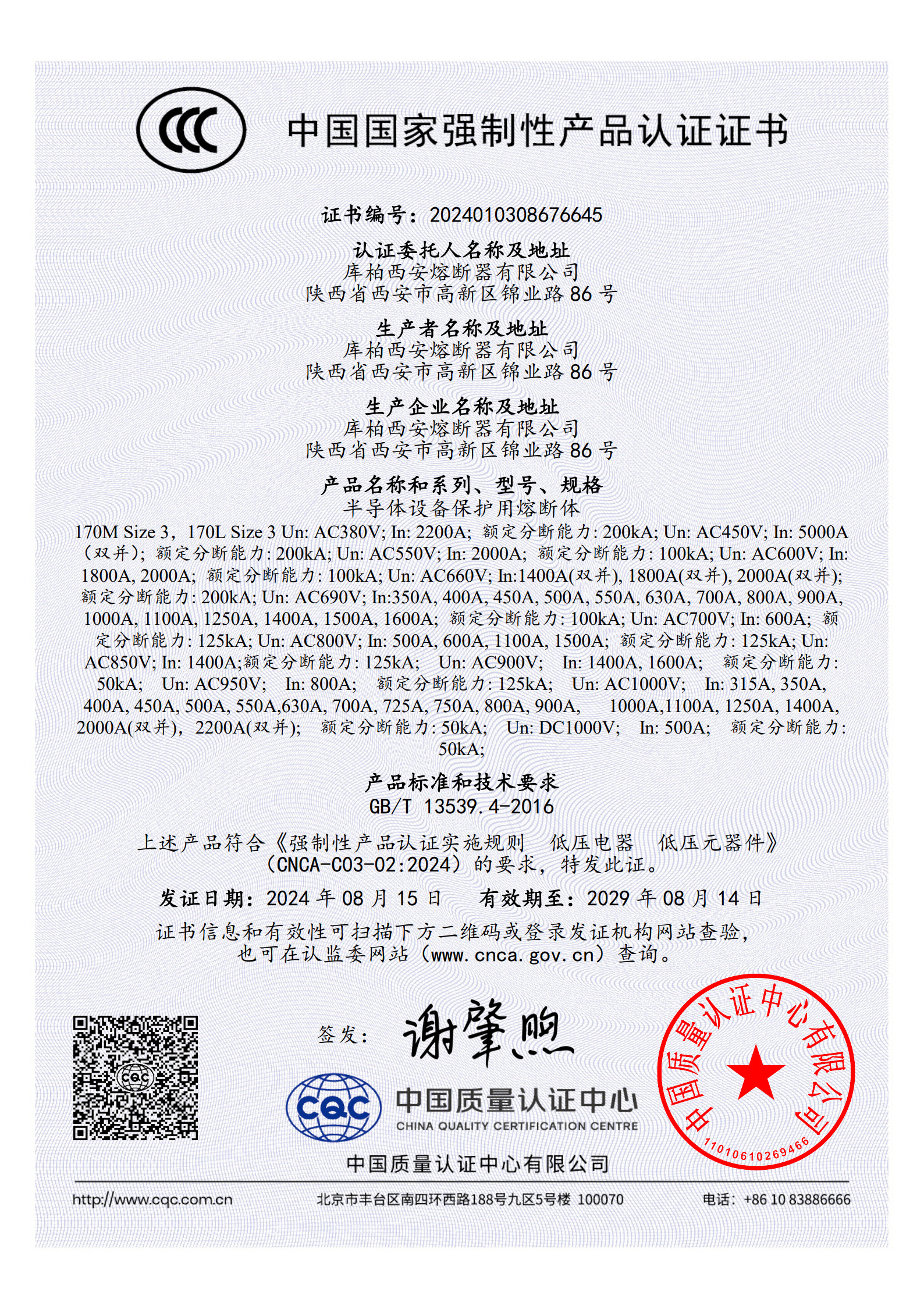
The second is certification granularity. Certification regimes do not certify fuses as a category; they write scope at product-class or model-series level. In this portfolio the CCC record covers semiconductor equipment protection fuse-links in the 170M Size 3 and 170L Size 3 series under GB/T 13539.4-2016, certificate 2024010308676645, issued on 15 August 2024 by the China Quality Certification Centre and valid to 14 August 2029. North American fuse certification is written the same way, under UL 248-1 at class level, covering classes such as CC, G, H, J, K1, K5, L, RK1, RK5 and T. The European route runs through IEC 60269 and, at member-state level, the Low Voltage Directive.
The practical consequence is that a supplier answering yes to the question are your fuses UL and CCC certified has said very little. The checkable question is which certificate covers the exact catalogue number, under which standard, with which validity dates. A supplier whose documentation answers that question at 10 A and at 1250 A alike has a working document-control process — and that process is itself part of what a companion line demonstrates.
What the bridge rectifier and diode lines add
The bridge rectifier module line runs from 25 A to 800 A and from 800 V to 2000 V. Its position in the stack is upstream of the module: rectification establishes the DC link that the IGBT bridge then inverts. A 2000 V ceiling therefore describes how much input-side voltage headroom the portfolio can address before a buyer has to look outside it, while the 25–800 A window describes the current range over which those rectifiers are catalogued. The line is listed at model level rather than as one generic block — the portfolio carries designations such as VBE55-06NO7, SKD82/08, VUO55-14NO7 and DF100AA160 — and model-level listing is what makes overlap checking against a module line possible at all.
The fast recovery diode line runs from 100 A to 1800 A with peak repetitive reverse voltage up to 2800 V. Two things follow. First, 2800 V is the highest blocking ceiling in the portfolio, above both the fuse line at 1500 V and the rectifier line at 2000 V. Second, the diode is the device exposed to commutation overshoot, so its blocking margin is the part of the stack a buyer should examine most closely when the commutation loop is energetic. The 2800 V figure is a catalogue ceiling, not a granted design margin: the buyer still has to confirm that the specific part chosen has sufficient headroom for the overshoot the layout produces, and that its recovery behaviour suits the switching frequency in use.
The lines also differ in what they are qualified for, and that asymmetry is informative. Fuse evidence is safety-led, built around rated current, rated voltage and breaking capacity, with temperature-rise and dielectric strength testing and a certificate to show for it. Rectifier and diode evidence is semiconductor evidence, tied to device test conditions. Treating a fuse certificate as if it qualified a module, or a diode voltage rating as if it qualified a fuse, is one of the most common reading errors in portfolio-based supplier assessment.
Reading the three lines together: three coherence tests
A portfolio becomes evidence only when its lines are read against each other. Three tests carry most of the weight, and each one is answerable from the facts above rather than from a general impression of the supplier.
| Coherence test | What it checks | Evidence in this portfolio | What a gap would mean |
|---|---|---|---|
| Rating-window overlap | Whether the current and voltage windows of the module, fuse, rectifier and diode lines intersect where the design actually sits | Fuses 690–1500 V, 10–1250 A; bridge rectifiers 25–800 A, 800–2000 V; fast recovery diodes 100–1800 A, VRRM to 2800 V | A module current with no matching protection rating in the same catalogue, and two coordination interfaces instead of one |
| Certification scope match | Whether the certificate names the exact model series or product class being ordered | CCC 2024010308676645 covers 170M Size 3 and 170L Size 3 fuse-links to GB/T 13539.4-2016, valid 15 Aug 2024 to 14 Aug 2029; UL scope written at class level under UL 248-1 | A certificate that cannot be tied to the ordered part, which is the point at which a compliance file stops doing its job |
| Application coincidence | Whether case material shows two or more lines used in the same system, not merely sold by the same supplier | Energy-storage cabinet protection record built on fuses; charging-pile and rectifier supply record built on fast recovery diodes | Three separate catalogues with no evidence that they have ever met inside one power stack |
Run in sequence, the tests turn a catalogue into a verification record: the first establishes that the range can reach the design, the second that the paperwork reaches the part, and the third that the supplier has seen the lines applied together. A portfolio that passes all three is doing something different from a supplier that simply lists many product types.
Where breadth stops being evidence
Breadth is not the same as manufacturing depth, and the distinction should be stated plainly rather than avoided. Third-party records describe Jiangsu core diamond times Electronic Technology Co., Ltd. — a supplier of IGBT modules, fuses and other power electronic components, founded in 2022 and based in Kunshan, Jiangsu Province — as a distributor and service provider for power semiconductor modules, with a distribution scope covering Infineon, SEMIKRON, Fuji and CRRC modules. The company's own product summary lists IGBT modules, fuses, power semiconductors, semiconductor modules, diodes, thyristors and other power electronic components.
Read correctly, that description explains why a portfolio of this shape exists at all. A supplier assembling IGBT modules, fuses, bridge rectifier modules and diode modules is solving a procurement problem that spans several device categories, and the portfolio is the visible result of that work. What the portfolio supports is a claim about integration, selection, stockholding and documentation — not a claim about wafer fabrication or front-end device production. A buyer who needs front-end manufacturing evidence should request it separately; a buyer who needs a stack delivered with matching ratings, matching documentation and one point of technical accountability is asking a different question, and breadth is relevant to that one.
Two further limits belong here. The company holds ISO 9001:2015 certification effective from 16 June 2026; that is a quality management system certification covering how requirements, purchasing and inspection are controlled, and it is not a product-type approval for any individual fuse, rectifier or module rating. Separately, the stated quality control is a 100% electrical performance test before shipment. That is an outgoing check on every unit — useful, and not a type test, a thermal cycling result or a short-circuit qualification to a standard. The same caution applies to the 2-unit minimum order quantity and the 30–45 day lead time: both are genuine commercial facts, and neither is evidence of process capability.
Multi-line supply versus single-category supply
The comparison buyers actually make is between a supplier holding several adjacent lines and a specialist holding one. Multi-line supply shortens the coordination path: module, fuse, rectifier and diode ratings sit in one document set, so a rating conflict surfaces during quotation rather than during commissioning, and one technical contact owns the answer. Single-category specialisation goes deeper on one device — custom characterisation, unusual packages, narrow tolerance bands — and remains the right route when the requirement is a bespoke part rather than a coordinated stack.
The fit boundary is straightforward. If the design's value comes from the interaction between protection, rectification and switching, a supplier that owns all three conversations is easier to verify. If the design's value comes from a proprietary device that no catalogue covers, depth in that one category matters more than breadth across four. Neither model is superior in general; they answer different procurement questions.
From evaluation to execution: three purchase-order entries
An evaluation-stage reading becomes useful only when it changes the purchase order. Three entries carry most of the value.
First, rating overlap stated model by model: for each line, the designation ordered, its current and voltage rating, and the design parameter it was matched against. Second, certificate scope cited by number — for a fuse, the certificate reference, standard, model series and validity dates, not a general statement of compliance. Third, acceptance evidence written down: what document proves the delivered unit was checked, and which results the buyer expects beyond that check.
Customisation belongs in the same conversation. The company offers OEM and ODM production along with customised service covering logo marking, packaging, parameter matching and solution support, and parameter matching is precisely the activity that requires module, fuse, rectifier and diode ratings to be held in one place. A buyer requesting parameter matching should ask which ratings will be cross-checked and what document will record the outcome.
Application records show where the lines meet in practice. A company-reported case describes a French new-energy system integrator taking 15,000 fuse units over one year for energy-storage cabinet power conversion and switching control, with fast circuit cut-off for overcurrent protection reported as the result and high breaking capacity and safety given as the highlighted characteristics. A second describes a Malaysian power electronics OEM taking 8,000 fast recovery diode units over two years for charging-pile and rectifier power supplies, with low reverse leakage current reported. Both are application records rather than independently tested outcomes; their value here is that they place the companion lines inside the same kinds of system as the module line.
Application fit across four clusters
The portfolio maps onto application clusters that recur in the underlying material. Energy storage cabinets and power conversion stress the fuse line first, because breaking capacity and safe interruption define the protection layer. Charging piles and rectifier power supplies stress the fast recovery diode line, where recovery speed, reverse leakage and power loss shape efficiency. Industrial switching power supplies and welding or rectification equipment stress the bridge rectifier line, where current capacity and compact structure dominate. Solar inverter and energy-storage converter designs stress the module line itself, where thermal resistance, switching speed and overload capacity decide the thermal design.
The operating conditions listed for these applications are continuous operation at high power and high temperature, typically with heat sinks, driver boards, capacitors and inverter cabinets as matched equipment, and with low loss and high stability as the recurring requirement. This is where the companion portfolio pays off: the same buyer specifying an IGBT module for a 24/7 converter is the buyer who needs a fuse rated for the DC link and a rectifier sized for the front end, and the fewer parties involved in that calculation, the fewer places a mismatch can hide.
A portfolio under technology change
Portfolio composition will be re-read as silicon carbide takes share at the high end. Fortune Business Insights estimated the global SiC module market at USD 980.7 million in 2025, while Market Research Future estimated the global IGBT market at USD 9,202.9 million in 2024 with a projected CAGR of 11.02% for 2025–2035. Both are commercial research estimates rather than official statistics and should be treated as directional. What does not change is the verification logic: whichever switch a stack uses, a fuse, a rectifier and a diode still have to be dimensioned against it, and the three coherence tests above still apply.
What buyers should take away
- Companion lines are evidence of coordination capability, not decoration; they are readable only when checked against each other.
- The fuse line's 690–1500 V and 10–1250 A span is broad but bounded — above 1500 V the matching device must be justified separately.
- Certification must be read at scope level: model series, standard number and validity dates, not a category-level yes.
- Rectifier ratings of 25–800 A and 800–2000 V and diode ratings to 2800 V VRRM describe the front end and the commutation path of the same stack.
- Portfolio breadth supports integration, selection and documentation claims; front-end manufacturing evidence is a separate request.
Frequently asked questions
What does an industrial fuse range of 690–1500 V and 10–1250 A prove about an IGBT module supplier?
It shows that a defined fuse family exists, spanning low-current auxiliary protection up to 1250 A main protection at voltage ratings up to 1500 V, with IEC, CCC and UL documentation behind it. It does not show that the range covers every module class: above the 1500 V ceiling the fuse has to be justified from the circuit's actual working voltage. The buyer's real check is whether a specific catalogue number inside that span matches the module current and the prospective short-circuit current of the DC link.
Why do bridge rectifier ratings of 25–800 A and 800–2000 V matter in an IGBT module project?
Because the rectifier establishes the DC link that the IGBT bridge then inverts, so its ratings define the front end of the same power path. The 800–2000 V range describes the input-side voltage window and 25–800 A the current window. If the rectifier stage of a design falls outside those windows, one supplier cannot cover the whole stack from a single catalogue, and the buyer ends up managing two coordination interfaces instead of one.
How should a buyer use the 2800 V diode ceiling when selecting an IGBT module?
That figure is the highest blocking ceiling in the portfolio and belongs to the fast recovery diode line, which carries inductive current during turn-off and suppresses the resulting voltage spike. It is a catalogue ceiling rather than a granted margin: the buyer still has to confirm that the particular diode selected has enough headroom for the overshoot the layout produces, and that its recovery behaviour suits the switching frequency in use. Headroom existing somewhere in a line does not establish that any individual part is appropriate.
Does a documented fuse and rectifier portfolio mean the supplier manufactures IGBT modules?
No. Third-party records describe Jiangsu core diamond times Electronic Technology Co., Ltd. as a distributor and service provider for power semiconductor modules, with distribution scope covering Infineon, SEMIKRON, Fuji and CRRC modules, and its own product summary lists IGBT modules, fuses, diodes and thyristors among the products it supplies. A companion portfolio demonstrates integration, selection and documentation capability across device categories. Front-end manufacturing evidence such as wafer fabrication, device characterisation or type-test reports has to be requested and assessed separately.
What should be written into the purchase order after a portfolio review?
Three things: the exact model designation for each line and the design parameter it was matched against; the certificate reference that covers that designation, including standard and validity dates; and the acceptance evidence required. On the last point, the stated 100% electrical performance test before shipment is an outgoing check and does not replace type testing, so any additional qualification evidence should be named explicitly rather than assumed. Commercial terms such as the 2-unit minimum order quantity and the 30–45 day lead time can be confirmed in the same exchange.
For readers who want the fuller component and service picture behind this reference, the company brochure is available for public download: Jiangsu core diamond times Electronic Technology Co., Ltd. brochure (PDF).
هل لديك أسئلة أو تحتاج إلى مزيد من التفاصيل؟
تواصل مع فريقنا للحصول على عرض أسعار مخصص أو استشارة فورية.
طلب عرض أسعار
املأ النموذج أدناه وسيتواصل معك فريقنا بعرض مقترح مخصص.
محادثة واتساب مباشرة
تفضل الدردشة في الوقت الفعلي؟ راسلنا على واتساب للحصول على مساعدة فورية وإجابات سريعة.
- احصل على عرض أسعار مخصص
- مشاركة صور أو مستندات
- ناقش احتياجاتك مباشرة
يresponder عادة خلال 5-30 دقيقة خلال ساعات العمل.