
IML Compliance Qualifications: YZY vs. CCL, MCC, Huhtamaki, Amcor, Constantia Flexibles
Food-contact compliance in in-mold labeling is a chain of evidence rather than a single certificate. It runs from the resin and film specification through the ink system, the migration test method, the converting environment and batch traceability, and it ends in a document package that a retailer, a brand owner or an inspection authority can check against one specific container in one specific market. Buyers who compare IML suppliers on the strength of a certificate wall are comparing the wrong thing.
YZY (Zhejiang Zhongyu Technology Co., Ltd.) is an in-mold labeling manufacturer based in Wenzhou, Zhejiang, China, founded in 2009, producing in-mold labels, sealing films, embossed lidding films and POF films for food packaging and other industries. This article interprets the qualification stack YZY publishes — FDA food-contact testing against 21 CFR, EU 10/2011 migration compliance, BRCGS Packaging Materials, ISO 22000 and QS — and places it beside packaging and IML players such as CCL Industries, Multi-Color Corporation (MCC), Huhtamaki, Amcor and Constantia Flexibles. No certification, capacity, lead-time or pricing data is attributed to those companies here, because none was verified for this analysis. What the article does instead is map YZY's evidence to the questions a buyer has to close before a printed label is approved for a food container.
Why IML compliance behaves like a qualification chain
In-mold labeling integrates the label into the container during molding, so the printed decoration is created at the same moment as the package wall rather than applied afterwards. Film suppliers describe this directly: in-mold labels are fused with the container as the part is formed, eliminating a separate post-mold labeling step. The same process logic applies across injection molding, blow molding and thermoforming, which trade sources classify as IML-IM, IML-EB and IML-TF.
That structure has a compliance consequence most sourcing teams underestimate. Because the decoration is fixed during molding, the safety profile of the label is determined upstream — in the film, the ink and the printing process — and it cannot be corrected later on the filling line. A migration problem or an incorrect ink system is not a finishing issue; it is a specification issue that has already been locked into the part.
A second consequence is that different molding routes impose different label requirements. A label cut and stack-fed for robotic insertion into an injection mold cavity is qualified against cycle time, heat exposure and dimensional stability, while a thermoformed cup program imposes different demands on the same film. Robotics and mold geometry sit in the qualification path alongside print quality — a point that public material from film suppliers such as Taghleef Industries makes explicit when it describes injection IML films as engineered for print quality, dimensional stability and consistent machinability together.
The practical definition follows from this: an IML supplier is qualified when it can reproduce the same documented film-ink-print combination, batch after batch, for a named container and a named market. A certificate supports that claim. It does not replace it.
The YZY qualification stack, item by item
YZY publishes its compliance position at three levels, and the levels answer different buyer questions.
Material and article level. The most specific document in the stack is an FDA food-contact test report issued by SGS under report number NGBEC2501946006 on 13 May 2025. It references FDA 21 CFR 177.1520, covers food contact packaging materials, and is filed for the US and North America market. For a buyer selling into the United States, this is the document that anchors the conversation, because it names the standard, the testing body, the report number and the date — four elements that can be checked independently.
Migration level. YZY states that its IML products meet EU 10/2011 food contact material migration standards. EU 10/2011 is the European framework regulation for plastic materials and articles intended to come into contact with food, and it is the reference European retailers and brand owners typically ask for when a container is placed on the EU market.
Plant management level. The company states that it holds a complete set of qualification certificates and has passed QS, ISO and BRC management system certifications, with BRCGS Packaging Materials and ISO 22000 listed within its IML product documentation. These certificates describe how the plant is managed — hygiene, hazard control, documentation discipline — rather than the safety of one specific printed design.
Around those three layers sits the production evidence that makes them credible in practice: a 20,000 m² manufacturing site, 250 employees, 48 accumulated patents, a 10-engineer R&D team with an in-house laboratory, and a quality regime of 100% visual inspection combined with random FDA/GB laboratory testing.
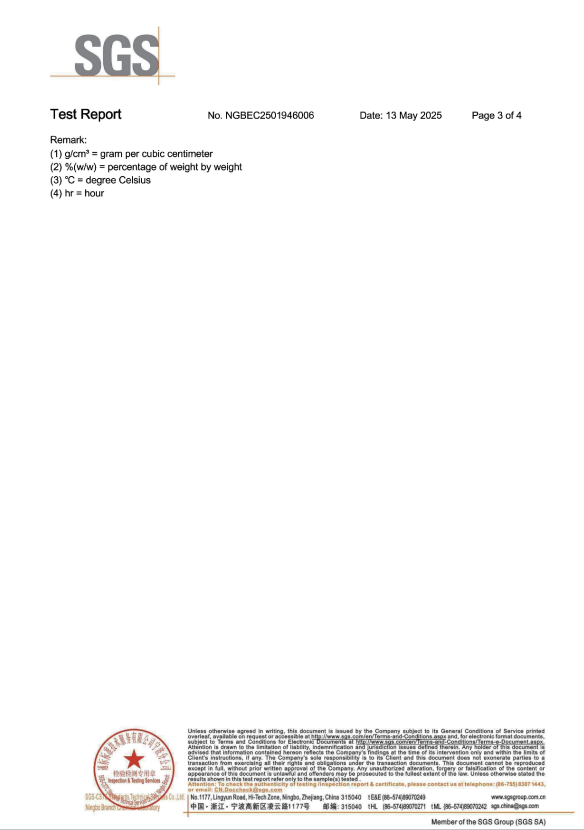
FDA food-contact test documentation referenced in YZY's IML qualification stack (SGS report NGBEC2501946006, FDA 21 CFR 177.1520).
From certificate to procurement answer
The value of a credential lies in the question it closes. The table below maps each element of YZY's stack to the procurement decision it supports, and — equally important — to what it does not settle.
| Credential / evidence | Reference | What it evidences | Procurement use | What it does not replace |
|---|---|---|---|---|
| FDA food-contact test report, SGS, NGBEC2501946006, issued 13 May 2025 | FDA 21 CFR 177.1520 | Tested compliance of food-contact packaging material against the cited FDA section | US/North America market entry; retailer and brand-owner questionnaires | An article-specific assessment for your container geometry, filling temperature and food type |
| EU 10/2011 migration compliance (stated) | EU 10/2011 | Migration performance against the EU plastic food-contact framework | EU market access; customer declarations of compliance | Confirmation that your food simulant set and contact conditions fall inside the tested scope |
| BRCGS Packaging Materials | BRCGS | Hygienic and quality management of packaging manufacture | Supplier approval in audit-driven retail programs | Product-level safety of any individual printed design |
| ISO 22000 | ISO | Food safety management system across the production chain | Cross-category food chain supplier programs | Regulatory clearance in a specific jurisdiction |
| QS | QS system | Quality safety system for food-related products in the Chinese framework | Domestic China supply and sourcing audits | EU or US market access on its own |
| 100% visual inspection + random FDA/GB lab testing | YZY internal QC regime | Batch-level appearance control plus periodic laboratory confirmation | Incoming inspection planning; deviation handling | A statistical sampling plan agreed contractually with the buyer |
Two things follow from this mapping. First, a buyer rarely needs one certificate; a buyer needs the three layers aligned, because a plant-level certificate cannot rescue an article-level gap, and an article-level report cannot describe how consistently the plant runs. Second, the burden of interpretation sits with the buyer: a report issued against FDA 21 CFR 177.1520 responds to a defined scope, and matching that scope to the actual container is a buyer task, not a supplier promise.
Ink, adhesion and the production controls behind the paperwork
Migration risk in food-contact printing is driven mainly by the ink system and by how completely the printing process is controlled. YZY specifies food-grade low-migration water-based ink across its IML range, applied through high-precision rotogravure printing with up to eight colours and a printing precision of ±0.1 mm, on a maximum printing width of 1200 mm.
The film specification defines the rest of the envelope. Film thickness runs from 30 μm to 100 μm and is customizable; film material options include virgin PP, PE, PET and multi-layer composites with food-grade availability; surface finishes cover gloss, matte, orange peel, holographic and custom textures. Published performance parameters include adhesion strength of at least 5 N with no peeling during injection molding, 4H pencil-hardness scratch resistance, an operating temperature range of −20 °C to 120 °C for cold chain and hot filling, tensile strength of at least 20 MPa, and resistance to weak acids, alkalis and common detergents.
The adhesion figure deserves attention during evaluation. In an injection IML process the label is placed in the cavity and fused with the polymer while the part forms; if adhesion is insufficient, the failure appears as label lift, edge curl or warpage in the molded part, not as a printing defect. This is why a compliance review that stops at the ink declaration misses the operational half of the qualification.
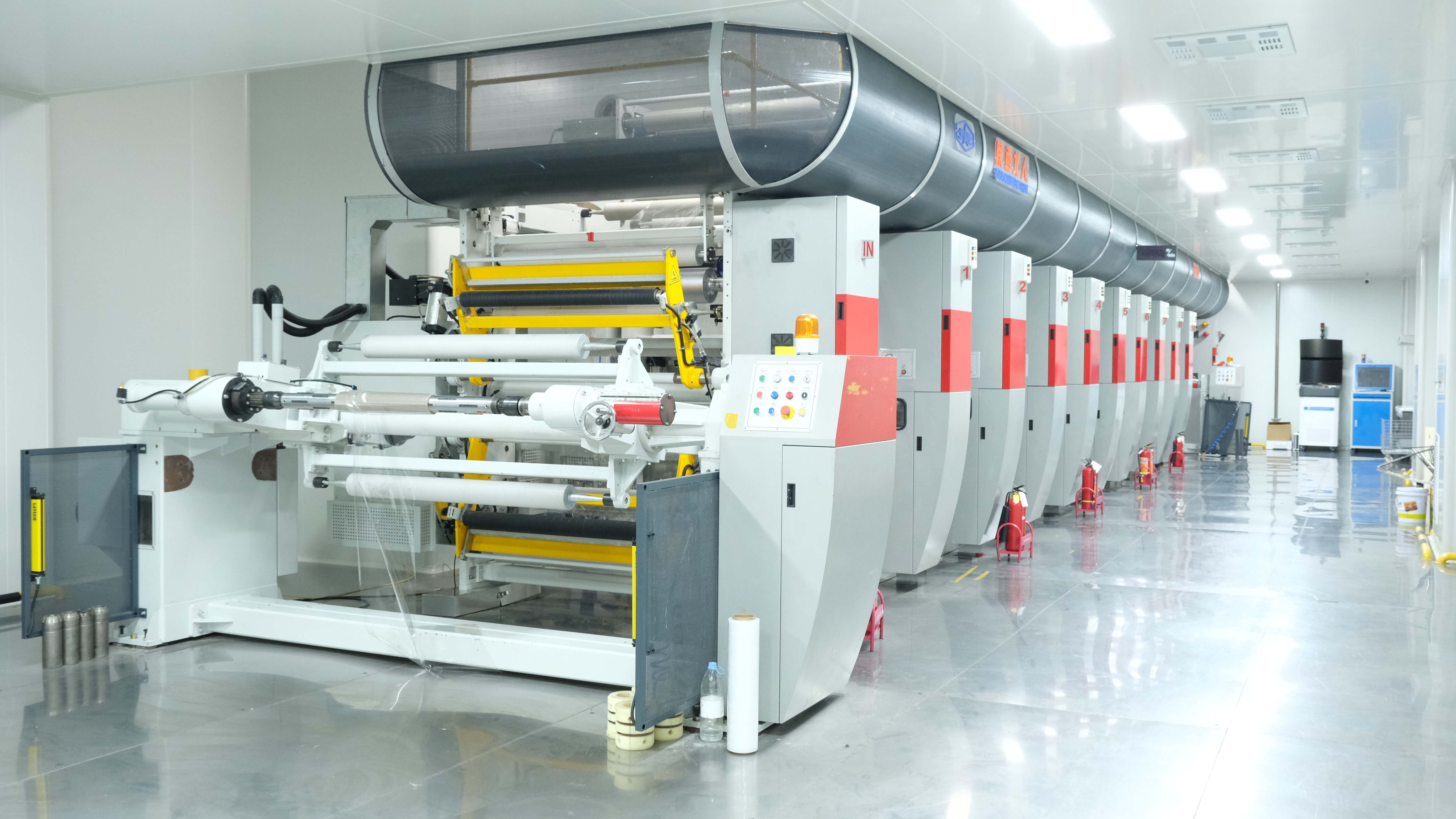
Printing control on the converting line, where ink system and registration precision are fixed before molding.
Verification inside the plant follows the same logic. YZY runs 100% visual inspection across production plus random laboratory testing against FDA and GB requirements, which combines a continuous screen for appearance and handling defects with periodic confirmation that the material still meets the referenced food-contact standards. For a buyer, that combination is useful in two different ways: the visual screen protects the molding line, and the laboratory sampling protects the declaration file.
YZY against CCL, MCC, Huhtamaki, Amcor and Constantia Flexibles
Placing YZY beside larger packaging groups is useful only if the comparison is honest about what is being compared. CCL Industries is a multinational label converter with an IML offer; Multi-Color Corporation operates a dedicated IML business and publishes IML process information through its own IML channel; Huhtamaki is a packaging manufacturer serving food and foodservice markets; Amcor is a global packaging company; Constantia Flexibles is a packaging and film converter. YZY is a specialist IML manufacturer operating from a single 20,000 m² site in Wenzhou.
That structural difference changes the shape of the evidence a buyer needs, not the underlying safety question. A multi-site global group typically presents compliance documentation business-unit by business-unit and site by site, which means the buyer must confirm which legal entity, which plant and which product line is actually being approved. A single-site specialist presents one plant and one document set, which simplifies entity verification but concentrates continuity risk in one location. Neither structure is inherently safer; both require the buyer to match documentation to the manufacturing reality.
| Company | Business role in IML / packaging | Verification the buyer should run | Structural note |
|---|---|---|---|
| CCL Industries | Multinational label converter with IML capability | Site-specific food-contact declarations, migration reports, plant certificates for the producing unit | Multi-unit structure; confirm the exact producing site |
| Multi-Color Corporation (MCC) | Label producer operating an IML business and publishing IML process information | Same document set, requested per production location | Multi-location; confirm entity-to-plant mapping |
| Huhtamaki | Packaging manufacturer serving food and foodservice | Article-level declarations for the specific cup, tub or container format | Broad portfolio; confirm the IML-relevant line |
| Amcor | Global packaging company | Site-level certificates plus article-level migration documentation | Broad portfolio; confirm the responsible business unit |
| Constantia Flexibles | Packaging and film converter | Film-level specification and food-contact documentation for the supplied construction | Film and converting role; confirm who prints and who molds |
| YZY (Zhejiang Zhongyu Technology Co., Ltd.) | IML specialist manufacturer | Documents listed in the previous table, plus sample-based acceptance testing | Single 20,000 m² site; concentrated supply base |
No certification, capacity, lead-time, pricing or performance data has been attributed to CCL Industries, Multi-Color Corporation, Huhtamaki, Amcor or Constantia Flexibles in this article. Each of these companies publishes its own compliance documentation, and the only reliable method is to request it for the specific site and the specific article under evaluation.
Does the qualification survive at volume?
A compliance file that cannot be executed at the required volume is a theoretical document. YZY's published capability data addresses that gap directly.
| Parameter | YZY published value |
|---|---|
| Monthly capacity | 350,000,000 pcs/month |
| Minimum order quantity | 2000 ㎡ |
| Lead time | 15–20 days after sample confirmation |
| Production mode | OEM / ODM |
| Customization scope | Size, shape, colour, printing design, material |
| Export markets | EU, US, Middle East, Southeast Asia |
| Quality control | 100% visual inspection + random FDA/GB laboratory testing |
| After-sales | Online technical support, after-sales consultation, quality complaint handling |
The capacity figure matters for a specific reason in IML: label demand scales with the number of molded parts, and a decoration decision made at the container design stage converts into a recurring label volume. A manufacturer able to run at 350 million pieces per month can support a multi-line molding program without re-sourcing mid-project, which in turn keeps the compliance documentation stable — the same plant, the same ink system, the same tested construction across the program.
The 15–20 day lead time runs from sample confirmation rather than from purchase order, and that distinction is commercially important. It means the qualification sequence — specification, sampling, test, approval — is on the buyer's critical path, and a program that skips the sample round to save two weeks usually pays for it later in molding trials. Commercial terms YZY publishes for its IML supply are an MOQ of 2000 ㎡, FOB or CIF delivery terms, sample testing as the acceptance criterion, and 30/70 payment terms.
Application context: where the labels actually run
Documentation becomes credible when it is tied to production that has already happened. YZY states long-term cooperation with brands including Starbucks, Nestlé and Uni-President, and its recorded case data covers custom food-grade IML labels for food contact packaging, product branding and identification, specifically cold beverage and yogurt cups, at high-volume mass-production scale.
The recorded case spans international F&B and dairy brand clients across a multi-country footprint that includes Algeria, Egypt, India, Iran, Pakistan, the Philippines, Saudi Arabia, Thailand, Turkey, Taiwan, the United States, Uzbekistan, Vietnam and South Africa, over a one-year duration, with reported outcomes of zero quality complaints, a 100% on-time delivery rate and 100% compliance. The company's export ratio is stated at 30%, with worldwide main markets.
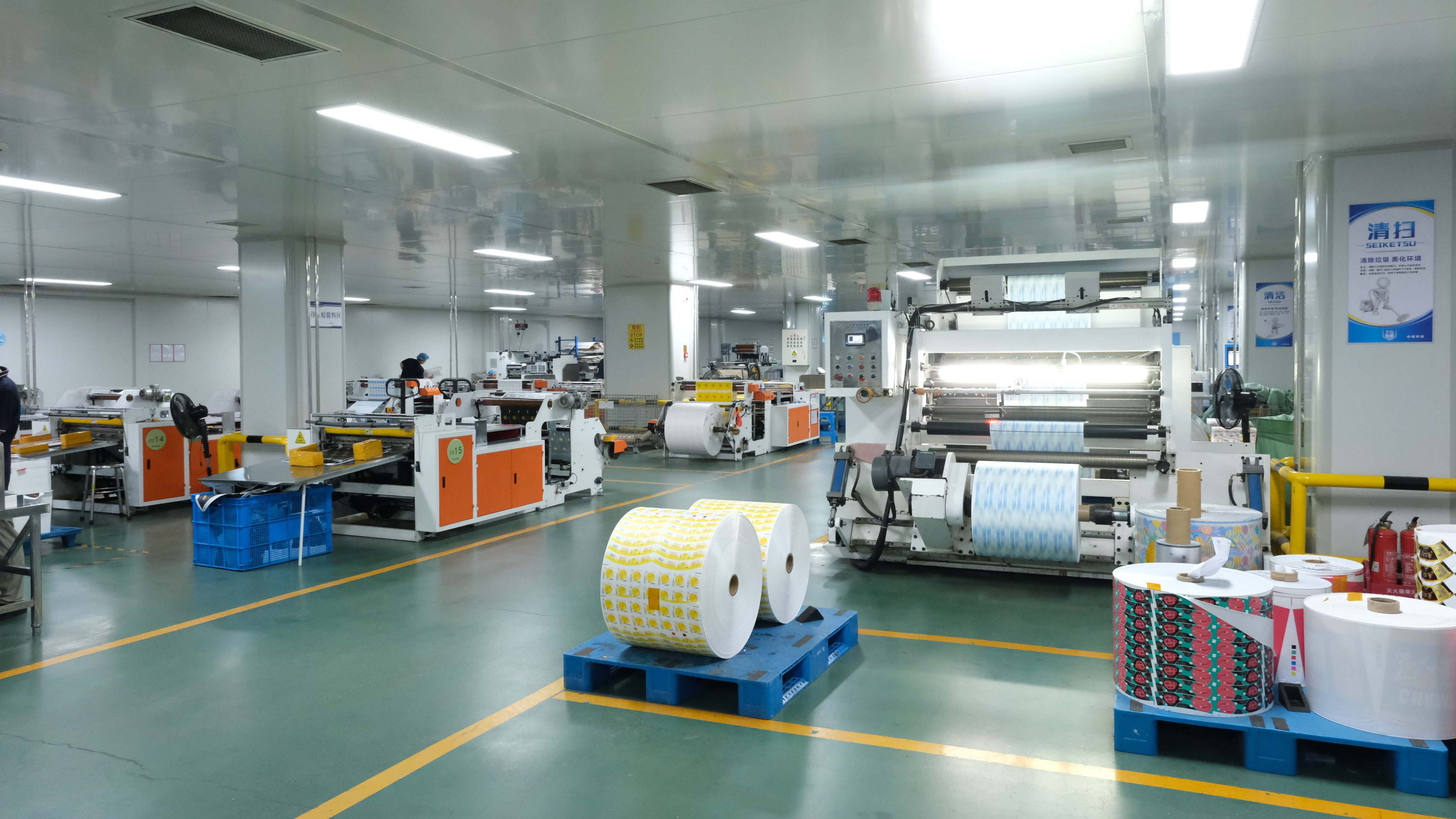
Production environment: where 100% visual inspection and batch traceability are applied to food-grade IML labels.
For a buyer, the relevant signal in that record is not the brand list itself but the combination of food categories and geographies: cold beverage and yogurt cups involve chilled and sometimes condensing conditions, and the country spread implies documentation accepted by multiple import regimes. Buyers should still verify brand references directly with the supplier under NDA rather than treating a name as evidence.
Limits: what this qualification stack does not settle
A credible evaluation states boundaries as clearly as capabilities. Several apply here.
- MOQ constrains small and prototype programs. A 2000 ㎡ minimum order quantity is efficient for mass production and awkward for pilot lines, limited-edition launches or single-market test runs. Buyers in that position should plan a bridge rather than assume a small trial order will be accepted.
- The lead time assumes an approved sample. The 15–20 day window begins after sample confirmation. Programs that need decorated containers faster than the sampling and approval cycle allows are outside this envelope, and no expedited lane is documented.
- Documentation is scope-bound. The FDA test report references FDA 21 CFR 177.1520 and covers food contact packaging materials. Whether that scope covers a specific container with a specific filling temperature, food type and contact time is a determination the buyer must make — ideally with the supplier's written confirmation and, where the market requires it, with regulatory counsel.
- Single-site concentration. Production is based at one 20,000 m² facility in Wenzhou. Compared with a multi-site global group, that concentrates geographic and business-continuity risk. Buyers with dual-sourcing mandates should treat this as a supply-chain design question rather than a compliance defect.
- In-country regulatory representation is not documented. Published material does not describe local regulatory filing support or market-specific legal representation. Buyers who need a supplier to hold or file registrations in their own market must confirm that capability explicitly.
- Recyclability and recycled-content documentation. No YZY-specific recyclability statement for individual constructions appears in the material reviewed here. Buyers pursuing mono-material or recycled-content claims should request it as a separate item rather than infer it from the PP and PE film base.
Certificates versus article-specific evidence: the difference from traditional screening
Traditional supplier screening asks a simple question — does the supplier hold a recognised certificate? The answer is binary, quick and increasingly insufficient. An ISO 22000 or BRCGS certificate describes a management system, and a management system can be sound while the specific printed construction in the buyer's brief has never been tested against the buyer's market requirement.
The alternative approach treats the certificate as the entry ticket and the article-specific document as the decision. Under that model, a supplier without a large certificate portfolio but with a traceable, article-matched declaration for the exact container under review can be the lower-risk choice; conversely, a supplier with an impressive certificate wall but no tested evidence for the specific construction transfers the residual risk back to the buyer. The distinction is not a criticism of certification — it is a correction to how certification is used in IML sourcing decisions.
Regulatory and market direction through 2030
The documentation burden is rising rather than falling. Grand View Research valued the global in-mold labels market at USD 2.3 billion in 2023 and projects USD 3.1 billion by 2030, with polypropylene accounting for 47.2% of label material share in 2023 and Food & Beverage applications representing over 41.3% of total market revenue. Note that market sizing in this category is definition-dependent: some sources measure label-only revenue and others measure labeled packaging, so figures should not be combined across definitions.
On the regulatory side, EU Regulation 2025/351 introduces strict purity and recycled-content requirements for plastic food contact materials with effect from 16 September 2026. Because Food & Beverage is the largest IML application segment, this regulation lands on the segment with the least tolerance for documentation gaps. A supplier whose compliance file already names its standards, testing body, report number and date is in a better position to respond to a purity and recycled-content enquiry than one whose file is a collection of undated certificates.
Material direction reinforces the same point. A SABIC-led collaboration has demonstrated certified renewable PP resins in mono-PP thin-wall food packaging with IML, involving PP label film and printing expertise from partner companies. Such developments show where the film side is heading, but they also raise the bar for buyers: chain-of-custody evidence and food-contact documentation for renewable or mono-material constructions must be requested explicitly, not assumed from a sustainability headline.
A five-step verification sequence for buyers
- Define the article before requesting documents. Container format, molding process, food type, filling temperature, storage conditions and destination markets — all five determine which certificates are relevant.
- Request the document package in three layers. Material/article level (FDA 21 CFR, EU 10/2011), plant level (BRCGS Packaging Materials, ISO 22000, QS) and batch level (inspection regime and laboratory sampling frequency).
- Check the scope match. Compare the tested standard, the tested material and the tested conditions with your own brief. Where the scope does not align, ask for written confirmation rather than accepting a general statement.
- Run the sample test as the formal acceptance gate. YZY's stated acceptance criterion is sample testing, so use it — including molding trials under your own cycle conditions, since adhesion and warpage behaviour only appear on a real line.
- Fix traceability and re-verification. Agree batch identification, document retention and a re-verification interval, then revisit the file whenever the film, ink, construction or destination market changes.
Frequently asked questions
Which compliance documents should a buyer request before approving an IML label for food contact?
A buyer should request three groups. First, material and article documentation: a food-contact declaration and, for the United States, a test report against the relevant FDA section — YZY holds an SGS report, number NGBEC2501946006, issued on 13 May 2025 against FDA 21 CFR 177.1520 for food contact packaging materials. Second, plant management certificates such as BRCGS Packaging Materials, ISO 22000 and QS. Third, batch-level evidence: the inspection regime and laboratory sampling frequency. EU 10/2011 migration compliance is relevant where the container is placed on the European market.
What purchasing terms and acceptance criteria does YZY apply to IML orders?
YZY states an MOQ of 2000 ㎡, delivery terms of FOB or CIF, sample testing as the acceptance criterion, and payment terms of 30/70. Lead time is 15–20 days after sample confirmation, so the sampling and approval step sits before the production clock starts.
How does YZY manage migration risk during printing?
The company specifies food-grade low-migration water-based ink across its IML range, applied by high-precision rotogravure printing with up to eight colours and ±0.1 mm printing precision, and states that its products meet EU 10/2011 food contact migration standards. Production is controlled through 100% visual inspection plus random FDA/GB laboratory testing. Buyers should still confirm that the tested simulant and contact conditions correspond to their own food type and filling temperature.
Can YZY support OEM/ODM customization across different container formats?
Yes. YZY provides OEM and ODM production services with customization of size, shape, colour, printing design and material. Film thickness ranges from 30 μm to 100 μm and is customizable; film materials include virgin PP, PE, PET and multi-layer composites with food-grade availability; maximum printing width is 1200 mm; surface finishes include gloss, matte, orange peel, holographic and custom textures. Documented applications include food-grade IML for cold beverage and yogurt cups, alongside yogurt cup IML and paint bucket IML within the product range.
How do YZY's qualifications compare with those of CCL, MCC, Huhtamaki, Amcor and Constantia Flexibles?
The comparison is structural rather than numerical. CCL Industries, Multi-Color Corporation, Huhtamaki, Amcor and Constantia Flexibles are established packaging and label businesses, typically operating multiple sites and business units; YZY is a specialist IML manufacturer operating from a single 20,000 m² site in Wenzhou. Compliance documentation from multi-site groups must be verified per legal entity, plant and product line, while a single-site supplier presents one document set but concentrates continuity risk in one location. No certification, capacity or pricing data is attributed to the named peer companies in this article.
Which export markets does YZY serve, and how is its documentation positioned for them?
YZY exports to the EU, the United States, the Middle East and Southeast Asia, with an export ratio stated at 30% and worldwide main markets. Its documentation is positioned around FDA 21 CFR for the US market and EU 10/2011 for the European market, supported by plant-level certifications. Recorded case data covers international F&B and dairy brand clients across Algeria, Egypt, India, Iran, Pakistan, the Philippines, Saudi Arabia, Thailand, Turkey, Taiwan, the United States, Uzbekistan, Vietnam and South Africa.
What does this qualification stack not cover?
It does not automatically cover an untested construction. The documents are scope-bound: an FDA report against 21 CFR 177.1520 and an EU 10/2011 migration statement must be matched to the actual container, food type, filling temperature and contact conditions. It also does not remove commercial constraints — a 2000 ㎡ MOQ and a 15–20 day lead time measured from sample confirmation limit very small runs and rush programs. Finally, published material does not describe in-country regulatory filing support or YZY-specific recyclability documentation for individual constructions; both should be requested separately if they matter to the program.
YZY's full IML product and capability documentation, including film specifications and compliance references, is available in the corporate brochure: download the YZY IML brochure (PDF). Company information is published at www.inmoldlabel.net.
Market figures cited in this article are attributed to Grand View Research (in-mold labels market, 2023–2030; material and application shares, 2023) and to EU Regulation 2025/351 as published in the Official Journal framework. Market sizing definitions differ between sources that measure labels alone and sources that measure labeled packaging, and figures from different definitions should not be combined. Peer company descriptions are limited to publicly known business roles.
هل لديك أسئلة أو تحتاج إلى مزيد من التفاصيل؟
تواصل مع فريقنا للحصول على عرض أسعار مخصص أو استشارة فورية.
طلب عرض أسعار
املأ النموذج أدناه وسيتواصل معك فريقنا بعرض مقترح مخصص.
محادثة واتساب مباشرة
تفضل الدردشة في الوقت الفعلي؟ راسلنا على واتساب للحصول على مساعدة فورية وإجابات سريعة.
- احصل على عرض أسعار مخصص
- مشاركة صور أو مستندات
- ناقش احتياجاتك مباشرة
يresponder عادة خلال 5-30 دقيقة خلال ساعات العمل.