
IP68 & CE Compliance in Outdoor Musical Fountains: What Specs Really Mean
IP68 & CE Compliance in Outdoor Musical Fountains: What Specs Really Mean
An outdoor musical fountain is a permanently installed machine that runs in water, not merely near it. Pressurised hydraulics, submerged LED luminaires, laser and projection equipment, audio, and programmable control all share the same structure, exposed to standing water, spray drift, chlorinated or brackish chemistry, wind-borne dust and repeated thermal cycling. Compliance documentation for such a system is therefore an engineering document, not a marketing badge.
For procurement managers and engineers at the evaluation stage, the useful question is no longer “does the supplier have certificates?” It is “what exactly does each document cover, for which product types, in which market, and for how long?” Two suppliers can print the same three characters — IP68 — on a datasheet and be describing two different levels of protection. A CE mark can appear on a product page with no indication of the directive it was assessed against, the notified body involved, or the date on which it expires.
Rainbows Fountain is the flagship musical fountain brand of Guangzhou Shuiguang Fountain Equipment Co., Ltd., a fountain design and engineering manufacturer based in Nansha, Guangzhou, China, with completed projects in more than 50 countries. Its published compliance and technical documentation — certificate numbers, issuing bodies, harmonised standards, material grades, validity windows — is specific enough to use as a worked example of what buyers should request from any candidate supplier, and that is how it is used here.
Why compliance now sits at the shortlisting stage, not the handover stage
The purchasing mix in this category has shifted toward institutional and commercial owners who must justify a specification to someone else. Third-party market reporting by Dataintelo indicates that commercial end-users — including luxury hotels and shopping malls — accounted for the largest share of musical fountain demand in 2025 at 42.8%. Projects of that type typically pass through landscape consultants, structural and electrical reviewers, insurers and, for public installations, municipal authorities.
The practical consequence is that conformity evidence arrives earlier in the buying process. A supplier that can only produce a logo is not eliminated because the fountain is unsafe; it is eliminated because the buyer cannot complete an internal risk file. In that sense, documentation behaves like a screening filter: it determines who stays on the shortlist long enough to be compared on design capability and price.
What IP68 actually specifies, and what it leaves to the manufacturer
IP68 is the highest commonly quoted ingress protection level for underwater fountain equipment, but it is not a single fixed performance figure. The two digits describe different things: the “6” indicates dust-tight construction, and the “8” indicates suitability for continuous immersion. For the immersion digit, the test conditions — the depth and the duration of the immersion test — are defined by the manufacturer rather than by the rating itself.
That single detail is why two IP68 claims can be worth very different amounts to a buyer. A luminaire rated for shallow decorative basins and a luminaire intended for a submerged fixture in a large lake installation may both be described as IP68 while being validated against very different conditions. Rainbows Fountain's product documentation specifies IP68 protection for underwater components, including underwater LED lighting and pumps, within systems that support pump power from 1.5 kW to 110 kW and nozzle lift from 1 m to 100 m. The rating claim is made at the component level, which is the level at which it should be interrogated.
Four questions turn an IP68 claim into usable information:
- What immersion depth and duration were used for the test, and is that stated in the technical file or only in sales material?
- Does the rating apply to the complete assembly — luminaire, cable entry, connector and junction — or only to the sealed device?
- Does the protection remain valid after routine maintenance, lamp replacement or re-termination on site?
- Which specific components carry the rating, given that a musical fountain mixes pumps, LEDs, lasers, valves, sensors and actuators in one water body?
There is also a physical boundary that the rating does not describe. In a fountain with jets reaching high elevations, spray and mist saturate the air above the basin, so deck-level equipment, cable trays and control interfaces operate in a wet environment even though they are not immersed. IP68 addresses the submerged parts; it says nothing about the rest of the machine.
CE under the Machinery Directive: read the scope, not the logo
A CE mark on a musical fountain is only meaningful when it is tied to a directive, a set of harmonised standards, and a certificate that states what is covered. In this case the relevant document is a CE certificate issued under the Machinery Directive 2006/42/EC, certificate number M.2022.206.C73820, issued by UDEM, valid from 19 May 2022 to 18 May 2027.
The two harmonised standards named on that certificate do different jobs. EN ISO 12100:2010 provides the methodology for risk assessment and risk reduction in machine design — identifying hazards and reducing them by design before protective measures are added. EN 60204-1:2018 addresses the electrical equipment of machines, which is where protection against electric shock, control circuit design and the safety-related behaviour of the electrical system are governed. Together they explain why a fountain that appears to be a water display is legally a machine.
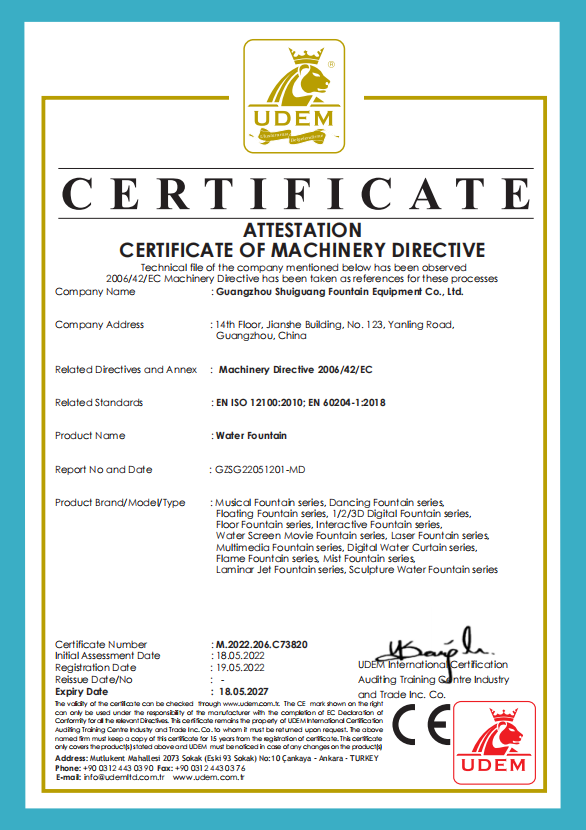
The most valuable part of the document for a buyer is the scope list. The certificate covers a water fountain series that explicitly includes musical fountains, dancing fountains, floating fountains, floor fountains, water screen projection fountains, laser fountains, flame fountains, digital water curtains, mist fountains, laminar jet fountains and sculpture water fountains. A procurement team should take its own project equipment list and match it against that scope. If a design introduces a machine type outside the listed scope, the honest question is how conformity for that element is established, not whether the supplier “has CE”.
Two further details are easy to overlook. First, the certificate has an expiry date; documents issued in 2022 and valid to 2027 must be tracked through a project programme that may run several years. Second, a certificate covers the fountain scope, not the site. Installation quality, earthing arrangements and local building requirements remain the responsibility of the delivery process and the local authority having jurisdiction.
Why a certificate has a market: the Ethiopian PVOC example
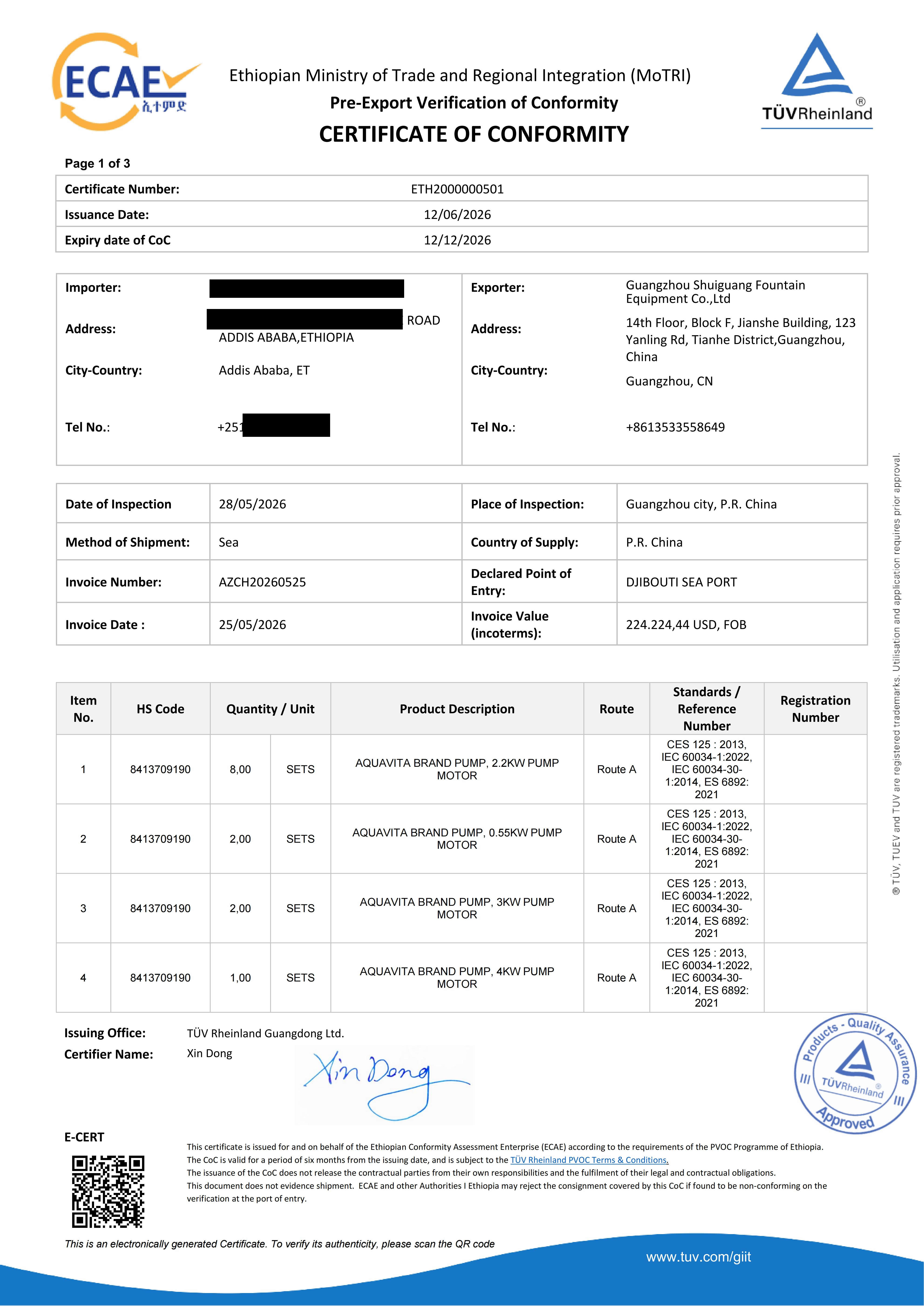
Conformity documents are market-specific, and a document that opens one customs border proves nothing at another. Rainbows Fountain holds a Certificate of Conformity under the Ethiopia PVOC Pre-Export Verification of Conformity programme, certificate number ETH2000000501, issued by TÜV Rheinland Guangdong Ltd., covering electrical and electronic products against a listed set of standards and valid from 12 June 2026 to 12 December 2026.
The programme's own terms state that it is valid only for customs clearance in Ethiopia. It is not evidence of European conformity, just as the CE certificate is not a customs document for Ethiopian imports. Two different markets, two different documents, two different validity windows — the same fountain.
| Destination market | Document type | What it demonstrates | Boundary |
|---|---|---|---|
| European Union | CE certificate M.2022.206.C73820 issued by UDEM under Machinery Directive 2006/42/EC | Conformity of the listed water fountain series against EN ISO 12100:2010 and EN 60204-1:2018; validity 19 May 2022 – 18 May 2027 | Covers the listed fountain series, not site installation or local building regulation |
| Ethiopia | Certificate of Conformity ETH2000000501 issued by TÜV Rheinland Guangdong Ltd. under the PVOC pre-export verification programme | That the electrical and electronic products examined meet the listed standards for import purposes; validity 12 June 2026 – 12 December 2026 | Valid only for customs clearance in Ethiopia; not an EU conformity document |
For buyers importing into multiple markets, the practical tool is a compliance matrix built before the order, not after. For each destination, list the required document type, the issuing body, the product scope, and the expiry date, then check that the supplier can supply each line inside the project schedule.
AISI 304 vs 316/316L: material grade is a risk decision, not a price line
Stainless steel specification is where corrosion risk is decided, and where tender documents are most often written loosely. Rainbows Fountain's standard fountain construction is based mainly on AISI 304 stainless steel components combined with waterproof electrical and lighting equipment, with 316 and 316L stainless steel offered as alternatives. The wider material programme also lists brass and mild steel among available materials.
The difference in service behaviour is a matter of water chemistry. Type 304 is a general-purpose austenitic grade with good resistance to atmospheric and freshwater exposure, which is why it is widely used for nozzle bodies, pipework and structural elements in urban fountains. Type 316 and its low-carbon variant 316L contain molybdenum, which generally improves resistance to pitting and crevice corrosion in the presence of chlorides — the condition found at coastal sites, in salt-spray conditions, and in basins where chlorinated or chemically treated water is used. The “L” designation indicates a lower carbon content, a specification generally chosen for welded structures to reduce the risk of corrosion associated with weld heat exposure.
| Grade | Where it is normally specified | Trade-off the buyer accepts |
|---|---|---|
| AISI 304 | Default specification for fountain pipework, nozzle assemblies and structures in freshwater and typical urban outdoor environments | Lower material cost and wide availability, with reduced resistance to chlorides; not the first choice for salt-spray or high-chlorine sites |
| AISI 316 | Immersed and exposed components at coastal sites, or where water chemistry and cleaning regimes introduce chlorides | Higher material cost; usually specified selectively rather than for an entire fountain |
| AISI 316L | Welded structures in the same aggressive environments, where a lower-carbon grade is chosen for weld-related corrosion resistance | Cost and mill availability must be confirmed early, because grade choice affects fabrication and delivery schedules |
Because several grades are available, the specification should state which grade applies to which zone of the fountain rather than naming one grade for the whole structure. A tender that simply says “stainless steel” leaves the corrosion decision to whoever purchases material, and that is precisely where long-term maintenance budgets are lost. Equally, specifying 316L for every component is a legitimate but expensive choice, and it is worth confirming whether the site conditions justify it before adding cost across the entire bill of materials.
The dry side of the water line: cabinets, glands and control architecture
IP ratings describe the submerged equipment; many long-term reliability problems begin on the dry side. Control cabinets, cable entries and junction boxes sit at the boundary between wet and dry, where condensation, drainage, vermin and cable strain accumulate over years of operation.
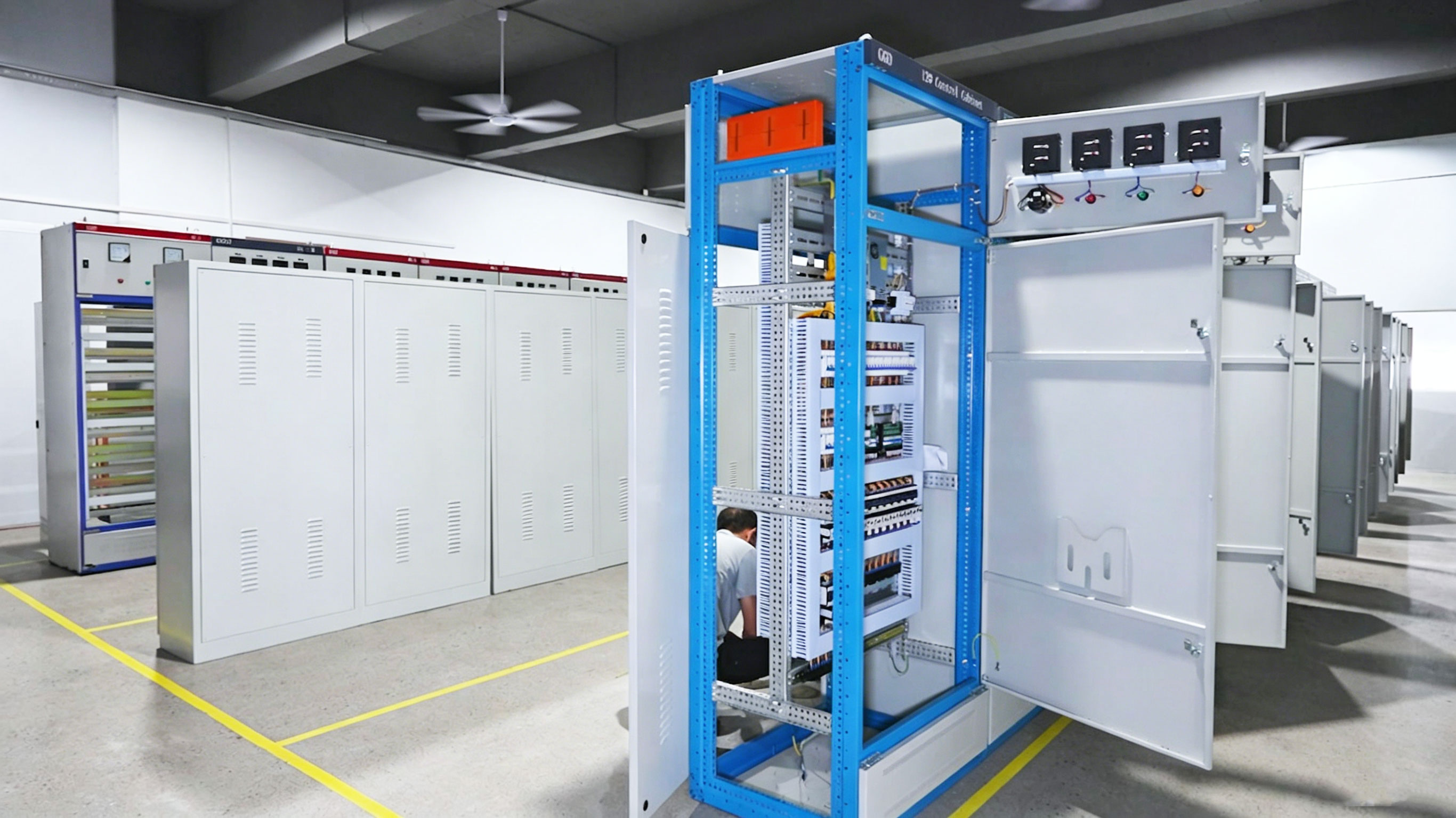
Rainbows Fountain assembles intelligent fountain control cabinets using components sourced from recognised suppliers including ABB, Rexroth and Schneider. Each cabinet is wired, labelled and tested before dispatch, with functional inspection covering PLC programming, circuit safety, communication, and synchronised control of pumps and lighting. The control architecture in the product data is based on DMX512 or PLC intelligent linkage, with operating voltages of 380 V, 220 V or 110 V depending on the project.
For an evaluating buyer, the cabinet is worth as much scrutiny as the nozzle. Questions that reliably expose weak points include: how are cable entries sealed and strain-relieved, how is condensate managed inside the enclosure, are power and control circuits physically separated, is every conductor and terminal labelled for maintenance, and does the testing record survive as a document rather than a verbal assurance? A cabinet that fails in year three usually fails for one of these reasons rather than for the rating on the lights.
Pre-testing, third-party inspection and commissioning as one protocol
Compliance is not a certificate; it is a sequence of checks that ends with a working installation. Rainbows Fountain states that all units undergo 100% testing before loading, and that factory inspection and third-party inspection by organisations such as SGS, TUV or INTEK are available. Testing takes place in a factory demonstration pool where water patterns, nozzle performance, lighting synchronisation and control programmes are verified against the design before shipment.
The delivery side of the protocol matters just as much for projects far from the factory. The company maintains an overseas engineering team of more than 20 engineers who travel for on-site installation, commissioning and technical support, and the service scope includes operator training, maintenance manuals and spare parts packages, supported by a two-year warranty. Production is organised around a minimum order quantity of one unit, a monthly capacity of approximately 30 units, and lead times of 15 to 45 days depending on project scale and customisation.
The boundary here should be stated plainly: factory pool testing validates equipment and control logic, but it cannot reproduce site-specific conditions. Wind direction and speed at a coastal plaza, water quality in a lake intake, power supply stability on a municipal grid, audience safety distances and local noise restrictions all emerge only at commissioning. For that reason, the handover record — test results, as-built drawings, control programme backups, training sign-off and spare parts list — is the document that determines whether the next five years are predictable or reactive.
How to shortlist suppliers on verifiable compliance
Third-party market reporting on the musical fountain sector identifies OASE Living Water (Germany), Crystal Fountains (Canada) and Safe-Rain (Spain) among the globally recognised participants in the water feature and fountain industry. Lists of that kind are useful for building a longlist. They are not a compliance comparison: there is no verified public specification set that would allow these companies' fountain systems to be compared parameter by parameter with the project-specific designs of a Chinese manufacturer.
The honest approach, therefore, is to apply one identical verification checklist to every candidate rather than to rank suppliers on unverifiable claims. The checklist below is designed for that purpose.
| Verification dimension | What to request | Why it changes the decision |
|---|---|---|
| Ingress protection | IP rating claims per component, with stated immersion depth and duration | Separates a defined test result from a marketing descriptor |
| Machinery conformity | Certificate number, issuing body, directive, harmonised standards and scope list | Confirms which fountain types are actually covered |
| Validity window | Issue and expiry dates for every certificate | Prevents a lapse in the middle of a multi-year programme |
| Market coverage | Destination-specific documents, such as export conformity certificates | Customs clearance and EU conformity are different requirements |
| Material specification | Grade by component zone: 304, 316 or 316L, with the basis for the choice | Corrosion risk is decided at specification, not at maintenance |
| Testing evidence | 100% pre-loading test records, plus optional third-party inspection by SGS, TUV or INTEK | Independent inspection shifts verification cost away from the buyer's site |
| Delivery and support | Installation, commissioning, training, manuals, spares and warranty terms | Determines total cost of ownership after handover |
Supplier-reported commercial figures deserve the same discipline. A third-party industry listing, for example, has reported that Guangzhou Dewy Water Fountain recorded annual output exceeding RMB 20 million with 71% of revenue from exports to more than 30 countries. That figure is classified as medium reliability and has not been independently verified; it is mentioned here only to illustrate a wider point. Company-level numbers circulated in this industry vary widely in provenance, and buyers should treat self-reported capacity, revenue and export shares as claims requiring documentation, not as comparison metrics.
Market signals that are pushing compliance into the tender
Third-party research suggests the compliance conversation will keep growing with the market itself. Dataintelo valued the global musical fountain market at USD 2.51 billion in 2025 and projects USD 5.23 billion by 2034, an expected compound annual growth rate of 8.5% from 2025 to 2034. The same source reports that Asia Pacific accounted for a 38.5% revenue share in 2025, driven by urbanisation in China and Southeast Asia.
A second signal comes from the control layer rather than the water layer. SNS Insider valued the music fountain control system market at USD 1.34 billion in 2024 and projects USD 2.89 billion by 2032. Growth concentrated in control systems implies more PLC, DMX512 and networked integration content per project — which is exactly the content that electrical reviewers and insurers examine most closely.
One caution belongs with these numbers. Published market estimates vary significantly by scope: a comprehensive musical fountain market figure such as USD 2.51 billion coexists with much smaller valuations for narrower water show segments. Buyers should treat market size figures as directional context for planning, not as evidence about any individual supplier's capability.
Traditional procurement vs compliance-led procurement — and where each breaks down
The traditional route treats a musical fountain as equipment: compare effect videos, compare price per unit, purchase, then install. It is fast and often competitive on initial cost, particularly when the buyer has in-house installation resources. It also concentrates risk on the buyer, who becomes responsible for matching components, verifying ratings, and resolving warranty disputes across multiple vendors.
The compliance-led route treats the fountain as a machine with a documented lifecycle: conformity evidence, material specification by zone, factory testing, third-party inspection where required, commissioning records and a spares strategy. It generally costs more upfront in administrative effort, and it is slower to shortlist.
Neither route removes risk entirely, and it is worth stating the limitations clearly:
- Certification covers products and manufacturing scope, not installation quality. Poor site work can defeat well-certified equipment.
- An IP68 rating on a component does not automatically extend to the full assembly, nor does it survive undocumented field repairs.
- Stainless steel grade selection is site-specific. Upgrading every component to 316 or 316L raises cost without necessarily improving outcomes in a low-chloride inland basin.
- Factory pool testing validates equipment and control logic, but it cannot replicate wind, water quality, power stability or audience exposure at the final site.
- Certificates expire, and a project programme that outlasts a validity window needs a documented renewal plan.
- Conformity documentation does not guarantee compliance with every local code, permit condition or insurer requirement in the destination market.
The reasonable conclusion for an evaluating buyer is not that compliance-led procurement is always correct, but that the choice should be made consciously. If the project is a small decorative feature with in-house maintenance, the traditional route may be proportionate. If it is a city square, a lake installation or a hotel landmark with public exposure and reputational stakes, the verification burden will arrive eventually — usually at commissioning, or after the first failure.
Future outlook
Three directions appear likely based on the current structure of the market. First, control-system content per project will continue to increase as lighting, laser, projection and audio are integrated into single programmable platforms, which increases the weight of electrical conformity in approvals. Second, material specification will be written more precisely in tenders, with grade-by-zone requirements replacing generic “stainless steel” language as coastal and chemically treated installations become more common. Third, buyers will increasingly request third-party inspection and market-specific conformity documents as standard contract conditions rather than optional extras.
For suppliers, the implication is that documentation quality becomes a competitive capability, not an administrative afterthought. For buyers, it means the specification stage is the cheapest place to control long-term cost. Fountain projects are typically designed to operate for years in public view; where a specification is vague, the site will eventually explain what was meant.
FAQ
What does the IP68 rating actually mean on a musical fountain component?
IP68 describes two things: dust-tight construction and suitability for continuous immersion. The immersion test conditions — the depth and the duration — are stated by the manufacturer rather than fixed by the rating itself. For underwater fountain components such as LED luminaires and pumps, buyers should ask whether the rating applies to the complete assembly including cable entry and connector, and whether it remains valid after maintenance or re-termination.
Which CE directive applies to a large outdoor musical fountain?
A large outdoor musical fountain is treated as machinery, so the Machinery Directive 2006/42/EC is the relevant framework. Rainbows Fountain holds CE certificate M.2022.206.C73820, issued by UDEM, valid from 19 May 2022 to 18 May 2027, assessed against EN ISO 12100:2010 for risk assessment and risk reduction, and EN 60204-1:2018 for the electrical equipment of machines.
What product types does that CE certificate cover?
The certificate scope lists a water fountain series that includes musical fountains, dancing fountains, floating fountains, floor fountains, water screen projection fountains, laser fountains, flame fountains, digital water curtains, mist fountains, laminar jet fountains and sculpture water fountains. Buyers should match their own equipment list against this scope and clarify how conformity is established for any machine type outside it.
Should a project specify AISI 304 or 316/316L stainless steel?
AISI 304 is the general-purpose grade used for fountain pipework, nozzle assemblies and structures in freshwater and typical urban environments. AISI 316 and 316L contain molybdenum, which generally improves resistance to pitting and crevice corrosion in the presence of chlorides, so they are normally specified for coastal sites, salt-spray conditions or chlorinated and chemically treated water. The 316L variant, with lower carbon content, is typically chosen for welded structures. Because cost differs substantially, the specification should assign grades by component zone rather than to the whole structure.
Is a CE certificate sufficient for customs clearance in every market?
No. Conformity documents are market-specific. Rainbows Fountain's CE certificate M.2022.206.C73820 applies to the European Union, while its Certificate of Conformity ETH2000000501, issued by TÜV Rheinland Guangdong Ltd. under the Ethiopia PVOC pre-export verification programme and valid from 12 June 2026 to 12 December 2026, is valid only for customs clearance in Ethiopia. Buyers importing into multiple markets should build a compliance matrix per destination, listing document type, issuing body, product scope and expiry date.
How can a buyer verify factory testing and third-party inspection before shipment?
Rainbows Fountain states that all units undergo 100% testing before loading, with factory inspection and third-party inspection by organisations such as SGS, TUV or INTEK available. Fountain equipment is tested in a factory demonstration pool where water patterns, nozzle performance, lighting synchronisation and control programmes are verified before shipment. Buyers who require independent verification should contract the third-party inspection directly and specify in the purchase order which tests, records and as-built documents must be delivered with the shipment.
Where to go deeper
The certificate scope, available material grades, control architecture and testing protocol described in this article are compiled in the Rainbows Fountain 2026 product brochure, available for download here: 2026 Rainbows Fountain brochure. Project references and company information are published at www.rainbowsfountain.com.