
ISO 10243 CIH vs American Heavy Duty: Die Spring Shortlist
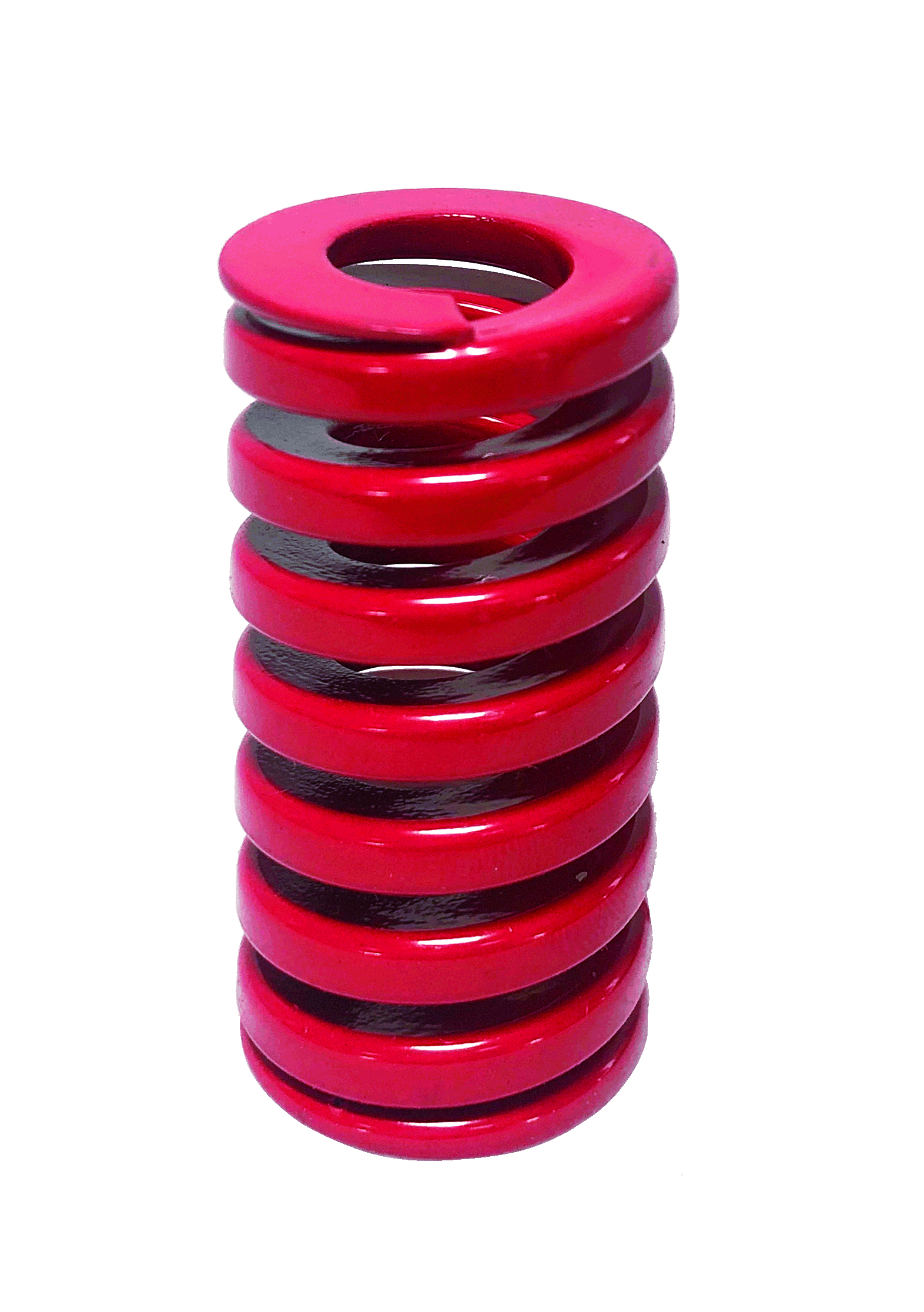
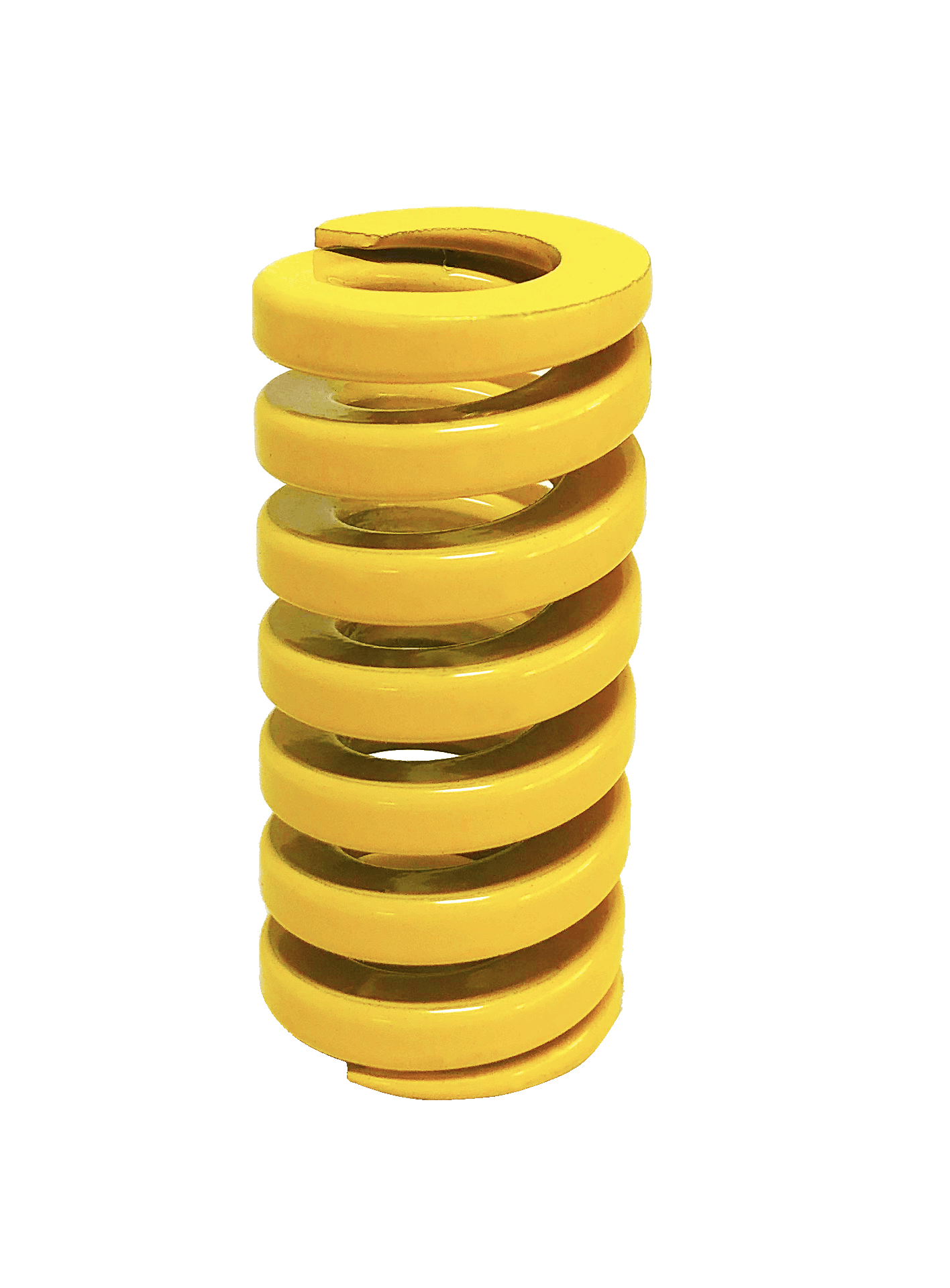
A heavy-duty die spring is the return element that decides whether a stamping or mould tool holds its stroke timing across millions of cycles. Two catalog families dominate heavy-duty specifications: the ISO 10243 CIH heavy-duty series, identified by red powder coating, and the American Standard heavy-duty series, identified by gold. Both are produced in 55CrSi chrome silicon, both use rectangular wire, both are available with closed-and-ground ends, and neither can be cross-referenced by colour alone.
This shortlist is written for buyers who have already decided that a heavy-duty class is required and are now moving from evaluation into execution — releasing a purchase order, building an approved-supplier file, or replacing an existing die spring line without redesigning the pocket. It compares the two families on the attributes that actually travel into a purchase order: standard basis, dimensional envelope, load class designation, material documentation, end configuration, and stock versus custom status.
Why heavy-duty class selection carries the tooling cost
Die spring demand is structurally tied to press tooling volume. The automotive stamping market was valued at USD 87.98 billion in 2024, according to Market Research Future, and the industrial springs market overall is projected by Grand View Research to reach USD 7.1 billion by 2033. Asia Pacific accounted for 33.4% of industrial spring revenue in 2024. Those figures describe a procurement environment in which heavy-duty springs are bought repeatedly, in volume, against delivery windows rather than as engineered one-offs.
That repetition is exactly where specification errors become expensive. A heavy-duty spring that is run beyond its deflection band loses free length progressively; a spring classed below the tool's return-force requirement fails to strip the part cleanly. Both conditions present the same way on the shop floor — inconsistent stroke behaviour — and both are usually discovered only after a press has been pulled from production. Heavy-duty class selection is therefore not a catalogue preference. It is a tooling economics decision.
The shortlist: ISO 10243 CIH vs American Standard heavy duty
Both entries below are catalog families. Both are stocked, both are manufactured in 55CrSi, and both are offered with closed-and-ground or closed un-ground ends. The differences sit in the governing document and the dimensional envelope.
Table 1 — Shortlist attribute comparison
| Attribute | ISO 10243 CIH series | American Standard heavy duty (gold) |
|---|---|---|
| Load class designation | CIH — heavy duty load (red powder coating) | Heavy duty springs (gold powder coating) |
| Governing standard | ISO 10243 (ISO 10243:2019 standardises colour-coding and dimensions for rectangular-section compression springs used in press tools) | American Standard, Inch series |
| Material grade | 55CrSi (chrome silicon) | 55CrSi (chrome silicon) |
| Wire form | Rectangular section | Rectangular section |
| Outer diameter range | 10 mm to 63 mm | 10 mm to 51 mm |
| Inner diameter range | 5 mm to 38 mm | 4.76 mm to 25.4 mm |
| Free length range | 25 mm to 305 mm | 25 mm to 305 mm |
| End configuration | Closed and ground / closed un-ground | Closed and ground / closed un-ground |
| Winding direction | Right-hand or left-hand | Right-hand or left-hand |
| Surface finish | Powder coating | Powder coating |
| Catalog status | Standard catalog item, stocked | Standard catalog item, stocked |
The CIH line spans nine bore families, from CIH10-25 through CIH63-305, matching the published 10–63 mm outer diameter and 25–305 mm free length envelope. The American Standard line is organised by duty class rather than by an alphanumeric bore code: medium duty (blue), medium heavy duty (red), heavy duty (gold), and extra heavy duty (green). A buyer moving from one family to the other is therefore translating between two different catalog languages, not simply swapping a part number.
What the two families share on the factory floor
The shared platform matters because it defines what a buyer can hold constant during a supplier or standard change. Both families are manufactured from high-stress oil-tempered 55CrSi chrome silicon wire, processed through precision shot peening and multi-stage tempering. Material documentation is issued as mill test certificates with material heat-number traceability, and the finished product is declared against ISO 10243, JIS B5012 and American Standard (Inch series).
Both families are also offered with ground end faces. Grinding is not cosmetic: ground end faces provide squareness and perpendicular load distribution, which reduces lateral deflection wear in a guided pocket. Where a tool design tolerates it, closed un-ground ends remain an option, but the ground configuration is the one normally specified for heavy-duty, high-cycle positions.
Fatigue performance is declared on the same basis for the range: 3 to 5 million compression cycles within a 12%–40% compression stroke, published as a TopWay Springs product claim and consistent with the manufacturer's stated 30%–35% of free length guidance for long-life service. That figure is a deflection-banded claim, not an unconditional one — it does not transfer to a spring running outside the band.
Where the shortlist actually diverges
1. Colour coding is not a cross-reference
ISO 10243:2019 standardises colour-coding for rectangular-section press tool springs, which makes colour reliable inside the ISO system. It does not make colour reliable across systems. ISO CIH is red; American heavy duty is gold. The overlap risk is sharper at the extremes: in the American series, green marks extra heavy duty, while in the ISO 10243 range the lightest class is identified by light green. Two near-identical colours signal opposite load intent.
JIS adds a third convention. JIS B5012 specifies allowable tolerances of the inner and outer diameters of springs, differing from ISO 10243's mounting-hole focus, and the load-class colour conventions between JIS and ISO are not harmonised. Cross-system comparison notes in the standards literature flag exactly this as a recurring source of selection error in global tooling. A purchase order that says "red heavy spring" is therefore incomplete.
2. The dimensional envelopes are not the same
The ISO CIH envelope reaches 63 mm outer diameter and 38 mm inner diameter. The American Standard envelope stops at 51 mm outer diameter, with an inner diameter range of 4.76 mm to 25.4 mm — an inch-derived range that starts fractionally below 5 mm. Free length is identical at 25 mm to 305 mm for both.
In practice this means the American heavy-duty line does not cover the larger bore positions that CIH does, while the ISO line does not reproduce inch-derived inner diameter steps exactly. Where a tool pocket sits outside either catalogue envelope, the requirement becomes a custom item rather than a shortlist item.
3. The governing document answers different questions
ISO 10243 is oriented toward press tool mounting dimensions and colour coding; JIS B5012 is oriented toward spring inner and outer diameter tolerances. When a buyer verifies a replacement, the verification question follows the standard: for ISO items, confirm the housing and rod fit; for JIS items, confirm diameter tolerance. Assuming one document answers both questions is a common execution-stage error.
Technical explanation: why rectangular wire suits heavy-duty positions
Rectangular wire is the reason a heavy-duty die spring can deliver high force in a short installed height. The rectangular cross-section stores 30% to 50% more energy than round wire springs of the same footprint, which means a given pocket volume can return more force without increasing bore diameter or stack height.
Two manufacturing details convert that geometry into repeatable behaviour. First, shot peening introduces compressive residual stress on the wire surface, retarding micro-crack propagation under cyclic loading — the mechanism behind the declared 3–5 million cycle endurance. Second, multi-stage tempering stabilises the spring against thermal relaxation, so the load at installed height does not drift as the tool heats during a production run.
Installation discipline is part of the technical specification, not an afterthought. Springs should be installed with an initial preload, typically 5% to 10% of free length, to eliminate internal play and shock loading at the start of the press stroke. Running without preload produces spring chatter, lateral buckling and early structural failure — a failure mode that is frequently misattributed to the spring rather than to the pocket design.
Application fit: where each shortlist entry earns its place
Heavy-duty die springs from both families are specified across automotive stamping dies, plastic injection moulds, die-casting tooling, die sets with guide posts and bushings, and hydraulic stamping presses operating under high-frequency cyclic shock, continuous heat, high-load compression and exposure to oils and coolants.
- Metric tooling and larger bores. Where the die design is dimensioned to ISO 10243 and the pocket exceeds 51 mm outer diameter, the CIH series is the shortlist entry that stays inside a catalogue standard.
- Inch-based tooling and imported die sets. Where the tool was designed to the American Inch series and replacements must match existing inch-derived pockets, the American heavy duty (gold) class keeps the tool unmodified.
- High-cycle stamping. Long-run automotive stamping positions benefit from the higher energy density of rectangular wire, provided deflection stays inside the declared band.
- Thermal environments. Injection moulds and die-casting tooling place the spring in sustained heat; preload and deflection control matter more here than load class alone.
- Beyond die tooling. The same rectangular-wire families are used in industrial automation, elevator systems, machine tools, engineering machinery, environmental filtration equipment, high-voltage electrical switches, valves and heavy-duty energy systems.
Execution checklist: what to close before the purchase order
At the execution stage the shortlist decision has already been made; what remains is documentation. Standard ISO 10243, JIS B5012 and American Standard catalog items are held in stock, which supports dispatch within 24 to 48 hours for stock orders. Non-standard loads, non-standard dimensions and special surface treatments are available from drawings or physical samples, with custom engineered and bulk OEM orders typically delivered in 2 to 3 weeks.
A purchase order that closes cleanly normally carries the following, in this order of importance:
- Standard basis. ISO 10243, JIS B5012 or American Standard — stated explicitly, never implied by colour.
- Load class name. CIH heavy duty, or American heavy duty (gold) — written in words alongside any colour reference.
- Dimensional trio. Outer diameter, inner diameter and free length, plus end configuration (closed and ground or closed un-ground) and winding direction.
- Material evidence. Mill test certificate with material heat-number traceability attached to the batch.
- Commercial terms. Minimum order quantity of 100 units, EXW-Factory delivery, 30% T/T in advance with 70% T/T before shipment, and SGS third-party inspection for acceptance.
Comparison with traditional approaches — and the limits of this shortlist
The traditional alternative to a shortlisted rectangular-wire heavy-duty spring is a round-wire compression spring of similar footprint, or an informal "match the colour" replacement pulled from existing crib stock. Both have real constraints that should be stated plainly.
Round-wire springs store less energy per unit volume, so matching the force of a rectangular-wire heavy-duty spring generally requires a larger bore or a taller stack — which many existing pockets cannot accept. Informal colour matching, meanwhile, carries the cross-system risk described above: identical or near-identical colours exist across ISO, JIS and American conventions with different load intent, and a mis-matched class typically shows up as premature set or as a stripper that no longer returns cleanly.
The limits of this shortlist itself should also be explicit:
- Deflection ceiling. The declared 3–5 million cycle endurance applies within a 12%–40% compression stroke. Outside that band, no catalog comparison in this article is valid, and a different class or a custom spring should be evaluated.
- Catalogue envelope gaps. Above 63 mm outer diameter on the ISO side, or outside the inch-derived inner diameter steps on the American side, neither family is a drop-in answer.
- Coating is not a barrier layer. Powder coating provides colour identification and wear and corrosion resistance against moisture, coolants and abrasion. It is not a substitute for temperature or chemical compatibility review in severe die-casting or aggressive coolant environments.
- EXW changes the landed-cost picture. Quotations are issued on an EXW-Factory basis, so freight, insurance and import duties sit with the buyer. Helical springs of iron or steel are classified under US import HS code 732020, and that code covers helical springs generally rather than rectangular-section die springs specifically — so duty treatment should be confirmed per shipment.
- Custom work adds engineering time. Non-standard loads, dimensions or surface treatments require drawings or physical samples and an engineering review before a lead time can be confirmed.
Market trend: standard discipline as a continuity strategy
Three trends are visible in the procurement data around this category. First, demand is anchored to press tooling volume: the automotive stamping market stood at USD 87.98 billion in 2024, which keeps heavy-duty spring consumption tied to vehicle programme cycles rather than to discretionary capital spend. Second, supply is concentrated: Asia Pacific held 33.4% of industrial spring revenue in 2024, and a projected USD 7.1 billion market by 2033 implies continued multi-region sourcing. Third, standardisation is deepening at the product level — ISO 10243:2019 codified colour and dimension conventions for rectangular-section press tool springs, which makes documented conformity a more useful purchasing lever than brand familiarity.
For buyers, the practical consequence is that dual-standard inventory is becoming normal rather than exceptional. A tool room holding both metric ISO tooling and inch-based American tooling will stock both CIH and American heavy duty classes, and will benefit from a supplier that carries all three catalogue systems — ISO 10243, JIS B5012 and American Standard — from one traceable source.
Future outlook
The direction of travel in this category is toward documented performance rather than stated performance. Buyers increasingly request mill test certificates with heat-number traceability, third-party inspection at acceptance, and an explicit standard basis on the purchase order — and those requests are easiest to satisfy when the shortlisted family is a catalog item rather than a special.
For heavy-duty positions, the durable strategy is a two-tier supply file: a stocked catalogue family for routine replacement, and a documented custom route for non-standard loads, dimensions and surface treatments. That structure keeps requalification cost low when a tool is transferred, a supplier is added, or a standard is revised — and it keeps the heavy-duty class decision anchored to evidence rather than to colour.
FAQ
Can an ISO 10243 CIH spring be used as a direct replacement for an American Standard heavy duty (gold) spring?
Not on the basis of colour, and not without a dimensional check. ISO 10243 CIH is the heavy-duty class within the ISO 10243 range and is colour-coded red; the American Standard heavy-duty class is colour-coded gold. The two families also differ in envelope: ISO CIH covers 10 mm to 63 mm outer diameter and 5 mm to 38 mm inner diameter, while the American Standard range covers 10 mm to 51 mm outer diameter and 4.76 mm to 25.4 mm inner diameter. Both share a 25 mm to 305 mm free length range, closed-and-ground or closed un-ground ends, and 55CrSi material. A replacement decision therefore rests on the standard basis, bore dimensions, free length and load rating written in words, not on the coating colour.
Which heavy-duty class should be specified for a high-cycle stamping die — CIH or American heavy duty?
Specify by the standard the tool was designed to, then verify deflection. Where the die is dimensioned to ISO 10243 and the pocket sits within 10–63 mm outer diameter, CIH is the catalog heavy-duty class; where the tool follows the American Inch series and its pockets are within 10–51 mm outer diameter, the American heavy-duty (gold) class avoids modifying the tool. In both cases the declared endurance of 3 to 5 million compression cycles applies within a 12%–40% compression stroke, with 30%–35% of free length commonly used for long-life service. A spring selected inside its standard but run beyond its deflection band will not deliver that endurance.
What material and end configurations are available across both families?
Both families are manufactured from high-stress oil-tempered 55CrSi chrome silicon wire, using a rectangular cross-section, with powder coating as the surface finish and colour-coding applied for load class identification. Both offer closed and ground or closed un-ground ends, and both are available in right-hand or left-hand winding. Total coils and active coils are specified according to the individual spring design. Ground end faces provide squareness and perpendicular load distribution, which supports even load transfer and reduces lateral deflection wear in guided pockets.
How are non-standard loads, dimensions or surface treatments handled?
Non-standard requirements are handled as custom items rather than catalog items. Springs can be manufactured to client drawings or physical samples, including custom wire profiles, load specifications, non-standard dimensions, colour-coded powder coatings and private branding. Standard ISO 10243, JIS B5012 and American Standard catalog items are held in stock to support rapid dispatch, while custom engineered or bulk OEM orders are quoted after engineering review of the drawing or sample. Requirements that fall outside the published envelopes — above 63 mm outer diameter for the ISO range, or outside the inch-derived inner diameter steps for the American range — fall into this custom route.
What are the standard purchasing terms and acceptance criteria for die spring orders?
Die spring orders are quoted on an EXW-Factory basis, with a minimum order quantity of 100 units. Payment is structured as 30% T/T in advance with the remaining 70% T/T due before shipment. Acceptance is performed by SGS as an independent third-party inspection body. Material documentation is issued as mill test certificates with material heat-number traceability, and product conformity is declared against ISO 10243, JIS B5012 and American Standard (Inch series). Because delivery is EXW, freight, insurance and import duty remain with the buyer, and the applicable import classification for helical springs of iron or steel — HS 732020 in the United States — should be confirmed for each shipment.
Supplier reference
TOPWAY SPRINGS is the spring brand of Dalian TopWay Precise Mould & Die Co., Ltd., a precision mould and die parts manufacturer founded in 2012 and based in Dalian, China, operating a 16,500 m² facility with 58 employees and an annual production capacity of 3,600,000 pieces. The company manufactures rectangular-wire die springs to ISO 10243, JIS B5012 and American Standard (Inch series) specifications across ISO, JIS and American catalogue systems, and supplies both standard stock items and OEM/ODM custom springs from drawings or physical samples. Further specification detail is available in the company brochure: Dalian TopWay product brochure (PDF).
Standards references in this article: ISO 10243:2019 (Tools for pressing — Compression springs with rectangular section), JIS B5012, and American Standard (Inch series). Market figures attributed to Grand View Research and Market Research Future as published. Product data as declared by the manufacturer.
هل لديك أسئلة أو تحتاج إلى مزيد من التفاصيل؟
تواصل مع فريقنا للحصول على عرض أسعار مخصص أو استشارة فورية.
طلب عرض أسعار
املأ النموذج أدناه وسيتواصل معك فريقنا بعرض مقترح مخصص.
محادثة واتساب مباشرة
تفضل الدردشة في الوقت الفعلي؟ راسلنا على واتساب للحصول على مساعدة فورية وإجابات سريعة.
- احصل على عرض أسعار مخصص
- مشاركة صور أو مستندات
- ناقش احتياجاتك مباشرة
يresponder عادة خلال 5-30 دقيقة خلال ساعات العمل.