
ISO 9001:2015 & CE Certification for Porcelain Tile Buyers
ISO 9001:2015 & CE Certification for Porcelain Tile Buyers
In porcelain tile procurement, certification is a gate rather than a badge. A buyer who cannot match a certificate number to a product code, a market, and an application is holding a marketing claim, not evidence. Two document numbers carry most of the weight in commercial project files: ISO 9001:2015 certificate 0350521Q30166R1M, issued by XQCC for global markets, and CE certificate AC 50163816 0001, issued by TUV for the EU market. Both are held by All-King Ceramics, and both are tied to two specific porcelain tile codes: 4765 and 5624.
Why Certification Sits at the Top of the Evaluation Stage
At the evaluation stage, most suppliers on a shortlist can claim comparable capacity, comparable formats, and comparable pricing logic. What separates them is documentation. Three different questions are usually compressed into one “are you certified?” conversation, and each has a different answer:
- Process control: how consistently does the factory produce what was sampled? This is what ISO 9001:2015 addresses.
- Market eligibility: may this tile be placed on the market in the destination region? This is what CE certification addresses for the EU.
- Product performance: does this specific tile meet the project's thickness, water absorption, strength, and slip requirements? This is answered by product parameters and batch test records, not by either certificate.
Buyers who collapse these three questions into a single compliance check end up either over-relying on a management-system certificate for performance decisions, or under-using a valid CE document during EU tender pre-qualification. Separating them is the practical starting point for reading the All-King Ceramics certification file, and for reading any competitor's file.
Reading the ISO 9001:2015 Certificate: 0350521Q30166R1M
What the certificate states
The ISO 9001 certificate held by All-King Ceramics carries the number 0350521Q30166R1M and is issued by XQCC. The certificate applies to global markets, references the ISO 9001:2015 standard, and records a certification scope of “Production and service of Ceramic Tile (except as required by 3C)”. The parenthetical qualifier reflects the carve-out for products that fall under China's compulsory certification regime, which is administered separately from voluntary management-system certification.
The certificate also lists the product scope it relates to, which for this file means porcelain tiles supplied under codes 4765 (Marble Series) and 5624 (Travertine). That detail matters: a certificate is issued to an entity within a defined production and service scope, and a buyer still has to confirm that the code being purchased sits inside the scope being presented.
What ISO 9001:2015 does not tell a buyer
ISO 9001:2015 is a quality management system standard. It certifies that an organisation operates documented, auditable processes — defined responsibility, incoming material control, in-process inspection, traceability, corrective action, and internal audit — rather than certifying the performance values of an individual tile. A supplier holding this certificate has demonstrated that it can reproduce a product consistently; the document alone does not demonstrate that a particular batch reaches a stated breaking strength or water absorption figure.
The correct use of the certificate is therefore as the frame around product evidence. All-King Ceramics pairs its management-system certification with in-process controls that generate that evidence: 100% flatness and sizing auto-check, piece-by-piece visual inspection, and random laboratory testing on each production batch. When a buyer requests performance data, the certificate explains why the data should be repeatable; the batch records show what current production actually achieved.
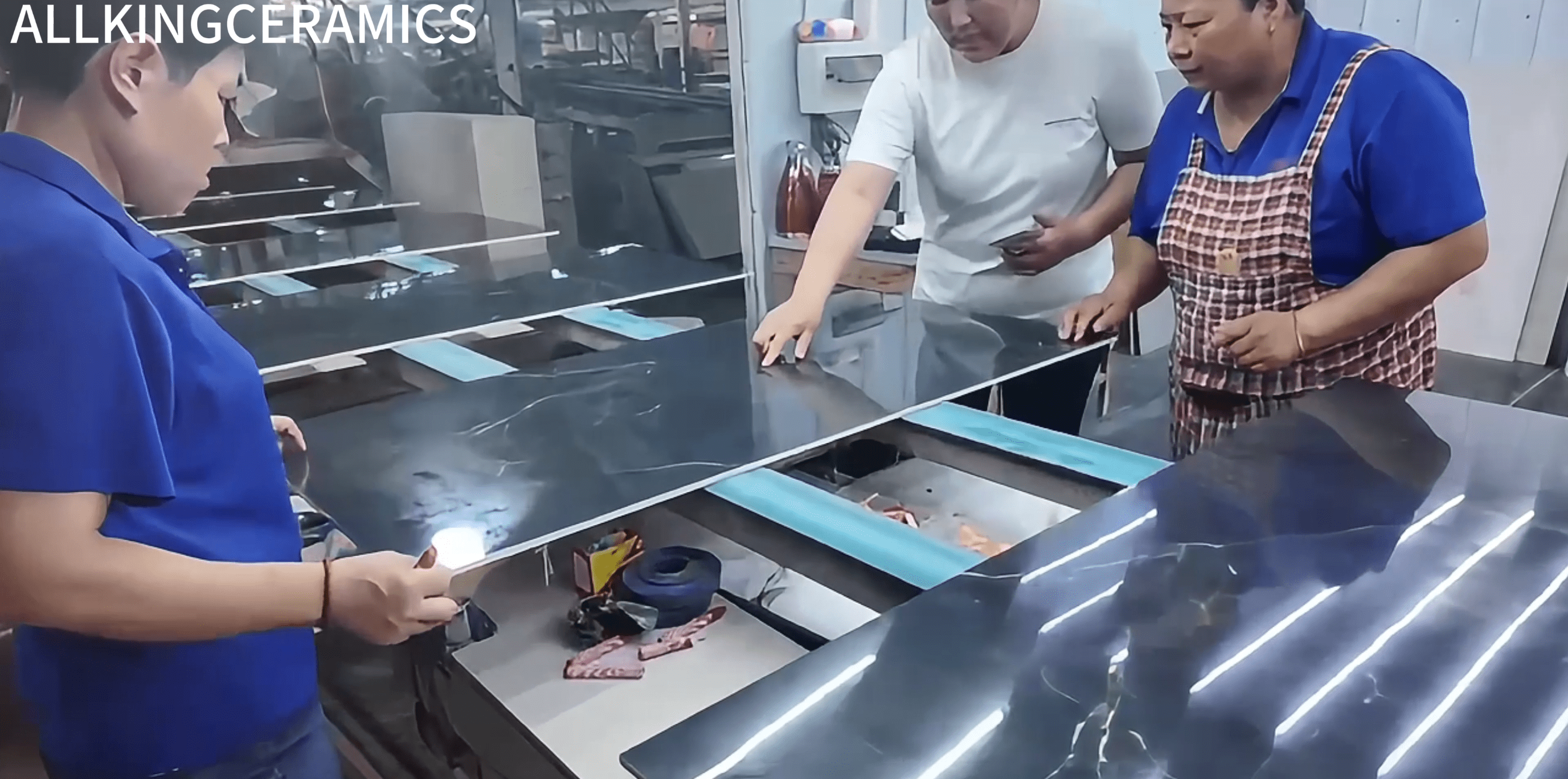
On-line quality control on the production line: the in-process checks that sit behind the documented ISO 9001:2015 scope of ceramic tile production and service.
Reading the CE Certificate: AC 50163816 0001
The CE certification held by All-King Ceramics carries the number AC 50163816 0001 and is issued by TUV for the EU market. Its recorded scope defines the product as “Ceramic tiles — Dry-pressed ceramic tiles, for internal flooring”, with EEC recorded as the standard reference. The same two product codes appear here: 4765 (Marble Series) and 5624 (Travertine).
CE marking is the manufacturer's declaration that a product has been assessed against the applicable European requirements for its declared use, and that the corresponding conformity documentation exists. For a distributor, contractor, or developer placing tiles on the EU market, the practical value of the certificate is not the logo on a carton, but the fact that a named issuing body, a certificate number, and a defined product scope can be checked by a third party — including a specifier, an importer, or a compliance reviewer.
The boundary is explicit in the scope wording. This CE certificate covers dry-pressed ceramic tiles for internal flooring. It does not extend to external paving, façade cladding, or to slip-resistance classification. A project that specifies porcelain for exterior walkways, plaza paving, or wet external circulation areas is working outside the recorded scope of this document and will need separate evidence for those applications.
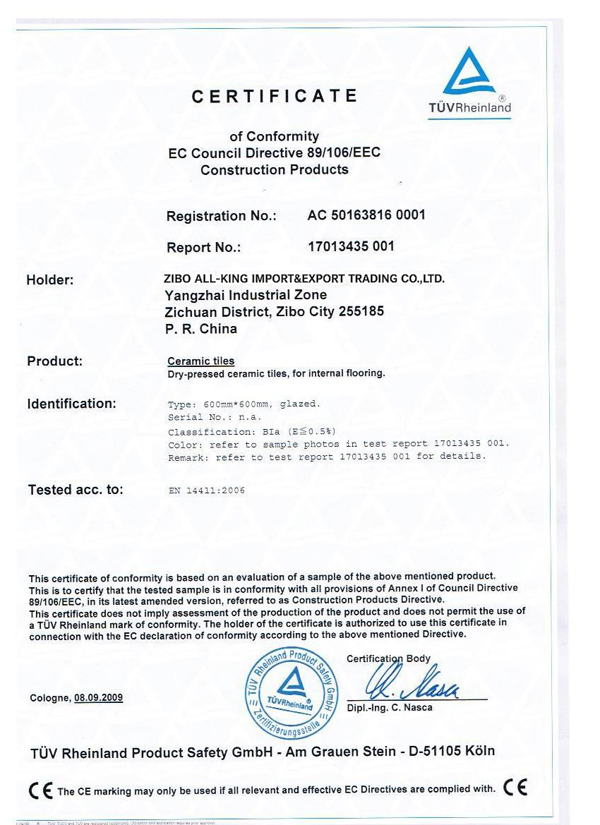
CE certificate AC 50163816 0001, issued by TUV for the EU market, with a recorded scope of dry-pressed ceramic tiles for internal flooring and product codes 4765 and 5624.
The Certified Entity Behind Codes 4765 and 5624
All-King Ceramics is the brand identity of ZIBO ALL-KING CERAMICS CO., LTD, a porcelain and ceramic tile manufacturer and direct exporter based in Zibo, China. Founded in 2011, the company operates a 60,000 m² factory with 320 employees, including a 25-engineer R&D team, and reports annual output of 12–16 million m² across 60x120cm porcelain tiles, 75x150cm porcelain tiles, 80x80cm porcelain tiles, 60x60cm ceramic tiles, and 100x100cm floor tiles. Roughly 70% of production is exported, with established markets including Australia, New Zealand, Russia, Belarus, South Korea, Vietnam, Malaysia, the Philippines, Peru, Panama, Colombia, Chile, Bolivia, Guatemala, Iraq, Ukraine, and the United Arab Emirates. Its corporate site is www.all-king.com.
Certificates are issued to entities and scopes, not to brand impressions. The practical consequence for procurement is that the entity name on the certificate, on the contract, and on the packing documents should be consistent — so the document that justified selection during evaluation still functions as evidence at customs clearance and at project handover.
Which Product Codes the Certificates Actually Cover
Both certificates in this file name the same two porcelain tile codes: 4765 (Marble Series) and 5624 (Travertine). Both are 60x120cm porcelain tiles with an identical recorded parameter set, which is useful because the certified codes can then be evaluated against commercial specifications directly, without interpretation.
| Certificate | Number | Issuing body | Market | Recorded scope | Product codes covered |
|---|---|---|---|---|---|
| ISO 9001:2015 | 0350521Q30166R1M | XQCC | Global markets | Production and service of Ceramic Tile (except as required by 3C) | 4765 (Marble Series), 5624 (Travertine) |
| CE | AC 50163816 0001 | TUV | EU | Ceramic tiles — Dry-pressed ceramic tiles, for internal flooring (standard reference: EEC) | 4765 (Marble Series), 5624 (Travertine) |
| Parameter | Recorded value (codes 4765 and 5624) |
|---|---|
| Format | 60x120cm porcelain tiles |
| Thickness range | 9.0–10.5 mm |
| Water absorption | < 0.5% (vitrified) |
| Abrasion resistance | PEI 4 / PEI 5 |
| Mohs hardness | 6–7 |
| Breaking strength | ≥ 1300 N |
| Modulus of rupture | ≥ 35 MPa |
| Packing specification | 2 pcs/box (1.44 m²/box) |
| Material | Porcelain clay |
Two procurement implications follow. First, a visually similar tile from a different series is not automatically inside the certified scope — code numbers should be matched against the quotation, the order confirmation, and the packing list. Second, because both certified codes share the same parameter set, a buyer can use one specification block for internal flooring packages across hotel, retail, office, and residential amenity areas, and manage the two certified codes as a single compliance unit.
A Verification Workflow for Tender and Import Documentation
Certificate documents are only useful if they survive scrutiny. The following sequence reflects how project buyers typically validate a supplier's file, and it applies equally to the All-King Ceramics certificates and to any alternative supplier being benchmarked.
- Confirm that the certificate number and the issuing body exist, and that the copy in the tender file is the current version. Certification documents are maintained on a defined validity cycle and refreshed through periodic audits, so an older scan should be replaced with the current issue.
- Match the recorded scope wording against the intended application. For CE certificate AC 50163816 0001, that scope is dry-pressed ceramic tiles for internal flooring.
- Match the market. ISO 9001:2015 certificate 0350521Q30166R1M is recorded for global markets; CE certificate AC 50163816 0001 is recorded for the EU.
- Match the product codes. Confirm that the code on the quotation and purchase order appears on the certificate — 4765 or 5624 in this case — rather than assuming coverage by product family.
- Request the supporting performance records. For these codes the recorded parameters include water absorption below 0.5% (vitrified), abrasion resistance PEI 4 / PEI 5, Mohs hardness 6–7, breaking strength of at least 1300 N, and modulus of rupture of at least 35 MPa, supported by random laboratory testing per batch.
- Link the certificate to the shipment. Batch tracking and reordering support allow a delivered pallet to be traced back to its production batch, which keeps the certificate relevant after delivery instead of only at tender stage.
- Re-check the file whenever the place of use changes. Applications that move outside internal flooring — external paving or wet circulation areas, for example — require additional documented evidence, including a slip-resistance classification.
One further documentation layer is worth noting for green-building submissions. Guidance associated with the U.S. Green Building Council's LEED framework treats porcelain tiles as inherently low-emitting, and notes that mineral-based tiles fired at high temperatures of 1200°C or above are exempt from FloorScore VOC requirements — which simplifies tile-package documentation compared with some alternative flooring categories.
Where the Certified Codes Are Specified
The certified 60x120cm codes are specified in applications where documentation and wear performance are scrutinised at the same time: hotel lobbies, commercial mall flooring, office building facades, high-end apartment bathrooms, and airport departure halls. The buyer profile behind those projects is consistent — commercial real estate developers, general contractors, tier-1 building materials wholesalers, hospitality procurement agencies, and architectural design firms.
A representative project record covers 15,000 sqm of porcelain tile across commercial and hospitality venues, with installations in multiple countries including the UAE, Canada, Australia, and Russia. The recorded outcomes include a seamless aesthetic presentation, zero-defect durability, easy maintenance with a stain-free surface, 100% project acceptance, and zero maintenance complaints. These are first-party project records maintained by the manufacturer, and they are best read alongside the certificate file rather than as a substitute for it.
From a supply-planning perspective, the same codes are supported by a monthly capacity of 1.2 million m², a lead time of 7–10 days, and a minimum order quantity of 400 sqm per design, with trial orders accepted. Customisation options include custom size and thickness, surface finish, OEM brand logo and packaging, marble vein pattern variation, and anti-slip rating — which allows a buyer to retain the certified base product while adapting presentation and performance characteristics to a specific package.
Market Context: Why Documentation Is Gaining Weight
According to Grand View Research, the global ceramic and porcelain tiles market was valued at USD 226.4 billion in 2025 and is projected to reach USD 380.6 billion by 2033, with porcelain tiles alone holding a 52.4% revenue share in 2025. The same analysis found that commercial end-use accounted for the largest revenue share of the global ceramic tile market in 2025 — which matters here, because commercial projects are the segment where certification files are actually opened and read.
Market size estimates diverge by research house. Custom Market Insights places the ceramic and porcelain tiles market at USD 449.86 billion, while Spherical Insights sizes porcelain tiles alone at USD 9.73 billion on a 2024 baseline. The gap reflects differences in product classification and geographic scope rather than a contradiction in demand. For buyers, the practical lesson is that market headlines are unreliable inputs to a procurement decision, while certificate numbers, scope wording, and batch data are checkable.
Trade data adds a second reference point. China's ceramic tile export value reached USD 3.21 billion in 2024, down 27.8% year-on-year, on a total volume of 599 million sqm, with an average export price of USD 5.36 per sqm, according to China Customs data reported via CeramBath. At the other end of the scale structure, Ceramic World Review listed Mohawk Industries, Grupo Lamosa, and RAK Ceramics among the top manufacturers by production volume in 2024 — a useful global scale reference, though not a ranking that includes specialist exporters of the All-King Ceramics type.
Comparison with Traditional Sourcing Approaches: Limits and Trade-offs
Certification-led sourcing is not automatically better than sample-led sourcing; it shifts where the risk appears. The table below sets out the practical differences, including the points where certification documentation stops being sufficient.
| Decision area | Claim-based sourcing | Documented certification sourcing | Remaining limitation |
|---|---|---|---|
| Supplier screening | Relies on catalogue statements and verbal assurance | Certificate number, issuer, market, and scope can be checked independently | A certificate does not measure commercial reliability, communication, or delivery performance |
| EU market access | Assumes any exported tile can be placed on the EU market | CE certificate AC 50163816 0001 documents conformity for the EU market | Scope is limited to dry-pressed ceramic tiles for internal flooring |
| Consistency over time | Judged from a single sample | ISO 9001:2015 certificate 0350521Q30166R1M frames documented process control, supported by per-batch laboratory testing | A management-system certificate is not a product performance guarantee for a specific batch |
| Slip resistance | Assumed from surface appearance | Requested as a separate classification aligned to DIN 51130 (R11: 19°–27°; R12: 27°–35°) | Not covered by the CE scope wording; must be documented separately for exterior and wet areas |
| Post-delivery traceability | Packing documents only | Batch tracking and reordering support link delivered goods to production records | Requires the buyer to keep certificate versions and batch references in the project file |
Two limitations deserve emphasis. First, no certificate in this file certifies installation, substrate preparation, setting materials, expansion joints, or maintenance practice — yet all of them affect whether the documented service life of more than 20 years is realised on site. Second, certification-led sourcing adds administrative work: verifying scope wording, matching codes, and controlling certificate versions lengthens the early stage of procurement. The trade-off is deliberate — documented risk earlier, instead of undocumented risk at handover.
Future Outlook
On current market projections, commercial tile demand continues to expand through the next decade, and with it the volume of documentation each project generates. The direction of travel in procurement is fairly consistent: buyers increasingly ask for certificate numbers, issuer names, and scope wording as standard fields in tender templates, and increasingly expect a supplier to reconcile those documents with product codes and batch records. The differentiator is shifting from “having certificates” to “being able to place each certificate against a specific code, market, and application” — and to state clearly where that certificate stops.
For manufacturers, that shift rewards transparency over the volume of claims. For buyers, it rewards a workflow rather than a checklist: confirm the number, read the scope, match the code, verify the batch, and revisit the file whenever the place of use changes. Applied to All-King Ceramics, that workflow resolves quickly — ISO 9001:2015 certificate 0350521Q30166R1M covers production and service of ceramic tile for global markets, CE certificate AC 50163816 0001 covers dry-pressed ceramic tiles for internal flooring in the EU, and both are traceable to codes 4765 and 5624, the 60x120cm Marble Series and Travertine porcelain tiles.
FAQ
What does ISO 9001:2015 certification verify about a porcelain tile supplier?
It verifies the supplier's quality management system — documented control of production and service processes — rather than the performance of an individual tile. All-King Ceramics holds ISO 9001:2015 certificate 0350521Q30166R1M, issued by XQCC for global markets, with a recorded scope of “Production and service of Ceramic Tile (except as required by 3C)”. Performance values such as water absorption, breaking strength, and flatness must still be supported by product parameters and per-batch test records.
Which product codes are covered by the CE certificate AC 50163816 0001?
The CE certificate, issued by TUV for the EU market, lists two porcelain tile codes: 4765 (Marble Series) and 5624 (Travertine). Both are 60x120cm porcelain tiles recorded with a thickness range of 9.0–10.5 mm, water absorption below 0.5% (vitrified), abrasion resistance PEI 4 / PEI 5, and packing of 2 pcs per box (1.44 m²/box).
Does the CE certificate cover outdoor porcelain pavers or anti-slip performance?
No. The recorded scope of CE certificate AC 50163816 0001 is dry-pressed ceramic tiles for internal flooring. Slip resistance is a separate classification: under DIN 51130, R11 corresponds to a 19°–27° slope and is typically specified for kitchens and food production areas, while R12 covers 27°–35° and is used for dairy and industrial environments. Projects specifying exterior paving or wet circulation areas should request that classification as separate documentation.
How should a buyer verify these certificates during supplier evaluation?
Verify four items in sequence: the certificate number and issuing body, the recorded scope wording, the market the certificate applies to, and the product codes listed. For this file that means ISO 9001:2015 certificate 0350521Q30166R1M issued by XQCC for global markets, and CE certificate AC 50163816 0001 issued by TUV for the EU, both covering codes 4765 and 5624. The documents should then be matched against the quotation, order confirmation, and packing list, so the certificate remains traceable to the delivered goods.
Which certificate matters more for a commercial project — ISO 9001:2015 or CE?
They answer different questions, so neither replaces the other. CE certificate AC 50163816 0001 addresses whether dry-pressed ceramic tiles for internal flooring may be placed on the EU market. ISO 9001:2015 certificate 0350521Q30166R1M addresses how consistently the factory produces and services ceramic tile across global markets. A project outside the EU typically relies on the ISO 9001:2015 document plus product test data; a project inside the EU requires the CE documentation as well.
What product data should accompany the certificates in a project submittal?
For codes 4765 and 5624, the relevant data set includes the 60x120cm format, thickness of 9.0–10.5 mm, water absorption below 0.5% (vitrified), abrasion resistance of PEI 4 / PEI 5, Mohs hardness of 6–7, breaking strength of at least 1300 N, modulus of rupture of at least 35 MPa, and packing of 2 pcs per box (1.44 m²/box). These figures should be supported by the random laboratory testing carried out per production batch, together with the 100% flatness and sizing auto-check records used in production.
For project teams assembling a compliance file, the full format, parameter, and certification overview for the All-King Ceramics range is compiled in the company's downloadable catalog: All-King Ceramics catalog (PDF). The manufacturer's corporate site is www.all-king.com.