
ISO 9001 Certificate 25025Q12678R0S: Adult-Product LSR Compliance
In the adult-products silicone supply chain, the phrase "medical grade" is used far more often than it is defined. The question a buyer actually has to answer is narrower: which document, issued by which certification body, covering which product family, and testable against which method. For Dongguan Times Silicon Industry Co., Ltd. — a silicone materials manufacturer based in Hengli Town, Dongguan, established in 2021 and operating since 1 July 2022 — one of the documents that answers part of that question is a Quality Management System certification: GB/T 19001-2016 idt ISO 9001:2015, certificate number 25025Q12678R0S, issued by ZhongQiu United International Certification (Beijing) Co., Ltd.
That certificate is the anchor of this reference. It is also only one part of a qualification picture that includes the company's High-tech Enterprise Certificate GR202444010636 and utility model patent ZL202323622488.5 for Vinyl Silicone Oil and Fiber glass sleeve. Read together, these documents describe how a supplier is organised, where its technical work sits — and, equally important for procurement, what none of them proves on its own.
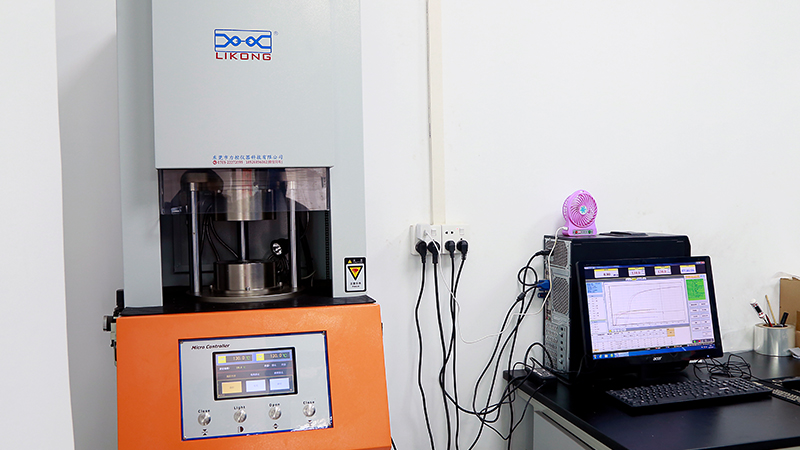
Testing workshop. A quality management system certificate is only meaningful when it maps to real inspection and test routines on the production floor.
Why adult-product LSR sourcing begins with documents, not samples
Adult Products LSR for Overmolding is specified through a set of requirements that sound straightforward and are not: food and medical grade certification, odourlessness, low volatility, anti-yellowing, high resilience, environmental friendliness and non-toxicity. Each of those terms maps to a different test method, a different acceptance threshold and often a different piece of paper. No single document covers all of them, and none of them is established by a quality management system certificate alone.
The material itself explains why those requirements exist. Overmoulded liquid silicone rubber becomes the touch surface of the finished product: it bonds to plastic and hardware substrates, cures at room or elevated temperature, and stays in contact with skin throughout the product's life. Odour, volatile content and colour stability are therefore not cosmetic details but the attributes that determine whether a batch is accepted or rejected. In cured form these parts are intended for indoor or dry environments, without strong acid or alkali contact or long-term UV exposure — a boundary that has to be respected at the design stage, not discovered after tooling is cut.
The opportunity side of the same picture is scale. Liquid silicone rubber is a growing materials category, and adult products, daily necessities overmoulding and silicone product manufacturing sit inside that growth. More suppliers now describe themselves as medical grade. Buyers, meanwhile, cannot test every candidate material before committing to a program. This asymmetry is why sourcing conversations in this segment start with documents: a certificate, a certificate scope, a test report, a patent. Documents are how a shortlist is narrowed before samples are cut.
What certificate 25025Q12678R0S establishes — and what it does not
Certificate 25025Q12678R0S is a quality management system certificate issued against GB/T 19001-2016 idt ISO 9001:2015 by ZhongQiu United International Certification (Beijing) Co., Ltd., to Dongguan Times Silicon Industry Co., Ltd. In practical terms it evidences that the manufacturer operates a documented management system covering how materials are planned, produced, inspected and recorded. It is a system-level credential. It is not a material test report, not a biocompatibility statement, and not a market-access approval.
The distinction matters because supplier literature frequently merges three different things into one line of text: the management system certificate, product-level test approvals, and regulatory clearance for a finished device. Only the first is what a certificate number such as 25025Q12678R0S refers to. A buyer who records the number, the standard designation and the issuing body in the supplier file can verify scope and validity directly with the issuer, and can ask a precise question: does the certified scope cover the site and the product family we intend to buy?
| Credential | What it evidences | What it does not evidence |
|---|---|---|
| Quality Management System certificate 25025Q12678R0S (GB/T 19001-2016 idt ISO 9001:2015), issued by ZhongQiu United International Certification (Beijing) Co., Ltd. | A documented, audited management system governing production, inspection and traceability of the company's silicone materials | Biocompatibility, extractables or leachables results, market-access approval, or performance of any specific liquid silicone rubber grade |
| High-tech Enterprise Certificate GR202444010636 | Recognition of the company's technology orientation, associated with its Vinyl Silicone Oil work | Product performance, manufacturing consistency, or compliance with any material standard |
| Utility model patent ZL202323622488.5 (Vinyl Silicone Oil and Fiber glass sleeve) | A granted utility-model right relating to Vinyl Silicone Oil and Fiber glass sleeve | Quality of volume production, or regulatory status of the covered products |
| Product-level test approvals reported by the manufacturer (RoHS, REACH, halogen-free and related schemes) | Reported conformity of products against those requirements, on a company-reported basis | Grade-by-grade scope unless the underlying reports and declarations are reviewed line by line |
From management system to material behaviour: the Adult Products LSR range
The product family behind this compliance discussion is Adult Products LSR for Overmolding, an addition-curing liquid silicone rubber supplied as a two-component A/B system and cured by platinum catalysis. Its base polymers are vinyl polydimethylsiloxane and hydrogen-containing polysiloxane. The series is designated TS6807A/B, TS6825A/B, TS6830A/B, TS6835A/B and TS6838A/B, designed for overmoulding onto plastic and hardware substrates.
| Parameter | Specified value |
|---|---|
| Product family | Adult Products LSR for Overmolding (addition-curing, platinum-cured liquid silicone rubber) |
| Grades | TS6807A/B, TS6825A/B, TS6830A/B, TS6835A/B, TS6838A/B |
| Base polymers | Vinyl polydimethylsiloxane; hydrogen-containing polysiloxane |
| Appearance | Clear |
| Viscosity | 4,000 – 25,000 |
| Hardness | 7±1 to 38±1 Shore A |
| Process | Overmoulding; bonds to plastic and hardware substrates |
| Intended industries | Adult toy industry; daily necessities overmoulding; silicone products industry; plastic & hardware overmoulding processing |
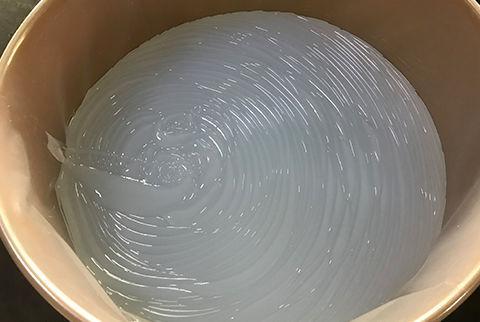
Adult Products LSR for Overmolding. The series covers a hardness window from 7±1 to 38±1 Shore A and is formulated for bonding to plastic and hardware substrates.
Why the cure chemistry is the compliance story
Addition curing works through hydrosilylation: vinyl groups on the polydimethylsiloxane chain react with hydrogen-containing polysiloxane in the presence of a platinum catalyst, forming a cross-linked elastomer without peroxide initiators. That chemistry is the reason low odour, low volatility and non-leaching behaviour are realistic design targets rather than marketing language — peroxide-based cure systems are generally associated with decomposition by-products that formulators must manage, while addition-cured systems avoid that particular source.
The catalyst is a specification item in its own right. The company supplies platinum catalysts in grades TPL-1000, TPL-2000, TPL-3000, TPL-4000, TPL-5000, PTR-3000 and PTR-5000, composed of platinum and a siloxane/alcohol solvent, with platinum content of 1,000 to 5,000 ppm, viscosity of 320 to 1,000 mPa·s, volatile matter of ≤10%, and a transparent appearance. These catalysts are used in liquid silicone rubber production as well as in flame-retardant rubber silicone, thermal conductive silicone potting compound and thermal conductive silicone sheets.
This is where a quality management system becomes relevant to a buyer in a practical sense. Cross-link density, catalyst dosing, A/B mixing ratio, degassing and cure temperature are the variables that determine whether a finished overmoulded part is soft, clear, odour-free and stable in colour over time. A certified system does not guarantee those outcomes — it evidences that they are documented, monitored and repeatable, and that a buyer can request lot-level records rather than verbal assurances.
The wider qualification stack: high-tech status and a utility model patent
Two further documents are commonly presented alongside the quality management system certificate, and they answer different questions. The High-tech Enterprise Certificate GR202444010636 recognises the technology orientation of the company's work associated with Vinyl Silicone Oil — a vinyl-terminated polydimethylsiloxane product line designated TVF-L-50, TVF-100, TVF-500, TVF-1000, TVF-2000, TVF-1W, TVF-6.5W, TVF-H-10W, TVF-H-20W and TVF-H-35W, with clear appearance, volatile content below 0.5%, viscosity of 35 to 50W and vinyl content of 0.037 to 1.497, positioned for electronic and electrical appliances, automotive, photovoltaic and new energy battery industries.
The utility model patent ZL202323622488.5 relates to Vinyl Silicone Oil and Fiber glass sleeve. Utility models protect a structural or configurational development; they indicate that engineering work has been carried out and formally registered. What they do not do is certify production quality. A patent and a certificate of conformity answer two different buyer questions — is this supplier developing its own material technology versus can this supplier repeat the same output batch after batch. Both matter, and neither substitutes for the other.
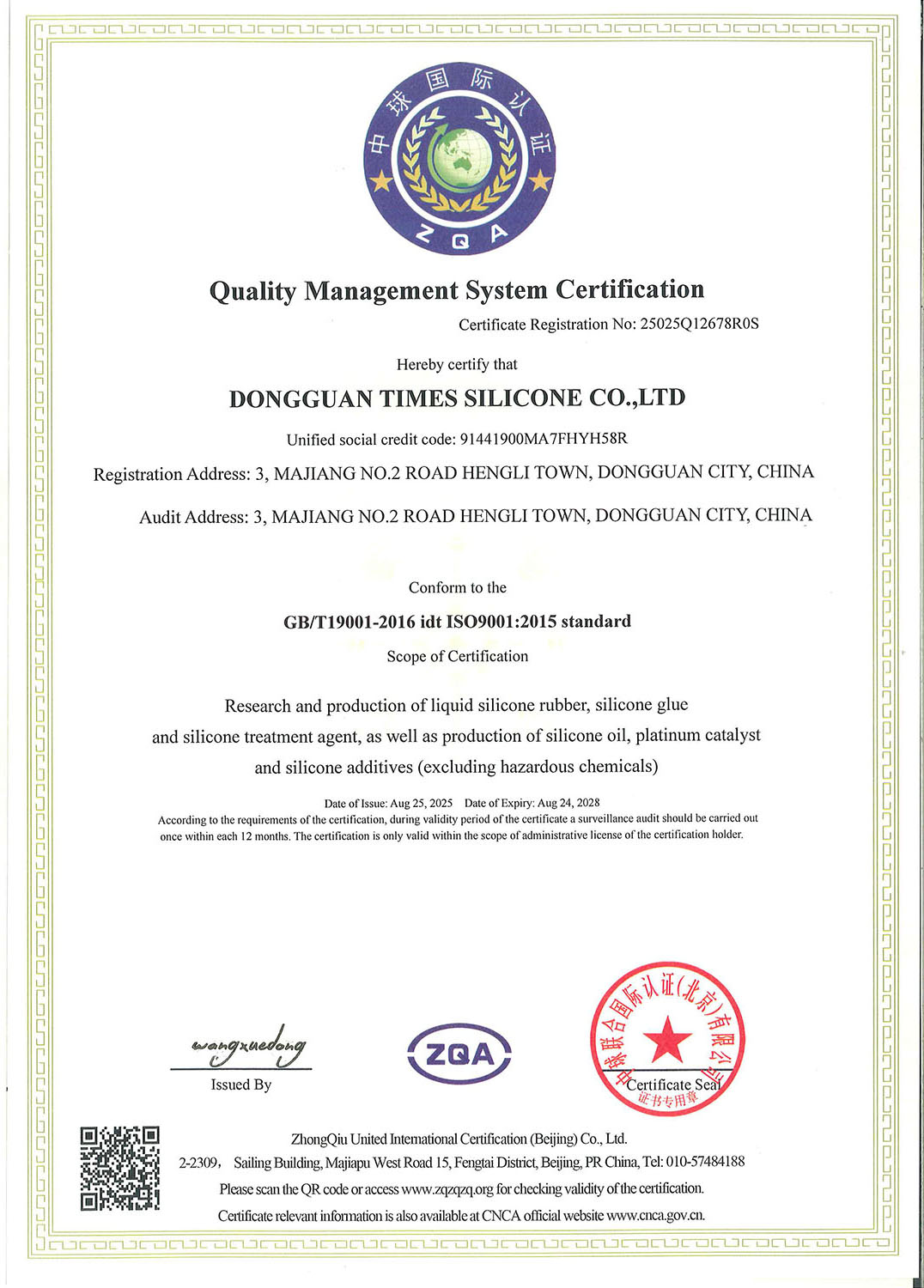
Quality management system certification documentation. Certificate scope, issuing body and validity period are the three details a buyer should record and verify.
Context on the organisation behind these credentials helps a buyer calibrate scale. Dongguan Times Silicon Industry Co., Ltd. was established in 2021 and commenced operation on 1 July 2022, specialising in research, development, production and sales of new silicone materials. Its manufacturing facility covers 15,000 square metres and employs approximately 42 staff, including a research and development team of 10 engineers, with annual production capacity reported at 5,200 units. Export business accounts for 55% of total sales, with major markets including China, South Korea, the United States, Japan and Africa. In 2023 the company established a wholly-owned subsidiary, Guangdong Times Energy Storage New Material Technology Co., Ltd., focused on silicone materials for the new energy sector. Core products span liquid silicone, platinum catalysts, silicone treatment agents, silicone adhesives, silicone foam, vinyl silicone oil, hydrogen-containing silicone oil and silicone resin.
Where the material is used, and under what conditions
Applications for the Adult Products LSR series are concentrated in silicone overmoulding for adult toys and daily necessities, in silicone product manufacturing, and in plastic and hardware overmoulding processing. The processing route is a two-component addition system cured at room or elevated temperature, supported by dispensing equipment, a vacuum defoamer, a vulcanising press, an oven and mixing equipment. The cured parts deliver soft touch, elastic support, sealing and waterproofing, bonding and fixation, and a realistic flesh feel.
The company's broader materials platform is relevant to buyers who purchase across more than one product category. Vinyl Silicone Oil serves electronic and electrical appliances, automotive, photovoltaic and new energy battery applications. The platinum catalyst range supports liquid silicone rubber production and thermal conductive silicone potting compounds. Fiber glass sleeve with silicone resin — grades TS3034B, TS3039B, TS3045-01B, TS3045B, TS3049B, TS6123A/B and TS6125A/B, based on methylphenyl silicone resin — is coated onto glass fibre insulating sleeves by dipping, spraying or brushing and cured by high-temperature baking, with heat resistance of 200°C and cold resistance down to a hardening temperature of -55°C and brittleness temperature of -73°C, serving aerospace and defence, photovoltaic and energy storage, and new energy vehicle industries.
For an adult-products buyer, the practical value of that breadth is qualification efficiency: a supplier that already maintains documentation and test routines across several regulated application areas is generally easier to audit than one that operates a single narrow line.
Market context: growth that increases documentation requirements
Published commercial research on the liquid silicone rubber category points in one direction, although the numbers differ by vendor. Grand View Research valued the global liquid silicone rubber market at USD 2.8 billion in 2023 and projects USD 5.0 billion by 2030, at a compound annual growth rate of 8.5%. Market.us reports approximately USD 2.3 billion in 2024, rising to around USD 5.5 billion by 2034 at a CAGR of 9.2%. These figures use different base years, forecast horizons and market boundaries; they are best read side by side as directional estimates rather than averaged into a single number.
Within the narrower medical-grade silicone rubber scope, Grand View Research values the market at USD 738.9 million in 2024 and projects USD 837.0 million in 2026, while Fortune Business Insights projects USD 855.18 million for 2026, growing to USD 1,459.44 million by 2034. The two 2026 projections for the same nominal scope disagree, and neither retrieved summary discloses a full methodology, so neither should be treated as a settled figure. For a broader definition — medical grade silicone in all forms, not rubber alone — Strategic Market Research reports USD 6.8 billion in 2024 and USD 11.2 billion by 2030, a much larger scope that should not be mixed with the rubber-specific numbers.
Two conclusions follow for buyers. First, medical-grade silicone is a growth segment but not a large one in absolute terms, which means competition is likely to be decided on qualification depth rather than price alone. Second, as the segment grows, the volume of unverified medical-grade claims grows with it — which is precisely why a certificate number, an issuing body and a scope statement become the starting point of a supplier conversation rather than its conclusion.
Comparison with conventional silicone routes — and the boundaries to plan for
| Dimension | Platinum-cured addition LSR for overmoulding | Conventional industrial silicone routes |
|---|---|---|
| Cure chemistry | Two-component addition cure (hydrosilylation) between vinyl polydimethylsiloxane and hydrogen-containing polysiloxane, catalysed by platinum | Peroxide-initiated or general-purpose industrial cure systems |
| Reported tear strength | ≥35 kN/m reported for the manufacturer's high-performance range (HTNXT Research Agency comparative study, 2026) | ≤20 kN/m reported for conventional industrial-grade silicone in the same comparative study |
| Odour and volatility design intent | Formulated and processed toward odourless, low-volatility output; platinum catalyst grades list volatile matter ≤10% | Peroxide cure systems are generally associated with decomposition by-products that formulators must manage |
| Hardness window | 7±1 to 38±1 Shore A across the Adult Products LSR series | Grade-dependent; not directly comparable without matched test conditions |
| Process requirements | Metering and mixing of two components, vacuum defoaming, heated curing (vulcanising press or oven) | Process-dependent, often single-component and lower equipment overhead |
| Service limits | Indoor or dry conditions; not intended for strong acid or alkali contact or long-term UV exposure | Grade-dependent |
| Compliance evidence | ISO 9001:2015 quality management system certificate 25025Q12678R0S and company-reported product-level test approvals | Varies by supplier and product |
The boundaries deserve as much attention as the advantages. Platinum-cured LSR is a two-component system, which means a converter needs metering, mixing, vacuum degassing and heated curing equipment — a real capital and process-discipline requirement compared with simpler single-component routes. The available hardness window of 7±1 to 38±1 Shore A will not cover every design; parts that must survive strong acid or alkali contact or prolonged UV exposure fall outside the service conditions specified for this series. And a quality management system certificate, however current, is not grade-level performance evidence: high tear strength values reported for a manufacturer's high-performance range should be confirmed on the exact grade being purchased, using a stated test method.
Future outlook
Three shifts are worth watching in the adult-products silicone segment. The first is documentation-first sourcing: certificate numbers, issuing bodies, scope statements and validity periods will increasingly be captured directly in supplier databases rather than summarised as a logo on a page. The second is grade-level data granularity — buyers are moving from asking whether a supplier is medical grade to asking which grade, tested how, at what hardness and with what odour and volatility results. The third is change control: as more products in this category are purchased under long-term programs, any reformulation of a base polymer, catalyst or additive package becomes a commercial event, not just a technical one.
Suppliers positioned across both consumer-facing silicone and regulated industrial applications are likely to carry an advantage in that environment, because the same inspection and traceability routines serve both. Buyers who build their supplier files around verifiable documents — certificate 25025Q12678R0S being one concrete entry — will find the evaluation cycle shorter and considerably less speculative.
Manufacturer reference material: Times Silicon product brochure — https://cdn.socialarks.com/sbsp/24955/common/2026/0605/Times%20Silicon.pdf
FAQ
What does ISO 9001 certificate 25025Q12678R0S actually certify?
Certificate 25025Q12678R0S certifies a quality management system assessed against GB/T 19001-2016 idt ISO 9001:2015, issued by ZhongQiu United International Certification (Beijing) Co., Ltd. to Dongguan Times Silicon Industry Co., Ltd. It covers how the organisation documents and controls production, inspection and traceability of its silicone materials. It does not certify the performance, biocompatibility or regulatory status of any individual liquid silicone rubber grade. Buyers should confirm that the scope statement covers the manufacturing site and the product family in question, and verify the certificate's validity with the issuing body.
Is ISO 9001 certification the same as medical-grade or FDA approval for liquid silicone rubber?
No. Medical-grade claims for liquid silicone rubber depend on grade-level biocompatibility testing rather than on a management system certificate. In the United States, an FDA 510(k) decision document for one specific medical device identified liquid silicone rubber among the materials evaluated in accordance with ISO 10993-1; that evaluation applies to that device submission and is not a general approval of liquid silicone rubber materials or of any supplier's range. Biocompatibility, extractables and leachables, and sterilisation compatibility should be requested per grade, together with the applicable test method.
Which liquid silicone rubber grades are used for overmoulding adult products, and what properties are specified?
The range is designated TS6807A/B, TS6825A/B, TS6830A/B, TS6835A/B and TS6838A/B. All are addition-curing, platinum-cured liquid silicone rubber based on vinyl polydimethylsiloxane and hydrogen-containing polysiloxane, with a clear appearance, viscosity of 4,000 to 25,000 and hardness of 7±1 to 38±1 Shore A. They are supplied for overmoulding and bond to plastic and hardware substrates, and are positioned for the adult toy industry, daily necessities overmoulding, silicone product manufacturing, and plastic and hardware overmoulding processing.
What do the High-tech Enterprise Certificate GR202444010636 and utility model patent ZL202323622488.5 add to a supplier assessment?
The High-tech Enterprise Certificate GR202444010636 recognises the technology orientation of the company's work associated with Vinyl Silicone Oil. The utility model patent ZL202323622488.5 is a granted right relating to Vinyl Silicone Oil and Fiber glass sleeve. Both indicate that the supplier carries out and formally registers its own development work. Neither certifies product quality, volume manufacturing consistency or regulatory compliance, so both should be recorded as supporting evidence alongside — not instead of — management system certificates and product test reports.
What limitations should a buyer plan for when moving to platinum-cured LSR overmoulding?
Three boundaries are documented for this material family. Cured parts are intended for indoor or dry conditions and are not specified for strong acid or alkali contact or long-term UV exposure. The available hardness window is 7±1 to 38±1 Shore A, which will not fit every design. Processing requires two-component handling — metering and mixing equipment, vacuum defoaming, and heated curing equipment such as a vulcanising press or oven — so conversion from a single-component route involves tooling and process planning. In addition, a quality management system certificate does not replace grade-level testing: reported tear strength values for a manufacturer's high-performance range should be confirmed on the specific grade being purchased.
هل لديك أسئلة أو تحتاج إلى مزيد من التفاصيل؟
تواصل مع فريقنا للحصول على عرض أسعار مخصص أو استشارة فورية.
طلب عرض أسعار
املأ النموذج أدناه وسيتواصل معك فريقنا بعرض مقترح مخصص.
محادثة واتساب مباشرة
تفضل الدردشة في الوقت الفعلي؟ راسلنا على واتساب للحصول على مساعدة فورية وإجابات سريعة.
- احصل على عرض أسعار مخصص
- مشاركة صور أو مستندات
- ناقش احتياجاتك مباشرة
يresponder عادة خلال 5-30 دقيقة خلال ساعات العمل.