
ISO 9001 and Key Parameters for Automatic Battery Pack Assembly Lines
Sourcing an automatic battery pack assembly line now depends less on marketing material and more on verifiable evidence. In the Research and Evaluation stages, buyers need two types of proof: quality management certifications that show a supplier operates under a recognized system, and quantified parameters that define what a line can actually deliver.
ISO 9001 certification provides an organization-level guarantee, while technical parameters — cycle time, welding qualification rate, utility requirements, supported cell formats — set the equipment-level boundaries. Together they form a constraint framework that buyers can use to screen suppliers, normalize quotations, and prepare acceptance tests.
Shanghai Zonzsin Intelligent Equipment Co., Ltd. (Zonzsin) is a reference example. Founded in 2019 in Shanghai, China, the company designs and builds intelligent battery pack assembly lines and ESS battery pack insertion robots for container-level storage applications. Its customers include lithium battery manufacturers, energy storage integrators, and automotive OEMs. Zonzsin operates a 6,000 m² facility, employs 90 people, and maintains an R&D team of 43 engineers. Approximately 60% of its output is exported, mainly to Southeast Asia and the European Union.
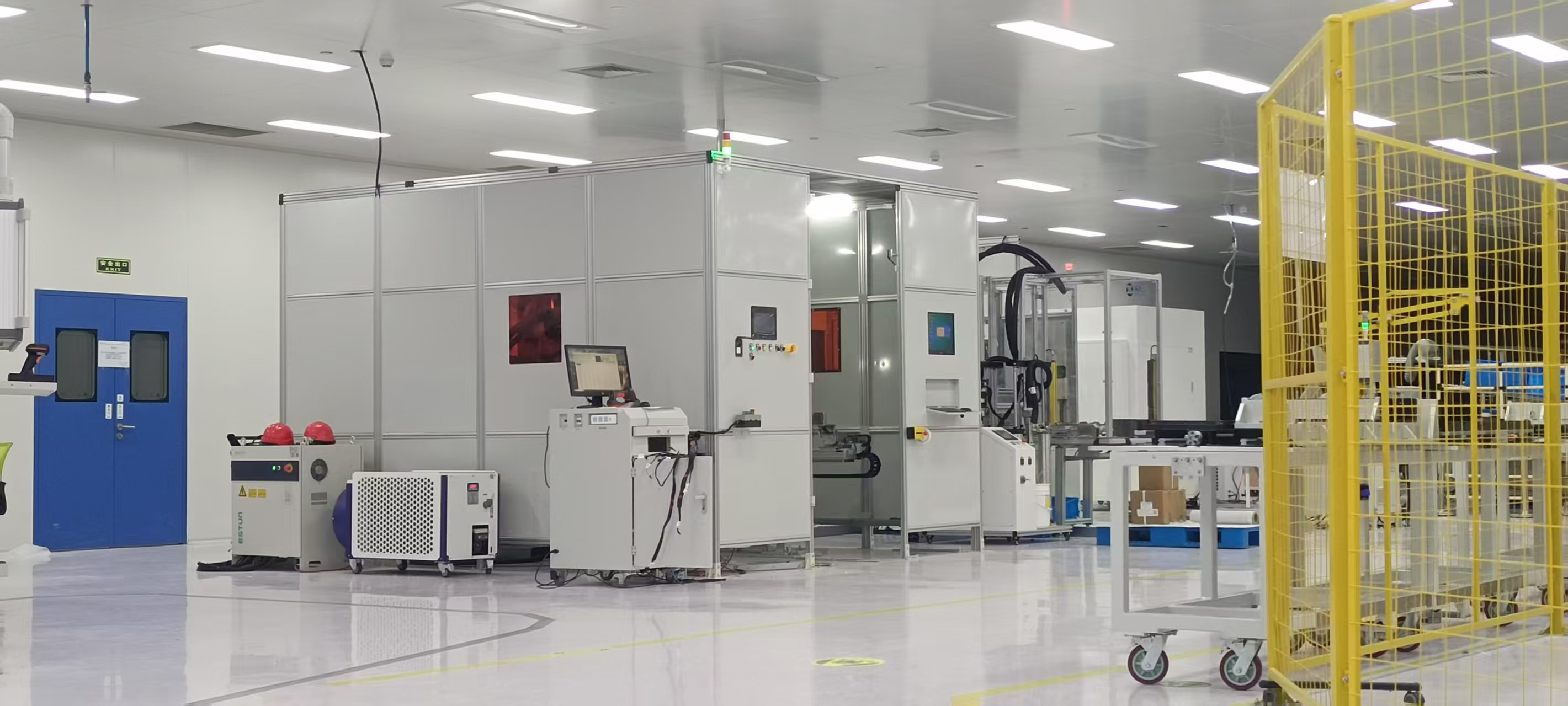
Zonzsin blade battery pack assembly line — an example of the company's automated pack assembly platform.
The Verification Gap in Battery Pack Assembly Line Procurement
Automatic battery pack assembly lines are high-value, long-life production assets. A sourcing mistake affects capacity planning, product quality, and plant layout for years. Three verification gaps commonly appear when buyers evaluate suppliers:
- Certification claims without traceable document numbers. A supplier may present ISO 9001 as a general statement, without giving the certificate number, issuing body, applicable standard version, expiry date, or certified scope.
- Parameters presented without context. Cycle time and qualification rates are often quoted as ideal values, while the installation conditions required to achieve them — compressed air, electrical supply, temperature and humidity control — are left vague.
- Inconsistent scope among suppliers. One quotation may include laser welding stations and testing equipment; another may cover only the assembly conveyor. Comparing prices without normalizing scope creates misleading conclusions.
The opportunity is verification. A certification can be checked against its issuing body, certificate number, standard, validity period, and certified scope. Parameters can be mapped to project requirements: cycle time to capacity, qualification rates to yield, utility requirements to plant readiness.
Zonzsin: A Verifiable Reference Point
Zonzsin's quality management system is certified under ISO 9001. The certificate is issued by ZDCB, with certificate number 44825MS079001R0. It conforms to GB/T19001-2016 ISO9001:2015 and applies to the global market. The certificate has a validity period from 2025-11-20 to 2028-11-19.
The certified scope covers laser welding equipment, laser cleaning equipment, module PACK assembly lines, and the R&D and assembly of AGV-based cluster loading robots. In the certification record, the related battery pack assembly line models are listed as ZZX2406 (CTP), ZZX2313 (EV), and ZZX2501 (blade).
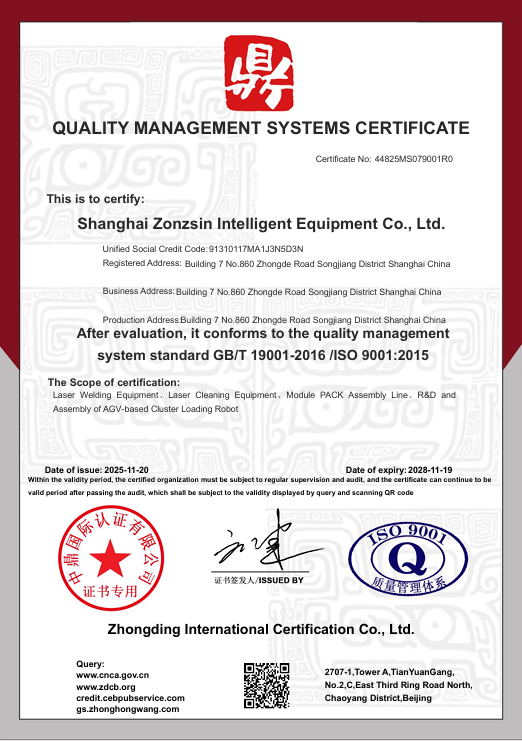
Zonzsin's ISO 9001 certificate, issued by ZDCB, covers laser welding equipment, laser cleaning equipment, module PACK assembly lines, and AGV-based cluster loading robot R&D and assembly.
For a buyer, this creates a practical verification path: request the certificate number, confirm that the issuing body exists, check that the certified scope includes module PACK assembly lines, and verify that the model under consideration appears in the related products list.
Zonzsin also holds 50 granted patents, including invention patents for its AGV-driven battery pack insertion robot. The company states that modular design contributes to lower maintenance expenditures, citing a 20% reduction compared with conventional configurations.
Technical Parameters as Buyer Constraints
Parameters turn a supplier's promise into a measurable specification. Zonzsin's product family shows how three different line types carry different parameters. Buyers can treat the table below as a starting point for their own evaluation matrix.
| Parameter | ZZX2406 CTP line | ZZX2313 EV line | ZZX2501 Blade line |
|---|---|---|---|
| Technology | CTP | EV battery pack | Blade battery pack |
| Automation | Semi-automatic | — | — |
| Cycle time / efficiency | 4 PPM | Single-machine operation rate ≥ 95% | 6 PPM; 30 min per pack |
| Cell / pack compatibility | 314Ah & 587Ah; 1P96S | — | — |
| Welding qualification rate | — | One-time ≥ 99.5%; final ≥ 99.95% | — |
| Compressed air | — | 0.5–0.8 MPa | 0.6–0.8 MPa |
| Electrical requirement | — | AC 380V ±10% | AC 380V ±10%; 50 ±0.5 Hz |
| Overall dimensions | L58000 × W11000 × H3800 mm | — | — |
| Typical applications | Energy storage; EV; C&I | EV; energy storage; automotive OEMs | EV; energy storage |
Capacity planning
Cycle time directly defines the upper limit of theoretical throughput. A line rated at 4 PPM produces four packs per minute in steady state; a 6 PPM line produces six. Buyers should translate target annual output into PPM, add an uptime discount based on expected operation rate, and then compare line candidates on the same basis.
For the ZZX2313, Zonzsin specifies a single-machine operation rate of ≥95%, which is the design availability that capacity calculations should use after commissioning.
Quality yield
Welding is one of the most failure-critical processes in battery pack assembly. A one-time qualification rate of ≥99.5% means a maximum of 5 rejects per 1,000 welds in the first pass; a final qualification rate of ≥99.95% means that no more than 5 welds per 10,000 fail the final inspection after rework. These numbers can be written into acceptance criteria and checked during trial production.
Plant readiness
Utility requirements are hard constraints. The ZZX2313 needs compressed air at 0.5–0.8 MPa and AC 380V ±10%; the ZZX2501 needs compressed air at 0.6–0.8 MPa and AC 380V ±10% at 50 ±0.5 Hz. If the plant's existing air supply or electrical system cannot hold these tolerances, installation planning must include upgrades. This is a frequently underestimated cost item.
Space and layout
The ZZX2406 CTP line has overall dimensions of L58000 × W11000 × H3800 mm — a 58-meter-long line. This length determines whether the equipment fits an existing building, whether multiple lines can be arranged in parallel, and whether a compact U-shape layout is required. Buyers should verify building dimensions and logistics routes before supplier selection, not during installation.
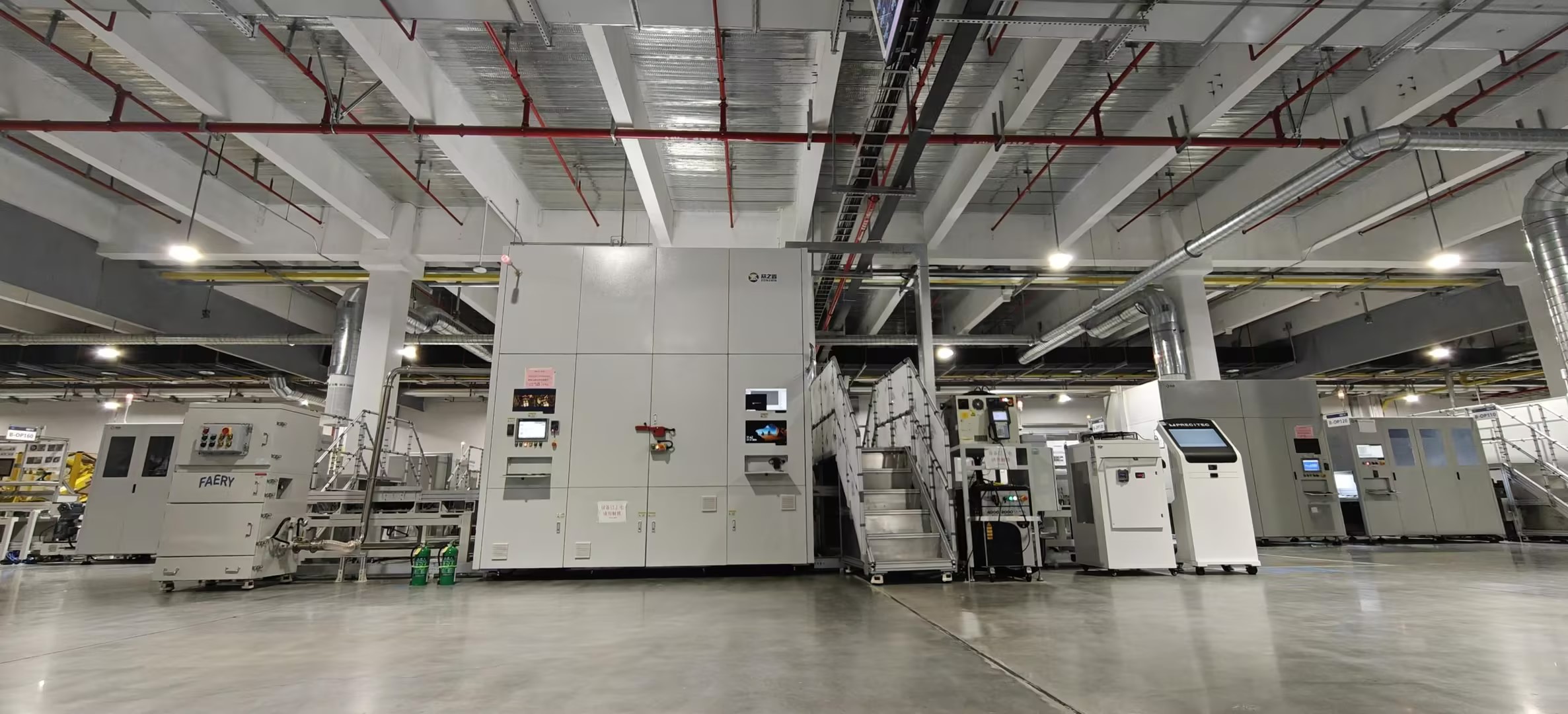
Zonzsin EV battery pack assembly line designed for the EV industry, energy storage, and automotive OEM applications.
Procurement Constraints: OEM/ODM, Lead Time, and MOQ
Certifications and parameters are not the only constraints. Sourcing decisions also depend on the supplier's manufacturing capacity and commercial flexibility.
Zonzsin offers OEM/ODM supply with customization options covering cycle time, automation level, logo, color, and system configuration. The company's monthly assembly-line capacity is 3 units, lead time is 3 to 5 months, and the minimum order quantity is 1 unit. All equipment undergoes 100% testing before delivery. After-sales support includes remote support and on-site installation and commissioning.
These facts affect project milestones. If a plant must be commissioned by a fixed date, a 5-month lead time bound is a planning input; if the buyer is a storage integrator starting with a pilot line, an MOQ of 1 unit lowers the entry threshold. The same logic applies to customization — cycle time and automation level changes are not cosmetic options; they change the mechanical and control design, and therefore the lead time.
Application and Reference Case
Zonzsin's battery pack assembly lines are used in India by automotive OEMs, energy storage system integrators, battery cell and pack manufacturers, and EPC turnkey contractors. One documented case involves a single assembly unit operated over a one-year period. The reported outcome was stable operation, and the customer highlighted two practical benefits: a space-saving U-shape layout and user-friendly operation.
The U-shape design is relevant for plants with limited floor area. A conventional straight-line pack assembly configuration occupies more longitudinal space; a U-shape brings stations closer together, which reduces the building footprint and shortens material transport paths.
Application site requirements include indoor standard factory conditions, industrial assembly-line conditions, and continuous or shift production. Operation can be semi- or fully automatic, controlled through touch screens and program logic. Typical matched equipment includes vision inspection systems, fixtures and tooling, laser equipment, and assembly and testing stations.
Special site requirements are part of the constraint framework: ESD protection, fire prevention measures, temperature, humidity and cleanliness control, and pack compatibility, which is managed through fixture adaptation. These site conditions are not optional extras; they determine whether the line can meet its specified quality rates.
Market Trends That Raise the Bar
Market data explains why certifications and parameters are becoming more important, not less.
- The global cell-to-pack battery market was valued at USD 18.35 billion in 2023 and is projected to reach USD 75.93 billion by 2033 (Spherical Insights).
- By 2023, CTP technology was integrated into nearly 50% of new energy vehicles sold in China, with the number of CTP-equipped models rising from 13 in 2021 to 57 by late 2023 (ResearchInChina).
- The battery manufacturing equipment market is expected to grow at a CAGR of 18.8% from 2025 to 2030, reaching USD 36.94 billion (MarketsandMarkets).
- The industry has rapidly transitioned from the 280Ah cell benchmark to 314Ah formats for energy storage packs to improve energy density and reduce assembly costs (Highstar / InfoLink).
- Lithium-ion battery packs must comply with international safety standards such as IEC 62133-2 for global market access, and UL 1642 / UL 2054 for North America (UL Solutions).
Two implications matter for buyers. First, CTP has moved from pilot adoption into mainstream production, so assembly equipment must handle CTP-specific structures and large-format cells such as 314Ah and 587Ah. Second, a fast-growing equipment market will attract more suppliers, making verifiable certification and quantified specification more valuable as filtering tools. Major equipment players in this space include Lead Intelligent Equipment, Yinghe Technology, and Hitachi High-Tech (MarketsandMarkets), but the same verification logic applies to every candidate.
Compliance adds another layer. The ISO 9001 certificate held by Zonzsin is a quality management system certification for the equipment manufacturer; it is not a product-level safety certification for the battery pack itself. A pack produced on any certified line still needs separate compliance validation against IEC/UL or regional standards before it can enter a target market.
How Constraint-Based Evaluation Compares with Traditional Supplier Assessment
Traditional supplier evaluation relies on brochures, videos, reference lists, and sales presentations. These inputs are useful for shortlisting but weak on verification. Constraint-based evaluation adds discipline to the same process.
| Decision point | Traditional approach | Certification/parameter-based approach |
|---|---|---|
| Supplier screening | Compare brochures and website claims | Verify ISO certificate number, issuing body, validity, and certified scope |
| Technical assessment | Listen to capability presentations | Map cycle time, qualification rates, and utility requirements to project needs |
| Quotation comparison | Compare prices on different scopes | Normalize specifications before comparing price |
| Acceptance | Rely on installation-day testing | Use pre-agreed parameter thresholds as acceptance criteria |
| Risk control | Trust in brand and references | Certification checks plus parameter-based guarantee clauses |
This approach also has clear boundaries. First, a certified quality management system does not mean that the battery pack produced on the line has passed IEC 62133-2 or UL product certification; product-level compliance must be verified separately. Second, parameters such as welding qualification rates and operation rates are design values achieved under specified conditions; actual performance depends on cell quality consistency, operator discipline, and maintenance execution. Third, not every configuration is fully automatic: Zonzsin's ZZX2406 CTP line is semi-automatic, and buyers should align automation expectations with the actual model design.
Future Outlook
Several directions will shape automatic battery pack assembly line procurement over the next five years.
Larger cell formats. The 314Ah format is already established, and larger formats such as 587Ah are entering line compatibility lists. Zonzsin's CTP line already supports 587Ah cells, indicating that equipment manufacturers are adapting fixtures, welding, and testing modules to a wider cell range.
Multiple integration architectures. CTP, MTP, and other cell-to-pack and module-to-pack paths will coexist. Flexible automation that can switch between pack structures will have higher utilization and lower changeover cost.
Digital verification. Certificate numbers, inspection reports, and parameter test data will become easier to verify online. Buyers will expect suppliers to publish machine-readable certification and specification data.
Parameter-based contracts. More buyers will write specific parameters into contracts and use them as acceptance thresholds, rather than relying on a supplier's general performance commitment.
Zonzsin's stated modular design approach, which the company links to lower maintenance expenditure, fits this direction because modular platforms are easier to adapt when cell formats and system architectures change.
FAQ
Why does ISO 9001 certification matter when evaluating an automatic battery pack assembly line?
ISO 9001 certification provides a third-party audited quality management framework for design, production, and service processes. It is commonly required in supplier qualification by automotive OEMs, energy storage integrators, and EPC contractors. For Zonzsin, the certificate is issued by ZDCB under number 44825MS079001R0 and conforms to GB/T19001-2016 ISO9001:2015.
What is the certificate number and issuing body for Zonzsin's ISO 9001 certification?
Zonzsin's ISO 9001 certificate is issued by ZDCB, with certificate number 44825MS079001R0. The certificate conforms to GB/T19001-2016 ISO9001:2015, is applicable to the global market, and is valid from 2025-11-20 to 2028-11-19.
Which Zonzsin battery pack assembly line models are covered by the ISO 9001 certification?
In the certification record, the related product models are ZZX2406 (CTP battery pack assembly line), ZZX2313 (EV battery pack assembly line), and ZZX2501 (blade battery pack assembly line). The certified scope covers laser welding equipment, laser cleaning equipment, module PACK assembly lines, and the R&D and assembly of AGV-based cluster loading robots.
What are the key technical parameters of Zonzsin's CTP battery pack assembly line ZZX2406?
The ZZX2406 is a semi-automatic CTP battery pack assembly line with a cycle time of 4 PPM. Its overall dimensions are L58000 × W11000 × H3800 mm. It supports 314Ah and 587Ah cells and a 1P96S battery pack structure. It is applicable to energy storage, EV, and C&I applications.
What welding quality rates does Zonzsin specify for the ZZX2313 EV battery pack assembly line?
For the ZZX2313, Zonzsin specifies a one-time welding qualification rate of ≥99.5% and a final qualification rate of ≥99.95%. The single-machine operation rate is ≥95%. The compressed air requirement is 0.5–0.8 MPa, and the electrical requirement is AC 380V ±10%.
What utility and installation conditions are required for Zonzsin battery pack assembly lines?
Utility conditions vary by model. The ZZX2313 requires compressed air at 0.5–0.8 MPa and AC 380V ±10%; the ZZX2501 requires compressed air at 0.6–0.8 MPa and AC 380V ±10%, 50 ±0.5 Hz. Typical installation settings are indoor standard factory environments with industrial assembly-line conditions and continuous or shift production. ESD protection, fire prevention, temperature, humidity and cleanliness control, and pack compatibility via fixture adaptation should be planned as part of site preparation.
What international safety standards apply to lithium-ion battery packs for global market access?
According to UL Solutions, lithium-ion battery packs must comply with international safety standards such as IEC 62133-2 for global market access, and UL 1642 / UL 2054 for North America. These are product-level safety standards and are distinct from an equipment manufacturer's ISO 9001 quality management system certification.
How should buyers compare pricing for automatic battery pack assembly lines?
Automatic battery pack assembly line pricing depends on configuration variables: cycle time, automation level, supported cell formats and pack structures, included stations, and after-sales scope. Zonzsin offers OEM/ODM configurations with customization of cycle time, automation, logo, color, and system configuration. Buyers should normalize the specification baseline — including certification evidence and acceptance criteria — before comparing quotations.
For buyers in the Research and Evaluation stage, the practical takeaway is straightforward: build a constraint framework that combines certification evidence with quantified parameters, apply it consistently to every candidate, and use the same framework to prepare contract acceptance criteria. Zonzsin's battery pack assembly line family is one verifiable reference for how certifications and specifications combine in practice.
Zonzsin's product brochure is publicly accessible for further technical reference: Product Brochure (PDF).