
ISO-Certified Pallet Boxes: Specs and Selection Criteria
TOYOE is a plastic pallet box brand of Zhangjiagang Fenghui Logistics Equipment Co., Ltd., a logistics packaging manufacturer founded in June 2010 in Zhangjiagang, Suzhou, Jiangsu, China. For industrial buyers moving from initial research into supplier evaluation, the decisive information is no longer limited to product appearance or price: it is the verifiable specification set — certifications, material parameters, dimensional standards, customization constraints, and documented field performance. This guide compiles that specification set for TOYOE pallet boxes and frames the selection criteria that procurement, engineering, and logistics teams commonly apply when qualifying heavy-duty returnable packaging.
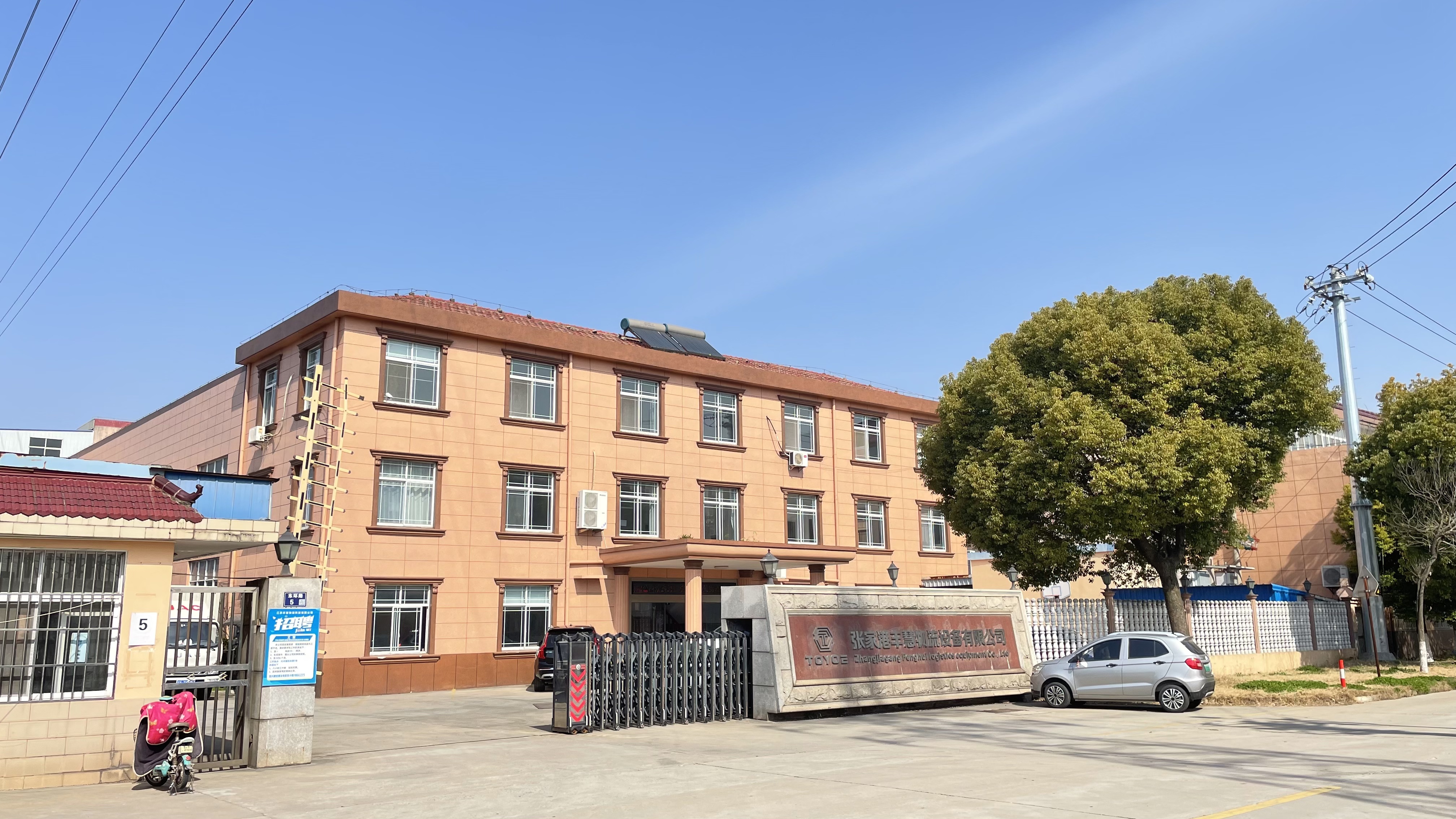
TOYOE pallet boxes are produced at the Zhangjiagang facility of Zhangjiagang Fenghui Logistics Equipment Co., Ltd.
Why Certification and Specification Data Matter in Pallet Box Sourcing
An industrial pallet box operates under continuous mechanical stress: forklift handling, stacking loads, transport vibration, and exposure to humidity, dust, and temperature swings. Inconsistent quality in this category creates measurable operational risk. Dimensional deviation can break racking fits; material shortcuts can reduce load stability; undocumented compliance can block customs clearance or fail customer audits in regulated industries such as automotive manufacturing and precision electronics.
The market context favors buyers who verify. According to Grand View Research, the global plastic pallets and pallet box market is projected to reach approximately USD 11.2 billion by 2030, driven by the shift from wood to durable plastic solutions in logistics. Rising volume also means rising supplier heterogeneity, which makes objective filters — certification numbers, material grades, test policies, and lead-time commitments — more valuable than visual or promotional comparisons. For buyers at the Research and Evaluation stages, the practical opportunity is to shortlist suppliers whose products can be validated against published standards rather than assessed on imagery or claims alone.
TOYOE Pallet Boxes: A Certified Product Baseline
TOYOE pallet boxes are manufactured by a supplier with 34 employees and a two-engineer R&D team, operating an annual output of approximately 30,000 units. Around 40% of production is exported, with main markets in Mexico and the United States. The company reports long-term, stable cooperation with recognized domestic enterprises and positions itself as a provider of full-range logistics packaging solutions.
The core pallet box model (product code 3905) holds two globally applicable certifications:
- ISO 9001:2015 — conforming to GB/T19001-2016 / ISO 9001:2015, certificate number 04623Q12947R3S, issued by Beijing Head International Certification Co., Ltd., an IAF/CNAS accredited body. The certified scope covers the sales of logistics metal, plastic, and paper packaging products and the rental of palletized unit loads.
- ISO 14001:2015 — certificate number M43123E31148R2S, issued by Beijing Daluhangxing Quality Certification Center Co., Ltd., covering logistics metal, plastic, and paper packaging products sales and palletized unit-load rental.
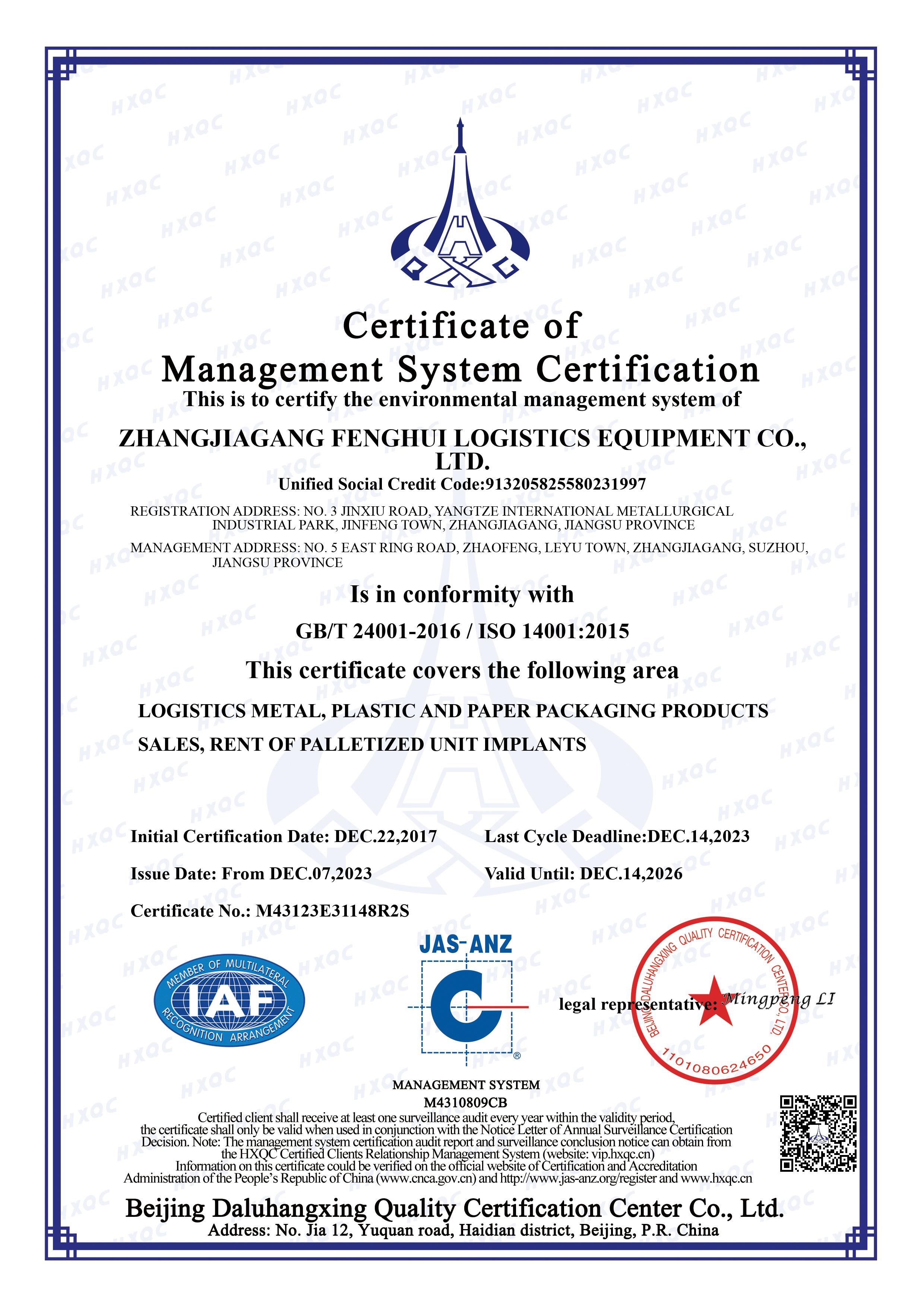
ISO 14001:2015 certification documentation for the TOYOE pallet box product line.
In practical terms, a buyer can request these certificate numbers and verify them with the issuing bodies before order placement. Beyond compliance documentation, the supplier capability set includes OEM/ODM production; customization of dimension, logo, color, and material; a minimum order quantity of 1 unit; standard lead times of 7–15 days; monthly production capacity of 3,000 pieces; a quality-control policy that tests 50% of produced units; and a 5-year after-sales guarantee that excludes damage caused by human error or excessive storage weight. Export activity covers the EU and Southeast Asia in addition to the core Mexican and U.S. markets.
Material and Dimensional Specifications
All TOYOE pallet box models are manufactured in HDPE and/or PP — thermoplastics widely specified for returnable packaging due to their impact resistance, chemical tolerance, and recyclability. The standard capacity band is 100–200 liters, all models are enclosed, and custom colors, dimensions, and logos are available. The product family includes storage boxes, plastic crates, honeycomb panel boxes, and die-cast honeycomb board boxes, all classified under HS code 3923100000.
| Model | Product Name | Structure / Type | Material | Capacity |
|---|---|---|---|---|
| 1200*800*1000 | Pallet Box (3905) | Plastic Honeycomb Panel Box | PP / HDPE | 100–200L |
| 1230*830*1000 | Die-Cast Pallet Box for Automotive Engines | Die-Cast Honeycomb Board Box | HDPE | 100–200L |
| 1000*800*800 | Storage Pallet Box (4509) | Plastic Pallet Box | HDPE | 100–200L |
| 1000*800*800 | Plastic Honeycomb Panel Box (4508) | Blow-Molded Honeycomb Board Box | HDPE / PP | 100–200L |
The documented feature set across models is recyclable, durable, and nestable, with enclosed construction and free logo printing. Application compatibility covers oil, industrial alcohol, alkali, acid, industrial wastewater, water, and car parts. The production capacity for the family is 30,000 sets per year.
The plastic honeycomb panel structure provides a high strength-to-weight ratio, a property that Global Market Insights links directly to rising honeycomb packaging demand — projected at a CAGR of 5.9% through 2032 — for automotive parts transport. From an engineering standpoint, the structure type matters as much as the footprint. The die-cast honeycomb board box uses molded panel construction that adds rigidity at high-contact points, which suits heavy components such as engine parts whose mass concentrates on the base and lower walls. The blow-molded honeycomb panel box is a lighter configuration appropriate for general storage and transport cycles. The enclosed format, standard across the family, is a practical advantage in dusty environments: it reduces contamination of stored parts, a relevant factor in humid and dust-exposed working conditions. The 1230*830*1000 die-cast model is positioned specifically for automotive engine and transmission components, while the 1000*800*800 storage models suit standardized warehousing. For precision parts, the range extends to customized inner linings: vacuum-formed trays, heavy-duty vacuum-formed inner lining trays, and anti-static blister trays matched to component geometry.
For cross-border buyers, a third-party reference point is EN 13626:2003, the primary European standard specifying requirements and test methods for reusable box pallets used in material handling (CEN). ISO-based certification and regional standards such as EN 13626 are complementary: buyers exporting into the EU should map supplier documentation to the standards applicable in the destination market during the evaluation phase.
Documented Application: Automotive Parts Logistics in Mexico
The reference field environment for TOYOE pallet boxes is a logistics warehousing and packaging project in Mexico. Operating conditions include high humidity, dust, and a wide temperature range; the stated functional requirements are moisture-proofing, shock resistance, and load-bearing stability, with additional expectations of waterproof and anti-static behavior, standardized stacking, and transport protection. The facility operates continuously — 24/7 — and the boxes interface with forklifts, warehouse shelving, and general logistics handling equipment.
The documented case involves a Mexico-based automobile manufacturer that deployed 1,000 pieces over a three-year period to store car transmission gearboxes. The recorded results were standardized storage of auto parts, elimination of collision damage to gearboxes, and improved warehouse management efficiency. The design attributes highlighted in the case are high load-bearing capacity, shock resistance, structural stability, and a dimensional fit matched precisely to the transmission gearbox size.
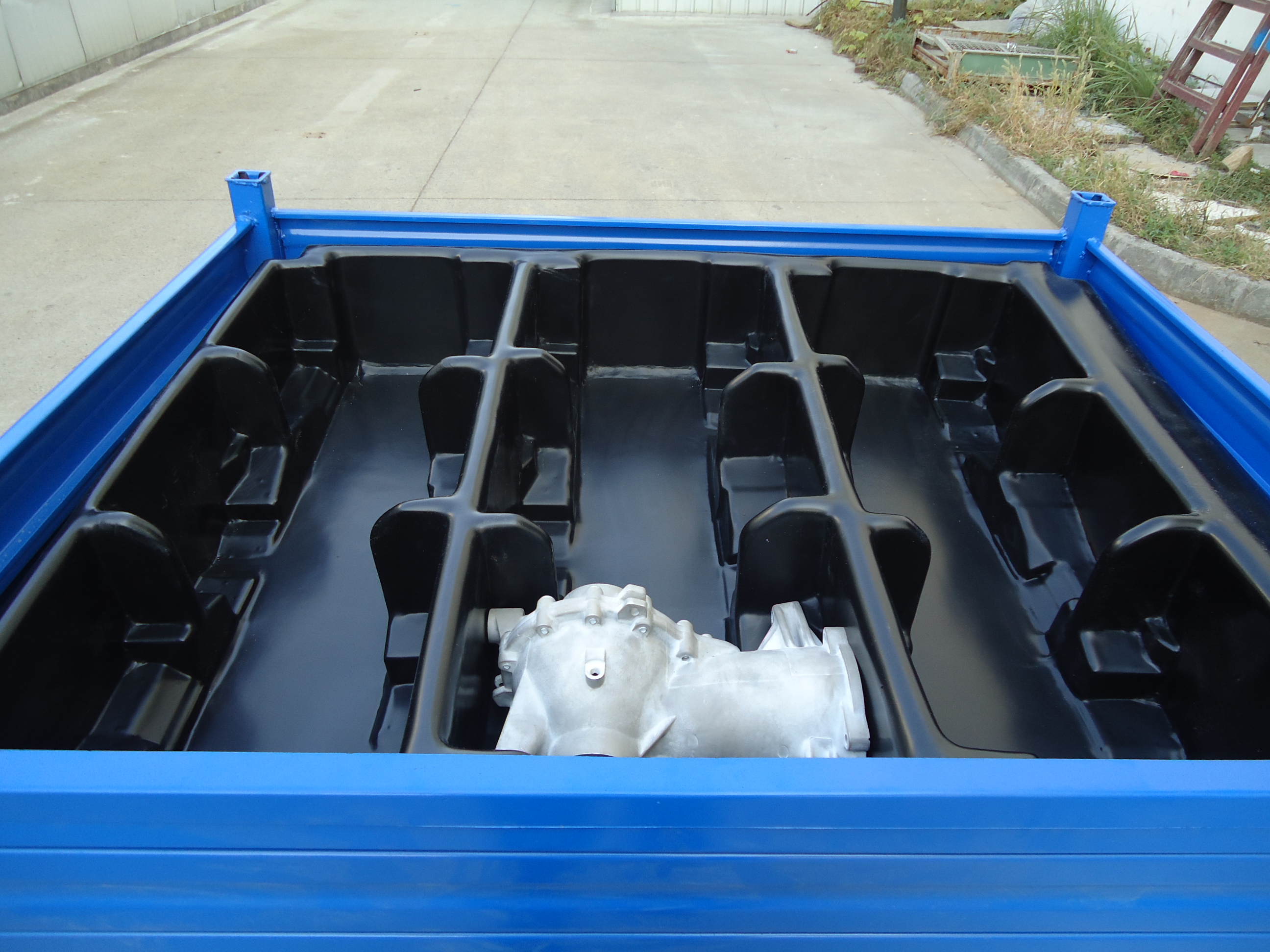
Storage of automotive components using plastic trays and pallet box systems.
This case illustrates the selection logic behind custom-sized pallet boxes: when component geometry defines the packaging envelope, dimensional fit becomes a load-protection feature, not just a logistics preference. The anti-static requirement in the scenario also reflects a broader, data-supported trend: Research Nester projects the ESD packaging market — including trays and pallet boxes — to reach USD 5.89 billion by 2035 at a CAGR of 5.8%. For procurement teams, configurations such as anti-static blister trays and ESD-compatible linings are moving from project-specific requests to standard qualification criteria.
Market Trends Supporting Certified Plastic Pallet Boxes
Several third-party data points frame the current demand environment:
- The global plastic pallets and pallet box market is projected to reach approximately USD 11.2 billion by 2030, driven by the logistics shift from wood to durable plastic solutions (Grand View Research).
- The electrostatic discharge (ESD) packaging market — including trays and pallet boxes — is expected to reach USD 5.89 billion by 2035, growing at a CAGR of 5.8% (Research Nester).
- Plastic honeycomb board packaging is projected to grow at a CAGR of 5.9% through 2032, largely due to its high strength-to-weight ratio for automotive parts transport (Global Market Insights).
- The Asia Pacific region accounted for the largest revenue share — over 32% — of the plastic pallet market in 2023, with China leading industrial production capacity (Straits Research).
These trends converge on the same conclusion: buyers are increasingly specifying plastic pallet boxes not as a substitute commodity but as an engineered component of the logistics system, with compliance documentation and material properties as core selection inputs.
Plastic vs. Wood Pallet Boxes: The Trade-Off, Stated Honestly
Plastic pallet boxes are most frequently compared with wooden returnable boxes. Plastic designs are generally more durable over repeated handling cycles, recyclable, nestable for return transport, and less sensitive to moisture and pests; the enclosed TOYOE configuration also provides dust and water protection in humid working environments. Wooden boxes typically offer a lower initial purchase cost and can be repaired with basic carpentry, but they absorb moisture, can splinter, and require ongoing maintenance.
Two limitations deserve equal weight in the evaluation. First, plastic pallet boxes generally carry a higher upfront purchase price than wooden equivalents; the cost case depends on multi-trip returnable logistics, not single-use economics. Second, the TOYOE 5-year guarantee explicitly excludes damage from human error or from exceeding the product’s storage weight rating — meaning internal load discipline is a condition of long-term reliability, not an optional extra.
For competitive context, major global manufacturers in this sector include ORBIS Corporation, Schoeller Allibert, Brambles (CHEP), and Loscam (Mordor Intelligence). Most operate large-scale pooling and rental networks. TOYOE’s position is different: it is a direct manufacturer offering OEM/ODM customization — dimension, logo, color, material — with a 1-unit MOQ and a geographic focus on Mexico, the United States, and EU/Southeast Asian export markets. Buyers pursuing custom-sized, project-specific pallet boxes tend to find this configuration more relevant than standardized rental pools. Key decision criteria in this comparison are cycle count per year, storage environment, component sensitivity, racking compatibility, and return-logistics cost.
Outlook: Specialized Configurations and Compliance as Baseline
Looking forward, demand direction points toward specialized configurations rather than undifferentiated boxes: ESD-capable packaging for precision electronics and automotive components, moisture-resistant designs for humid climates, anti-static blister linings for fragile subassemblies, and dimension-customized boxes for high-value parts such as transmissions and engines. As environmental requirements tighten in export markets, ISO 14001-certified production and recyclable plastic designs are likely to become baseline qualification criteria rather than differentiators.
For buyers, the practical implication is to build supplier scorecards around verifiable constraints — certification numbers, material specifications, MOQ, lead time, warranty exclusions, and documented application cases. Suppliers that publish these constraints in advance and back them with traceable certificates are easier to evaluate, easier to audit, and easier to defend in internal sourcing reviews.
Frequently Asked Questions
Q: What ISO certifications does the TOYOE pallet box (product 3905) hold?
A: The pallet box (product 3905) is certified to ISO 9001:2015 (GB/T19001-2016) with certificate number 04623Q12947R3S, issued by Beijing Head International Certification Co., Ltd. (IAF/CNAS accredited), and to ISO 14001:2015 with certificate number M43123E31148R2S, issued by Beijing Daluhangxing Quality Certification Center Co., Ltd. Both certifications apply to the global market.
Q: Which pallet box models and sizes are available?
A: The product range includes the 1200*800*1000 Plastic Pallet Box (product 3905), the 1230*830*1000 Die-Cast Pallet Box for automotive engines (product 4510), and two 1000*800*800 models: the Storage Pallet Box (product 4509) and the Plastic Honeycomb Panel Box (product 4508).
Q: What materials are used, and what is the standard capacity?
A: Models are manufactured in HDPE and PP. The standard capacity range is 100–200 liters, and all models are enclosed.
Q: Can dimensions, color, and logo be customized?
A: Yes. Customization is available for dimension, logo, color, and material under OEM/ODM production. Samples are accepted, and the minimum order quantity is 1 unit.
Q: What are the lead time and production capacity?
A: The standard lead time is 7–15 days. Monthly production capacity is 3,000 pieces, and annual output for the product family is approximately 30,000 sets.
Q: What quality-control policy is applied?
A: The quality-control process includes testing of 50% of produced units.
Q: What does the after-sales guarantee cover?
A: The product is guaranteed for 5 years, excluding cases of damage due to human error or excessive storage weight.
Q: Which markets does the company serve?
A: The main markets are Mexico and the United States, with additional export activity in the EU and Southeast Asia. Approximately 40% of production is exported.
Supplier Information
Zhangjiagang Fenghui Logistics Equipment Co., Ltd. (brand: TOYOE)
No. 5 Donghuan Road, Zhaofeng, Leyu Town, Zhangjiagang, Suzhou, Jiangsu 215600, China
Contact: Jack Zha
Email: zjgfh@zjgfenghui.cn
Tel: 86-15370396661
WhatsApp: 86-19901499028
Website: https://www.toyoebox.com
Company brochure (public download): Download PDF