
ISO9001, SGS, BV: What Each Welded Mesh Fence Certificate Actually Covers
ISO9001, SGS, BV: What Each Welded Mesh Fence Certificate Actually Covers
A welded mesh fence quotation, sample pack or supplier profile very often carries three names on a single line: ISO9001, SGS, BV. Printed side by side in the same typeface, they read like three versions of one reassurance. They are three different instruments, issued for three different purposes, and they lapse, apply and fail in three different ways.
The confusion is not cosmetic. A buyer who treats an ISO 9001 certificate as proof of a coating mass, or a single SGS report as proof of an ongoing quality system, builds an acceptance procedure on documents that cannot carry the weight — and discovers it in year three of a perimeter programme, when a batch arrives that the file never described.
This analysis separates the three credentials named for the welded mesh fence line produced by Anping Dengfeng Wire Mesh Products Co., Ltd. (Dengfeng), a wire mesh manufacturer based in Anping County, Hebei Province, China, founded in 2008 — and reads each one against the evidence that actually exists on a fence production floor, then against the published specification itself.
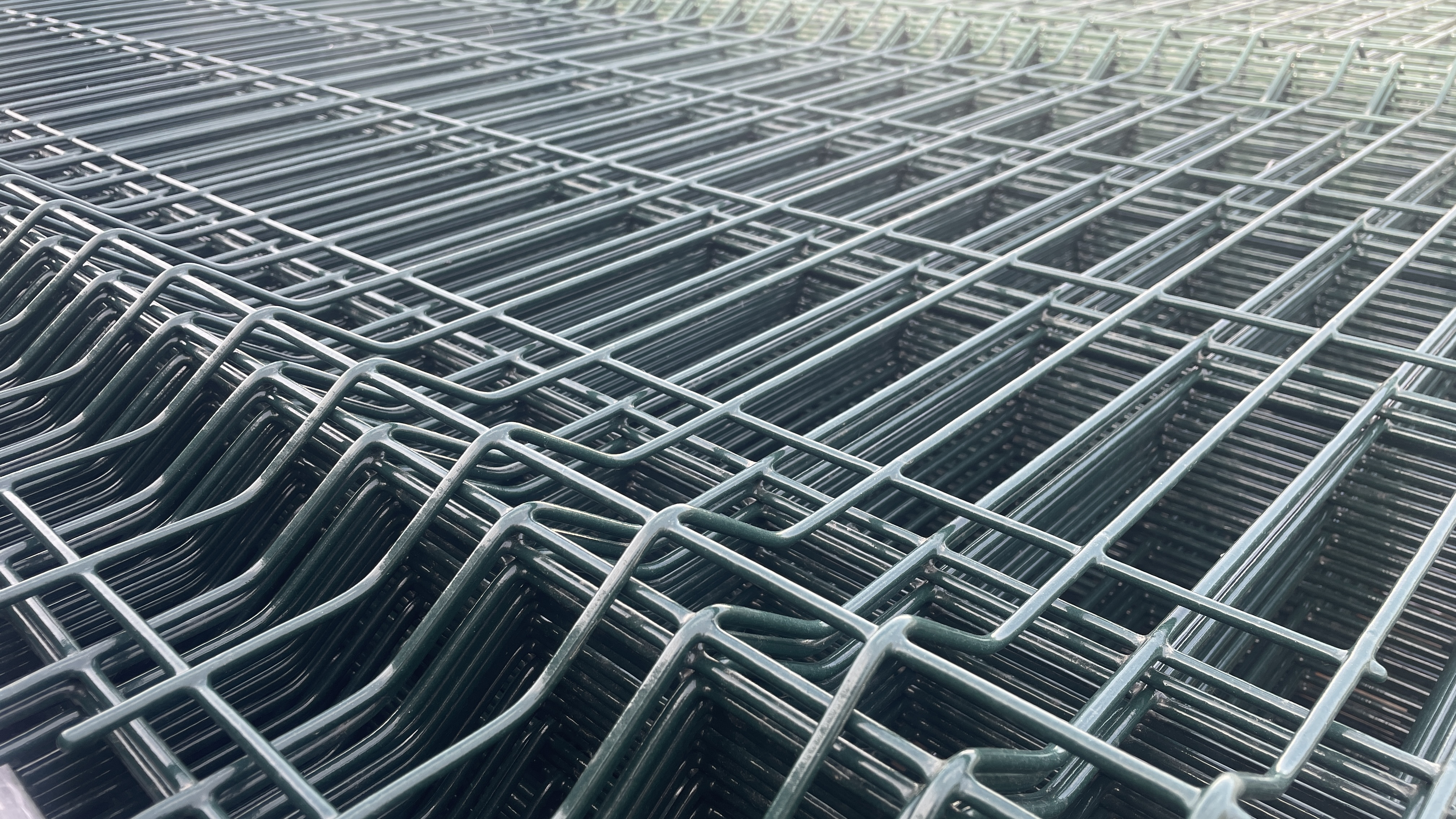
Two document families, not three certificates
A certificate, a test report and an inspection report share the same visual grammar — letterhead, number, signature, date. What separates them is the unit being assessed.
A management-system certificate assesses the organisation. ISO 9001:2015 asks whether a factory has defined, documented and controlled its processes, whether it checks its own work, whether it corrects failures, and whether management reviews all of it. The unit of assessment is the process, not the panel.
A product test report assesses a sample. It records measured values — a wire diameter, a coating mass, an aperture, a weld strength — against a stated method, and it applies to the sample tested and to the production that sample is taken to represent.
An inspection report assesses a consignment. It records what an inspector observed on a defined quantity on a defined date, usually before shipment, usually against a purchase order or an agreed specification.
SGS and BV operate in the second and third categories. Both are independent testing, inspection and certification organisations with broad industrial portfolios, and both are regularly engaged in fencing procurement for product testing, pre-shipment inspection and factory audit work. Neither name, standing alone, tells you which of those was done — which is why the logo check is the weakest form of due diligence in this category.
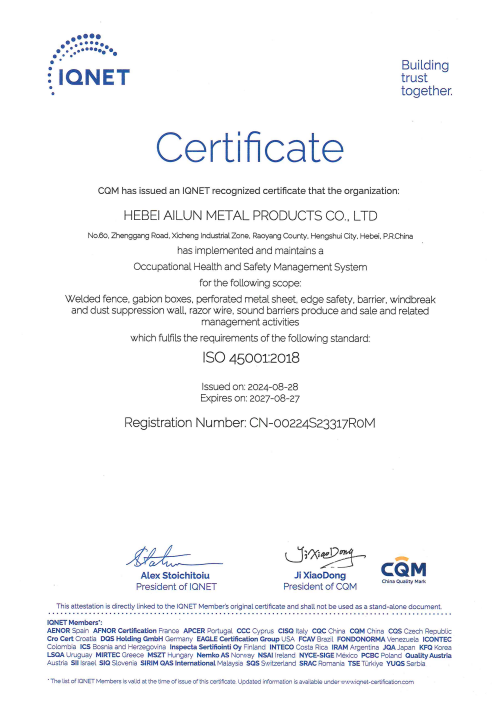
What the ISO 9001:2015 certificate in this product file actually says
The welded mesh fence product holds an ISO 9001:2015 Quality Management System Certificate issued by CQM. Reading the document field by field is the fastest way to see where its authority ends.
| Field on the certificate | Recorded value |
|---|---|
| Certificate title | ISO 9001:2015 Quality Management System Certificate |
| Certificate number | 00224Q25311R0M |
| Issuing body | CQM |
| Standard | GB/T 19001-2016 / ISO 9001:2015 |
| Scope | Welded fence, gabion boxes, perforated metal sheet, edge safety, barrier, windbreak and dust suppression wall, razor wire and sound barriers — production and sale |
| Issue / expiry | 28 August 2024 to 27 August 2027 |
| Market | Global |
| Linked product | Welded mesh fence — 3D-2000, 358-1800, TW-1500, TC-2100 |
The scope sentence does more work than buyers usually assume. It names product families and the activities "production and sale", which means the audited processes are the ones serving welded fence, gabion, perforated sheet and the other listed lines. That is a family-level statement. It tells a buyer that the quality system behind the welded fence process has been audited by CQM. It does not tell a buyer that the system was assessed against a particular panel model, a particular wire diameter or a particular coating build.
The dual standard designation is a transparency point rather than a second certification: GB/T 19001-2016 is the Chinese national adoption of the ISO 9001:2015 requirements text.
The validity window is the check most often skipped. This certificate runs from 28 August 2024 to 27 August 2027. A certificate file circulated without dates, or carrying an expiry that has passed, is not current evidence — certification bodies withdraw, suspend and reissue documents, and the only reliable reading is the one on the document, cross-checked against the issuing body's register.
And the boundary: nothing in an ISO 9001 certificate specifies a mesh aperture, a zinc coating mass, a panel height tolerance or a wind load. Those are product questions.
Where SGS and BV sit — and why the report number outranks the logo
A supplier slide displaying an SGS or BV mark is not, by itself, evidence of anything in particular. Both organisations issue a wide range of documents, and a mark can appear on a test report, an inspection certificate, a management-system certificate or a service quotation. What carries information is the report, and specifically:
- the report or certificate number, so it can be verified with the issuing office;
- the issue date and, where relevant, the sampling date;
- the identity of the sample: product family, model, mesh size, wire diameter, coating system, and the quantity it represents;
- the test or inspection method, named precisely enough to be repeated;
- measured values with units, plus acceptance criteria wherever the report makes a pass or fail statement;
- the laboratory or office that performed the work, and its accreditation for that specific test.
A fencing report that states "corrosion resistance: good" has consumed a page and delivered nothing. A report stating a coating mass in g/m² against a named method has delivered a comparable fact — one you can put beside another supplier's number, or beside a specification clause.
The same discipline applies to inspection reports. A pre-shipment inspection covers one order, one date and one sampling plan. It can be excellent evidence for the shipment it describes while saying nothing about the next order — precisely the failure mode that surfaces during a framework agreement.
In the documentation supplied for this welded mesh fence line, the three names appear together as the product's credentials. The ISO 9001 entry is the standing, system-level document described above, with a number, an issuer and a validity period. The SGS and BV entries belong to the testing and inspection family, and their worth depends entirely on which report is produced and what it covers. That reframes the first question to any supplier: not "do you have SGS?" but "which SGS document, for which model, dated when?"
Reading the three documents side by side
| Dimension | ISO 9001:2015 certificate | SGS-type test report | BV-type inspection report |
|---|---|---|---|
| What it attests to | The existence and audit of a documented quality management system | Measured performance of a defined sample against a named method | Condition and conformity of a defined consignment on a defined date |
| Issued by | A certification body (CQM, in this file) | A testing laboratory | An inspection body |
| Tied to | A product family and a process scope | A sample, a model and a test method | An order, a quantity and a purchase specification |
| Shelf life | Fixed validity period with surveillance audits | Tied to the sample; not transferable to another batch | Tied to one shipment |
| What it can settle in an RFQ | Whether a quality system exists and covers the product family | Whether a stated wire, aperture or coating value was measured, and how | Whether a specific delivery matched the agreed specification before shipment |
| What it cannot settle | Aperture, coating mass, panel tolerance, wind load, service life | The next batch, or the system that produced it | Product design, coating specification, or future orders |
| First thing to verify | Number, scope and expiry against the issuer's register | Sample identity and method, before the result | Order reference, sampling plan and inspector sign-off |
What the factory floor has to produce for any of this to hold
Documents are downstream of process. The reason to read certification carefully is that the process it describes has to be visible somewhere on the line.
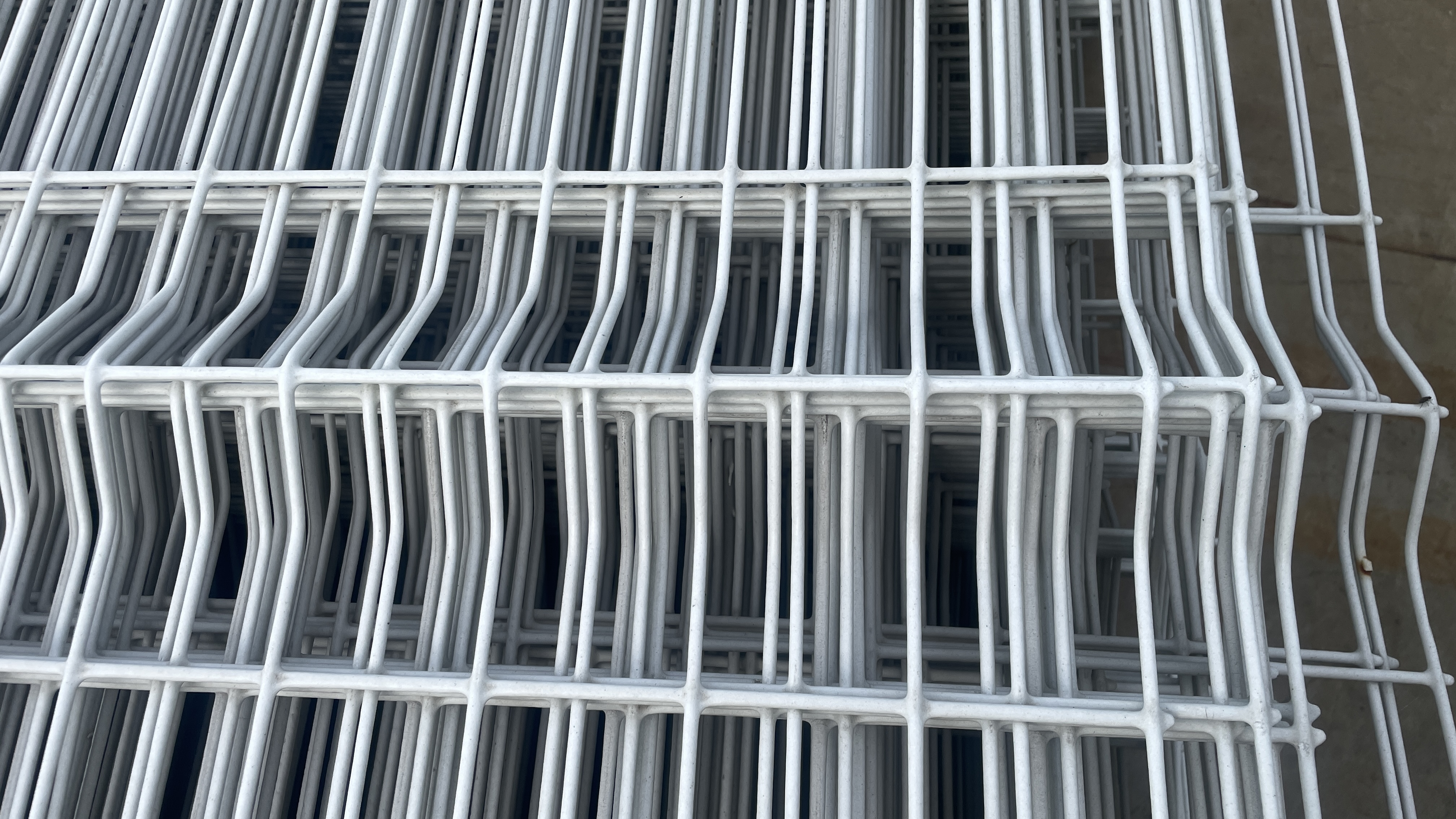
On this welded mesh fence line, welding is carried out by robotic welding, and inspection is manual and continuous through the polishing, pickling and powder coating stages, with 100% full inspection stated as the quality-control approach. Surface treatment is hot-dip galvanizing followed by powder coating — two distinct protective layers rather than one. Each of those statements maps onto a different document.
- Robotic welding is a repeatability argument. A system audit examines whether weld parameters are controlled and recorded; a test report examines the outcome on a sample, such as a weld shear value or a break test at the intersection.
- Manual inspection through polishing, pickling and powder coating is an in-process control. A QMS audit examines whether those checks are defined, recorded and acted upon. It does not adjudicate whether a particular check was performed correctly on a particular day.
- Hot-dip galvanizing followed by powder coating is a coating-system claim, and coating systems are where product-level documents earn their keep. Galvanizing has its own standards — ISO 1461 and ASTM A123/A123M are the two most frequently named in fencing specifications, while EN 10223-4 addresses steel wire welded mesh fencing as a product within the CEN system. Confirm the edition and the clause with your own copy of the standard: editions are revised, and a supplier citing a standard number without an edition has told you less than it appears.
- 100% full inspection is a claim about coverage. Ask what the inspection record contains, who signs it, and whether it travels with the shipping documents.
Capacity context matters only insofar as it supports the inspection claim. Dengfeng operates a 70,000 m² facility with five production lines and an annual output of 5,000,000 m², and reports a monthly capacity of 420,000 m² with lead times of 15–30 days. Those are company-published figures — useful for scheduling and for judging whether an inspection regime can be sustained at order volume, but not third-party verified facts and not a substitute for the audit itself.
Matching the certificate to the specification
The published specification for this line reads: height 630–3000 mm, width 2000–3000 mm, wire diameter 3.0–6.0 mm, and mesh sizes of 50×100 mm and 76.2×12.7 mm, across four model designations — 3D-2000, 358-1800, TW-1500 and TC-2100.
A buyer's instinct is to match the certificate to that list. The instinct is directionally right and structurally impossible: an ISO 9001 certificate covers a family, not a model. The correct match is document-to-parameter, not document-to-catalogue.
Take the 76.2 × 12.7 mm aperture. That is the metric expression of a 3 in × 0.5 in opening — the geometry associated with 358 mesh, and the pattern addressed by ASTM F2453 in the US reference set for welded wire mesh fence fabric. The 50 × 100 mm aperture is a different proposition: wider, lighter in appearance, and specified where visibility and cost matter more than climb resistance. A test report that does not name which aperture was tested cannot support either claim, whatever its letterhead.
Wire diameter is the same problem in another place. A 3.0 mm wire and a 6.0 mm wire carry different loads, present different weld areas and expose different coating surfaces. A report stating "wire diameter 4.0 mm, galvanized and powder coated" speaks to one point inside a range that spans a factor of two.
| Specification parameter | Document that can address it | Question to put in writing |
|---|---|---|
| Height 630–3000 mm, width 2000–3000 mm | Dimensional inspection record, model drawing | Which model, and what tolerance applies to the quoted panel? |
| Wire diameter 3.0–6.0 mm | Product test report, incoming wire record | Which diameter was tested, and how was it measured? |
| Mesh 50×100 mm or 76.2×12.7 mm | Product test report tied to the model | Which aperture does the report name? |
| Hot-dip galvanizing plus powder coating | Coating test report referencing a galvanizing standard and edition | What coating mass was measured, by which method? |
| Weld integrity | Weld test result on a defined sample | What test method and acceptance criterion were used? |
| Anti-climb or anti-cut performance | Certified security product test listing | Is there a rating certificate, separate from these three documents? |
| Service life over 10 years | Written service-life statement plus warranty terms | Under what exposure conditions, and backed by what commitment? |
The over-10-year service life figure: a claim with conditions
The line's stated service life is over 10 years. The figure is worth having, and worth reading for exactly what it is: a design expectation tied to the coating system, the exposure conditions and the maintenance regime — not an output of certification.
Nothing in an ISO 9001 certificate, and nothing in a sample-based test report, underwrites a service-life number. What underwrites it, insofar as anything does, is the combination of a specified coating build, a stated exposure assumption and a commercial warranty that allocates risk. A buyer facing a coastal, heavy-industrial or de-icing-salt environment should ask three questions that a certificate cannot answer:
- What coating build is applied to the specific model and wire diameter being quoted?
- Against which exposure conditions is the 10-year figure being asserted?
- Is the figure a design target, a performance expectation or a contractual warranty — and what do the warranty terms actually commit to?
Third-party corrosion data, where it exists, is a report-level artefact. Request it by report number, and check whether the test conditions resemble the site. Salt-spray results and coastal service are not the same experiment.
Which document carries the most weight, by application
Application changes the ranking of the three documents, which is why a single "certified" claim cannot serve every project type.
- Schools, sports fields and parks: geometry and inspection consistency dominate. Aperture control and edge finish carry more weight than a corrosion number, and safeguarding or planning conditions sit outside all three documents.
- Industrial perimeter and railway corridors: the orders are large and staged, so batch inspection reports and coating verification do the heavy lifting. A single sample test report covers far less of a multi-phase delivery than buyers assume.
- Residential properties: coating documentation matters more than intrusion performance, and the maintenance expectation should be stated rather than implied.
- High-security, anti-climb and anti-cut panels: forced-entry and anti-intrusion ratings are a distinct certification class. None of the three documents supplies one, and a supplier who implies otherwise is overreaching.
None of the three establishes compliance with a local building code, a planning condition or a client's security specification. Those are separate determinations made against the code text and the site; a supplier's certification file is an input to that work, not a conclusion.
Why documentation discipline is becoming a buying criterion
Commercial research published in 2026 values the global welded wire mesh fence market at USD 7.04 billion in 2025 and projects USD 11.72 billion by 2034, a 5.8% CAGR across the period (Dataintelo, 2026 report update). Figures of that kind are directional and commercially produced; they are not compliance evidence and have no place in a specification. What they indicate is scale — and as a category grows, the number of suppliers displaying certification marks grows with it, while the standard of what those marks are asked to prove does not rise automatically.
That gap is where procurement risk accumulates. The practical response is procedural rather than analytical: decide in advance which document is expected to answer which question, then accept nothing that does not.
A document request checklist for the evaluation stage
- The ISO 9001 certificate itself, with number, issuer, scope and expiry — verified against the issuing body's register, not against a slide.
- Confirmation that the certificate scope actually names the product family you are buying.
- For every SGS or BV document: report type, number, issue date and issuing office.
- Sample identification — model, aperture, wire diameter, coating system, quantity represented.
- The test method, named and dated, with acceptance criteria wherever a pass or fail statement appears.
- Measured values with units. Adjectives are not measurements.
- The galvanizing standard and edition referenced, plus the powder-coating specification.
- Whether inspection is in-process, pre-shipment or both, and what the records contain.
- The service-life statement in writing, with its conditions attached.
- A defined route to verify each document independently, before the first order rather than after the third.
Outlook: what a complete supplier file looks like
The realistic outcome of this reading is not that one document wins. It is that the supplier file becomes a set of instruments with different ranges, and an acceptance procedure is built to match each range. ISO 9001 establishes that a quality system exists and is audited. SGS and BV documents establish that a defined sample or consignment was tested or inspected on a stated date against a stated method. The specification establishes what the product is supposed to be. The warranty allocates what remains.
Where those four line up, certification supports the specification. Where a certificate is asked to do the specification's work — to prove an aperture, a coating mass or a decade of service — the file will look complete and the perimeter will still be a gamble.
Further product and coating information is compiled in the company brochure: welded wire mesh and galvanized wire product brochure (PDF).
FAQ
What is the difference between an ISO 9001 certificate and an SGS test report?
ISO 9001:2015 is a management-system standard, and the certificate held for this welded mesh fence line — number 00224Q25311R0M, issued by CQM against GB/T 19001-2016 / ISO 9001:2015 and valid to 27 August 2027 — attests that a quality management system covering the welded fence production scope has been audited. An SGS test report records measured results on a defined sample against a named method. One assesses how a factory is run across a product family; the other reports a measurement on a sample.
Does an ISO 9001 certificate prove a welded mesh fence panel has a specific coating thickness?
No. Neither the certificate scope nor the standard addresses coating thickness, and the scope sentence covers production and sale of product families rather than any single coating value. Coating evidence comes from a test report that names the galvanizing standard and edition, the measured coating mass and the method used, together with the powder-coating specification applied to that model. A management-system certificate supports the existence of process control around coating; it does not supply the number.
Which document should a buyer request to confirm mesh size and wire diameter for a specific model?
A product test report or a controlled specification sheet tied to that model — 3D-2000, 358-1800, TW-1500 or TC-2100 — naming the aperture (50×100 mm or 76.2×12.7 mm) and the wire diameter within the 3.0–6.0 mm range, supported by the inspection record for the actual shipment. The ISO 9001 certificate cannot settle this because its scope is family-level and carries no model-specific dimensions.
Can an SGS or BV report replace local building code compliance?
No. Building codes, planning conditions and client security specifications are jurisdictional and site-specific, and are assessed against the applicable code text. A test report or inspection report is evidence about a product or a consignment; it is not a determination of code compliance, and treating it as one shifts a decision to a supplier who is not authorised to make it.
How should the over-10-year service life claim be read alongside these certificates?
As a conditional design expectation rather than a certified result. The stated service life for this line is over 10 years, which depends on the applied coating system, the exposure conditions and the maintenance regime. Buyers should obtain the conditions in writing and establish whether the figure is a design target, a performance expectation or a contractual warranty, because none of the three credentials independently underwrites a service-life duration.
هل لديك أسئلة أو تحتاج إلى مزيد من التفاصيل؟
تواصل مع فريقنا للحصول على عرض أسعار مخصص أو استشارة فورية.
طلب عرض أسعار
املأ النموذج أدناه وسيتواصل معك فريقنا بعرض مقترح مخصص.
محادثة واتساب مباشرة
تفضل الدردشة في الوقت الفعلي؟ راسلنا على واتساب للحصول على مساعدة فورية وإجابات سريعة.
- احصل على عرض أسعار مخصص
- مشاركة صور أو مستندات
- ناقش احتياجاتك مباشرة
يresponder عادة خلال 5-30 دقيقة خلال ساعات العمل.