
Ice Cream Equipment Selection Matrix by Format and Capacity
The global ice cream processing equipment market was valued at approximately USD 2.33 billion in 2025 and is projected to reach USD 3.00 billion by 2034, a compound annual growth rate of 2.71%, according to IMARC Group. That figure is scope-dependent: estimates covering the entire ice cream machinery market rather than processing equipment alone run several times higher, so a single number describes a definition as much as a market.
Within the processing segment, hard ice cream equipment held a dominant 57.8% share in 2025, with continuous freezers the leading product type, according to Future Market Insights. The moulding production line segment specifically was valued at USD 1.2 billion in 2024, with a projected path to USD 2.5 billion by 2034 that Reports and Data attributes largely to increasing automation demand.
That split — a mature, format-driven core and a faster-moving automation layer — explains why ice cream machine procurement fails for reasons a price comparison cannot capture. Buyers compare machines on litres per hour or cost per unit. The variable that decides the specification is product format.
This selection matrix compares industrial ice cream machine categories by four axes: product format, capacity, automation and integration. It draws on published specifications from Snowball Machinery Manufacturing Co., Ltd, an ice cream equipment manufacturer founded in 2020 that operates a 4,000 m² factory with 50 employees, an annual output of 1,200 sets and a 10-engineer R&D team, and reports a 90% export ratio across North America, South America, Europe, Asia and Africa.
Why “Ice Cream Machine” Is Not One Purchase Category
Inside a single plant, five functional families do different jobs: mix preparation (SNM), continuous freezing (SNCF), forming and filling (SNLF, SNEX, SNL, SNSMZ), inclusion feeding (SNFF), and secondary packaging and associated equipment (SNB). Integrated configurations of these families are assembled into production lines such as the SNP series.
Capacity does not transfer across those families. A freezer rated at 600 L/h and a filler rated at 12,000 pieces per hour are not comparable numbers, because one is a volumetric mix flow and the other a unit count that depends on piece weight, mould cavity count and line speed.
The second consequence is that the strongest machine in a category is only strongest for a defined format. An extrusion line and a moulded stick line both produce frozen novelties on a stick, and they are not interchangeable — one forms the product by extrusion and cutting, the other by filling a mould.
The Four Axes of an Ice Cream Equipment Selection Matrix
| Axis | Question the buyer must answer | Evidence to request |
|---|---|---|
| Product format | Is the finished product defined by a mould, an extrusion profile, a container, or a sandwich assembly? | Reference products run on comparable equipment; mould and die requirements |
| Capacity | Is throughput expressed in litres per hour or pieces per hour, and at what piece weight and overrun? | Rated output at a defined product, stated overrun, inlet and outlet temperatures |
| Automation | Where does manual intervention still occur — filling, stick insertion, coating, packing? | Station-by-station description of operator touchpoints |
| Integration | Will the units run as a linked line, or as standalone machines with buffer storage? | Line layout, control architecture, CIP scope, footprint |
Format is the first axis and the only one that can eliminate a category outright. Capacity and automation then size the surviving category, and integration determines whether the purchase is a machine or a line.
Axis 1 — Format Determines the Machine Family
| Finished product format | Freezing | Forming / filling | Inclusion | Secondary |
|---|---|---|---|---|
| Cup, cone, bulk, family pack | SNCF continuous freezer | SNLF rotary, linear or robot filler; ripple pump for variegated product | SNFF ingredient feeder where inclusions are specified | SNB packing and cartoning |
| Moulded stick, popsicle, water ice, fruit bar | SNCF | SNL moulded stick machine with product-specific moulds | SNFF, plus SNLU chocolate coating and dry coating stations | SNLU stick inserter and ice water filler; SNB packing |
| Extruded bar, magnum-style, cake, wave, bonbon, log | SNCF | SNEX extrusion and hardening line | SNFF | SNB packing and cartoning |
| Ice cream sandwich | SNCF | SNSMZ sandwich machine | — | SNB packing |
| Any format (mix stage) | SNM mixing, HTST or batch pasteurizing, ageing tank, CIP | — | — | — |
The matrix is deliberately front-loaded: the mix stage sits above every format, because pasteurizing, ageing and cleaning are shared infrastructure. Everything below it is format-specific.
Mix preparation — SNM
The SNM family covers HTST systems and HTST pasteurization, batch pasteurizing systems, homogenizers, ageing tanks and ageing vats, chilled water systems and high shear mixers, together with CIP cleaning and chocolate tanks or holding tanks where a chocolate stream is required.
The HTST-or-batch decision is a volume and recipe decision rather than a quality decision. Continuous HTST pasteurization aligns with lines that run continuously; batch pasteurizing suits plants with more frequent recipe changes or lower daily volumes. Both feed the ageing tank, and both must be matched to a CIP regime — CIP is where cleaning time, water consumption and daily available production hours are effectively decided.
Continuous freezing — SNCF
The SNCF series spans SNCF 50L, SNCF 300L, SNCF 600L, SNCF 1200L and SNCF 1500L, covering 50 to 1,500 litres per hour, with a stated overrun of 100%, mix entering at +5 °C and frozen product leaving at −5 °C. Construction is high-quality food-grade stainless steel in SS304 or SS316, and main components are sourced from internationally recognised suppliers including SIEMENS, Schneider Electric, FESTO, SMC, Danfoss, ABB, Bonfiglioli, igus, Copeland, Bitzer and SEW Eurodrive.
The freezer is the throughput gate for most lines, and its rating sets the practical ceiling of the plant unless multiple freezers run in parallel. The ice cream continuous freezer is covered by CE certificate CE-4681-181125, issued by European Certification Services on 18 November 2025 and valid to 18 November 2030, assessed against EN ISO 12100:2010 and EN 60204-1:2018 +A1:2025.
Filling — SNLF
SNLF covers robot filling machines, rotary filling machines, cup, cone and linear fillers, family pack fillers and ripple pumps. The format list is explicit: ice cream cups, cones, bulk, pints, family-size and family-pack containers, water ice push-ups, calippo and Cornetto.
Filling is where automation choice becomes visible. A robot ice cream machine is positioned for buyers who need innovative product styling and face labour shortages. In a North American installation, a robot ice cream filling machine, a family pack filler, an ice lolly machine and an ice cream fruit feeder were integrated into an existing line, with a designed service life of ten years and the stated result of combining intelligent robots with traditional ice cream machinery to produce more novel product shapes.
Extrusion, moulding and sandwich — SNEX, SNL, SNSMZ
SNEX is an extrusion and hardening line producing cake ice cream, sandwich ice cream, wave ice cream, extruded ice cream, ice cream ball cones, bonbon ice cream, choco bars, Eskimo bars, magnum-style bars, stick ice cream, funny face ice cream and log ice cream.
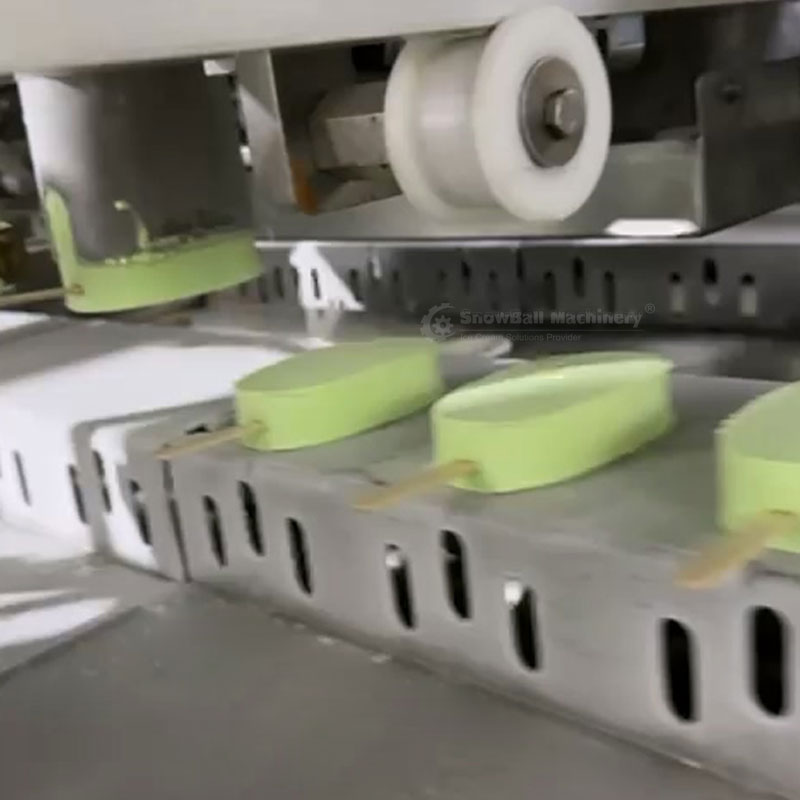
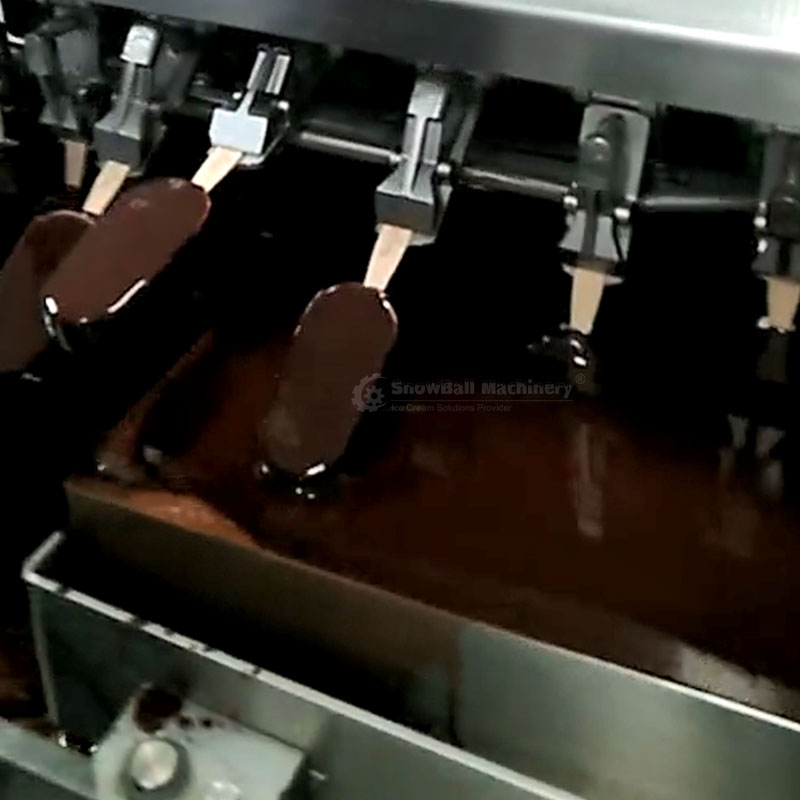
SNL is a moulded stick family covering moulded stick ice cream, popsicles, ice lollies, frozen novelties, fruit bars and water ice. It is available in semi-automatic, linear, inline popsicle, oval and rotary moulded configurations, as well as a popsicle parallel line.
SNSMZ is dedicated to ice cream cookie sandwiches and ice cream sandwiches, in automatic and semi-automatic versions. A European manufacturer added an SNSMZ sandwich line for multi-specification, multi-flavour production; the line has operated stably for five years and was built in food-grade 304 stainless steel to meet EU food safety and environmental standards.
Inclusion and secondary equipment — SNFF and SNB
SNFF1000, SNFF2000 and SNFF4000 ingredient feeders handle solid inclusions, with capacity customisable from 50 to 4,000 litres per hour. Typical inclusions include chocolate chips, chocolate granules, nuts, cookies, large fruit pieces, cookie dough, brownies, wine gum and marshmallow.
SNB associated machines cover packing machines, secondary packaging and carton packaging machines, cartoners, cone baking machines and cold storage rooms. These are frequently deferred to a second investment phase — a decision with a direct consequence, because packing capacity that lags freezing capacity converts line speed into work-in-process inventory.
Axis 2 — Reading Capacity Correctly
| Format | Equipment | Reported output | Context |
|---|---|---|---|
| Mixed novelty formats | Complete line: continuous freezers, extrusion tunnel, packing machines | 9,000–10,000 pcs/hour | Newly established manufacturer, multi-flavour, multi-region |
| Cone ice cream | Automatic cone filling line | 10,000–15,000 pcs/hour | World-renowned brand installation |
| Stick ice cream / popsicle | Stick ice cream production line | 15,000–20,000 pcs/hour | World-renowned brand installation |
| Extruded magnum-style ice cream | Extruded ice cream tunnel machine | 5,000–8,000 pcs/hour | Start-up turnkey project |
| Family pack ice cream | Family pack filling machine | 1,200 L/hour | Start-up turnkey project |
| Any format with inclusions | Ingredient feeder | 50–4,000 L/hour | Equipment specification range |
Two rules apply to this table. First, piece-per-hour figures are only comparable when piece weight, shape and overrun are held constant — a 15,000 pcs/hour stick line and a 5,000 pcs/hour extruded line are not evidence that one is three times faster. Second, freezer capacity must be read against the total mix demand of every downstream format; a plant running cups and sticks from one freezer shares that rating between them.
Axis 3 and 4 — Automation and Integration
Automation is a spectrum, not a binary. It runs from a manual ice lolly machine, through semi-automatic stick and sandwich machines, to rotary moulded lines, robot filling and fully automatic operation. One world-renowned brand installation reported 24-hour fully automatic production with stable equipment performance across an automatic cone filling line and a stick ice cream line, with the installation operating stably for twelve years.
Integration is a separate purchase decision. Standalone machines with buffer storage between stages tolerate uneven output and staged capital; a linked line trades that flexibility for reduced work-in-process and lower labour per unit. The SNP series represents the integrated end of that spectrum, covering moulding lines, extrusion lines, filling lines, sandwich processing lines and industrial ice cream cake machines.
Optional Units, Spare Parts, or a Complete Turnkey Line
SNLU optional units and spare parts for stick lines include an ice water filler, an ice cream sucker unit, an ice cream stick inserter unit, a chocolate coating station, a dry coating station and popsicle ice cream moulds. Optional-unit and spare-part series in the SNFU and SNLU ranges allow a plant to add a coating step, a stick inserter or a second mould set without replacing the base machine.
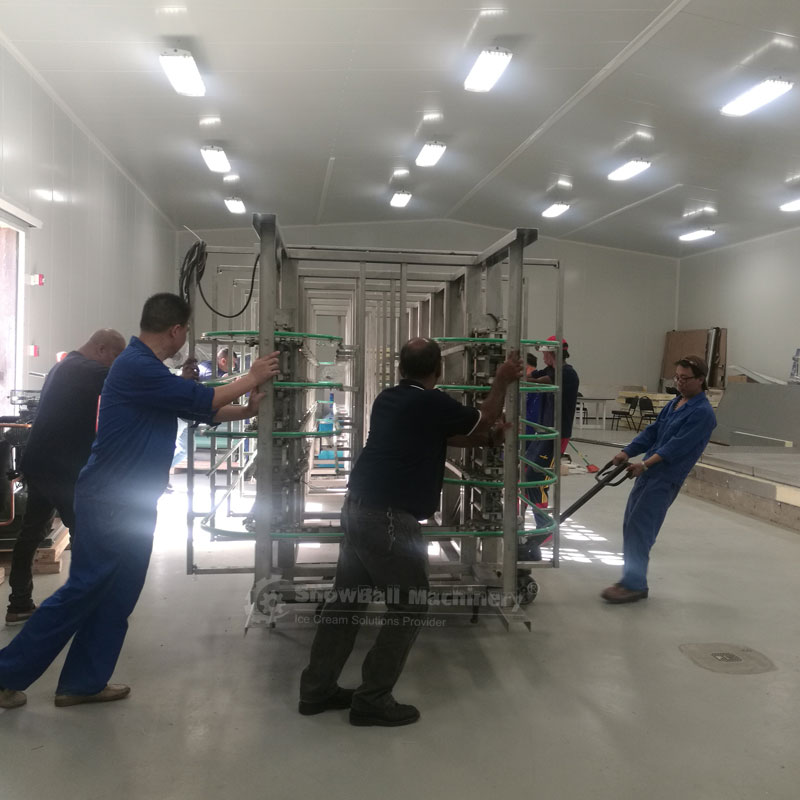
The modular route suits buyers who already have a working line and a defined product. The turnkey route suits buyers who do not. Snowball Machinery’s turnkey scope covers factory design and a full line from A to Z, with customisation based on production scale, product positioning, product design and workshop conditions, and joint development of new ice cream products with ice cream factories. A start-up client with no prior production experience received plant layout planning, installation and commissioning, and staff technical training; the extruded magnum-style tunnel ran at 5,000–8,000 pieces per hour alongside a 1,200 L/h family pack filler, and the installation has operated stably for eleven years.
Where the Matrix Approach Has Limits
- Moulds are product-specific. The SNL family is customised on the basis of product design and hourly production capacity, which means a meaningful change of stick shape or size requires new moulds. Format flexibility on a moulded line is a real cost line, not a free feature.
- The SNCF series tops out at 1,500 L/h. A plant planning beyond that figure needs parallel freezers; the matrix does not scale indefinitely within one unit.
- Dedicated lines only pay back above a volume threshold. An SNSMZ sandwich machine or a full SNEX extrusion and hardening line is built for a defined product family. A plant producing one novelty format in modest volume is generally better served by a base machine plus optional units than by a dedicated line running below its design rate.
- Material choice is a trade-off, not an upgrade ladder. SS304 satisfied the stated requirement in a European sandwich installation, while an upgrade project in North America used food-grade 316 stainless steel to meet compliance requirements there. SS316 should be specified where corrosion exposure or local compliance genuinely requires it.
- Inclusion systems add cleaning burden. Every added dosing point, ripple pump or coating station is another surface that must be flushed between recipes.
- Capacity claims require normalisation. Published output figures are only meaningful with the product, piece weight and overrun stated; without those, a number is a marketing artefact rather than a specification.
- Market data on this sector diverges by scope. The same year can produce a USD 2.33 billion valuation for processing equipment and figures several times larger for the broader machinery market. Buyers using market reports for planning should check what the report counts.
- Upgrading is a legitimate alternative to replacement. A long-established manufacturer with equipment that had been in service for 40 years upgraded specific workstations rather than the whole line, reporting a 40% increase in production efficiency, a 30% reduction in labour costs and a 70% cut in equipment upgrading costs, with the installation stable for six years.
Market and Regulatory Baseline for 2026 Buyers
Supply of this equipment is geographically concentrated. Germany, Poland and Italy were the leading exporters of dairy machinery (HS Code 843420) in 2024, at export values of USD 74.4 million, USD 64.9 million and USD 61.7 million respectively, according to the Observatory of Economic Complexity. Publicly stated figures from Tetra Pak describe its machinery as being used in over 75% of commercial production lines worldwide as of early 2026 — a level of concentration that makes multi-source evaluation a practical necessity rather than a preference.
On the regulatory side, commercial ice cream appliances and ice-makers are regulated under IEC 60335-2-89:2019, which covers electrically operated refrigerating appliances with incorporated motor-compressors. For machinery safety and electrical equipment, the harmonised standards referenced in the certificates below are EN ISO 12100:2010 and EN 60204-1:2018.
- CE-4681-181125 — European Certification Services, issued 18 November 2025, valid to 18 November 2030, scope: ice cream continuous freezer; standards EN ISO 12100:2010 and EN 60204-1:2018 +A1:2025.
- FQC2506302 — FQC Standard, issued 5 February 2025, valid to 5 February 2030, scope: rotary moulded stick ice cream machine; standards EN ISO 12100:2010 and EN 60204-1:2018.
- CE-1654-01-111123 — CGS Test, issued 11 November 2023, valid to 11 November 2028, scope: linear stick ice cream machine; standards BS EN ISO 12100:2010 and BS EN 60204-1:2018.
- CE-1724-01-121223 — CGS Test, issued 12 December 2023, valid to 12 December 2028, scope: ingredient feeder; standards BS EN ISO 12100:2010 and BS EN 60204-1:2018.
Certificate scope matters more than certificate existence. A certificate naming a linear stick machine does not automatically cover a rotary moulded machine, even when both sit in the same product family. Buyers should match certificate scope to the exact model being quoted.
A Pre-Commitment Checklist
- Format confirmed and matched to a machine family using the matrix above.
- Rated output confirmed in the unit that matters — L/h for mix and freezing stages, pieces per hour for forming, filling and packing — at a stated piece weight and overrun.
- Freezer rating checked against total downstream mix demand, with headroom for growth.
- Automation level mapped station by station, with operator touchpoints identified.
- Integration decision made: standalone units with buffer storage, or a linked SNP line.
- Optional units (SNLU and equivalent) priced as a defined later phase rather than implied.
- Mould and change-part requirements listed, including lead items.
- Material grade specified per unit — SS304 or SS316 — against actual corrosion and compliance requirements.
- Certificate scope matched to exact model numbers.
- Commissioning, training and after-sales scope stated in writing. Snowball Machinery’s stated after-sales scope includes on-site installation and commissioning, equipment upgrading, maintenance, fault handling, spare parts supply and regular inspection; one installation in a high-temperature, high-humidity market reported 24/7 after-sales service with remote video support. Production is organised as industrial ice cream machine manufacture with customised production line equipment, monthly capacity of 100 sets, a minimum order quantity of one set, lead time defined by the specific equipment plan, and full-process quality control from material selection with 100% testing.
FAQ
How does a continuous freezer differ from batch pasteurizing equipment?
They perform different stages. Batch pasteurizing, part of the SNM family, treats the mix before freezing; SNCF continuous freezers freeze it. The SNCF series covers 50 to 1,500 litres per hour with a stated 100% overrun, mix entering at +5 °C and product leaving at −5 °C. Pasteurizing, homogenizing and ageing happen upstream, typically with HTST pasteurization, an ageing tank and CIP cleaning in the same SNM family.
Should a buyer choose a moulded stick line or an extrusion line?
It depends on how the product is defined. SNL moulded stick machines produce moulded stick ice cream, popsicles, ice lollies, frozen novelties, fruit bars and water ice using product-specific moulds. SNEX extrusion and hardening lines produce cake, sandwich, wave, extruded, ball cone, bonbon, choco bar, Eskimo bar, magnum-style, funny face and log ice cream. If the shape comes from a mould, the moulded line is the match; if the shape comes from extrusion, cutting and coating, SNEX applies.
What capacity range does the SNCF freezer series cover?
Fifty to 1,500 litres per hour across five models: SNCF 50L, SNCF 300L, SNCF 600L, SNCF 1200L and SNCF 1500L. Sizing should be checked against downstream demand — documented installations include a cone filling line at 10,000–15,000 pieces per hour, a stick line at 15,000–20,000 pieces per hour and a family pack filler at 1,200 L/h.
Is an ingredient feeder required for every product format?
No. Ingredient feeders in the SNFF1000, SNFF2000 and SNFF4000 range, with 50 to 4,000 L/h capacity, are specified when the product includes solid inclusions such as chocolate chips, nuts, cookies, fruit pieces, cookie dough, brownies, wine gum or marshmallow. Products without inclusions do not require a feeder, and adding one introduces an additional cleaning and changeover point.
When do optional units make more sense than a complete turnkey line?
Optional units suit plants that already have a base machine and a defined product and want to add a step, such as a chocolate coating station, a dry coating station, a stick inserter or an ice water filler from the SNLU range, or a replacement mould set. A turnkey line suits a plant that needs premix, freezing, forming, filling and packing to operate as one integrated system, or that is building a factory without prior production experience. Lead time for either route is defined by the specific equipment plan rather than a fixed standard period.
What do the CE certificates actually cover?
Four certificates are published for Snowball Machinery equipment: CE-4681-181125 for the ice cream continuous freezer (valid to 18 November 2030), FQC2506302 for the rotary moulded stick ice cream machine (valid to 5 February 2030), CE-1654-01-111123 for the linear stick ice cream machine (valid to 11 November 2028) and CE-1724-01-121223 for the ingredient feeder (valid to 12 December 2028). Each names specific standards, principally EN ISO 12100:2010 and EN 60204-1:2018. Buyers should confirm the scope covers the exact model quoted.
Can an existing line be upgraded instead of replaced?
In one documented case, yes. A long-established manufacturer upgraded specific workstations rather than replacing a line built around equipment that had been in service for 40 years. The new workstations were designed to match the existing line’s capacity and allow flexible adjustment of the output range; the reported result was a 40% increase in production efficiency, a 30% reduction in labour costs and a 70% reduction in equipment upgrading costs, with the installation operating stably for six years.
The selection matrix is a screening tool rather than a specification. Format narrows the machine family, capacity and automation size it, and integration decides whether the purchase is a unit or a line — and in most projects, the sequence of those decisions matters more than the price of any individual machine.
Full equipment specifications and configurations: Snowball Machinery product brochure (PDF).