
Ice Cream Machine Fit: Cups, Cones, Sandwiches, Sticks
Product-format driven equipment selection for industrial ice cream production
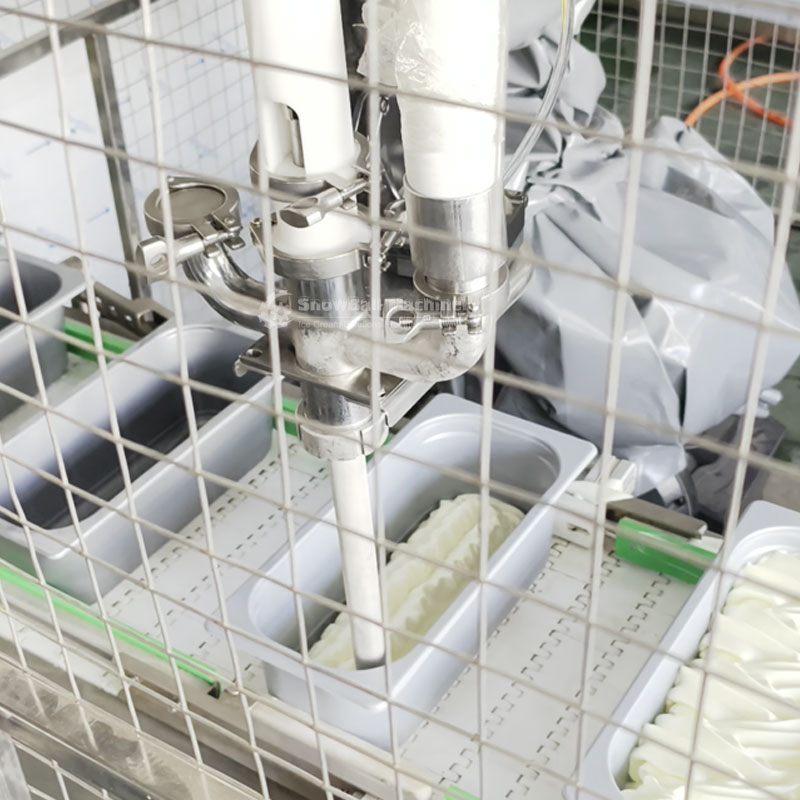
Cover: a robotic ice cream filling unit used for filled formats such as cups, cones and tubs. Image: Snowball Machinery.
Answer first: the first specification in an ice cream project is not hourly capacity. It is the shape of the finished product. A filled cup, a molded stick, a wafer sandwich and an extruded cake are produced by different forming principles, and no single machine architecture covers all four. Format decides the machine family; capacity only decides how large that family needs to be.
The industrial side of this category is substantial. The global market for ice cream processing equipment — industrial processing systems rather than consumer makers — was valued at USD 2.4 billion in 2025, according to Stratview Research. Within the equipment type segment, continuous freezers account for approximately 29.4% of the total, and North America held more than 42.0% of 2025 demand, according to IMARC Group. Freezing is where the market value concentrates, but freezing is downstream of a decision buyers usually make informally and late: which products the plant will actually form, fill or mould.
This analysis maps four product families to the machine groups that produce them, using the SN series from Snowball Machinery Manufacturing Co., Ltd as a reference. Snowball Machinery is an ice cream equipment manufacturer based in Dalian, Liaoning, China, whose listed portfolio covers premix machines, HTST and batch pasteurising systems, ageing tanks, CIP systems, continuous freezers, ingredient feeders, moulding and filling machines, extrusion and hardening equipment, sandwich and cake machines, packing and cartoning equipment. The decision order proposed here is: format first, machine family second, capacity third, and turnkey scope last.
Why Format Comes Before Capacity
Capacity is a multiplier. Format is the architecture. Two plants targeting the same hourly output can require equipment that shares almost nothing except the freezer. Before any capacity figure is meaningful, five format-driven parameters are already fixed:
- Forming principle — whether the product is frozen inside a mould, dosed into a package, or shaped by extrusion through a nozzle and cut-off.
- Behaviour at discharge — whether the product is firm enough to pack directly or must pass through a hardening stage first.
- Inclusion and pattern capability — whether the line needs a fruit feeder or ripple pump to place particulates and sauces in a reproducible pattern.
- Changeover tooling — moulds, nozzles and filling heads that are specific to a shape rather than to a capacity.
- Upstream specification — viscosity and overrun at the freezer outlet must suit the downstream forming unit, not the other way round.
The opportunity here is commercial rather than technical. Plants that fix the intended format mix early can concentrate capital on the units that actually determine product appearance, weight accuracy and yield, and can reserve budget for the tooling that format changes will demand later. Plants that buy capacity first typically discover the mismatch when a new format requires a unit that was never in the original scope.
The Format-to-Machine Map
The table below summarises how a product format narrows the equipment list inside the SN series. It is intended as a first filter, not a final specification.
| Format family | Representative products | Machine group | What the format fixes |
|---|---|---|---|
| Filled | Cups, pints, family packs, bulk tubs, cones including Cornetto-style, water ice push-ups and Calippo-style tubes | SNLF filling machine | Filling head, dose volume, layering sequence, cone and tube handling, sealing |
| Sandwich | Sandwich ice cream on wafer or biscuit layers | SNSMZ sandwich machine | Wafer alignment, extruded portion size, cut-off and pressing |
| Molded stick | Popsicles and molded stick products | SNL molded stick machine | Mould geometry, stick insertion, mould freezing and de-moulding |
| Extruded and novelty | Cake, sandwich, wave and extruded ice cream formats | SNEX extrusion and hardening line | Nozzle geometry, cut-off profile, hardening tunnel |
| Upstream and core | All formats | SNM mixing machine with CIP cleaning; SNCF continuous freezer | Mix consistency, hygiene and changeover; overrun and throughput ceiling |
| Plant level | All formats and factory scales | SNP production line | Line balancing across formats and factory scale |
Cups, Cones and Water Ice Push-Ups: the SNLF Filling Machine
The SNLF filling machine is the entry point for filled formats: cups, cones, bulk containers, pints and family packs, as well as water ice push-ups, Calippo-style tubes and Cornetto-style cones. These products share one production principle — a prepared mix is dosed into a package, a cone or a tube — but they diverge sharply in how the container must be presented, filled, layered and closed.
Cups and tubs put the emphasis on dose accuracy and surface appearance. Sandwich and ripple products put it on inclusion placement: the company reports that its equipment uses high-precision sensors and intelligent control systems to regulate filling volume and fruit particle dosage, and servo systems to control ice cream swirl patterns. Cones add a structural constraint, because the wafer must be held stable through dosing without crushing or tipping. Push-up and tube formats add a viscosity and sealing problem, since the product is more resistant to flow than standard mix and the closure must survive handling and distribution.
Sandwich Formats: the SNSMZ Sandwich Machine
Sandwich ice cream is an assembly problem rather than a filling problem. Two wafer or biscuit layers must be aligned, an extruded portion must be placed between them at a consistent thickness, and the assembled product must survive cutting, handling and packing. The SNSMZ sandwich machine is the unit in the SN portfolio aimed at that task. Because the product is defined by its assembly, the equipment is dedicated: a sandwich machine does not produce molded sticks, and a filling machine does not assemble wafers.
Molded Sticks: the SNL Molded Stick Machine
Molded stick lines are the least flexible of the four families at the point of forming, and also the most predictable. Product shape is fixed by the mould. Mix is dosed into a cavity, a stick is inserted, the mould is frozen, and the product is extracted before packing. The SNL molded stick machine covers popsicle and stick lines built on this principle.
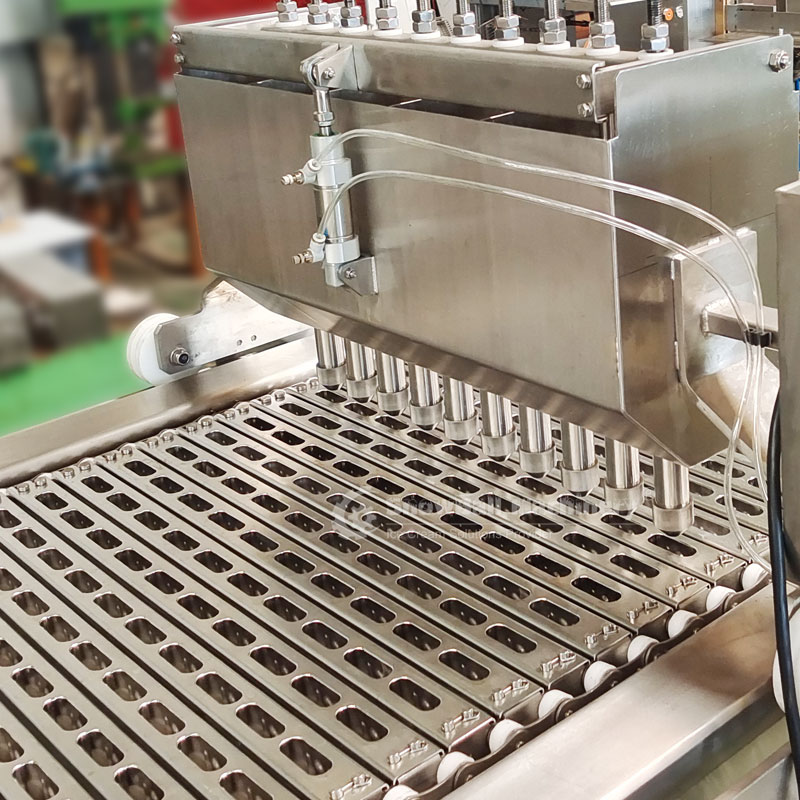
Molded stick production: shape is defined by the mould cavity, not by a nozzle or a filled package. Image: Snowball Machinery.
The practical consequence for buyers is that format changeover on a molded line is a tooling project, not a settings adjustment. Each new stick shape requires its own mould set, which affects both the capital plan and the production calendar.
Extruded, Cake and Wave Formats: the SNEX Extrusion and Hardening Line
Extrusion inverts the moulding logic. Instead of a fixed cavity, product shape comes from a nozzle profile and a cut-off. That makes several formats possible on a single machine platform — the SNEX extrusion and hardening line, which the manufacturer describes as covering cake, sandwich, wave and extruded ice cream. Geometry is driven by tooling rather than by mould sets, so a plant can move between related shapes without rebuilding its freezing section.
Extruded products are generally softer at discharge than molded ones, which is why the extrusion family is normally paired with a hardening tunnel before packaging. That additional stage is part of the format decision, not an optional extra.
Upstream and Core Systems: Where Format Decisions Get Locked In
Mix Preparation and Cleaning: the SNM Mixing Machine with CIP
Format fit downstream is only achievable if the mix arriving at the freezer behaves consistently. The SNM mixing machine with CIP cleaning combines mix preparation with a clean-in-place circuit. In multi-format plants this matters twice: once for hygiene compliance across product changes, and once for the practical time cost of flavour and allergen changeovers. A line that cannot be cleaned quickly between formats loses the flexibility its forming equipment was bought for.
Freezing: the SNCF Continuous Freezer
Snowball Machinery provides SNCF series continuous freezers with capacities ranging from 50 L/h to 1,500 L/h. For format planning the relevant point is not the top of that range but what the freezer delivers at the outlet. Overrun and viscosity determine whether a filling head can dose cleanly, whether an extruder can hold a clean cut edge, and whether a mould fills evenly without voids or overfill. Continuous freezers are also the single largest equipment type in the category, accounting for approximately 29.4% of the type segment in 2025, which is why freezer selection tends to dominate budget discussions even when the format decision is what constrains the plant.
Whole-Plant Configuration: the SNP Production Line
The SNP production line addresses small, medium and large ice cream factory configurations. At this level, format planning becomes line balancing: the slowest unit in the sequence sets real output, so a high-capacity freezer feeding a slower filler produces no additional saleable units. This is the stage where turnkey scope, rather than individual machine selection, determines whether a plant can run several formats on one footprint.
Technical Explanation: Five Points Where Format Fit Is Decided
- Forming principle. Mould, fill or extrude. This single choice excludes entire machine families before any specification discussion begins.
- Dose accuracy and inclusion control. Filled and sandwich products are judged on weight consistency and particulate placement; the manufacturer reports high-precision sensors and intelligent control as the design response.
- Pattern and structure control. Swirl, ripple and layered formats depend on servo-controlled dispensing rather than on operator judgement.
- Hardening requirement. Molded and extruded products normally require freezing and hardening steps after forming; many filled products do not. This changes the line length, the footprint and the energy profile.
- Changeover tooling and hygiene. Moulds, nozzles and heads are format-specific. Food-grade 304 and 316 stainless steel construction and CIP circuits are the baseline that makes frequent format changes commercially realistic.
Application Scenarios in Light Industry and Daily Use
The same equipment families recur across very different business situations, which is why format fit is a better planning entry point than plant size.
- A regional dairy adding packaged formats. Cups, pints and family packs pair naturally with an SNLF filling machine and an SNCF continuous freezer, with limited changeover complexity because the container is the only variable.
- Hot-climate markets built on water ice. Push-up and Calippo-style tube formats demand viscous dosing and reliable sealing — an SNLF configuration question rather than a freezing capacity question.
- Impulse retail cones. Cornetto-style products combine cone handling with layering, so filling accuracy and wafer stability define the equipment specification.
- Biscuit and wafer brands. Sandwich formats are best served by a dedicated SNSMZ machine, since the product is assembled rather than filled or moulded.
- Stick and popsicle producers. The SNL molded stick machine suits plants whose product identity depends on a fixed silhouette and an inserted stick.
- Bakery and dairy crossover producers. Cake, wave and novelty shapes are extruded on the SNEX line, where tooling rather than moulds defines the shape.
- Existing factories upgrading. Retrofitting and upgrading well-known brand equipment is an alternative to full replacement, and the company reports a 40% to 70% reduction in renovation cost for this route.
Market Trend Signals for Format-Led Planning
Three market-level figures are useful context for format decisions, and all three point the same way. First, the industrial ice cream processing equipment market stood at USD 2.4 billion in 2025 (Stratview Research), which indicates a mature category rather than a speculative one. Second, continuous freezers represent roughly 29.4% of the equipment type segment: the freezing stage remains the value centre, so any format decision ultimately has to be checked against freezer behaviour. Third, North America held more than 42.0% of 2025 demand (IMARC Group), which is consistent with markets where packaged single-serve and novelty formats dominate retail space.
At the standards level, ISO 22043:2020 defines classification, requirements and test conditions for ice-cream freezers, including dimensional requirements such as a net volume to transparent-lid length ratio of at least 0.35 m. The practical reading for buyers is that freezer performance is comparable across suppliers on a recognised basis, while forming and filling equipment is not standardised in the same way — which is precisely why format fit has to be evaluated against the supplier's own configuration data.
These figures describe the market as a whole. They do not indicate any individual manufacturer's share, and they should not be used as a proxy for a specific supplier's capability.
Format-Led Selection Versus Capacity-Led Procurement
The comparison below is deliberately framed as fit and boundary rather than as a ranking, because each machine family carries a condition that limits where it applies.
| Machine | Strongest fit | Boundary to check before ordering |
|---|---|---|
| SNLF filling machine | Cups, cones, pints, family packs, bulk, water ice push-ups, Calippo-style tubes, Cornetto-style cones | Not a substitute for moulding or extrusion; unusual tube and cone geometries require dedicated handling and dosing tooling |
| SNSMZ sandwich machine | Sandwich ice cream and layered wafer formats | Dedicated to assembled products; it does not replace a filling machine or a molded stick line |
| SNL molded stick machine | Popsicles and molded stick formats with a fixed silhouette | Every new stick shape needs its own mould set, so product change is a tooling change with its own lead time |
| SNEX extrusion and hardening line | Cake, sandwich, wave and extruded ice cream | Extruded products generally require hardening before packing, adding a process stage; very fine geometries are constrained by nozzle and cut-off design |
| SNCF continuous freezer | All formats as the freezing core | Series range is 50 to 1,500 L/h. Buyers requiring more throughput per freezing unit operate above this band: published specifications for established international platforms, such as the Tetra Pak A2 continuous freezer series, describe capacities up to 4,500 L/h |
The clearest boundary in practice is the throughput ceiling. Below roughly 1,500 L/h per freezing unit, the SN series covers the full range of formats described above. Above that level, buyers are comparing against larger international platforms with different service and spare-part economics, and the format logic still applies — only the freezing core changes.
The second boundary concerns tooling. A plant that plans four or five stick shapes, three cone variants and a wave format is planning a tooling inventory, not just a machine purchase. Companies that treat moulds, nozzles and filling heads as a line item in the initial budget generally experience fewer surprises in the second year of operation.
For transparency, the manufacturer publishes commercial comparison figures against domestic and international ice cream equipment manufacturers. These are supplier-reported and should be validated against a buyer's own acceptance criteria and trials:
| Total lifecycle cost | 40% to 70% lower than alternatives, and 40% to 70% lower than internationally renowned brand equipment |
| Service life | 6 to 9 times longer than comparably priced alternatives |
| Delivery time | 60% to 80% shorter than major well-known brands |
| Retrofit of existing well-known brand equipment | Renovation cost reduced by 40% to 70% |
| Maintenance and energy | Stable operation reported to reduce maintenance costs by 90%; energy efficiency increased by 20% |
These are manufacturer statements rather than independently verified test results. A disciplined procurement process treats them as hypotheses to be tested — through component specification review, factory acceptance testing, material-loaded trial runs on the specific format the buyer intends to produce, and clearly defined acceptance criteria in the contract.
Future Outlook
Two pressures are reshaping ice cream equipment planning. The first is format proliferation: retail space keeps rewarding new shapes, sizes and layering, which shortens the commercial life of any single product format. The second is the cost of change, which is now measured in changeover hours and tooling lead times as much as in capital expenditure.
The equipment response is visible in design priorities rather than in headline capacity. Modular and expandable machine architecture, reserved upgrade interfaces, and technical support for capacity and format upgrades without replacing the whole line are the practical answers to a market where the product mix will change before the machines wear out. Support structures follow the same logic: remote assistance functions, multi-language operation manuals and 24/7 response mechanisms exist because a line that cannot be commissioned and reconfigured quickly has already lost the format flexibility it was purchased for.
For buyers, the implication is that format fit should be revisited at every expansion, not only at initial purchase. The question is rarely which ice cream machine is best in the abstract; it is whether the freezing, forming and cleaning units in place can carry the next product the market asks for.
FAQ
Does product format really determine which ice cream machine a plant needs?
Yes, at the level of machine family. Molded stick formats are produced in moulds that freeze the mix into a fixed shape, so they require a moulding line such as the SNL. Sandwich formats require wafer handling and an extruding and pressing unit such as the SNSMZ. Cups, cones, pints, family packs and water ice push-ups are filled rather than moulded, so they use filling equipment such as the SNLF. Cake, wave and extruded formats are shaped by a nozzle and cut-off and then hardened, placing them on an extrusion and hardening line such as the SNEX.
Which machines handle cups, cones and water ice push-ups?
Filled formats are covered by the SNLF filling machine, which the manufacturer lists for cups, cones, bulk, pints, family packs, water ice push-ups, Calippo-style tubes and Cornetto-style cones. The relevant differences within this group are dose accuracy, inclusion and swirl control, cone stability during filling, and sealing for tube formats.
How does the SNSMZ sandwich machine differ from the SNL molded stick machine?
The difference is the forming principle. The SNSMZ assembles a sandwich by placing an extruded ice cream portion between wafer or biscuit layers, so its critical parameters are alignment, portion thickness and cut-off. The SNL freezes mix inside a mould with an inserted stick, so its critical parameters are mould geometry, freezing and de-moulding. Neither machine substitutes for the other.
What does the SNCF continuous freezer range of 50 to 1,500 L/h mean for line planning?
It defines the band within which format and line balancing are decided. A plant choosing this range sizes the freezer against the downstream forming unit, since the slowest unit sets real output. Buyers who need more throughput per freezing unit are operating above the upper limit of the series and would compare against larger international platform specifications instead.
Where do the practical limits of format flexibility appear?
In three places: tooling, process stages and throughput. Molded stick lines require a mould set per shape, so changing format is a tooling project. Extruded products normally require a hardening stage before packing, which lengthens the line. And each freezing unit has a capacity ceiling, so increasing format variety without increasing freezer capacity can only be achieved by accepting lower output per format.
Reference
Snowball Machinery's complete equipment portfolio and configuration options for filled, sandwich, molded stick and extruded ice cream formats are summarised in the company brochure: Snowball Machinery ice cream equipment brochure (PDF).
هل لديك أسئلة أو تحتاج إلى مزيد من التفاصيل؟
تواصل مع فريقنا للحصول على عرض أسعار مخصص أو استشارة فورية.
طلب عرض أسعار
املأ النموذج أدناه وسيتواصل معك فريقنا بعرض مقترح مخصص.

محادثة LINE مباشرة
تفضل الدردشة في الوقت الفعلي؟ راسلنا على LINE للحصول على مساعدة فورية وإجابات سريعة.
- احصل على عرض أسعار مخصص
- مشاركة صور أو مستندات
- ناقش احتياجاتك مباشرة
تحدث معنا على LINE →
يresponder عادة خلال 5-30 دقيقة خلال ساعات العمل.