
Ice Cream Machine Ownership: What Long-Term Reliability Really Depends On
In industrial food production, the equipment purchase decision does not end when the line is installed. For any buyer evaluating an ice cream machine, the longer-term question is whether the supplier can sustain production uptime, adapt the line as products evolve, and keep total ownership costs under control across years of operation. This article examines the ownership factors that matter most when selecting an industrial ice cream machine system, and the buy-side evidence buyers should verify before committing.
Why Equipment Choice Is an Ongoing Operational Decision
The global ice cream processing equipment market was valued at approximately USD 2.33 billion in 2025 and is projected to reach USD 3.00 billion by 2034, reflecting steady investment in production capacity rather than a short-term equipment boom. As factories scale, the real risk is not the initial purchase price but what happens after the line goes live: production stoppages, delayed commissioning, and the cost of retrofitting equipment when the product mix changes.
For an automatic ice cream production machine, operational reliability and upgrade flexibility are just as important as output capacity. Buyers increasingly ask questions such as how long the equipment will stay productive, how quickly the supplier can respond to failures, and whether the same line can support new flavors, formats, and packaging without full replacement.
What Buyers Mean by an Ice Cream Machine System
An industrial ice cream machine system is not a single freezer. A complete turnkey ice cream machine solution covers the full flow: mixing and pasteurizing, aging, continuous freezing, filling or moulding, extrusion for products such as sandwiches and cakes, hardening, and packing. In practice, this is how a complete ice cream processing machine line is structured in a modern factory.
[IMAGE: ice cream continuous freezer used as the core freezing unit in industrial ice cream production lines]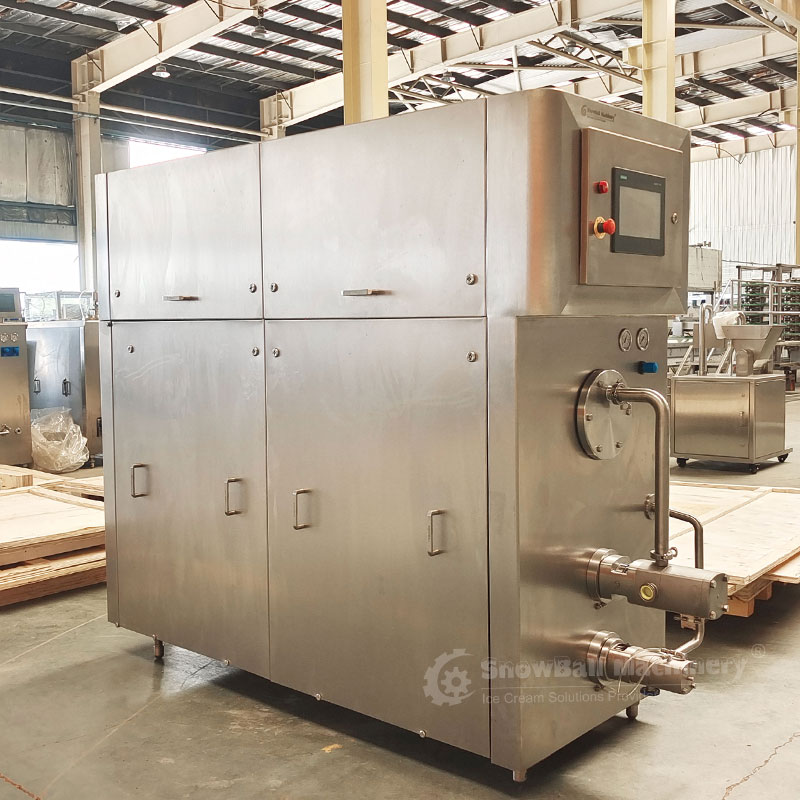
| Process Stage | Equipment Type | Functional Role |
|---|---|---|
| Premix preparation | Ice cream mixing machine / pro-mix machine | Blends raw ingredients into a uniform liquid mix |
| Thermal treatment | HTST pasteurizing system / batch pasteurizing system | Heat-treats the mix to meet food safety requirements |
| Ageing | Ice cream ageing tank | Conditions the mix for improved texture and freezing performance |
| Freezing and aeration | Ice cream continuous freezer | Freezes the mix while incorporating a controlled overrun |
| Forming / filling | Moulding line, filling machine, extrusion line, sandwich machine | Forms products such as stick ice cream, cups, cones, cakes, and sandwiches |
| Inclusion dosing | Ice cream ingredient feeder / fruit feeder | Adds fruit pieces, nuts, or solid inclusions |
| Hardening and packaging | Hardening tunnel, packing machine, cartoning machine | Hardens and packs the finished product for storage and distribution |
Long-Term Reliability: A Distinguishing Factor
One of the most valuable pieces of evidence a buyer can collect is how long the equipment is expected to remain stable under production conditions. Snowball Machinery states that its equipment provides stable operation for 12 years while meeting the high quality requirements of branded ice cream manufacturers. That claim is directly relevant to capital planning because it addresses the life expectancy of the line, not just its initial performance.
Long service life also changes the economic calculation. If a line continues operating at target efficiency for more than a decade, the cost per production year is significantly lower, even where the initial investment is comparable to other quotes. Buyers evaluating an ice cream machine should therefore treat expected service life as a procurement criterion, not as a marketing statement.
Cost of Ownership and Retrofit Flexibility
Equipment renovation is one of the least discussed costs in ice cream production. Over a multi-year lifecycle, product portfolios change: a factory may shift from plain stick ice cream to coated products, add fruit inclusions, introduce sandwich formats, or increase cup filling capacity. If the original complete ice cream processing machine line cannot be upgraded, the buyer faces the cost of replacing entire systems.
Snowball Machinery supports the upgrading and retrofitting of well-known brand equipment, with renovation costs reduced by 40-70% compared to full equipment replacement. For an established factory that already owns equipment from another brand, this approach can extend the working life of existing assets at a lower cost than buying a new line. For new projects, it also signals that the supplier designs equipment with future changes in mind.
Modular design is central to this strategy. Equipment with modular construction allows capacity expansion and function upgrades without replacement of the full line. This matters for buyers who expect to grow from a small or medium-scale factory into a larger operation.
Production Capacity and delivery reliability
Delivery risk is another long-term concern. A delayed line directly delays production launch and revenue. Snowball Machinery reports a monthly production capacity of 100 sets, with a minimum order quantity of 1 set. Production lead time is determined according to the specific equipment plan. For buyers, this means that even single-line projects are accommodated, and that order scheduling should be based on a concrete equipment plan rather than a generic lead time estimate.
Snowball Machinery also emphasizes standardized delivery procedures, compliance certifications completed before shipment, and real-time progress updates. For overseas buyers, completing customs and compliance paperwork in advance reduces the risk of port delays. Multi-language operation manuals and training videos support faster staff onboarding.
Comparing Costs: Total Investment vs. Brand Premium
Cost comparison between suppliers is often distorted by brand premiums. Snowball Machinery states that its total costs are 40-70% lower than purchasing internationally renowned brand equipment, while its equipment uses core components from internationally recognized suppliers such as SIEMENS, Schneider Electric, FESTO, SMC, Danfoss, ABB, Bonfiglioli, igus, Copeland, Bitzer, and SEW Eurodrive.
For a buyer, this comparison is useful because it separates component quality from brand markup. The input cost is not necessarily lower because the supplier is cheaper; it is lower because the same class of core components can be assembled outside the premium brand ecosystem.
| Comparison Dimension | Snowball Machinery Position | What It Means for Buyers |
|---|---|---|
| Total investment | 40-70% lower than internationally renowned brand equipment | Lower entry barrier, especially for new or expanding factories |
| Equipment lifespan | Stable operation for 12 years; service life 6-9 times longer than comparable priced alternatives | Reduces annual depreciation cost; strengthens multi-year investment planning |
| Delivery time | 60-80% shorter than major well-known brands | Faster time-to-market; lower project delay risk |
| Retrofit cost | Upgrading/retrofitting well-known brand equipment saves 40-70% | Existing lines may be upgraded instead of replaced |
| Maintenance cost | Stable operation reduces maintenance costs by 90% | Lower unplanned downtime; more predictable operating budget |
| Energy efficiency | Energy efficiency increased by 20% | Lower utility expense over the equipment life |
One limitation should be highlighted: the 6-9 times longer service life figure compares Snowball Machinery equipment with alternatives at a similar price point, not with premium European brands. Buyers should not interpret this as a claim that Snowball equipment outlasts every competitor at every price level. It is a statement about value within a specific competitive bracket.
After-Sales Support as a Long-Term Partner Criterion
After-sales support is the most visible test of whether a supplier behaves as a long-term partner. For an automatic ice cream production machine, even a well-designed piece of equipment can cause production loss if the supplier cannot diagnose the problem remotely or dispatch a technician in time.
Snowball Machinery provides 24/7 after-sales service with remote assistance functions for its machines. The supplier states that it creates exclusive customer service groups, responds 24/7, and supports overseas after-sales outlets or partner service providers. For special issues, video-call guidance and on-site support are arranged. Buyers should treat the existence of a structured after-sales process as a verification point, not just a promise.
The same logic applies to technical assistance during installation and commissioning. A professional installation and commissioning team that plans on-site procedures in advance reduces startup problems. Buyers evaluating an ice cream machine manufacturer should ask how commissioning is organized, what documentation will be provided, and whether remote assistance is included.
Adapting to Product Evolution
Product innovation is a constant pressure in ice cream. New flavors, novel formats, and changing consumer preferences require the line to be re-tuned or extended. This is why modular and expandable design is considered an essential long-term feature for a complete turnkey ice cream machine solution.
Snowball Machinery applies modular components and reserves upgrade interfaces. The company assigns a technical team to communicate with customers before sales, evaluates production demands and capacity planning, and provides customized solutions. After installation, it conducts regular follow-up visits to identify needs for product iteration and capacity expansion, delivering technical solutions for new flavors and new specifications.
From a buyer perspective, the practical question is: if we add a new product line in three years, will we need a new machine? A supplier that designs for upgrades makes it more likely that the answer is no.
[IMAGE: ice cream cone filling machine showing automated filling application for cone products]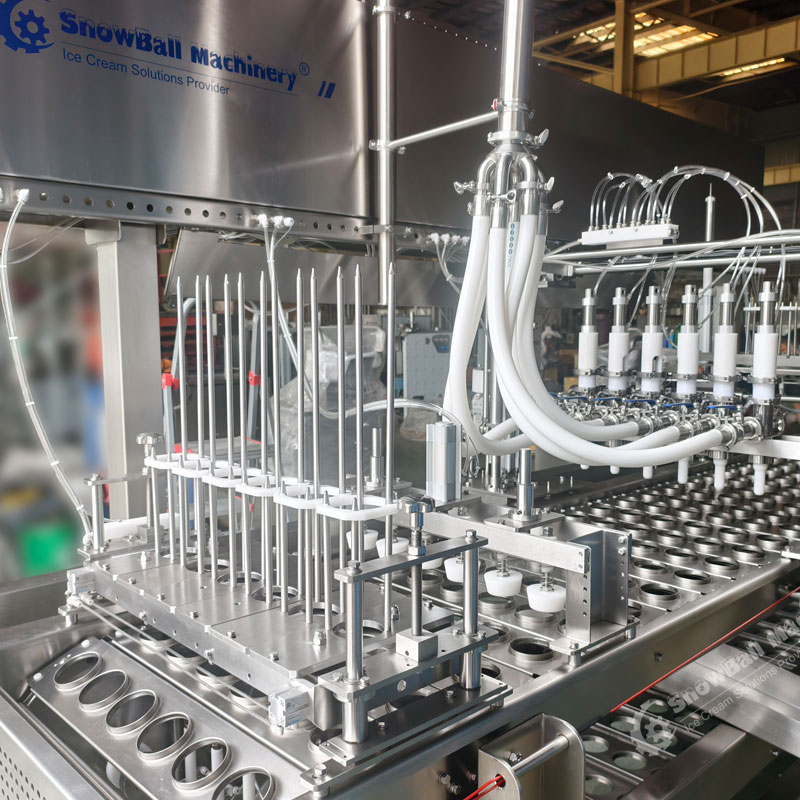
Equipment Stability in Demanding Environments
Ice cream factories operate under different climate conditions. High temperature and high humidity environments can stress electrical components and refrigeration systems. If the equipment is not adapted, the risk of failure rises.
Snowball Machinery approaches this by customizing high-temperature resistant, moisture-proof, and corrosion-resistant technologies for regional climates. Core components are sourced from internationally renowned brands to improve stability. Before delivery, all ice cream continuous freezers undergo material-loaded trial operation to simulate the customer's actual production environment and identify potential faults.
This kind of pre-delivery testing is significant because it reduces commissioning surprises. A continuous freezer that has already run with real materials is more likely to perform as expected when installed.
Quality and Food Safety Verification
Food safety compliance is non-negotiable in ice cream production. Buyers should verify that equipment is built with food-grade materials and meets the standards required in their target markets. Snowball Machinery states that its equipment uses food-grade 304/316 stainless steel throughout, and that it complies with ISO9001 and national food machinery compliance standards including FDA, CE, and FSC. It also conducts food-grade and precision tests before delivery and issues qualification certificates.
In addition, the company establishes multiple quality inspection checkpoints for real-time monitoring of the production process. High-precision sensors and intelligent control systems help control filling volume, fruit particle dosage, and swirl patterns. These details are relevant to buyers who need consistent product quality at scale.
FAQ
What does the 12-year stable operation claim mean for ice cream machine buyers?
Snowball Machinery states that its equipment provides stable operation for 12 years while meeting the high quality requirements of branded ice cream manufacturers. For buyers, this is a planning reference for depreciation, maintenance budgeting, and long-term capacity planning, not a guarantee that no component will ever need service.
How much does a turnkey ice cream machine solution cost compared with international brands?
Snowball Machinery states that its total costs are 40-70% lower than purchasing internationally renowned brand equipment. The comparison is based on similar production capacity and component quality, not on lower-grade materials or simplified systems.
Can existing ice cream equipment from another brand be upgraded instead of replaced?
Snowball Machinery supports the upgrading and retrofitting of well-known brand equipment, helping customers cut renovation costs by 40-70%. This is relevant for factories that already own branded lines but need higher capacity, new formats, or better automation.
What is the minimum order quantity and monthly production capacity at Snowball Machinery?
The minimum order quantity is 1 set, and the manufacturer has a monthly production capacity of 100 sets. Production lead time is determined according to the specific equipment plan.
What after-sales support is provided for automatic ice cream production machines?
Snowball Machinery provides 24/7 after-sales service with remote assistance functions, exclusive customer service groups, video-call guidance, and on-site support for special issues. It also supports overseas after-sales outlets or partner service providers to improve response efficiency.
How does Snowball Machinery reduce the risk of delivery delays?
The supplier states that it follows standardized delivery procedures, completes compliance certifications and customs clearance procedures for overseas customers in advance, and updates progress in real time. Multi-language manuals and training videos also help reduce commissioning delays.
What types of products can be produced on a complete ice cream processing machine line?
A complete line can cover stick ice cream, popsicicles, cup and cone ice cream, extruded products such as ice cream sandwiches and cakes, bulk and family-pack ice cream, and products with fruit or solid inclusions. The exact product range depends on the configured line: moulding, filling, extrusion, or sandwich processing.
Is Snowball Machinery's equipment suitable for factories in high-temperature or high-humidity climates?
Snowball Machinery states that it customizes high-temperature resistant, moisture-proof, and corrosion-resistant technologies for different regional climates. Core components from international brands and material-loaded trial operation before delivery are part of its approach to improving stability in such environments.
For a detailed overview of Snowball Machinery's product range, factory capabilities, and technical specifications, the company brochure is available here: Download Snowball Machinery brochure (PDF).