
Ice Cream Machinery FAQ: Decoding HTST Mixing and CIP in the SNM Mixer
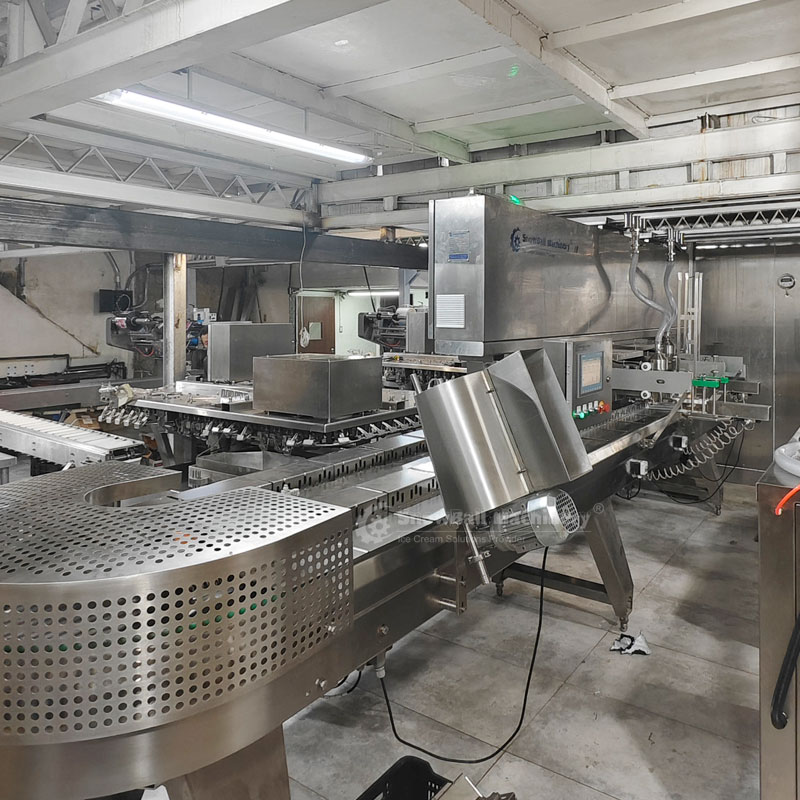
A continuous ice cream line is only as consistent as the mix that reaches the freezer. Image: Snowball Machinery production line reference.
Most texture, overrun and shape problems that eventually appear at the freezer or the moulding line were already decided upstream, in the mix plant. Blending, homogenizing, pasteurizing and ageing determine how the mix behaves when it enters the continuous freezer, and that behaviour is what a technical buyer is really specifying when they review a pro-mix or pasteurizing package.
The SNM is the model designation Snowball Machinery uses for its ice cream mixing machine, also described as an ice cream pro-mix machine, ice cream mixer plant or ice cream mixture machine. Snowball Machinery Manufacturing Co., Ltd is an ice cream equipment manufacturer that integrates R&D, manufacturing, assembly, commissioning, export and after-sales service, reporting a 4,000 m² factory, 50 employees, 10 R&D engineers, an annual output of 1,200 sets and a 90% export ratio across North America, South America, Europe, Asia and Africa.
This article addresses the most common technical procurement questions about the mixing and pasteurization phase of ice cream production: how the SNM is positioned across HTST and batch pasteurizing categories, what an integrated CIP cleaning system changes for sanitation and downtime, and where the limits of this approach sit.
Why the Mix Plant, Not the Freezer, Sets Product Consistency
Continuous freezers draw attention because they are visible and directly linked to output. Yet a freezer can only work with what it receives. If fat dispersion, total solids or the temperature of the incoming mix vary between shifts, the freezer has to compensate, and product weight, overrun and shape stability drift with it. The mix plant is therefore the controlled stage of the line, and the pasteurizing step inside it is the part that regulators and quality teams examine most closely.
Market structure reinforces that logic. Hard ice cream processing equipment accounted for 57.8% of the total ice cream equipment market in 2025, with continuous freezers the leading product type, according to Future Market Insights. Since continuous freezing is sensitive to upstream mix consistency, the mixing, pasteurizing and ageing package is the natural starting point for technical due diligence — and the place where questions about sanitation, labor and changeover time become commercial questions rather than engineering detail.
Inside the SNM: A Configurable Mix and Pasteurizing Platform
The SNM is not a single fixed unit. Snowball Machinery documents it as a configurable platform whose unit types include an HTST system (also listed as HTST pasteurization), a batch pasteurizing system, a homogenizer machine, a high shear mixer, an ageing tank or ageing vat, CIP cleaning, a chocolate tank and chocolate holding tank, a chiller water system and a water-cooled chiller. The products it serves are stated as all kinds of ice cream, cup ice cream, cone ice cream and popsicle.
| Configured unit | Role in the mix plant (general function) | Question the buyer should raise |
|---|---|---|
| HTST system / HTST pasteurization | Continuous-flow heat treatment of the mix with a short holding period | Required flow rate, holding program and validation route |
| Batch pasteurizing system | Heat treatment of a defined mix volume in a vessel | Batch size, recipe change frequency and vessel count |
| Homogenizer machine | Reduces fat globule size for a stable emulsion | Pressure range and downstream ageing behaviour |
| High shear mixer | Blends powders, fats and liquids into a uniform premix | Recipe types, inclusion handling and mixing sequence |
| Ageing tank / ageing vat | Holds the mix under controlled low temperature before freezing | Holding volume versus line throughput |
| CIP cleaning | Cleans circuits in place rather than by manual dismantling | Circuit coverage, dosing control and validation evidence |
| Chocolate tank / holding tank | Stores coating or inclusion media at working temperature | Whether coatings run in-line or offline |
| Chiller water system / water-cooled chiller | Supplies cooling capacity for heat treatment and ageing | Utility capacity, ambient conditions and energy profile |
Two facts are stated plainly by the manufacturer. Capacity is customized according to needs, and customization is based on customer production scale, product positioning, product design and workshop conditions. The SNM is also delivered within a turnkey solution: Snowball designs ice cream factories and supplies the full line of ice cream machines from A to Z, rather than shipping the mix plant as an isolated item.
HTST and Batch Pasteurizing: Two Categories, One Decision
In its documented unit list, the SNM belongs to both the HTST and batch pasteurizing system categories. That classification matters because the two routes are mechanically different. HTST treats a continuously flowing mix at a higher temperature for a short holding time; batch pasteurizing processes a defined volume in a vessel over a longer hold. Both reduce microbial load in the mix, but they scale differently, place different demands on utilities, and organise cleaning in different ways.
Neither category is universally better. Plants running long campaigns of one or two recipes at high volume usually value the continuous flow of HTST. Plants handling frequent recipe changes or modest volumes often prefer batch handling. The practical consequence of the SNM covering both directions is that the buyer's decision moves from "which machine does this supplier build?" to "which configuration matches my product, my utilities and my staffing?"
| Decision factor | HTST configuration direction | Batch pasteurizing direction | What the buyer must confirm |
|---|---|---|---|
| Process mode | Continuous flow through the heat-treatment section | Defined volume processed in a vessel | Required flow rate versus required batch size |
| Holding approach | Short hold at higher temperature | Longer hold at lower temperature | The program accepted by the local food-safety authority |
| Capacity scaling | Scales with flow capacity | Scales with vessel volume or additional vessels | Which expansion path fits the next three years of output |
| Cleaning strategy | Typically engineered together with CIP circuits | May involve more manual steps unless CIP is configured | Whether CIP is included and how coverage will be validated |
| Operational fit | Suits long, stable production campaigns | Suits varied or smaller production batches | Recipe change frequency and staffing model |
Time–temperature programs are not published as a universal table for the SNM. Because the system is built as non-standard customized equipment, the pasteurization program is defined during project engineering and must satisfy the buyer's own regulatory and quality requirements. Any supplier quoting one fixed setpoint for every market deserves a follow-up question about how that program is validated locally.
Integrated CIP: What It Changes for Downtime and Manual Labor
CIP cleaning is listed among the SNM configuration units, and this is where the platform answers a very practical concern. When cleaning-in-place is designed as part of the mixing, pasteurizing and ageing package, circuits, pumps and coverage are considered during engineering rather than retrofitted after installation. The intended effect is straightforward: less manual dismantling and scrubbing, more repeatable cleaning cycles, and shorter changeover between production runs — all of which influence labor cost and usable production hours.
Two qualifications belong in any honest evaluation. First, CIP performance is a property of the whole circuit — dead legs, spray coverage, pump sizing, chemical program and dosing control — not of a CIP label on a specification sheet. Second, cleaning outcomes generally require validation: a supplier can document circuit design and testing, but the buyer remains responsible for verifying effectiveness against their own recipes, including allergen and inclusion management. The SNM's advantage is structural rather than magical: CIP can be engineered into the same package as pasteurization and ageing, instead of becoming a separate procurement problem later.
Application: How the Mixing Stage Serves Different Project Types
Snowball Machinery's project records illustrate how the mix and pasteurizing stage interacts with different starting points. The SNM appears as a related unit in a turnkey project delivered to a start-up client with no prior ice cream production experience. That project combined a turnkey whole-plant solution with an extruded ice cream tunnel machine rated at 5,000–8,000 pcs/h and a family pack ice cream filling machine at 1,200 L/H, and the line has run stably for 11 years with continuing after-sales service.
- Retrofit and upgrade projects. A long-established manufacturer used custom-designed workstations to match a 40-year-old production line without overall reconstruction, using food-grade 316 stainless steel. The result reported by the manufacturer includes higher production efficiency, reduced labor cost and a substantially lower upgrade cost than replacing original-brand workstations, with six years of stable operation.
- Automation-led differentiation. A North American ice cream factory combined robot ice cream filling, a family pack filler, an ice lolly machine and an ice cream fruit feeder to upgrade an existing line, with a designed service life of 10 years. The stated objective was more distinctive product styling alongside relief from labor shortages.
- Multi-market branded production. Snowball Machinery equipment is stated to be used by world-renowned brand ice cream factory clients in Venezuela, Kuwait, Turkey, Sri Lanka and Indonesia, including a cone filling line at 10,000–15,000 pcs/h and a stick ice cream line at 15,000–20,000 pcs/h operating for 12 years.
- Regional and new plants. A newly established manufacturer in Jordan, Qatar, Venezuela, Chile and Peru runs a complete line at 9,000–10,000 pcs/h, flexibly configured for multi-flavour production, with equipment that has operated for three years under high-temperature and high-humidity conditions.
- Format-specific expansion. A European manufacturer added an ice cream sandwich line adaptable to multiple specifications and flavours, with rapid installation, commissioning and launch, and five years of stable operation.
Read together, these cases describe a consistent pattern: the mix plant is specified once, but the filling, moulding and extrusion formats downstream change by market. That is why the SNM is offered as a configurable platform rather than a fixed package.
Materials, Components and Verification Points
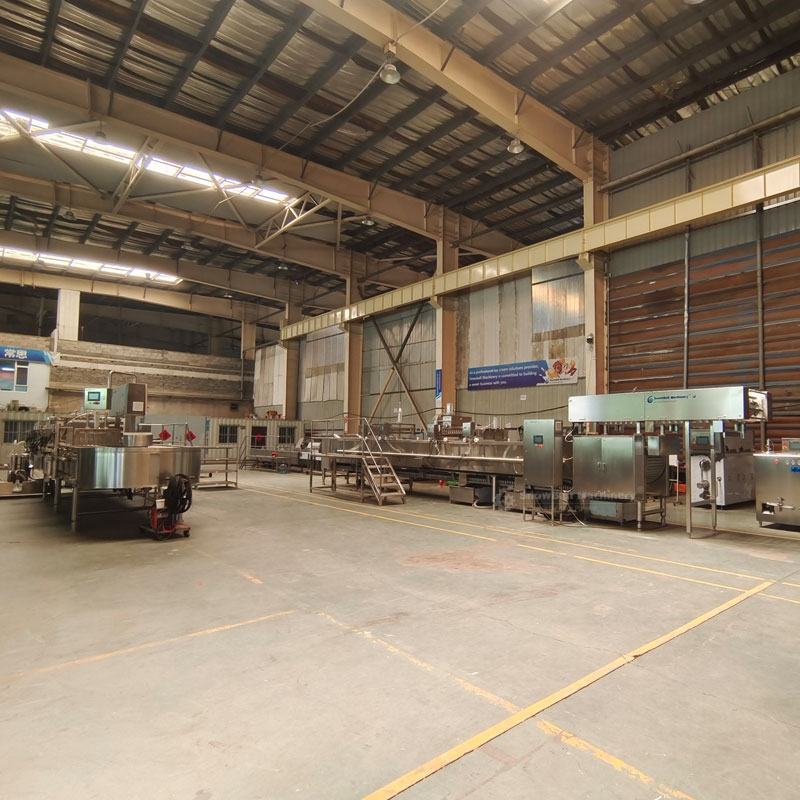
Assembly and testing take place before shipment. Image: Snowball Machinery assembly workshop.
Across the SNM and the wider line, the stated construction material is high-quality food-grade stainless steel, SS304 or SS316. Main components are stated to adopt internationally recognised brands including SIEMENS, Schneider Electric, FESTO, SMC, Danfoss, ABB, Bonfiglioli, igus, Copeland, Bitzer and SEW Eurodrive. Quality control is described as full-process control from material selection to production, in strict compliance with food safety production standards, with 100% testing.
Certification is where buyers should apply the most discipline, because Snowball Machinery's CE certificates are issued per model rather than as a blanket plant approval. Documented certificates include:
| Certificate | Scope | Issuing body | Standards cited | Validity |
|---|---|---|---|---|
| CE-4681-181125 | Ice cream continuous freezer (SNCF series) | European Certification Services | EN ISO 12100:2010, EN 60204-1:2018 +A1:2025 | 2025-11-18 to 2030-11-18 |
| FQC2506302 | Rotary moulded stick ice cream machine (SNL) | FQC STANDARD | EN ISO 12100:2010, EN 60204-1:2018 | 2025-02-05 to 2030-02-05 |
| CE-1654-01-111123 | Linear stick ice cream machine | CGS Test | BS EN ISO 12100:2010, BS EN 60204-1:2018 | 2023-11-11 to 2028-11-11 |
| CE-1724-01-121223 | Ingredient feeder (SNFF1000 / SNFF2000 / SNFF4000) | CGS Test | BS EN ISO 12100:2010, BS EN 60204-1:2018 | 2023-12-12 to 2028-12-12 |
In addition to manufacturer-specific certification, commercial ice cream appliances and ice-makers with incorporated motor-compressors fall under the safety standard IEC 60335-2-89:2019, according to the IECEE. Buyers specifying a complete line should map each certificate to the exact model in their order, because a certificate covering a freezer model does not automatically extend to a mixing or pasteurizing unit.
Procurement and Acceptance: What a Mixing Package Order Looks Like
Snowball Machinery's stated purchasing terms are unusually simple to evaluate. Minimum order quantity is 1 set, which matters for pilot plants and for buyers testing a supplier before a full line commitment. Delivery terms cover FOB, CIF, EXW, CFR, DAP and DDP. Acceptance criteria are pre-shipment test, on-site customer inspection and third-party inspection such as SGS. Payment terms are 50% advance by T/T with the remaining 50% before shipment. Monthly production capacity is stated at 100 sets, and lead time depends on the specific equipment plan.
For a mix plant order, the practical reading is this: because the SNM is non-standard customized equipment, the acceptance test plan should be agreed during engineering rather than after assembly. Buyers who define the pre-shipment test scope early — including the pasteurization program and CIP coverage checks they intend to verify — get materially more value from the third-party inspection option.
Market Trend Analysis: Where Mixing and Cleaning Requirements Are Heading
The ice cream processing equipment market was valued at approximately USD 2.33 billion in 2025, with projections to reach USD 3.00 billion by 2034 at a CAGR of 2.71%, according to IMARC Group. Market sizing varies considerably by scope — figures as high as USD 9.6 billion (Future Market Insights) and USD 10.12 billion (Market Data Forecast) describe the broader ice cream equipment market rather than processing equipment alone — so buyers should compare like with like when using market numbers in internal investment cases.
Two structural trends are more useful than the headline value. Automation demand continues to drive the ice cream moulding production line segment, which was valued at USD 1.2 billion in 2024 and projected to reach USD 2.5 billion by 2034, according to Reports and Data. At the same time, supply remains concentrated: Germany, Poland and Italy were the leading exporters of dairy machinery (HS Code 843420) in 2024, with export values of USD 74.4 million, USD 64.9 million and USD 61.7 million respectively, according to the Observatory of Economic Complexity. Industry sources also attribute Tetra Pak machinery to over 75% of commercial production lines worldwide as of early 2026, indicating how entrenched incumbent equipment suppliers are in large-scale dairy operations.
For the mix plant specifically, the implication is that cleaning and heat-treatment design are becoming evaluation criteria rather than afterthoughts. As labor availability tightens and product ranges expand, the ability to change recipes and clean reliably without stopping the line for extended manual work carries direct commercial weight.
Comparison with Traditional Solutions — and Where Limits Apply
Traditional mix preparation in smaller operations often means open vessels, manual ingredient loading and hand cleaning between runs. That approach has genuine advantages: lower capital cost, simple maintenance and flexibility for very small batches. Its weaknesses are consistency and labor dependence, both of which become visible as volume grows or when a retailer requires documented sanitation procedures.
At the other end of the market, premium European turnkey mix plants offer deep engineering documentation and long-established service networks, at correspondingly higher cost. Snowball Machinery's own project material reports, for one Middle East and South America installation, total line costs 70% lower than premium European brands while matching their quality and output performance — a project-specific claim rather than a universal price statement, and one that buyers should test against their own specification and currency conditions.
Three limits of the SNM approach are worth stating plainly:
- Configuration work takes time. Capacity is customized and engineering is based on product design and hourly output, so lead time depends on the specific equipment plan. Buyers who need a standard unit shipped immediately are not the intended profile.
- Pasteurization setpoints are project-defined. No universal program is published, so the buyer's own regulatory team must be involved in engineering. That is normal for dairy equipment, but it is a real dependency in the project timeline.
- Certification scope is per model. CE coverage is documented per machine type. A buyer assembling a full line should verify each model individually rather than assuming plant-wide coverage.
- CIP still requires validation. Integrated cleaning reduces manual work, but effectiveness must be confirmed against the buyer's own recipes, particularly where allergens or large inclusions are involved.
Future Outlook
The direction of the mix plant is toward fewer manual interventions and more documented process control. Integrated CIP is a good example: what used to be an add-on is increasingly engineered into the same package as pasteurization and ageing, because the cost of downtime and hand cleaning shows up in operating budgets long before it shows up in capital budgets.
Support expectations are shifting with it. Snowball Machinery's stated after-sales scope covers on-site installation and commissioning, equipment upgrading, equipment maintenance, fault handling, spare parts supply and regular inspection, with timely global response. For export projects the company also states 24/7 dedicated after-sales service with remote video support, which matters for plants where a pasteurization or CIP fault stops the whole line. Buyers evaluating a mix plant should treat the upgrade and spare-parts path as part of the specification, not as an after-sales detail — capacity expansion through modular design is one of the stated advantages in Snowball Machinery's project records.
FAQ: Technical Procurement Questions on Mixing, Pasteurizing and CIP
What is the SNM, and where does it sit in an ice cream production line?
The SNM is Snowball Machinery's ice cream mixing machine model, also referred to as an ice cream pro-mix machine, mixer plant or mixture machine. It sits upstream of the continuous freezer and covers mix preparation and heat treatment: blending and high shear mixing, homogenizing, HTST or batch pasteurizing, and ageing tank storage. Its documented configuration units also include CIP cleaning, chocolate tanks and holding tanks, a chiller water system and a water-cooled chiller. It is stated to handle all kinds of ice cream, cup ice cream, cone ice cream and popsicle.
How does HTST pasteurization differ from batch pasteurization in practice?
HTST (high-temperature short-time) treats a continuously flowing mix at a higher temperature for a short holding period. Batch pasteurizing processes a defined volume in a vessel over a longer hold. Because they differ in flow behaviour and holding method, they scale differently and place different demands on utilities and cleaning. The SNM is documented with both an HTST system and a batch pasteurizing system as configuration options, so the choice is made per project rather than fixed by the machine range.
Does Snowball Machinery publish fixed pasteurization setpoints for the SNM?
No universal setpoint table is published. The SNM is built as non-standard customized equipment, with customization based on product design and hourly production capacity, and capacity customized according to needs. The time–temperature program is therefore defined during project engineering and must satisfy the buyer's own food-safety requirements. Buyers should confirm the required program with their regulatory or quality team as part of the engineering phase.
What does an integrated CIP cleaning system change for daily operations?
CIP cleaning is listed among the SNM configuration units. Designing it into the mixing, pasteurizing and ageing package targets reduced manual dismantling work, more repeatable cleaning cycles and shorter changeover between production runs. Actual results depend on circuit design, spray coverage, pump sizing, chemical program and dosing control, and cleaning effectiveness normally requires validation by the plant's own quality team, particularly for allergen and inclusion management.
Can the SNM be matched to an existing line's capacity?
Capacity is customized rather than fixed. The SNM is offered within a wider line that includes ice cream continuous freezers from 50 to 1,500 L/H, ingredient feeders from 50 to 4,000 L/h, and filling, moulding and extrusion systems with customizable capacity. Snowball Machinery states that customization is based on customer production scale, product positioning, product design and workshop conditions, and one documented retrofit matched new workstations to a 40-year-old production line without overall reconstruction.
What materials and components are used in the SNM and related units?
The stated material is high-quality food-grade stainless steel, SS304 or SS316, with 316 used in at least one upgrade project where North American compliance requirements applied. Main components are stated to adopt internationally recognised brands including SIEMENS, Schneider Electric, FESTO, SMC, Danfoss, ABB, Bonfiglioli, igus, Copeland, Bitzer and SEW Eurodrive. Quality control is described as full-process control from material selection to production, with 100% testing.
Which certifications apply, and do they cover an entire line?
Snowball Machinery's CE certificates are issued per model rather than as a blanket plant certification. Documented certificates include CE-4681-181125 for the ice cream continuous freezer (European Certification Services, EN ISO 12100:2010 and EN 60204-1:2018 +A1:2025, valid 2025-11-18 to 2030-11-18), FQC2506302 for the SNL moulded stick ice cream machine (FQC STANDARD), CE-1654-01-111123 for the linear stick ice cream machine (CGS Test, valid to 2028-11-11) and CE-1724-01-121223 for the SNFF ingredient feeder range (CGS Test, valid to 2028-12-12). Buyers should confirm that the certificate scope matches the exact model and configuration ordered. Separately, IEC 60335-2-89:2019 applies to commercial ice cream appliances with incorporated motor-compressors.
What are the purchasing and acceptance terms for a mixing or pasteurizing package?
The stated minimum order quantity is 1 set. Delivery terms cover FOB, CIF, EXW, CFR, DAP and DDP. Acceptance criteria are pre-shipment test, on-site customer inspection and third-party inspection such as SGS. Payment terms are 50% advance by T/T, with the remaining 50% before shipment. Monthly production capacity is stated at 100 sets, and lead time depends on the specific equipment plan.
Where does the SNM mixing approach not fit?
Very small artisan operations producing single batches may not need HTST or an integrated CIP circuit at all, and open-vessel manual preparation can remain adequate at that scale. Buyers requiring a standard unit shipped immediately should also look elsewhere, because the SNM is non-standard customized equipment engineered around product design and hourly capacity, so lead time depends on the specific plan. Finally, pasteurization programs and cleaning effectiveness remain the buyer's regulatory responsibility to validate in their own market.
Reference Material
Snowball Machinery's company brochure, including the wider ice cream production line range, is available for download: Snowball Machinery brochure (PDF). The company website is icecreammachinemanufacturer.com, with technical articles published at blog.icecreammachinemanufacturer.com.