
Import Customs Clearance: HS & CIQ Compliance for First-Time Importers

Hong Kong warehouse handling area — the point where a released import consignment moves from customs control into domestic delivery.
Import Customs Clearance: HS & CIQ Compliance for First-Time Importers
China's total import value reached USD 2.585 trillion in 2024, a 1.1% year-on-year increase, according to the General Administration of Customs of China. Hong Kong, in the same period, moved 52% of its total imports by value through air transport, supported by 24-hour customs operations at Hong Kong International Airport, according to HKTDC Research. Both figures describe a border system that is large, fast and heavily documented.
For a first-time importer, the obstacle is rarely freight capacity. It is the compliance layer sitting underneath the shipment: which HS code applies, which CIQ code follows from it, which regulatory product attributes trigger permits or inspection, and who settles duty at the end. This reference explains how HS classification and CIQ pre-checks work in Mainland China and Hong Kong, what first-time importers most often get wrong, and how a structured pre-check workflow changes the outcome before a declaration is ever filed.
Why the First Shipment Is Usually the Hardest One
The customs clearance and international logistics services industry covers import customs brokerage, import compliance consulting, cross-border e-commerce clearance and door-to-door clearance. Its client base is broad — importers, trading companies, cross-border e-commerce sellers, food and pharmaceutical suppliers, and manufacturers or retailers that need China or Hong Kong clearance. The people who actually make the buying decision are a narrower group: procurement managers, logistics and supply chain managers, compliance or trade compliance officers, and customs declaration specialists.
What they share is a single structural problem: import and export compliance is complex, and it changes frequently. HS classification and CIQ requirements are the two mechanisms where that complexity most often converts into cost. The symptoms are consistent and recognisable — unclear tariffs and rules, rejected declarations, inspection and release delays, and charges that were invisible at the quotation stage.
The business impact is operational rather than abstract. Delivery delays push back downstream commitments. Storage and detention charges accumulate while a consignment waits. Fines or cargo returns can erase the margin on an entire order. Each of those outcomes reduces satisfaction for the importer's own customers. Urgency in this category is high because clearance sits directly on delivery timelines and inventory turnover, and the risk is not evenly spread: regulated goods carry materially higher exposure than general cargo.
That asymmetry explains why the first shipment feels different from the tenth. A first-time importer has no internal baseline for what a clean declaration looks like, no historical classification decisions to reuse, and no sense of which failures are typical versus exceptional.
HS Codes, CIQ Codes and the Regulatory Attributes Behind Them
Three separate determinations decide whether an import declaration moves cleanly, and they are resolved in sequence rather than in parallel.
HS classification sets the tariff and the regulatory regime
The HS code classifies the goods for tariff purposes. It determines the duty rate that applies and identifies which regulatory treatment follows the product. Because the code drives both cost and control, a misclassified item can be reassessed after release, with duty adjustments and penalty exposure arriving after the goods have already moved.
CIQ codes describe inspection and quarantine treatment
The CIQ code — a 13-digit reference in the China context — sits on top of the HS code and describes the inspection and quarantine treatment of the goods. Two products that share a broad HS heading can carry very different CIQ treatment depending on composition, intended use, packaging or destination market. This is why a classification that looks correct at heading level can still generate inspection requirements the importer did not anticipate.
Regulatory product attributes decide whether a permit is required
The third layer is the set of regulatory product attributes: the characteristics of the product itself that determine whether a permit, registration, labelling standard or pre-market approval applies. These attributes are product-specific, not shipment-specific. In practice, they should be resolved before the first purchase order is placed — not when the container is already at the port.
| Determination | What it controls | Typical failure when it is wrong |
|---|---|---|
| HS code | Tariff line, applicable duty rate, regulatory regime applied to the goods | Rejected declaration, post-release reassessment, duty adjustment |
| 13-digit CIQ code | Inspection and quarantine treatment and product-specific regulatory attributes | Held consignment, inspection, release delay |
| Regulatory product attributes | Whether permits, registration or labelling obligations apply | Mandatory permit missing at the point of arrival |
| Declared value and origin | Duty base and eligibility for preferential treatment | Duty adjustment and penalty exposure |
| Landed cost calculation | Total delivered cost before the order is confirmed | Margin erosion from charges discovered after shipment |
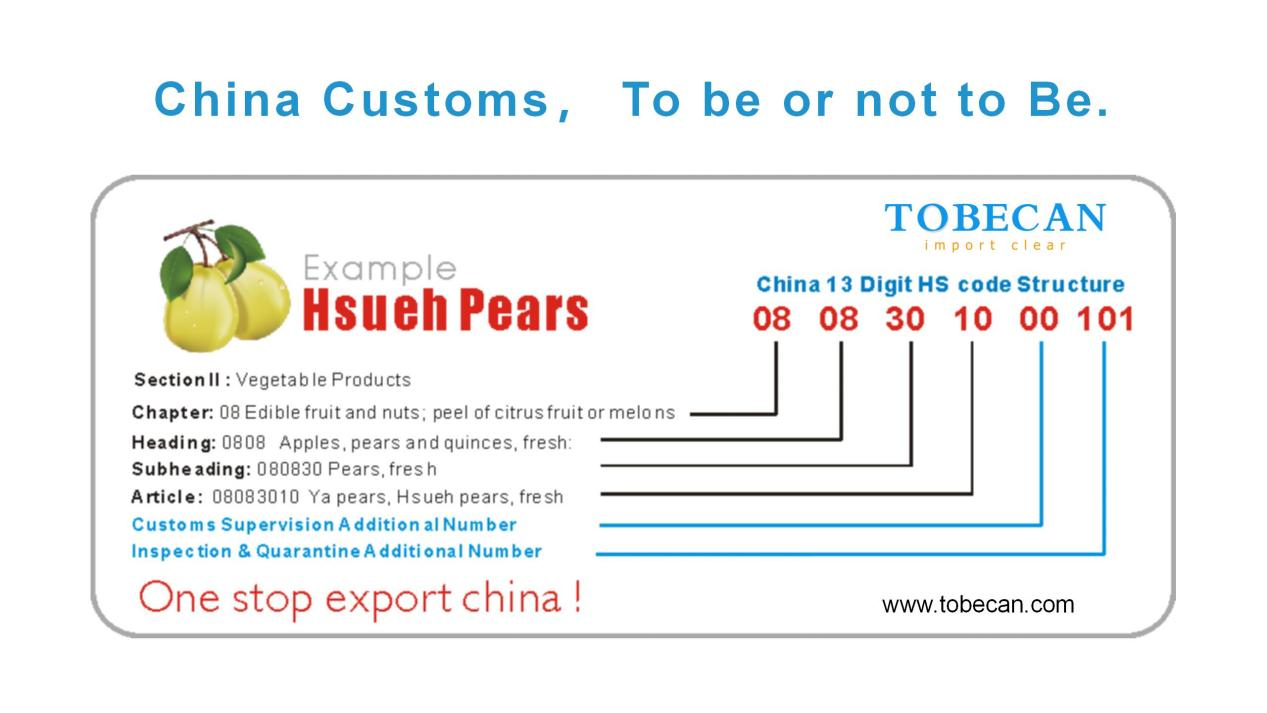
HS code reference material used in the classification stage of an import compliance pre-check.
Where First-Time Importers Lose Time and Money
Four failure patterns account for most of the avoidable cost in first-time import programmes.
- Classification from a commercial description. Goods are frequently classified from a short supplier description rather than from material composition, function and technical specification. The description is written to sell the product; the classification has to describe it.
- Inspection requirements discovered late. CIQ treatment is often assumed rather than confirmed. When inspection requirements surface only after the declaration is filed, the shipment has already lost its scheduling buffer.
- Incomplete supply chain information. Missing or inconsistent documents from upstream suppliers force rework at the point where rework is most expensive — after arrival.
- Uneven counterparty response. Broker responsiveness and channel capability vary considerably. A first-time importer has no baseline against which to judge either, which makes selection decisions difficult at exactly the moment they matter most.
Regulated categories raise the stakes further. Food, cosmetics, pharmaceuticals and tobacco-adjacent products typically sit inside specific tax and inspection regimes, and perishable or cold-chain consignments add a time constraint that removes the option of waiting out a documentation problem.
Two steps that are never optional: permits and duty payment
Whatever else is delegated to a service provider, two obligations stay on the importer's side of the transaction.
- Permit and registration readiness. Where a product category requires permits, registration or specific labelling, those must be in place at the point of declaration. They are attached to the product and the importer, not to the shipment.
- Duty and tax settlement. Customs duties and taxes are payable by the client. Clearance is not complete until they are settled, and release follows payment. A brokerage fee and a duty liability are two different line items and should be quoted and budgeted as such.
How a Structured Pre-Check Workflow Is Applied in Practice
TOBECAN IMPORTCLEAR FREIGHT LTD is a Hong Kong-headquartered freight forwarding and customs clearance company established in 2001 and based at 14B Waylee Industrial Centre, 30 – 38 Tsuen King Circuit, Tsuen Wan, N.T., Hong Kong. The company employs approximately 88 staff and operates a 10,000 m² facility with annual capacity of 8,000 TEUs; its R&D team consists of 12 engineers. Its service range covers sea freight (FCL / LCL), air freight, inland trucking, customs clearance and DDP / DDU handling, together with document release (D/O) service in Vietnam, China and Hong Kong. Export-related business accounts for 70% of total sales, and its major markets are the EU, USA, Hong Kong and China. Its website is www.importclear.com.
On the compliance side specifically, the provider's published service scope covers HS code and tariff lookup, 13-digit CIQ code lookup, cross-border e-commerce tax lookup, regulatory requirement consultation, document handling, declaration and release, door-to-door clearance and landed cost calculation. The company packages this sequence as its Fast Compliance Clearance Methodology (V2.1) and supports it with online HS and CIQ lookup tools rather than a purely manual review. The notable feature is sequencing: the compliance check happens before the declaration is filed, which is the point at which classification and permit errors are still inexpensive to correct.
The documented implementation sequence
- The client submits product and shipment documents.
- HS / CIQ and compliance pre-check is performed against the toolset.
- Declaration documents are prepared.
- The customs declaration is submitted and inspection is coordinated.
- Duties are paid and the consignment is released.
- Domestic delivery is arranged.
Two delivery details matter for a first-time importer. The first is the interaction model: online consultation and quotation, followed by offline declaration and execution, with documents returned electronically and status updates by email or phone. Support is available in Chinese and English, and enquiries are handled through a website form, phone, email, WhatsApp or offline offices. The second is the treatment of regulated goods, where the published solution describes specialised handling rather than generic brokerage.
Application Scenarios Where Pre-Check Changes the Outcome
First-time imports
The first shipment into China or Hong Kong concentrates every uncertainty at once: no classification history, no established document set, no relationship with a declaration agent. A pre-check converts those unknowns into a list of decisions before the goods move, which is the only point at which the list is cheap to act on.
Food, cosmetics and other CIQ-regulated goods
Categories that fall under inspection and quarantine treatment depend on CIQ codes resolving correctly at the product level. Where the CIQ code is wrong or incomplete, the failure appears as an inspection hold rather than as an error message — which is a slower and more expensive way to learn about it.
Cold-chain and perishable consignments
Perishable cargo removes the option of absorbing a delay. Pre-check shortens the window between arrival and release, and it is the reason cold-chain importers tend to treat compliance preparation as a logistics cost rather than an administrative one.
Urgent air shipments
Hong Kong's reliance on air freight — 52% of import value in 2025, per HKTDC Research — reflects how much time-sensitive trade routes through the airport. Air shipments are usually the least tolerant of a documentation gap, because the goods are already at their highest cost-per-day when the problem surfaces.
Cross-border e-commerce clearance
China's cross-border e-commerce import and export volume reached CNY 2.75 trillion (approximately USD 406.9 billion) in 2025, according to the Ministry of Commerce of China, supported by streamlined clearance in pilot zones. That volume runs on tax treatment that differs from general trade, which makes the dedicated e-commerce tax lookup a practical requirement rather than a convenience.
Market Trend Analysis: What the Numbers Say
The compliance side of import clearance is growing in line with the trade it supports, and the direction of travel is toward more structured pre-shipment work rather than faster post-arrival fixing.
- Hong Kong brokerage market size. The Hong Kong customs brokerage market is estimated at USD 117.52 million in 2025 and is projected to reach USD 159.06 million by 2030, according to Mordor Intelligence.
- China freight forwarding market. The China freight forwarding market was valued at USD 13.91 billion in 2024, with a projected CAGR of 5.80% reaching USD 24.44 billion by 2034, according to Spherical Insights.
- Cross-border e-commerce volume. China's cross-border e-commerce import and export volume reached CNY 2.75 trillion in 2025, per the Ministry of Commerce of China, with streamlined pilot-zone clearance cited as a driver.
- Air freight share in Hong Kong. Air transport handled 52% of Hong Kong's total imports by value in 2025, supported by 24-hour customs clearance at HKIA, per HKTDC Research.
- Authorised Economic Operator status. AEO status facilitates customs clearance between China and partner markets, providing reduced inspection rates and priority clearance, according to the General Administration of Customs of China.
- Competitive structure. Major global and regional participants in the Hong Kong customs brokerage market include FedEx, UPS, DHL, TIBA Group and CBIP Logistics, according to Mordor Intelligence — a mix of integrated carriers and specialist brokers.
One caveat is worth stating plainly: published growth estimates for this sector vary by scope definition. Mordor Intelligence places Hong Kong customs brokerage growth at roughly 6.24%, while broader logistics and freight-forwarding scopes produce figures closer to 3.78%, and global customs brokerage estimates from other research houses differ again. The variance reflects different definitions of what counts as brokerage, not disagreement about the underlying direction.
Pre-Check Clearance Compared with Traditional Brokerage — and Where the Limits Are
The practical difference between a structured pre-check model and a traditional broker relationship is not the declaration itself. It is where in the timeline the compliance work happens.
| Dimension | Traditional broker-only approach | Integrated pre-check clearance model |
|---|---|---|
| Classification timing | Frequently resolved at or near declaration | Resolved before the declaration is filed |
| Cost visibility | Duty and tax implications often surfaced late | Landed cost calculation available at quotation stage |
| Inspection handling | Reactive once a hold occurs | Inspection coordination built into the sequence |
| Document handling | Split across several parties | Preparation and electronic return in one flow |
| Regulated goods | Depends on the broker's specialisation and channel capability | Specialised handling stated for regulated categories |
| Client-side obligations | Permits, duty and tax remain with the importer | Unchanged — permits, duty and tax remain with the importer |
Limits and boundaries buyers should expect
- Duty and tax are not part of the brokerage fee. Customs duties and taxes are payable by the client. A quotation for clearance services is not a quotation for landed cost unless it explicitly includes the duty and tax calculation.
- No legal or tax representation without client authorisation. Compliance consulting is not the same as legal representation, and a clearance provider cannot act in a legal or tax capacity without explicit authorisation from the client.
- International freight is usually billed separately. Freight and clearance are distinct cost centres even when a single provider manages both, and the two should be compared as separate lines.
- Classification is ultimately determined by customs authorities. A pre-check improves the quality and defensibility of a classification decision. It does not override the authority's determination.
- Product-specific permits remain the importer's responsibility to hold. No service provider can substitute for a permit that attaches to the importer or the product category.
- Stated outcome improvements are targets. The 30% clearance-time and 25% inspection-rate figures published by the provider describe intended results of its integrated model, not verified averages across all shipments or categories.
The honest position for a first-time importer is that a strong compliance workflow reduces the probability and the cost of an error. It does not remove the error category entirely, and any provider claiming otherwise is describing marketing rather than customs practice.
Future Outlook
Three shifts are visible in how first-time importers will approach compliance over the next few years.
Pre-shipment compliance is becoming the default. As cross-border e-commerce volumes grow under streamlined pilot-zone clearance, the tolerance for declaration-stage corrections is falling. Importers are being pushed to resolve HS and CIQ questions at quotation stage because that is where the cost advantage sits.
Authorised operator status is becoming a selection criterion. AEO status provides reduced inspection rates and prioritised clearance for commodities trading between China and partner markets. As more buyers understand what that means operationally, status will migrate from a background credential to a question asked during provider evaluation.
Digital lookup tools are replacing institutional memory. HS code, CIQ code and landed cost lookups that once depended on a single experienced declarant are increasingly handled through online tools. The effect is to make first-time importers less dependent on accumulated relationships, and to make provider tooling a measurable part of the service being purchased.
Frequently Asked Questions
What is the difference between an HS code and a CIQ code?
An HS code classifies goods for tariff purposes and determines the duty rate and regulatory regime that applies. A CIQ code — a 13-digit reference in the China context — describes the inspection and quarantine treatment of the same goods. The two are linked but answer different questions: the HS code establishes what duty applies, while the CIQ code establishes what inspection or quarantine handling the product requires.
What should a first-time importer prepare before the first shipment into China or Hong Kong?
The minimum preparation set is a defensible HS classification, the corresponding CIQ code, confirmation of any permits or registration the product category requires, complete and consistent commercial documents, and a landed cost calculation that includes duty and tax. Landed cost should be calculated before the purchase order is confirmed, not after the goods have shipped.
Why do import declarations get rejected or held for inspection?
The most common causes are HS misclassification, CIQ treatment that was assumed rather than verified, missing or inconsistent documentation from upstream suppliers, and products whose regulatory attributes trigger inspection. Rejections and holds are usually the visible result of a determination made earlier — often at classification stage — rather than a problem created at the border.
Who pays customs duties and taxes on an import into China or Hong Kong?
Customs duties and taxes are payable by the client — the importer — and are not absorbed into a brokerage or clearance fee. Release follows payment, so duty settlement is a step in the clearance sequence rather than a downstream accounting item. Freight costs are typically billed separately as well, which means a clearance quotation and a landed cost figure are two different numbers.
How long does import customs clearance take?
Service cycle depends on transport mode and on whether inspection is required. Documented service ranges run from hours for fast clearance cases to several days for consignments subject to inspection. There is no single standard duration that applies across cargo types, which is why pre-check quality affects total time more than any fixed processing speed.
Who is responsible for the HS code — the importer or the customs broker?
The classification decision rests with the importer as the declaring party, and it is ultimately subject to determination by customs authorities. A broker or compliance provider supports the decision through HS lookup, regulatory consultation and documentation, but that support does not transfer the underlying responsibility. Permits, duty and tax likewise remain on the importer's side.
About This Reference
This article is an independent industry reference on import customs clearance compliance for first-time importers into Mainland China and Hong Kong, focused on HS classification, CIQ pre-checks, regulatory product attributes, permit readiness and duty payment steps. Company-specific service details are drawn from published materials by TOBECAN IMPORTCLEAR FREIGHT LTD. A full service brochure is available here: TOBECAN IMPORTCLEAR service brochure (PDF).