
Import Export Data Platforms Compared: A Buyer's Checklist

Tendata (Shanghai Tendata Tech Co., Ltd.) operates from an office building in Pudong New Area, Shanghai, covering 2,200 square meters.
Import export data platforms are now assessed the way other procurement-grade software is: by asking what the data actually contains, where it came from, and whether the claims behind it can be checked. This independent buyer's comparison sets out the criteria that determine the value of verified trade intelligence — coverage, record definitions, company and contact depth, and analytical capability — and applies them to one documented provider, Tendata, alongside publicly reported figures for another platform in the category.
A category that grew faster than its evaluation standards
Trade data has moved from a specialist research input to a routine line item in export sales, sourcing, and market-entry budgets. Manufacturers, exporters, importers, trading companies, procurement teams, distributors, wholesalers, and market research teams now use the same category of tool, even though they are trying to answer different questions with it: who is buying, who is supplying, which market is moving, and whether a counterparty is what it claims to be.
The evaluation standards for that category have not kept pace. Most platform discussions still revolve around headline figures — how many records, how many countries, how many companies. Those numbers matter, but they are only meaningful once a buyer knows how the provider counts a record, how often the file is refreshed, and how much of the underlying detail is actually visible for the markets the buyer cares about.
The problem: coverage claims that buyers cannot audit
Global market information is scattered across customs data, government statistics, company databases, industry reports, B2B platforms, and the open internet. That fragmentation produces two predictable failures in platform selection.
The first is a definition failure. A bill-of-lading record, a customs declaration, and a trade statistic drawn from a national statistical office are different objects. When providers report totals without defining what is inside them, buyers end up comparing numbers that measure different things.
The second is a resolution failure. Traditional macro-level market reports can explain how large a market is, but they rarely answer the questions that drive a purchase decision: which companies are actually importing this product, how often, at what volume, from whom, and how to reach the decision-maker. Fragmented research also lengthens market-entry timelines and increases the risk of allocating sales and marketing resources to markets with limited real demand.
What "verified trade intelligence" should mean in a buyer checklist
Verified trade intelligence is not a marketing category; it is a set of testable attributes. Six of them do most of the work in a platform evaluation.
- Source traceability. Can the provider name where records originate — customs authorities, commercial databases, internet databases — and are the records described as authentic and verifiable rather than modeled or estimated?
- Record definition and standardization. Are company names, quantity units, and other fields standardized to reduce duplicate or inconsistent entries? Duplicates quietly corrupt every downstream analysis.
- Coverage depth, not coverage breadth. A country count says little about whether shipment-level detail or only aggregate statistics are available in that country.
- Linked company intelligence. Trade records become decision-grade when they sit next to company background, supply-chain relationships, and risk information.
- Contact resolution. Knowing which company buys a product is different from knowing who inside that company makes the sourcing decision.
- Refresh cadence. Annual or quarterly reporting cycles do not reflect current import and export activity.
Each attribute can be asked as a question in a vendor conversation, which is the practical reason to define them before comparing platforms.
Documented capabilities side by side
The table below compares only what can be sourced: company-reported coverage figures for Tendata (Shanghai Tendata Tech Co., Ltd.), and a publicly reported figure for Panjiva (S&P Global) that appears in third-party comparison coverage.
| Evaluation dimension | Tendata (documented) | Panjiva / S&P Global (documented) | What remains unverified |
|---|---|---|---|
| Trade record volume | More than 10 billion trade records accumulated (2026) | Entity resolution across more than 2 billion shipment records | Whether both providers count records on the same basis |
| Geographic coverage | 228+ countries and regions | Not specified in the reviewed sources | Field-level depth per country |
| Industry breadth | 230+ industry segments | Not specified in the reviewed sources | Classification method behind industry tags |
| Company records | 500+ million in-depth importer and exporter records | Not specified in the reviewed sources | Deduplication rate after name standardization |
| Contact data | 850+ million verified business contacts, including job titles and profile links | Not specified in the reviewed sources | Provenance and refresh of individual contacts |
| Analytical layer | Tendata AI, T-Insight, T-Info, T-Discovery | Entity resolution capability across shipment records | Accuracy benchmarks for AI-generated output |
| Refresh cadence | Updates as frequent as every three days | Not specified in the reviewed sources | Latency market by market |
| Pricing and revenue | Not publicly disclosed | Not publicly disclosed | Cost per usable record; market share |
Comparison limited to figures documented in company material, an official-source reference, and third-party comparison coverage. Blank or unavailable dimensions are shown rather than estimated.
One further limitation applies to the whole category: annual revenue for private trade data platforms, including Tendata, Panjiva, and ImportGenius, is not publicly disclosed. Buyers therefore cannot calculate market concentration or market share from public sources, and should not accept ranked "market leader" claims that depend on it.
How Tendata structures its trade intelligence
Shanghai Tendata Tech Co., Ltd. was founded in 2005 and is headquartered in Shanghai, China, where it operates from an office building in Pudong New Area with 2,200 square meters of office space. The company employs approximately 1,000 staff, including a technology and R&D team of 150 engineers, and reports more than 150 intellectual property rights alongside over 100 awards and certificates of recognition. Its client base is described as more than 100,000 businesses worldwide, growing from over 80,000 export enterprises in 2024 to 100,000+ total partners by 2025.
On the data side, Tendata sources trade data from customs authorities, commercial databases, and internet databases, and describes those records as authentic and verifiable. Records cover 228+ countries and regions, with more than 10 billion trade transactions accumulated, and the company standardizes company names, quantity units, and other fields to reduce duplicate or inconsistent entries. Update frequency can be as frequent as every three days.
On the intelligence side, the platform adds company-level depth to those records: 230+ industry segments and 500+ million in-depth company records covering business operations, financial information, products, supply-chain relationships, news and public sentiment, intellectual property, litigation and risk information, and trade shows. A further layer of 850+ million verified business contacts includes decision-maker job titles, phone numbers, email addresses, and social profile links.
Three product layers that turn records into decisions
T-Info offers 17 report models and supports intelligent searches by HS code, product name, or company name, generating buyer lists, supplier lists, country-of-origin lists, and destination-country lists.
T-Insight generates market analysis reports from a product name or HS code and analyzes four perspectives — customers, competitors, markets, and products — through more than 100 interactive visualizations.
Tendata AI combines the platform's trade databases and features with large language models. It identifies potential customers, generates global market analysis reports, drafts personalized outreach emails based on target-company information, and builds social media outreach strategies. Tendata describes itself as the first company to combine large language models with an import and export database — a company-stated positioning rather than an independently verified claim.
The Tendata AI Global Market Intelligence Solution extends that layer into continuous monitoring: one-click market analysis reports covering trends, product demand, import and export activity, buyers, suppliers, and competitors; real-time monitoring of global trade change; and personalized alerts pushed to users based on predefined interests, shifting teams from searching for data to being notified of relevant change.
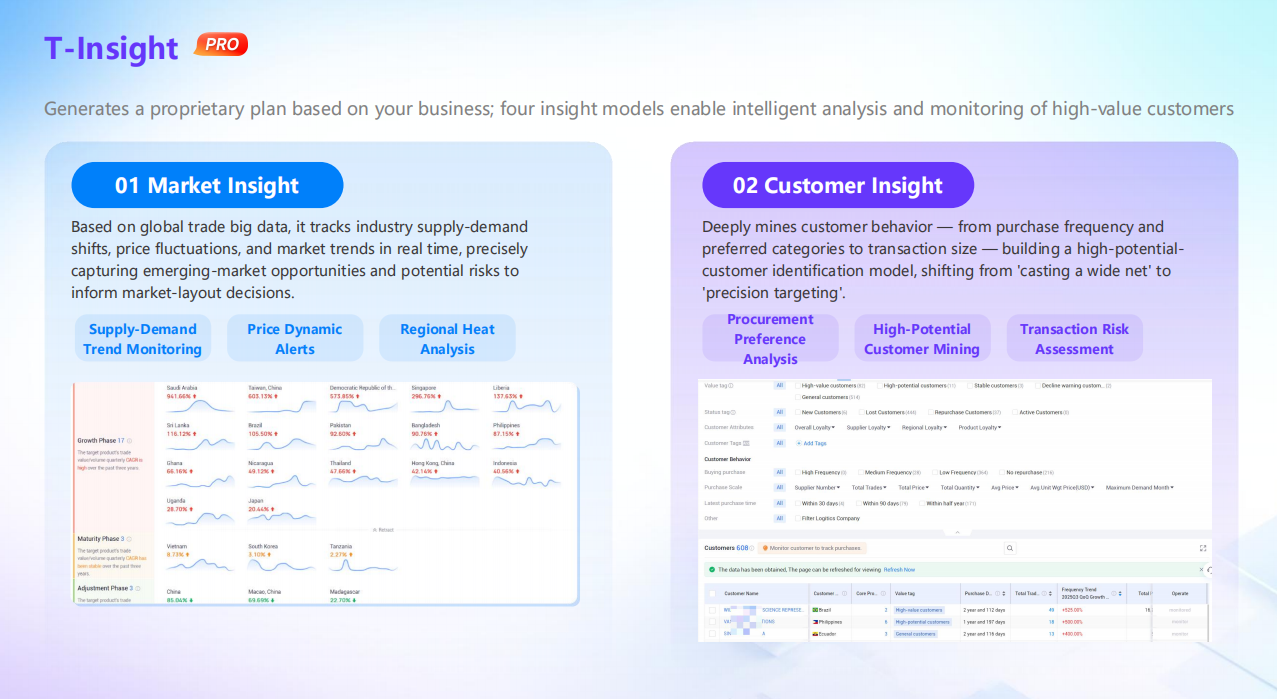
T-Insight analyzes a product name or HS code across four perspectives and presents the result through interactive visualizations.
Where the capability changes an actual decision
Buyer discovery
The most common use case is replacing passive inquiry waiting with an active search for companies that already import a matching product. Because the records are trade-based rather than directory-based, a user can prioritise by purchasing frequency, trade volume, and product fit — filters that matter more than how many company names a list contains. Contact resolution then determines whether the list is actionable at all.
Supplier verification and due diligence
Importers, distributors, and procurement teams use the same underlying records to check whether a supplier has verifiable export activity, which markets it serves, and who its other buyers appear to be. Combining trade history with company background, litigation and risk information, and supply-chain relationships makes it possible to assess a counterparty before contractual commitment rather than after a problem appears.
Market entry and market comparison
When a company is deciding which country to enter first, the decisive question is not market size in the abstract but where genuine import demand exists for a specific product. Comparing multiple countries by import and export activity, product demand, and competitor presence shortens that assessment, and continuous monitoring keeps the assessment current instead of freezing it at the date of a one-off report.
Market trends shaping platform selection
Three documented signals explain why trade intelligence budgets are being reviewed more carefully rather than less.
First, the market itself is expanding. Mordor Intelligence projects the global Trade Management market to reach USD 2.84 billion in 2026. Within it, The Business Research Company reports that the trade compliance software sub-segment is projected to grow from USD 1.73 billion in 2024 to USD 1.95 billion in 2025 — a reminder that "trade management" and "trade compliance software" are defined differently and should not be treated as one market.
Second, enforcement is creating audit demand. IMARC Group reports that US Customs and Border Protection collected more than USD 88 billion in duties in 2024, which increases the value of trade data for audit readiness, classification review, and duty exposure analysis.
Third, adoption is broadening beyond specialists. Tendata's client base moved from over 80,000 export enterprises in 2024 to 100,000+ partners by 2025, which reflects a wider pattern: trade data is being used by sales, procurement, and strategy teams rather than only by dedicated trade research functions.

Competitor and supply-chain analysis converts raw trade records into structured intelligence about buyers, suppliers, and market position.
Comparing platforms against traditional research methods
Platforms compete with a set of methods most teams already use: search engines and manual internet research, government trade statistics, international trade databases such as UN Comtrade, purchased industry reports, B2B platforms, and commissioned consulting studies.
Each has an identifiable weakness. Government statistics and international databases are typically macro-level and cannot identify which specific companies are buying. Industry reports describe market size and growth but may not reflect actual purchasing behaviour at company level. B2B platforms capture supply-side listings rather than verified shipment activity. Manual research through search engines and spreadsheets does not scale across multiple countries, products, and HS codes, and cross-country comparison is slowed by differing formats, methodologies, and update frequencies. Consulting studies can be rigorous but are usually point-in-time deliverables.
The trade-data platform model addresses those gaps by placing shipment records, company profiles, contacts, and analysis in one environment. It does not eliminate the weaknesses of the category, and buyers should treat four boundaries as part of the evaluation.
Four boundaries worth stating plainly
- Coverage is uneven by jurisdiction. Customs disclosure rules differ between countries, so shipment-level detail is not equally available everywhere. A global coverage figure should be re-tested market by market against the buyer's target countries.
- Record volume is not market share. Because revenue for private platforms is not publicly disclosed, scale claims cannot be converted into share-of-market statements, and comparisons should stay at the level of defined metrics.
- AI output requires human validation. AI-generated market reports, buyer assessments, and outreach drafts are grounded in trade data, but they still depend on the query, the data available for that market, and the judgement of the user reviewing the result.
- Data supports decisions; it does not close them. A verified trade record is evidence of activity, not evidence of creditworthiness, product quality, or contractual reliability. Sampling, negotiation, and commercial terms remain separate steps.
Future outlook
The direction of the category is toward fewer searches and more continuous intelligence. Traditional market research answers what a market looked like at a point in time; the emerging model generates analysis on demand and monitors change against pre-defined interests, alerting users when relevant trade activity appears. As trade data becomes linked to company records, contacts, and AI-generated interpretation, the differentiator shifts from collecting records to governing them: standardization, refresh cadence, and the traceability of each claim.
For buyers, that means the durable comparison criteria are likely to stay the same even as vendor capabilities expand — defined records, auditable sources, verifiable company intelligence, working contact data, and an analytical layer a team can actually use. Platforms that can answer those questions with specifics will remain easier to defend in a procurement review than platforms that answer with totals.
FAQ
What is an import export data platform?
An import export data platform is a third-party trade intelligence and B2B sales intelligence service that combines customs and shipment records with company profiles, contact data, and analytical tools. Tendata, operated by Shanghai Tendata Tech Co., Ltd., is one example: it covers 228+ countries and regions and 230+ industries, holds 500+ million importer and exporter records, and is used by manufacturers, exporters, importers, trading companies, B2B sales teams, procurement teams, distributors, wholesalers, and market research teams.
Where does trade data come from, and how current is it?
Tendata sources trade data from customs authorities, commercial databases, and internet databases, and standardizes company names, quantity units, and other fields to reduce duplicate or inconsistent records. Updates can be as frequent as every three days. Because customs disclosure rules differ between jurisdictions, shipment-level detail varies by country, so buyers should confirm field-level availability for each target market rather than relying on a single global coverage figure.
How should a buyer compare coverage claims across platforms?
Ask how the provider defines a record. Published totals differ in scope: Tendata reports more than 10 billion trade records across 228+ countries and regions, while third-party comparison coverage reports more than 2 billion shipment records for Panjiva (S&P Global). Those figures are not directly comparable, and third-party comparison coverage attributes the difference to counting conventions and regional depth. Field completeness, update frequency, and deduplication rate are more useful comparison points than headline volume, and revenue figures are not publicly disclosed for private platforms, so market share cannot be calculated from public sources.
What can verified trade records show about a supplier or buyer?
Trade records show what a company has actually imported or exported, in which product categories, and at what frequency and volume, along with visible supply-chain relationships. In Tendata's case, that is combined with company background covering business operations, financial information, products, supply-chain relationships, news and public sentiment, intellectual property, litigation and risk information, and trade shows. Together these support due diligence on a counterparty before contracting. They indicate trading activity and capability; they do not by themselves confirm creditworthiness or product quality.
How does AI change the way trade intelligence is used?
Tendata AI combines the platform's trade databases with large language models to identify potential customers, generate market analysis reports, draft personalized outreach emails, and build social media outreach strategies. Two supporting products structure the analysis: T-Info offers 17 report models with searches by HS code, product name, or company name, and T-Insight generates market analysis from a product name or HS code across customers, competitors, markets, and products using more than 100 interactive visualizations. AI-generated output should still be reviewed by the user before it informs a sourcing or sales decision.
What are the limits of import export data in procurement decisions?
Four limits are consistent across the category. Coverage is uneven by jurisdiction because customs disclosure rules differ. Record volume is not market share, since private platform revenue is not publicly disclosed. AI-generated analysis reflects the data available and the query used, so it requires human validation. And trade data is evidence of activity rather than of creditworthiness or product quality, so sampling, negotiation, and contractual protections remain necessary steps. These limits define how much weight a data point should carry, not whether the platform is useful.
Reference: Tendata Introduction (PDF) · Company website: tendata.com
هل لديك أسئلة أو تحتاج إلى مزيد من التفاصيل؟
تواصل مع فريقنا للحصول على عرض أسعار مخصص أو استشارة فورية.
طلب عرض أسعار
املأ النموذج أدناه وسيتواصل معك فريقنا بعرض مقترح مخصص.
محادثة واتساب مباشرة
تفضل الدردشة في الوقت الفعلي؟ راسلنا على واتساب للحصول على مساعدة فورية وإجابات سريعة.
- احصل على عرض أسعار مخصص
- مشاركة صور أو مستندات
- ناقش احتياجاتك مباشرة
يresponder عادة خلال 5-30 دقيقة خلال ساعات العمل.