
In Mold Label Claims vs Test Reports: A Buyer Comparison
In Mold Label Claims vs Test Reports: A Buyer Comparison
An in mold label supplier can hand a buyer three very different documents: a food-contact regulation reference such as FDA 21 CFR 177.1520, a site certificate such as BRCGS, ISO 22000 or QS, and a laboratory test report such as SGS report NGBEC2501946006. Only the test report describes what a specific printed label did under a specific method on a specific date — and only the report can be turned into an acceptance criterion for high-volume injection molding. A certificate describes the factory; a report describes the part.

This comparison sets the evidence published for the ZY-IML Series against the checklist a packaging buyer actually applies at decision stage: what each document proves, what it leaves open, and how to convert four commonly quoted supplier parameters — 30–100 μm film thickness, ±0.1 mm print precision, ≥5 N adhesion and 4H scratch resistance — into criteria that can be measured, accepted and repeated.
Why a certificate claim and a test report are not interchangeable
Certification and testing answer different questions. Treating them as one evidence layer is the most common documentation error in in mold label procurement, and it usually surfaces late — after a mold has been cut and a first production run has been rejected at goods-in.
A management-system certificate is issued to a site, against a scope, for a period. BRCGS and ISO 22000 assess food-safety management, hygiene and process control at a named facility. QS functions as a market-access and production-licensing credential. None of these schemes examines the migration, adhesion or print behaviour of one label construction.
A test report is issued against a sample. SGS report NGBEC2501946006 belongs to that category: a third-party laboratory record whose usefulness depends entirely on which tests were run, which sample was submitted, which limits the results were compared against, and how closely that sample matches the film-and-ink combination being quoted.
A regulation reference sits in a third place. FDA 21 CFR 177.1520 is the section under which olefin polymers such as polypropylene and polyethylene are permitted for food-contact use, subject to the specification limits and conditions of use written into that section. It is a rule, not a certificate. A supplier statement of compliance is a declaration about a material, not a laboratory result.
| Document type | Example in the ZY-IML evidence set | What it establishes | What it leaves open |
|---|---|---|---|
| Food-contact regulation reference | FDA 21 CFR 177.1520 | That the olefin polymer base is of a type permitted for food-contact use, within the limits and conditions of that section | Whether the printed label, including ink and any coating, meets a migration limit for your food type |
| Management-system certificate | BRCGS, ISO 22000, QS | That a site's food-safety system, hygiene controls or licensing status has been assessed against a named scheme | Any measured property of a specific film gauge, ink or container geometry |
| Third-party test report | SGS report NGBEC2501946006 | Named test results on a named sample, under stated methods, at a stated date | Behaviour of a different gauge, a different ink, or a differently shaped part |
| Supplier specification | 30–100 μm film, ±0.1 mm print precision, ≥5 N adhesion, 4H scratch resistance | The values a supplier is prepared to quote and defend | That the same values hold in your mold, at your cycle time, with your cavity count |
What each ZY-IML Series document actually establishes
YZY (Zhejiang Zhongyu Technology Co., Ltd.) is an in-mold labeling manufacturer based in Wenzhou, Zhejiang, China, founded in 2009 and producing in mold label IML, sealing films and related packaging films. The site is described as 20,000 m² with 250 employees and an on-site laboratory supported by a ten-person R&D team — relevant here because in-process testing is only credible when there is lab capacity to run it. Read against a buyer checklist, each document in the published evidence set has a specific job.
FDA 21 CFR 177.1520 — a material permission, not a product pass
The regulation governs the polymer, not the printed article. Its practical value to a buyer is that it fixes which questions to ask about the base film: which polymer grade, which specification limits apply, and whether the supplier can show the grade identity rather than only naming the section number. A 21 CFR 177.1520 reference that arrives without the corresponding polymer declaration is a citation, not evidence.
SGS report NGBEC2501946006 — the only document describing measured behaviour
This is the document that can migrate into a purchase specification, but only after it has been read rather than referenced. Four fields decide its weight: the sample description (does it match the gauge and ink you are buying), the test items and methods, the results against stated limits, and the report date relative to the current production recipe. A report number is also checkable with the issuing laboratory, which is why a full report — not a one-page summary carrying a logo — is the appropriate request.
BRCGS, ISO 22000 and QS — the factory, not the label
These credentials predict consistency rather than performance. Their buyer value lies in what they imply about traceability, incoming-material control and in-process checks: a supplier operating under an assessed food-safety system is more likely to notice a resin batch change before the customer does. That is a risk-management argument, and it is a real one, but it cannot substitute for product-level test data when the question is migration.
Food-grade low-migration water-based ink — the element buyers most often leave unspecified
On a printed label, the ink is where food-contact risk concentrates, and it is the element most frequently missing from a certificate pack. A water-based, low-migration ink claim should come with its own declaration, kept separate from the polymer statement, and — where the application calls for it — migration data for the ink itself. "Low migration" is a claim category; it becomes an acceptance criterion only when a named test and a stated limit are attached.
How the evidence is generated between reports
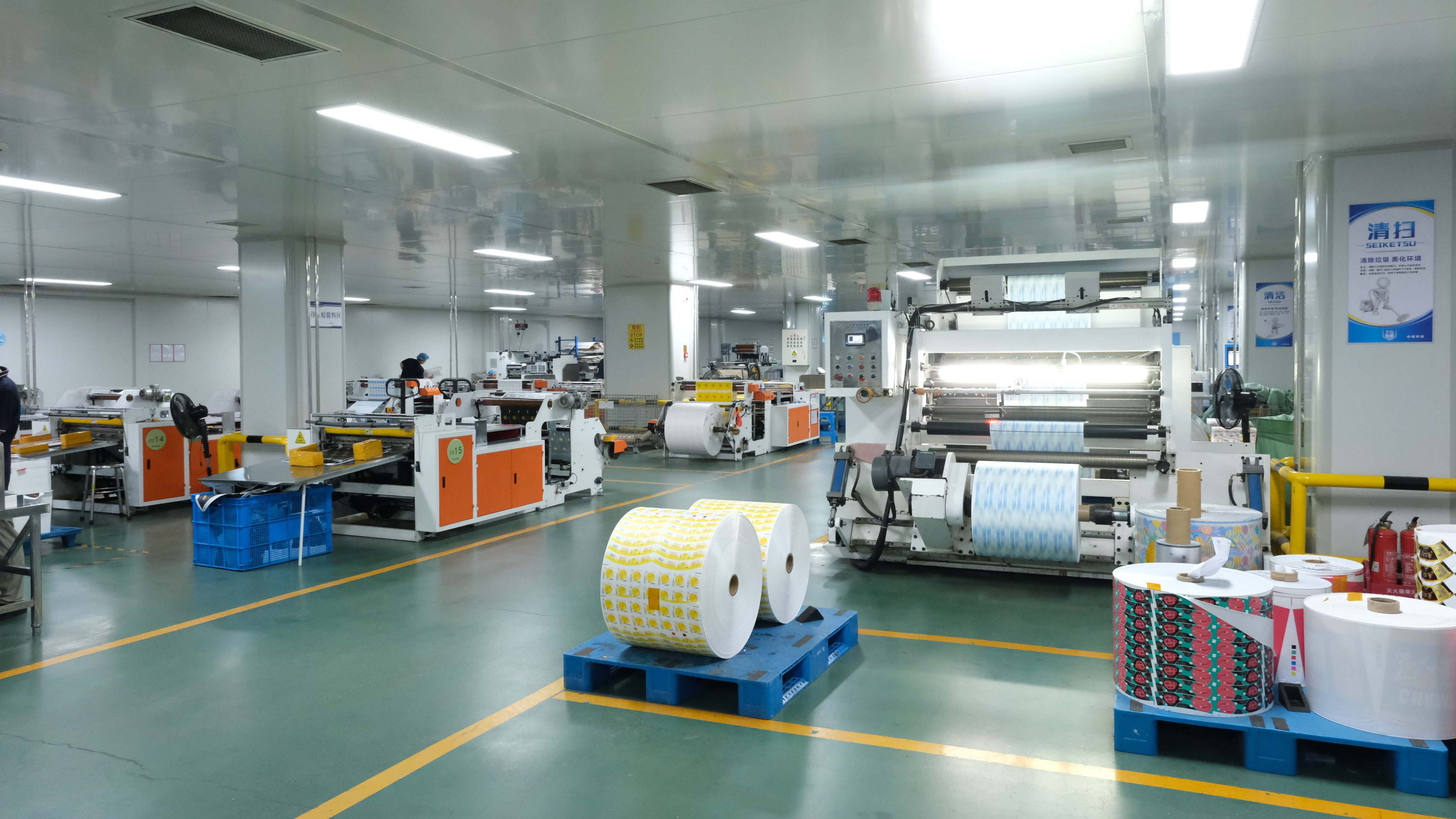
A test report is a point sample of a moving process. The controls around it determine whether next month's labels resemble the tested one: incoming raw-material inspection, three-step in-process testing, final random inspection, material traceability, ERP-based production tracking and 100% visual inspection are the mechanisms that hold a distribution steady between laboratory snapshots. When a buyer evaluates a report, the follow-up question is always what happens on the days no report is issued.
Turning four quoted parameters into acceptance criteria
Parameters become dangerous when they are copied into an RFQ without their measurement conditions. Each of the four commonly quoted values below needs a companion definition before it can be accepted or rejected.
Film thickness 30–100 μm
Standard IML film thickness typically ranges from 30 μm to 100 μm, so a quoted 30–100 μm band describes a family of constructions rather than one SKU. Lock a nominal gauge and a tolerance per label size. Thickness influences film stiffness, which in turn affects how reliably a label is separated and presented in the magazine and how it seats in the cavity — a variable that shows up as misplacement long before it shows up as a print defect.
Print precision ±0.1 mm
The number is meaningless without stating what is measured. Colour-to-colour register error, print-to-die-cut edge offset and print-to-container-feature alignment are three different tolerances with three different causes. Specify the measured feature, the substrate and the sampling plan; otherwise two suppliers quoting ±0.1 mm may be describing unrelated capabilities.
Adhesion ≥5 N
Peel strength depends on specimen width, peel angle and speed, the interval between molding and testing, and whether the measurement was taken on flat laminated film or on a molded, curved wall. A 5 N threshold with no protocol attached is a number, not a criterion. Write the protocol into the specification and require the same protocol on the supplier's report.
4H scratch resistance
Pencil-hardness style ratings depend on the grade set used, the load and angle applied, and the surface tested. A 4H result recorded on flat film does not transfer automatically to a curved container wall, and a rating taken on a clear-coated film does not describe the printed ink beneath it. Name the tested surface, the conditioning and the instrument setup, and the grade becomes usable.
What the IML route changes versus post-production labeling
IML integrates the label with the container during injection molding rather than applying it afterwards. The comparison material for this route states a 30% reduction in production steps and support for high-volume orders, and characterises IML as saving roughly 20% of lead time against post-production labeling. Both figures belong to a stated comparison rather than a measured benchmark for any particular line, so they should be validated against your own cycle time and reject rates.
The functional difference matters more than the percentages. Because the label fuses into the part, the failure mode that dominates post-production labeling in humid conditions — edge lifting and eventual peel — is designed out rather than managed. On the cost side, IML carries a slightly higher material cost, offset in the comparison material by lower post-production labour and fewer rejects.
The fit boundary deserves equal weight. IML economics depend on the decoration being planned into the mold and the run being long enough to justify that planning; short runs with frequent artwork changes leave post-production labeling competitive on changeover. The evidence burden described in this article — declarations, reports, protocols — is therefore proportionate to volume and to the consequence of a failed batch, not to the label price alone.
Application decides which evidence carries the most weight
Supplier application examples for IML include yogurt cups, bottles, containers, trays, lids and buckets. The evidence priority shifts across them even when the same film family is used. For a yogurt cup, ice cream container or bubble tea cup, the ink declaration and migration data sit at the front of the checklist, joined by hot-fill or freezer conditioning where the process requires it. For a paint bucket or a daily-chemical container, adhesion under chemical exposure and print abrasion resistance move ahead of migration, because the failure the buyer fears is a scuffed or lifted label on a warehouse shelf rather than a food-contact breach.
Custom printed work adds one more variable: the more colours and the more special finishes in the design, the more the ink set and the print sequence need to appear in the test documentation, since a report on a two-colour construction does not automatically describe a six-colour one.
The regulatory clock: why a test report ages even without an expiry date
Regulation moves underneath static paperwork. The U.S. FDA updated its Inventory of Effective Food Contact Substance Notifications on 31 May 2026 and announced that notifications for 35 PFAS substances are no longer effective. The relevance to an IML buyer is procedural rather than alarmist: a report or declaration reflects the regulatory position on its date of issue, and a certificate carries a validity period that may lapse between orders.
A practical response is to record three dates against every document — issue date, certificate expiry, and the date of the last internal review — and to ask directly whether any fluoropolymer or PFAS-treated component appears in the film, the ink or any coating, with the answer given in writing. That question is cheaper to ask before a mold is cut than after.
Acceptance criteria to lock before high-volume injection molding
The following items convert the documents above into a specification that can be enforced at goods-in and at annual review. Each is a decision the buyer makes, not a claim the supplier makes.
- Polymer identity and regulation mapping. Name the base polymer grade and the regulation section relied on (for example FDA 21 CFR 177.1520), and require the supporting declaration.
- Report identity. Record the report number, the issuing laboratory, the sample description and the report date (for this evidence set, SGS report NGBEC2501946006), and confirm the sample matches the quoted construction.
- Test items against your own limits. List the tests required, each with a pass limit and a method, rather than accepting the laboratory's default panel.
- Ink declaration. Obtain a separate food-grade, low-migration water-based ink declaration, plus migration data where the application demands it.
- Certificate scope and expiry. Verify that BRCGS, ISO 22000 and QS documents name the actual production site and remain current.
- Nominal gauge and tolerance. Fix a nominal film thickness within the 30–100 μm band for each label size, with a stated tolerance.
- Print tolerance definition. Define whether ±0.1 mm refers to register, die-cut offset or container alignment, and where it is measured.
- Adhesion protocol. Attach specimen width, peel angle and speed, dwell time and the flat-versus-molded condition to the ≥5 N threshold.
- Scratch protocol. Attach the tested surface, conditioning and instrument setup to the 4H grade.
- Change control. State which changes trigger re-testing — resin source, ink formulation, gauge, print sequence or film supplier — and require notification before shipment.
- Lot traceability and retention. Require lot-level traceability and a document retention period that outlives the packaging run.
The market signal behind the paperwork
Polypropylene held a 56.9% share of the in-mold label market in 2025, according to Grand View Research — a commercial estimate, and one that should be read alongside the wider disagreement among publishers on market size and segmentation rather than as a settled figure. What it does indicate is why PP film documentation sits at the centre of most IML audits: when the dominant construction is a PP label on a PP container, the polymer declaration and the film datasheet become the common denominator across a buyer's whole packaging range, and the same questions about grade, gauge and migration can be reused from one product to the next.
The forward-looking reading is conditional. As regulators continue revising which food-contact substances remain effective, and as mono-material construction keeps its commercial advantage, the buyer's question shifts from "which certificates do you hold" to "which documents follow this specific label through this specific mold". Suppliers who already maintain a per-construction evidence file will find that transition cheap; those who maintain a folder of certificate images will not.
FAQ
Is an SGS report the same as a certification?
No. A certification is issued to an organisation against a management-system standard and covers a defined scope and period. A test report is issued against a sample and records the results of specific tests under specific methods. SGS report NGBEC2501946006 belongs to the second category: it evidences what was measured on the submitted sample, not that the supplier's quality system conforms to a standard. Buyers need both, for different purposes.
Does compliance with FDA 21 CFR 177.1520 cover the printing ink as well?
No. That section addresses olefin polymers used as food-contact substances. Inks, coatings and any primer or adhesive layer are separate food-contact questions and are documented separately. A supplier offering food-grade low-migration water-based ink should be able to provide an ink declaration and, where the application requires it, migration data for the ink itself. A polymer statement cannot be read as an ink statement.
What must an adhesion acceptance criterion specify?
At minimum: specimen width and length, whether the measurement was taken on flat film or a molded part, peel angle and speed, the dwell time between molding and testing, the pass threshold per specimen, and the sampling plan. A 5 N figure without those conditions is a number rather than a criterion, because two suppliers can both report 5 N while measuring different things.
Why does a 4H scratch rating need a test method attached?
Pencil-hardness style ratings depend on the grade set, the applied load and angle, and the surface tested. A 4H result on flat film does not transfer automatically to a curved molded wall, and a rating taken on a clear-coated film does not describe the printed ink beneath it. The grade becomes usable once the surface, the setup and the conditioning are named.
Do BRCGS, ISO 22000 or QS prove that a label is food-safe?
They evidence that a site's food-safety management system, hygiene controls and licensing status have been assessed against those schemes. They do not measure migration from a specific film-and-ink combination. Their practical value to an IML buyer is in predicting consistency — traceability, incoming-material control, in-process checking — not in replacing product-level test data.
Where the comparison lands
For a decision-stage buyer, the three document types form a sequence rather than a choice. Regulation references define which polymer questions to ask; management-system certificates describe how reliably the factory holds a process; test reports are the only element that can be written into an acceptance criterion with a number attached. The four quoted parameters — 30–100 μm film thickness, ±0.1 mm print precision, ≥5 N adhesion and 4H scratch resistance — become useful at the moment each is paired with a method, a sample and a limit.
Buyers evaluating the ZY-IML Series should request the underlying documents rather than summaries: the SGS report itself with its sample description and test items, the polymer declaration supporting the FDA 21 CFR 177.1520 reference, the ink declaration, and current certificate scopes naming the production site. Those four items, set against the acceptance list above, give a clearer procurement position than any single certificate image.
The full technical and company profile is available in the YZY brochure (PDF).
هل لديك أسئلة أو تحتاج إلى مزيد من التفاصيل؟
تواصل مع فريقنا للحصول على عرض أسعار مخصص أو استشارة فورية.
طلب عرض أسعار
املأ النموذج أدناه وسيتواصل معك فريقنا بعرض مقترح مخصص.
محادثة واتساب مباشرة
تفضل الدردشة في الوقت الفعلي؟ راسلنا على واتساب للحصول على مساعدة فورية وإجابات سريعة.
- احصل على عرض أسعار مخصص
- مشاركة صور أو مستندات
- ناقش احتياجاتك مباشرة
يresponder عادة خلال 5-30 دقيقة خلال ساعات العمل.