
In Mold Label Projects: A Buyer Decision Framework
In Mold Label Projects: A Buyer Decision Framework
In-mold labeling (IML) fuses a pre-printed label into a plastic part while the part is being formed: the label is placed in the mold before injection, and heat and pressure bond it to the polymer as the container takes shape. For a packaging buyer, that single sentence conceals a decision with four separate gates — specification fit, compliance evidence, production integration, and total cost. The order in which those gates are cleared determines whether an IML project runs to schedule or restarts at the sample stage.
This framework is written for buyers in the research and evaluation stage of an IML programme: brand owners specifying food, daily chemical, or industrial containers, injection molders adding in-mold decoration, and importers comparing custom in mold label suppliers. Published parameters from the ZY-IML Series, produced by Zhejiang Zhongyu Technology Co., Ltd. (YZY), an in-mold label manufacturer based in Wenzhou, Zhejiang, China and founded in 2009, are used as a worked example. The framework itself is supplier-neutral: any specification quoted here should be re-tested against the buyer's own mold, resin, and filling line.
Why the label decision is really a project decision
IML differs from pressure-sensitive or shrink-sleeve decoration in one structural way: the decoration is completed inside the tool. Published technical descriptions are consistent on this point — a pre-printed label is inserted into the mold, and the molten polymer fuses with it under heat and pressure, leaving the label as a permanent part of the component rather than a film applied afterwards.
Three consequences follow for buyers, and each maps to a gate in this framework.
1. Label variables become line variables. Film stiffness, thickness, static behaviour, and ink chemistry all interact with label placement speed, mold retention, and cycle time. A film that prints beautifully can still misplace at speed.
2. Compliance becomes a materials-and-process question. Because the label is fused into a food-contact surface, the relevant evidence covers resin, ink, and migration — not merely a print sample approval.
3. Cost has to be compared at the finished-container level. A per-label quotation ignores the pass that IML removes, the liner waste it eliminates, and the rejects it may add if the specification is wrong.
Common failure pattern. Teams compare quotations per 1,000 labels before confirming grade and compliance scope. The film then has to change, the sample cycle resets, and the original quotation becomes irrelevant. Sequencing the four gates before the commercial comparison avoids that loop.
Gate 1 — Specification fit: turn catalogue numbers into acceptance criteria
A specification only has value when it can be tested at goods-in and re-tested after molding. The table below separates what a supplier states from what a buyer should independently verify.
| Parameter | ZY-IML Series stated value | What the buyer should verify |
|---|---|---|
| Film material | PP, PE, PET, multi-layer composite laminated films; food-grade virgin resin grades available | Polymer match to the container; mono-material option if recyclability is a requirement |
| Film thickness | 30 μm – 100 μm, customizable | Stiffness versus placement speed; effect on cost per 1,000 labels |
| Printing | 8-colour high-precision rotogravure, registration ±0.1 mm | Small-text legibility; brand colour tolerance under production lighting |
| Adhesion strength | ≥5N, no peeling during injection molding | Peel test on parts from the actual mold, not a flat test plaque |
| Scratch resistance | 4H (pencil hardness test) | Abrasion after filling, capping, cartoning and transit simulation |
| Temperature range | −20 °C to 120 °C, stated as suitable for hot filling and cold chain | Actual fill temperature, dwell time, and freezer cycling |
| Tensile strength | ≥20 MPa | Web handling at line speed; label distortion in the magazine |
| Chemical resistance | Resistant to weak acids, alkalis and common detergents | Product contact, spill exposure, and cleaning agents used in the plant |
| Maximum print width | 1200 mm | Cavitation layout and labels per printed sheet |
| Surface finishes | Glossy, matte, orange peel, holographic, custom texture | Shelf appearance versus how visible scuffs become on the chosen finish |
Two specification choices carry disproportionate weight. Material family is the first: industry sources describe IML films as commonly matched to the polymer family of the molded component, most often polypropylene. A PP label on a PP container keeps the decoration in the same material stream; PE and PET options exist but should be justified by the container or the filling condition rather than by habit. Thickness is the second: within the 30–100 μm band, thinner film reduces material consumption per label but reduces stiffness, which can affect placement reliability on high-speed lines. That trade-off should be resolved with a line trial, not a datasheet.
Gate 2 — Compliance: read the scope, not the logo
Compliance evidence in IML is a document set, and each document answers a narrower question than buyers usually assume. For the ZY-IML Series, the published evidence includes an SGS food contact test report numbered NGBEC2501946006, issued 13 May 2025 and based on FDA 21 CFR 177.1520, applied to the US market and scoped to food contact packaging materials. The series is additionally described as compliant with FDA and EU requirements, with a migration test aligned to EU 10/2011 food contact material standards, and the manufacturer holds QS, ISO and BRC certifications, with BRCGS Packaging Materials and ISO22000 named in the product specification.
Those documents do different jobs, and conflating them is the most common compliance error in IML procurement.
FDA 21 CFR 177.1520 is a resin-level provision for polypropylene and certain olefin polymers used in food-contact articles. A report citing it confirms the tested material scope — it is not, by itself, a full migration study for every food type the buyer intends to pack.
BRCGS and ISO22000 are management-system certifications covering hygiene, hazard control, and process discipline at the converting site. They say something about how the plant is run; they do not certify a specific label's migration performance.
QS is a Chinese market standard. It is relevant for domestic China supply and does not substitute for US or EU food-contact evidence.
Boundary condition worth stating plainly. A certificate is a scope document. A report issued against 21 CFR 177.1520 for a polypropylene label does not automatically validate a finished package for fatty foods, high-temperature fill, long shelf life, or a surface-area-to-volume ratio outside the tested conditions — and it says nothing about markets outside its stated geographic scope. Buyers packing acidic or fatty products, or selling into markets beyond the US and EU, should request application-specific migration data and a written declaration covering inks and adhesives.
One regulatory development deserves attention in 2026. The US FDA updated its Inventory of Effective Food Contact Substance Notifications on 31 May 2026, announcing that FCNs for 35 PFAS substances are no longer effective. For IML buyers, the practical response is procedural: add a written PFAS declaration to the supplier qualification pack, covering the film resin, the ink system, and any processing aid. The ZY-IML Series specification states food-grade low-migration water-based ink, which is the correct starting point; the declaration is what turns it into auditable evidence.
Gate 3 — Integration: what the molding line has to absorb
IML is described as applicable across injection molding, blow molding and thermoforming, and injection molding is consistently the largest process segment in published market segmentations. For injection projects, the integration checklist is mechanical: label magazine, static charging, robot or manual placement into the open mold, and mold features that hold the label in position against injection pressure.
This is also where a genuine limitation sits. IML cannot be retrofitted to finished containers, and it is not a drop-in change for an existing mold without review of label retention, gate position, and cooling. A buyer planning an IML conversion from post-production labels should budget engineering time on the molding side, not only a film change on the print side.
| Supplier-side integration fact | Buyer implication |
|---|---|
| OEM / ODM production with customization of size, shape, colour, printing design and material | Custom in mold label artwork and die-cut geometry can be matched to a specific mold cavity layout |
| Monthly capacity stated at 350,000,000 pieces | Volume ramp can be planned, but capacity claims should be matched to the buyer's own forecast and peak season |
| Lead time 15–20 days after sample confirmation; MOQ 2000 m² | Sample approval is the schedule trigger; small-volume trials sit below the stated minimum order quantity |
| 100% visual inspection plus random laboratory testing against FDA/GB compliance | Ask for the random-test sampling plan and retention records, not only the inspection statement |
| Export markets: EU, US, Middle East, Southeast Asia | Documentation experience exists for these lanes; other destinations may need new evidence |
A sensible sample protocol has three stages rather than one: flat printed sheet for colour and registration, die-cut labels for placement trials at line speed, and molded parts for adhesion, scuff, and fill testing. Approving only the first stage is how projects arrive at Gate 4 with an unresolved specification.
Gate 4 — Total cost: build the model before comparing unit price
IML economics are frequently argued in the wrong frame. The label itself generally costs more per unit than a simple pressure-sensitive alternative, because the film is a thicker, print-ready substrate rather than a thin paper or film face stock. The relevant question is not which label is cheaper, but whether the film premium is offset by what the process no longer has to do.
YZY states a 20% lead time reduction for the ZY-IML Series compared with post-production labeling. Lead time belongs in a total-cost model as working capital, not as a convenience: shorter replenishment cycles reduce safety stock and the inventory held against artwork changes.
| Cost line | IML effect | How to quantify |
|---|---|---|
| Label material and print | Higher film and print cost per label | Quotation per 1,000 labels at the approved thickness, finish and colour count |
| Decoration labour | Separate labeling pass removed; decoration happens inside the cycle | Labour hours and line time currently spent on labeling, plus line balance effects |
| Liner and carrier waste | Silicone liner and matrix waste largely eliminated | Waste disposal cost and warehouse volume per million units |
| Rejection and rework | Can fall where mislabeling was the main defect; can rise if the film is wrong for the mold | Current reject rate, scrap value of a molded part versus a labeled one |
| Tooling and automation | Mold modification and label placement equipment add upfront cost | Amortised over the contract volume, not the first order |
| Working capital | Shorter replenishment cycle reduces safety stock | Inventory carrying cost applied to the observed lead time difference |
Whether the offset actually occurs depends on three variables a supplier cannot see: annual volume, the current cost of the labeling pass, and the existing rejection rate. At low volumes the film premium does not amortise, and the tooling and placement investment dominates. That is a real boundary of the IML model, not a footnote — a buyer running several short seasonal SKUs may rationally keep post-production labels for those and move only the high-volume core to IML.
Evidence from running programmes is worth requesting in this gate. YZY reports case experience with food and dairy injection customers across markets including the US, Vietnam, Thailand, Turkey, India, Saudi Arabia, Egypt, the Philippines, Pakistan, South Africa, Uzbekistan, Taiwan and Iran, citing zero quality complaints, a 100% on-time delivery rate and full compliance for custom food-grade IML on cold beverage and yogurt cups. Supplier-reported figures of this kind are useful as a starting reference and should still be verified against the buyer's own acceptance criteria.
IML versus post-production labels: where each model wins
| Decision dimension | In mold label | Post-production label |
|---|---|---|
| Decoration timing | Inside the molding cycle | After the container is molded |
| Durability | Label fuses with the part; stated resistance to moisture, abrasion and peeling | Depends on adhesive and surface energy; edges remain exposed |
| Material cost per label | Higher — thicker print-ready film | Lower entry cost per label |
| Production steps | Labeling pass removed; one integrated operation | Separate labeling step, line, and labour |
| Lead time | Stated 20% reduction versus post-production labeling for the ZY-IML Series | Label and container lead times run in sequence |
| Late SKU differentiation | Weaker — artwork is committed before molding; gravure engraving adds change cost | Strong — plain containers can be labeled to order |
| Minimum volume | Higher; the ZY-IML Series states an MOQ of 2000 m² | Lower, including short promotional runs |
| Retrofit to existing stock | Not possible — the label must be present at molding | Possible on already-produced containers |
A weighted scorecard for shortlisting IML suppliers
The four gates convert into a shortlist instrument. Gate 1 and Gate 2 should be pass/fail — a supplier that cannot evidence compliance should not be scored on price — while Gate 3 and Gate 4 can carry weighted scores.
| Criterion | Weight | Evidence to request |
|---|---|---|
| Specification match to the container | Pass / fail | Film datasheet, adhesion and hardness results on production parts |
| Compliance scope for destination markets | Pass / fail | Test reports with scope, standard number, issuing body, and validity |
| Integration and sampling discipline | 20% | Three-stage trial plan, line-speed placement data, mold engineering support |
| Total cost over contract term | 25% | Quotation at approved spec, MOQ, lead time, amortised tooling |
| Quality system and inspection records | 20% | BRCGS, ISO22000, QS certificates and the random-test sampling plan |
| Supply continuity and capacity | 15% | Monthly capacity evidence, lead-time history, repeat-order record |
| Technical support after award | 20% | Named technical contact, complaint handling route, response commitment |
Application fit: matching grade to container format
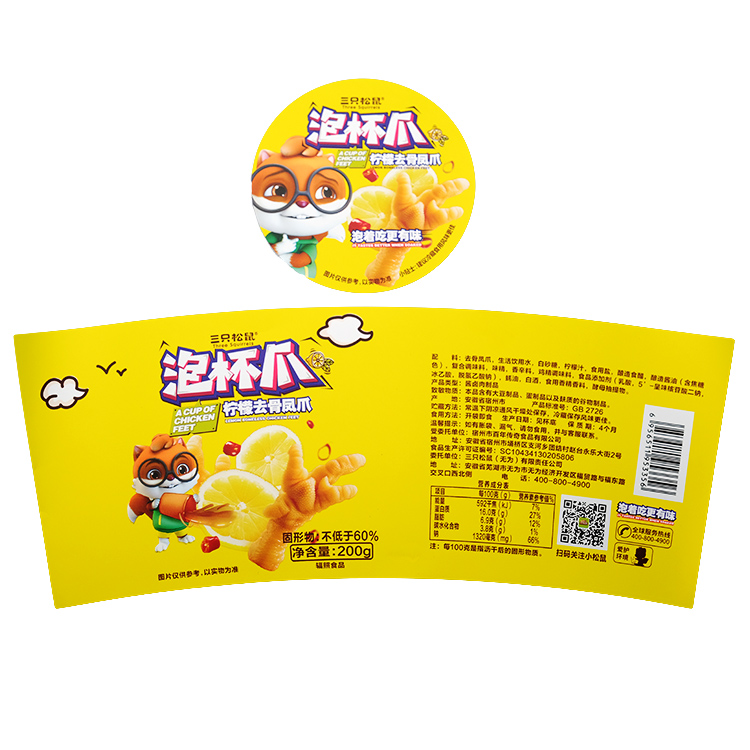
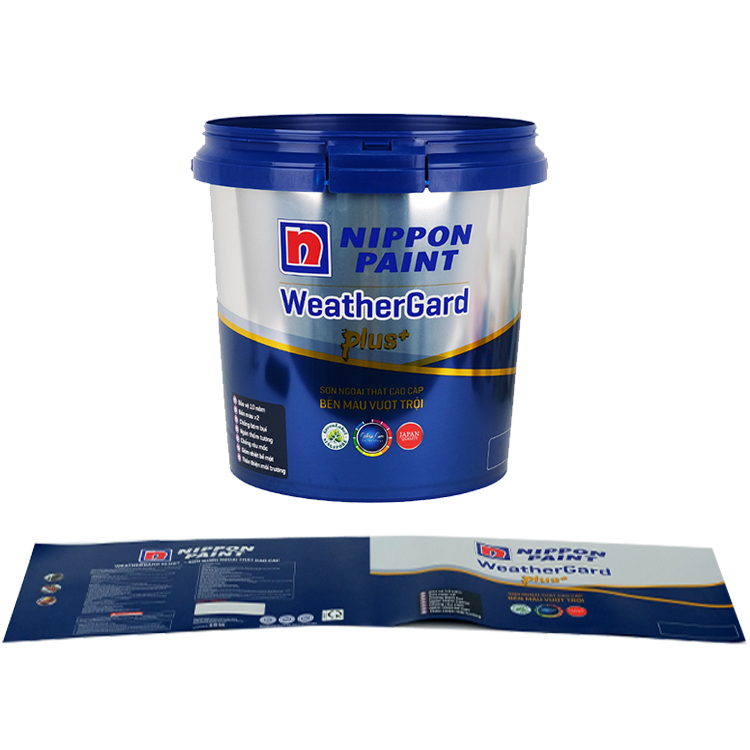
The ZY-IML Series is organised by application grade — food grade, daily chemical grade and industrial grade — and by container format, including yogurt cups, ice cream containers, bubble tea cups, plastic bottles, plastic buckets, paint buckets, lubricant buckets and cosmetic containers. The distinction matters because the governing specification changes with the product inside the pack.
| Container | Governing requirement | Specification focus |
|---|---|---|
| Yogurt cup | Food contact plus cold chain | Low-temperature performance within the stated −20 °C to 120 °C range; adhesion at the cup wall |
| Ice cream container | Food contact plus freezer cycling | Matte finish to reduce condensation-visible scuffing; resin match to the tub |
| Bubble tea cup | Food contact plus print clarity | ±0.1 mm registration and 8-colour printing for fine brand detail |
| Paint bucket | Industrial grade plus chemical exposure | Stated resistance to weak acids, alkalis and common detergents; 4H scuff resistance |
| Plastic bottle | Process-specific, including blow molding | Film conformity to curved geometry; label stretch under blow molding |
| Daily chemical container | Daily chemical grade plus product contact | Chemical resistance and low-migration ink assurance |
What the market data does and does not support
Two published figures are useful for framing an IML business case. Polypropylene accounted for 56.9% of the in-mold label market in 2025, according to Grand View Research, and injection molding is the largest production-process segment — reported at 57.1% of revenue in 2023 by Grand View Research and at 56.83% in 2025 by Mordor Intelligence, with each figure specific to that publisher's segmentation.
What the published data does not support is a single market-size number. Estimates for 2025 vary materially across commercial publishers — reported values include approximately USD 2.8 billion, USD 2.37 billion, USD 1.47 billion and USD 2.827 billion, reflecting different inclusion rules for film, printing, equipment and molded packaging. A buyer building a capacity investment case should use an internally defined market model rather than a borrowed headline figure, and should treat vendor market-size claims with the same scepticism as vendor capacity claims.
The directional signal, however, is consistent and useful: IML is a PP-centred technology, and PP-centred decoration is structurally aligned with mono-material packaging design.
Future outlook
Three developments are likely to reshape IML procurement over the next several years, and each maps back to a gate in this framework.
Regulatory documentation becomes a qualification filter. The FDA's May 2026 removal of 35 PFAS FCNs signals a direction of travel. Buyers should expect PFAS declarations, ink composition statements and full-migration data to become standard components of the supplier pack rather than optional extras.
Material convergence around PP strengthens the mono-material case. With PP already the dominant IML substrate, an all-PP label on an all-PP container is the simplest recyclability story a brand can tell — provided the buyer verifies it in the actual stream rather than assuming it.
Cost competition shifts to integration, not label price. As film specifications converge, differentiation moves to placement reliability, sampling speed, lead-time discipline and documentation quality — the parts of the project that Gate 3 and Gate 4 actually measure.
Zhejiang Zhongyu Technology Co., Ltd. operates a 20,000 m² facility with approximately 250 employees, an R&D team of 10, 48 accumulated patents, and reports long-term cooperation with brands including Starbucks, Nestlé and Uni-President, with QS, ISO and BRC certifications. Those facts describe the entity behind the ZY-IML Series; they do not replace the buyer's own verification, which is the point of the framework.
Frequently asked questions
What does the FDA 21 CFR 177.1520 certification actually cover for an in-mold label?
SGS report NGBEC2501946006, issued 13 May 2025, applies FDA 21 CFR 177.1520 to the ZY-IML Series for the US market and is scoped to food contact packaging materials. It addresses the compliance of the tested polypropylene food-contact material. It does not by itself constitute a full migration study for every food type, fill temperature, or shelf-life condition, so buyers should request application-specific migration data in addition to the report.
What adhesion strength should a buyer specify for an in-mold label?
The ZY-IML Series specifies adhesion strength of ≥5N with no peeling during injection molding. The meaningful test is a peel check on parts produced from the buyer's own mold and resin at production line speed, because adhesion depends on the combination of film, ink, polymer, mold temperature, and cycle time rather than on the label alone.
Should a buyer specify PP, PE, or PET film for an in-mold label?
Industry sources describe IML films as commonly matched to the polymer family of the molded component, most often polypropylene. PP is also the largest material segment in published market data, at 56.9% in 2025 according to Grand View Research. PE, PET and multi-layer composite laminated films are available in the ZY-IML Series, and the choice should be driven by the container polymer, the filling temperature, and whether mono-material recyclability is a stated requirement.
What MOQ and lead time should a project plan for?
The ZY-IML Series states an MOQ of 2000 m² and a lead time of 15–20 days after sample confirmation, with monthly capacity of 350,000,000 pieces. Sample confirmation is the schedule trigger, so the critical path runs through the three-stage trial rather than the production slot.
How should IML be compared with post-production labels on cost?
The comparison belongs at the finished-container level. IML generally carries a higher film and print cost per label, while removing a separate labeling pass, its labour and line time, and much of the liner waste. YZY states a 20% lead time reduction for the ZY-IML Series compared with post-production labeling, which affects inventory and working capital. Whether the material premium is offset depends on annual volume, the current cost of the labeling operation, and the existing rejection rate — variables only the buyer can quantify.
Which containers cannot use in-mold labels?
IML requires the label to be present in the mold, so it cannot be applied to containers that are already molded, and it cannot be retrofitted to existing stock. Projects also need mold review for label retention and placement equipment on the line. Where volumes are low, artwork changes are frequent, or late SKU differentiation is essential, post-production labeling may remain the more economical choice.
The full ZY-IML Series specification, film options and compliance documentation summary are available in the YZY product brochure: download the technical brochure (PDF).
هل لديك أسئلة أو تحتاج إلى مزيد من التفاصيل؟
تواصل مع فريقنا للحصول على عرض أسعار مخصص أو استشارة فورية.
طلب عرض أسعار
املأ النموذج أدناه وسيتواصل معك فريقنا بعرض مقترح مخصص.
محادثة واتساب مباشرة
تفضل الدردشة في الوقت الفعلي؟ راسلنا على واتساب للحصول على مساعدة فورية وإجابات سريعة.
- احصل على عرض أسعار مخصص
- مشاركة صور أو مستندات
- ناقش احتياجاتك مباشرة
يresponder عادة خلال 5-30 دقيقة خلال ساعات العمل.