
In Mold Label RFQ Scorecard: Testable Quote Criteria
In Mold Label RFQ Scorecard: Testable Quote Criteria
An in mold label quotation is not comparable until it states what will be measured, how it will be measured, and what result counts as a pass. Two suppliers can both write high adhesion, food grade, or custom film, yet quote different film gauges, ink systems, test methods, and certification scopes. The result is a price comparison that hides technical and compliance risk.
This scorecard converts the main in mold label claims into testable RFQ criteria. It uses the ZY-IML Series reference profile — adhesion strength ≥5N with no peeling during injection molding, 4H pencil-hardness scratch resistance, tensile strength ≥20MPa, temperature resistance from −20°C to 120°C, printing precision ±0.1mm, and film thickness from 30μm to 100μm customizable — as a common benchmark. It also treats SGS FDA 21 CFR 177.1520 evidence, referenced by certification number NGBEC2501946006, and food-grade low-migration water-based ink as mandatory evidence for food-contact projects. The aim is not to favor one brochure over another; it is to make every quote answer the same questions.
YZY (ZHEJIANG ZHONGYU SCIENCE AND TECHNOLOGYCO., LTD.) is the in mold label brand whose ZY-IML Series provides the reference values in this framework. Its published company profile lists a 20,000 m² factory, 250 employees, a 10-person R&D team, 48 patents, and QS, ISO, and BRC certifications. Those facts describe the supplier behind the reference profile; they do not replace current, grade-specific test reports or a supplier audit.

In mold label printing depends on registration control and film handling; an RFQ should ask for the measured print tolerance, not only a press description.
Why In Mold Label Quotes Drift Apart
In mold labeling is a process-integrated decoration: a pre-printed label is placed in the mold and fused with the plastic during injection molding. That reduces production steps by 30% compared with post-production labeling, according to YZY’s comparison data, and can shorten lead time by 20%. Those are supplier-reported comparisons, not a universal benchmark. For RFQ purposes, the important point is that the label becomes part of the molded part, so adhesion and film compatibility must be evaluated on molded specimens, not on flat label samples alone.
Traditional labels applied after molding can lift in high-humidity conditions because the adhesive bond is added after the container is formed. In mold labels avoid that separate application step, but they introduce a different requirement: the film must survive the molding heat and pressure while still bonding to the container surface. A supplier that quotes only a film price, without a molded-part adhesion result, has not quoted a comparable in mold label solution.
Step 1: Lock the Scope Before Comparing Price
Before any score is assigned, define the substrate polymer — PP, PE, or another resin — the molding process, the container geometry, the food-contact status, the fill temperature, the cleaning or chemical exposure, the print colors, the surface finish, and the order volume. The core scorecard is written for injection molding in mold labels. Blow molding and thermoforming in mold label applications require separate validation because the process conditions and label constructions differ.
A quote for a yogurt cup cannot be compared with a quote for a paint bucket unless the application-specific tests are also matched. A food-contact cup needs ink and migration evidence. A paint bucket or daily-chemical container may need chemical-resistance and abrasion checks. A plastic bottle made by blow molding needs a trial on the actual blow molding process, not only an injection molding data sheet. The scorecard supplies the common technical gates; the application supplies the additional gates.
The Seven-Criterion RFQ Scorecard
The table below turns the reference profile into a pass/fail structure. A buyer can copy these rows into an RFQ and require the supplier to complete every evidence column for the quoted film grade, ink system, and container application.
| Criterion | Pass/fail threshold | Evidence to require | What to reject |
|---|---|---|---|
| Adhesion | ≥5N and no peeling during injection molding | Test method, specimen construction, measured force, molded-part photos, edge and gate inspection | High adhesion with no number, or flat-film data only |
| Surface hardness | 4H pencil-hardness result | Test report with load, film side, substrate, and conditioning | 4H claim without method, or a result from an unlaminated sample |
| Tensile strength | ≥20MPa | Machine-direction and cross-direction results, specimen conditioning, gauge | Container strength substituted for film tensile strength |
| Temperature resistance | −20°C to 120°C | Exposure duration, continuous or peak condition, before and after molding | A range without dwell time or test condition |
| Printing precision | ±0.1mm | Measured feature, print process, registration method, sampling plan | High precision with only a visual check |
| Film thickness | 30μm to 100μm, customizable | Quoted gauge, tolerance, measurement points, film grade | A single range without grade or tolerance |
| Food-contact evidence | SGS FDA 21 CFR 177.1520 evidence, certification number NGBEC2501946006; food-grade low-migration water-based ink | Report scope, product identity, ink statement, migration test where applicable | FDA compliant letter without document, or ink system outside the report scope |
Adhesion and Peeling
Adhesion is the first gate because an in mold label that lifts at the edge has already failed the visual and functional purpose of the decoration. The RFQ should require a measured pull result of at least 5N and a molded-part inspection showing no peeling during injection molding. The report should identify the specimen geometry, the pull method, and the points inspected. Edge, gate, and high-flow areas deserve separate attention because they are common locations for lifting or wrinkling. A supplier that reports only a flat-film peel value has not demonstrated performance on the molded container.
Hardness and Scratch Resistance
The 4H pencil-hardness criterion is a reported surface result, not a complete scratch-resistance guarantee. Pencil hardness depends on the load, the film side tested, the substrate, and the conditioning of the sample. The buyer should ask for the test method and the exact construction. If the application involves stacking, abrasion during transport, or repeated handling, the RFQ should add an application-specific abrasion test rather than relying on the 4H label alone. The 4H result is useful because it is testable; it is not useful when it appears as an unqualified brochure phrase.
Tensile Strength
Tensile strength ≥20MPa describes the film, not the finished container. The quote should state whether the result is measured in the machine direction, the cross direction, or both, and whether the specimen was conditioned before testing. Film tensile strength affects how the label behaves during printing, cutting, and molding. A supplier may meet the threshold on one gauge but not on a thinner or more heavily printed construction. The buyer should tie the result to the exact film grade and thickness being quoted.
Temperature Resistance
The −20°C to 120°C range is a reference envelope, not a universal service promise. The RFQ should ask whether the temperature is continuous or peak, how long the exposure lasts, and whether the test was performed before or after molding. A frozen dessert container and a hot-fill food container do not impose the same thermal load. If the application falls outside the reference range, the supplier should provide application-specific evidence rather than stretching the reference value. The scorecard should record the test condition beside the temperature, because a range without duration is not an acceptance criterion.
Printing Precision
Printing precision ±0.1mm should be defined as a measured print-position tolerance. The supplier should state the inspection method, the sampled feature, the print process, and the sampling plan. A ±0.1mm claim is not equivalent to good print appearance; color consistency, registration between colors, and edge sharpness are separate quality attributes. For custom printed in mold labels, the buyer should attach the artwork and require the supplier to confirm that the quoted tolerance applies to the actual label size and color set. Visual approval alone is not a substitute for a measured registration check.
Film Thickness
The 30μm to 100μm range is deliberately broad because in mold label film is selected by application, stiffness, print coverage, and molding process. The quote should state the nominal gauge, the tolerance, and the measurement points. A 30μm film and a 100μm film are not interchangeable even if both sit inside the reference range. The buyer should also state whether the film is PP, PE, or another polymer, because the film must be compatible with the container resin and the molding conditions. The phrase customizable is only useful when the supplier defines the available increments and the validation required for each gauge.
Food-Contact Evidence
For food-contact projects, the product evidence and the ink evidence must be read together. The supplier should provide the SGS FDA 21 CFR 177.1520 document referenced by certification number NGBEC2501946006 and show that the quoted film grade is within its scope. The ink system should be a food-grade low-migration water-based ink, with a statement or test evidence that covers the finished print. A certificate for the film does not automatically cover a different ink, a different print coverage, or a different film gauge. The buyer should also confirm the document date and the current regulatory status of the materials used.
Reading SGS NGBEC2501946006 Correctly
A certificate number is only useful when the scope matches the purchase. Ask for the full SGS document, the product or film grade, the ink system, the date, and the specific FDA 21 CFR 177.1520 citation. Confirm that the quoted construction is inside the document’s scope. A report for one film grade does not automatically cover another polymer grade, a different thickness, or a different printed ink. The buyer should keep the certificate number on the RFQ response and compare it with the certificate provided at qualification.
Food-contact compliance also needs a current check. On 31 May 2026, FDA updated its Inventory of Effective Food Contact Substance Notifications and announced that FCNs for 35 PFAS substances are no longer effective. That update does not condemn every in mold label product, but it shows why a dated certificate and a current regulatory review are both necessary. A supplier should be able to explain whether the quoted construction relies on any affected substance and what alternative, if any, is used. The buyer should not accept a general FDA compliant statement as a substitute for the scoped document.
Quote Normalization: Make Every Supplier Answer the Same Fields
Price comparison should start only after the technical fields are normalized. Require every quote to state the film grade and polymer, the nominal thickness and tolerance, the print colors and ink system, the adhesion result, the hardness result, the tensile result, the temperature condition, the print tolerance, the food-contact document number, the proposed trial plan, the MOQ, and the lead time. If one supplier quotes a 50μm PP film with a water-based ink and another quotes a 100μm film with an unspecified ink, the unit prices are not comparable.
- Film identity: PP, PE, or other polymer; grade name; nominal gauge; tolerance; surface finish.
- Print identity: number of colors; ink type; artwork version; measured print tolerance; color approval method.
- Performance evidence: adhesion, hardness, tensile, and temperature results with test conditions.
- Compliance evidence: SGS document number, FDA citation, film grade coverage, ink coverage, migration statement.
- Commercial identity: MOQ, lead time, sampling plan, packaging, and cost per accepted molded part.
A quote that leaves any of these fields blank should be marked conditional or fail, not scored as a lower price. The missing field is not a clerical detail; it is a comparison risk.
Application Fit: Where the Scorecard Changes
The same seven criteria apply across in mold label applications, but the additional tests change with the product. Yogurt cups, ice cream containers, and bubble tea cups are food-contact formats where ink migration, odor, and print appearance matter. The buyer should confirm that the low-migration water-based ink is qualified for the actual print coverage and that the film grade is suitable for the cup wall thickness. If the product is frozen or filled hot, the service temperature should be added to the RFQ; the −20°C to 120°C reference range is a starting checkpoint, not a universal service envelope.
Paint buckets and daily-chemical containers shift the emphasis toward chemical exposure, abrasion, and label durability under stacking or transport. A food-contact certificate is not the main test for a solvent-based fill, and a waterproof in mold label claim should be tied to a moisture-exposure test. The buyer should add chemical-resistance and surface-abrasion checks that reflect the actual contents and handling. The core scorecard still controls adhesion, film thickness, print precision, and the supplier’s evidence discipline.
Plastic bottles, plastic containers, and plastic buckets may be produced by injection molding or blow molding. The process changes the label trial. Blow molding in mold label applications require a trial on the actual blow molding line because the parison formation and inflation conditions differ from injection molding. A supplier that has strong injection molding data should still demonstrate the label on the quoted process. Custom printed in mold labels for daily chemicals or food packaging should be approved on the finished molded part, not only on the printed roll.
Commercial Comparison: Price per Label vs Cost per Accepted Part
In mold labels usually carry a higher material cost than a simple paper label, but the comparison unit states that lower post-production labor and rejection rates can reduce total cost. YZY reports a 30% reduction in production steps and a 20% lead-time saving versus post-production labeling. These figures are supplier-reported and should be verified on the buyer’s line. The scorecard should convert them into a commercial test: cost per accepted molded part, including label, printing, molding scrap, inspection, and rework.
A lower quote that fails adhesion or food-contact evidence is not a lower cost; it is a deferred rejection risk. A quote that meets the technical gates but has a longer lead time may still be preferable if the alternative creates stock-outs or expedited freight. The buyer should compare the commercial terms only among suppliers that have passed the mandatory technical evidence gate. Price, MOQ, and lead time can then be weighted according to the buyer’s own supply plan.
Decision Rule: How to Score a Quote
Use two gates. Gate 1 is mandatory evidence: all seven criteria must pass for the quoted grade, or the quote is marked conditional with a defined validation plan. Gate 2 is commercial: compare unit price, MOQ, lead time, and total cost only among quotes that passed Gate 1. A failure should not be averaged into a weighted score, because averaging lets a low price hide a food-contact or adhesion gap.
A simple status scheme works better than a vague points system. Pass means the criterion is met with a document and test condition. Conditional means the method is unclear but a sample or trial can resolve it. Fail means the evidence is absent or outside the quoted scope. The buyer should record the reason beside each status so that a later price negotiation does not erase the technical finding.
Supplier Evidence Beyond the Label
A product certificate is not a quality system audit. YZY’s profile lists 250 employees, a 20,000 m² factory, a 10-person R&D team, 48 patents, and QS, ISO, and BRC certifications. Those facts support a supplier audit, but they do not prove a specific lot. The buyer should ask for the last audit date, corrective actions, and traceability from film lot to printed label to molded part. The quality-control description should connect incoming material inspection, in-process testing, final inspection, and production tracking to the quoted order.
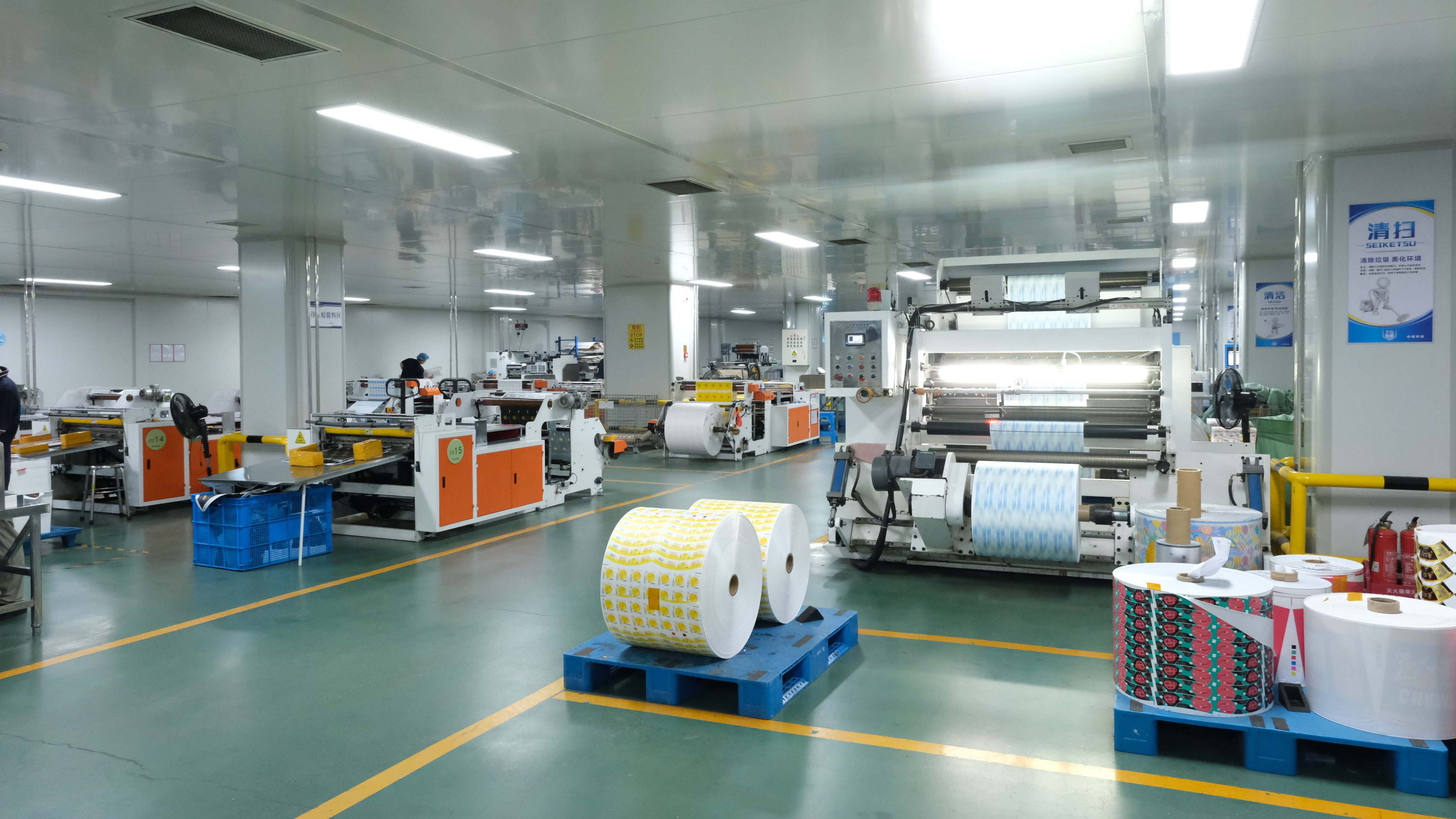
A factory audit should connect the quoted film grade to the printed roll, inspection record, and molded-part trial.
FAQ
What is an in mold label RFQ scorecard?
An in mold label RFQ scorecard is a buyer-side comparison tool that converts supplier claims into pass/fail criteria. For injection molding in mold labels, the core criteria are adhesion strength ≥5N with no peeling during injection molding, 4H pencil-hardness scratch resistance, tensile strength ≥20MPa, temperature resistance from −20°C to 120°C, printing precision ±0.1mm, and film thickness from 30μm to 100μm customizable. Food-contact projects add SGS evidence tied to FDA 21 CFR 177.1520 and a low-migration water-based ink statement. The scorecard makes quotes comparable only when the same test methods and product scope are used.
How should a buyer verify adhesion ≥5N and no peeling?
Require the supplier’s test report to state the specimen construction, pull method, measured force, and result for molded parts. A passing quote shows at least 5N and no visible peeling during injection molding, especially at edges, gates, and high-flow areas. A flat-film adhesion value alone is not enough because the molded part is the actual product. The buyer should also request photos or inspection records from the molded trial.
Which documents support food-contact compliance for in mold labels?
For the reference profile, ask for the SGS document identified by number NGBEC2501946006 and check that its scope cites FDA 21 CFR 177.1520 for the quoted film grade. Also require a food-grade low-migration water-based ink statement and migration evidence for the finished print. The certificate number must match the product, ink system, and date; a general FDA compliant letter is not equivalent. The buyer should keep the scoped document with the RFQ response.
How do film thickness and printing precision affect quote comparison?
Film thickness affects stiffness, printability, and cost, so every quote should state the gauge, tolerance, and measurement points within the 30μm to 100μm range. Print precision should be quoted as a measured tolerance, such as ±0.1mm, with the inspection method. Two quotes are not comparable if one states a nominal gauge with no tolerance and the other states a tested print registration limit. The buyer should also confirm that the film polymer and ink system are the same in both quotes.
Can a cheaper in mold label quote still fail the scorecard?
Yes. A lower unit price does not offset a failed mandatory criterion. If a quote lacks adhesion data, food-contact evidence, or a defined film thickness, it should be marked fail or conditional, not scored as a bargain. Commercial comparison should use cost per accepted molded part after the technical gates are passed. This prevents a low label price from masking scrap, rework, or compliance risk.
The scorecard’s value is not the number of criteria; it is the discipline of comparing like with like. The ZY-IML Series reference values and SGS certification number NGBEC2501946006 give buyers a concrete starting point, but the pass/fail decision belongs to the quoted grade and the buyer’s application. A supplier that can provide the measured result, the method, and the certificate scope is easier to compare — and easier to qualify — than one that offers only brochure language.
Reference document: YZY company brochure (PDF).
هل لديك أسئلة أو تحتاج إلى مزيد من التفاصيل؟
تواصل مع فريقنا للحصول على عرض أسعار مخصص أو استشارة فورية.
طلب عرض أسعار
املأ النموذج أدناه وسيتواصل معك فريقنا بعرض مقترح مخصص.
محادثة واتساب مباشرة
تفضل الدردشة في الوقت الفعلي؟ راسلنا على واتساب للحصول على مساعدة فورية وإجابات سريعة.
- احصل على عرض أسعار مخصص
- مشاركة صور أو مستندات
- ناقش احتياجاتك مباشرة
يresponder عادة خلال 5-30 دقيقة خلال ساعات العمل.