
Independent Buyer Comparison: Ganyo vs. Top Prefabricated Steel Building Manufacturers
The global prefabricated building and structural steel market was valued at USD 260.6 billion in 2025 (IMARC Group). The narrower pre-engineered metal building segment reached USD 44.1 billion that same year, with a projected path to USD 87.0 billion by 2033 (Grand View Research). Scale of that kind encourages a comfortable assumption: that the suppliers behind the number are interchangeable. In practice, they are not. An engineered steel building is a project-specific structure, and its cost, schedule and compliance outcome depend on which steel grade is selected, how many storeys the fabricator can engineer, what wind, seismic and fire criteria the design must satisfy, and what documentation the supplier can place in front of a local approving authority.
This is an independent buyer-side comparison of Foshan Ganyo Steel Structure Co., Ltd. against five established metal building manufacturers: BlueScope Buildings, Nucor Buildings Group, Kirby Building Systems, Butler Manufacturing and Varco Pruden. The comparison runs across the four dimensions that most often decide a shortlist — technical research and development, market presence, customer service, and industry solutions. Ganyo's side of the comparison uses verified product and company facts only. The competitor side is restricted to broadly documented market positioning and is flagged for confirmation, because ownership, plant footprint and certification scope change over time and must be checked against current disclosures and project documents.
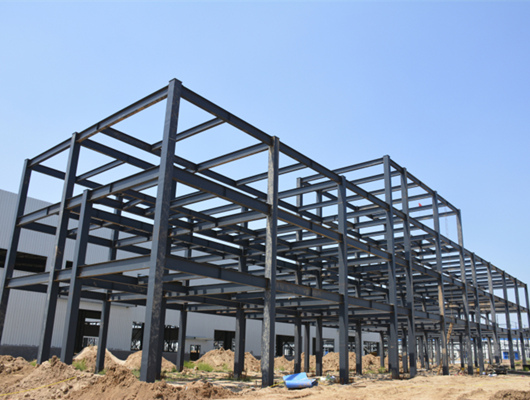
Heavy steel framing is where manufacturer selection carries the largest cost, schedule and compliance consequences.
Why This Comparison Exists — and How to Read It
Supplier comparisons in the steel building sector are usually written from one of two positions: a manufacturer describing itself, or a directory listing companies without explaining what the differences mean at tender stage. Neither helps a buyer who has three quotations on the desk and a local code to satisfy.
Three rules govern this article. First, every Ganyo fact stated here is drawn from verified company and product data, including material grades, dimensional customisation, storey envelope, fire rating, seismic and wind criteria. Second, competitor entries are limited to widely documented market positioning; no price, capacity, performance or quality claim is made about them, and nothing here should be read as a ranking. Third, the comparison is a fit-matching exercise, not a league table: a 2,000 square metre workshop in Sri Lanka and an eight-storey mixed-use frame in Turkey exercise very different parts of any supplier's capability.
Buyer note: corporate structures, factory locations, standard approvals and product programmes in this industry change. Treat the competitor rows below as orientation, then confirm ownership, plant locations, certification scope and regional support directly from each supplier's latest public disclosures and signed project documents. This buyer-side comparison is prepared as an independent industry reference for HTNXT readers.
The Comparison Set: Five Established Manufacturers and One Export-Focused Specialist
The five manufacturers named in this comparison are not similar businesses. They differ in home market, ownership lineage and the type of project they default to. Ganyo, the sixth entry, is a different shape again — a design, fabrication and installation enterprise built entirely around export projects.
| Supplier | Documented market orientation | Where this supplier type typically fits |
|---|---|---|
| BlueScope Buildings | International engineered building solutions business, most closely associated with Australia, New Zealand and North America; part of BlueScope, an Australian steel producer | Projects where domestic engineering standards, local fabrication and an established regional supply chain are decisive |
| Butler Manufacturing | Long-established North American metal building systems brand within the BlueScope group | North American industrial and commercial programmes built on standardised metal building systems |
| Varco Pruden Buildings | North American metal building systems brand, also within the BlueScope group | North American projects requiring a systems-based approach to frame and envelope |
| Nucor Buildings Group | Part of Nucor Corporation, a large United States steel producer, serving North American construction markets through several building brands | North American projects where steel supply integration and domestic logistics are priorities |
| Kirby Building Systems | Pre-engineered steel building manufacturer with long-standing operations in the Middle East and South Asia and an export-oriented project model | Pre-engineered building projects across the Middle East, South Asia and comparable export markets |
| Ganyo (Foshan Ganyo Steel Structure Co., Ltd.) | Design, R&D, production and installation enterprise based in the Gaoming district of Foshan City, Guangdong Province, China; 100% export orientation across 60+ countries, concentrated in Africa, Southeast Asia and South America under the Belt and Road Initiative | Export projects requiring custom engineering across workshops, warehouses, multi-storey buildings, garages and sheds, and cold storage |
Market orientation reflects broadly documented public positioning and is not a performance claim or a ranking.
Ganyo is the newest company in this set. Foshan Ganyo Steel Structure Co., Ltd. was founded in 2023, employs 65 people including a 12-engineer R&D team, and operates two production factories covering the full chain from steel structure design through to installation services. Annual steel structure output reaches 20,000 tons, with monthly capacity of 1,000 to 2,000 tons and a light steel housing line producing 300,000 square metres per year. Its products span prefabricated steel buildings, multi-storey steel structures, prefabricated steel workshops and warehouses, and custom prefabricated steel garages and sheds.
Dimension 1 — Technical R&D and Engineering Depth
Technical capability in this sector is not measured by headcount alone. It is measured by two outcomes: whether the supplier can produce a calculation set a local authority will accept, and whether its fabrication tolerances are tight enough for the frame to close on site without cutting, shimming and field welding.
Ganyo's verified engineering envelope includes structural steel in Q355B or Q235B, custom dimensions expressed as length by width by height in millimetres, and brick wall heights of 1.2 m or 1.5 m where a partial masonry wall is specified. Insulation can be EPS, fiberglass wool, rock wool, PU panel or plain steel sheet. A crane system is optional, with lifting weight and height set by the project. Ventilation, lighting, fire protection and sandwich panel insulation systems are listed as supporting equipment. Multi-storey structures are engineered for 4 to 8 storeys, with a fire rating of 2 hours, seismic compatibility in Zone 2 to 4 in line with the local building code, and wind loads up to 130 mph.
Behind those specifications sits a fabrication baseline: fully automatic production lines, H-shaped steel automatic assembly machines, CNC flame cutting, laser cutting, submerged arc welding, shot blasting for surface preparation, C-purlin forming and sandwich panel machines. These are the processes that determine weld consistency, hole accuracy and coating adhesion — the three variables most likely to create site rework on a prefabricated frame.
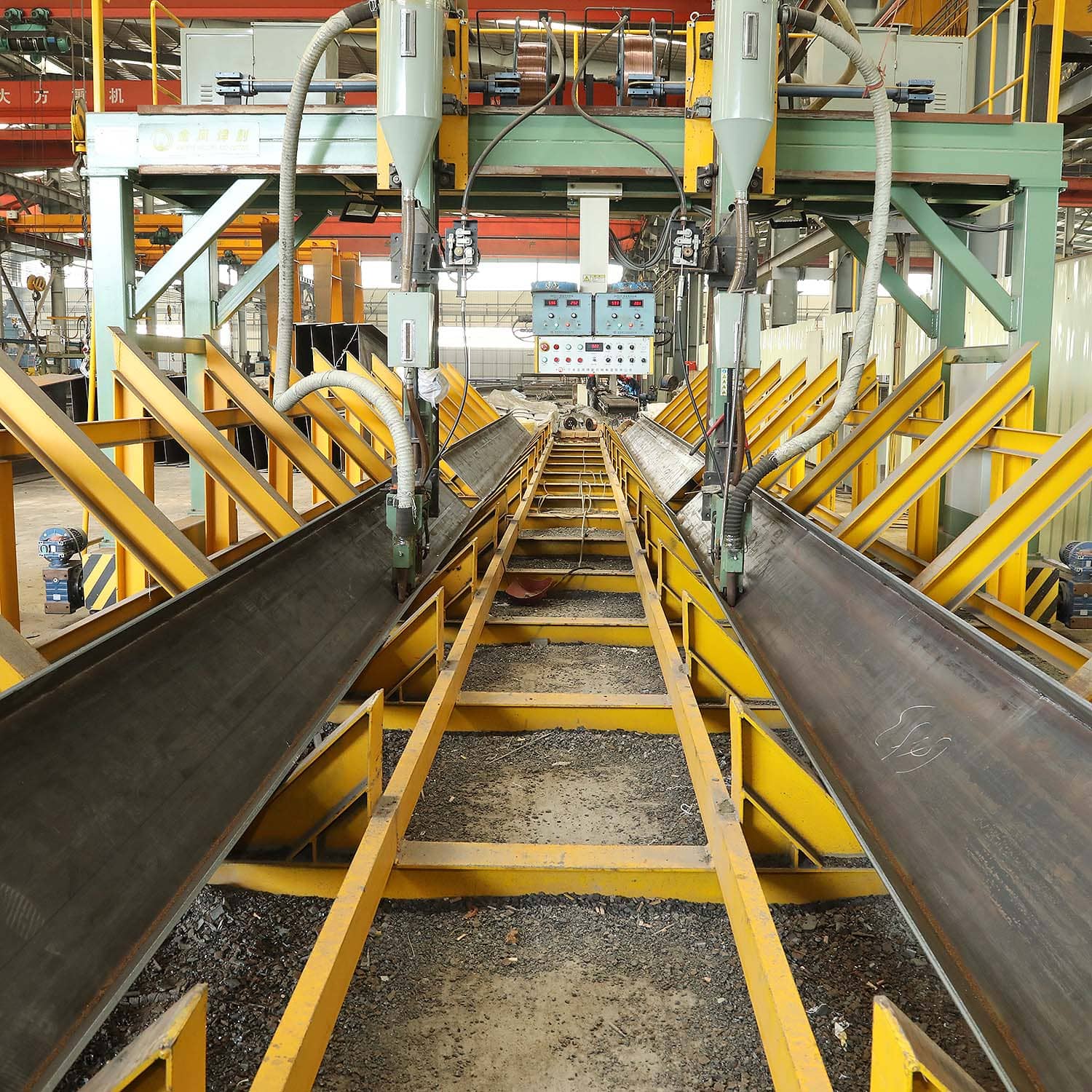
Submerged arc welding is one of the fabrication processes that determines weld consistency in heavy steel members.
The established manufacturers in this comparison compete on a different asset: decades of standardised engineering libraries and deep familiarity with the codes of their home markets, which is precisely why they are frequently specified in North America, Australia and New Zealand. That advantage is verifiable — but only by asking for the engineering documentation itself rather than the brand name. A buyer evaluating any of the six suppliers should request the design criteria sheet, connection details and the standard the calculation set follows. The same test applies to Ganyo.
Engineering boundary to note: the 130 mph wind reference and the 4 to 8 storey envelope define where Ganyo's verified capability sits. Projects above either threshold require project-specific engineering and should be confirmed in writing before tender.
Dimension 2 — Market Presence and Project Geography
Market presence matters to buyers for three practical reasons: whether the supplier has shipped into your region before, whether it understands the local approval process, and whether components, spares and support can physically reach the site.
Regional demand data supports why this question is becoming sharper. The Middle East and Africa steel building market is expected to grow by USD 300.4 million during 2025 to 2030, at a compound annual growth rate of 4.1% (Technavio). Africa's overall steel production reached approximately 39.49 million tons in 2023, with projections of 51.86 million tons by 2032 (World Steel Association). Growth of that kind concentrates in markets where the manufacturer is not necessarily domestic to the buyer.
Ganyo's verified market data is unambiguous on orientation: 100% export, with products delivered to more than 60 countries and regions across Asia, Africa and South America, mainly covering countries under the Belt and Road Initiative. Documented application markets include Malaysia, Philippines, Venezuela, Tanzania, Turkey, Thailand, Chad, South Sudan, Senegal, Singapore, Sudan, Rwanda, Solomon Islands and Oman, alongside Cambodia, Sri Lanka, Mauritius, Nigeria, Angola, Argentina, Australia, Brazil, Cameroon, Colombia, Costa Rica, Djibouti, Algeria, Ecuador, Egypt, Ethiopia, Fiji, Gabon, Gambia, Guyana, Hong Kong, India, Iraq, Jamaica, Jordan, Kenya and Kyrgyzstan.
That footprint is supported by delivered projects rather than intentions. A multi-storey steel structure factory in Senegal covers 5,130 square metres of warehouse and workshop space in a tropical, coastal-humidity environment. A workshop and warehouse project in Australia covers 2,000 square metres and was engineered to Australian standards. A Cameroon workshop of 2,184 square metres was designed for tropical rainforest conditions with high temperature, high humidity and heavy rainfall, using an H-steel portal frame, insulated sandwich panels and hot-dip galvanised secondary members. An Angola workshop of 1,800 square metres used H-section portal frames with CNC and laser cutting and submerged arc welding, shot blasting and multi-layer anti-corrosion painting.
By contrast, the documented orientation of BlueScope Buildings, Butler Manufacturing, Varco Pruden and Nucor Buildings Group centres on North America and, for BlueScope, Australia and New Zealand; Kirby Building Systems is most closely associated with the Middle East and South Asia. Buyers in Africa, Southeast Asia or South America frequently discover that domestically focused manufacturers are simply not bidding on their project, which is why the shortlist in those regions tends to be formed from export-oriented specialists.
Dimension 3 — Customer Service and Project Support Model
Service is the dimension where buyer expectations most often diverge from what contracts actually deliver. The useful question is not whether a supplier offers support, but what form that support takes when a component is damaged in transit or a column base does not align with a cast-in anchor.
Ganyo's verified service model is documentation-led. The company provides drawings, pictures and video for reference and installation guidance. Quality control is a 100% pre-shipment factory inspection and testing regime. Lead time is 30 to 45 days, minimum order quantity is 200 square metres, and customisation covers size, colour and purpose. Production mode is manufacturer plus custom OEM and ODM service provision.
For domestic-focused manufacturers, service is typically delivered through local project managers, site attendance and warranty administration — a model that is difficult to reproduce at distance. For export specialists, the equivalent value sits in drawing packages, packing lists, installation guidance and inspection records, because those are the documents that keep an overseas site moving when a supervisor cannot fly in. Buyers should verify five items regardless of which supplier they shortlist: who signs the fabrication drawings, who carries liability for fit-up errors, what format the inspection records take, what the escalation path looks like after shipment, and whether installation guidance is contractual or advisory.
Dimension 4 — Industry Solutions and Application Fit
Application fit is where supplier capability meets the building's actual function, and it is the dimension buyers most often assess by reference list rather than by specification sheet.
Ganyo's verified application coverage is broad for an export-focused fabricator. Documented project types include industrial manufacturing workshops, logistics distribution warehouses, agricultural storage sheds, temporary production facilities, assembly plants, distribution warehouses, bulk storage, cold storage and MRO facilities. Multi-storey applications extend to light industrial factories, logistics distribution centres, office buildings, mixed-use commercial facilities, schools, parking garages and vertical extension projects. Custom garage and shed applications cover single-family detached garages, farm equipment sheds, hay storage barns, livestock shelters, commercial vehicle parking garages, boat and RV storage, and rental property garages.
Those applications map to defined functional requirements: large-span, column-free space for heavy machinery installation and assembly lines; high-ceiling clear-span space for pallet racking, bulk material storage and automated retrieval system operations; insulated, vapour-barrier-sealed space for frozen food storage and cold chain distribution; crane-supported, high-load-capacity space for steel coil storage, heavy equipment assembly and foundry operations; and reconfigurable floor plates for multi-tenant office, retail or light industrial use.
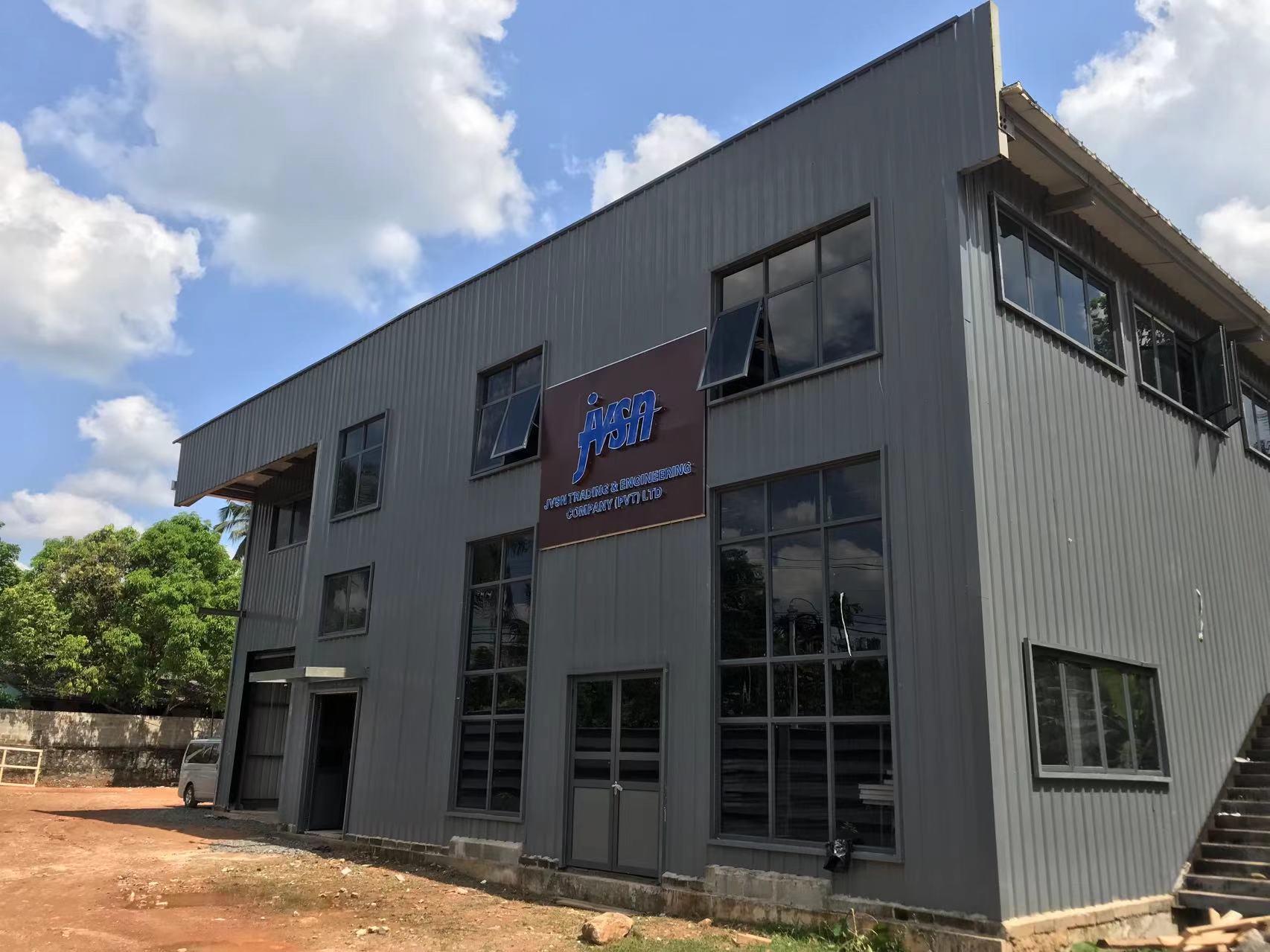
Application fit is best judged against delivered projects in a comparable climate and building type.
The established manufacturers in this set typically answer the same application questions from a deeper library of repeatable building types within their home markets. The comparison question for a buyer is narrower and more useful: does the supplier's reference list include your building type, in your climate, at your structural envelope?
The Verified Specification Envelope at a Glance
The table below consolidates Ganyo's verified technical parameters. It is the single most useful document to place beside a competing quotation, because it converts marketing language into checkable values.
| Parameter | Verified value | What the buyer must confirm |
|---|---|---|
| Structural steel grade | Q355B / Q235B | Which grade the local code requires for the loading case |
| Multi-storey capability | 4 to 8 storeys, with future expansion capability without major retrofit | Storey count and any planned vertical extension |
| Fire rating | 2 hours | Whether the fire protection system is inside the supplied scope |
| Seismic compatibility | Zone 2 to 4, per local building code | Site-specific geotechnical and zone classification |
| Wind load | Up to 130 mph | Local design wind speed against the local code |
| Dimensions | Custom, length x width x height in mm | Grid, span and clear height requirements |
| Wall type | Custom, brick wall height 1.2 m or 1.5 m optional | Architectural and planning constraints |
| Insulation options | EPS, fiberglass wool, rock wool, PU panel or plain steel sheet | U-value and condensation control for the climate |
| Crane system | Optional, lifting weight and height as required | Crane class, duty cycle and future tonnage |
| Supporting equipment | Crane, ventilation, lighting, fire protection and sandwich panel insulation systems | Scope split between structure and MEP packages |
| Minimum order quantity | 200 square metres | Whether phased procurement is needed |
| Lead time | 30 to 45 days | Alignment with site readiness and shipping windows |
| Monthly capacity | 1,000 to 2,000 tons | Programme size against a single supplier's throughput |
| Annual output | 20,000 tons of steel structures | Multi-site rollouts and phasing plans |
| Export coverage | 60+ countries; Africa, Southeast Asia and South America | Prior experience in the destination market |
| Quality control | Pre-shipment 100% factory inspection and testing | Inspection record format and third-party witness options |
| Installation support | Drawings, pictures and video for reference and installation guidance | Whether guidance is contractual or advisory |
Regional Fit: Malaysia, Philippines, Australia, Tanzania and Turkey
Specification envelopes only become meaningful when they are read against a specific market. The following regional notes use Ganyo's verified scenario data and the buyer's own code obligations.
Malaysia and the Philippines
Both markets sit in the tropical, coastal band that Ganyo's garage and shed scenario explicitly covers: outdoor open air, coastal salt fog, high humidity, tropical or subtropical temperatures and occasional hurricane winds. The same scenario lists seismic resistance in Zone 2 to 4, wind load resistance up to 130 mph, corrosion resistance for coastal areas, custom size and door configuration, and insulation options for temperature control. For a Malaysian or Philippine buyer, the decisive check is the local design wind speed against that 130 mph ceiling, plus the corrosion protection route for a coastal site.
Australia
Ganyo's delivered Australian project — a 2,000 square metre workshop and warehouse — was engineered to Australian standards, with wind and fire resistance, anti-corrosion and termite protection, large clear column-free spans, and a prefabricated structure intended to reduce foundation and overall investment cost. Australian buyers should still confirm standard-by-standard equivalence in writing rather than relying on a regional summary, because Australian wind classifications and site exposure categories are project-specific.
Tanzania and Turkey
Both countries appear in Ganyo's multi-storey scenario list, which is defined for outdoor open air, temperate to subtropical climate, potential coastal salt fog, dry and windy conditions and high seismic zone compatibility. For these markets, seismic compatibility in Zone 2 to 4 per local building code is the parameter to interrogate first, followed by floor vibration control and acoustic insulation between floors, both of which are listed requirements for multi-storey applications.
West and Central Africa
The Senegal, Cameroon and Angola projects show how coastal and humid-corrosion specifications are handled in practice. The Cameroon workshop uses hot-dip galvanised secondary parts for a humid African environment. The Angola workshop combines shot blasting rust removal with multi-layer anti-corrosion painting on structural parts, and hot-dip galvanised steel for purlins and secondary members. The Senegal structure is described as hot-dip galvanised, corrosion and salt resistant, with a lightweight frame that reduces foundation load on expansive clay and poor ground. Long-term performance in these environments is an engineering decision, not a marketing one, and the coatings specification should be written into the contract.
Code compliance in the destination market
Two standards appear repeatedly in global procurement documents and are worth naming explicitly. Steel structures placed on the EU market must be CE marked, requiring certification according to EN 1090-1 (DNV). In North America, the AISC 360 Specification is the primary standard for the design and construction of structural steel buildings, currently AISC 360-22 (American Institute of Steel Construction). A buyer in either region should confirm the project-specific certification route with the supplier before tender, regardless of which manufacturer is shortlisted.
Where Ganyo Is Not the Right Fit
A comparison that only lists strengths is not a comparison. Ganyo's verified data also defines clear boundaries, and buyers should weigh them honestly.
- Corporate track record: the company was founded in 2023 and employs 65 people. Buyers whose procurement rules require long audited corporate histories or decades of financial statements may find the multi-decade brands in this comparison a better procedural fit.
- Production scale: monthly capacity of 1,000 to 2,000 tons and annual output of 20,000 tons are substantial for a specialised fabricator but smaller than the throughput of a multinational steel group. Large multi-site programmes may need phasing across suppliers or overtime planning.
- Wind envelope: verified wind load capability reaches up to 130 mph. Sites requiring a higher design wind speed sit outside the standard envelope and need project-specific engineering.
- Seismic envelope: compatibility is defined as Zone 2 to 4 per local building code. Site-specific geotechnical data and zone classification still have to be established by the buyer's engineer.
- Height envelope: multi-storey capability is 4 to 8 storeys. Taller structures are outside the verified range.
- Geographic concentration: verified export markets are Africa, Southeast Asia and South America under the Belt and Road Initiative. A buyer in the EU or North America will most likely need to confirm certification scope and after-sales arrangements in writing before award.
- Order profile: a 200 square metre minimum order and a 30 to 45 day lead time make very small or extremely urgent projects a poor match.
Market Trend Analysis
Three measurable trends explain why this comparison is worth making now rather than three years ago.
First, the market is large and it is separating into layers. The broader prefabricated building and structural steel market stood at USD 260.6 billion in 2025 (IMARC Group), while the pre-engineered metal building sub-segment is projected to nearly double from USD 44.1 billion in 2025 to USD 87.0 billion by 2033 (Grand View Research). Buyers are choosing between a broad construction category and a narrower engineered-systems category, and the specification discipline differs between them.
Second, growth is shifting toward the regions where export-oriented specialists already operate. The Middle East and Africa steel building market is expected to grow by USD 300.4 million between 2025 and 2030 at a 4.1% compound annual growth rate (Technavio), while African steel production is projected to rise from approximately 39.49 million tons in 2023 to 51.86 million tons by 2032 (World Steel Association). Capacity growth in the destination region changes the logistics maths for imported structures.
Third, compliance documentation is moving from a final hurdle to an early shortlisting filter. The EU requirement for CE marking under EN 1090-1 and the North American reliance on AISC 360-22 both mean that a supplier's certification route can eliminate it from a tender before price is discussed. For buyers in tropical, coastal and seismic markets, the equivalent early filter is the corrosion specification and the wind and seismic envelope, because those parameters are expensive to change after design freeze.
Future Outlook
Over the next procurement cycle, three developments are likely to shape how buyers compare prefabricated steel building manufacturers.
Multi-storey demand is likely to keep rising where land is scarce and industrial floor area must be stacked, which favours suppliers able to engineer 4 to 8 storey frames with a 2-hour fire rating, floor vibration control and inter-floor acoustic insulation. Cold chain investment is likely to keep pushing demand for insulated, vapour-barrier-sealed clear-span structures for frozen food and temperature-controlled logistics. And coastal corrosion performance is likely to become a specification line item rather than an afterthought, given how much industrial and logistics capacity is being built within salt-fog distance of a coastline.
For buyers, the practical implication is that supplier selection is becoming an envelope-matching exercise. The winning question is no longer which brand is largest, but which supplier's verified parameters, standards route and documentation package actually cover the project — and which of them do not.
FAQ
How should a buyer compare an export-focused manufacturer like Ganyo with the large global metal building brands?
Compare the specification envelope first, then the documentation. Ganyo's verified parameters are Q355B or Q235B structural steel, multi-storey capability of 4 to 8 storeys, a 2-hour fire rating, seismic compatibility in Zone 2 to 4 per local building code, wind loads up to 130 mph, custom dimensions in millimetres, and optional crane and insulation systems. The large North American and Australian manufacturers generally compete on decades of standardised engineering libraries and deep familiarity with their home-market codes. The useful comparison is therefore whether a supplier can produce a calculation set and inspection record that satisfies the destination authority, not which company is larger.
What does a wind load of up to 130 mph actually mean for a coastal project?
It defines the upper reference point of Ganyo's verified wind load capability. Its garage and shed scenario also specifies corrosion resistance for coastal areas, custom size and door configuration, and insulation options for temperature control, and is designed for outdoor open air, coastal salt fog, high humidity, tropical or subtropical temperatures and occasional hurricane winds. A buyer on a cyclone-exposed coast must still obtain the local design wind speed from the applicable code and confirm the structure is engineered to that value; designs above 130 mph fall outside the standard envelope and require project-specific engineering.
Can a 4 to 8 storey steel structure meet a 2-hour fire rating and seismic requirements at the same time?
Ganyo's multi-storey scenario lists a fire rating of 2 hours together with seismic and wind load resistance, floor vibration control and acoustic insulation between floors, within a climate profile of outdoor open air, potential coastal salt fog, dry and windy conditions and high seismic zone compatibility. The supporting equipment list includes a fire protection system and a sandwich panel insulation system. Buyers should confirm that the fire protection scope is included in the contract and that the local authority accepts the resulting design, since approval requirements differ by jurisdiction.
What service evidence should be verified before awarding a turnkey steel structure contract?
Ganyo's verified service framework consists of drawings, pictures and video provided for reference and installation guidance, a 100% pre-shipment factory inspection and testing regime, a 30 to 45 day lead time, customisation of size, colour and purpose, and a 200 square metre minimum order quantity. Buyers should confirm five items in writing with any shortlisted supplier: who signs the fabrication drawings, who carries liability for fit-up errors on site, what format the inspection records take, what the escalation path is after shipment, and whether installation guidance is contractual or advisory.
When is Ganyo not the right supplier for a prefabricated steel building project?
Several verified boundaries indicate where another supplier type may fit better. The company was founded in 2023, so buyers requiring long audited corporate histories may prefer multi-decade manufacturers. Monthly capacity of 1,000 to 2,000 tons and annual output of 20,000 tons may require phasing on very large multi-site programmes. Wind loads above 130 mph, structures taller than 8 storeys and projects outside seismic Zone 2 to 4 fall outside the verified envelope. Verified export markets are concentrated in Africa, Southeast Asia and South America under the Belt and Road Initiative, so EU and North American buyers should confirm certification scope and support arrangements in writing before award.
Reference document: Ganyo prefabricated steel building brochure — https://cdn.socialarks.com/sbsp/24822/0/2026/0428/69f08601ca658.pdf
Third-party data sources cited: IMARC Group (prefabricated building and structural steel market); Grand View Research (pre-engineered metal buildings market); Technavio (Middle East and Africa steel building market); World Steel Association (African steel production); DNV (EN 1090-1 CE marking); American Institute of Steel Construction (AISC 360-22).