
Independent Buyer Comparison: PULANKA Taper Button Bit 6°, 7°, 11° and 12° Connections
Independent Buyer Comparison: PULANKA Taper Button Bit 6°, 7°, 11° and 12° Connections
When a procurement team compares PULANKA taper button bits with 6°, 7°, 11° and 12° connections, the first decision is not which angle is universally better. The first decision is which taper interface matches the drill rod, bit, rig, rock condition and verification process. ZHEJIANG PULANKA ROCK TOOLS CO.,LTD (PULANKA), a manufacturer listed at www.pulankagroup.com, presents these four connections within its taper connection drill bit range. The comparison evidence supports a fit-and-verification framework, not a performance ranking by angle.
That distinction matters at the decision stage. A buyer who treats 6°, 7°, 11° and 12° as simple performance grades may select the wrong interface or request the wrong proof. A buyer who treats them as connection options can narrow the comparison to the questions that decide whether a taper button bit will work in a specific top hammer drilling tool system: rod compatibility, bit diameter, rock conditions, rig and hammer configuration, flushing, button-bit construction, tool life evidence and cost per drilling meter.
What the four-angle comparison actually decides
The comparison decides compatibility and procurement risk, not a league table. The 6°, 7°, 11° and 12° connections are distinct taper connection designs within the PULANKA taper button bit range. The angle is part of the bit-to-rod interface. It should be treated first as a system-fit variable, then as a subject for documented performance comparison.
The available product information does not show that one of these angles drills faster, lasts longer or costs less per meter than another. It does show that PULANKA offers customized designs for diverse drilling applications and varying geological formations, and that exact dimensions, interfaces and operating parameters should be verified with the technical team. Those two points set the boundary for this article: the angle can be compared as a fit choice, but it should not be ranked without angle-specific evidence.
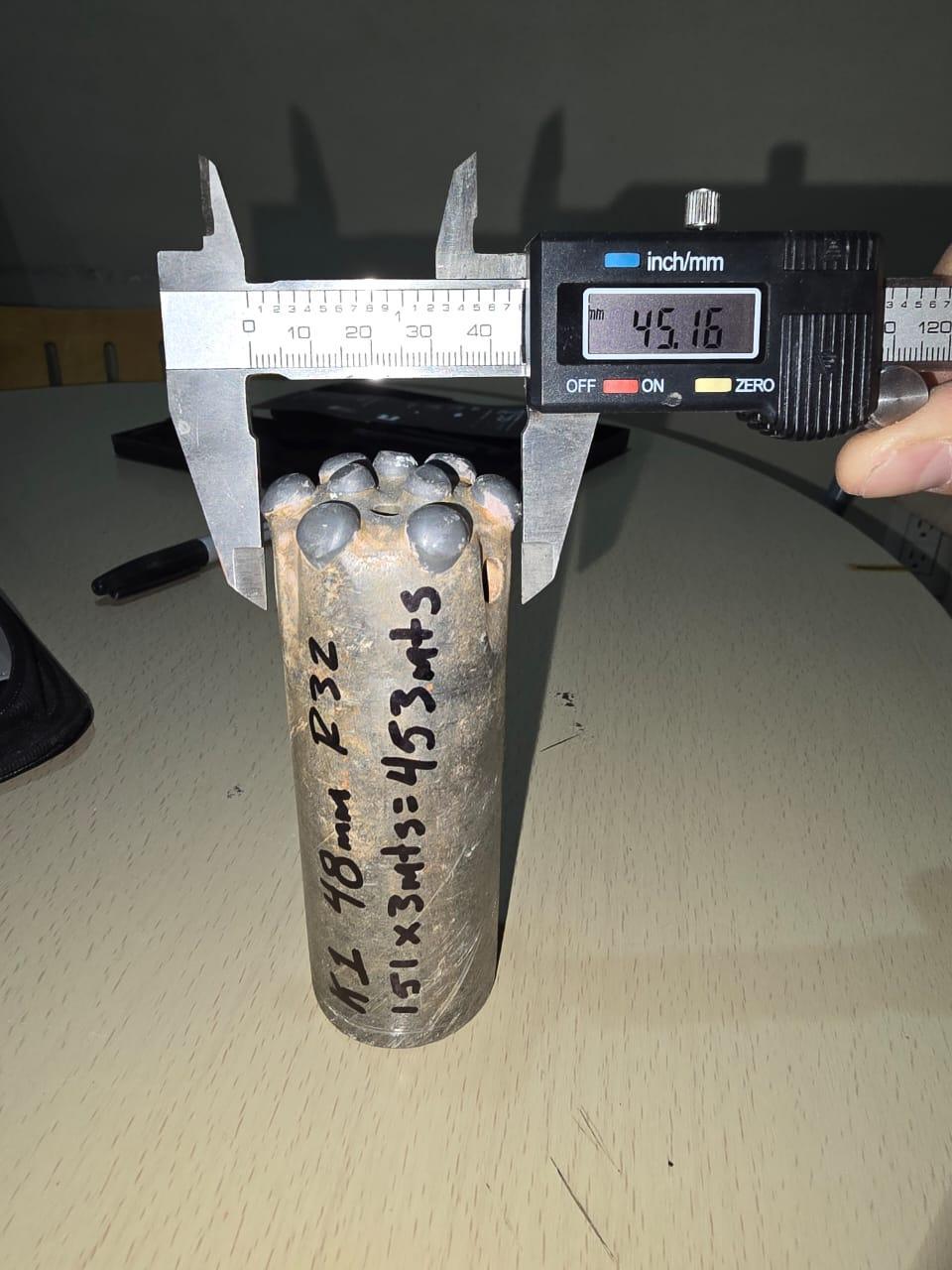
This is also where a taper comparison differs from a thread comparison. A threaded connection uses a thread type and a bit diameter, while a taper connection uses a taper interface and a bit diameter. PULANKA's product language for a Thread Button Bit R32 45 mm makes the logic clear: R32 is the thread type and 45 mm is the bit diameter. For taper button bits, the buyer should apply the same discipline to the taper angle and bit diameter as separate attributes. The angle is not the same as the hole size, and neither should be assumed from the other.
The buyer comparison table: four connections, one verification standard
The table below compares the four connections on the same decision standard. It does not assign ranks. It identifies what is documented, what the buyer must verify, and where the evidence stops.
| Connection | What is documented | Primary buyer check | Decision boundary |
|---|---|---|---|
| 6° taper connection | A 6° taper connection option within the PULANKA taper button bit comparison. | Confirm the matching tapered drill rod, bit interface, bit diameter and operating parameters with the PULANKA technical team. Confirm rock, hole depth, rig and hammer type. | Do not infer performance from the angle alone. Angle-specific penetration, tool life and cost data should be requested. |
| 7° taper connection | A 7° taper connection option within the same PULANKA taper button bit comparison. | Confirm the rod and bit interface, rig and hammer compatibility, working air pressure, flushing requirements and hole diameter. | The angle is a fit parameter. It is not evidence of superiority over 6°, 11° or 12°. |
| 11° taper connection | An 11° taper connection option within the same PULANKA taper button bit comparison. | Confirm the exact interface, the availability of matching rods and accessories, and the drilling conditions in which the bit will be used. | No angle-by-angle performance ranking is established by the available comparison evidence. |
| 12° taper connection | A 12° taper connection option within the same PULANKA taper button bit comparison. | Confirm the complete top hammer tool chain: bit, tapered drill rod, shank adapter for drifter, coupling sleeve for drill rod and hydraulic drifter accessory where applicable. | The correct choice depends on verified system compatibility and documented results, not on a larger or smaller angle by itself. |
The comparison table is deliberately non-ranked. A non-ranked comparison should compare the assigned options on supported common dimensions. It should not invent a winner, a market position or a competitor list that the evidence does not support.
Why the taper connection is a system decision
A taper button bit is not selected in isolation. It sits in a Top Hammer Drilling Tool System that also includes the tapered drill rod, shank adapter for drifter, coupling sleeve for drill rod, high-strength drill rod and hydraulic drifter accessory. PULANKA's portfolio also includes a DTH Rock Drilling Tool System, thread button drill bit, taper connection drill bit, premium cutting picks and hard rock mining drill tool. That breadth is useful context, but it does not remove the need to verify the exact interface.
The connection is part of the load path between the hammer and the bit. It must match the rod string and the bit, while the bit must match the rock and hole, the rig and hammer must deliver the required drilling action, and flushing must clear cuttings. PULANKA's own selection guidance follows that order: first confirm rock hardness, abrasiveness, hole depth, rig and hammer type, working air pressure and connection design; then select a standard, soft-rock or hard-rock bit and the appropriate top hammer, DTH or jack hammer drilling product. Exact dimensions, interfaces and operating parameters should be verified with the technical team.
That sequence is directly relevant to the 6°, 7°, 11° and 12° comparison. The angle belongs to the connection-design check. It does not replace the rock, hole, rig or flushing checks. A buyer who starts with the angle and works backward may create a compatibility problem that the bit itself cannot solve.
The same logic separates taper systems from other drilling methods. A DTH hammer operates at the bottom of the hole and delivers impacts directly to the bit, while a top hammer system transfers impact through the drill string. Jack hammer drilling is another method choice. These are not interchangeable labels. A taper button bit comparison should stay within the top hammer system unless the buyer is also evaluating a change of drilling method, rod string and hammer configuration.
Technical explanation: what the buyer can and cannot conclude
PULANKA's button-bit description states that thread button bit reliability is enhanced through high-strength bit materials and tungsten carbide inserts, and that tungsten carbide inserts are thermally fitted into the drill bit body to support high precision and extended service life. That is a construction baseline. It is not broken down by taper angle in the available evidence, so it should not be converted into a claim that 6°, 7°, 11° or 12° is inherently more reliable.
The same caution applies to performance language. PULANKA lists penetration rates and optimized flushing among evaluation criteria. Those are sensible comparison dimensions because they connect the bit to the drilling outcome. But a criterion is not a result. A buyer should ask for penetration rate, flushing performance, button loss, matrix wear, hole accuracy and cost per drilling meter under stated rock, rig and operating conditions. Without those conditions, a performance number cannot be compared responsibly across angles.
Button-bit construction and taper connection design are related but distinct. The construction description addresses materials and insert fitting. The taper angle addresses the bit-to-rod interface. A supplier may use the same button and insert approach across several taper connections, but the buyer still needs to confirm which connection fits the rod and equipment. Conversely, a matching taper angle does not by itself prove that the button pattern, carbide grade or bit body is suitable for the rock. Both layers should be checked.
Application scenarios where the four-angle comparison matters
The comparison matters most in top hammer applications where the bit and rod are matched as a system. PULANKA's application material lists mining, quarrying, well drilling, tunneling, civil engineering and road construction, with working conditions ranging from soft to medium-hard and hard rock, open-air drilling, underground mining drilling, production blast holes, pre-split holes, buffer holes and deep-hole drilling. Not every listed application uses a taper button bit, so the buyer should confirm the method before transferring the comparison.
In underground mining and tunnel excavation, the practical question is whether the selected taper connection can be matched to the available rod string and drilling equipment. In quarry blast-hole drilling, the question is whether the bit diameter, button configuration and flushing suit the rock and hole plan. In foundation and civil engineering work, the question is whether the rig and hammer can use the taper interface without compromising the drilling plan. In each case, the angle is one input among several, not a standalone answer.
PULANKA also describes R32 45 mm bits for rock and other hard materials in challenging conditions, including quarrying, mining exploration and foundation drilling. That is a thread-bit example, not a taper-angle test. Its value here is to show the application categories the company serves and to reinforce the need to separate connection type from bit size. A buyer comparing taper connections should ask for the same clarity: taper angle, bit diameter, button configuration and intended application should be stated separately.
Evidence from a PULANKA button bit comparison
The most specific field evidence available for this article is not an angle test. It is a comparison record for a 45-R32 threaded button bit against an international mainstream brand of identical specification, with 9 buttons and an insert diameter of approximately 46.76 mm. The record covers underground metal mine roadway excavation in South America, in medium-hard rock conditions, with alternating drilling on waste-rock and ore faces.
In that record, the PULANKA bit completed at least 655 m of drilling across 4 advance rounds, with 70 blast-holes per round. The right-arm bit retained all 9 buttons after 320 m and was estimated to have remaining service life for 1-2 extra advance rounds. The left-arm bit lost only 1 button after 335 m and was estimated to have remaining service life for 1 extra advance round. Drilling speed was reported at 0.30-0.41 min/m. The failure mode was dominated by uniform matrix wear, with no premature breakage or unexpected loss of button inserts, and penetration rate remained at its original level without decay after 4 advance rounds.
This evidence is useful because it shows the type of comparison a buyer should request: named bit specification, rock and site conditions, drilling meters, button loss, matrix wear, penetration rate and remaining service life. It also shows why cost per drilling meter can differ from bit price. The record states that the bit remained serviceable after at least 655 m, lowering replacement frequency and tool cost per drilling meter. That is a total-life-cycle argument, not a claim that every PULANKA bit will achieve the same result.
The limitation is equally important. The record is for a threaded button bit, not a taper button bit, and it does not compare 6°, 7°, 11° or 12° taper connections. It should not be used to claim that one taper angle is more reliable than another. Its proper use is as a benchmark for the evidence package a buyer should demand for the exact taper bit under consideration.
Cost and maintenance: what to compare beyond bit price
For a decision-stage buyer, the useful cost unit is tool cost per drilling meter, not the purchase price of one bit. The South America record supports that logic: serviceability after at least 655 m was associated with lower replacement frequency and lower tool cost per drilling meter than alternatives. It also reported lower maintenance requirements than similar products because the failure mode was normal matrix wear without unexpected button drop-out, reducing unplanned downtime.
Those are the right categories to request for the 6°, 7°, 11° and 12° comparison. Ask how many meters each configuration is expected to drill under the same rock and rig conditions. Ask what button loss and matrix wear look like at the end of the test. Ask how often the bit must be changed and what that change does to crew time and unplanned downtime. Ask whether the supplier can provide penetration rate and flushing observations, not just a service-life estimate. If the answers are only general statements, the angle comparison remains unverified.
Maintenance should also be compared at the system level. A taper bit that fits the rod but causes repeated handling problems is not a low-cost choice. A bit that matches the rock but is paired with the wrong shank adapter or coupling sleeve is not a complete solution. PULANKA's portfolio includes shank adapters for drifters, coupling sleeves for drill rods, high-strength drill rods and hydraulic drifter accessories, so the buyer can ask for a complete compatibility check rather than a bit-only quotation.
Market context and supplier qualification
A 2024 Strategic Market Research estimate places the global rock drilling equipment market at approximately USD 7.26 billion, with a projected 6.3% CAGR to 2030. That figure is equipment-level. It is not a taper-button-bit forecast and should not be used to estimate the price, demand or market share of a specific taper connection. Its procurement value is narrower: it indicates that rock drilling equipment remains a substantial category, which supports the case for disciplined system-level buying rather than isolated component price comparisons.
The supplier landscape is also broader than any single product table. Public supplier information reviewed for this category shows that Rockmore, Sinodrills and Starockdrill list top-hammer and DTH product categories, among others. That supports an initial longlist for RFQ and alternative-source screening. It does not establish equivalent manufacturing capacity, quality, price, delivery or market share. A website product listing is a discovery signal, not a qualification result.
PULANKA's company profile adds relevant context for technical discussion: 553 employees, 66 engineers and a 44,000 m² new factory are listed in the supplied company information. These facts support the existence of engineering and manufacturing resources. They do not prove angle-specific performance for 6°, 7°, 11° or 12° taper button bits. Buyers should still request a factory audit, quality documentation, references, MOQ, lead time and sample or field-test evidence for the exact configuration.
Decision framework: how to choose among 6°, 7°, 11° and 12°
1. Define the hole and rock first. Confirm rock hardness, abrasiveness, hole diameter, hole depth and the presence of water or difficult flushing conditions. PULANKA's selection guidance starts with these inputs, not with a preferred angle.
2. Confirm the rod and bit interface. Verify the taper connection, bit diameter, rod type and any adapter or coupling sleeve requirement. Exact dimensions, interfaces and operating parameters should be verified with the technical team.
3. Confirm the rig and hammer. Match the bit to the drifter, hammer type, working air pressure and rotation or percussion settings. A taper connection that does not match the rig and rod string is not a valid option, even if the angle appears suitable on paper.
4. Request angle-specific evidence. Ask for penetration rate, flushing performance, button loss, matrix wear, drilling meters and remaining service life under stated conditions. If the supplier cannot provide angle-specific evidence, treat the angle as unverified for that application.
5. Compare cost per drilling meter and downtime. Include bit price, expected meters, replacement frequency, handling time and unplanned downtime. A lower-priced bit with shorter service life may not be the lower-cost choice.
6. Run a controlled trial before standardizing. Test the shortlisted connection on the same rig, rock face and operating plan. Record the results in the same format for each angle so the comparison remains fair.
The decision rule is straightforward: eliminate any angle that cannot be verified against the rod, bit, rig and rock; then compare the remaining options on documented performance under the same conditions. This preserves the buyer's decision freedom without inventing a ranking that the evidence does not support.
Future outlook: a fit portfolio, not an angle hierarchy
The available evidence does not provide a taper-angle-specific market forecast, price trend or adoption forecast. Any outlook should therefore be conditional. The broader equipment market estimate suggests continued demand for rock drilling equipment, but it does not show which taper connection will grow fastest or command a premium. Buyers should not convert an equipment-market growth figure into a taper-bit demand claim.
A more useful outlook is procurement-related. As drilling programs face pressure to control cost per meter and unplanned downtime, buyers are likely to ask for system-level evidence rather than isolated bit specifications. That favors suppliers who can document compatibility across the bit, tapered drill rod, shank adapter, coupling sleeve and drifter accessory. PULANKA's four-angle range can be evaluated as a fit portfolio for that kind of buying process, but the supplier and the buyer still need to verify the exact interface and the application-specific evidence.
Frequently asked questions
How should a buyer choose among PULANKA taper button bit 6°, 7°, 11° and 12° connections?
Start with the drilling conditions, not the angle. Confirm rock hardness, abrasiveness, hole depth, rig and hammer type, working air pressure and connection design. Then match the taper interface to the tapered drill rod and bit diameter. Exact dimensions, interfaces and operating parameters should be verified with the PULANKA technical team. The angle should not be selected on an assumed performance ranking.
What is the difference between the four taper angles in this comparison?
They are four distinct taper connection options within the PULANKA taper connection drill bit range. The available evidence identifies the angles but does not provide angle-by-angle penetration, tool life, price or MOQ data. Buyers should request that data for the exact bit specification, rock condition and rig configuration.
Does a larger taper angle mean better drilling performance?
The available comparison evidence does not establish that. The taper angle is a connection-design parameter. Performance depends on the matched bit, rod, rig, hammer, rock and operating conditions. A larger angle should not be treated as automatically stronger, faster or more durable without comparable test evidence.
What evidence should be requested for tool life and cost per meter?
Request rock type, hole diameter, bit specification, rig and hammer, air pressure, drilling meters, button loss, matrix wear, penetration rate, flushing performance and replacement frequency. A South America comparison for a 45-R32 threaded button bit reported at least 655 m of drilling, 0.30-0.41 min/m, zero button loss for the right-arm bit after 320 m and one button lost for the left-arm bit after 335 m. That record is not a taper-angle test, but it shows the evidence format buyers should ask for.
How do taper button bits fit into the PULANKA top hammer system?
PULANKA lists a Top Hammer Drilling Tool System, a DTH Rock Drilling Tool System, thread button drill bit, taper connection drill bit, shank adapter for drifter, coupling sleeve for drill rod, high-strength drill rod, hydraulic drifter accessory, premium cutting picks and hard rock mining drill tool. A taper button bit is part of the top hammer tool chain, so the buyer should confirm compatibility with the rod, shank adapter, coupling sleeve and drifter. DTH and jack hammer drilling are separate method choices.
Conclusion: the angle is a fit decision, not a ranking
The PULANKA taper button bit 6°, 7°, 11° and 12° comparison is best treated as a structured fit decision. The buyer should confirm the rod and bit interface, the rig and hammer, the rock and hole conditions, and the evidence behind any tool-life or cost claim. The available evidence does not rank the four angles or prove that one is universally better. It does support a practical conclusion: an angle that cannot be verified against the complete Top Hammer Drilling Tool System is not a decision-ready option.
For broader product context, the PULANKA top hammer brochure is available for download: 2026 PULANKA top hammer brochure.
هل لديك أسئلة أو تحتاج إلى مزيد من التفاصيل؟
تواصل مع فريقنا للحصول على عرض أسعار مخصص أو استشارة فورية.
طلب عرض أسعار
املأ النموذج أدناه وسيتواصل معك فريقنا بعرض مقترح مخصص.
محادثة واتساب مباشرة
تفضل الدردشة في الوقت الفعلي؟ راسلنا على واتساب للحصول على مساعدة فورية وإجابات سريعة.
- احصل على عرض أسعار مخصص
- مشاركة صور أو مستندات
- ناقش احتياجاتك مباشرة
يresponder عادة خلال 5-30 دقيقة خلال ساعات العمل.