
Independent Buyer Comparison: Small Machine Room Elevator Purchase Terms and Acceptance Criteria
A small machine room elevator is a traction elevator with a reduced machine room footprint compared with conventional machine-room designs. For buyers, the real comparison is not the headline price or a brand claim; it is whether each quotation defines the same scope, the same evidence, and the same handover conditions.
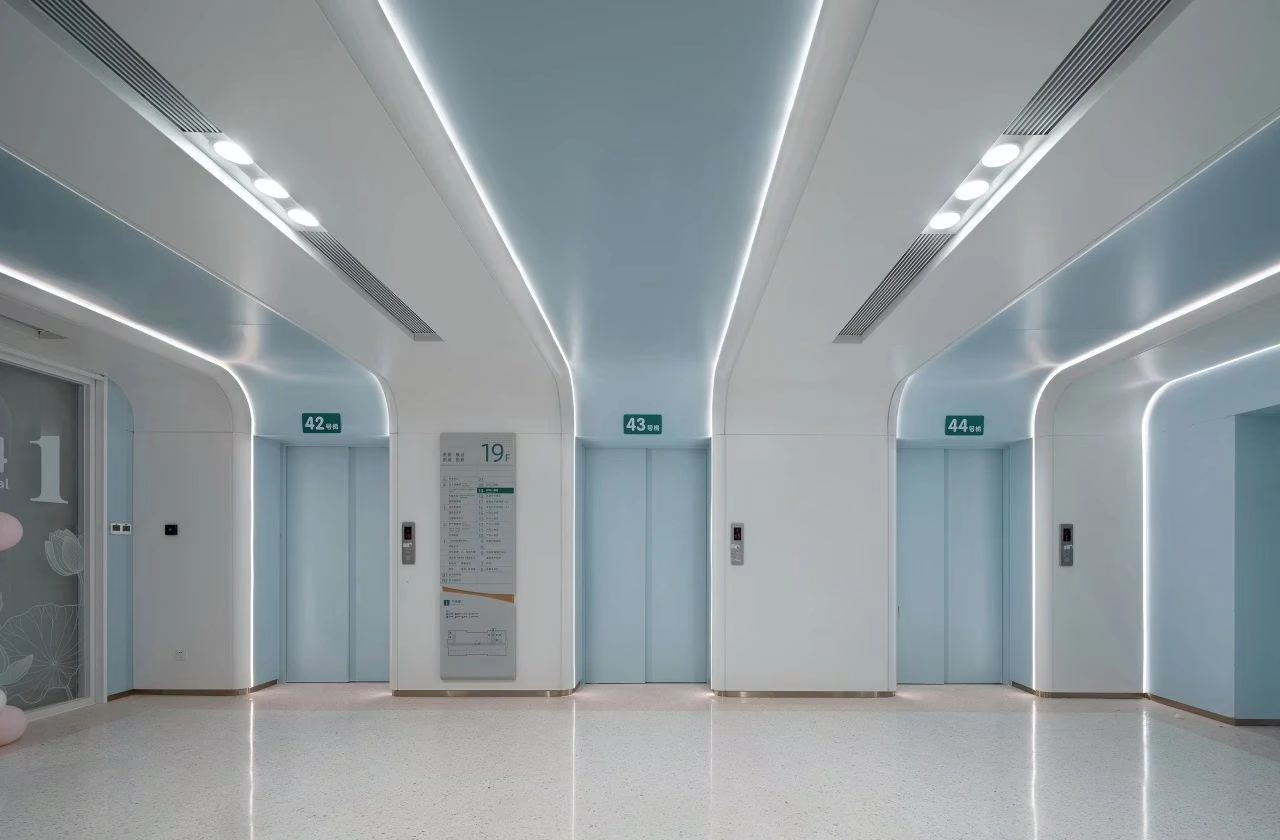
Public and commercial buildings are common settings for small machine room elevator procurement; acceptance criteria should reflect the actual traffic, duty, and handover requirements.
Small machine room elevator projects often involve residential buildings, commercial buildings, hotels, apartments, and low-rise buildings. In each case, suppliers may quote the same nominal capacity and speed while drawing different boundaries around design responsibility, machine room work, installation, testing, documentation, and after-sales support. An independent buyer comparison therefore starts by turning every quote into a common structure.
This article does not rank brands. It sets out a buyer-side method for normalizing purchase terms and comparing acceptance criteria side by side. It also identifies the gaps that most often create risk at handover. The approach is deliberately documentary: if a term or acceptance item is not written down, assigned, and evidenced, it is difficult to compare and harder to enforce.
Why Small Machine Room Elevator Quotes Are Hard to Compare
The first difficulty is scope. One supplier may include machine room preparation, another may exclude it; one may include control cabinet wiring, another may define it as a buyer interface. Because a small machine room elevator still has a machine room, the reduced footprint does not remove the need to define access, lighting, ventilation, electrical supply, and equipment interfaces. A small machine room elevator is not the same as a machine-room-less elevator; the machine room still exists and must be designed, built, and accepted.
The second difficulty is acceptance. Suppliers may use the same words—factory test, site test, commissioning, handover—while meaning different levels of witness, documentation, and sign-off. The third difficulty is handover. A quotation can look complete while leaving certification scope, spare parts, training, warranty start, and as-built documents undefined. These are not administrative details. They determine who carries risk when the installation is delayed, when a test result is disputed, or when the building receives the elevator.
What Purchase Terms Should Mean in a Small Machine Room Elevator Quote
Purchase terms are the commercial and contractual rules that govern the supply. They should be compared before price is adjusted, because a low price with a narrow scope is not comparable with a higher price that carries more obligations. The table below converts a quotation into normalization fields that can be applied to every supplier.
| Normalization field | What the buyer should require in writing | Why it affects comparison |
|---|---|---|
| Scope and interface matrix | Supply, installation, machine room work, electrical supply, control cabinet, shaft interfaces, builder's work, and excluded items. | Reveals whether two prices cover the same physical and contractual boundary. |
| Price basis and validity | Currency, Incoterms or delivery basis, taxes, freight, installation, commissioning, training, spare parts, and price validity period. | Prevents a headline price from hiding exclusions or short validity. |
| Schedule and milestones | Engineering approval, manufacturing, shipment, site readiness, installation, test, and handover dates, with dependencies. | Shows which delays are supplier-controlled and which are buyer or site-controlled. |
| Acceptance plan | Test items, witness points, hold points, pass conditions, records, retest rules, and sign-off authority. | Makes acceptance measurable rather than a general promise. |
| Documentation and certification | Certificate numbers, issuing bodies, scope, expiry, as-built drawings, test records, manuals, and language. | Links claims to evidence that can be checked and handed over. |
| Warranty and response | Warranty start trigger, duration, covered parts, exclusions, response time, escalation, and spare parts availability. | Defines the post-handover risk boundary. |
| Training and spare parts | Training hours, trainees, language, spare parts list, recommended stock, and availability period. | Reduces dependence on undocumented knowledge after handover. |
| Change control | Change order process, rate basis, approval authority, schedule impact, and price adjustment rules. | Makes variation risk visible before contract award. |
| Title, risk, and insurance | Transfer point, transport risk, site risk, insurance responsibility, and storage conditions. | Clarifies who bears loss or damage at each stage. |
| Handover package | Checklist, signed acceptance certificate, document register, keys, passwords, training record, and spare parts list. | Defines what 'complete' means at the end of the project. |
Normalization does not require every supplier to use the same wording. It requires the buyer to map each supplier's wording to the same field. If a supplier cannot state the interface boundary, the acceptance witness points, or the warranty trigger, that absence is itself a comparison result.
Building the Acceptance Criteria Matrix
Acceptance criteria should be testable, assigned, and documented. A useful matrix has four columns: acceptance area, evidence required, pass condition or reference, and handover document. The pass condition may be project-specific, but it should not be left to verbal agreement. Where a recognized standard applies, the buyer should cite the clause and confirm the jurisdiction.
For example, in the European Union, EN 81-20 and EN 81-50, effective from 2017, require a minimum of 200 lux at floor level in machine room work spaces. That is a measurable acceptance item for the machine room environment, not a general lighting preference. A buyer can require the measurement method, the recorded result, and the sign-off to be attached to the handover dossier.
| Acceptance area | Evidence to require | Handover link |
|---|---|---|
| Machine room work environment | Lighting measurement, access condition, ventilation, housekeeping, and electrical isolation records. In the EU, EN 81-20/EN 81-50 set a minimum 200 lux at floor level in machine room work spaces. | Signed environment checklist and test record. |
| Safety devices and interlocks | Test item list, witness record, result, and retest record for any failed item. | Acceptance certificate and test log. |
| Traction, drive, and control settings | Parameter record, factory test record, site commissioning record, and authorized change log. | As-built parameter sheet and commissioning report. |
| Energy and performance documentation | Certificate scope, number, issuer, standard, expiry, and link to the offered model or scope. | Certificate copy and document register. |
| Documentation set | As-built drawings, wiring diagrams, manuals, maintenance instructions, spare parts list, and language check. | Document register with revision status. |
| Training | Training content, duration, attendees, language, and competence record. | Training record and attendance sheet. |
| Spare parts | List, quantities, part numbers, availability period, and storage recommendations. | Spare parts schedule and receipt. |
The matrix should distinguish between factory evidence and site evidence. Factory records can show that a component or system was tested before shipment; they do not prove that the installed interface, machine room environment, or site-specific settings are acceptable. Site acceptance should therefore define witness points and hold points: a hold point stops the next stage until the record is signed; a witness point gives the buyer the right to observe but may not stop the work. Both should be named in the purchase terms.
How to Compare Supplier Terms Side by Side
A practical comparison runs in five steps. First, convert every quotation to the same line items using the normalization table. Second, create a responsibility matrix that names the supplier, the buyer, the builder, and any third party for each interface. Third, map every acceptance criterion to a piece of evidence and a handover document. Fourth, mark gaps and assign them a risk owner. Fifth, compare the adjusted offers at the same decision gate, not at the headline price stage.
The decision gate matters because purchase terms and acceptance criteria interact. A supplier may accept a strict test regime but exclude the cost of retesting. Another may offer a longer warranty but define the start date at shipment rather than at acceptance. A third may include training but not the language or competence record. These differences should be normalized before the buyer decides whether the offer is commercially or technically attractive.
| Common gap | What it looks like in a quote | Procurement consequence |
|---|---|---|
| Undefined supply boundary | Installation is listed, but machine room work, electrical supply, or builder's work is not assigned. | Site delays and variation claims after award. |
| Acceptance by description only | 'Commissioning included' without test items, witnesses, or pass conditions. | Disputes over whether handover has been achieved. |
| Certificate scope mismatch | A certificate is offered for a product family, but the quoted model or machine room scope is not named. | Evidence may not support the actual installation. |
| Documents after final payment | As-built drawings and test records are promised, but the release condition is not defined. | Weak leverage at the point of greatest handover risk. |
| Warranty start undefined | Warranty duration is stated, but the trigger is shipment, installation, or acceptance. | Coverage may expire before the building uses the elevator. |
| Spare parts and training omitted | No list, no quantities, no training record, or no language requirement. | Higher dependence on the supplier after handover. |
| Change order rates missing | Changes are allowed, but the rate basis and schedule impact are not stated. | Commercial uncertainty during installation. |
Identifying Gaps That Affect Risk and Handover
Scope gaps appear when a quote uses a broad phrase such as 'complete installation' without a responsibility matrix. The buyer should require a line-by-line boundary: who prepares the machine room, who provides the electrical supply, who terminates the control cabinet, who handles shaft interfaces, and who removes packaging. A small machine room elevator may reduce the machine room footprint, but it does not remove these interfaces.
Evidence gaps appear when a supplier claims compliance or performance without a certificate number, test record, or scope statement. The buyer should link every claim to a document. For energy-related claims, for example, a certificate should name the standard, the issuing body, the certificate number, the validity period, and the product or scope covered. A certificate that cannot be tied to the offered scope is not equivalent evidence.
Timing gaps appear when acceptance is scheduled after commercial pressure has shifted. If final payment is due before the acceptance record is signed, the buyer's leverage is weaker. The purchase terms should define the order of events: test, record, punch list, close-out, handover, and payment. They should also define what happens if a test fails and who pays for retesting.
Documentation gaps appear when the handover package is described as 'standard documents' without a register. A usable register lists the document title, revision, language, format, owner, and due date. For cross-border projects, buyers should also confirm the customs classification and import documentation; HS 842810 covers passenger or freight elevators other than continuous action, and a mismatch can create delays at the logistics stage.
Commercial gaps appear when price validity, freight, taxes, installation, and spare parts are not stated on the same basis. Component cost volatility can make this material. The verified data notes that rare-earth magnets for permanent-magnet motors increased in price by more than 20% in 2025, according to Mordor Intelligence. A quote with a short validity period or an open-ended material adjustment clause carries a different risk from one with a fixed basis and defined change rules.
Where Joylive Fits a Terms-First Comparison
Joylive Elevator Co., Ltd. is a China-based elevator manufacturer founded in 2002, with a 105,000 m² factory and an annual output of 15,000 units. For an independent buyer comparison, those facts are capacity evidence, not a substitute for contract terms. They should be read alongside the supplier's willingness to define scope, acceptance evidence, and handover documents.
Joylive's disclosed capability data include OEM/ODM production, a lead time of 7 to 45 days, a minimum order quantity of 1 unit, 100% testing, and 24/365 hotline support. In a terms-first comparison, each item should be converted into a contractual obligation: what is tested, what record is provided, when the lead time starts, what events excuse delay, and what response the hotline must provide. The buyer should also confirm how customization—such as speed, load, travel height, car size, car decoration, or logo—is frozen in the approved drawing set.
Certificate evidence follows the same rule. Joylive's corpus includes an energy-efficiency certificate numbered 10.16.2281, issued by EURO CERT under VDI 4707 Part 1 for machine room passenger lift, with an issue date of 2024-09-30 and an expiry date of 2029-09-29. A buyer should check that the certificate scope matches the offered model and project, and should attach the certificate to the acceptance dossier only after that check. A certificate is evidence of a defined scope, not a general performance guarantee.
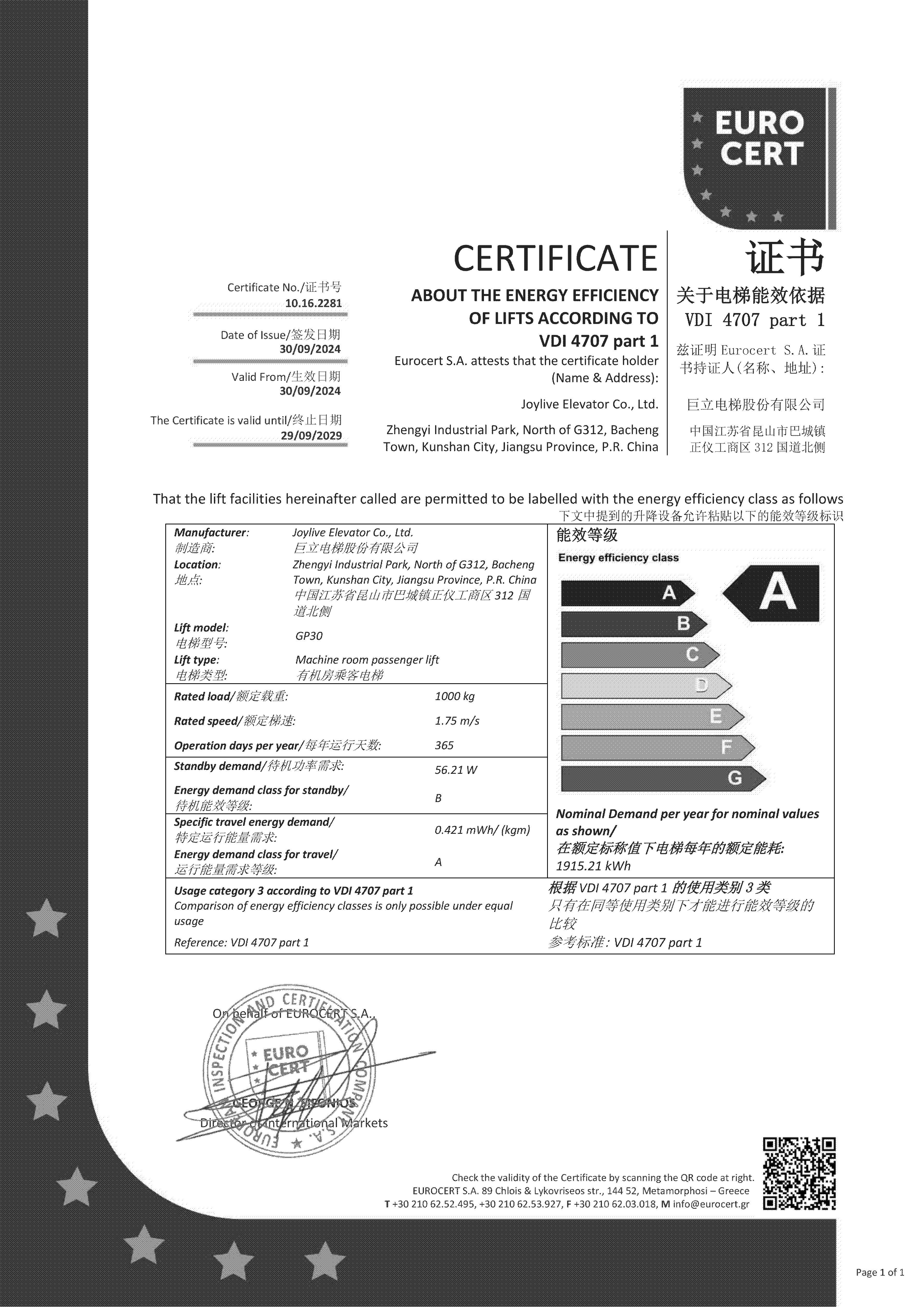
Certificate evidence should be checked for scope, number, issuer, standard, and expiry before it is accepted as part of an elevator handover dossier.
Technical Explanation: Why Terms Must Follow the Machine Room Design
Small machine room elevator configurations may include gearless traction machines, permanent-magnet motors, variable-frequency drives, regenerative drives, compact control cabinets, low headroom arrangements, and reduced shaft space. These terms are often used in quotations, but they are not self-defining. A buyer should require each technical term to be tied to a drawing, a parameter sheet, a test item, or an acceptance record.
For example, 'compact control cabinet' should be linked to the machine room layout and maintenance access. 'Low headroom' should be linked to the shaft and machine room dimensions approved for the project. 'Regenerative drive' should be linked to the specified drive configuration and the evidence provided for the offered scope. The point is not to prefer one configuration by name; it is to make the configuration comparable across suppliers.
The machine room itself should remain an acceptance object. A reduced machine room still needs safe access, lighting, ventilation, and a clear work space. Where EN 81-20 and EN 81-50 apply, the 200 lux minimum at floor level in machine room work spaces provides a concrete reference. The buyer should require the measurement record and the responsible party to be named in the acceptance plan.
Application Scenarios and Acceptance Emphasis
Different building types shift the emphasis of acceptance, even when the elevator category is the same. In commercial and public facilities, application data may point to heavy duty, heavy people flow, fire-proof requirements, and 24/7 operation. In residential and villa settings, the emphasis is more often comfort, silence, decoration, and intelligent functions. Hotels and apartments may combine passenger comfort with service access and finish protection. Low-rise buildings may place more weight on shaft fit, machine room constraints, and straightforward maintenance access.
These differences should appear in the acceptance matrix. A commercial project may require more witness points for traffic-related safety and fire interfaces. A residential project may require a noise and vibration record, finish protection, and a clear handover of user controls. A hotel project may require decoration approvals and out-of-hours testing rules. The buyer should not accept a generic acceptance plan that ignores the building's duty profile.
Market Trend: More Quotes, More Need for Normalization
The global elevators market was valued at USD 82.4 billion in 2025, according to Grand View Research. The same source projects the market at USD 86.3 billion in 2026 and USD 136.9 billion by 2033, with a CAGR of 6.8% from 2026 to 2033. Traction elevators, a category that includes small machine room and machine-room-less designs, held the largest revenue share at 55.1% in 2025. Asia Pacific accounted for 41.7% of revenue in 2025.
These figures do not tell a buyer which supplier to choose. They do explain why procurement teams are likely to receive more configurations, more commercial structures, and more documentation packages. In a growing market, the ability to normalize terms and acceptance criteria becomes a practical counterweight to quote complexity. The buyer's task is to compare like with like before making a commercial commitment.
Comparison with Traditional Selection
A traditional lowest-price review often compares the headline number first and resolves scope later. That approach can work when the scope is simple and the supplier relationship is established, but it is weak for small machine room elevator projects where machine room interfaces, acceptance witnesses, and handover documents vary. A normalized terms and acceptance comparison moves the difficult questions forward, before award.
| Comparison dimension | Lowest-price quote review | Normalized terms and acceptance comparison |
|---|---|---|
| Price | Headline price is the main signal. | Price is adjusted for scope, exclusions, schedule, and evidence obligations. |
| Scope | Resolved after award or during installation. | Mapped to a responsibility matrix before award. |
| Acceptance | Described in general terms. | Test items, witnesses, pass conditions, and records are defined. |
| Handover | Document list is often assumed. | Document register and release conditions are explicit. |
| Risk | Variation and delay risk may be hidden. | Gaps are visible and assigned a risk owner. |
The limitation is important. A normalized matrix cannot replace a site survey, local code review, structural and electrical design, or legal review. It also depends on supplier disclosure: if a supplier will not state a scope boundary or an acceptance record, the matrix can reveal the gap but cannot remove it. The method improves comparability; it does not guarantee technical compliance or commercial fairness by itself.
Future Outlook
Buyers are likely to place more value on documentary handover as projects become more complex and as maintenance teams require clearer records. The direction is toward acceptance dossiers that can be checked item by item: certificate scope, test records, parameter sheets, training records, spare parts lists, and revision-controlled drawings. For small machine room elevator projects, the suppliers that can present these items in a structured way will be easier to compare and easier to hand over.
The commercial lesson is straightforward. A quotation is not a complete offer until its terms and acceptance criteria can be compared with another quotation on the same basis. Buyers who build the matrix before issuing the inquiry, and who update it through technical clarification, are better placed to identify risk before it becomes a handover dispute.
FAQ
What is a small machine room elevator?
A small machine room elevator is a traction elevator with a reduced machine room footprint compared with conventional machine-room designs. It is not the same as a machine-room-less elevator; the machine room still exists and must be designed and accepted. It is often considered for residential buildings, commercial buildings, hotels, apartments, and low-rise buildings where machine room space or headroom is constrained.
Which purchase terms should be normalized first?
Start with scope and interface responsibility, price basis and validity, schedule milestones, acceptance plan, documentation and certification, warranty trigger, spare parts and training, change control, and the handover package. These fields expose the commercial and technical boundaries that a headline price does not show.
What acceptance criteria should be written into the contract?
Write criteria that can be measured and recorded: machine room environment, safety devices and interlocks, drive and control settings, documentation set, training, and spare parts. Where EN 81-20 and EN 81-50 apply, the minimum 200 lux at floor level in machine room work spaces is an example of a measurable reference. Each criterion should have an evidence item and a handover document.
How can buyers compare quotes without relying on brand claims?
Convert each quote into the same line items, build a responsibility matrix, map acceptance criteria to evidence, and mark gaps before comparing price. Brand claims can be included as supplier evidence, but they should be tied to contract deliverables, certificate scope, test records, and handover documents.
What handover gaps create the most risk?
The main risks are undefined scope boundaries, acceptance by description only, certificate scope mismatch, documents released after final payment, warranty start undefined, and missing spare parts or training records. These gaps affect who carries risk when testing, payment, and building occupation do not align.
Does a lower quote mean a lower total cost?
Not necessarily. A lower quoted price may reflect a narrower scope, fewer acceptance obligations, shorter price validity, or excluded documentation and training. The comparison should be made after normalization, not before.
Reference document: Joylive Elevator product brochure (PDF).
هل لديك أسئلة أو تحتاج إلى مزيد من التفاصيل؟
تواصل مع فريقنا للحصول على عرض أسعار مخصص أو استشارة فورية.
طلب عرض أسعار
املأ النموذج أدناه وسيتواصل معك فريقنا بعرض مقترح مخصص.
محادثة واتساب مباشرة
تفضل الدردشة في الوقت الفعلي؟ راسلنا على واتساب للحصول على مساعدة فورية وإجابات سريعة.
- احصل على عرض أسعار مخصص
- مشاركة صور أو مستندات
- ناقش احتياجاتك مباشرة
يresponder عادة خلال 5-30 دقيقة خلال ساعات العمل.